Momentum Trading Strategy

Notes

Short lessons on momentum trading, every day.

Every note from Substack, in one place: risk, setups, leading stocks, market conditions and the mindset behind them. Search them, browse by topic, or filter by stock.

Showing 1121–1140 of 1230 notes

View on Substack ↗

Some stocks lead loudly. Others lead silently.

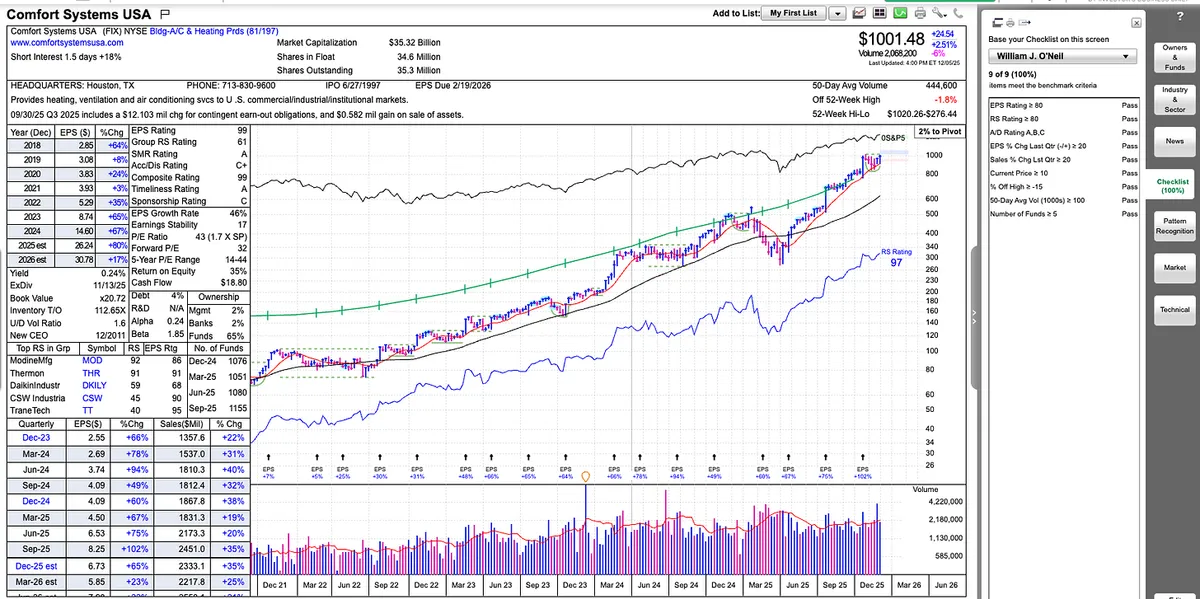
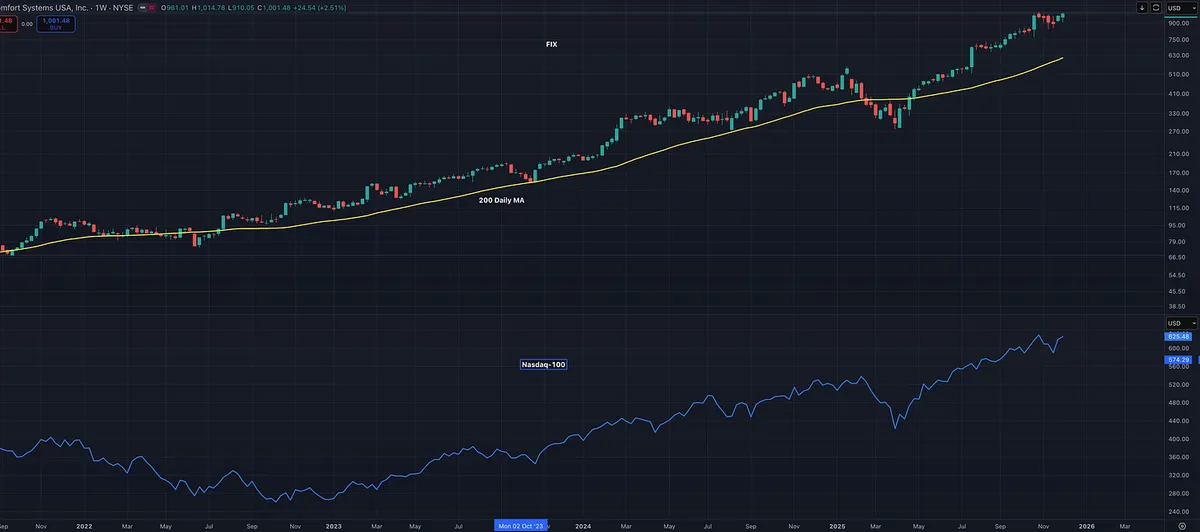
Comfort Systems (FIX) has been one of the cleanest and strongest institutional-quality leaders for nearly two years and hardly anyone talks about it. It is not from a hot sector or a trendy industry group. It just keeps delivering.

Just like ELF, this stock was making new highs while the indexes were still in the 2022 bear market. Unlike ELF, it is still a top performer two and a half years later. The lesson is simple. Real market leaders often emerge in bear markets. That is one of William O’Neil’s most important teachings.

Strong earnings. Strong sales. Top tier relative strength. Consistent institutional accumulation.

Sometimes the quiet leaders end up being the real ones.

View on Substack ↗

Momentum traders: here is your big picture update for the week ahead.

The new Market Pulse is live covering market conditions, RS leadership, and what to watch into FOMC.

Zoom out before you zoom in. Update your awareness of the big picture before running scanners, refining watch lists, and building your trading plan for the week.

https://tradingmomentum.substack.com/p/market-pulse-december-7-2025-what

On SubstackMarket Pulse — December 7, 2025: What This Week’s Conditions and RS Leadership Are Signaling for Momentum Traders
View on Substack ↗

One of the Hardest Parts of Trading Is Not What You Think

A real world lesson every trader can learn from

One of the hardest parts of trading is not finding the right stock or timing the perfect breakout. It is knowing how to manage a winning trade once you finally have one.

Most traders struggle with this. They sell too early, hold too long, or give back huge gains because they do not have a clear exit plan. Almost every painful trading mistake can be traced back to poor trade management.

Today I shared a complete breakdown of how professionals handle this, using a real world example that teaches the entire lesson in one chart. If you have ever wondered how to stay in a trend, protect profits, or recognize when the move is truly over, this is the post to read.

https://tradingmomentum.substack.com/p/how-to-manage-a-winning-trade-a-complete

ArticleHow to Manage a Winning Trade: A Complete Guide Using ELF Beauty (ELF)
View on Substack ↗

“I Rarely Pay Any Attention to Overbought/Oversold Indicators.” William O’Neil

Most traders hesitate when a stock looks “overbought.” O’Neil built his entire career on doing the opposite.

After studying more than 100 years of the greatest market winners, he realized something almost nobody wants to accept:

The biggest leaders spend most of their advances looking overbought. They break out to new highs while RSI is elevated. They stay extended for weeks or months. They never give you the oversold dip everyone waits for.

If you use overbought or oversold indicators to time CANSLIM type stocks such as big earnings, big sales, high relative strength, and leading sectors, you will almost always talk yourself out of the best trades.

These stocks run because institutions are accumulating them, not because RSI is comfortable.

The truth:If you wait for strong stocks to look not overbought, you will never own a true market leader.

This is why momentum traders like Darvas, O’Neil, Minervini, and Zanger focus on strength, not comfort.

Strong stocks tend to stay strong. Weak stocks tend to stay weak.

Everything else is noise.

View on Substack ↗

A Quiet Thank You to the Average Investor

Why I Am Grateful for Conventional Wisdom

I am grateful for the conventional wisdom of the stock market and all the strategies that look nothing like mine. The traders who buy dips, average down, ignore trends, or rely on CNBC calls create the inefficiencies that momentum and trend-following traders use to outperform.

When I became consistently profitable, I wanted to explain everything to everyone. Eventually I learned that most people are not listening, and that is fine. If everyone traded like me, the edge would disappear. Markets only work because traders disagree.

This also does not ignore the fact that traders in completely different disciplines can be incredibly successful. Simons as a quant, Buffett as a value investor, and Paul Tudor Jones as a macro trader prove that many paths can work. What they all share is risk management and discipline.

You could argue that different styles succeed because other styles exist. Trend traders need sellers at new highs. Value traders need buyers when they want to sell. Every strategy depends on someone else seeing the world differently.

The diversity of beliefs and behaviors in the market is what makes outperformance possible. Without it, none of us would have an edge.

View on Substack ↗

Paul Tudor Jones and the Psychology You Need to Win

Trading is similar to competitive sports in that it requires a strange mix of confidence and humility.

You need confidence to take risk, pull the trigger, and believe you can win.

You need humility to respect the market, cut losses fast, and stay a student.

Confidence moves you forward.

Humility keeps you alive.

Treat competition like it matters, but never let ego run the show.

Care enough to improve, but not so much that it controls you.

You can see this balance clearly in the 1980s Paul Tudor Jones documentary. He shows real humility toward the market, a constant fear of being wrong, and deep respect for risk. At the same time he has total confidence, a fierce competitive spirit, and the belief that he can win. That combination is what makes him dangerous.

The best traders believe they can do anything another person can do.

They also know they are not special yet and still have a lot to learn.

Hold both truths at once.

That balance builds a dangerous trader.

https://youtu.be/0Fsa4sOJwh4?si=QvZFV7rfo-QZSrgr

youtube.com- YouTube
View on Substack ↗

Reflection on Gold: A Lesson in Sentiment Journaling

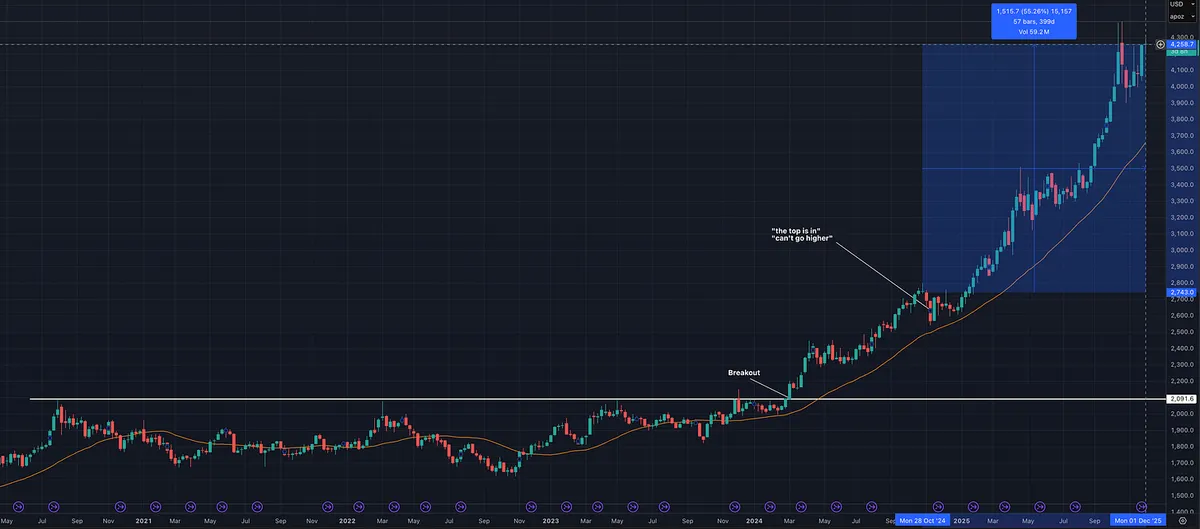
I remember telling friends and family back in 2024 that it was the year of gold. And I remember just as clearly how everyone insisted the top was in.

But gold kept pushing higher all the way through 2025.

One of the most important lessons I learned years ago is this:

Journal sentiment. Every time you hear strong opinions like “the top is in,” “it can’t go higher,” or “this is the blow off,” write them down. Track the commentary. Capture the mood. Then come back to it months later.

You will be shocked at how often the crowd is wrong.

Doing this has given me more conviction in my process. It helps me trust the setups instead of getting pulled into the noise. And when the market moves in ways that nobody expects, I am no longer surprised. That is just how markets work.

Sentiment lies. Price does not.

View on Substack ↗

Growth Investors: The CAVA Chart Is the Perfect Reminder

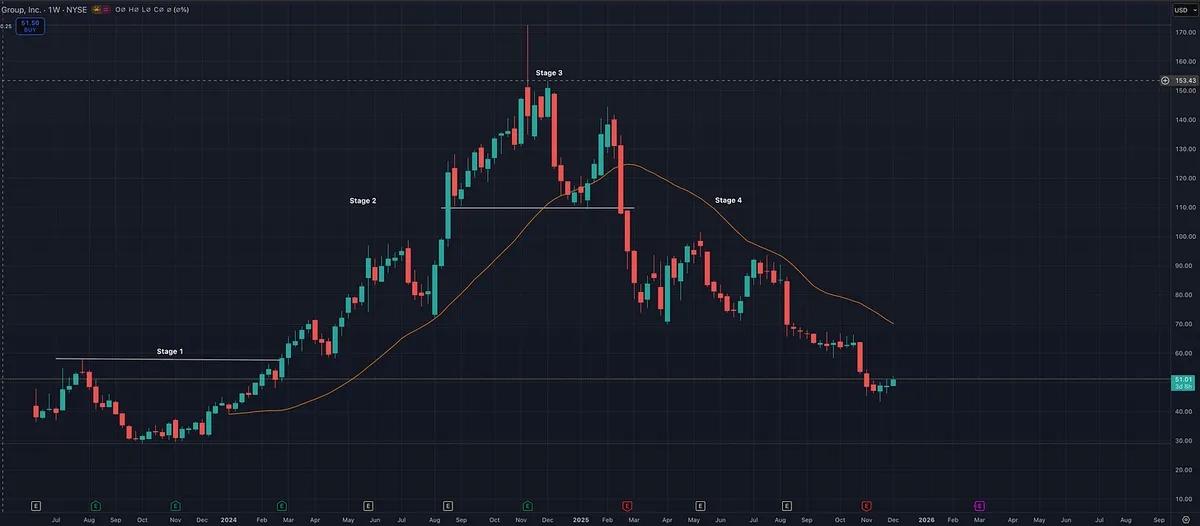
If you ever needed a real-world example of why we do NOT hold once a breakdown begins, CAVA is it.

This was a textbook CANSLIM winner with triple digit earnings growth, double digit sales, strong RS, and institutional sponsorship. Everything a model book stock should have.

And yet, the chart still went through all four stages exactly as Weinstein describes:

Stage 1: Base with early accumulation Stage 2: Strong advancing trend Stage 3: Loss of momentum and choppy distribution Stage 4: Breakdown followed by a sustained downtrend

The most important lesson?

Stocks tend to go much higher than we expect in Stage 2 and much lower than we think possible in Stage 4.

This is why successful growth traders sell weakness instead of hoping strength returns.

Fundamentals did not save it, and at the time of the breakdown the earnings and sales still looked great with +150 percent EPS growth and +28 percent revenue growth. The story did not save it. The theme did not save it.

Only price saves you, and price clearly told you when the party was over.

The chart is the final judge.

Use CAVA as a reminder of this rule:

There is no good stock except one going up in price.

And as William O’Neil famously said: “All stocks are bad unless they go up.”

You only want to participate in Stage 2 uptrends.

View on Substack ↗

My trading changed when I accepted that I don’t know much. The smarter I got and the more work I put in, the more obvious it became that certainty is an illusion in this game. Letting go of the need to be right helped me trade better.

View on Substack ↗

Most strategies do not work in all market types. Do you know how to read the market type you are trading in right now?

Are you forcing trades in the wrong environment for your strategy without realizing it?

I just posted a short guide on the six market types that Van Tharp taught and how to spot them quickly. Understanding the environment changes everything.

Read it here: https://tradingmomentum.substack.com/p/the-6-market-types-every-trader-must

ArticleThe 6 Market Types Every Trader Must Understand
View on Substack ↗

Stop Obsessing Over Your Entry Price. Paul Tudor Jones Shows Why.

Most people never break out of thinking about trades in terms of their entry price. Pros think in terms of conditions, risk, and what the market is doing right now. Paul Tudor Jones explained it perfectly in Market Wizards.

Here is one of the most important trading quotes you will ever read:

“Don’t be too concerned about where you got into a position. The only relevant question is whether you are bullish or bearish on the position that day. Always think of your entry point as last night’s close. I can always tell a rookie trader because he will ask me, “Are you short or long?” Whether I am long or short should have no bearing on his market opinion. Next he will ask (assuming I have told him I am long), “Where are you long from?” Who cares where I am long from? That has no relevance to whether the market environment is bullish or bearish right now, or to the risk/reward balance of a long position at that moment.” -Paul Tudor Jones

View on Substack ↗

The Quiet Leaders: What’s Been Outperforming the Market All Year

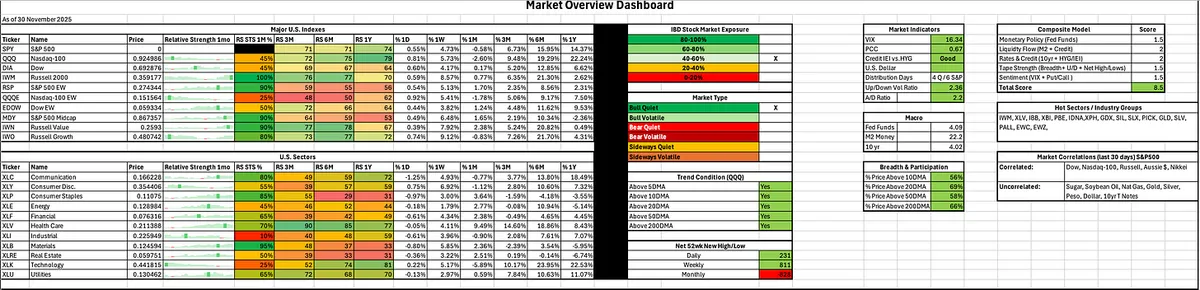
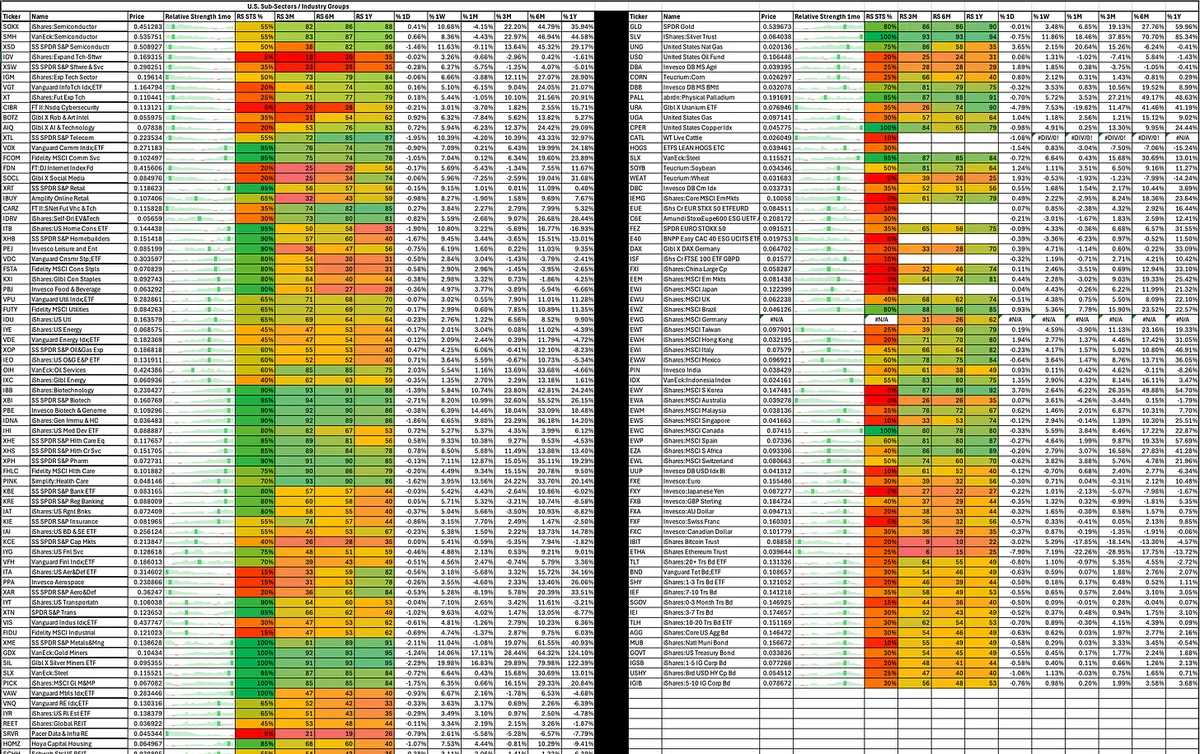
Looking at my Relative Strength Dashboard and combining it with IBD’s RS data, which ranks stocks and ETFs against over 11,000 tickers across the entire market, a clear group of long-term leaders emerges.

These are not just beating the S&P 500, they are outperforming almost everything.

Here is what has dominated across 1-year RS, 6-month RS, 3-month RS, and 1-month RS:

Biotech: IBB, IHI, XPH, PBE Biotech consistently shows up at the top regardless of timeframe. It has been one of the most reliable pockets of strength in the entire market, even during periods when growth cooled off.

Metals and Mining: XME, GDX, SIL, SLX, GLD, SLV This entire complex has been a powerhouse. Industrial metals, gold miners, silver, broad miners. Every category keeps landing near the top of the RS rankings. This is structural strength, not a short-term theme.

Chips (Semiconductors): Semis have shown strong RS over 1-year, 6-month, and 3-month windows. The only softness has been in the past month, and even that looks more like normal digestion after a big run.

Foreign Markets: Canada and Brazil consistently rank near the top across multiple timeframes.

Bottom Line: When RS leadership shows up in every timeframe, and across 11,000 plus tickers, it is not random. Biotech and metals and mining have been the real leaders all year.

This is why I rely on Relative Strength. Leadership is obvious when you measure it.

View on Substack ↗

Financing Your Risk: A Minervini and Soros Method

How I use the low cheat setup, partials, and breakeven stops to trade with house money

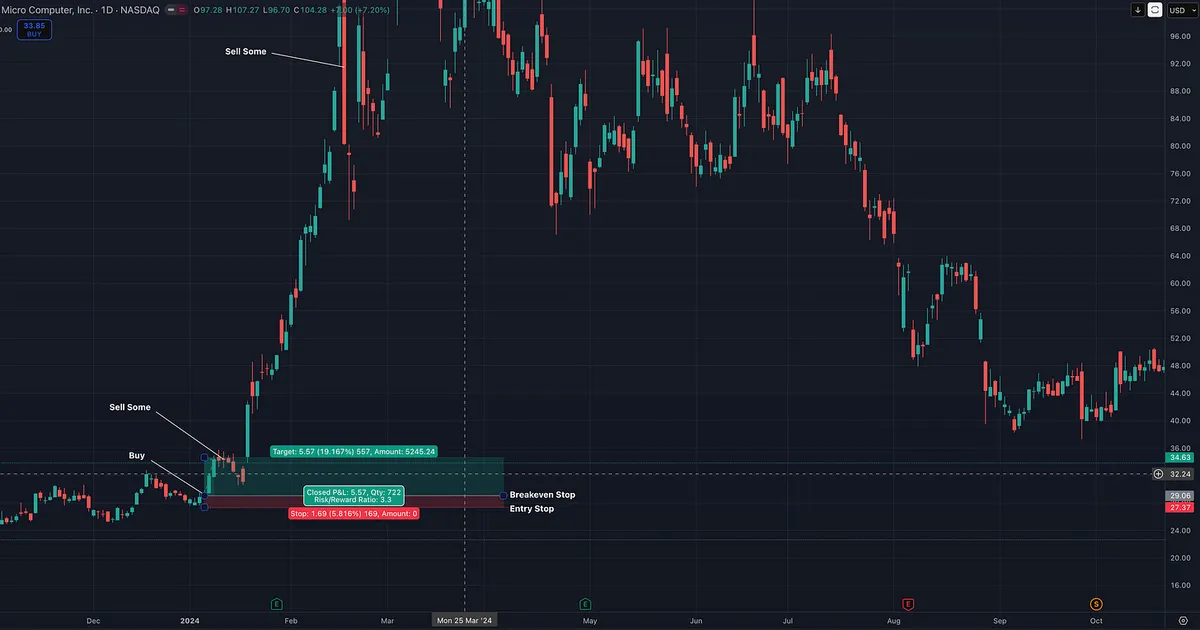
This SMCI chart from 2024 is a perfect example of what I mean when I say I like to finance my risk.

I bought using a classic Minervini low cheat entry. That means I was not waiting for a flat-base breakout at new highs. I entered lower in the base as price turned back up, forming a higher low and then a higher high. It is a tactical way to enter earlier when you see constructive higher-high and higher-low structure developing.

Once the trade began working and I hit roughly three times my initial risk, I sold a portion into strength. This locked in profit and reduced my emotional burden. When price pulled back, formed another higher low, and then pushed to a fresh high, that is when I moved my stop to breakeven. At that point the remaining position was operating on house money.

This idea lines up perfectly with something George Soros said in his 60 Minutes interview: “It’s very different when you’re risking your principal than when you’re risking your profits.”

That is the entire logic behind financing your risk. Lock in gains early when structure allows, remove exposure, and let the rest of the trade run without emotional drag.

Minervini gave me the entry tactics. Soros gave me the psychology. Together they create a simple edge: Protect the downside, pay for the trade early, and let the market decide how big the winner becomes.

View on Substack ↗

“I set protective stops at the same time I enter a trade. I normally move these stops in to lock in a profit as the trend continues. Sometimes, I take profits when a market gets wild. This usually doesn’t get me out any better than waiting for my stops to close in, but it does cut down on the volatility of the portfolio, which helps calm my nerves. Losing a position is aggravating, whereas losing your nerve is devastating.”  -Ed Seykota

View on Substack ↗

Can Regular People Be Taught to Become Millionaire Traders?

Most traders believe success comes from talent. The Turtle experiment proved something very different.

Two Chicago traders once trained a group of complete beginners for two weeks and handed them real capital. Many of those students went on to make millions by following a simple set of rules.

No special background. No genius needed. Just discipline and a system.

I just published a deep dive on the entire experiment, including the real rules they used, how they entered trends, where they placed stops, how they pyramided, and why the lessons still matter today.

Read the full breakdown here:

https://tradingmomentum.substack.com/p/the-100-million-bet-that-rewrote

ArticleThe $100 Million Bet That Rewrote Trading Forever: The True Story of the Turtle Traders