Momentum Trading Strategy

Notes

Risk Management & Position Sizing

Notes whose main point is limiting losses and deciding how much to buy and how much to risk on each trade.

Showing 1–20 of 224 notes

View on Substack ↗

You’re Copying the Trade Without Understanding the Trader.

Two things completely derail new traders:

They misunderstand time frames, and they mix incompatible risk-reward expectations.

They see someone posting a setup, explaining an entry, or taking a profit, and immediately try to apply it to their own trading.

But they never ask whether that person is trying to make the same type of trade.

Even the label “swing trader” doesn’t tell you enough.

One swing trader might hold positions for only a few days. Another might hold for several weeks. One might typically place stops 1–3% below entry. Another might allow 4–7%.

Now add position traders looking to hold for many weeks or months, and the differences become even greater.

Two traders can study William O’Neil, Mark Minervini, David Ryan, and Dan Zanger and still develop very different approaches. Shared influences don’t mean identical entries, holding periods, or exit rules.

For example:

One trader might use a stop 2–3% below entry, accept frequent small losses, and take profits around 12–15%.

Another might allow 6–8% from entry to stop, plan to hold considerably longer, and look for a 20–30% advance before taking an initial partial profit.

Those are illustrative approaches, not universal rules. And those stop percentages describe the distance from entry to stop, not the percentage of the account being risked. Position size determines that.

The problem starts when a beginner borrows pieces from both without understanding how they fit together.

They allow the wider loss but keep taking the smaller profit. They buy an entry designed for a short burst and expect a sustained advance. Or they plan to hold for months, then panic because a short-term trader sold after three days.

They’re mixing approaches before mastering one.

Your holding period, entry technique, stop placement, position size, average gain, and win rate all need to work together.

Before copying a trade or applying someone’s advice, ask:

  • What is their typical holding period?

  • How far is their initial stop from entry?

  • What are their average gain, average loss, and win rate?

  • What price action are they using to enter and exit?

  • Does that approach match the trade I’m trying to make?

Social media puts all these approaches in the same feed. A trading room can put them in the same conversation.

That doesn’t make them interchangeable.

Learn from other traders. Study their reasoning. But understand the complete approach before borrowing individual rules.

Know your time frame. Know your risk-reward profile. Know whose advice actually fits your style.
View on Substack ↗

William O'Neil Recommended 4–5 Stocks. But That Doesn't Mean You Start With 4–5 Full Positions.

In my last note, I shared William O'Neil's recommendation of owning roughly 4–5 stocks for an account equivalent to $100,000 today.

But there's an important distinction between building a concentrated portfolio and already having one.

Imagine the market is emerging from a correction. Several industry groups are showing strength, and leading stocks are beginning to break out.

You don't necessarily jump straight into five stocks at 20% each.

Instead, you might begin with smaller positions, perhaps 5–10% of your account, sometimes less, and let your trading results determine when to increase exposure.

Here's a hypothetical example using a $100,000 account:

  • You begin with two or three smaller positions, perhaps 5–10% each, keeping most of your capital in cash while testing the market.

  • As those trades begin working, you add to successful positions at proper entry points or establish new positions in other qualifying stocks.

  • You might eventually hold five positions at 10% each, representing 50% portfolio exposure.

  • Some stocks fail, stall, or simply aren't performing as expected. You cut losses and eliminate weaker holdings according to your rules.

  • Your strongest positions may gradually grow from 5–10% to 15%, and potentially 20–25%, through price appreciation and additional purchases at proper entry points.

  • If the market remains healthy and your trading continues working, you might eventually reach 100% exposure concentrated in 4–5 leading stocks.

But that progression isn't always linear.

During the process, you might temporarily hold 8–10 smaller positions, or more depending on your strategy and market conditions. That doesn't mean all of them will become full-sized positions.

This is closely related to what Mark Minervini calls progressive exposure.

Minervini explains how he starts with smaller positions and increases exposure as his trading becomes profitable. He may accomplish that by increasing position sizes, initiating additional trades, or both.

David Ryan describes a similar approach in Momentum Masters, starting with 5% positions when conditions are uncertain and allowing successful positions to grow toward 20–25%.

Dan Zanger also adjusts his number of holdings and position sizes based on market conditions and how many strong opportunities are available.

And O'Neil himself discussed adding to winning positions while eliminating weaker holdings, although he preferred keeping the overall number of stocks more tightly limited.

Here's the important takeaway:

You don't need to identify your biggest winners in advance or force your portfolio to reach a predetermined number of holdings.

You identify promising opportunities, manage your risk, increase exposure as your trades prove themselves, and direct more capital toward your strongest positions.

And remember, 100% exposure is not the objective in every market. You work toward greater exposure only when conditions and your trading results justify it.

As Minervini wrote:

"Build on success. Subtract on setbacks. Let your portfolio guide you."

The objective isn't to force concentration. It's to let your best opportunities earn it.

Quoting Momentum Trading StrategyHow Many Stocks Should You Own? William O'Neil's Rules, Adjusted for Inflation. In How to Make Money in Stocks (4th edition, 2009), William O'Neil explained why he believed individual investors should concentrate their portfolios rather than over diversify. He even provided specific recommendations based on account…
View on Substack ↗

How Many Stocks Should You Own? William O'Neil's Rules, Adjusted for Inflation.

In How to Make Money in Stocks (4th edition, 2009), William O'Neil explained why he believed individual investors should concentrate their portfolios rather than over diversify.

He even provided specific recommendations based on account size.

But that was 17 years ago. What would those dollar amounts look like today?

O'Neil's Original Recommendations vs. 2026 Dollars

$3,000 in 2009 → $4,700 today

Recommended: 2 stocks

$5,000–$20,000 in 2009 → $7,800–$31,200 today

Recommended: 3 stocks maximum

$20,000–$200,000 in 2009 → $31,200–$312,300 today Recommended: 4–5 stocks

Over $1 million in 2009 → Over $1.56 million today

Recommended: 6–7 stocks

Dollar amounts adjusted using the U.S. Consumer Price Index through August 2026, approximately 56% cumulative inflation since 2009.

Think about that.

According to O'Neil's inflation-adjusted guidelines, someone managing a $100,000 account today would generally hold just 4–5 carefully selected stocks.

His philosophy was simple: Concentrate your capital in your best opportunities, know your holdings exceptionally well, and avoid spreading yourself too thin.

But concentration didn't mean blindly buying a handful of stocks and hoping for the best.

O'Neil emphasized buying correctly, cutting losses, adding to winners as they proved themselves, and reducing exposure when market conditions deteriorated.

The objective wasn't to own fewer stocks simply for the sake of owning fewer stocks. It was to put meaningful capital behind your best ideas while maintaining strict risk controls.

“The best results are usually achieved through concentration, by putting your eggs in a few baskets that you know well and watching them very carefully.” - William O’Neil

How many stocks do you typically hold when you're fully invested?

View on Substack ↗

Your Broker Could Be Stopping You Out at Prices the Stock Never Traded.

Here's a warning for traders, especially beginners and those using offshore brokers or platforms offering 24-hour trading.

A trader reached out yesterday because his stop-loss on a U.S. stock had been triggered. He believed his broker's chart showed the stock dropping to $184.25, but MTS Velocity showed nothing close to that price.

My first thought? Great, I've got a bug in my software to fix. 😂

So we investigated.

On October 8, during regular market hours:

  • MTS Velocity: $187.83 low

  • Schwab thinkorswim: $187.83 low

  • TradingView: Consistent with the same price action

  • Trader's reported broker price: $184.25

We also checked pre-market and after-hours exchange data, where the lowest trade we found was $187.61.

That's a difference of more than $3 between the reported broker price and the lowest exchange trade we found.

But here's where things got interesting.

His broker offers overnight trading, and at the time of his screenshot, the spread between the Buy and Sell quotes was nearly $3!

Something many beginners don't realize is that your broker's displayed price isn't necessarily the last price a stock actually traded at.

Depending on the broker, stop-loss orders can be triggered by bid/ask quotes rather than actual exchange transactions. During overnight trading, liquidity can be extremely thin, spreads can widen dramatically, and prices may differ between trading venues.

We haven't confirmed exactly what triggered this particular stop, but it raises an important issue.

KNOW YOUR BROKER.

There are plenty of questionable offshore brokers out there, including poorly regulated and outright fraudulent operations. Some brokers offer CFDs or other derivatives rather than actual ownership of U.S. shares. In those arrangements, the broker may have considerable discretion over the quotes and spreads displayed to customers.

That doesn't automatically mean there's wrongdoing. Plenty of international brokers are perfectly legitimate.

But if you're trading U.S. stocks, you should know:

  • Are you buying actual shares or trading CFDs?

  • Where does your broker get its prices?

  • Do your stops trigger on actual trades or bid/ask quotes?

  • Are your stop orders active outside regular market hours?

  • Who regulates your broker, and what protections do you have?

If your broker can't clearly answer these questions, that's a major red flag.

And on a personal note, this investigation was pretty satisfying.

I went into it expecting to find a bug in MTS Velocity. Instead, our market data matched Schwab's regular-session low to the cent and was consistent with TradingView.

A nice bit of validation for what we're building.

Sometimes the problem isn't your trading strategy or stop placement. It's how your broker handles your orders.

View on Substack ↗

Get really comfortable with losing. Comfortable enough that you stop needing any individual trade to work.

I know that sounds strange, but you need to reach a point where a stock can stop you out without taking your confidence, discipline, and emotional balance with it.

Tom Hougaard gets right to this in Best Loser Wins: learn to take a loss without resentment, emotional attachment, or the need to get even.

Mark Douglas puts it plainly in Trading in the Zone:

“When you have accepted the risk, you will be at peace with any outcome.”

That is what I mean when I say you have to get to the point where you “don’t care” what happens on an individual trade.

You care deeply about your preparation. You care about protecting your capital. You care about following your rules, but you have accepted that this particular trade can fail, even when you do everything correctly.

For my approach, the framework is straightforward:

  • The stock meets my criteria. Check.

  • The setup is part of my playbook, with a clear entry and favorable potential reward relative to the risk. Check.

  • The position is sized so I can accept the planned loss before entering. Check.

  • I take the trade with an attached stop.

  • I take partial profits into strength or sign of weakness. As the trade progresses, I move the stop to breakeven when my rules and the price structure justify it.

  • If the stock keeps working, I give the remaining position room to run, using a trailing method such as a stop beneath higher lows or an appropriate moving average.

If it fails, I take the loss. If it works, I manage the winner.

I know that sounds almost too simple when we’re talking about exceptional performance, but these books repeatedly bring us back to the same principles: accept losses, control risk, and execute a repeatable process.

These principles have been passed down through generations of traders. The big names you hear about today didn’t invent these fundamentals. They studied those who came before them, learned from their successes and mistakes, and refined those lessons into their own approaches.

They learned these principles. They practiced them. So can you.

View on Substack ↗

I’d Take a 40% Return Over 100%. Here’s Why.

Big returns are the goal. But a profitable outcome doesn’t justify behavior that can destroy an account.

Consider two hypothetical traders over the same full year:

  • Trader A: Returns 100%, but suffers a 60% maximum equity drawdown while oversizing positions and ignoring planned exits.

  • Trader B: Returns 40% with a 10% maximum equity drawdown while following position-sizing and exit rules.

I would favor Trader B. I want a process I can keep repeating.

Two metrics help me evaluate that:

1. Calmar ratio: Annualized compounded return divided by maximum drawdown over the same period. Using the same equity-measurement method, these traders’ one-year ratios are 1.67 and 4.0. Trader B earned more return relative to the drawdown experienced.

That drawdown should reflect account equity, including open profits and losses. A closed-trade report can hide declines that recovered before exit. Intraday observations can also reveal losses missed by daily snapshots.

2. Maximum adverse excursion (MAE): How far an individual trade went against you while it was open.

A stock bought at $100, held through $75, and sold at $115 produced a 15% gain with a 25% price MAE. That isn’t automatically a 25% account drawdown, but it raises a question: Did you follow your risk plan?

Jack Schwager writes in Unknown Market Wizards:

“Return levels only have meaning in context of the risk undertaken to achieve those returns.”

Peter Brandt explicitly advocates Calmar as a measure of performance relative to risk. And Mark Minervini writes:

“My goal, as always, is to minimize risk and maximize my potential gains.”

The older I get, the more I care about improving that balance.

Positions need to be large enough for winners to matter and controlled enough for losses to remain manageable. Calmar and MAE help evaluate that balance, although neither reveals every risk.

I want substantial returns earned through a process that protects my ability to keep trading.

View on Substack ↗

William O’Neil Said This Decades Ago.

One of my favorite distinctions from William O’Neil in Market Wizards:

“So you treat a fund very differently from an individual stock account?” “Very, very differently. With an individual stock, you absolutely have to have a stop-loss point, because you never know how far down the stock is going.” - William O’Neil, Market Wizards

This is an important difference.

An individual stock and a diversified fund should not always be managed the same way.

An individual company can permanently deteriorate.

Earnings can collapse. Management can fail. A competitive advantage can disappear. In extreme cases, the stock can eventually become nearly worthless.

That is why O’Neil was so aggressive about cutting losses in individual stocks.

But a broadly diversified fund is different.

O’Neil went on to say:

“When you buy a fund, you want to be in it for 15 years or more. That is how you will make the really big money. But in order to do that, you need the courage to sit through three, four, or five bear markets. The typical diversified growth stock fund will go up 75 to 100 percent in a bull market, but it will decline by only 20 to 30 percent in a bear market.”

- William O’Neil, Market Wizards

That gets to the heart of his argument.

A diversified fund owns many companies across the economy. Individual companies can fail while the fund survives, changes its holdings, and participates when the broader market eventually recovers.

And I think this principle translates directly to many ETFs today.

A broad-market ETF tracking something like the Nasdaq-100 (QQQ), S&P 500 (SPY) or total U.S. stock market (VTI) is much closer to the diversified mutual funds O’Neil was describing than it is to owning one individual company.

But….

Not every ETF should be treated this way.

Leveraged ETFs, inverse ETFs, single-stock ETFs, highly concentrated sector ETFs, and narrow thematic ETFs can carry very different risks.

And if you are trading an ETF tactically rather than holding it as a long-term diversified investment, a predefined stop should be used.

Don’t treat a broken individual stock like a diversified index fund.

And don’t treat a normal bear-market drawdown in a broadly diversified long-term fund like one company whose thesis has completely failed.

Ironically, O’Neil pointed out that many investors do the exact opposite.

They hold individual-stock losers hoping they come back, then panic and sell diversified funds during bear markets.

Individual stocks require protection from permanent loss.

Broad diversified funds require the patience to survive normal market cycles.

Two different vehicles.

Two different jobs.

Two different timeframes.

Two different approaches to risk.

View on Substack ↗

The Market Doesn’t Have to Crash to Wreck Your Account

Everybody fears the big market drop, but for a momentum trader, a sideways, choppy market can do more damage than a clear downtrend.

Think about COVID or the tariff selloff. Those moves were large, and sudden gaps can carry a stock beyond your stop. But with disciplined sell rules, a sustained breakdown pushes us out of positions and into cash. We take the losses, reduce exposure, and wait for conditions to improve.

The danger in a choppy market is that it keeps convincing you to come back.

A stock sets up. You buy. It breaks out, stalls, reverses, and stops you out. Another setup appears, and you think this one will be different. Maybe you even make a little money before the next few trades take it back.

Each loss looks manageable. The cumulative damage is not.

Mark Minervini addresses this directly in Momentum Masters:

“A whipsaw market is more dangerous than a bear market.”

He describes the repeated buying and stopping out as “death by a thousand cuts.” His point is that a clear bear market can force you into cash, while a whipsaw market keeps drawing you into trades that fail.

David Ryan calls a whipsaw market the toughest environment to trade. His response is to reduce exposure, trade smaller, and favor selective pullbacks in leading stocks over breakouts.

Dan Zanger often steps aside entirely:

“Long or short, chop will eat you alive.”

This is why having a stop on every trade is only part of risk management. You also have to manage how often you trade and how much you commit when your setups aren’t working.

You can obey every individual stop and still bleed your account by repeatedly taking full-size positions in an environment that offers little follow-through.

For me, repeated failures are a signal to slow down, reduce size, and become more selective. I want successful trades to justify increasing exposure.

We don’t need to wait for a crash, or settle the debate over whether the market is officially in Stage 3, to recognize that our approach isn’t being rewarded.

Protect your capital from the small losses you keep volunteering to take, too.

View on Substack ↗

Minervini Averaged 50% Cash. Still Feel Underinvested?

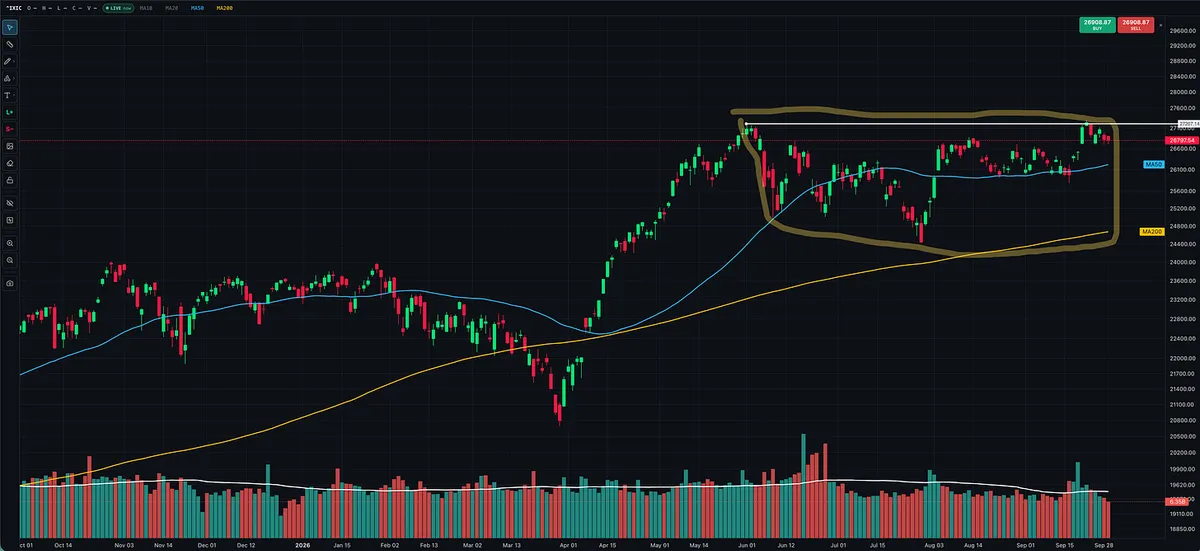
Stocks are ripping. The Nasdaq is making new highs. You look at the cash in your account and feel like you’re doing something wrong.

That feeling can get expensive.

Mark Minervini said he had averaged roughly 50% cash over his career.

People see his big returns and assume he must always be fully invested or leveraged, but he explained that he gets aggressive when conditions and results support it, while spending plenty of time in cash or smaller positions.

Big returns don’t require maximum exposure all the time.

The pressure to be fully invested can push you into extended stocks, mediocre setups, and positions you never would have taken without the fear of missing out.

Having cash available doesn’t mean you need to find something to buy today. Let the opportunities develop. Start with manageable exposure, increase it as your trades work, and pull back when they don’t.

That 50% figure was a historical average, not a target allocation. The point is to let your setups and results determine your exposure.

Cash is a position. Your job is to grow the account, not to keep every dollar busy.

View on Substack ↗

An A+ Setup Doesn’t Automatically Deserve Your Biggest Position

The best chart you’ve seen all month appears. Everything lines up.

Do you take your biggest position?

That depends on two things: the quality of the opportunity and how well your trading has been working.

1. Grade the stock and the setup.

For my CAN SLIM-style trades, the strongest opportunities combine:

  • A healthy market and a leading industry group.

  • A leading stock with high relative strength across multiple timeframes.

  • Strong earnings and sales growth, supported by strong ROE and/or margins.

  • A constructive base, such as a cup with handle or VCP.

  • A precise entry with a logical, tight stop and attractive reward potential.

When those characteristics line up, the opportunity earns consideration for a larger position.

2. Let your results determine how much size you’ve earned.

If your recent trades have been failing, even an A+ setup gets a smaller commitment. A beautiful chart doesn’t erase a string of losses.

If your trades are working and you’re building profits, you can progressively increase exposure. This is the principle behind Minervini’s progressive exposure: build on success and reduce on failure.

Your best opportunities, arriving when your trading is working, are where your largest positions belong.

All within your predetermined risk limits. The distance to your stop still determines how much you can buy for the risk you’re willing to take.

Grade the opportunity. Check your results. Then size the trade.

View on Substack ↗

He Sold His Winner to Keep His Loser Alive

Bernard Baruch didn’t just lose money on a bad trade. He sacrificed a profitable investment to keep funding it.

In My Own Story, he recalls buying coffee heavily on margin in 1905. When prices started falling, a respected coffee merchant advised him to hold on. Baruch listened as the losses mounted and profits from years of successful trading began disappearing.

Meanwhile, his Canadian Pacific shares had risen substantially. Instead of closing the losing coffee position, he sold those profitable shares to raise more margin money. Eventually, all his Canadian Pacific stock was gone, and coffee was still falling.

By his account, the experience cost him $700,000 or $800,000. He suffered nervous indigestion for days afterward.

He sold what was working to defend what wasn’t.

But the most important part of the story is that Baruch already knew better. He understood the temptation to sell a winner because taking a profit feels easier than admitting a loss. He knew the correct response was to let go of the bad position rather than sacrifice the good one. He did the opposite anyway.

That’s the uncomfortable lesson: knowing your trading rules is not the same as following them when money and ego are involved.

Taking profits isn’t the mistake. Selling a healthy position simply to keep an unhealthy one alive is. At that point, you’re no longer evaluating each trade on its merits. You’re reorganizing your account around the one mistake you refuse to accept.

Baruch resolved never again to take a major risk in something he didn’t understand. He also made cutting losses quickly an explicit rule.

Don’t make your winners pay for your refusal to admit you’re wrong.

View on Substack ↗

You Don’t Need Margin to Make Big Returns

It’s easy to assume that growing your account faster requires more buying power.

But a powerful stock can make a substantial move without you borrowing a dollar.

Individual stocks can advance far more than the major indexes over the same period. Selecting those opportunities gives you a way to pursue exceptional performance with the capital you already have.

The other half of the equation is keeping failed trades small.

A 20% gain against a planned 6% risk is approximately a 3.3R winner. With a position representing 20% of your account, that translates to a 4% account gain against 1.2% planned account risk.

No borrowed money required.

Margin can amplify results in both directions. It doesn’t improve the stock, fix a poor entry, or create an edge. One of the most dangerous mistakes a beginner can make is adding borrowed money before developing consistent execution and disciplined risk management.

Learn to manage the capital you have before borrowing more to magnify the results.

View on Substack ↗

Concentrate on Your Best Ideas. Control What You Risk

“Diversification is a hedge for ignorance.”

William O’Neil said that in Market Wizards. His reasoning was straightforward: own a manageable number of carefully selected stocks, understand them, and watch them closely.

Minervini reinforces the same principle. If you have a demonstrated edge, spreading your capital across too many positions can dilute the contribution of your best ideas.

But concentration makes position sizing and sell discipline even more important.

A stock can deserve a meaningful position without deserving an unlimited amount of risk.

For example, allocating 20% of your account to a stock with a stop 5% below your entry puts approximately 1% of your account at planned risk.

Concentrate your capital where you have an edge. Size your risk so you can withstand being wrong repeatedly.

View on Substack ↗

Compounding Isn’t Just About How Long You Hold

Everyone wants the stock that doubles. Fewer people appreciate what a series of smaller winners can do for their account.

When we talk about compounding, we usually talk about time and time is important. Holding an exceptional stock through a sustained advance can produce extraordinary returns.

But Minervini emphasizes another powerful factor: how often you can reinvest your capital and apply your edge.

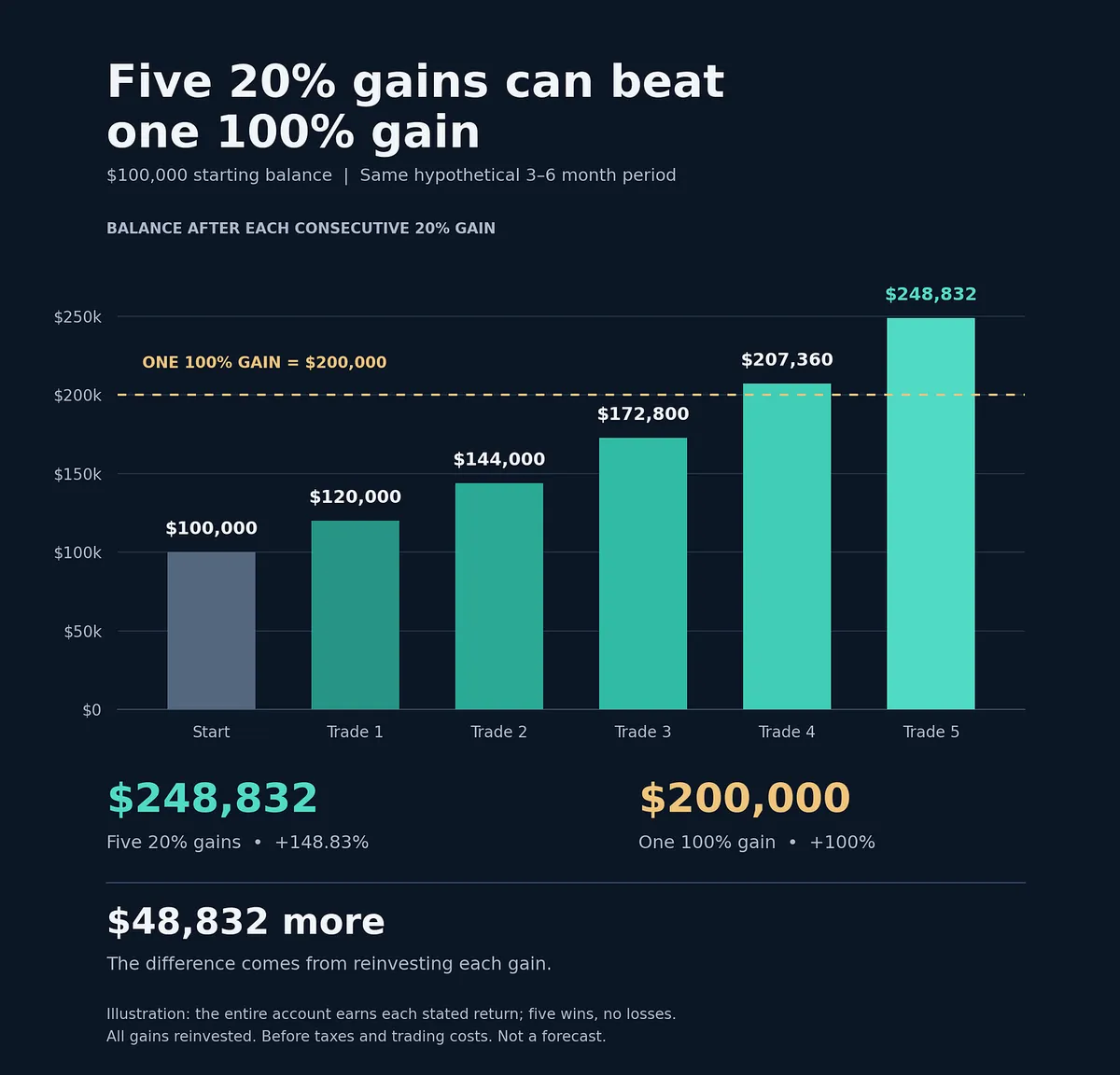
Consider the simple example in the image:

Starting with $100,000, one 100% gain produces $200,000.

Five consecutive 20% gains, with everything reinvested, produce $248,832.

That’s a 148.83% return without a single trade doubling. If both happen over the same period, the smaller compounded gains finish $48,832 ahead.

This simplified example assumes the entire balance earns each return, with five winners and no losses or trading costs. Actual account results depend on position sizing and the full mix of wins and losses.

But the principle deserves attention: repeated gains can produce an extraordinary result when you reinvest them.

A worthwhile gain captured in a few weeks can free capital for another qualifying opportunity. Each opportunity gives you another chance to apply your edge and compound the proceeds.

The benefit depends on maintaining that edge and controlling losses as you repeat the process.

You don’t need every winner to double for your account to achieve exceptional returns.

View on Substack ↗

Your Account Can Outgrow Your Comfort With Money

Before you ever learned to read a chart, you were learning what money meant. You learned from the bills your parents worried about, the arguments you overheard, and what the people around you considered a good income. Those experiences helped shape your expectations about what was normal, what was possible, and what you stood to lose.

Childhood experiences and inherited beliefs shape our self-image. What we repeatedly hear and experience can become what we expect from ourselves. Sometimes we carry an old definition of what’s possible into a life that has already changed.

Think about how that can show up in trading. One trader becomes overwhelmed risking $1000. Another stays composed at $10,000, while another feels that pressure at $100,000. Account size, position sizing, and exposure are all important, but so is what those dollars represent to each person.

That becomes especially important when you scale. You might follow your rules consistently at one size, then start hesitating, cutting winners prematurely, or resisting losses at the next. The percentage risk can stay the same while the dollar amount crosses an emotional threshold. Brett Steenbarger addresses this in The Daily Trading Coach, explaining how thinking in familiar dollar amounts can make increasing size psychologically difficult.

Mark Douglas describes an even more striking pattern in The Disciplined Trader: traders who make money consistently until they reach a certain threshold, then surrender their profits through decisions completely inconsistent with the trading that got them there. After the losses, they return to their usual approach, rebuild, and repeat. He connects this pattern to conflicts between the success traders consciously want and the beliefs they carry about money, work, and what they deserve.

That is one possible explanation for what looks like self-sabotage. A useful question is: When I reach that level, what changes in my decisions?

  • Do I start protecting every dollar instead of following the setup?

  • Do I feel pressure to make even more?

  • Does a normal loss suddenly feel like a verdict on my ability or a threat to my security?

Start noticing those patterns. Keep risk within your financial capacity, increase size gradually, and track whether you can still execute your plan. Give yourself repeated experience managing the new level before increasing it again.

These are the quiet parts of trading that don’t get enough attention, yet they can undermine even a well-developed strategy. It’s difficult to accept that you could be holding yourself back when you want so badly to move forward. But wanting success doesn’t automatically undo beliefs you’ve carried for decades.

Breaking those patterns may require examining parts of your life you never expected to confront through trading: what money meant growing up, what you learned to fear, and what you came to believe was possible for someone like you. Recognizing those beliefs is the beginning. Changing their influence on your decisions takes deliberate work and repeated practice.

For the next version of you to grow, some of the old beliefs have to die. Part of that growth is rewiring what you learned to expect from yourself, so yesterday’s conditioning stops setting tomorrow’s limits.

View on Substack ↗

You Don’t Need Every Winner to Be a Home Run

A 15% winner can look unimpressive when everyone is talking about stocks that doubled.

But how much did you risk to earn that 15%, and how long did it take?

A 15% gain against a planned 5% risk is a 3R winner.

That’s a meaningful trade. You’ve earned three times your initial planned risk. Across a series of trades, keeping your average gains substantially larger than your average losses, with a sufficient win rate, can support a profitable strategy without requiring a steady supply of 100% winners.

Minervini emphasizes the power of smaller gains compounded over time. When you have an edge, capturing and reinvesting a series of smaller gains can compound capital faster than waiting for one larger move. O’Neil’s familiar 20–25% profit-taking guidelines also recognize the value of capturing intermediate moves, while making exceptions for unusually powerful stocks.

Time matters, too. A gain captured in a few weeks can free capital for another qualifying opportunity. Waiting months for a hoped-for move while better setups develop has an opportunity cost.

Singles and doubles deserve a place in a strategy designed to find exceptional winners.

I screen for stocks with the earnings, sales, relative strength, and price-and-volume characteristics that can support a major advance, but I can’t know in advance which qualifying stock will become the home run.

Some will fail. Some will produce worthwhile gains. A few may develop into something much bigger.

My job is to manage each one as the evidence unfolds: cut losses, take partial profits when justified, protect gains, and give strong positions room to continue.

A 15% gain isn’t an automatic instruction to sell everything. The stock’s behavior, market conditions, and my sell rules guide that decision.

The home runs can emerge from that same process. I don’t have to correctly predict them before buying, and I don’t have to dismiss every smaller winner while waiting for one.

Build a process that makes singles and doubles worthwhile and gives home runs room to develop.

View on Substack ↗

The First Loss Is Your Best Loss

The stop is easy to agree with before the trade. The test comes when the stock reaches it.

Suddenly, you start negotiating.

“It’s probably just a shakeout.” “I’ll give it another day.” “I’ll sell when it bounces.”

A planned 5% loss can become 10%, then 15%. The setup that justified your entry has failed, but now you’re holding because you don’t want to accept the loss.

Moving the stop lower changes how much you’re risking. It doesn’t improve the trade.

If your plan calls for an exit 5% below your entry, honor that decision. If the setup needs more room, account for that before buying through your stop placement and position size. Once your exit is triggered, follow through.

Sometimes the stock will recover after you sell. That doesn’t make following your stop a mistake. If it produces another qualifying entry, you can evaluate it again.

You don’t need to stay in a failed trade to participate in a future opportunity.

The first loss is the one you planned and sized for. Refusing to take it opens the door to a loss you never intended to carry.

You won’t avoid every losing trade. You can build the discipline to exit when your rules tell you to.

Decide where you’re getting out before you get in. When that exit triggers, act.

View on Substack ↗

You Can’t Predict the Reward. You Can Plan the Risk

You don’t know how far a stock will go after you buy it. You can study past winners, estimate the potential, and identify a strong setup. You still don’t know what this particular trade will deliver.

When I review my biggest winners, many went much farther than I ever expected. Meanwhile, some of the stocks I thought had the greatest potential barely went anywhere.

That’s why I’ve never placed too much emphasis on predicting an exact price at which to take profits. I focus on finding stocks with the characteristics I teach in the MTS Course, entering at a sound buy point, and managing my risk and position size. From there, price and volume action, along with my sell rules, guide how I manage the position.

Before you start counting the potential profit, calculate the planned loss.

  • Where is your entry?

  • What would tell you the setup has failed?

  • Where will you place your stop?

  • How many shares can you own while keeping the planned loss within your risk limit?

Those decisions belong before the buy, while you can evaluate the trade without the pressure of an open position.

Your historical win rate, average gain, and average loss help you evaluate your strategy across a series of trades. They don’t tell you whether the next trade will fail or become your biggest winner of the year.

That’s why I want a defined exit if I’m wrong and room for the stock to develop if I’m right. As the trade unfolds, I can take partial profits, raise stops, and respond to changes in the stock’s behavior.

I don’t need to know the final reward to make a disciplined decision about the risk.

Rule: Quantify your planned risk before entry. Manage the reward as the trade develops.

View on Substack ↗

Every Add Has to Be Good Enough to Be a First Buy

Buying a stock well doesn’t automatically make buying more a good decision.

The first entry may have been excellent, but after the stock moves higher, the distance to a sensible stop can widen, and the risk of adding can look very different.

Before I increase a position, I ask:

If I didn’t already own this stock, would I buy it here?

I want a qualifying entry with clearly defined risk. That might be another pivot within the base, a breakout from a new consolidation, or a constructive pullback that turns back up.

“Because I’m already in” doesn’t qualify. Neither does wishing I had bought more before the move.

A profitable position can make it easier to overlook an extended entry. Your original shares have a cushion, and you start treating the additional shares as if they do, too.

The new shares carry risk from the price you pay for them.

Before adding, I need to know where I’ll exit those shares, how I’ll manage the original position, and what the combined risk looks like. A larger position still has to fit my account risk limits.

I want to build on a trade that’s working while keeping control of the downside.

Every additional purchase has to earn its place, just like the first one.

View on Substack ↗

If You Don’t Know Your Stop, You’re Not Ready to Buy.

A stock looks great. You buy it. Then it starts falling, and suddenly you’re deciding how much you’re willing to lose while you’re already losing money.

That decision belongs before the trade.

Before I buy, I want three things defined:

  • My entry price.

  • My stop-loss level.

  • My position size, so the planned loss fits my account risk limit.

Once money is on the line, it becomes easier to negotiate with yourself.

“I’ll give it another day.”

“It’s still a great company.”

“I’ll sell when it gets back to breakeven.”

Those thoughts can turn a manageable loss into a serious problem.

If my stop is reached, I exit. I don’t move it lower just because I still like the stock. If the setup deteriorates, I may exit sooner.

And if the stock recovers after I sell? I can reassess it. Getting stopped out doesn’t mean I can never buy it again.

The discipline is making the decision before emotions take over, then following through when it’s uncomfortable.

Know your stop. Size the trade. Honor the exit.