Momentum Trading Strategy

Notes

Risk Management & Position Sizing

Notes whose main point is limiting losses and deciding how much to buy and how much to risk on each trade.

Showing 1–5 of 5 notes

$LITE ×
View on Substack ↗

Why I Wouldn’t Buy DELL Right Before Earnings

Someone asked me why I wouldn’t buy DELL before earnings, especially when I’ve held other stocks through earnings.

The difference is context.

With LITE, I was already in the stock and had roughly a 25% cushion going into earnings. In situations like that, I may sell some before the report and hold the rest through earnings.

That is completely different from initiating a brand-new position right before earnings.

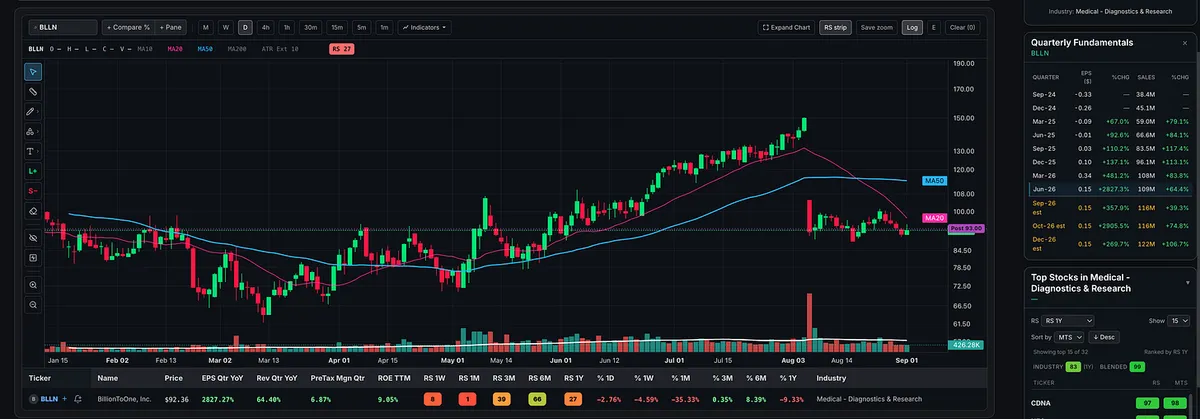
If you want to hold stocks long enough to capture really big moves, eventually you have to get comfortable sitting through some earnings reports. There is no way around that. Even with a large profit cushion, you can still get hit with an ugly reaction, like we saw with BLLN.

But I will NOT buy a stock immediately before earnings just to gamble on the report.

And with DELL specifically, the decision was even easier.

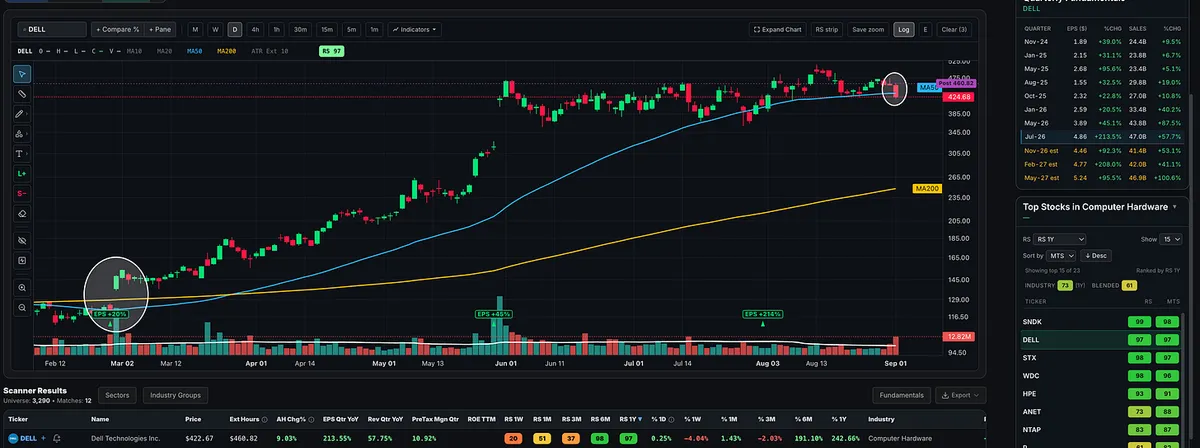
The stock looked like it wanted to go higher, but showed very little follow-through. Then it had a bad day today, falling more than 6% and closing below the 50-day moving average.

On top of that, the overall market hasn’t been acting well.

So now you have:

  • Poor follow-through after a failed breakout attempt

  • A greater than 6% down day

  • A close below the 50-day moving average

  • A less-than-ideal overall market

  • Earnings immediately ahead

Why would I initiate a brand-new position and take on earnings risk with all of that working against me?

For me, there is a big difference between holding earnings with a 20% to 30% profit cushion in an existing position and buying a stock immediately before earnings with no cushion at all.

Those are two completely different risk situations.

Now, with DELL up roughly 10% after hours, I’ll watch how the price continues to act and see whether it gives me a setup. It did something similar in early March after the big gap up in late February.

I don’t need to predict the earnings reaction or gamble on the report. I can wait for the report, see how the market reacts, and then look for a proper setup.
View on Substack ↗

You Cannot Predict the Winner. You Can Control the Risk.

I screen for stocks with the same characteristics shared by many of the biggest winners in market history.

Strong relative strength. Accelerating sales. Triple-digit earnings growth. High ROE and margins. Leading industry groups. The CANSLIM characteristics and many of the traits I teach throughout Modules 4 and 5 of the Momentum Trading Strategy Course.

All of that improves the probabilities.

But even then, I never truly know which stock will become the big winner.

There are plenty of names I expect to work that quickly stop me out. Then there are trades like LITE.

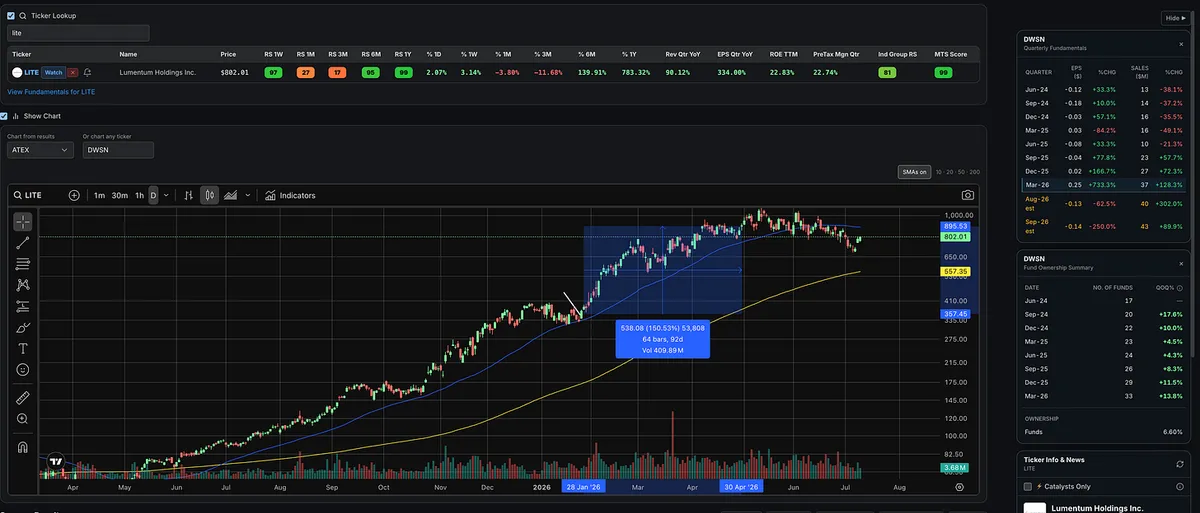
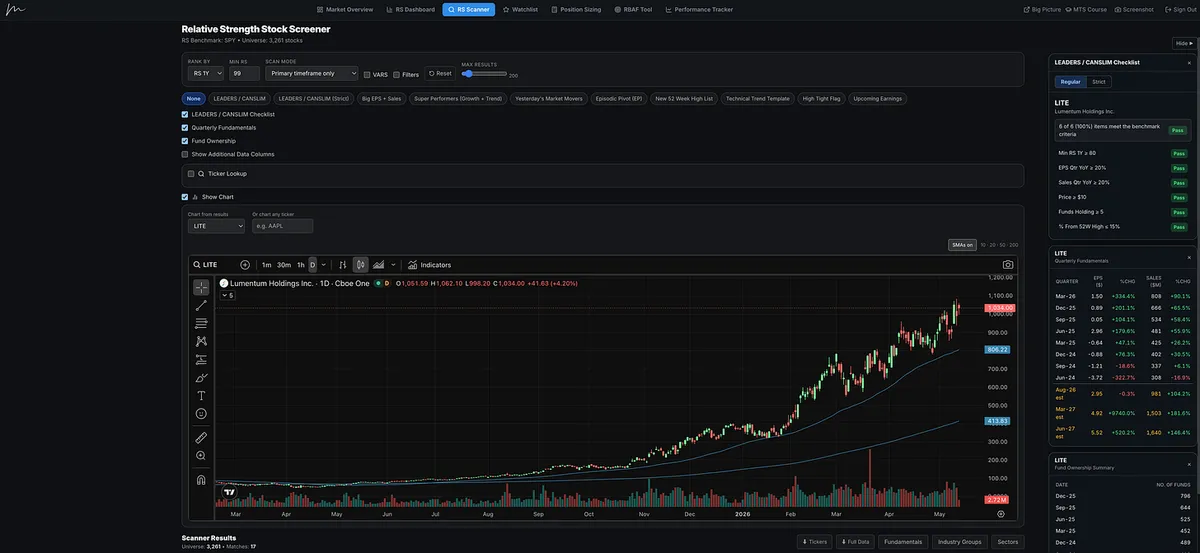
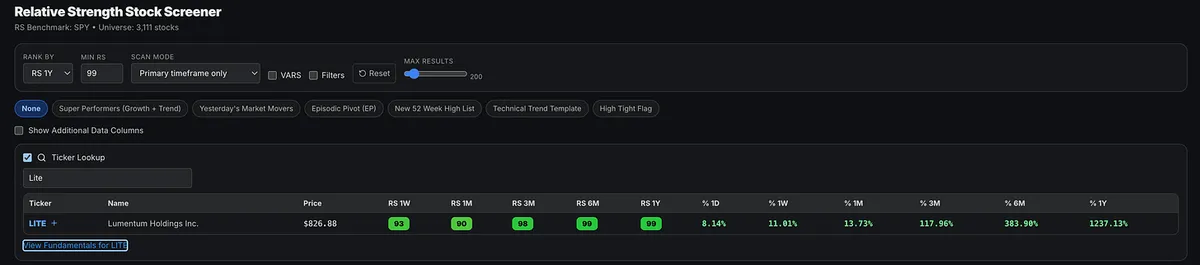
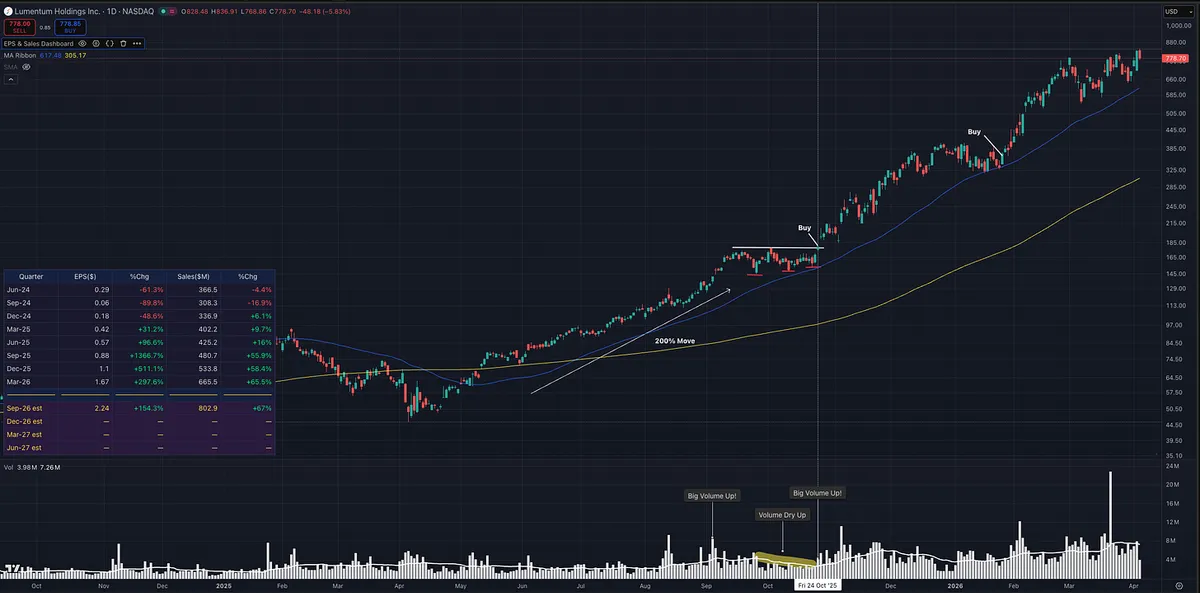
I bought LITE in late January as it found support around the 50-day moving average. It had a 99 RS Rating, accelerating sales, improving triple-digit earnings, strong ROE and pre-tax margins, and belonged to a strong industry group.

I did not know the company well. I did not fully understand the story. I did not even know NVIDIA was a major investor until that news surfaced later.

I was simply following my system.

LITE became a much larger winner than I could have predicted. But there were several other stocks with similar characteristics where I entered, took a small loss, and moved on.

That is trading.

Your criteria create an edge, but they do not create certainty.

The one thing you can control before entering is how much you are willing to risk.

I stay concentrated, cut losing positions, and add to positions that prove themselves. Once I have sold some into strength and raised my stop toward breakeven, I become more adaptable.

Sometimes a trade I expect to hold for a few days becomes a multi-month winner.

Sometimes a stock I expect to hold as a position trade stops acting right, and I exit quickly.

You do not decide which stock becomes the monster winner.

The stock and the market decide.

Your job is to control the risk, follow your system, and stay with the winners that prove themselves.

View on Substack ↗

You Don’t Pick the Big Winner. Your Process Finds It.

Here is something many beginners do not understand.

You can have a real strategy.

You can have a proven method.

You can know exactly what you are looking for.

And still, to find the big winner, you may have to take 10 qualified trades.

Six or seven may end up as small losses or break-even trades.

One or two may be average winners.

And then one may turn into something like SNDK or LITE.

That is the part most people miss.

The big winner usually does not announce itself in advance.

At the time of entry, it is just another name that fits the process.

That is why I do not get obsessed with any single stock.

I do not fall in love with the story.

I do not assume this has to be “the one.”

LITE was a big winner for me, but I did not know at the time it was going to be one of the one or two out of ten that really worked.

That is not how this game usually works.

Sometimes you know you have something special early, but most of the time you don’t.

Your job is not to predict with certainty which one will be the monster.

Your job is to follow the process, cut the ones that do not work, and stay with the ones that do.

That is why process beats obsession.

The beginner wants to know which stock is going to be the big winner.

The professional knows the big winner will reveal itself over time.

View on Substack ↗

Is a 5% Stop Too Tight in Today’s Market?

I got a great comment recently:

“It’s just that -5% is not much in today’s markets. Not enough not to get whipsawed. What’s your view?”

Here’s my answer.

I disagree.

There are still plenty of setups where you can risk 5 percent or less.

If that wasn’t the case, traders like Kristjan Kullamägi wouldn’t be as successful as they are.

Same with Mark Minervini. He won the U.S. Investing Championship in 2021. He’s still finding tight entries in today’s market.

It comes down to tactics and timing.

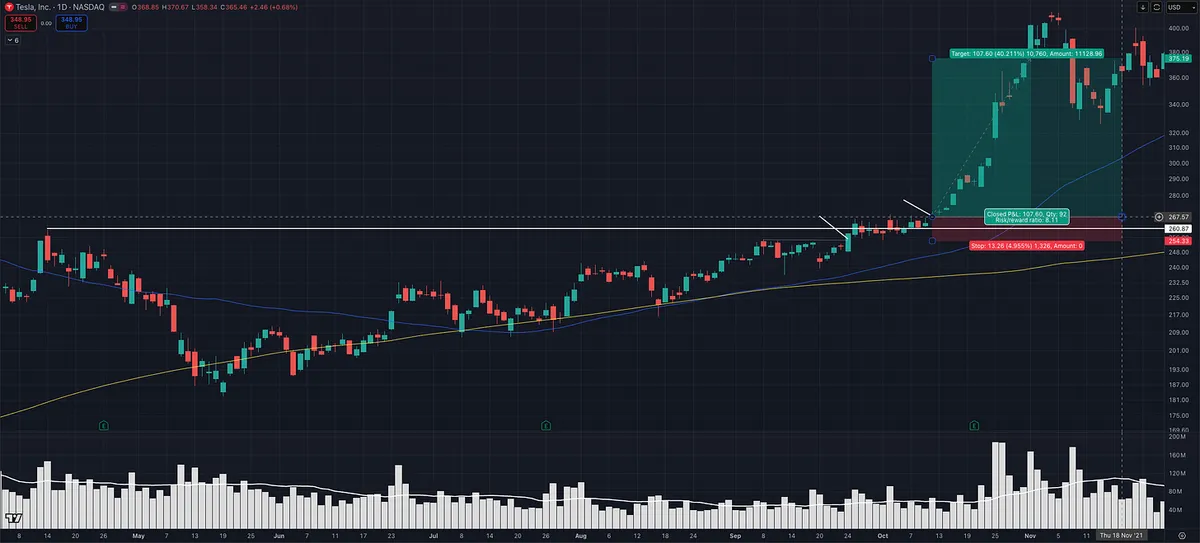
This TSLA example is a good illustration.

On the right side of the base, price was tightening and structure was clean. That created multiple opportunities where risk could be kept at 5 percent or less.

Recently (2025-2026), with many of the big winners already extended in Stage 2 uptrends, it’s a different environment.

If you’re only buying standard breakouts here, then yes, your stop likely needs to be 7 to 10 percent.

But that’s just one way to play it.

A lot of the big winners from 2025 to now in areas like computer data storage and telecom, names like LITE, SNDK, MU, CIEN, WDC, were harder to trade with tight risk using traditional breakout entries.

Their ADR% was higher, and there was less contraction into the pivot, so traders had to adapt.

Pullback entries. Low cheats. Intraday entries like ORB.

Those allow you to define risk much tighter and still participate without getting shaken out.

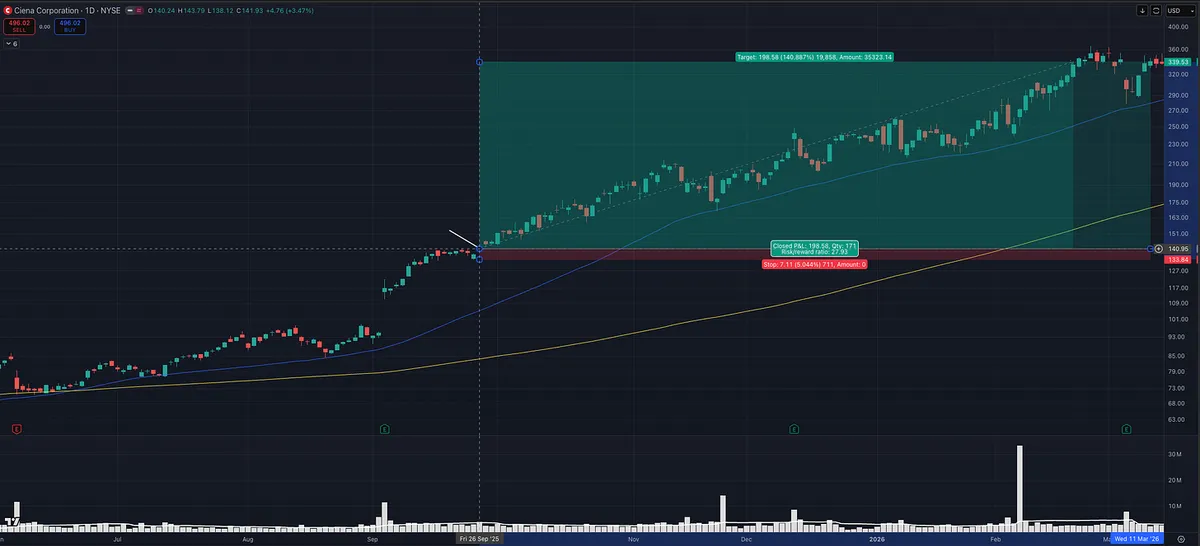
CIEN is another good example.

After an episodic pivot on earnings, price ran, then tightened sideways. That created a clean opportunity to enter with defined, tight risk.

This isn’t about forcing a fixed 5 percent stop on every trade.

It’s about finding entries with proven setups where tight risk actually makes sense.

Timeframe matters. Setup matters. Execution matters.

And just like Minervini, I’m not rigid with it.

Some trades might be 3 percent risk. Some 5 percent. Some 6 to 8 percent depending on the setup.

I’ll even go up to 10 percent and adjust position size, but I prefer tighter risk when the setup allows it.

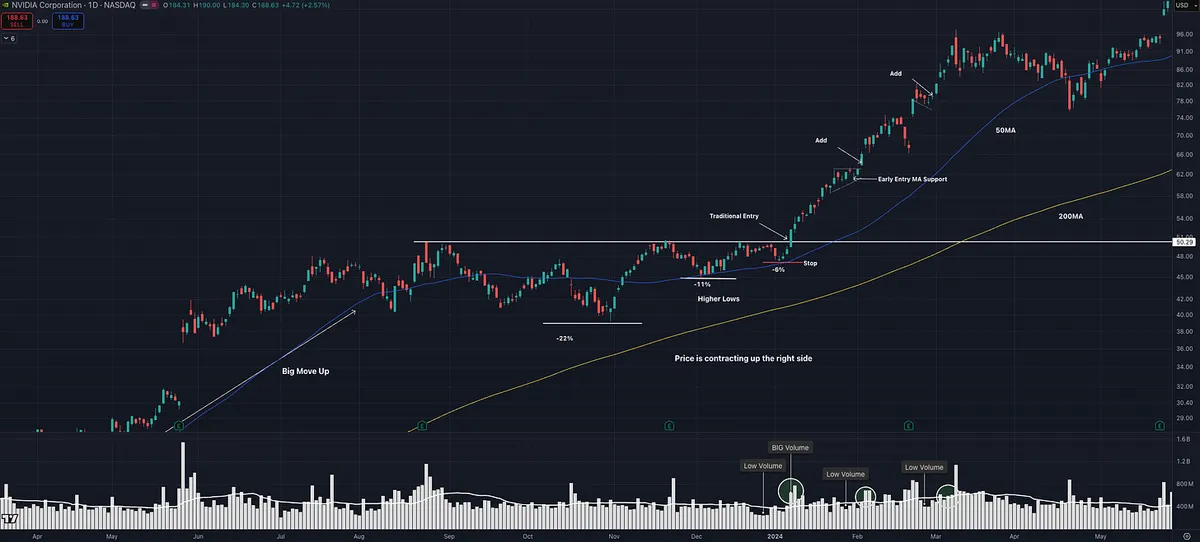
Another good example is NVDA in 2024. I had about 6 percent risk. Someone else could have taken the same trade and used the breakout day opening range low as a stop and risked closer to 1.82 percent and likely wouldn’t have been stopped out.

Like David Ryan often emphasizes, the best trades tend to be hard to buy, work right away, and don’t look back.

The principle stays the same.

Keep losses small. Don’t let one trade do real damage.

And at the end of the day, we all trade differently and that’s ok.

That’s what makes a market.

Different styles can still make money.

View on Substack ↗

Trading and Entrepreneurship Follow the Same Playbook

Most people think trading is about predicting.

It’s not.

It’s about testing.

Great entrepreneurs don’t wait for certainty. They move with conviction, knowing they could be wrong. Even someone like Jeff Bezos didn’t know which ideas at Amazon would become massive winners. They tested constantly. Many failed. A few changed everything.

That’s exactly how we operate as traders.

We’re not here to be right 100% of the time. That’s impossible.

We’re here to:

• Test ideas with real capital

• Cut losses quickly when we’re wrong

• Add when something proves itself

• Let the real winners run

Our strategy is built on what has worked for decades, but even then, no individual trade is guaranteed to be a winner.

The market decides what works.

For example, those of you who are paid subscribers heard me talking about LITE back in January, and it has gone up over 125% since then. But here is the honest truth. It was one of many names I was looking at and trading.

There were plenty of other stocks with big earnings, strong sales, and high relative strength just like LITE that did not move.

The difference is simple.

I cut the losers and added to the ones that worked.

I will even continue trading that same name off and on until it clearly shows the move is over.

Just like in business, you don’t go all in on every idea. You place small, calculated bets, watch what gains traction, and then press your advantage when something starts working.

In fact, this is even more important in trading. In business, you can take action to influence outcomes. In the market, you cannot. Once you enter a trade, the market is in control.

So start treating trades like a series of small tests, and let the market tell you which ones deserve more capital.

Cut losers. Press winners.

Whether you're building a company or trading stocks, the principle is the same.