Momentum Trading Strategy

Notes

Risk Management & Position Sizing

Notes whose main point is limiting losses and deciding how much to buy and how much to risk on each trade.

Showing 1–4 of 4 notes

$NVDA ×
View on Substack ↗

The Best Thing About a VCP Isn’t the Breakout

One of my favorite quotes in Market Wizards comes from Bruce Kovner:

“Whenever I enter a position, I have a predetermined stop. That is the only way I can sleep. I know where I’m getting out before I get in. The position size on a trade is determined by the stop, and the stop is determined on a technical basis. For example, if the market is in the midst of a trading range, it makes no sense to put your stop within that range, since you are likely to be taken out. I always place my stop beyond some technical barrier.”

- Bruce Kovner, Market Wizards

That quote explains one of the biggest reasons I love the Volatility Contraction Pattern.

Most people focus on the obvious part of a VCP.

  • Price tightens.

  • Volume dries up.

  • Supply appears to diminish.

It is almost like a rubber band being pulled tighter and tighter, creating the potential for an explosive move once demand overwhelms the remaining supply.

All of that is great, but that is not my favorite part.

My favorite thing about a VCP is that it can give you a very clear technical level where you have decided the trade is wrong.

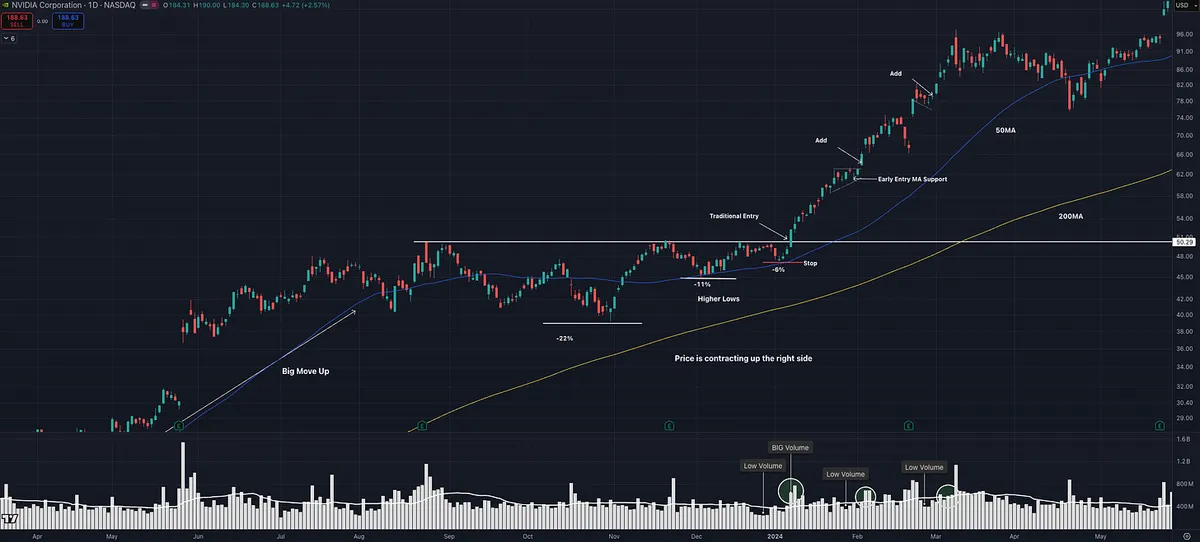
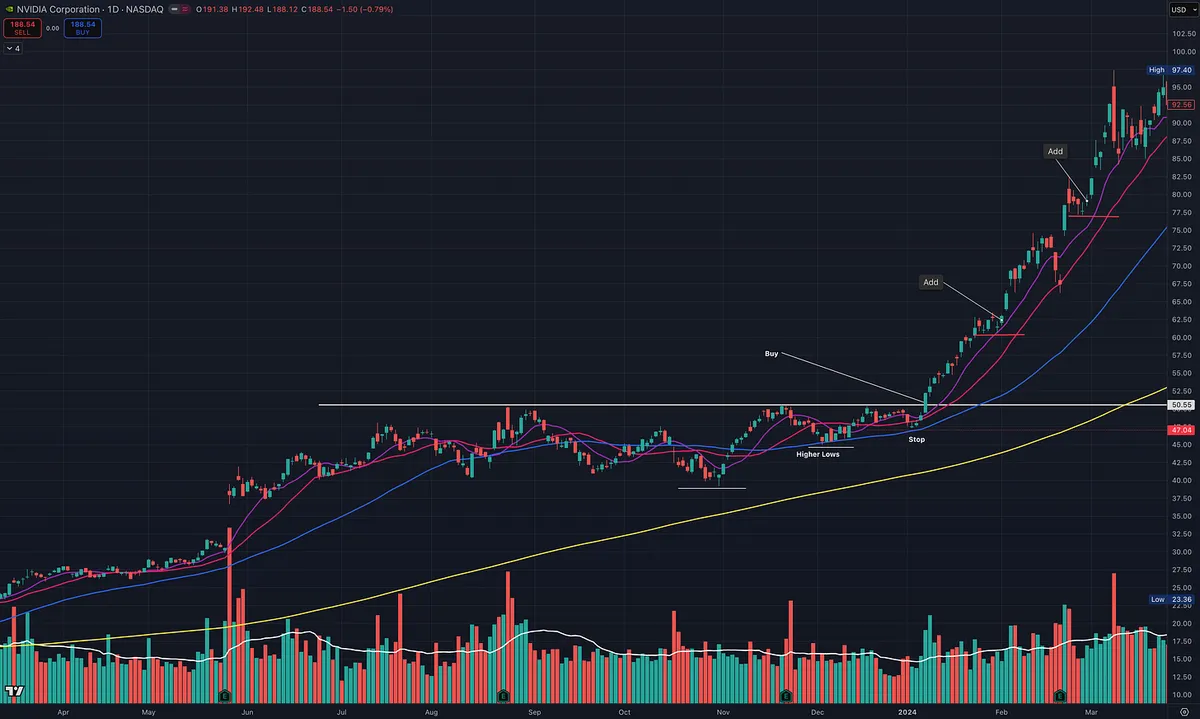
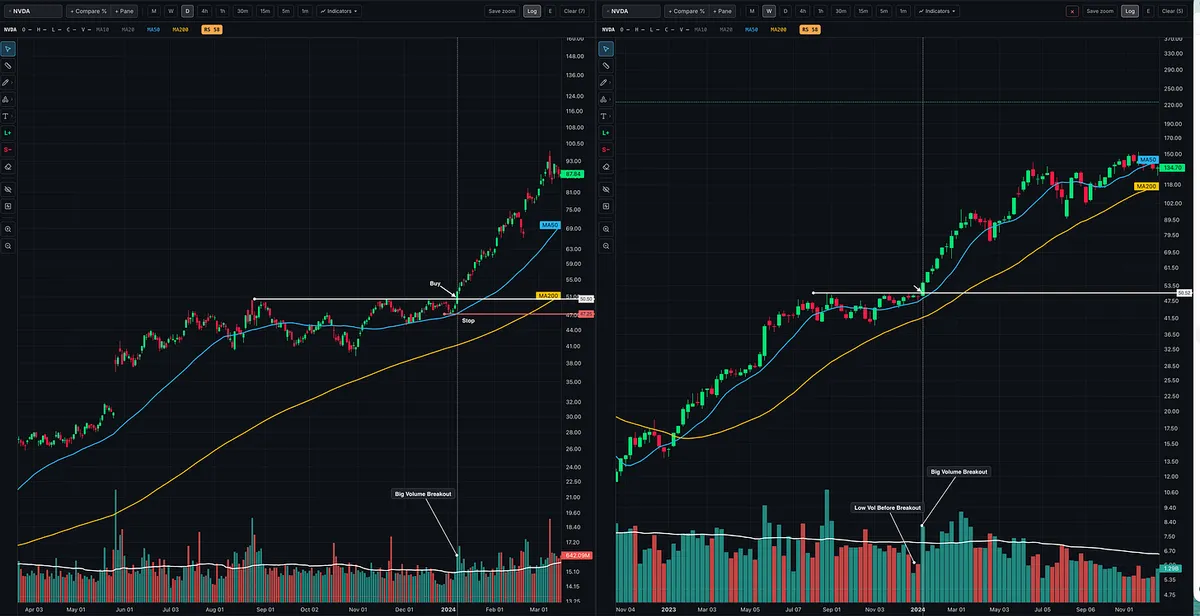
Look at NVIDIA in early 2024.

The stock tightened up near the pivot. Volume dried up. Then price broke through the line of least resistance on expanding volume.

But before the breakout ever happened, I could already identify my risk.

I knew where I wanted to enter.

I knew where the technical structure would begin to fail.

And because I knew my stop, I could determine my position size before putting capital at risk.

That is the part many traders get backwards.

They decide how many shares they want to own first, then try to squeeze a stop somewhere underneath the trade.

I prefer the opposite:

  • Find the setup.

  • Find the technical level that invalidates the setup.

  • Set the stop beyond that level.

  • Then size the position.

The chart determines the risk.

Your desired position size should not determine the chart.

And this is why a tight, well-formed setup can be so powerful. It is not simply that the stock might explode higher.

It is that you can potentially participate in that move while knowing where your idea no longer makes sense.
View on Substack ↗

Is a 5% Stop Too Tight in Today’s Market?

I got a great comment recently:

“It’s just that -5% is not much in today’s markets. Not enough not to get whipsawed. What’s your view?”

Here’s my answer.

I disagree.

There are still plenty of setups where you can risk 5 percent or less.

If that wasn’t the case, traders like Kristjan Kullamägi wouldn’t be as successful as they are.

Same with Mark Minervini. He won the U.S. Investing Championship in 2021. He’s still finding tight entries in today’s market.

It comes down to tactics and timing.

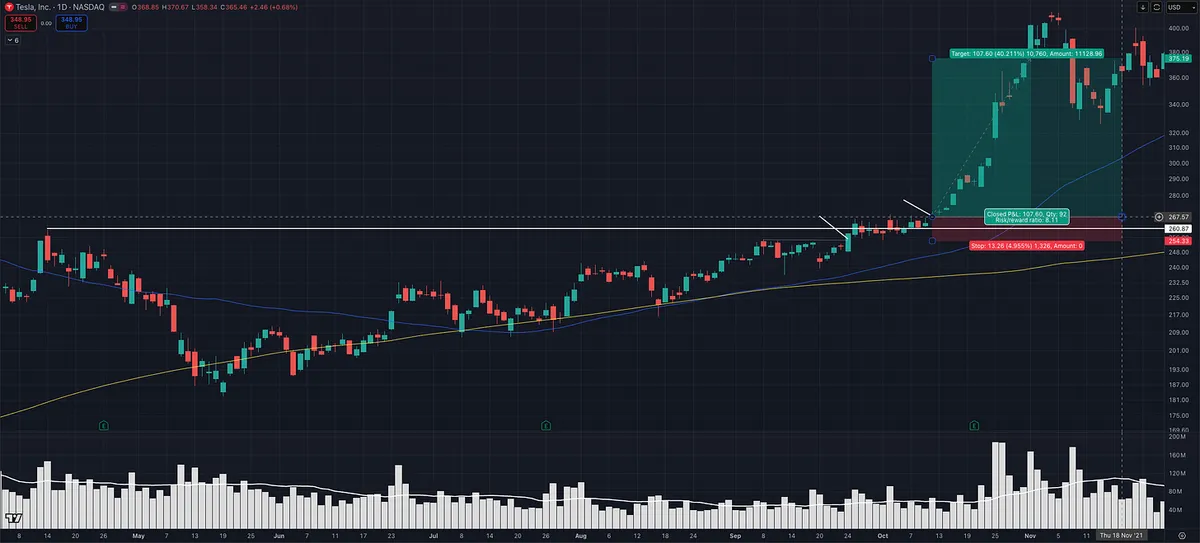
This TSLA example is a good illustration.

On the right side of the base, price was tightening and structure was clean. That created multiple opportunities where risk could be kept at 5 percent or less.

Recently (2025-2026), with many of the big winners already extended in Stage 2 uptrends, it’s a different environment.

If you’re only buying standard breakouts here, then yes, your stop likely needs to be 7 to 10 percent.

But that’s just one way to play it.

A lot of the big winners from 2025 to now in areas like computer data storage and telecom, names like LITE, SNDK, MU, CIEN, WDC, were harder to trade with tight risk using traditional breakout entries.

Their ADR% was higher, and there was less contraction into the pivot, so traders had to adapt.

Pullback entries. Low cheats. Intraday entries like ORB.

Those allow you to define risk much tighter and still participate without getting shaken out.

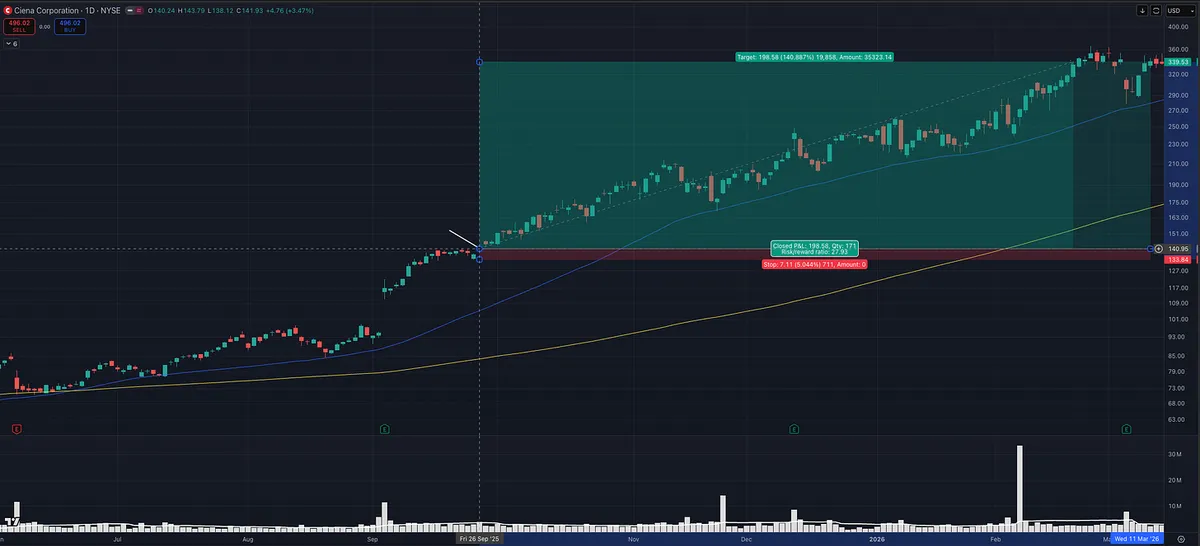
CIEN is another good example.

After an episodic pivot on earnings, price ran, then tightened sideways. That created a clean opportunity to enter with defined, tight risk.

This isn’t about forcing a fixed 5 percent stop on every trade.

It’s about finding entries with proven setups where tight risk actually makes sense.

Timeframe matters. Setup matters. Execution matters.

And just like Minervini, I’m not rigid with it.

Some trades might be 3 percent risk. Some 5 percent. Some 6 to 8 percent depending on the setup.

I’ll even go up to 10 percent and adjust position size, but I prefer tighter risk when the setup allows it.

Another good example is NVDA in 2024. I had about 6 percent risk. Someone else could have taken the same trade and used the breakout day opening range low as a stop and risked closer to 1.82 percent and likely wouldn’t have been stopped out.

Like David Ryan often emphasizes, the best trades tend to be hard to buy, work right away, and don’t look back.

The principle stays the same.

Keep losses small. Don’t let one trade do real damage.

And at the end of the day, we all trade differently and that’s ok.

That’s what makes a market.

Different styles can still make money.

View on Substack ↗

The Most Important Trading Skill Nobody Talks About: Position Sizing

Most traders obsess over finding the perfect entry.

But the truth is, position sizing is what determines whether you survive long enough to compound real gains.

I receive a lot of questions about this because it is rarely discussed in detail in most trading books. There are several ways to position size and manage risk, but here is a very basic example that should help illustrate the concept.

Below is a response I recently sent to a reader.

—

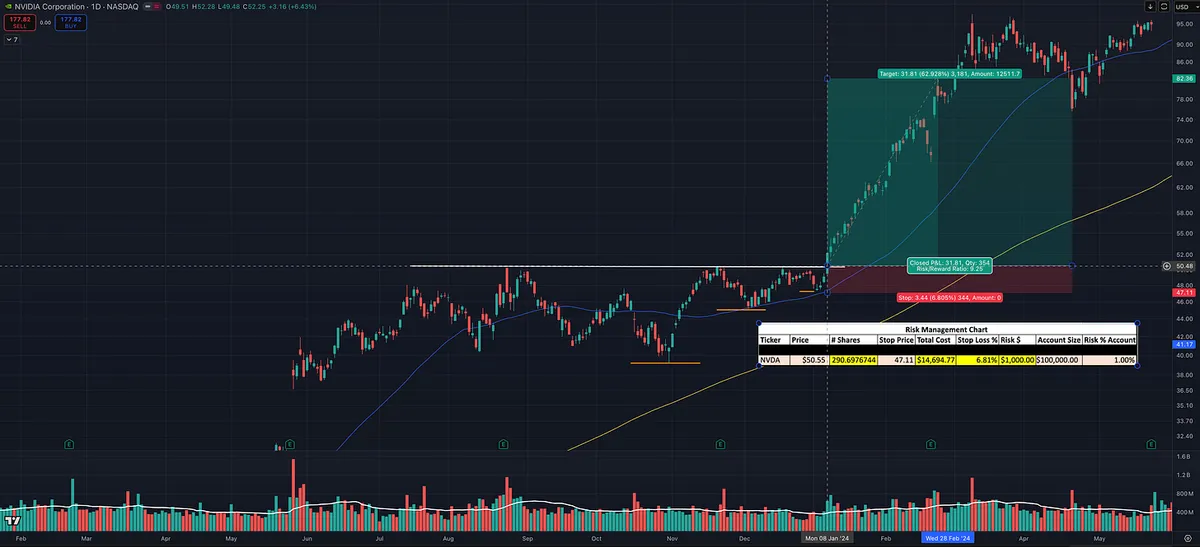
Here’s a simple method I use (see chart).

Let’s say I want to buy a breakout in NVDA at $50.55. I would place my stop at a technical level, right under the previous higher low and near the 50 day moving average at $47.11.

I always base my stop on technical level, not on the percentage I want to lose.

Bruce Kovner said it well in Market Wizards:

“Whenever I enter a position, I have a predetermined stop. That is the only way I can sleep. I know where I’m getting out before I get in. The position size on a trade is determined by the stop, and the stop is determined on a technical basis.”

In this example, the distance from entry ($50.55) to the stop ($47.11) is about 6.81%, which happens to be under the 8% rule that William O’Neil talks about, but that percentage alone does not determine your overall risk.

Once you know your entry and stop, then you determine position size based on how much of your portfolio you are willing to risk.

For example:

If you have a $100,000 account and you only want to risk 1% on the trade, that means you are risking $1,000 total.

With the stop distance in this example, that would equal about 290 shares ($14.6k worth).

Now let’s say you don’t want about $14,600 (14.6% of your account) tied up in this one trade. You could instead calculate position size based on portfolio exposure.

For example:

• If you only want 10% of your account in NVDA, you would buy about 197 shares, risking roughly 0.68% of the account if the stop is hit.

• If you’ve been doing well and want to press harder with 25% of your account, you could take about 494 shares, risking roughly 1.7% of the account if the stop gets hit.

Hopefully that helps.

A lot of people misunderstand the 8% rule from William O’Neil. That rule refers to the distance from entry to the stop, not necessarily the percentage of your total portfolio you are risking on the trade.

View on Substack ↗

Buying Pullbacks vs Buying Breakouts

Most traders think you have to pick one.

You don’t.

You just need to know what each one does for you.

Buying Breakouts

You buy strength.

You buy as price clears resistance.

You buy as the stock moves into new high ground.

Why I use it:

• It confirms demand

• Overhead supply is gone

• Risk is clearly defined below the pivot

• Momentum is aligned

Breakouts increase probability.

When the market is in a strong uptrend, this is the cleanest way to initiate a position.

But there is a tradeoff.

• You pay up

• Everyone sees the same level

• Shakeouts are common

• Cost basis rises quickly if you keep adding

Breakouts are powerful.

They are also crowded.

Buying Pullbacks

You are not buying weakness in a downtrend.

You are buying weakness inside a confirmed uptrend.

Higher highs. Higher lows.

Rising 10-day, 21-day, or 50-day moving average.

Why I use it:

• Lower cost basis

• Better risk to reward

• Easier to accumulate shares

• Less competition

• Opportunity to add size without chasing

But the key to buying pullbacks is not guessing.

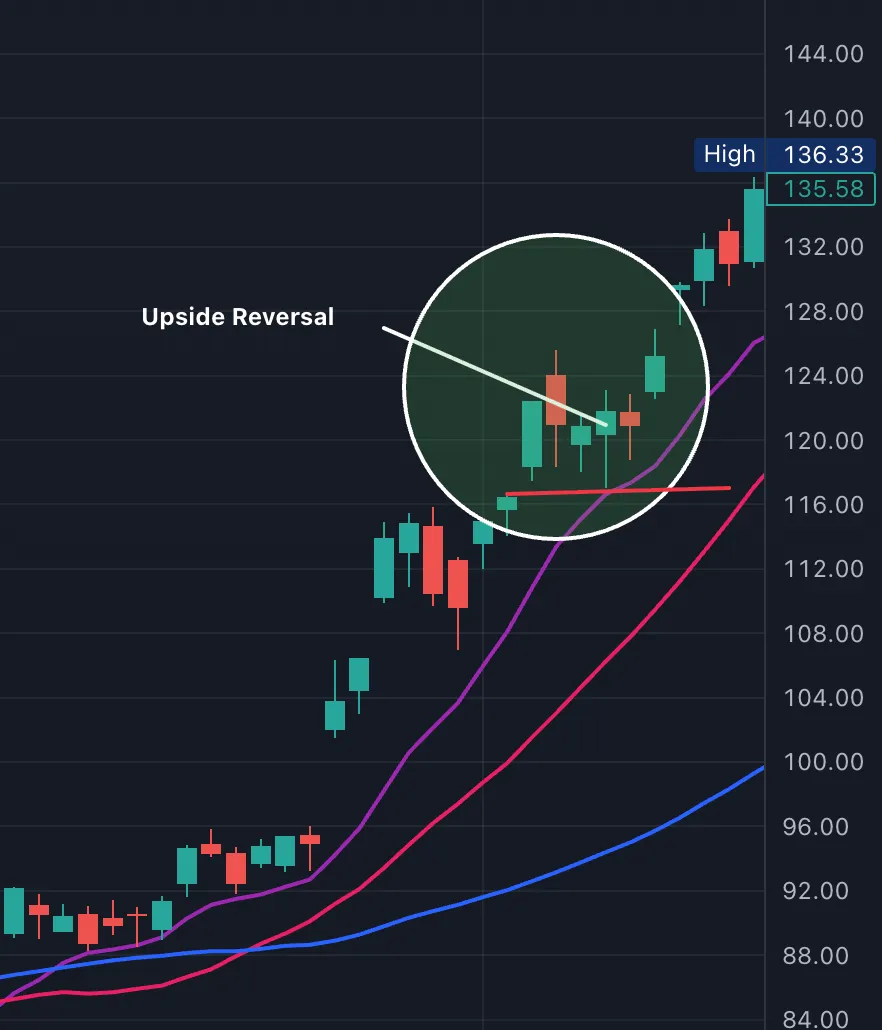
It is waiting for an upside reversal at support.

A shakeout.

A reclaim.

A strong close near the highs of the day.

That upside reversal becomes your signal.

The low of that reversal day becomes your stop.

If price undercuts it, you are wrong.

Without that trigger, you are just catching a falling knife.

Pullbacks improve positioning.

But they require:

• A strong general market

• A stock in a defined uptrend

• Clear support levels

• Absolute risk control

If support breaks, you are wrong.

How I Actually Trade It

Many times I do both.

I buy the traditional breakout.

Then I add on pullbacks.

Breakouts get me involved. Pullbacks help me build size.

If the stock is truly a leader, it will:

• Break out

• Pull back to the 10, 21, or 50

• Stage an upside reversal

• Resume higher

That is where real position building happens.

The goal is not to be right once.

The goal is to build size in the right stock while controlling risk.

Some uptrends reward breakouts more.

Some reward pullbacks more.

You need to be aware of what is working best right now.

NVDA Example

NVDA provided a textbook example of this sequence.

Flat base breakout from VCP to initiate.

Then a controlled pullback into the rising 10-day.

On that pullback, price:

• Touched support

• Reversed higher

• Closed above the prior day’s close

• Traded above the prior day’s high

That is buying a pullback within an uptrend.

The low of that reversal day or low of pullback becomes the stop.

Breakout to get involved.

Pullback to add.

That is how real leaders let you build a position.