Momentum Trading Strategy

Notes

Short lessons on momentum trading, every day.

Every note from Substack, in one place: risk, setups, leading stocks, market conditions and the mindset behind them. Search them, browse by topic, or filter by stock.

Showing 1–8 of 8 notes

$FIX ×
View on Substack ↗

6,400% From a Stock I Knew Nothing About

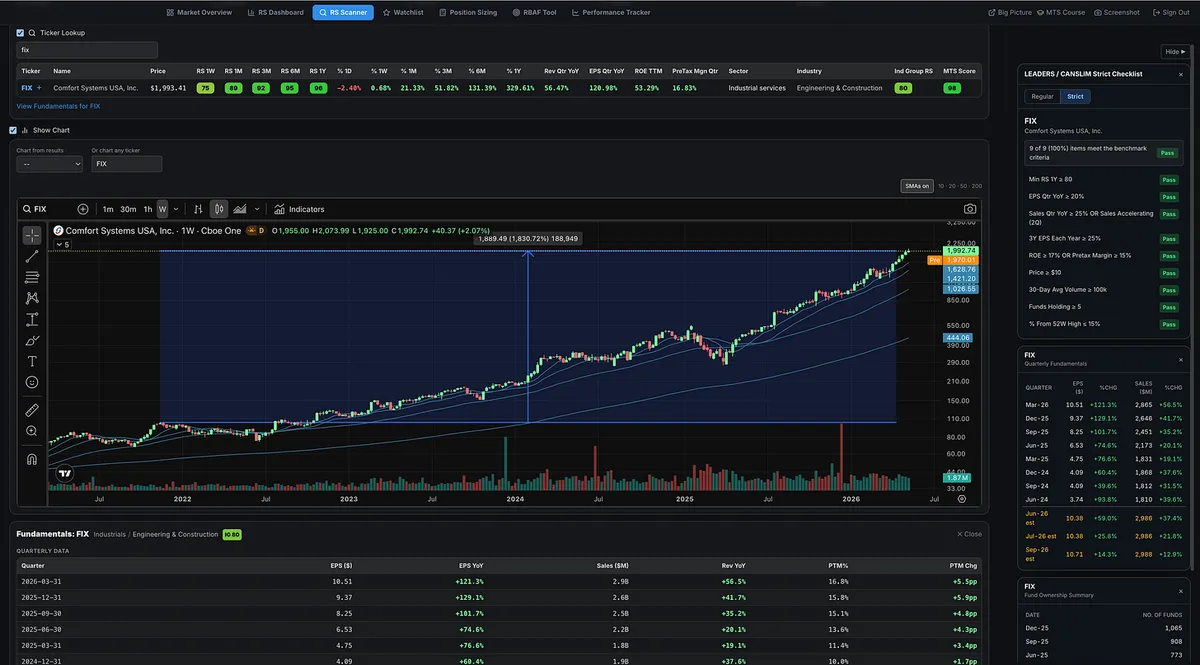
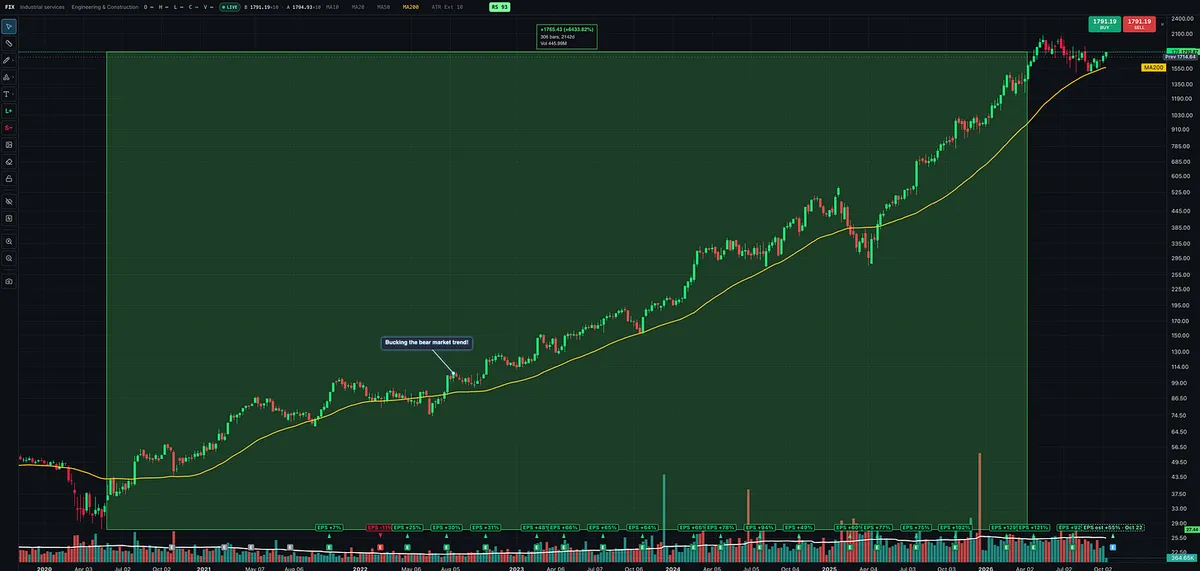
FIX has climbed more than 6,400% from the 2020 level marked on this chart.

When it first appeared on my stock screeners, I knew nothing about the company.

That is exactly why this chart is worth studying.

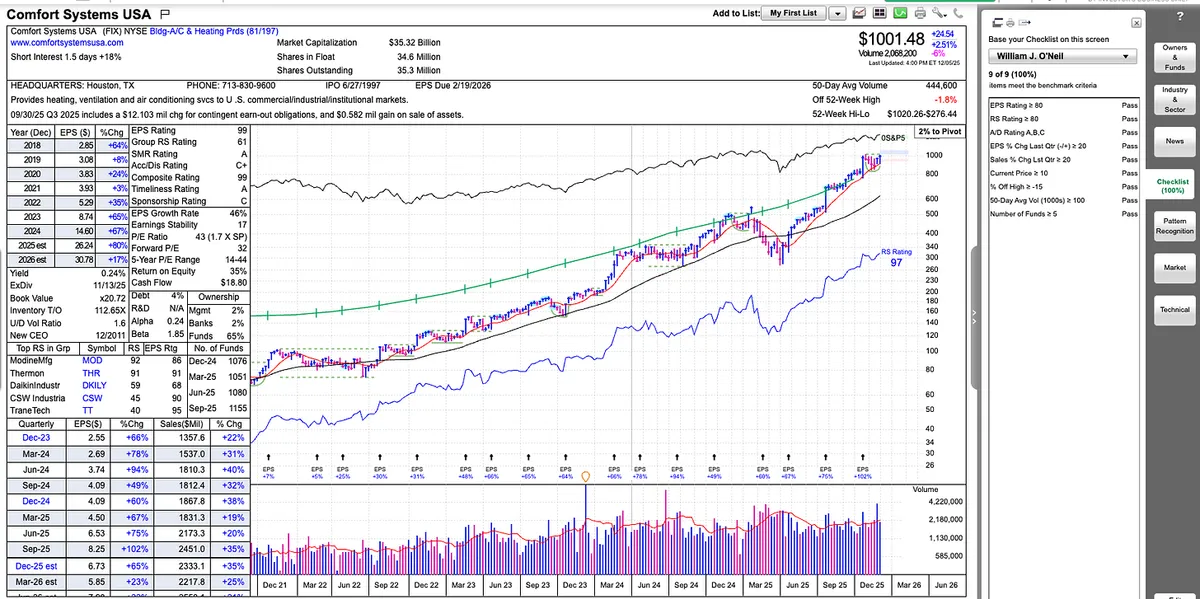
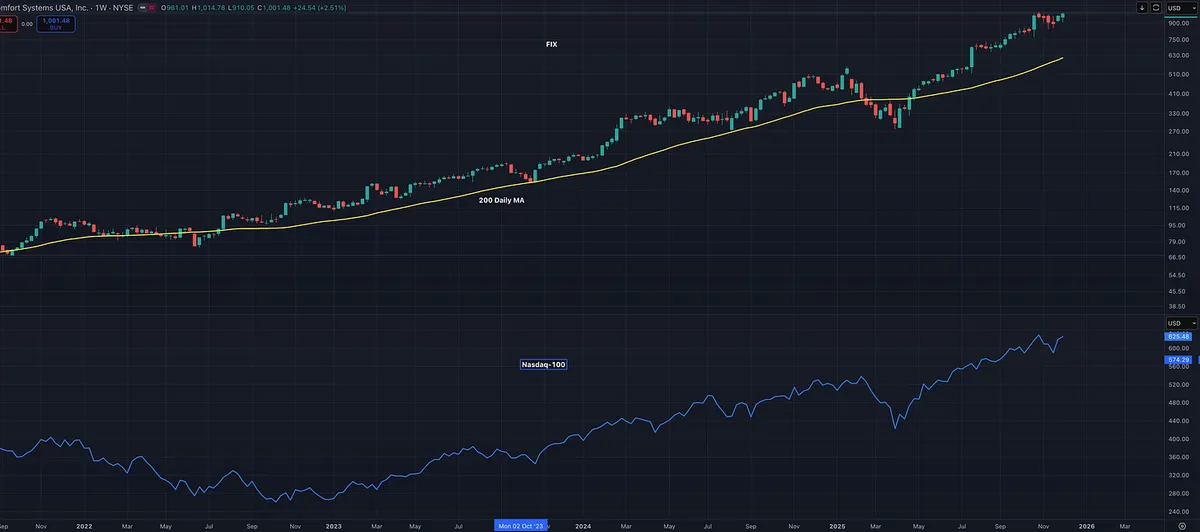
Comfort Systems USA first caught my attention in the summer of 2022. The broader market was in a bear market, yet FIX was pushing to new highs and bucking the trend.

By January 2023, when there was still plenty of uncertainty about whether the indexes were emerging from the bear market, FIX was already establishing higher highs and higher lows.

The stock was demonstrating leadership before the market’s recovery felt comfortable.

I wasn’t searching for an AI trade when I found it. I was screening for the CAN SLIM leadership characteristics I look for.

As it turns out, FIX is an AI infrastructure beneficiary. Its mechanical, electrical, cooling, and modular construction capabilities help build the data centers supporting AI. Management has explicitly identified AI as an additional source of data center demand.

But I didn’t understand that connection when the stock first appeared on my screens.

My process found the strength before I understood the story.

Throughout much of the advance, the fundamentals reinforced the price action. From 2023 to 2025, annual sales rose from $5.2 billion to $9.1 billion, diluted earnings per share more than tripled, and gross margins expanded from 19% to 24.1%.

To me, FIX is a modern model book stock.

It displays the combination William O’Neil teaches us to recognize in How to Make Money in Stocks: strong earnings and sales, improving profitability, relative strength, and constructive price action. There is a reason he opens the book with 100 charts of past market winners. Studying their recurring characteristics helps us recognize potential leaders while their moves are still developing.

Mark Minervini makes a point in Think & Trade Like a Champion that fits this experience perfectly:

“I embrace new names instead of avoiding them.”

The discussions in Momentum Masters reinforce another lesson: leading stocks can emerge before the indexes make a new uptrend obvious. Stan Weinstein’s Stage 2 framework gives us a way to recognize the advancing phase, with rising prices, higher highs, and higher lows.

These lessons come together in FIX.

A process helps you find potential leaders, identify proper entries, define your risk, and manage the trade as it develops. Following that process requires discipline, especially when the company is unfamiliar or the market still feels uncertain.

“The trend is your friend until the end, when it bends.”

The last part is important, too. Give a winner room to develop within your rules, and respect your exits when the evidence changes.

You need a process that can bring an unfamiliar leader to your attention, the patience to let a winner develop, and the discipline to follow your rules from entry to exit.
View on Substack ↗

If I Could Only Use One Indicator for the Rest of My Life, It Would Be This

As a momentum trader or growth stock investor, it is hard to beat relative strength.

If I could look at only one thing besides price for the rest of my trading career, it would be RS.

And no, relative strength is not the same thing as RSI.

At the most basic level, a standard one-year RS rating ranks a stock’s price performance over the past 52 weeks against every other stock in the market.

A stock with a 99 RS rating has outperformed 99% of the market. You are looking at one of the strongest-performing stocks over that period.

But relative strength is much more than simply sorting stocks by their one-year rating.

Suppose the market falls 20%, but a stock declines only 10%. That stock is showing relative strength.

If the market is falling or moving sideways while a stock continues advancing, that is relative strength.

You can take the analysis even further by comparing the stock with its sector, industry group, related ETF, and the strongest themes in the market.

Suppose an industry group is up 50%, but the individual stock is up only 30%. The stock may look strong in isolation, but it is actually showing relative weakness compared with its peers.

Why trade the laggard when stronger names exist within the same group?

Why take the additional company-specific risk of owning an individual stock when the sector or theme ETF is outperforming it?

Ideally, I want to see a stock outperforming:

  • The major indexes

  • Its sector

  • Its industry group

  • The market’s strongest themes

  • Other stocks across the market

And do not study relative strength only while the market is rising.

Some of the most valuable information appears during corrections.

When the market is falling, which stocks refuse to break down?

Which names hold above support, decline less than their peers, or continue advancing while everything around them weakens?

Strong relative strength during a correction does not guarantee that a stock will become a future market leader.

But it can be one of the biggest signals a momentum trader can find.

O’Neil’s research found that the best-performing stocks already had an average RS rating of 87 before beginning their major advances. In other words, the greatest winners were already outperforming nearly nine out of every ten stocks before their most explosive moves began.

This was not based on a few cherry-picked examples. O’Neil studied more than 1,000 of the market’s greatest winners, spanning more than a century, and specifically examined the degree of relative strength they displayed before their enormous advances.

FIX is a perfect modern example.

The stock turned higher and began making new highs while the broader market was still struggling. It revealed itself before the indexes confirmed the new uptrend, then went on to become a massive winner of more than 1,000%.

That is why relative strength during a correction matters so much.

The future leaders do not always wait for the market to give everyone an obvious signal. Some begin separating from the crowd before the indexes turn higher.

However, there is an important caveat.

When growth stocks are being beaten down, defensive areas will often rise to the top of the RS rankings as investors rotate toward safety.

That does not automatically make those defensive stocks the next major leaders.

When the market recovers and growth stocks begin improving, many of those defensive names quickly disappear from the top of the rankings.

Do not confuse temporary defensive strength with genuine emerging leadership.

Look for growth stocks with strong earnings and sales, improving price and volume action, strong industry-group support, and exceptional relative strength that are already separating from the market.

Strong RS during a correction is not a guarantee.

But it is one of the most important clues that a future market leader may already be emerging.

View on Substack ↗

Nothing Lasts Forever. Don’t Fall in Love With Any Stock.

Some of the market’s biggest winners over the past year have now broken down. At least for the moment, their runs appear to be over.

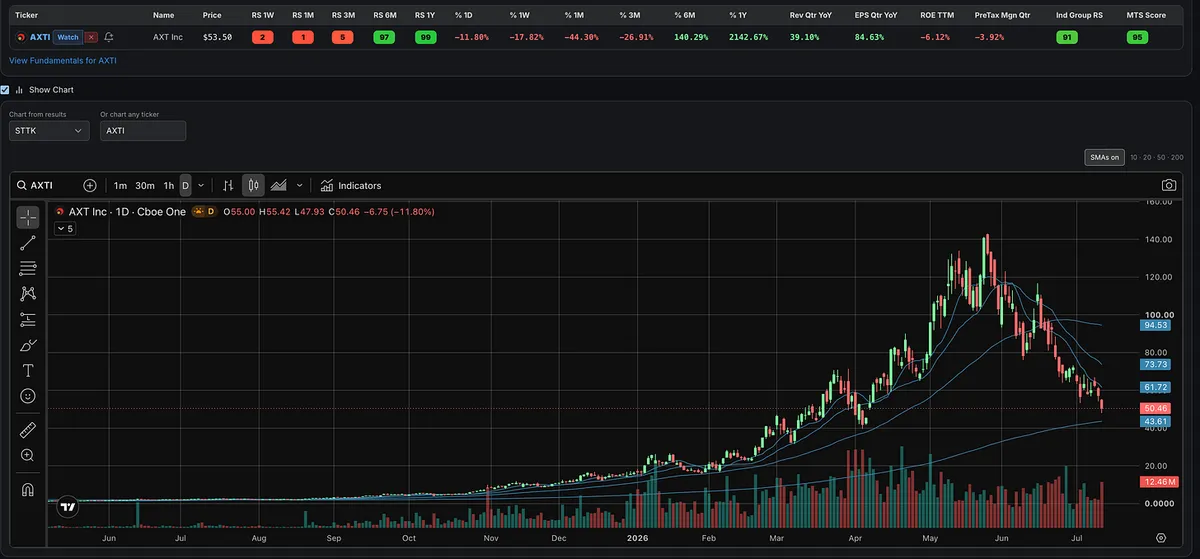
AXTI delivered enormous gains over the last year, but it has now fallen below its 50-day moving average and is heading toward the 200-day. Its 10-day and 20-day lines are declining, and the 50-day is beginning to roll over.

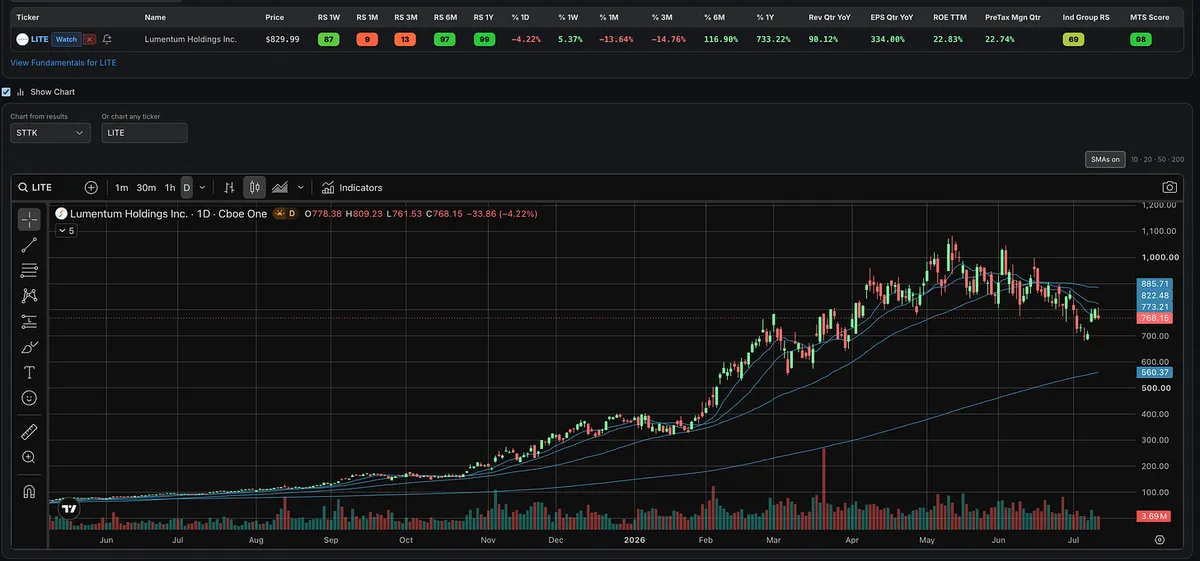
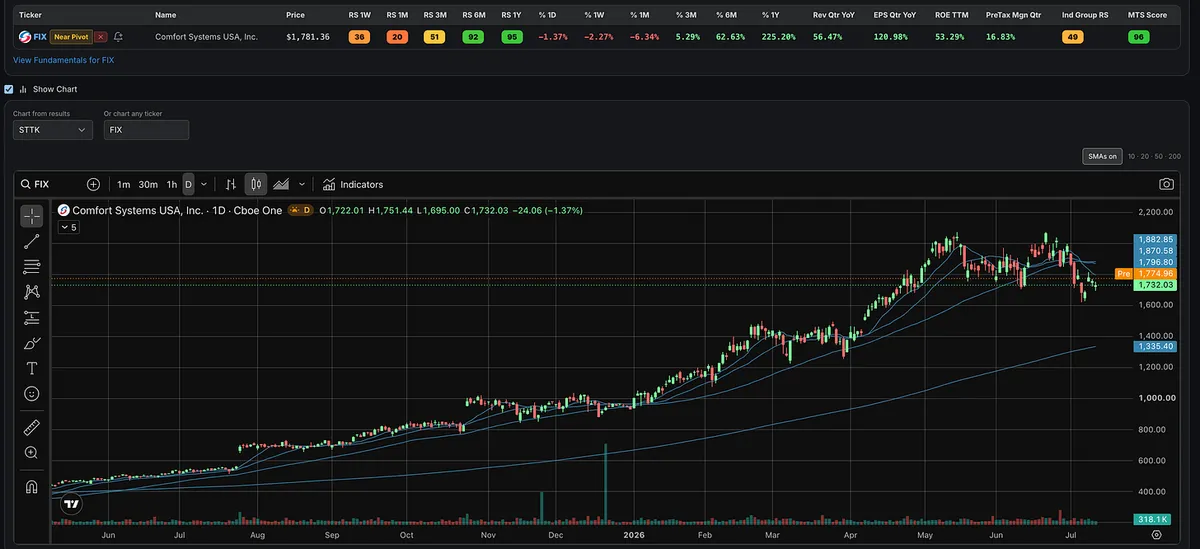
LITE, CIEN, VICR, AAOI, VIAV, TTMI, FIX, COHR, and several other former leaders have also broken down or suffered significant technical damage.

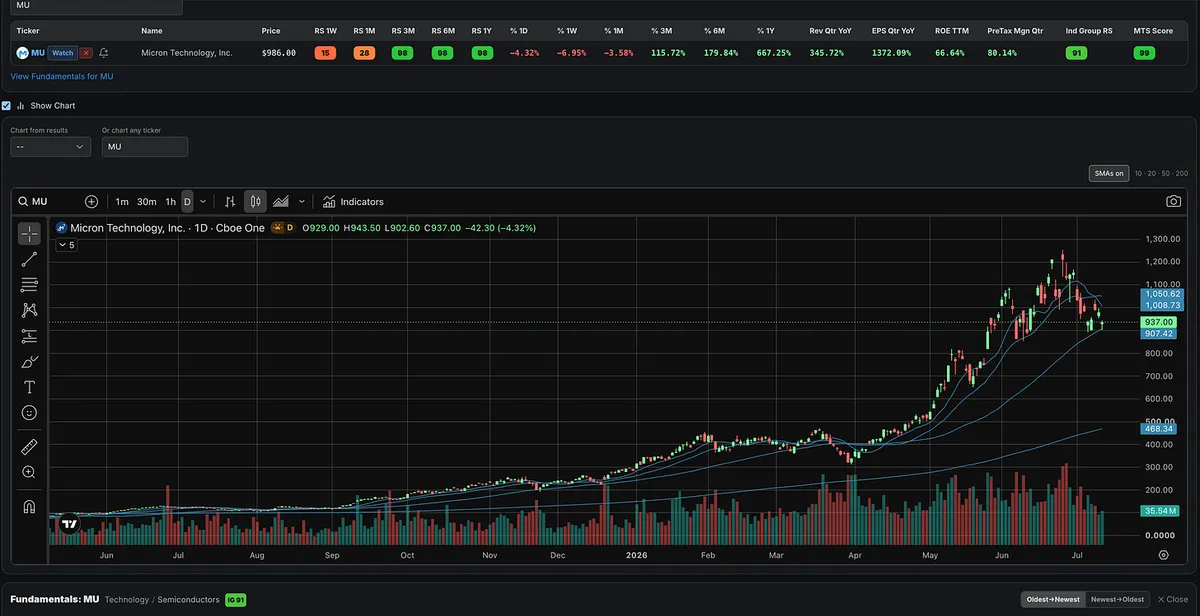
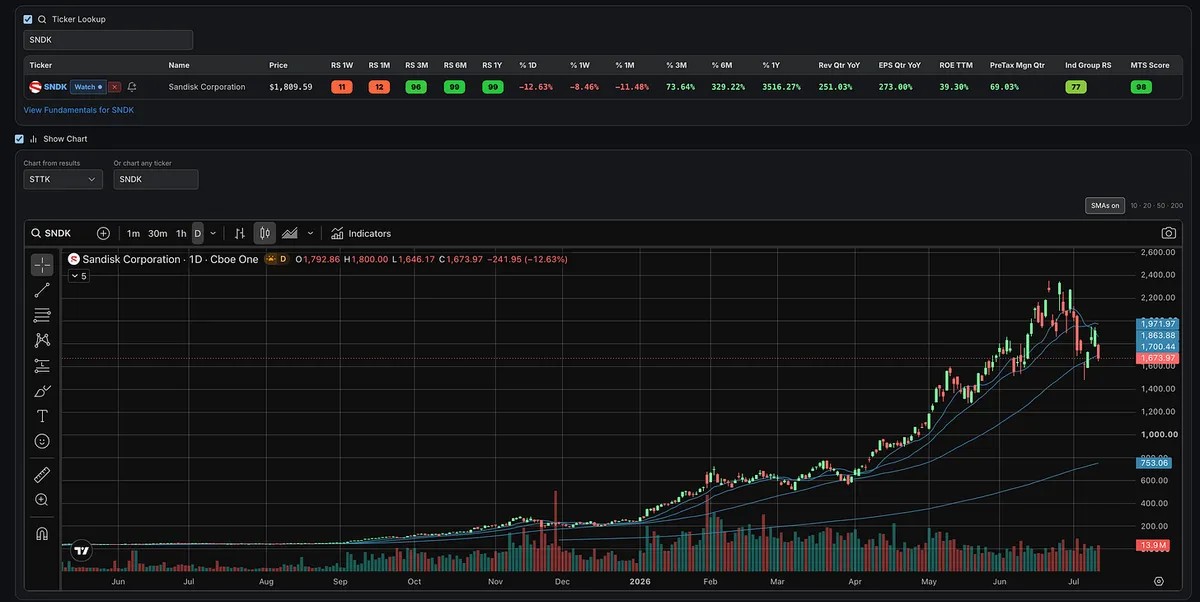
Many more are sitting in the danger zone near their 50-day moving averages. That includes the memory names SNDK, WDC, STX, and MU, along with other hot names from hot groups VPG, MBIS, MXL, LSCC, MRVL, TER, VSH, STM, ADI, INTC, TSM, LRCX, COHU, PDFS, and others.

The bottom line is that many of the stocks that have driven this market, particularly the memory, semiconductor, and telecom names, have either already broken down or are now testing a critical area around their 50-day lines.

I have not needed to share many new tickers from week to week because the same names I have discussed throughout the year continued to lead. There was no reason to constantly search for something new when the existing leaders were still working.

But nothing lasts forever.

Many of the stocks that worked all year are now either ending their runs or approaching a decisive point. Do not fall in love with any stock. Respect the price action and let the market tell you whether the trend is still intact.

View on Substack ↗

Can’t Stop, Won’t Stop: FIX

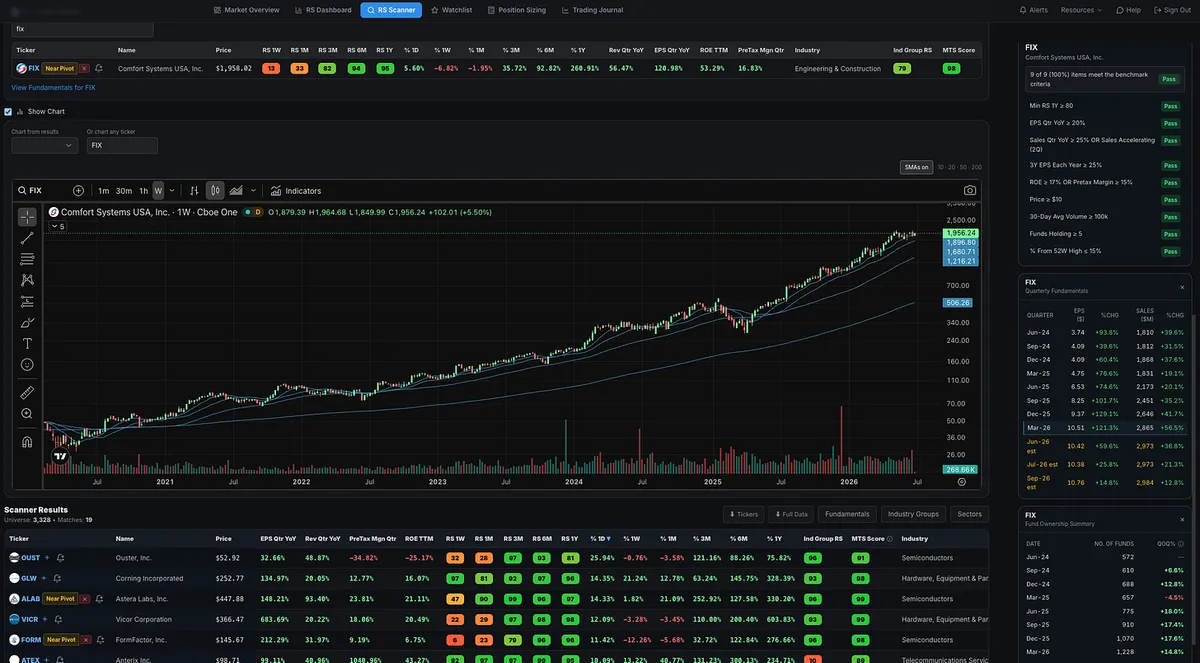
Comfort Systems USA (FIX) continues to refuse to end its trend.

Every time the stock looks like it may finally need a deeper reset, buyers show up. It has repeatedly found support around key moving averages, including the 10-week and 50-day area, and continues to hold near highs after a massive multi-year advance.

This is what real leadership often looks like. Strong stocks do not always give easy pullbacks. They ride the short-term moving averages, shake out weak hands, and keep pressing higher while traders wait for a better entry that never comes.

The fundamentals still support the move. FIX continues to show strong earnings growth, strong sales growth, high ROE, and a 98 MTS Score.

At some point, every trend ends.

But until price actually breaks, the message is simple:

The trend is still alive.

View on Substack ↗

Eventually This Pullback Will Fail

And that's perfectly okay.

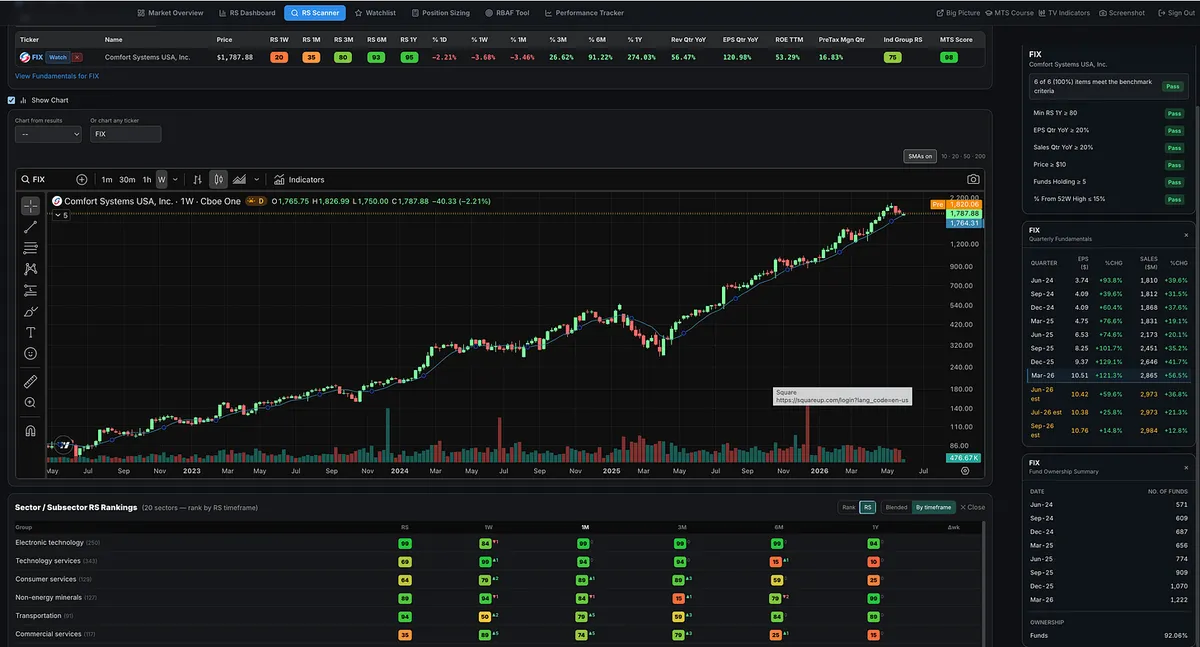
FIX is pulling back toward the 10-week moving average again. I been talking about this name for years and since I first started sharing names with subscribers.

One day, a pullback like this won't work.

One day, I'll buy a leader on a pullback, and it will fail.

I'll take a loss.

That's not a flaw in the strategy.

That's the cost of doing business.

Many new traders make the mistake of thinking they need to know exactly when a stock's run is over.

You don't.

Nobody does.

The goal isn't to predict the end.

The goal is to participate in the trend while it lasts.

Great leaders can keep working much longer than most people think is possible.

So we continue buying proper pullbacks and setups until the stock proves the trend is over.

Sometimes we'll be wrong.

We'll take a small loss and move on.

But if you've been participating throughout the trend, one small loss at the end doesn't erase the gains made along the way.

That's how this works.

We don't need to know when the run will end.

We just need to be willing to participate until it does.

View on Substack ↗

Stop Chasing Stocks. Start Mastering the Real Game.

I’m amazed at how much effort people put into trying to find the next big stock, while ignoring the things that actually determine whether they survive long enough to compound capital:

  • Risk management.

  • Position sizing.

  • Trade management.

  • A disciplined process.

FIX is a great example.

This is not some random name that suddenly showed up on a screen. I’ve talked about FIX for a long time and have been watching it since 2022.

Why?

Because it checks many of the same boxes William O’Neil wrote about when studying the greatest winning stocks in market history.

  • Consistently strong relative strength. 90+

  • Massive quarterly earnings growth.

  • Massive quarterly sales growth.

  • Annual earnings growth of 25% or greater over the last three years.

  • Strong return on equity.

  • Strong margins.

  • Increasing fund ownership quarter after quarter.

At some point, what else are you looking for in a leading stock?

The problem for most traders is not that there are no good stocks.

The problem is usually one of three things:

  • They are looking at and trading the wrong stocks, instead of focusing on the right characteristics.

  • They lack discipline, risk management, and position sizing skills.

  • They have no clue how to manage the trade once they are in.

  • Or they do not have a real system or strategy.

Everyone says they want stocks.

But when strong names show up, many people still do not execute.

And the ones who do execute often do not know how to manage the trade once they are in it.

That is exactly why I decided to put so much work into the Momentum Trading Strategy Course.

Because finding the next big stock is only a small part of success in this game.

Real lasting success comes from knowing what to look for, when to act, how much to risk, and how to manage the position after entry.

Stocks matter.

Process matters more.

View on Substack ↗

This Is Why You Track Leadership Before Everyone Else Sees It

On April 8, the market gave us the signal.

We had a follow-through day, the NASDAQ-100 reclaimed key moving averages, including the 50-day and 200-day, and the conversation shifted from defense back toward offense.

But the real edge was not just knowing the market was improving.

The edge was knowing where to look.

When the market gets stronger, I want to be focused on the strongest industry groups and the strongest stocks inside those groups.

That is exactly what we had been tracking for months.

  • Telecom.

  • Computer Data Storage.

  • Semiconductors.

Many of these names were not random new ideas. They had already been showing up in our work, some for months, and some even last year.

So when the market confirmed on April 8, there was no need to bounce around looking for the next hot ticker.

The leadership was already there.

From the April 8 signal to yesterday’s close:

AAOI up 40%

LITE up 12%

CIEN up 12%

VIAV up 30%

SNDK up 81%

WDC up 38%

STX up 53%

TER flat

AEIS down 4%

AEHR up 50%

LRCX up 12%

FIX up 30%

GLW flat

Not every stock works.

That is normal.

But when the market confirms, and multiple stocks from the same leading groups start moving together, that is usually not a coincidence.

That is institutional money flowing into a theme.

Strong market.

Strong industry groups.

Strong stocks.

That is the process.

The goal is not to chase every move.

The goal is to already know where the strength is clustering before the move becomes obvious.

View on Substack ↗

Some stocks lead loudly. Others lead silently.

Comfort Systems (FIX) has been one of the cleanest and strongest institutional-quality leaders for nearly two years and hardly anyone talks about it. It is not from a hot sector or a trendy industry group. It just keeps delivering.

Just like ELF, this stock was making new highs while the indexes were still in the 2022 bear market. Unlike ELF, it is still a top performer two and a half years later. The lesson is simple. Real market leaders often emerge in bear markets. That is one of William O’Neil’s most important teachings.

Strong earnings. Strong sales. Top tier relative strength. Consistent institutional accumulation.

Sometimes the quiet leaders end up being the real ones.