Momentum Trading Strategy

Notes

Short lessons on momentum trading, every day.

Every note from Substack, in one place: risk, setups, leading stocks, market conditions and the mindset behind them. Search them, browse by topic, or filter by stock.

Showing 1–18 of 18 notes

$QQQ ×
View on Substack ↗

William O’Neil Said This Decades Ago.

One of my favorite distinctions from William O’Neil in Market Wizards:

“So you treat a fund very differently from an individual stock account?” “Very, very differently. With an individual stock, you absolutely have to have a stop-loss point, because you never know how far down the stock is going.” - William O’Neil, Market Wizards

This is an important difference.

An individual stock and a diversified fund should not always be managed the same way.

An individual company can permanently deteriorate.

Earnings can collapse. Management can fail. A competitive advantage can disappear. In extreme cases, the stock can eventually become nearly worthless.

That is why O’Neil was so aggressive about cutting losses in individual stocks.

But a broadly diversified fund is different.

O’Neil went on to say:

“When you buy a fund, you want to be in it for 15 years or more. That is how you will make the really big money. But in order to do that, you need the courage to sit through three, four, or five bear markets. The typical diversified growth stock fund will go up 75 to 100 percent in a bull market, but it will decline by only 20 to 30 percent in a bear market.”

- William O’Neil, Market Wizards

That gets to the heart of his argument.

A diversified fund owns many companies across the economy. Individual companies can fail while the fund survives, changes its holdings, and participates when the broader market eventually recovers.

And I think this principle translates directly to many ETFs today.

A broad-market ETF tracking something like the Nasdaq-100 (QQQ), S&P 500 (SPY) or total U.S. stock market (VTI) is much closer to the diversified mutual funds O’Neil was describing than it is to owning one individual company.

But….

Not every ETF should be treated this way.

Leveraged ETFs, inverse ETFs, single-stock ETFs, highly concentrated sector ETFs, and narrow thematic ETFs can carry very different risks.

And if you are trading an ETF tactically rather than holding it as a long-term diversified investment, a predefined stop should be used.

Don’t treat a broken individual stock like a diversified index fund.

And don’t treat a normal bear-market drawdown in a broadly diversified long-term fund like one company whose thesis has completely failed.

Ironically, O’Neil pointed out that many investors do the exact opposite.

They hold individual-stock losers hoping they come back, then panic and sell diversified funds during bear markets.

Individual stocks require protection from permanent loss.

Broad diversified funds require the patience to survive normal market cycles.

Two different vehicles.

Two different jobs.

Two different timeframes.

Two different approaches to risk.
View on Substack ↗

The Warnings Are There, but So Is the Strength

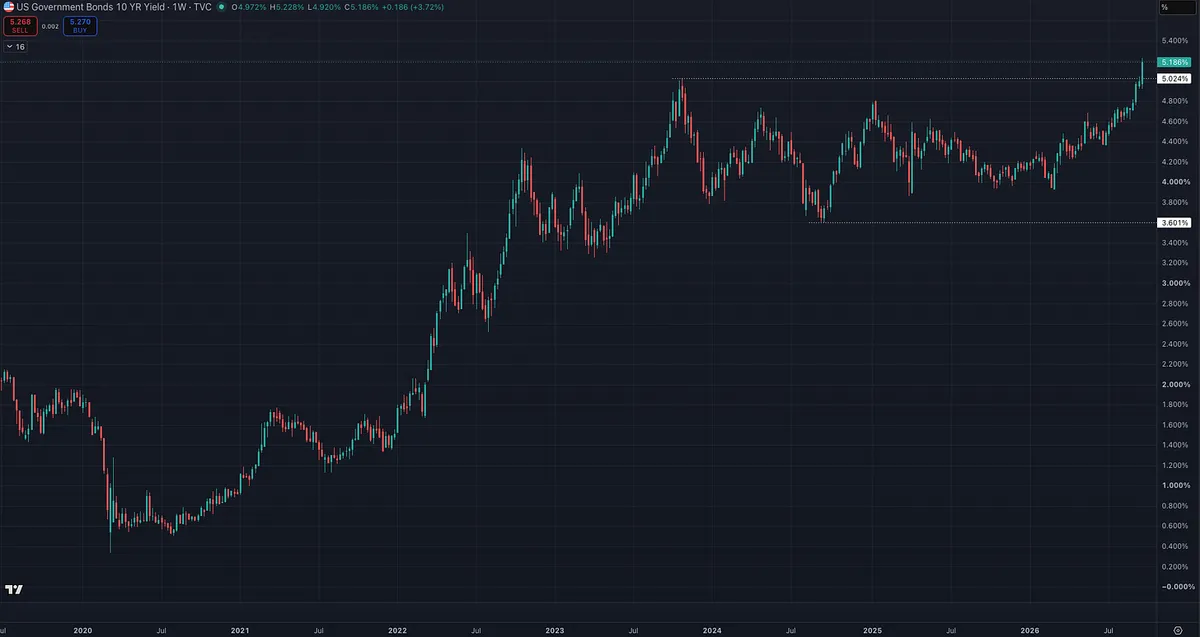
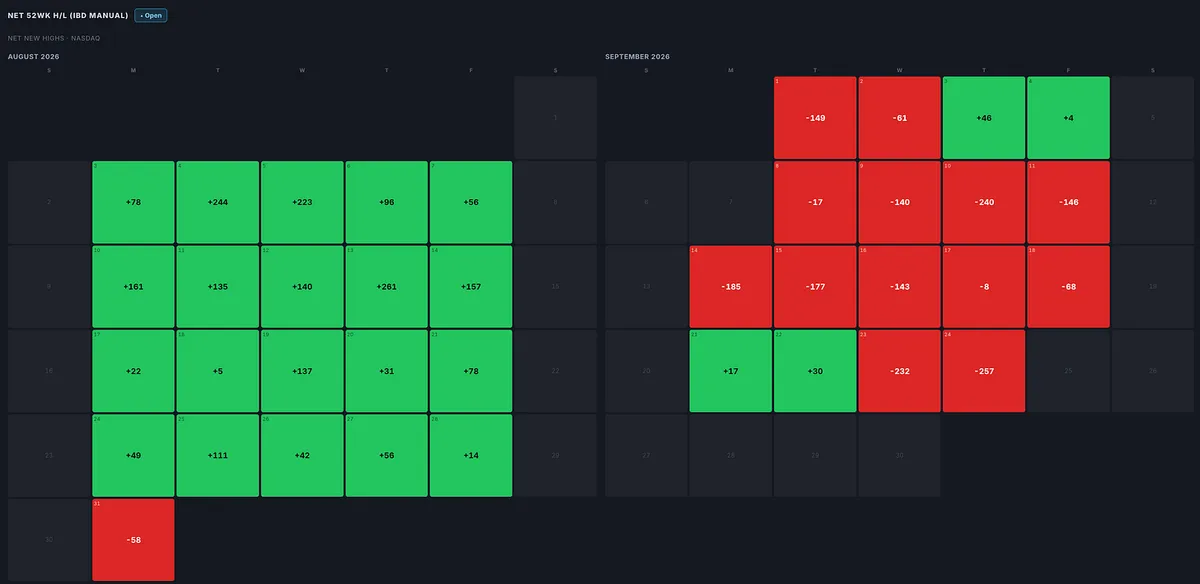
Net new lows and the percentage of stocks above key moving averages are showing some of the weakest readings I’ve seen since March. Stocks falling 4% have substantially outnumbered those rising 4%. Add a 10-year Treasury yield around 5.2%, and there are plenty of reasons to approach this market cautiously.

Yet look at QQQ and the Nasdaq Composite.

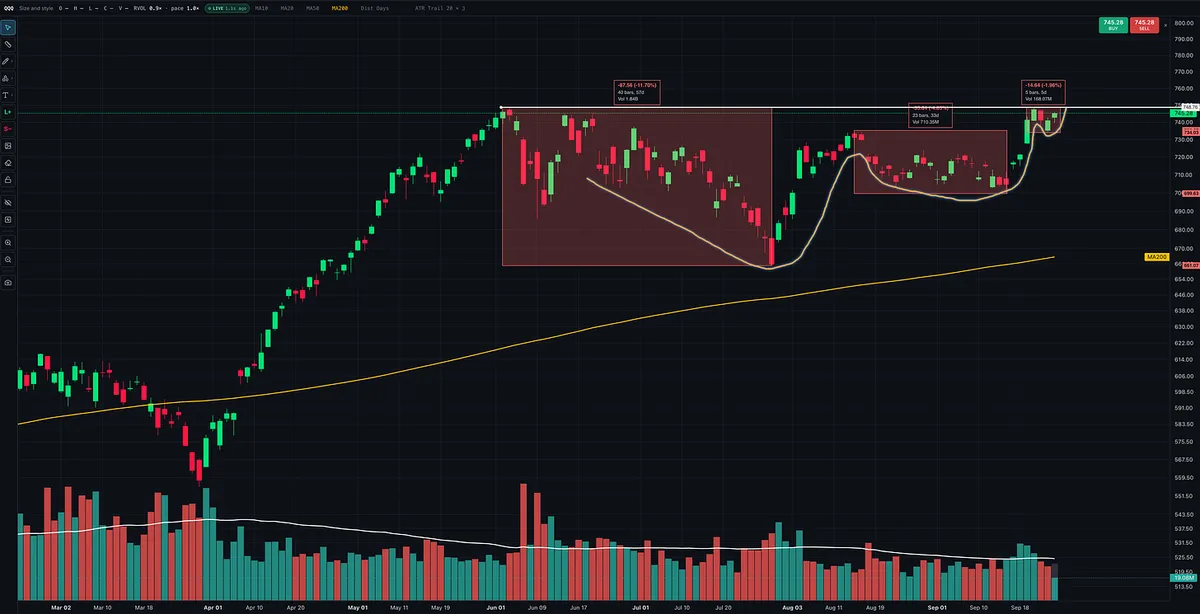
Both are sitting near their highs. On QQQ, successive pullbacks have narrowed from roughly 12% to 5% to 2%, creating VCP-like tightening up the right side of the chart. Meanwhile, leaders such as AMD continue to show strength.

The internal weakness is real, but so is the resilience in the leaders.

O’Neil explained that a market can continue advancing under the leadership of fewer, stronger stocks even as breadth deteriorates. Weinstein emphasized that weakening participation can warn of trouble before it becomes obvious in the averages. Those observations help explain why a constructive index chart and a weak broader market can exist at the same time.

The mistake would be letting either observation erase the other. QQQ holding near its highs doesn’t make the breadth deterioration irrelevant. Weak breadth doesn’t establish when the strongest stocks will stop advancing.

My approach is to respect the leading stocks and the indexes that reflect their strength. We are growth stock investors and momentum traders. We do not need every part of the market to be doing well to find opportunities in our stocks. Leadership is selective, and substantial gains can be concentrated in a relatively narrow group.

If stocks are setting up, breaking out, and following through, I will let those results help determine my exposure. The 10-year, the Dow, the Russell, and broader participation all provide context, but they do not automatically overrule constructive action in the stocks I trade. Price remains my most important indicator.

Will I remain aware of the poor breadth and rising yields? Absolutely.

But those warnings alone will not keep me on the sidelines while leading stocks continue to offer valid entries and reward them with progress. Successful breakouts and an expanding list of quality setups would support becoming more aggressive. Failed breakouts and deterioration in the leaders would support becoming more defensive.

Does participation improve around the leaders, or does the broader weakness eventually reach them?

That is what I’m watching, and I’ll adjust my exposure as the evidence develops.

View on Substack ↗

Growth Stocks Took the Wheel Today

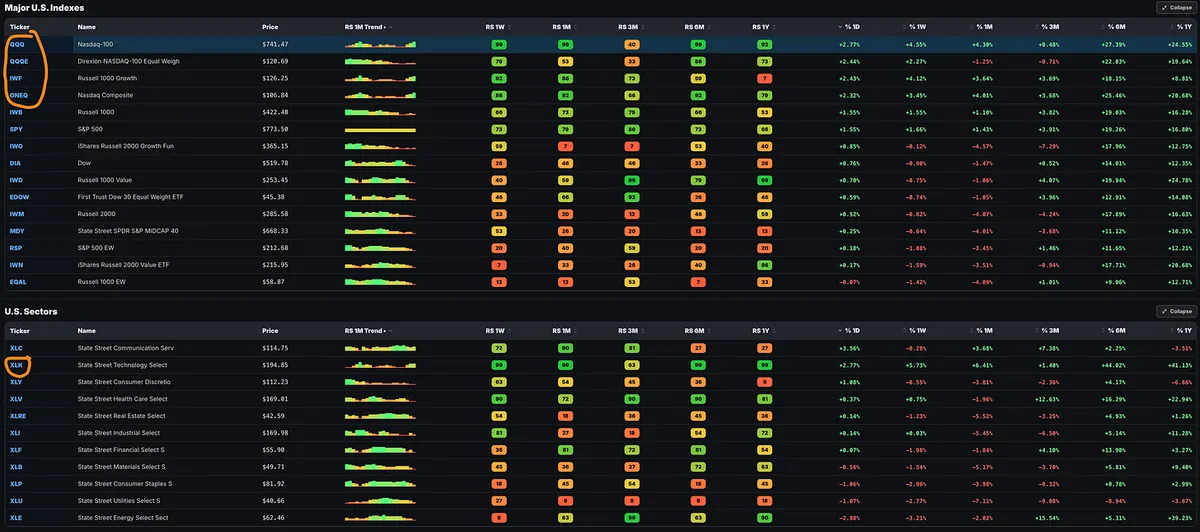
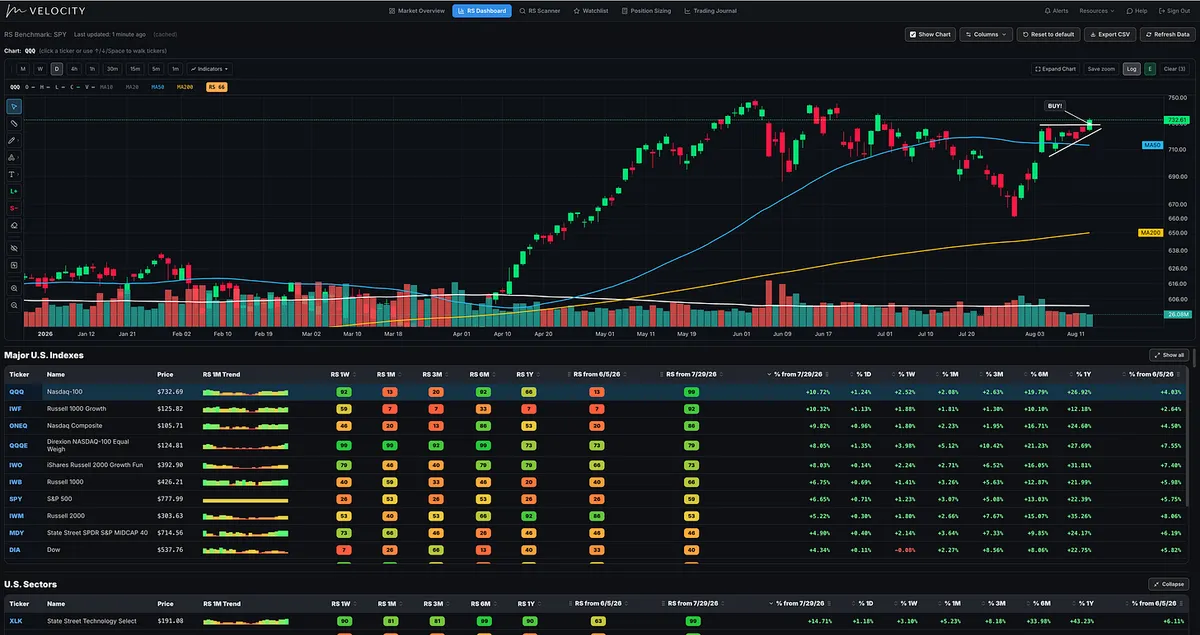
Nice day today, especially in growth and technology. A look at MTS Velocity’s RS Dashboard shows where the strength showed up:

  • Nasdaq-100 $QQQ: +2.77%

  • Nasdaq-100 Equal Weight $QQQE: +2.44%

  • Russell 1000 Growth $IWF: +2.43%

  • Nasdaq Composite ETF $ONEQ: +2.32%

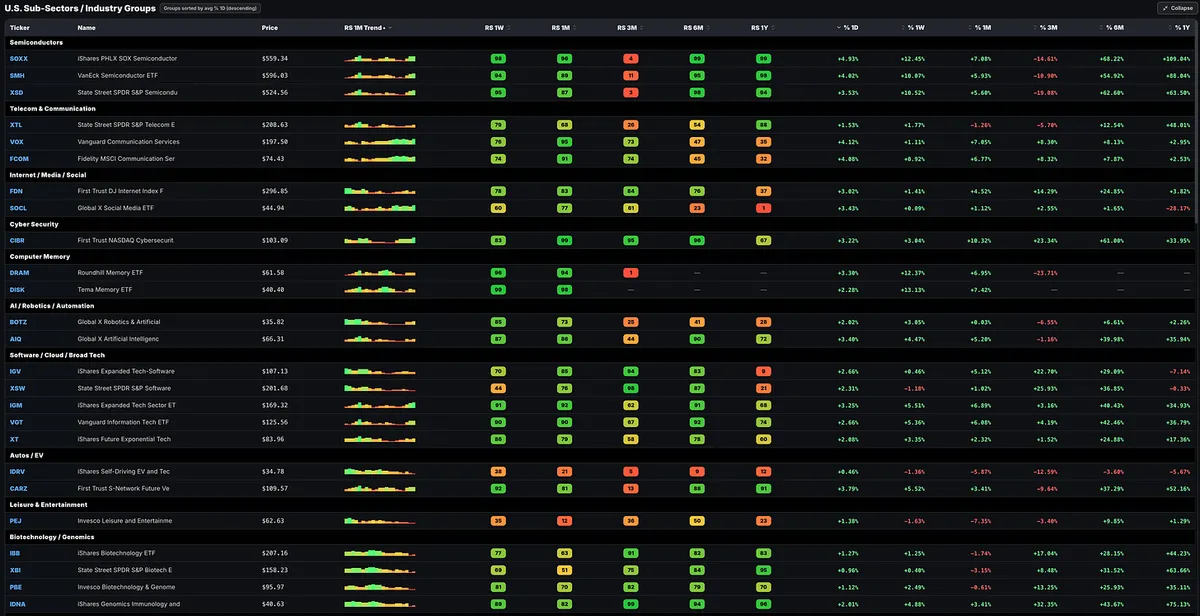
Semiconductors led the industry groups, with $SOXX gaining 4.93% and $SMH 4.02%. Memory, cybersecurity, internet, and software participated too. At the sector level, Communication Services +3.56% and Technology +2.77% led the way.

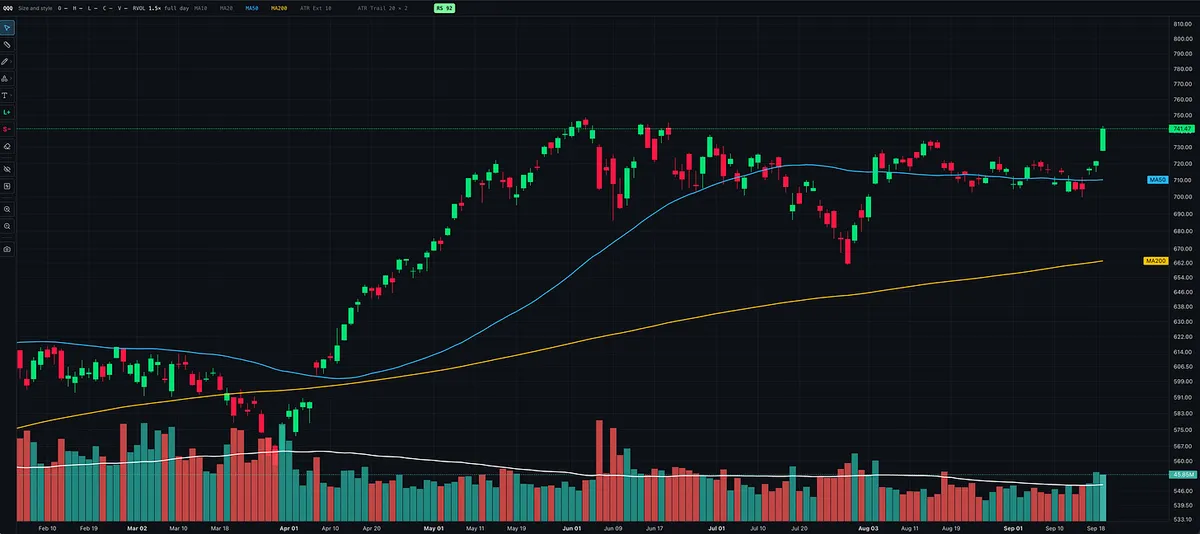
The QQQ chart is looking good: a strong move back toward the top of its multi-month range on above-average volume, putting the prior highs within reach.

Encouraging action in growth. Now I’m watching whether Nasdaq Composite and QQQ can clear those prior highs and whether more individual stocks can complete their bases and break out alongside it.

View on Substack ↗

The Market Is Confirming the Rally

The NASDAQ continues to look strong, but the most important part isn’t simply that QQQ is moving higher.

It’s what’s happening underneath the indexes.

The August 4 follow-through day gave us the important confirmation that the market may have changed character. Since then, the rally has continued to hold up. The Nasdaq 100, Nasdaq Composite, S&P 500, and Russell 2000 are all above their key moving averages, while the Dow is pulling back toward its 10-day and still holding up well.

The market internals are also supporting the move.

Up/down volume is well above 1.0, showing buying volume is outpacing selling volume. The advance/decline ratio is positive. NASDAQ net 52-week highs are positive and expanding. Breadth has improved across the market, and over the past two weeks we’ve consistently seen significantly more stocks advancing 4% or more than declining 4% or more.

I consider those secondary pieces of evidence.

The most important confirmation is coming from the stocks themselves.

Growth stocks are beginning to outperform again. Technology has moved back into the lead, and many of the areas that led earlier in the year are reasserting themselves off the July 29 lows.

Semiconductors. Memory. Cybersecurity. Artificial intelligence. Select software.

And when I go into the stock screener and look at the strongest movers with big earnings and sales growth, I’m finding many of those same areas showing up again.

There was significant damage to growth leadership beginning in early June. So I didn’t want to assume that leadership had returned simply because the indexes bounced.

I wanted the market to prove it.

A follow-through day was one piece of evidence.

Improving price action was another.

Expanding new highs and stronger breadth added confirmation.

But ultimately, the strongest evidence is seeing fundamentally strong growth stocks with high relative strength beginning to break out, move higher, and emerge as leaders again.

That is what we want to see.

Of course, none of this means the market has to continue higher. There are no guarantees.

The goal isn’t to predict what happens next.

The goal is to objectively read what the market is doing right now, follow the strongest stocks and industry groups, and let our own trading results determine how aggressive we should become.

If the leaders keep working, exposure can increase progressively. If breakouts begin failing and our trades stop working, we pull back.

Right now, the weight of the evidence continues to improve.

But as always, the stocks themselves get the final word.

View on Substack ↗

Before You Chase the Next Breakout, Step Back

Like I say every week, before you dive into individual stock screening and selection, step back and understand the market environment and the big picture.

The weekend is the perfect time to do this while the market is closed.

The Nasdaq-100 held the 10-week moving average this week, breadth improved, net new highs stayed positive, and volatility cooled.

But the market has not fully repaired last week’s warning shot. QQQ and SPY still need to reclaim the 10-day and 20-day moving averages, distribution days remain elevated, and short-term leadership is rotating beneath the surface.

Stepping back and reviewing the big picture can give you clarity before stock screening and help you ask the right questions:

  • Which stocks held up best during the pullback?

  • Which names are already moving to new highs while the major indexes are still repairing?

  • Which groups are attracting new demand?

  • Which stocks are continuing to lead?

That is where the next watchlist starts.

Read the Big Picture Market Pulse here:

https://tradingmomentum.substack.com/p/the-nasdaq-held-the-10-week-now-comes

On SubstackBig Picture Market Pulse | June 14, 2026: The Nasdaq Held the 10-Week. Now Comes the Real Test
View on Substack ↗

Calling Yourself an Investor Does Not Remove the Risk

A lot of people believe investing is automatically safer than trading.

That is not necessarily true.

What often happens is someone fails at trading, pushes out their timeframe, stops using stops, and starts calling themselves an investor.

Now instead of taking a small loss, they are “holding for the long term.”

Instead of admitting the trade failed, they convince themselves they own a great company.

Instead of following a process, they hide behind a label.

There is nothing wrong with passive investing.

If someone does not want to trade, I completely understand buying broad market ETFs like SPY or QQQ and passively investing into the major indexes over time.

That is very different from buying individual stocks with no rules.

Individual stocks are not the same as owning the market.

  • A single company can break down.

  • A former leader can lose institutional support.

  • A growth story can slow.

  • A stock can go sideways for years.

  • A stock can decline 50%, 70%, or 90% and never come back.

So if you are going to buy individual stocks, even on a longer timeframe, you still need a system.

  • You need to know when you are wrong.

  • You need rules for cutting losses.

  • You need rules for letting winners run.

You need a process for separating normal volatility from real deterioration.

That is why so many “investors” underperform the market.

They are not really investing with a disciplined strategy.

They are just holding stocks and hoping time fixes bad decisions.

When you read Market Wizards, you see traders and investors with different styles, different timeframes, and different methods.

But almost none of them are simply buying individual stocks, holding them for years, ignoring losses, and operating with no exit plan.

  • They have rules.

  • They manage risk.

  • They protect capital.

They understand that being on a longer timeframe does not eliminate the need for discipline.

Calling yourself an investor does not make individual stock risk disappear.

If you do not have a plan to cut losses and let winners run, you do not have a safer strategy.

You just have a slower-moving mistake.

View on Substack ↗

The Market Told You Before the News Did

Remember when everyone was scared to buy?

  • “The ceasefire didn’t hold.”

  • “AI is going to take everyone’s jobs.”

  • “Inflation is back.”

  • “The market is in a bubble.”

There is always a reason to be scared.

But the job of a trader is not to sit around reacting to every headline.

The job is to follow the price action.

On April 8, the market gave us a signal.

QQQ reclaimed key moving averages, the follow-through day confirmed, and the strongest groups and strongest stocks led the way.

That was the message.

Not the news.

Not the fear.

Not the social media panic.

The market will usually tell you more than any news feed ever will.

Instead of spending hours a day listening to people explain why you should be afraid, imagine spending that time learning how to actually read the market like the great traders did.

The Market Wizards were not great because they predicted every headline.

They were great because they knew how to read price, manage risk, and follow strength.

Stop letting the news think for you.

Learn to read the market.

View on Substack ↗

The $1,000 Car Payment Is Keeping People Poor

A lot of people complain about money while living paycheck to paycheck.

And I’m not talking about people in poverty.

I’m talking about middle-class and upper-middle-class Americans making good incomes while driving $100,000 vehicles, fully loaded Suburbans, Escalades, Mercedes, BMWs, Audis, and other status symbols they can barely justify.

They make money.

Just not enough money to support the lifestyle they are trying to maintain.

That is the trap.

So many people are stuck in the materialistic rat race of keeping up with the Joneses and because so much of society does it, it feels normal.

But normal does not mean sustainable.

How many of those same people have millions saved by their 40s or 50s?

Not many.

The problem is not always income.

The problem is that every time income goes up, liabilities go up with it.

Bigger house.

Bigger car.

Bigger payment.

Bigger lifestyle.

Same financial stress.

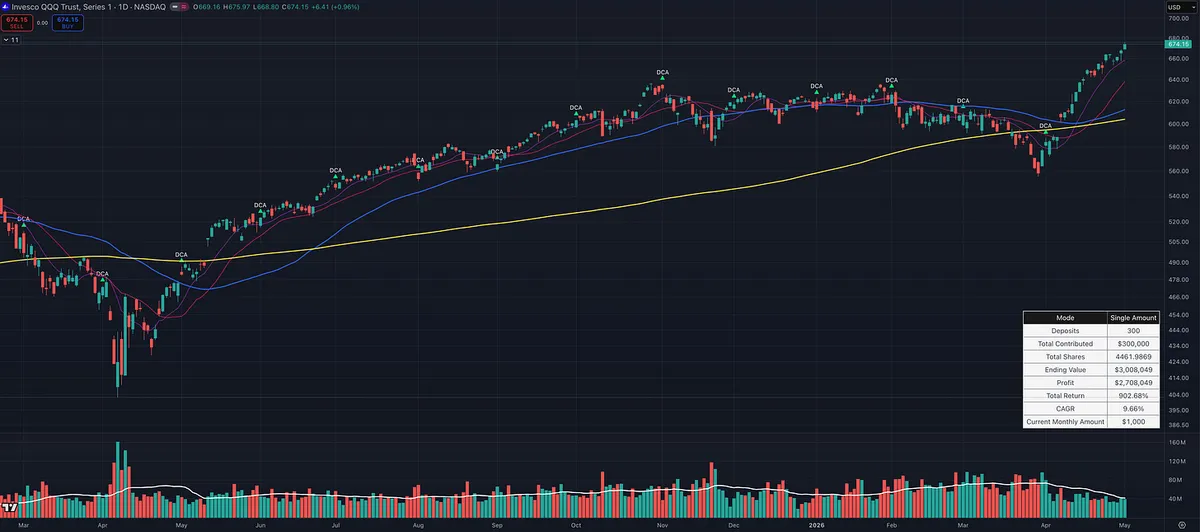
Now look at the chart.

$1,000 invested every month into QQQ over this 25-year period would have required $300,000 in total contributions.

That is not some impossible number.

That is the equivalent of a luxury car payment redirected into ownership instead of consumption.

The result?

Roughly $3 million.

The person who chose the car has a depreciating asset.

The person who chose discipline has a life-changing portfolio.

Past returns do not guarantee future results, and QQQ may not repeat this exact return.

BUT that is not the main point.

The point is that consistently buying productive assets beats consistently financing depreciating assets.

I’m a momentum growth trader. I own businesses that generate income. I do not rely only on passive index investing.

But even I deeply respect the power of compounding like this over time.

Even William O’Neil, long before ETFs became mainstream, understood that mutual funds could be a powerful vehicle for long-term growth when held over years.

Most people do not need a complicated strategy to change their financial future.

They need discipline.

Live on 80% of what you make.

Save and invest 20%. (yes, the 80/20 rule)

At a minimum, pay yourself first with 10% every month.

As you make more, save more.

But most people do the opposite.

They make more and add more liabilities.

That is the never-ending rat race.

View on Substack ↗

The 4 Rules That Separate Average Investors From Superperformers

Most people are taught the wrong things about the stock market.

Turn on financial TV and you will hear the same advice repeated over and over:

You cannot time the market. Diversify widely. Buy and hold. Trade less.

But traders who achieve true superperformance do something very different.

Mark Minervini laid out four key principles that helped him turn a small account into millions and win the U.S. Investing Championship.

Here they are.

1. Yes, You Can Time the Market

Most experts say market timing is impossible.

Yet every great trader times the market.

Not by predicting the future.

By waiting for specific conditions and precise setups.

When the odds are in your favor, you act.

When they are not, you stay out.

Timing is everything because asymmetric opportunities require precision.

2. Overdiversification Kills Performance

Owning too many stocks dilutes your results.

If you want broad diversification, you might as well just buy an index ETF like SPY or QQQ.

Great traders focus on a small number of high-conviction opportunities.

Concentration is what allows a big winner to actually move your portfolio.

3. Turnover Is an Advantage

Wall Street funds often hold positions for long periods.

Not because it is optimal.

Because they have billions to manage.

Individual traders have a massive advantage.

You can enter quickly. You can exit quickly. You can move capital to the best opportunities.

Flexibility is one of your greatest edges.

4. Always Demand Asymmetric Risk vs Reward

Superperformance comes from repeatedly taking trades where the potential reward greatly outweighs the risk.

Small losses are part of the process.

The goal is simple.

Lose small. Win big.

A trading system built around low risk entries and large upside potential allows a few big winners to drive your results.

Most investors try to be right most of the time.

Great traders focus on making sure their winners are much bigger than their losers.

That is how superperformance is built.

View on Substack ↗

This Is Not a “Foot on the Gas” Market

Growth investors are frustrated right now.

And they should be.

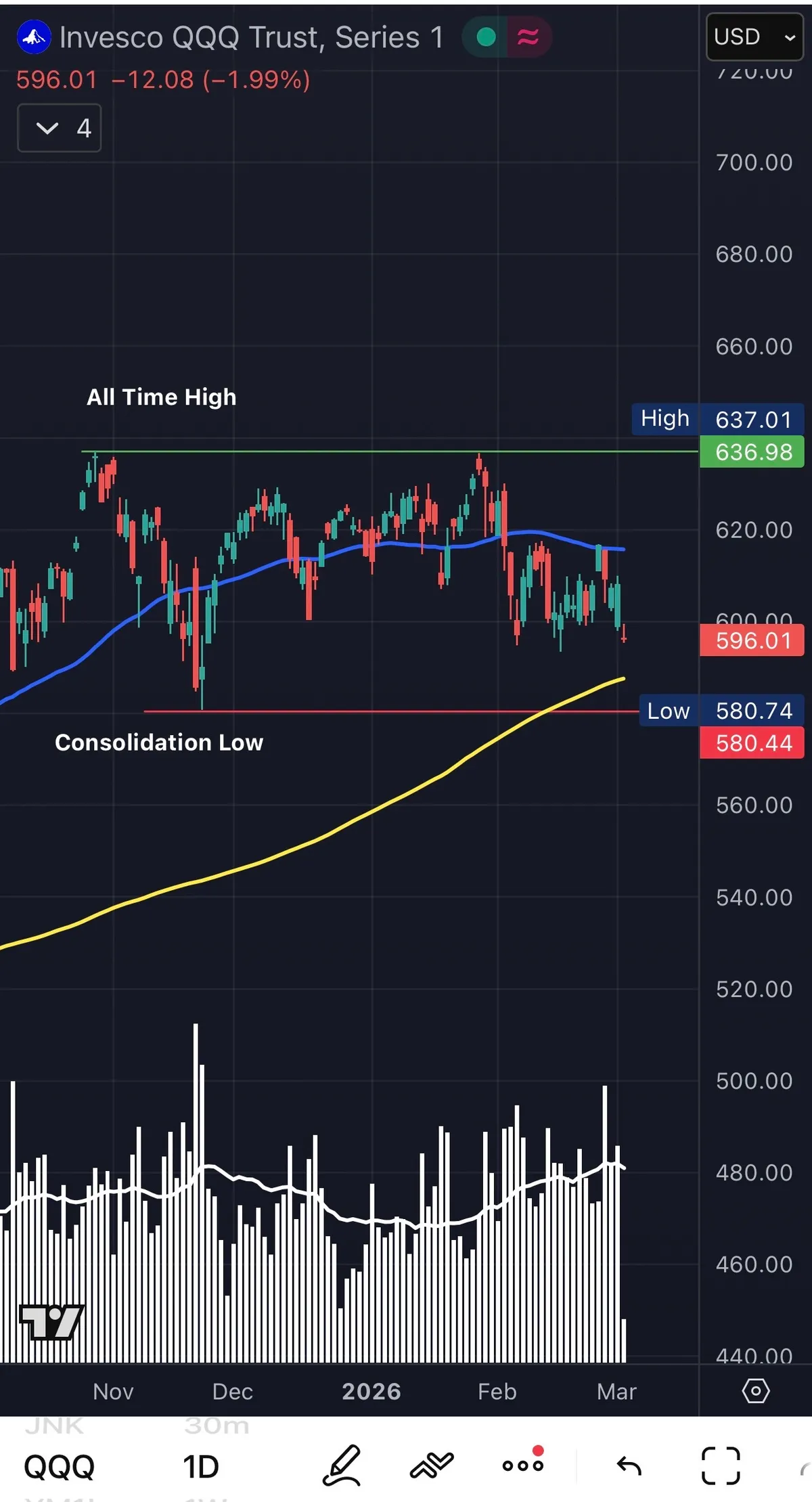
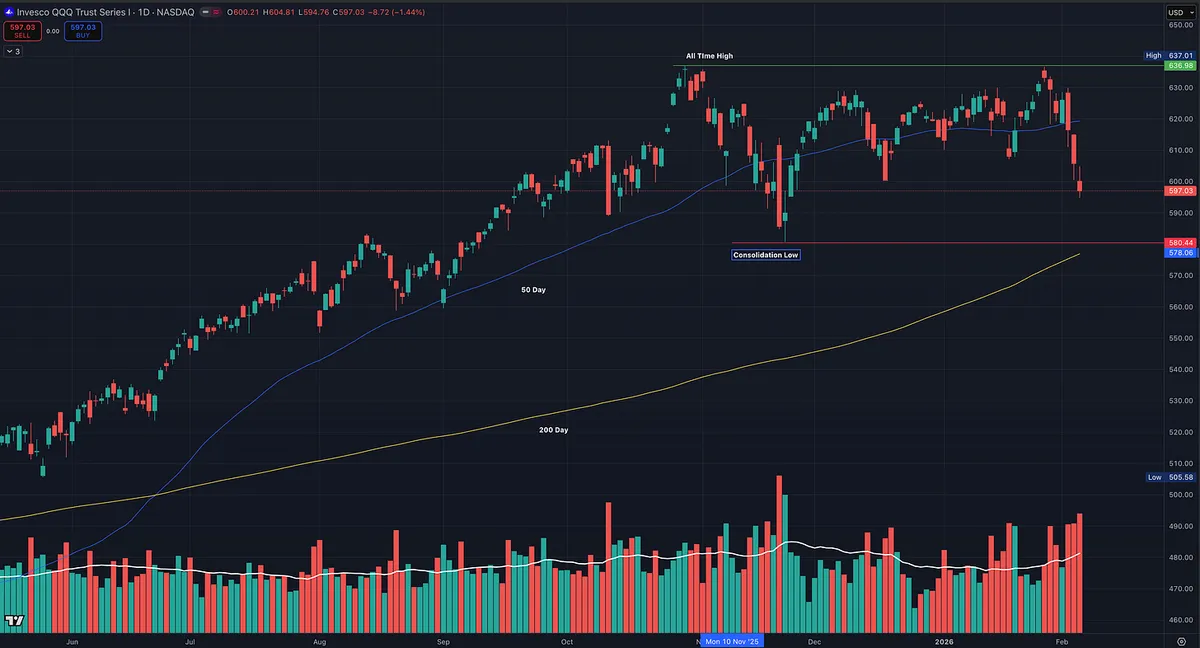
Look at Image 1.

Since the fall of ’25, the QQQ has been in a prolonged consolidation.

Lower highs.

Choppy action.

Failed breakouts.

Distribution weeks mixed with weak rallies.

This is not a clean Stage 2 advance.

This is digestion.

William O’Neil was very clear in his work:

Most investors underperform not because they pick the wrong stocks…

But because they fail to align with the general market.

He studied over 1,000 of the greatest winners and found that 3 out of 4 stocks follow the direction of the general market.

Three out of four.

If the market is chopping, your growth stocks will struggle to gain traction.

And when that happens, professionals do something amateurs refuse to do:

They reduce exposure.

They raise cash.

They protect capital.

O’Neil taught that there are times to be heavily invested… and times to sit tight.

This is a capital preservation environment.

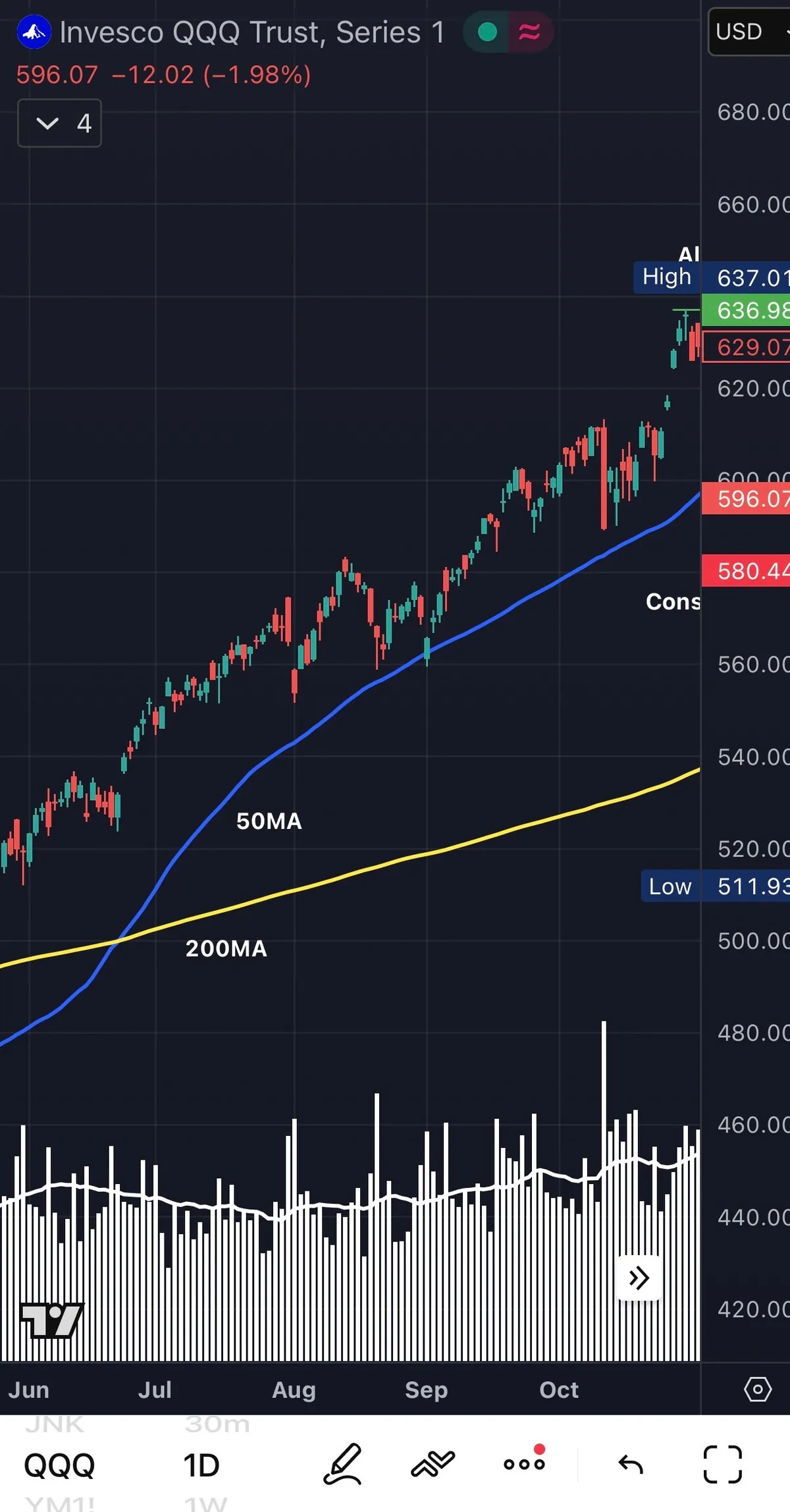
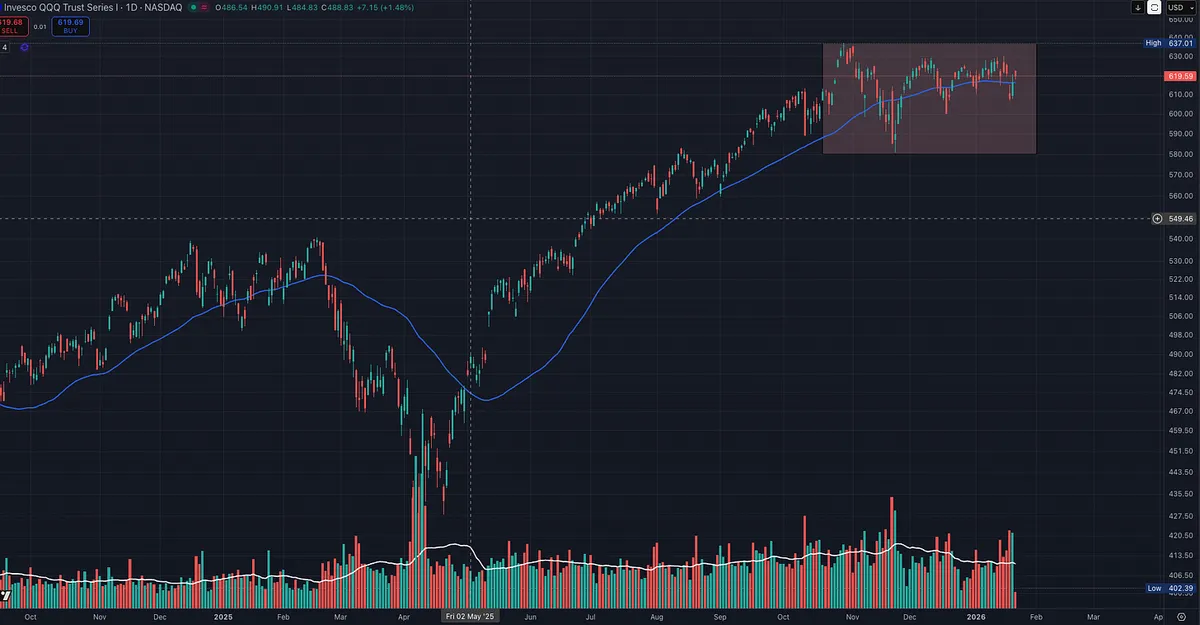
Now look at Image 2.

That is what a Stage 2 uptrend looks like.

Higher highs.

Higher lows.

50 day moving average rising cleanly.

Price respecting support.

Breakouts working.

That is when growth investors thrive.

That is when you increase exposure.

That is when you pyramid strength.

That is when you press your edge.

The mistake most traders make is simple:

They try to force Stage 2 behavior in a Stage 3 consolidation.

The market does not reward urgency.

It rewards alignment.

Professional money managers think in terms of environments, not emotions.

When the wind is at your back, you sail.

When it is not, you lower the sails and preserve the boat.

Right now, the job is not to be heroic.

It is to be disciplined.

And when the next true Stage 2 begins, you will have capital, clarity, and confidence to attack it.

View on Substack ↗

Selective Participation > Constant Trading

Most traders grind all year.

The best returns often come from a few windows.

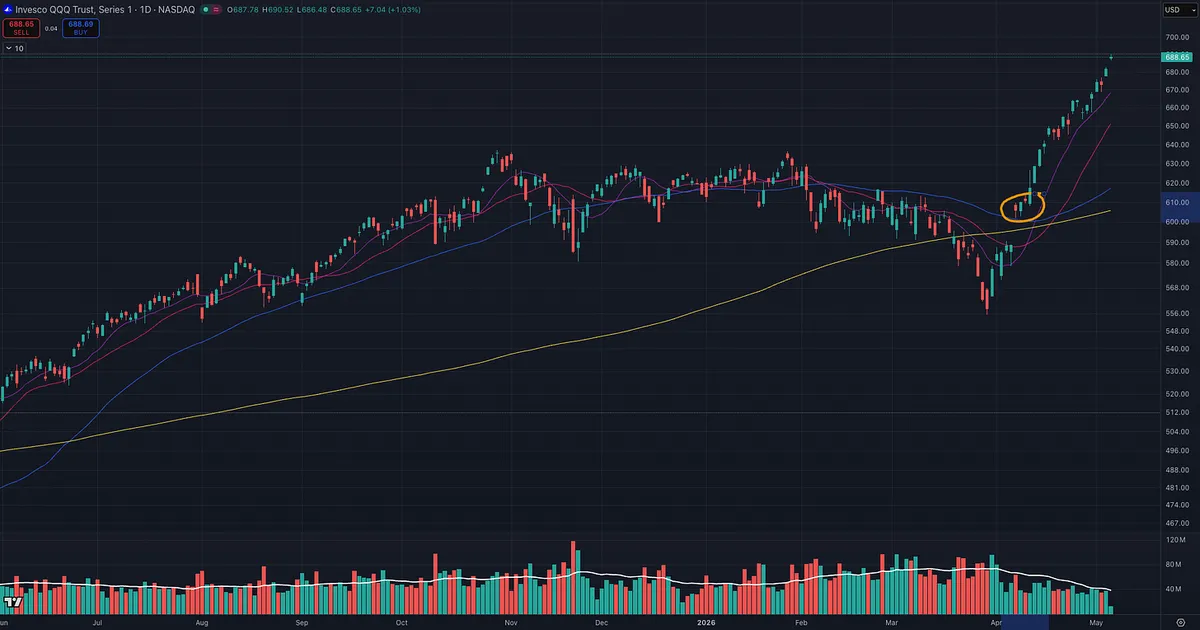
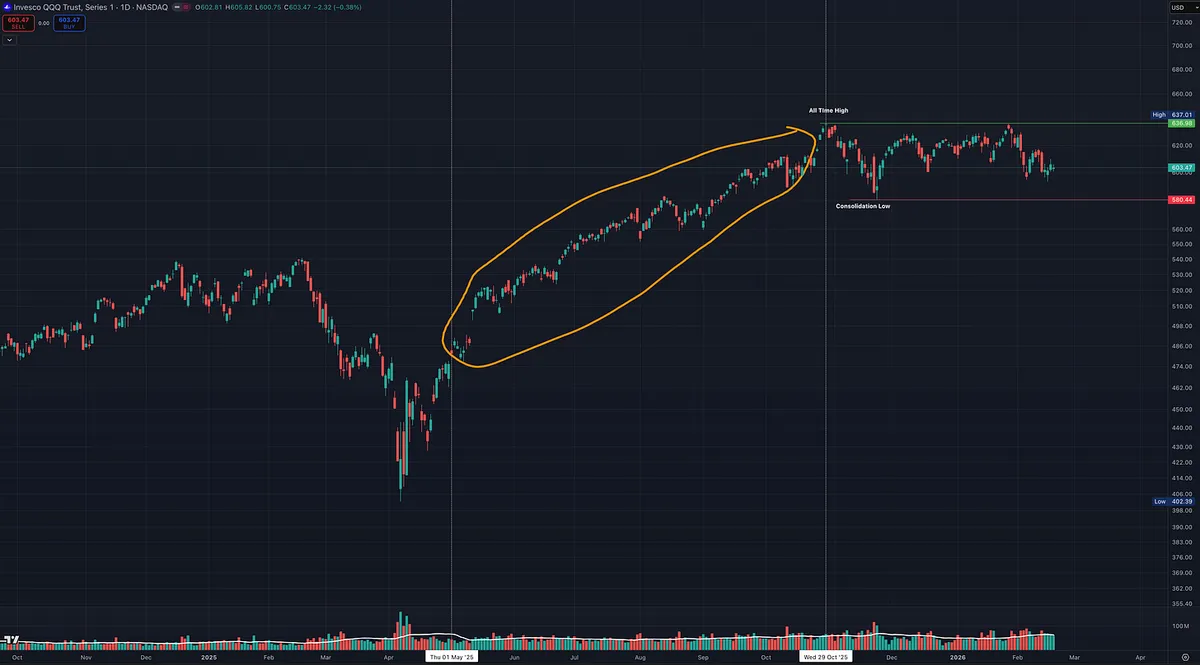
These charts are the proof.

Look at the structure after the April flush:

  • Deep correction

  • Explosive move off the lows

  • Reclaim of key moving averages

  • Higher low

  • Breakout into expansion

  • Sustained trend above rising 20 / 50 / 200

The April flush looked horrible. It created immense fear.

Below the 200-day. Headlines negative. Sentiment weak.

But what actually happened?

QQQ made an explosive move off the lows right at prior major levels. It pulled back, set a higher low, and then accelerated.

That’s character change.

Leaders stopped breaking down. Pullbacks held. Breakouts followed through.

Even entries 15–20% off the lows worked because the environment improved and we got a reset.

From May through September, that move was enough to make the year.

Selective participation means:

Trade less during noise. Save capital for when it’s time to press.

Markets don’t distribute opportunity evenly.

They cluster it.

The edge isn’t trading more.

It’s trading when conditions are exceptional.

Why fight current conditions?

Wait.

We will get another great environment.

View on Substack ↗

Rotation Example

When the market is down, stalling, or consolidating like this, leadership often shifts instead of disappearing.

QQQ looks heavy here and is pulling back within a broader consolidation. In environments like this, money tends to rotate out of higher-beta growth and into more defensive areas.

That’s why consumer staples often show relative strength during periods like this. As risk appetite narrows, capital looks for stability, not necessarily cash.

This is typical rotation, and the relative strength dashboard reflects it, with 3-month RS improving for consumer staples right around the start of the consolidation.

View on Substack ↗

Winning in Trading Demands Everything and Promises Nothing

Most people fail at trading because they start by treating it like a get rich quick game. When they realize it isn’t, they move on. This happens every cycle. A new group comes in, then quietly leaves.

Because of that, the hard truth is that most people would be better off consistently putting money each month into a simple ETF like SPY or QQQ and letting time do the work.

For the few who stay, the path looks very different.

They get their ass kicked.

They hit the books.

They get their ass kicked again.

They study more, test, execute, and eventually find a method with a real edge.

Just as important, they learn when and how to use that edge. That’s what gives them a chance.

Winning long term at trading requires far more than most people realize. It’s total commitment with no guarantees. It reminds me of a video I showed my boys who compete in sports:

“Winning requires all of you, and more, but it promises you nothing.”

-Lewis Caralla

View on Substack ↗

The Most Ignored Letter in CANSLIM and Why It Is Stopping You Out

If you keep getting stopped out, or you feel like there are no good stocks to buy right now, the problem might not be your entries.

It might be the M.

In CANSLIM, the M stands for Market, and it matters more than most traders want to admit.

When the market is chopping sideways, whipping above and below key moving averages, even the best setups struggle. Breakouts fail. Tight stops get hit. Clean trends disappear. This is exactly the type of environment where traders start questioning their strategy, when in reality the issue is conditions, not skill.

Remember this simple truth:

Most stocks move with the market. All ships rise and fall with the tide.

When indexes are stuck in wide, whipsaw consolidations, individual stocks feel that pressure. That is why so many traders experience death by a thousand paper cuts during these phases. You can do everything right and still lose money because the market is not offering follow through.

This is often a signal to slow down, not force trades.

That does not mean do nothing. It means do the right things.

Set alerts instead of chasing. Study past leaders and bases. Review risk management and position sizing. Let patience become a position.

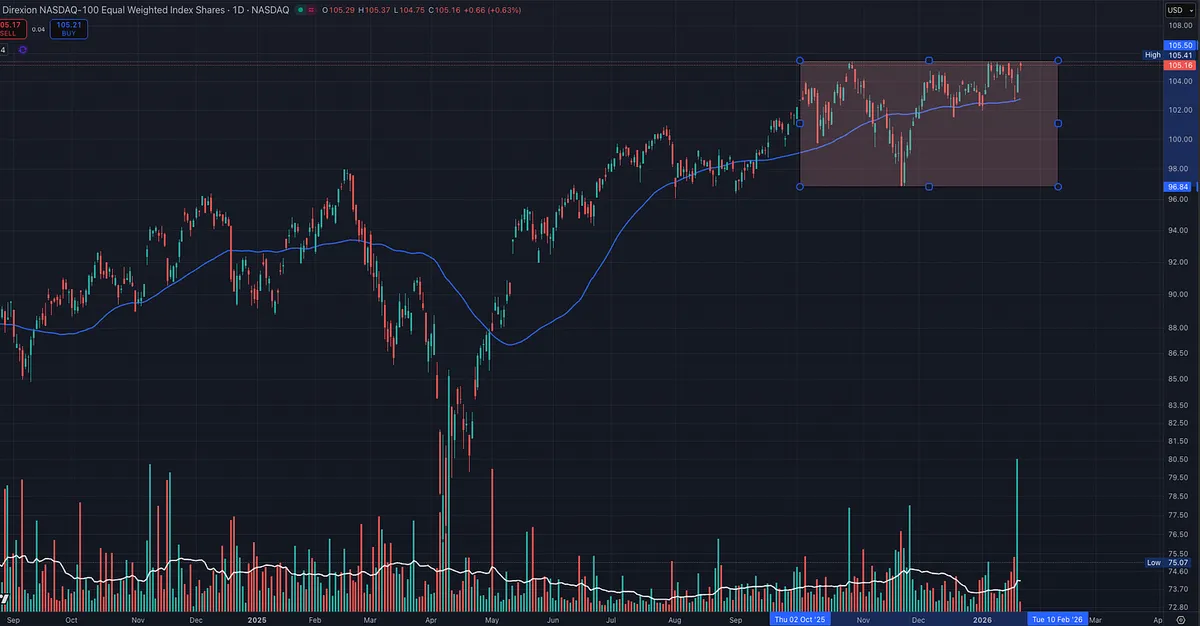
For growth investors especially, many strong CANSLIM names are tightly linked to the Nasdaq and tech leadership. That is why watching QQQ and QQQE matters. QQQ has been locked in a choppy consolidation that has made sustained upside difficult. QQQE, on the other hand, is showing constructive action, compressing with higher lows and pressing toward all time highs.

That divergence is important.

When the market improves, leadership tends to move fast. Being prepared matters more than being early.

If the market is not cooperating, there is no shame in waiting. Some of the best trades come after long periods of frustration, when conditions finally align.

Respect the M. Be patient. And be ready when the tide turns.

View on Substack ↗

When emotions run high, zoom out

I’m a short-term trader.

I run a day trading account. I also run a swing and position trading account built around O’Neil and CANSLIM and I also have an account that does nothing fancy and consistently invests into SPY and QQQ.

You would think someone like me would be the most emotionally affected by short-term market moves.

I’m not.

A 2% down day like today is no big deal. It is not the end of the world, no matter how financial media or influencers try to frame it.

When in doubt, zoom out.

What always surprises me is how emotional people get over pullbacks, corrections, and even full bear markets. Most of these people are not short-term traders. They claim to be long-term investors with long time horizons, yet they panic at exactly the moments that long-term investors should expect.

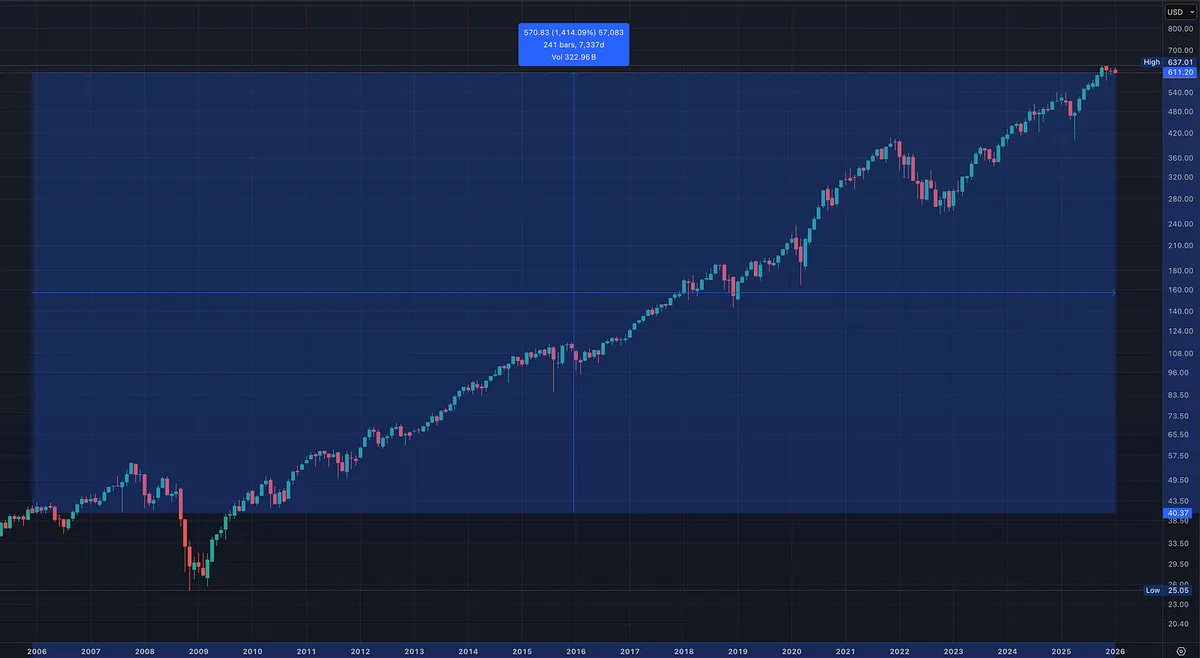
Look at the last 20 years.

  • Tariff scares.

  • COVID.

  • The 2022 bear market.

  • 2018.

  • 2015.

  • 2011.

  • The Great Financial Crisis.

Even with all of that, the Nasdaq-100 is up over 1400% in the last two decades.

That perspective changes everything.

If normal volatility makes you emotional, that is feedback. It usually means one of two things. You are either gambling, struggle emotionally, or you do not truly understand markets or risk management.

Long-term investing is boring. It requires patience, discipline, and the ability to ignore noise.

The market does not reward emotional reactions. It rewards time, consistency, and perspective.

Zoom out.

View on Substack ↗

Most People Are On the Slow Path and Don’t Know It

Fun fact: About 70 percent of people click their 401k default options, and another 30 percent try to manage things themselves. But here is the shocking part. Ninety five percent of professional fund managers cannot beat SPY or QQQ long term, and 70 to 90 percent of individual brokerage accounts fail to make money at all.

If you simply avoid the default and choose QQQ for long term growth, and move to SPY as you get closer to retirement, you instantly put yourself in the top tier of all retirement accounts. No trading. No stock picking. No timing. Just choosing a better index.

I just published a full breakdown showing why even William O’Neil told most people to keep it simple, along with two charts that make this reality impossible to ignore. One shows QQQ vs a typical 401k fund since 2006. The other shows what 1,000 dollars per month would have grown into with each one. The difference is life changing.

Read the full post here: https://tradingmomentum.substack.com/p/even-william-oneil-knew-most-people

ArticleEven William O'Neil Knew Most People Should Keep It Simple
View on Substack ↗

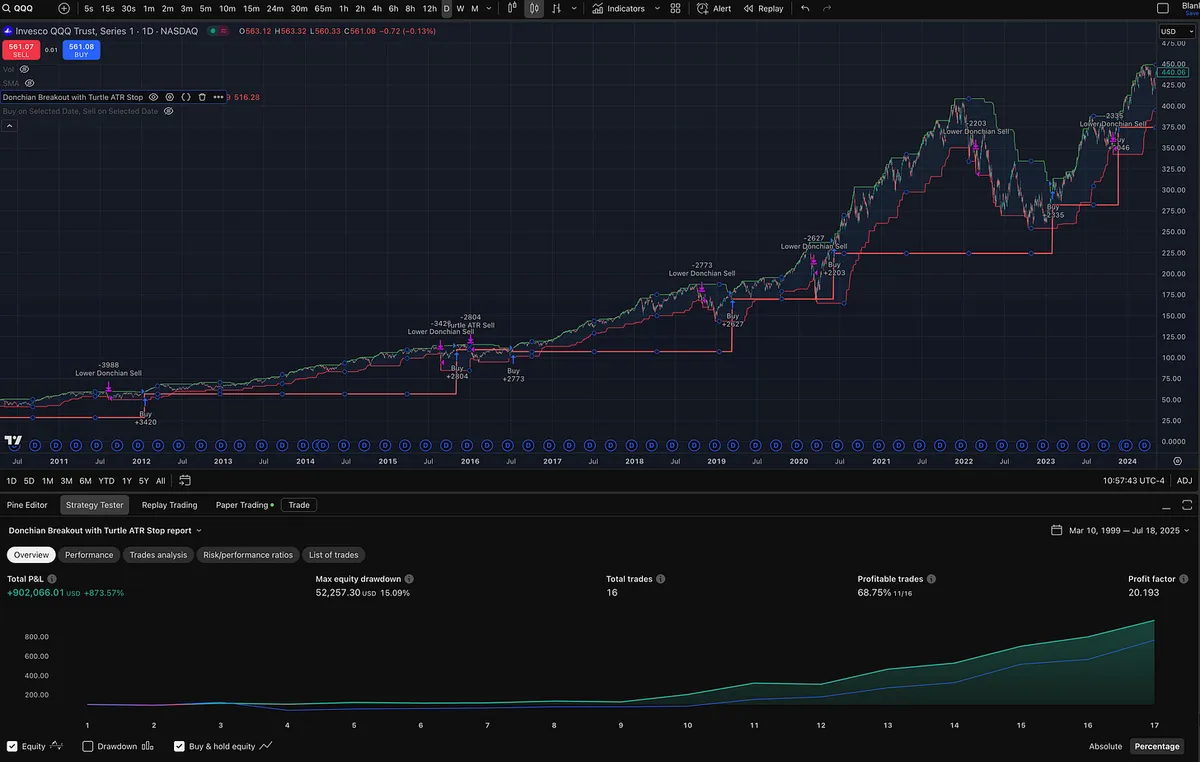
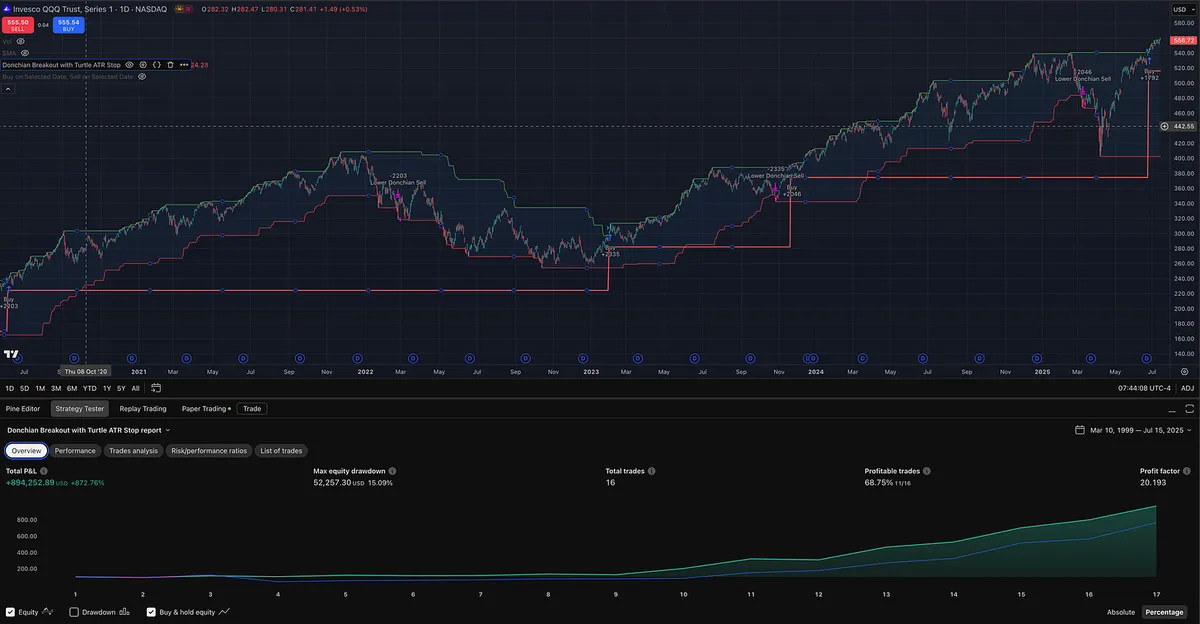
Most X macro chatter is mental masturbation—lots of talk, little action, few excellent results. Most would be better off doing something simple like the Donchian Breakout + ATR Stop Strategy with QQQ: +870% since 1999, -15% drawdown vs. buy-and-hold’s -55%. Simple and works.

View on Substack ↗

📈 Would You Be Happy With These Results? Imagine following a simple rules-based strategy to trade the Nasdaq-100...

✅ +870% total return ✅ 15% max drawdown ✅ Profit factor: 20.19 ✅ 68.75% win rate ✅ Only 16 trades in 26 years

This is the performance of a Donchian Breakout + Turtle ATR Stop strategy trading $QQQ from 1999 to 2025. It also performs well going all the way back to 1985.

No prediction. No guessing. Just trend-following rules that ride big winners and cut losses quickly.

💡Would you trade a system like this? Or stick to buy & hold?

👇 Let me know in the comments.