
Trading articles/Even William O'Neil Knew Most People Should Keep It Simple
Nov 16, 2025 · Momentum Trading Strategy
Even William O'Neil Knew Most People Should Keep It Simple
Retirement saving advice from a growth trader that may shock you. It is not buying and selling individual growth stocks.
Originally published on Substack.
Do you want a simple retirement system that beats the majority of 401ks and professional fund managers?
Fun fact: About 70 percent of people just click their 401(k) default options, and roughly 30 percent try to manage things themselves. In reality, 95 percent of professional fund managers cannot beat SPY or QQQ in the long run, and 70 to 90 percent of individual brokerage accounts fail to make money. If you want to be in the top 99 percent of retirement investors, skip the defaults, put your money in QQQ if you have a longer horizon, and shift to SPY as you approach retirement.
When you stick with the default 401(k) options, you are often placing your money in managed funds that have higher fees and more complexity than simply buying a broad index fund like SPY or QQQ. These managed funds might aim to outperform, but historically, 95 percent of professional fund managers do not consistently beat those simple index benchmarks over the long term.
For those who try to manage their 401(k)s themselves, the challenge is even greater. While it is possible to pick individual stocks and outperform the market, it usually requires the kind of time, discipline, and expertise that only a tiny percentage of full-time professionals and part time traders can commit to. For the vast majority of people, a simpler index approach is the more realistic and effective route.
So why do fund managers still pick more complex investments instead of simply using SPY or QQQ? It is likely that many fund managers understand how difficult it is to beat broad indexes, but the structure of the financial industry often incentivizes them to choose investments that come with higher fees or active management. They may have business reasons, such as fee structures or the perceived need to show that they are doing something, that shape these decisions. We cannot know every individual motivation, but industry incentives can absolutely play a role.
This is why a straightforward approach, like choosing QQQ or SPY, is often the most effective route for most individuals. And it might surprise people to know that even William ONeil, one of the greatest growth stock traders, did not recommend that the average person pick individual stocks for retirement.
When he wrote How to Make Money in Stocks, ETFs like SPY and QQQ did not exist yet. The best diversified options available were mutual funds, so that is what he recommended to most people. He understood that only a small percentage of investors have the discipline and skill required to beat the market.
If O’Neil were giving that advice today, it would almost certainly translate into something simple like SPY or QQQ for long term retirement accounts. The reasoning has not changed. Only the tools have.
Bottom line: even one of the greatest stock traders in history understood that most people should not be picking individual stocks. Broad index funds remain the most reliable, realistic path for almost everyone.
And for those who truly want to learn the craft of growth stock trading, remember that many great traders started with small accounts and grew them to significant levels. If you are dedicated and willing to study, practice, and follow rules, you can still pursue that path. A smart approach is to use the majority of your savings for the simple index strategy, and reserve a small percentage for learning and improving your growth trading skills over time.
What This Really Means for Your Money
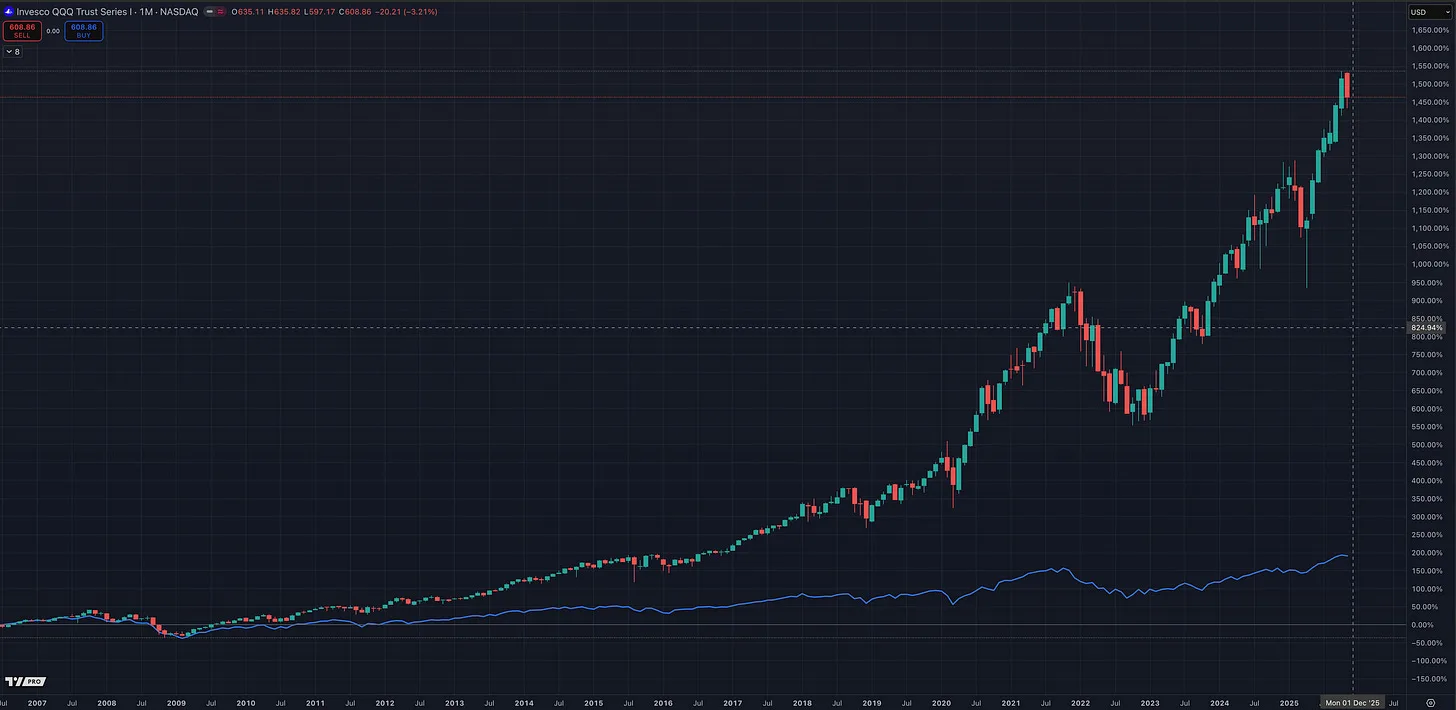
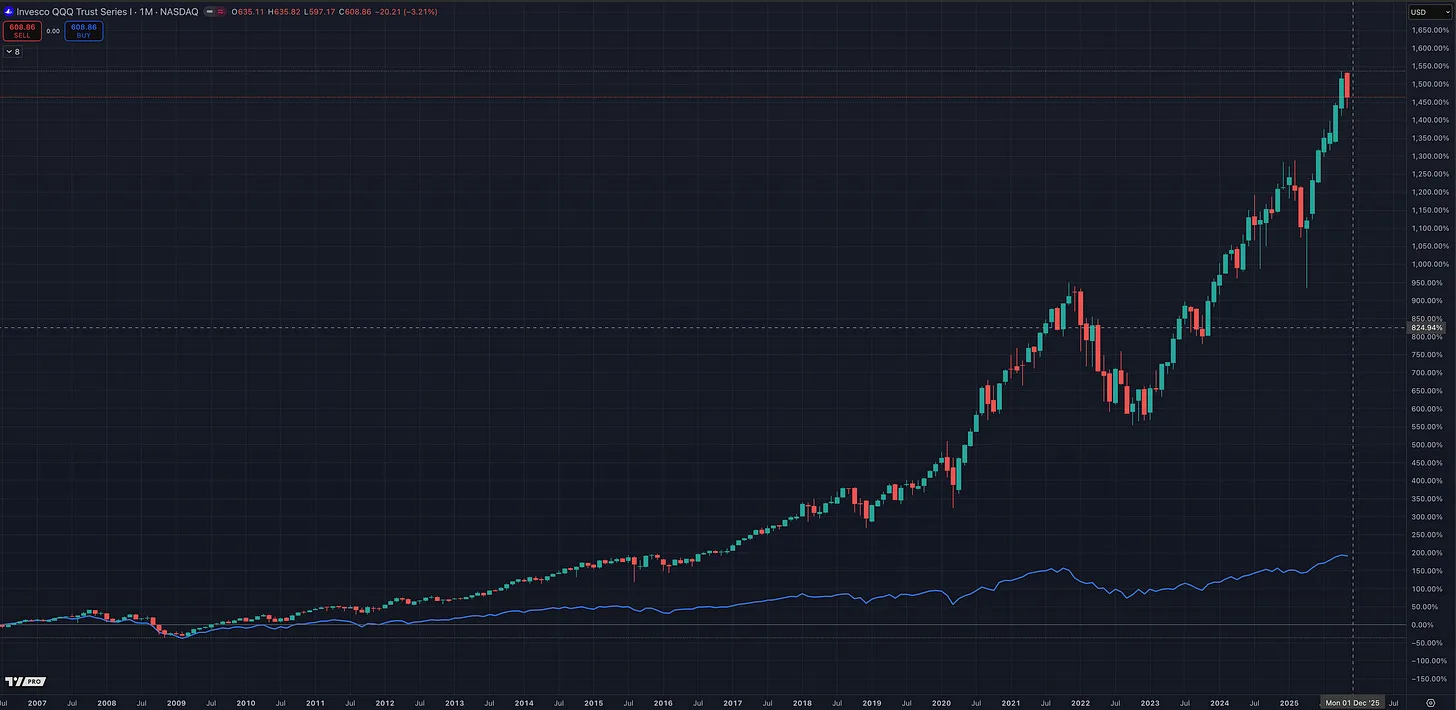
Chart 1: QQQ vs a typical 401(k) default fund since June 2006
QQQ gained about 1447 percent since June 2006. A typical 401(k) target date fund gained about 190 percent over the same period. This is the difference between compounding at roughly 15 percent per year and 5.6 percent per year. Same starting date, completely different outcomes.
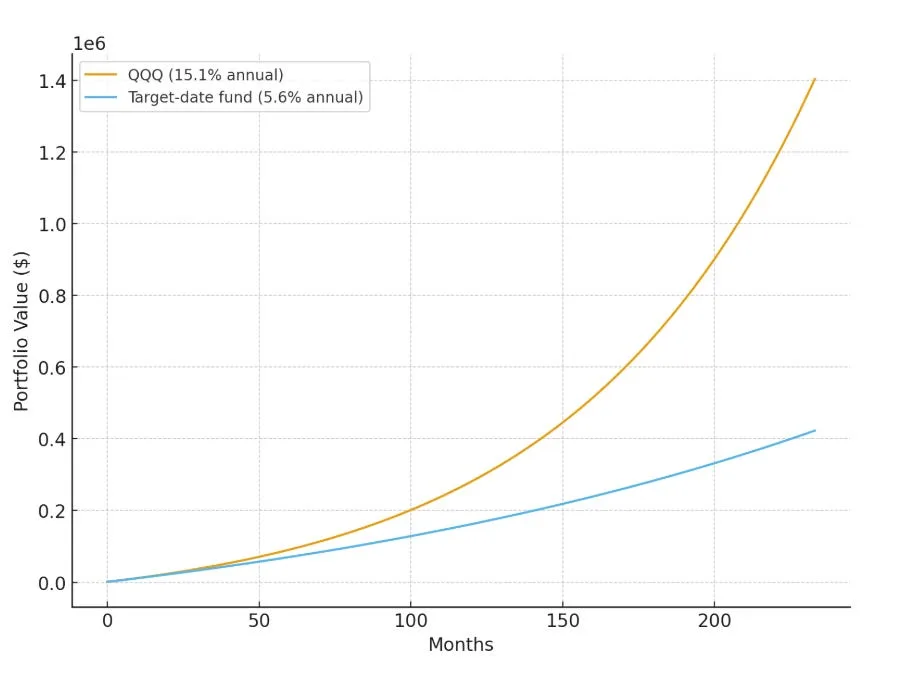
Chart 2: What $1,000 per month looks like in each investment
If you added 1,000 dollars per month since June 2006, QQQ would have grown to about 1.41 million dollars. The typical 401(k) target date path would be worth about 425,000 dollars. Identical contributions. Identical timeline. The only difference is the index you choose.
Why this hits so hard
Because this is not “trading.”
It is not “timing.”
It is not “stock picking.”
It is simply:
Choosing QQQ over the average 401(k) default fund.
The images show the truth better than any argument:
- one path is wealth creation
- one path is wealth stagnation
- most people are unknowingly on the slow path
More in Other Articles
All Other Articles articles →
Sep 6, 2026 · Other Articles
Growth Stock and Momentum Trading: What It Is and What It Isn’t
What 100 Years of Stock Charts Reveal About Growth-Momentum Trading, and Where Personal Style Ends and a Different Strategy Begins
- how to make money in stocks
- Momentum Trading
- CANSLIM
- position trading
- Stan Weinstein
- David Ryan
- Trend Trading
- Kristjan Kullamägi

Jun 23, 2026 · Other Articles
If I Had to Bet on a Group of Traders, I’d Bet on These Ones
The real edge after you learn the rules is becoming the kind of person who can actually follow them.
- Investing
- Trading

Jun 4, 2026 · Other Articles
Why It Hurts More to Spend Money You Earn Yourself
I thought making more money would make spending easier. Instead, trading and building businesses made every dollar feel harder to let go.
- Investing
- CANSLIM
- Trading
- Business
- Stock Market
- growth stock investing