Momentum Trading Strategy

Notes

Short lessons on momentum trading, every day.

Every note from Substack, in one place: risk, setups, leading stocks, market conditions and the mindset behind them. Search them, browse by topic, or filter by stock.

Showing 1–11 of 11 notes

$DELL ×
View on Substack ↗

DELL Shook Everyone Out. Now It’s Breaking Out.

I think DELL gets the award for shaking the most people out this week.

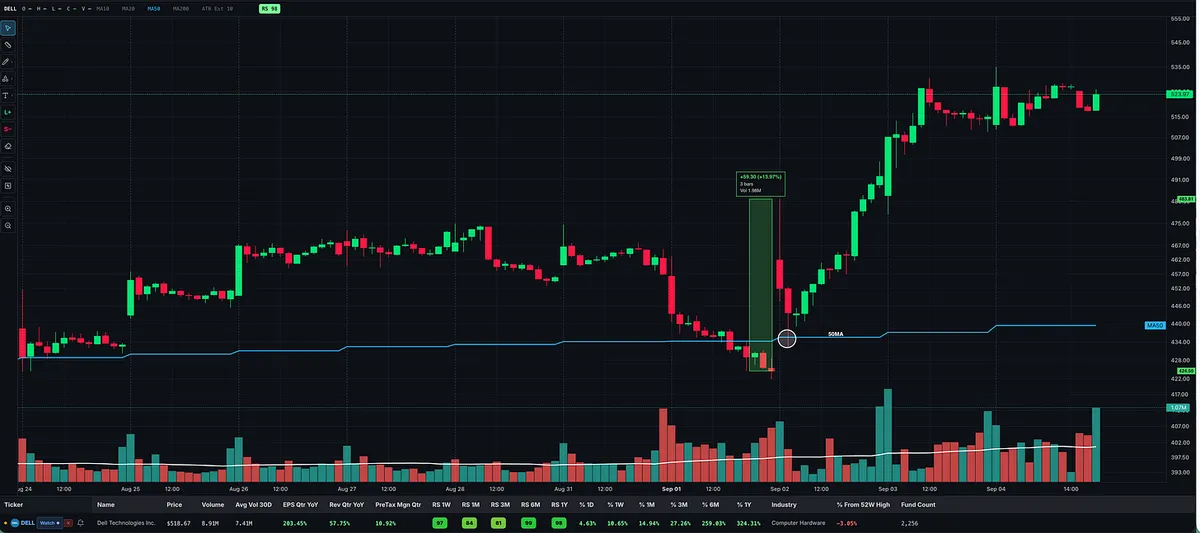
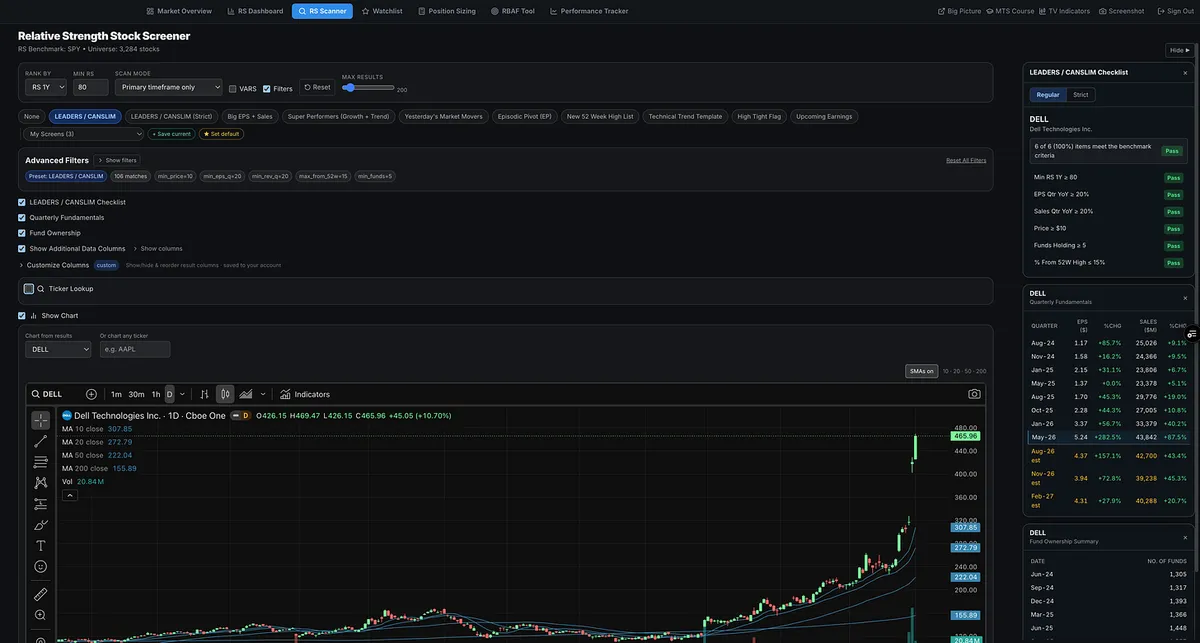
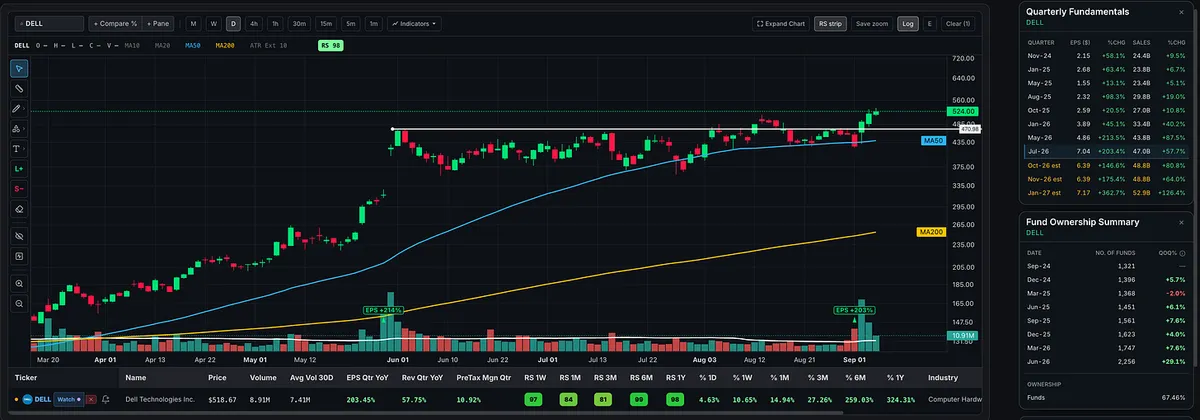
The 30-minute chart tells the story. DELL gapped up after earnings, completely reversed, gave up the entire gap, and briefly undercut its 50-day moving average. Anyone who chased the initial gap or placed an obvious stop near the 50-day probably got taken out.

Then DELL snapped back, reclaimed the 50-day, and rallied nearly $100 from Tuesday’s low.

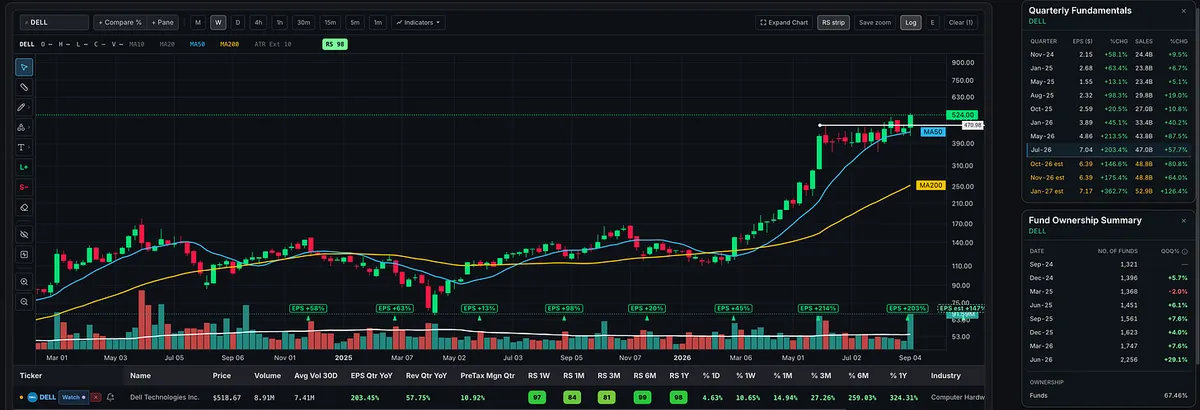
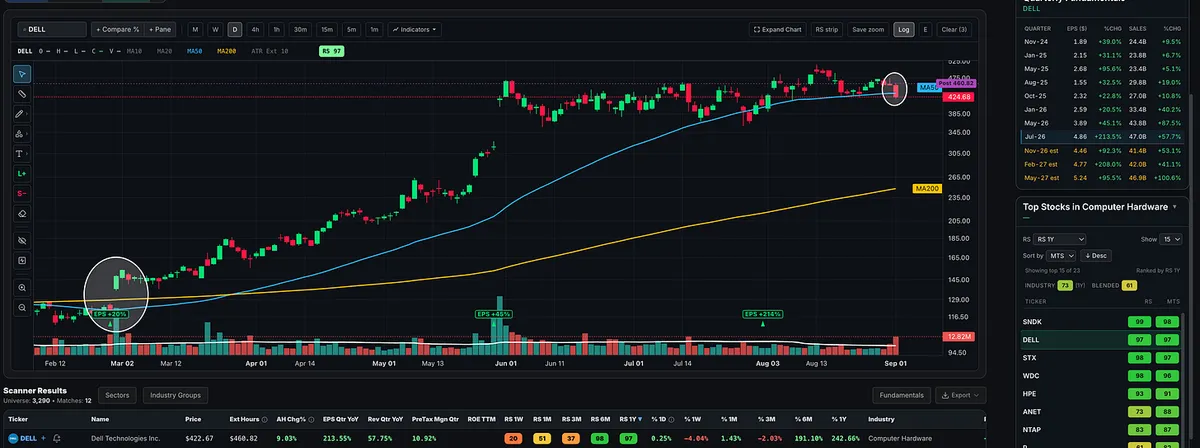
The daily chart shows how violent the shakeout was. On the weekly chart, it looks like nothing more than a brief pause within the larger uptrend.

The breakout is still developing, but this is a great example of a strong stock doing everything possible to shake people out before starting its next move.

Good job, DELL. 😂
View on Substack ↗

Why I Wouldn’t Buy DELL Right Before Earnings

Someone asked me why I wouldn’t buy DELL before earnings, especially when I’ve held other stocks through earnings.

The difference is context.

With LITE, I was already in the stock and had roughly a 25% cushion going into earnings. In situations like that, I may sell some before the report and hold the rest through earnings.

That is completely different from initiating a brand-new position right before earnings.

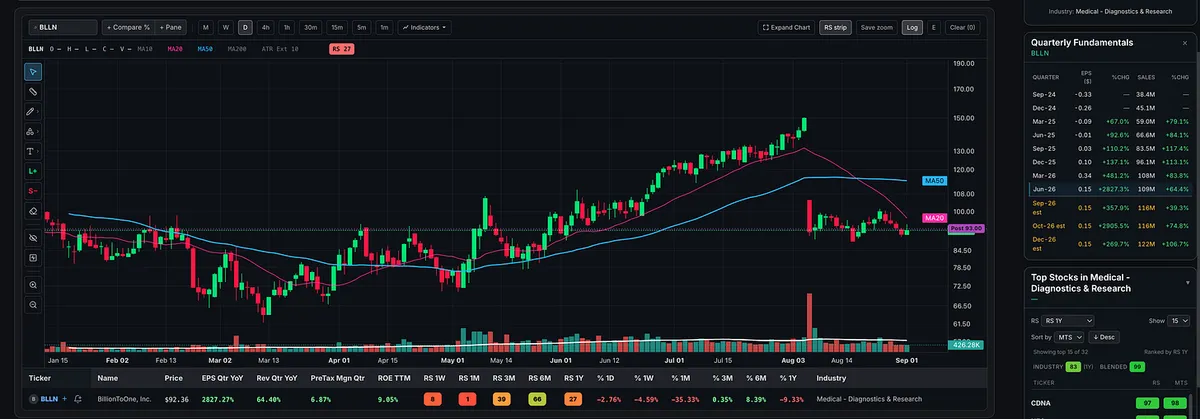
If you want to hold stocks long enough to capture really big moves, eventually you have to get comfortable sitting through some earnings reports. There is no way around that. Even with a large profit cushion, you can still get hit with an ugly reaction, like we saw with BLLN.

But I will NOT buy a stock immediately before earnings just to gamble on the report.

And with DELL specifically, the decision was even easier.

The stock looked like it wanted to go higher, but showed very little follow-through. Then it had a bad day today, falling more than 6% and closing below the 50-day moving average.

On top of that, the overall market hasn’t been acting well.

So now you have:

  • Poor follow-through after a failed breakout attempt

  • A greater than 6% down day

  • A close below the 50-day moving average

  • A less-than-ideal overall market

  • Earnings immediately ahead

Why would I initiate a brand-new position and take on earnings risk with all of that working against me?

For me, there is a big difference between holding earnings with a 20% to 30% profit cushion in an existing position and buying a stock immediately before earnings with no cushion at all.

Those are two completely different risk situations.

Now, with DELL up roughly 10% after hours, I’ll watch how the price continues to act and see whether it gives me a setup. It did something similar in early March after the big gap up in late February.

I don’t need to predict the earnings reaction or gamble on the report. I can wait for the report, see how the market reacts, and then look for a proper setup.

View on Substack ↗

HPE Is Showing the Kind of Strength I Want to See

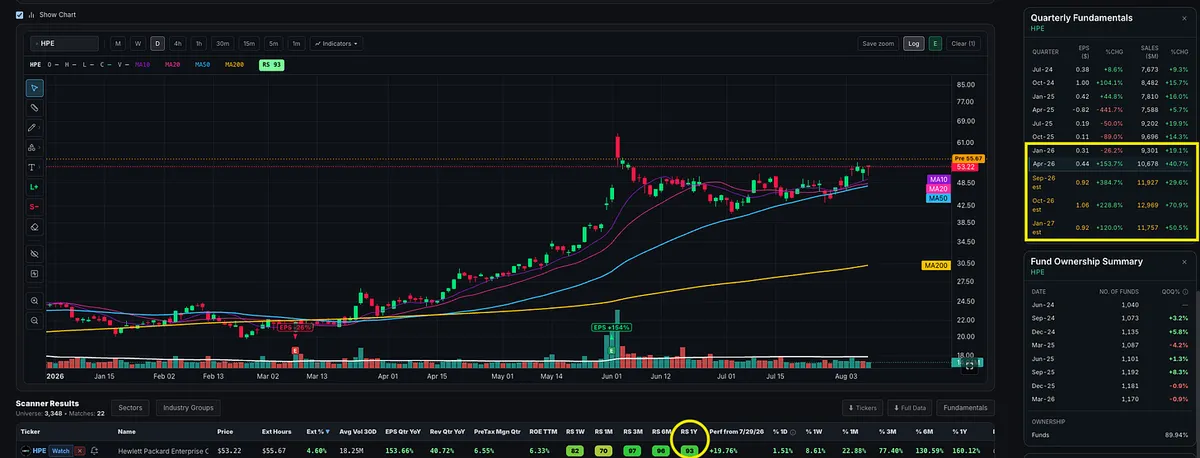
Besides DELL, HPE is another computer hardware name that has held up better than most of the group. It’s up about 4% premarket this morning and has a 93 RS Rating, along with a big improvement in both earnings and sales growth. Definitely one I’m keeping an eye on for continued relative strength.

View on Substack ↗

Let’s Go, Dell.

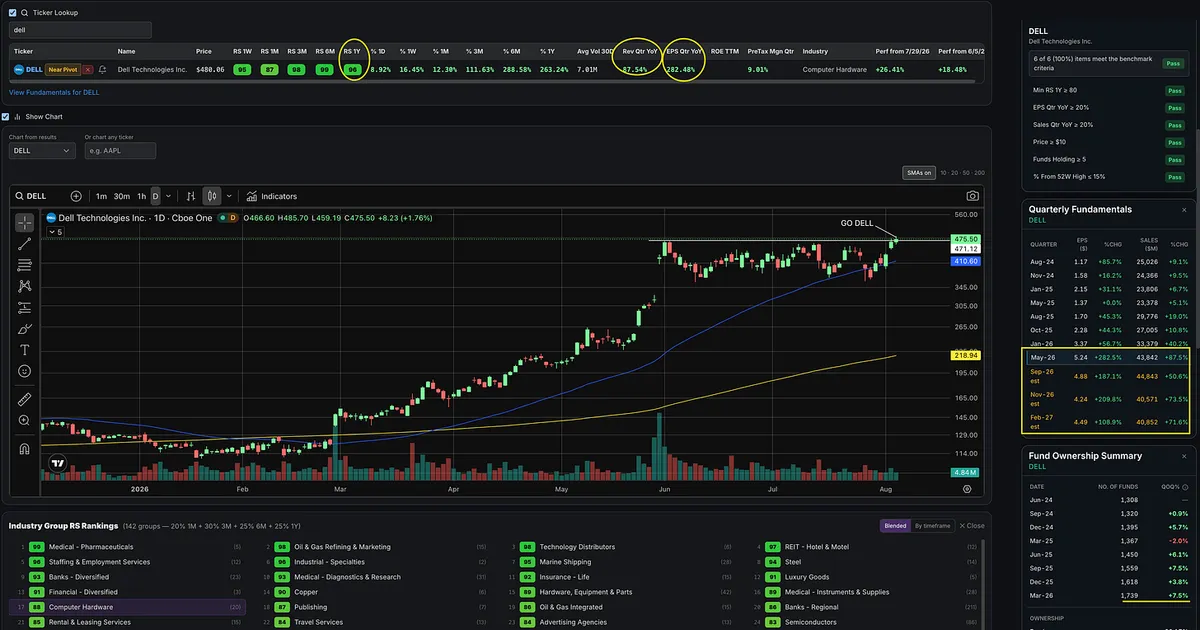
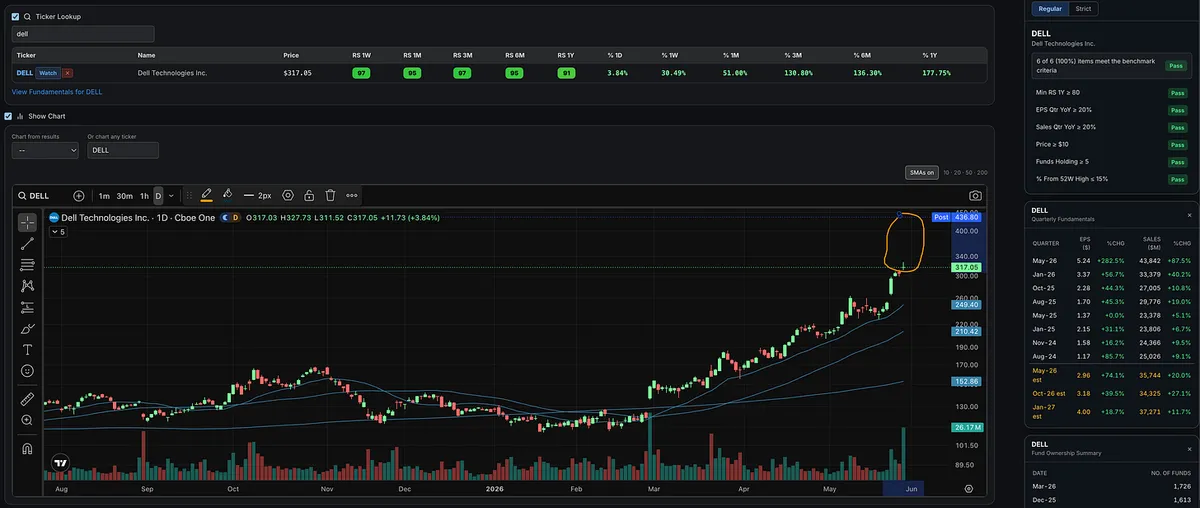
DELL is exactly the type of growth stock I want to trade.

Strong earnings. Strong sales. Strong relative strength.

DELL also showed clear relative strength during the recent market weakness, holding up far better than many of the stocks that led the prior advance.

View on Substack ↗

The Episodic Pivot (EP) Setup Most Traders Miss

I get a lot of questions about episodic pivots.

  • What are they?

  • How do you find them?

  • And more importantly, how do you make sure you do not forget about them?

An episodic pivot is a powerful price and volume move caused by a meaningful catalyst, usually earnings, guidance, FDA news, contract news, or some other event that forces the market to reprice the stock.

But here is what most traders miss.

The best setup does not always happen on the day of the big move.

Sometimes the stock gaps up, runs hard, pulls back, volume dries up, tightens, and then gives a much cleaner entry days, weeks, or even months later.

That is why tracking these names matters.

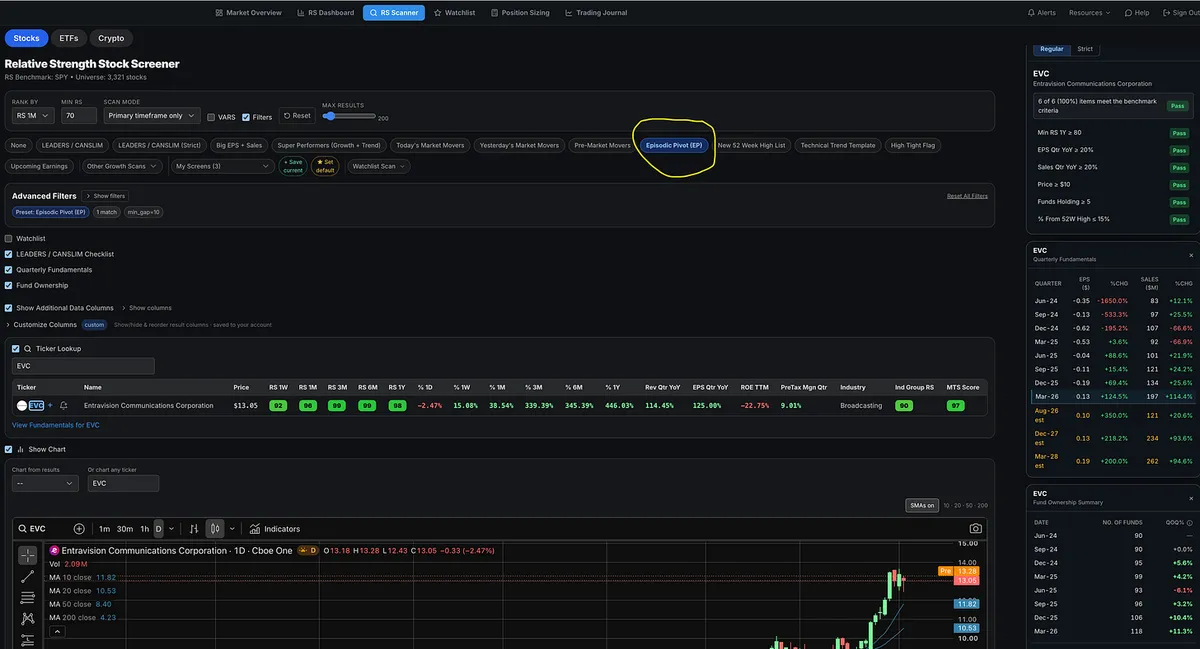
Inside the Momentum Trading Strategy software, we have an episodic pivot preset screen to help find these stocks.

But finding them is only step one.

The real edge is creating an Episodic Pivot watchlist inside the Relative Strength Stock Screener.

Under Manage Sub-Categories, create one called EPs.

Now you have your episodic pivots organized in one place.

Add the names when they show up.

Review them daily or weekly.

Do not force the trade.

Just wait.

Some will fail.

Some will go nowhere.

But some will tighten up and set up again.

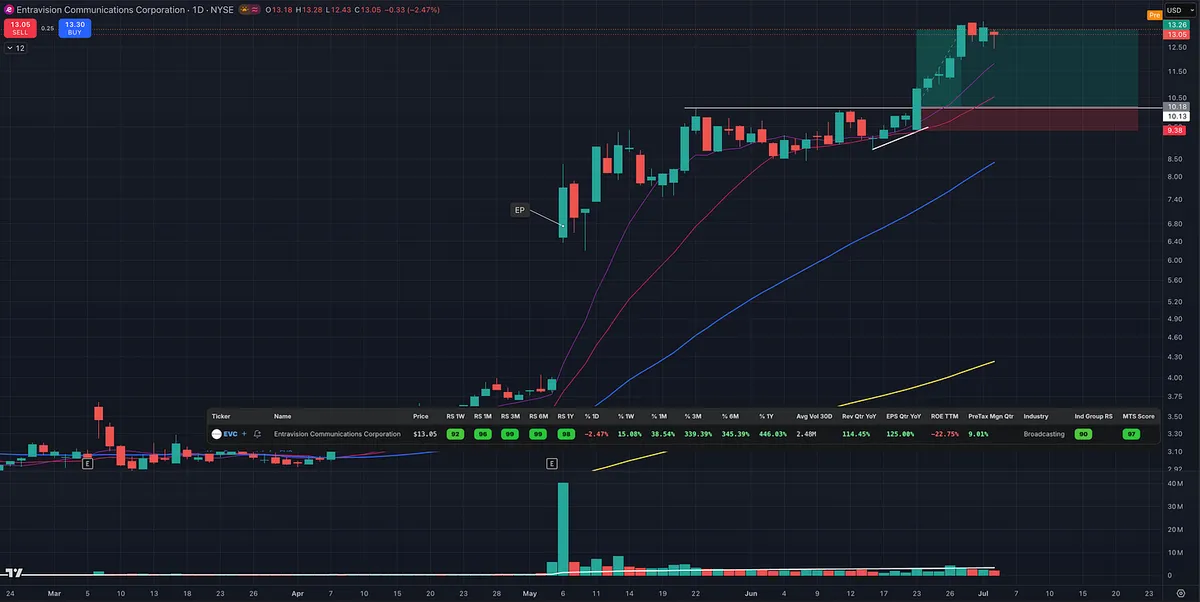
EVC is a good example.

The earnings catalyst launched the stock higher, but the cleaner opportunity came later after it consolidated, tightened up, and broke out again.

DELL was another great example.

The episodic pivot should gets your attention.

The watchlist keeps it on your radar.

The setup tells you when to act.

View on Substack ↗

Stop Waiting for Someone to Hand You the Next Big Winner

If you are struggling to find the big winning stocks, you do not need to wait around for me or anyone else to tell you the names.

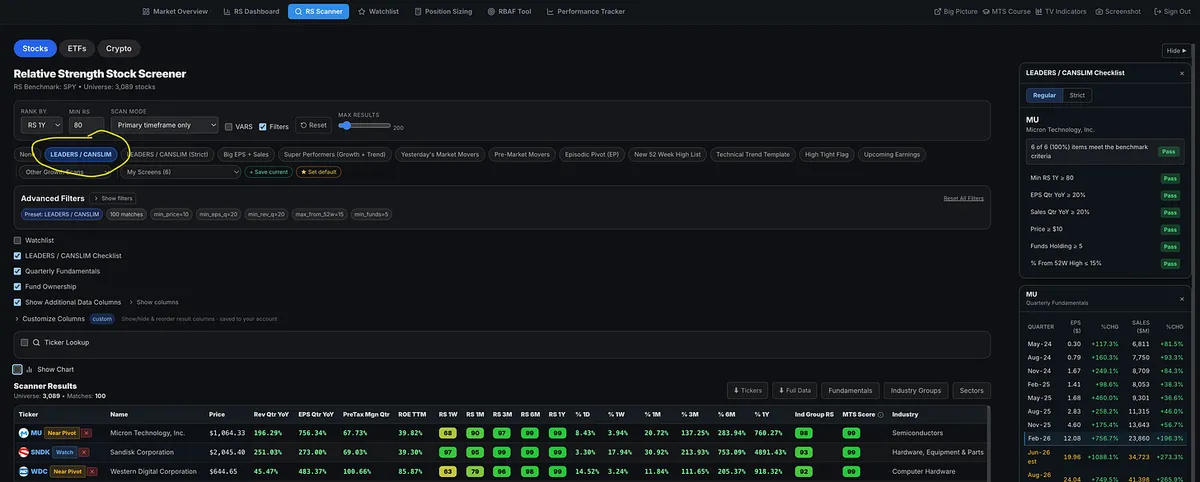
Open the Relative Strength Stock Screener and click the Leader / CANSLIM preset stock screen.

You will immediately see many of the market’s strongest names near the top of the list.

As you scroll through the list, some names will be extended. Those go on your watchlist so you can wait for the next proper pullback or setup.

Some will be near pivot points.

Some will already be actionable.

That is the entire point of the screener.

It is not there to overwhelm you with tickers. It is there to help you quickly identify where the real leadership is.

This is the same exact process I have used to find and share many of the biggest winners since January.

Names like:

SNDK

MU

AAOI

AXTI

DELL

CIEN

LITE

WDC

STX

SIMO

and many more!

Your job is to build the habit of checking the list, following the leaders, managing risk, and being ready when the setup appears.

Everything you need to learn the process is inside the Momentum Trading Strategy Course. I also provide a list of books that teach many of the same timeless principles.

Learn the process.

Use the tools.

Trust yourself.

You can do this.

View on Substack ↗

The Multi-Bagger Irony

A lot of stock newsletters sell people on the hope of finding the next multi-bagger.

A 100%, 200%, or 300% winner.

Many talk about holding for years to get the big returns.

What people don't realize is this:

By the time you figure out they were full of it, they already made plenty of money selling you the hope.

The funny thing is, I don't even teach or claim to give people multi-baggers.

But many investors would likely get similar or better results by learning how to identify true growth stock leadership, proper setups, institutional demand, and strong price action.

Here are a few names I mentioned in January and early February:

• AAOI +302%

• AXTI +294%

• SNDK +249%

• DELL +214%

• MU +160%

• LITE +155%

• CIEN +147%

• STRL +127%

• STX +126%

• WDC +124%

• INTC +101%

• AMD +101%

These were discussed in the paid subscriber chat and watchlist posts.

But to be clear, this is not what I do here.

I'm not telling you to blindly buy a stock and hold it until it becomes a multi-bagger.

The goal is to teach you how to find leadership, manage risk, identify proper entries, and build a repeatable process.

View on Substack ↗

Copying Traders Won’t Make You Rich. Learning the Way Might.

At this point in my trading, I don’t pay attention to what anyone else is doing.

But recently, I looked around and noticed something interesting.

Some of the traders I learned from, including Dan Zanger, recently were buying many of the same names, around the same areas, using the same types of setups I was seeing.

Names like: SNDK, DELL, MU, LITE

Why?

Because we learned from the same source material.

The same books. The same legends. The same principles. The same market truths.

When you truly learn a strategy, your decisions start to look similar to others who have learned the same way.

To outsiders, it can look like people are copying each other.

But that is not what is happening.

Will you be one of the few who carries the torch forward?

The traders who actually learn the process, study the patterns, understand the risk, and develop their own conviction are the ones who carry the torch forward.

That is how great trading knowledge gets passed down from one generation to the next.

Will you be one that carries the torch forward?

View on Substack ↗

Why I Track Big Gap-Ups Inside the RS Screener

Someone asked me why I track episodic pivots and big gap-ups inside the Relative Strength Stock Screener.

Here’s why.

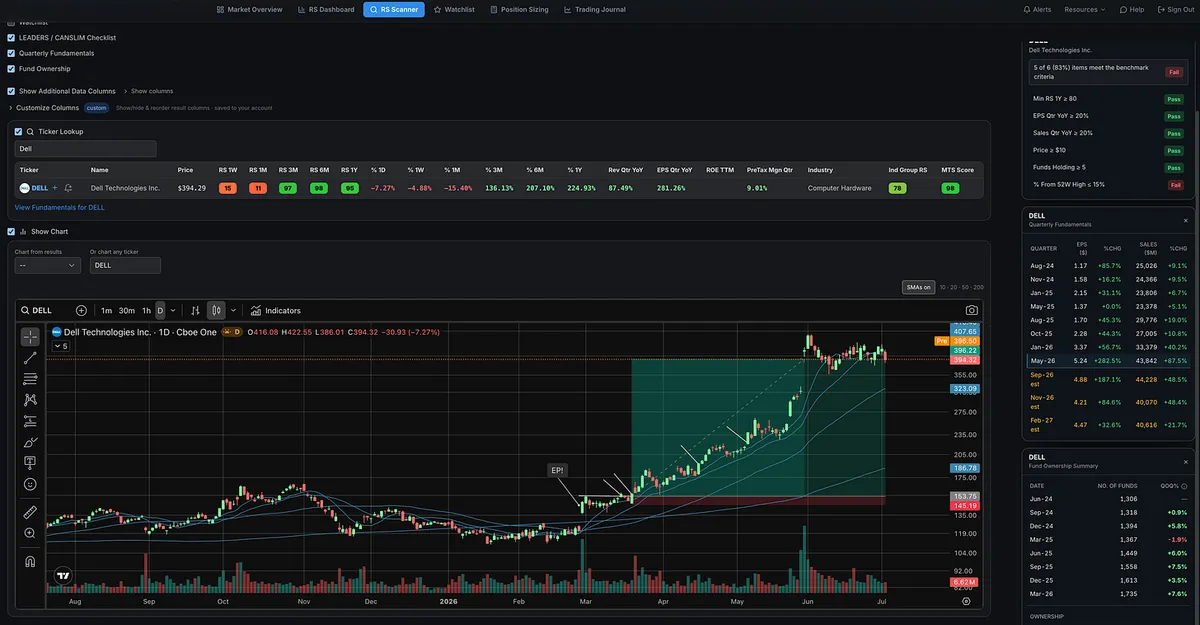
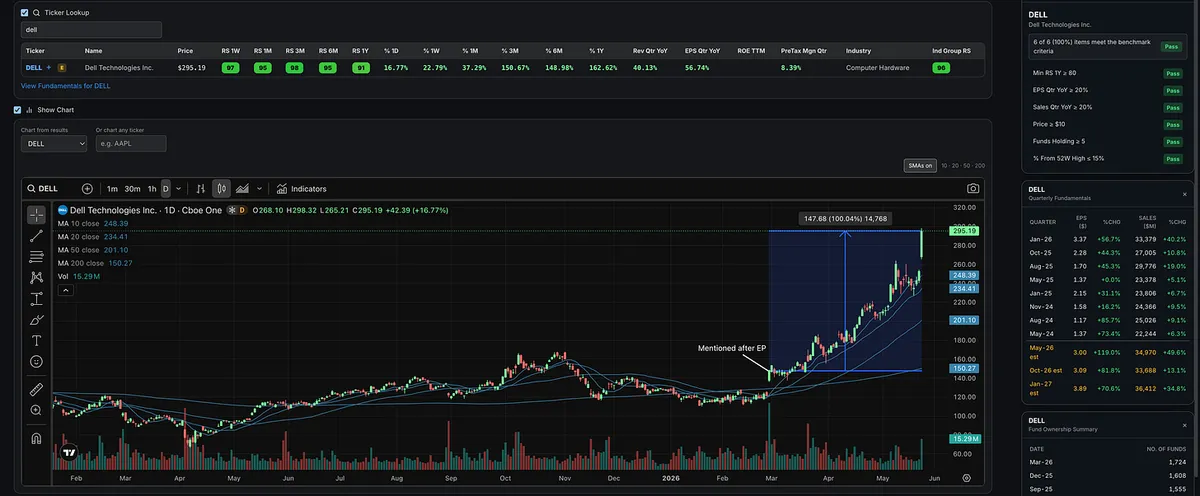
I wrote about Dell on March 1st after its episodic pivot, when the stock gapped up more than 10% on earnings with massive volume.

Since then, Dell has continued to trend higher, up roughly 100%, while making higher highs and higher lows.

Strong industry group. High relative strength across multiple time frames. Strong earnings. Strong sales. Massive volume after earnings.

That is exactly the kind of behavior I want to track.

Not because every gap-up works.

Not because you blindly chase every stock that moves.

But because big institutional-quality moves often leave footprints before the bigger trend fully develops.

The Relative Strength stock screener inside the Momentum Trading Strategy app is simple, but extremely powerful.

It helps me find the names that are showing up in the right places, at the right time, with the right characteristics.

This is exactly what I’m using to find the stocks I share.