Momentum Trading Strategy

Notes

Short lessons on momentum trading, every day.

Every note from Substack, in one place: risk, setups, leading stocks, market conditions and the mindset behind them. Search them, browse by topic, or filter by stock.

Showing 1–9 of 9 notes

$AAOI ×
View on Substack ↗

Nothing Lasts Forever. Don’t Fall in Love With Any Stock.

Some of the market’s biggest winners over the past year have now broken down. At least for the moment, their runs appear to be over.

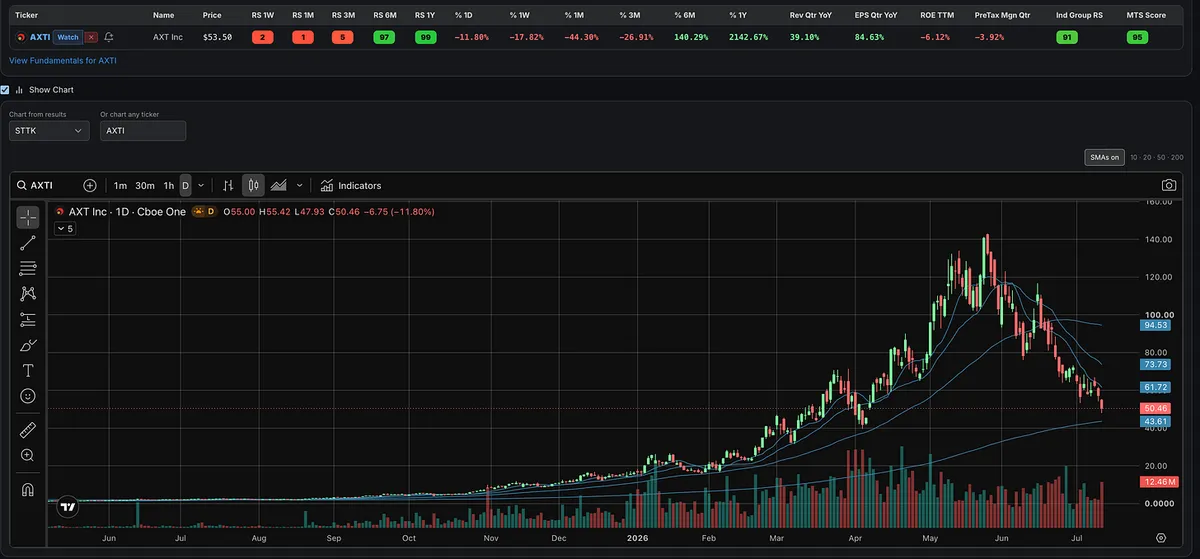
AXTI delivered enormous gains over the last year, but it has now fallen below its 50-day moving average and is heading toward the 200-day. Its 10-day and 20-day lines are declining, and the 50-day is beginning to roll over.

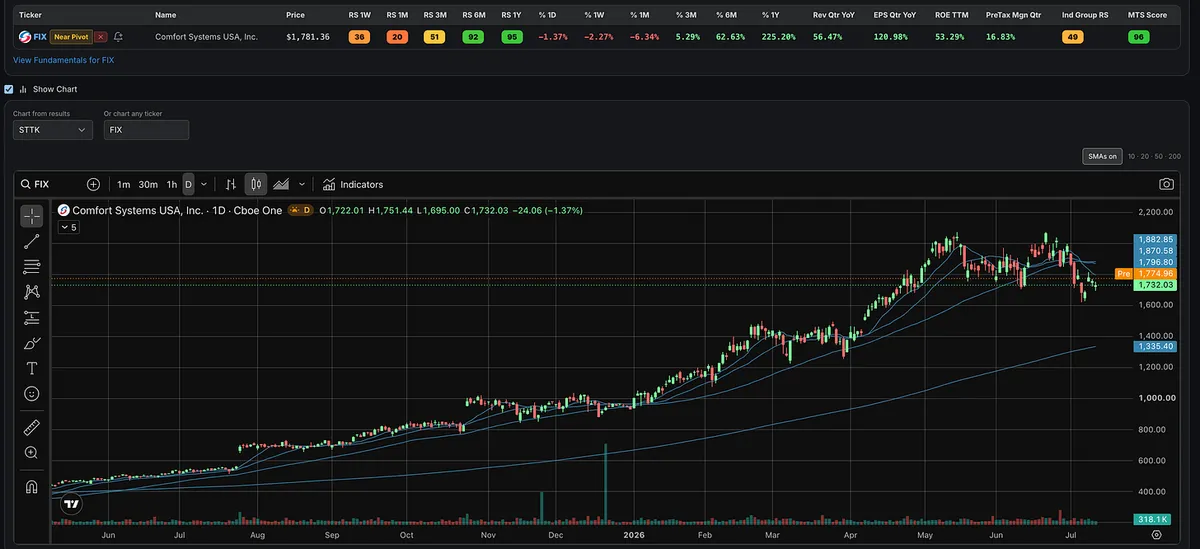
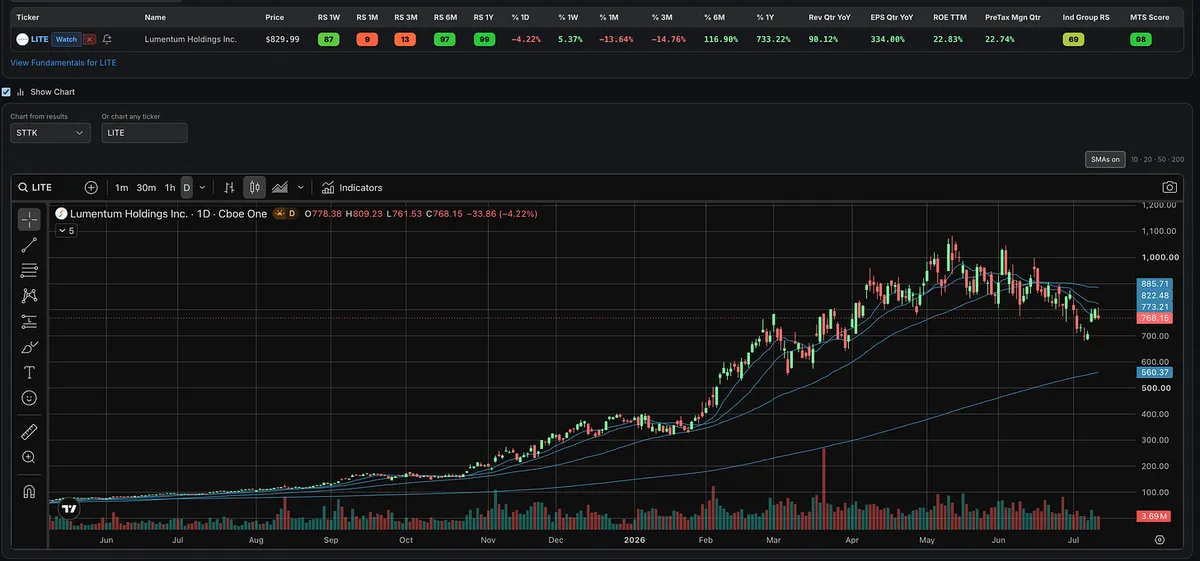
LITE, CIEN, VICR, AAOI, VIAV, TTMI, FIX, COHR, and several other former leaders have also broken down or suffered significant technical damage.

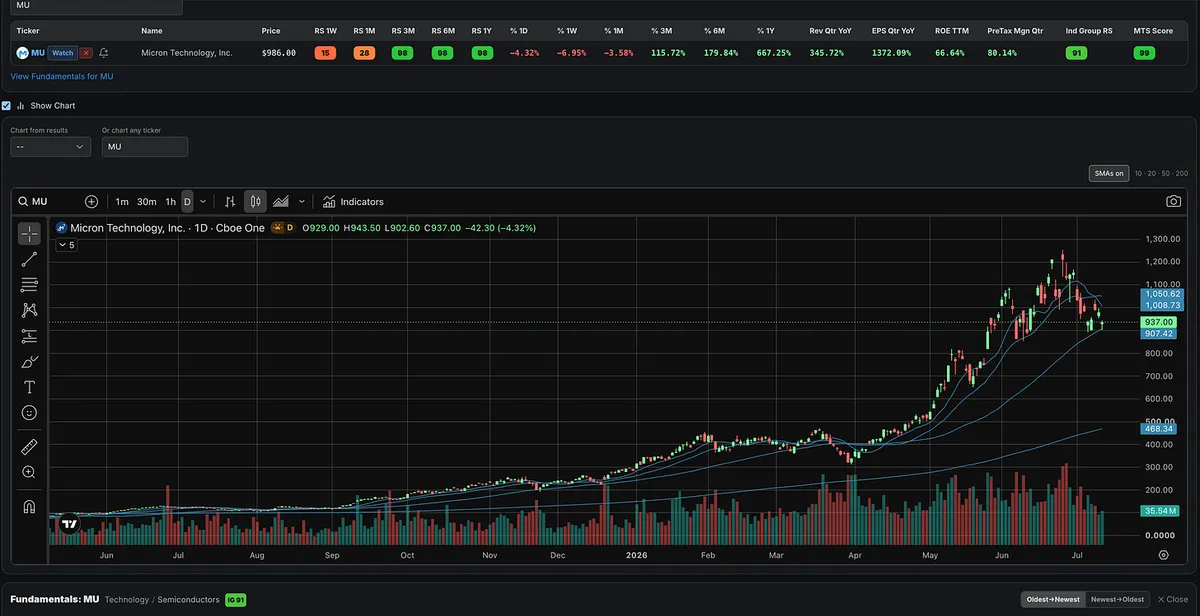
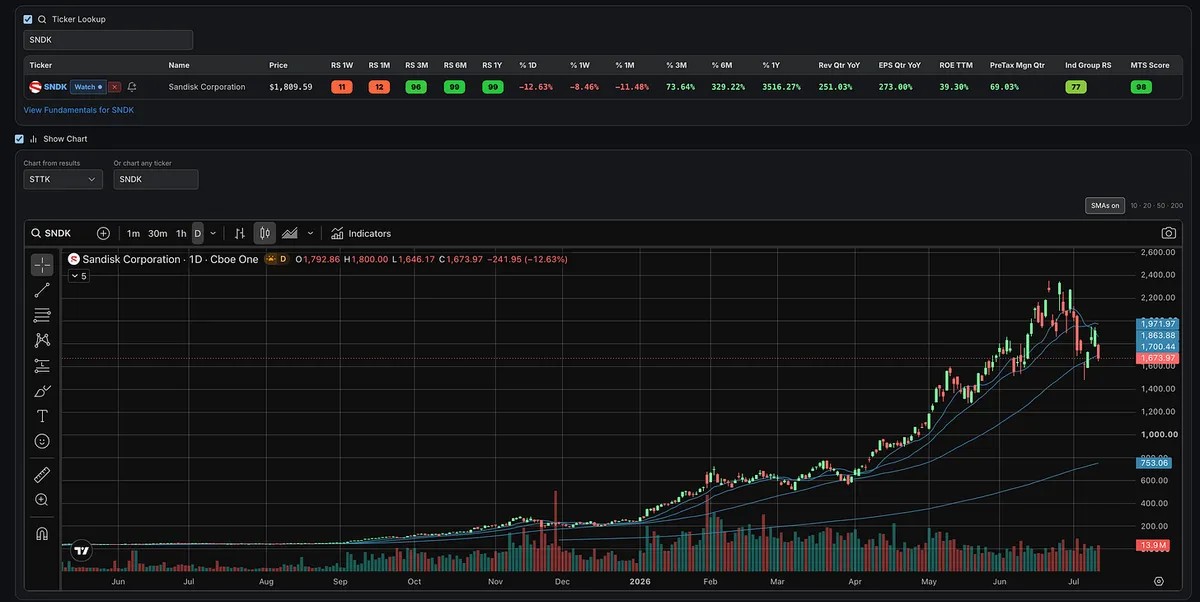
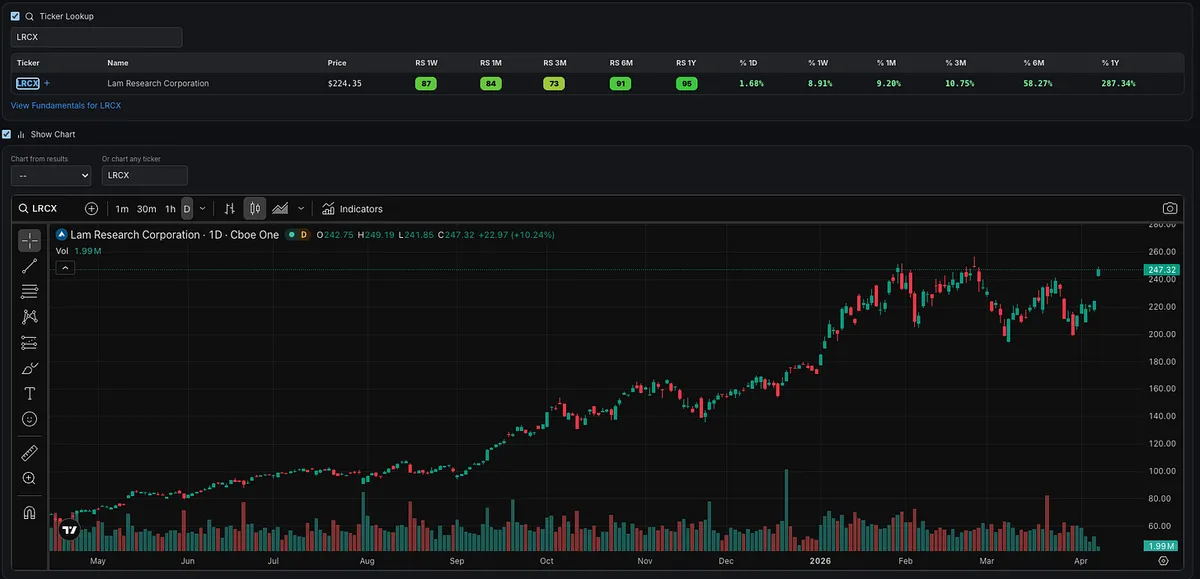
Many more are sitting in the danger zone near their 50-day moving averages. That includes the memory names SNDK, WDC, STX, and MU, along with other hot names from hot groups VPG, MBIS, MXL, LSCC, MRVL, TER, VSH, STM, ADI, INTC, TSM, LRCX, COHU, PDFS, and others.

The bottom line is that many of the stocks that have driven this market, particularly the memory, semiconductor, and telecom names, have either already broken down or are now testing a critical area around their 50-day lines.

I have not needed to share many new tickers from week to week because the same names I have discussed throughout the year continued to lead. There was no reason to constantly search for something new when the existing leaders were still working.

But nothing lasts forever.

Many of the stocks that worked all year are now either ending their runs or approaching a decisive point. Do not fall in love with any stock. Respect the price action and let the market tell you whether the trend is still intact.
View on Substack ↗

Stop Waiting for Someone to Hand You the Next Big Winner

If you are struggling to find the big winning stocks, you do not need to wait around for me or anyone else to tell you the names.

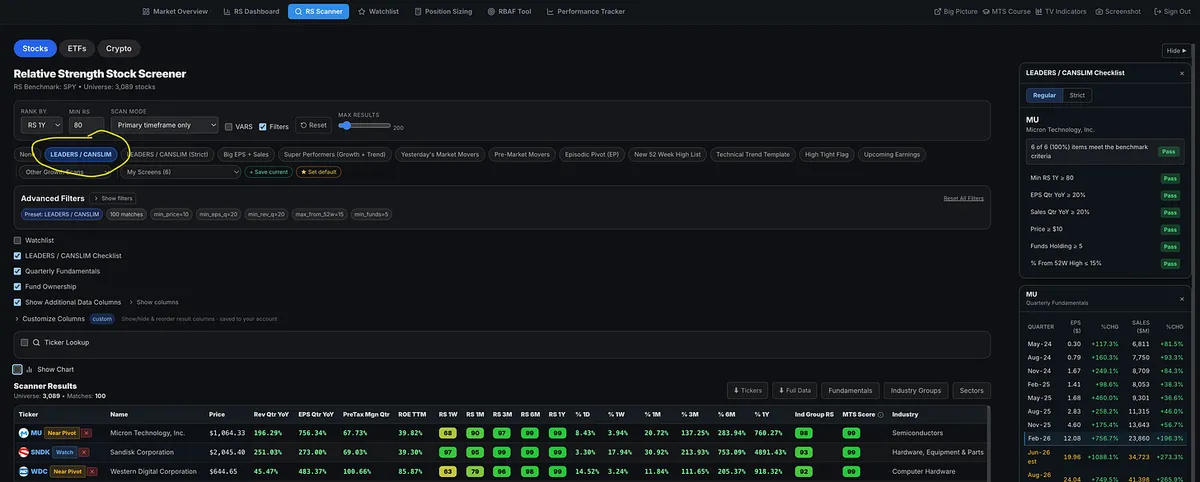
Open the Relative Strength Stock Screener and click the Leader / CANSLIM preset stock screen.

You will immediately see many of the market’s strongest names near the top of the list.

As you scroll through the list, some names will be extended. Those go on your watchlist so you can wait for the next proper pullback or setup.

Some will be near pivot points.

Some will already be actionable.

That is the entire point of the screener.

It is not there to overwhelm you with tickers. It is there to help you quickly identify where the real leadership is.

This is the same exact process I have used to find and share many of the biggest winners since January.

Names like:

SNDK

MU

AAOI

AXTI

DELL

CIEN

LITE

WDC

STX

SIMO

and many more!

Your job is to build the habit of checking the list, following the leaders, managing risk, and being ready when the setup appears.

Everything you need to learn the process is inside the Momentum Trading Strategy Course. I also provide a list of books that teach many of the same timeless principles.

Learn the process.

Use the tools.

Trust yourself.

You can do this.

View on Substack ↗

The Multi-Bagger Irony

A lot of stock newsletters sell people on the hope of finding the next multi-bagger.

A 100%, 200%, or 300% winner.

Many talk about holding for years to get the big returns.

What people don't realize is this:

By the time you figure out they were full of it, they already made plenty of money selling you the hope.

The funny thing is, I don't even teach or claim to give people multi-baggers.

But many investors would likely get similar or better results by learning how to identify true growth stock leadership, proper setups, institutional demand, and strong price action.

Here are a few names I mentioned in January and early February:

• AAOI +302%

• AXTI +294%

• SNDK +249%

• DELL +214%

• MU +160%

• LITE +155%

• CIEN +147%

• STRL +127%

• STX +126%

• WDC +124%

• INTC +101%

• AMD +101%

These were discussed in the paid subscriber chat and watchlist posts.

But to be clear, this is not what I do here.

I'm not telling you to blindly buy a stock and hold it until it becomes a multi-bagger.

The goal is to teach you how to find leadership, manage risk, identify proper entries, and build a repeatable process.

View on Substack ↗

The Quiet Warning Showing Up Under the Surface

A lot of leading stocks are still acting strong.

Many are making new highs. Many still have great relative strength.

Price is still king, and I would never execute a trade based on one data point alone.

But I am noticing something worth paying attention to.

On the most recent earnings reports for a lot of leading names I’ve been following, fund ownership has dropped.

Again, this does not mean the move is over.

These stocks can absolutely keep running higher from here. That’s exactly why price always comes first.

Also, sometimes this happens for a quarter or two, then funds increase again and come right back into the name.

But when leading stocks are pushing higher while fund ownership starts declining, it can be an early sign that some institutions are taking profits into strength.

If price starts to break down later, this gives us a possible clue as to what may have been happening under the surface.

Some names where I’m noticing this:

SIMO, ALAB, MRVL, LITE, TTMI, NVT, LASR, AMD, STRL, LRCX, AAOI.

This is not a sell signal.

This is not a prediction.

Just something I’m taking note of.

View on Substack ↗

This Is Why You Track Leadership Before Everyone Else Sees It

On April 8, the market gave us the signal.

We had a follow-through day, the NASDAQ-100 reclaimed key moving averages, including the 50-day and 200-day, and the conversation shifted from defense back toward offense.

But the real edge was not just knowing the market was improving.

The edge was knowing where to look.

When the market gets stronger, I want to be focused on the strongest industry groups and the strongest stocks inside those groups.

That is exactly what we had been tracking for months.

  • Telecom.

  • Computer Data Storage.

  • Semiconductors.

Many of these names were not random new ideas. They had already been showing up in our work, some for months, and some even last year.

So when the market confirmed on April 8, there was no need to bounce around looking for the next hot ticker.

The leadership was already there.

From the April 8 signal to yesterday’s close:

AAOI up 40%

LITE up 12%

CIEN up 12%

VIAV up 30%

SNDK up 81%

WDC up 38%

STX up 53%

TER flat

AEIS down 4%

AEHR up 50%

LRCX up 12%

FIX up 30%

GLW flat

Not every stock works.

That is normal.

But when the market confirms, and multiple stocks from the same leading groups start moving together, that is usually not a coincidence.

That is institutional money flowing into a theme.

Strong market.

Strong industry groups.

Strong stocks.

That is the process.

The goal is not to chase every move.

The goal is to already know where the strength is clustering before the move becomes obvious.

View on Substack ↗

How do you find stocks that can go up 100%, 200%, or 300%?

Relative strength.

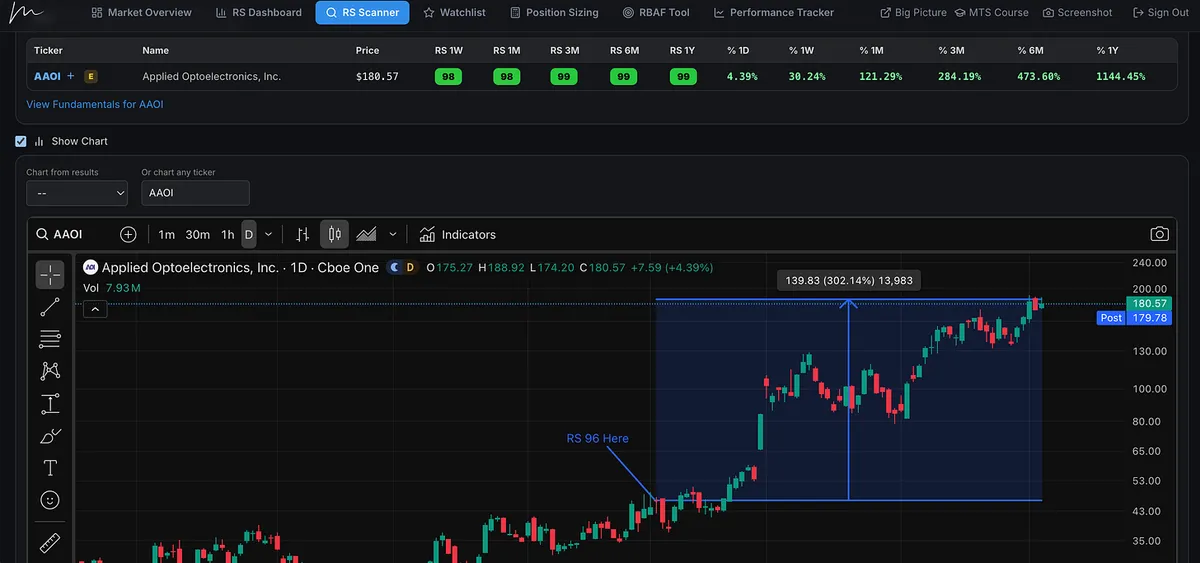
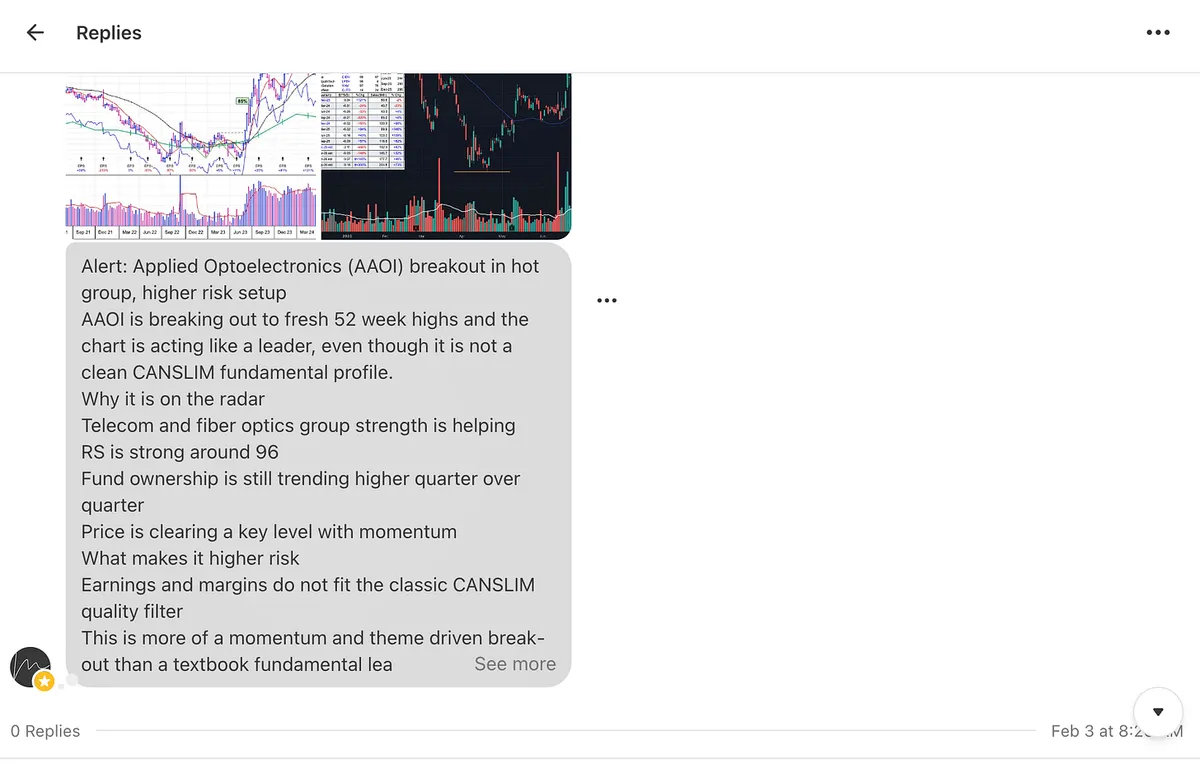
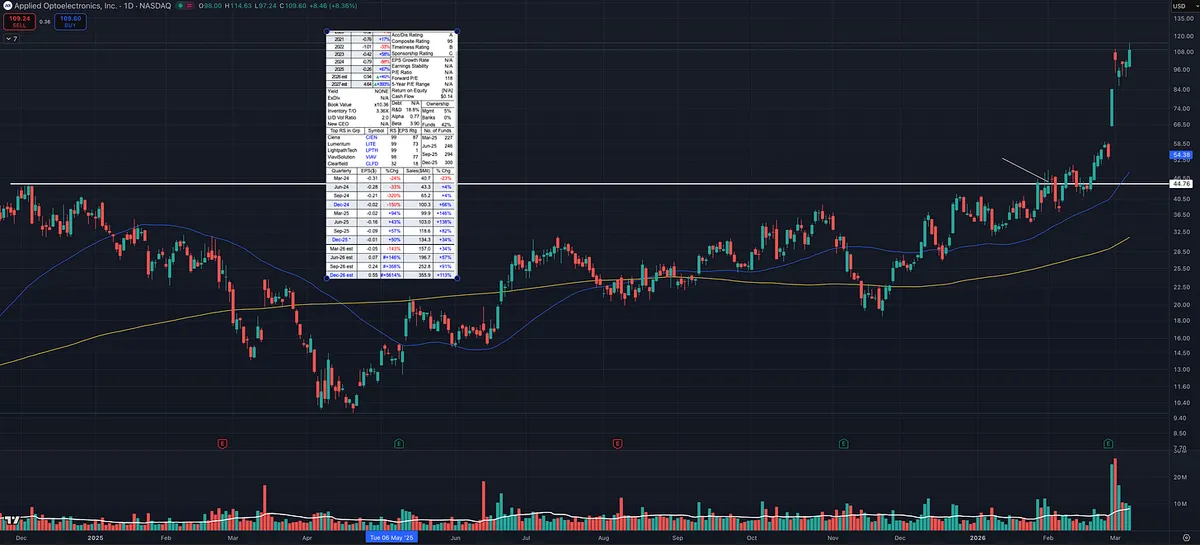
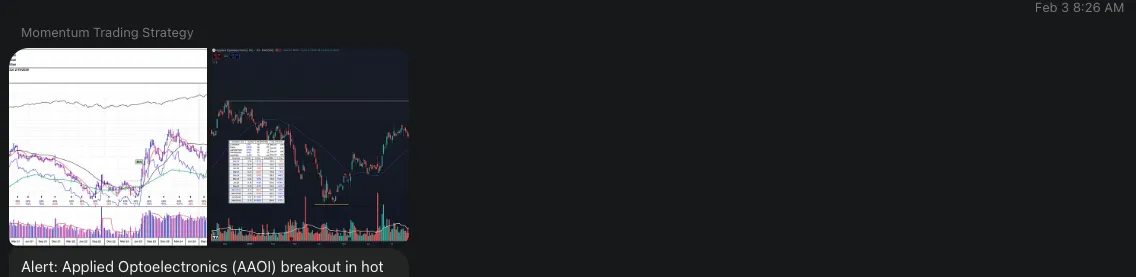
On February 3, I posted AAOI as a breakout in a hot group.

At the time, AAOI had a 96 RS rating.

It was not “cheap.”

And I’m sure plenty of people would have said the same thing they always say about strong stocks:

“But it’s extended.”

Since then, AAOI is up more than 300%.

Let that sink in.

The stock was already strong.

The group was already strong.

The relative strength was already obvious.

And that was the point.

This is exactly why I built the Momentum Trading Strategy Web App and why I literally give this tool to my paid subscribers to use.

The process is simple, but most people skip it:

Follow strength.

Find the strongest industry groups.

Then find the strongest stocks inside those groups.

That is how AAOI ended up on the radar.

AAOI was not random.

It was a strong stock in a strong group, telecom and fiber optics, breaking out with powerful relative strength.

The biggest winners rarely look comfortable early. They usually look “too high,” “too extended,” or “too late” to people who are trained to look for bargains instead of leadership.

Relative strength does not guarantee a stock will become a huge winner.

But it does one very important thing:

It puts you in the right hunting ground.

Strong stocks in strong groups, breaking out to new highs, with institutional demand behind them, are where many of the biggest moves begin.

This is why I don’t spend my time randomly bouncing around looking for the next hot ticker.

I start with relative strength.

I look for leadership.

I track the strongest industry groups.

Then I wait for the market, the setup, and the risk/reward to align.

AAOI was not a surprise.

It was on the radar because the process put it there.

The screenshots show the “then” and the “now.”

February 3: AAOI with a 96 RS rating.

Today: AAOI up more than 300%.

This is why relative strength matters.

Not because every strong stock works.

But because the biggest winners are almost always strong before most people believe they can go much higher.

View on Substack ↗

What We Actually Do As Momentum Traders

For those of you that are new, here’s what we actually do.

Momentum Trading Strategy primarily focuses on swing and position trading, mainly in growth stocks, while following the trend.

Our strategy is rooted in principles that have worked for over 100 years.

The foundation comes from traders such as Jesse Livermore, Gerald Loeb, Bernard Baruch, Richard Wyckoff, Nicolas Darvas, William O'Neil, and more modern traders like Mark Minervini, David Ryan, Dan Zanger, Kristjan Kullamägi, along with many U.S. Investing Champions.

Different eras.

Same principles.

So what are we primarily looking for?

When the market is bad, we are preserving capital.

We are mostly in cash.

We are preparing for the next Stage 2 uptrend.

When the market is healthy, we are looking to participate in the strongest industry groups.

This changes cycle to cycle.

More recently, we’ve seen strength in areas like computer data storage with names like SNDK.

Telecom with LITE.

And semiconductors with AAOI.

Within these hot industry groups, we are looking to trade the biggest names and the best leaders.

These tend to have high relative strength (RS), meaning they are outperforming the index and most other stocks in the market.

They also have fuel driving that strength.

That fuel usually comes from:

  • Strong earnings

  • Strong sales

  • Or acceleration in earnings and sales

Also, something that might catch the market off guard.

These stocks are typically making new highs repeatedly.

If you look at the chart, they are consistently forming higher highs and higher lows.

So what we are doing is aligning:

  • The overall bull market theme

  • The hottest industry groups

  • The strongest stocks within those groups

All while looking to enter at points that offer low-risk, high-reward opportunities.

If we are wrong, we lose a small amount.

If we are right, we make multiples of that risk.

3x. 5x. 10x. 15x. 20x.

That’s the entire game.

My goal is to provide you with all the tools necessary to actually do this.

Paid subscribers get access to:

  • A web app with a Relative Strength Stock Screener to find these types of stocks

  • A weekly market newsletter to help you stay aligned with the market

  • A Relative Strength dashboard

  • A watchlist feature and additional risk management tools

  • Shared stock ideas and scans

  • And a full course that breaks all of this down in depth.

All for $120 per year.

That’s only $10 per month.

If that’s too expensive, then frankly, you probably shouldn’t be trading.

View on Substack ↗

This Is What Real Leadership Looks Like

It’s not a coincidence.

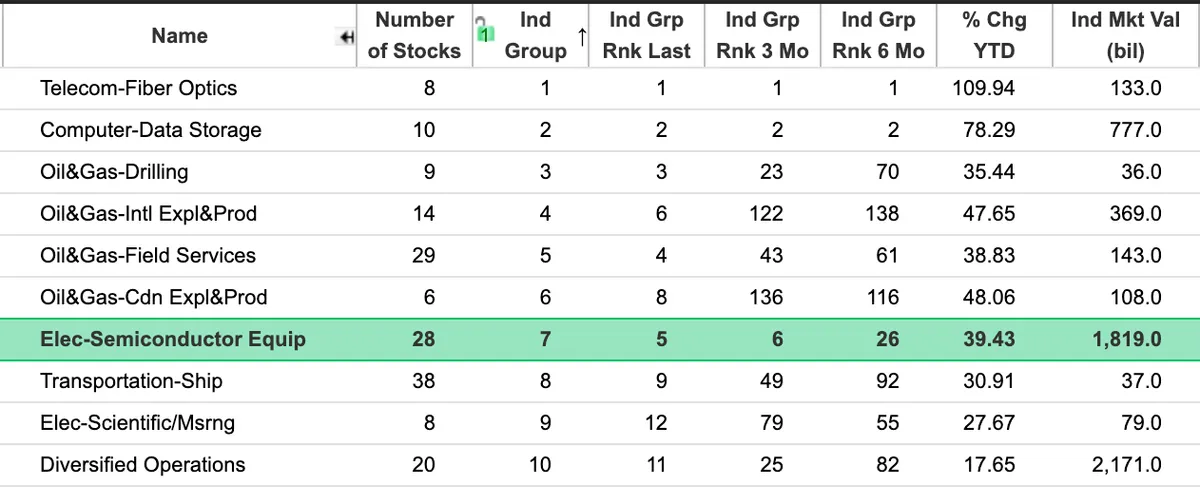
When we look at the Top 10 Industry Groups right now, we’re seeing clear clustering of strength:

  • Telecom: AAOI, LITE, CIEN, VIAV

  • Computer Data Storage: SNDK, WDC, STX

  • Semiconductors: TER, AEIS, AEHR, LRCX

All showing up in the top groups.

This is exactly how leadership reveals itself.

It’s not just one stock. It’s clusters of strength moving together.

When you start seeing multiple names across the same industry groups all:

  • Breaking out

  • Showing strong relative strength

  • Backed by strong fundamentals

That is not random.

That is institutional money flowing into a theme.

This is how real trends work.

Stay focused on where the strength is clustering, just like we teach in the MTS Course. https://tradingmomentum.substack.com/s/mts-course

How do we find the strongest names in the strongest groups?

Relative Strength Stock Screener.

Use it now as part of the MTS Web App https://momentumtradingstrategy.app/

That’s where the opportunity is.

momentumtradingstrategy.appMomentum Trading Strategy
View on Substack ↗

Why I Mentioned AAOI Before Earnings

Someone asked why I mentioned AAOI in early February with earnings coming up.

First, the stock checked several boxes I look for.

It was in a HOT group (telecom) showing strong relative strength across multiple timeframes. I had already seen success with LITE and CIEN, which are in the same space. It reminded me of past industry runs like the computer data storage group when SNDK, MU, WDC, and STX all moved together.

AAOI also had:

• Strong earnings and sales acceleration

• Rising forward estimates

• Accelerating fund ownership

• Tight price action on the right side of the chart

• Trading near new 52 week highs

Since that mention the stock has moved about 150%, but the trade management is the important part.

I normally do NOT buy a stock a few days before earnings. There is too much risk and no time to build a cushion.

I follow the advice from Paul Tudor Jones:

“Never trade in situations where you don’t have control. For example, I don’t risk significant amounts of money in front of key reports, since that is gambling, not trading.”

In this case there were about three weeks before the report, which gave the trade time to work.

From the original buy, the stock moved roughly 30% before earnings.

At that point the plan becomes simple:

• Trim a large portion before the report

• Lock in gains and reduce risk

• Hold a smaller position into earnings

Even great stocks can drop 15–20% overnight on earnings.

By trimming beforehand, the position already has a profit cushion, so the remaining shares carry much less risk.

This is something I learned studying the playbooks of William O’Neil, Mark Minervini, and David Ryan.

The goal isn’t predicting earnings.

The goal is managing risk while letting strong stocks work in your favor.