
Trading articles/How to Manage a Winning Trade: A Complete Guide Using ELF Beauty (ELF)
Dec 6, 2025 · Momentum Trading Strategy
How to Manage a Winning Trade: A Complete Guide Using ELF Beauty (ELF)
The 2022 to 2023 ELF run is one of the cleanest modern examples of trend following, pyramiding, and trade management working exactly as they should.
Originally published on Substack.
Most Traders Lose Money for One Simple Reason
Let me ask you a few questions, and be honest with yourself as you read them.
Have you ever sold a stock too early and then watched it explode higher without you?
Have you ever held a winner too long and slowly watched all your gains disappear?
Have you ever entered a great setup, only to panic out because you had no clear selling plan?
If your head is nodding, that is good.
It means you are ready to learn something that can actually transform your trading results.
Most traders obsess over entries. They spend years searching for the perfect breakout pattern or the perfect pullback or the perfect indicator. Yet this is not what separates amateurs from professionals. If you are thinking risk management, you are right, but there is another piece to the puzzle that is rarely talked about compared to entries and stops.
You win this game by knowing how to manage a winning trade.
Entries only get you into the arena. Your sell rules and your profit taking rules determine whether you leave as a champion or as a casualty.
And today, using one of the best modern examples we have, ELF Beauty, I will show you exactly how professionals stay in trends, protect profits, pyramid correctly, and listen when the market says the move is over.
By the end of this post, you will understand trade management at a level most traders never reach, or they understand it intellectually but still never implement it when it matters.
Let’s begin.
1. Why ELF Beauty Was a Clue Before Anyone Saw It
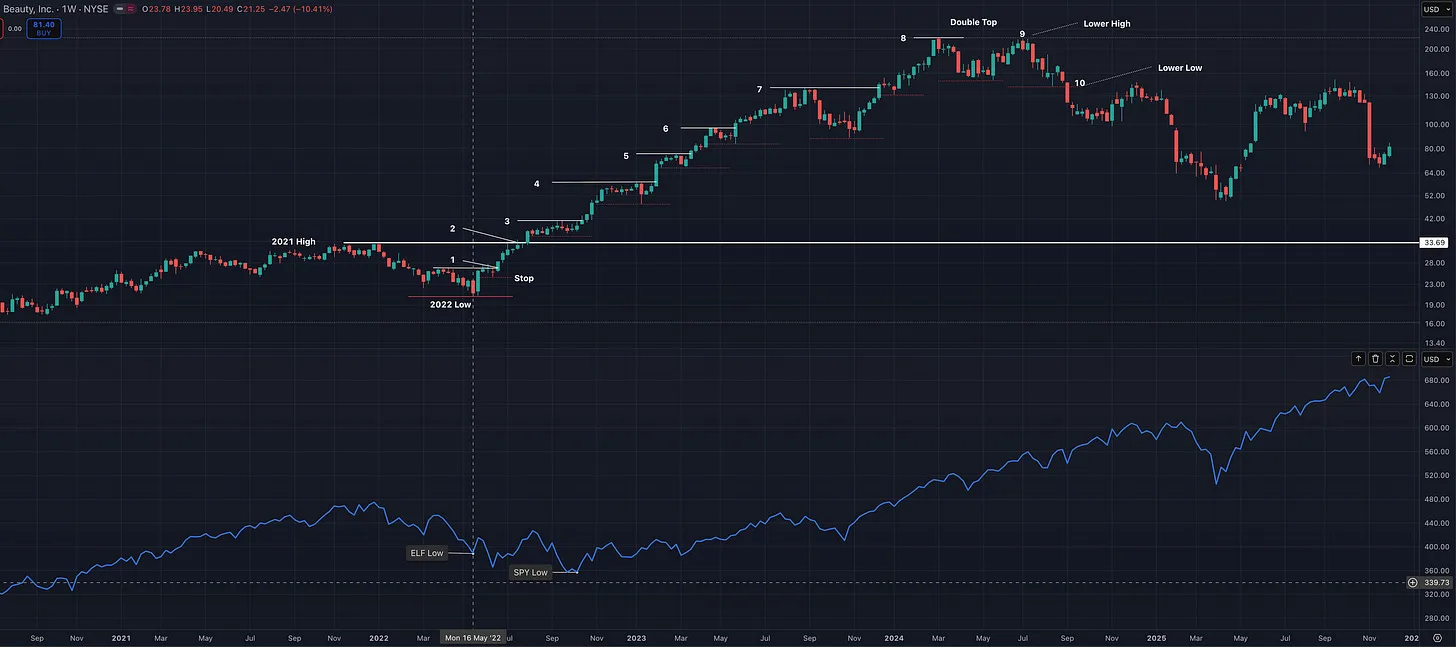
In 2022, the market was falling apart. SPY made new lows in June and then again in October. Most stocks were in brutal downtrends.
But ELF Beauty was not.
- ELF bottomed in May 2022
- SPY bottomed five months later, in October 2022
This is one of the strongest leading-stock signals you will ever see. When the entire market is drowning and a stock refuses to make new lows, that is a future leader raising its hand.
This is exactly what William O’Neil taught for decades. The best stocks of the next bull market often reveal themselves in the bear market that comes before it.
ELF was showing:
- Strong relative strength
- Explosive earnings and sales
- A clear positive divergence vs the major indexes
This is what you look for in the next correction or bear market. Stocks that refuse to die. Those are your leaders. Those are your future big winners.
2. A Clean, Logical Entry: Higher Low into Higher High
Forget the endless debates about exact entry points. For this post, assume a simple and repeatable scenario.
- You spotted ELF’s strength off the May 2022 low
- You waited for a small pullback
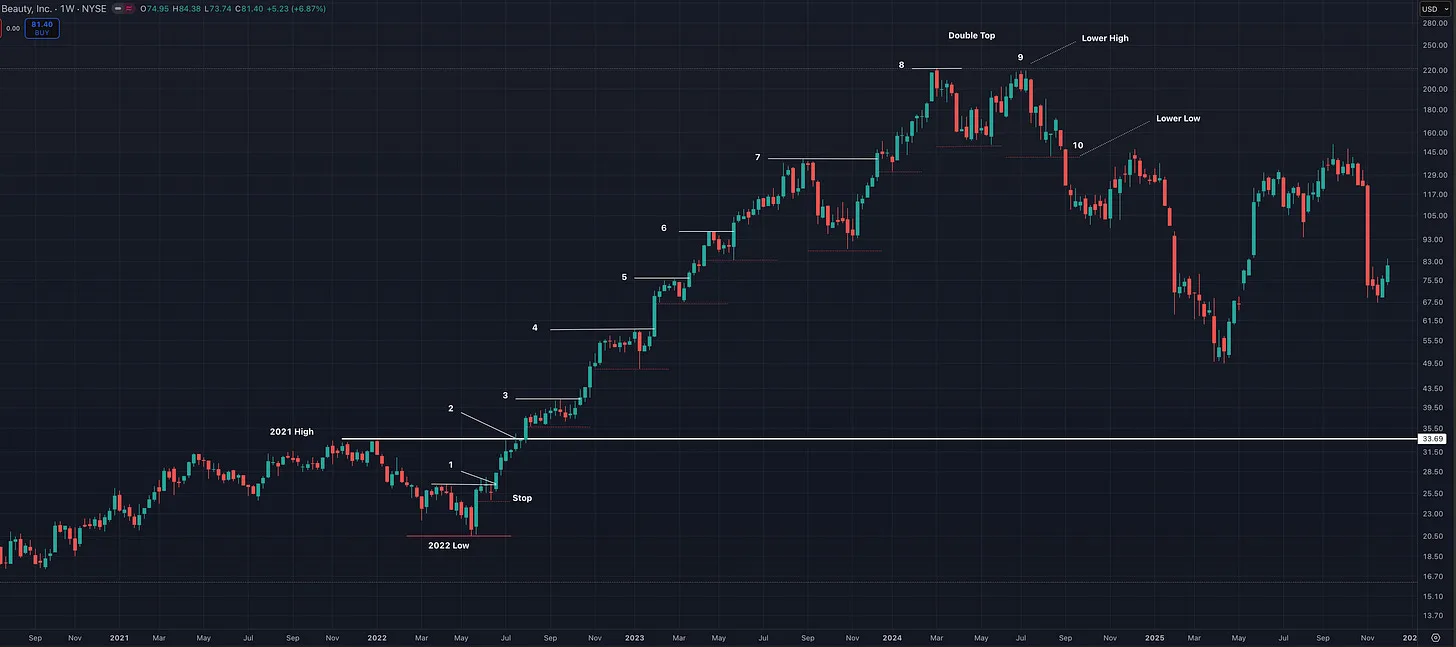
- You bought the higher high at point 1
- You placed your stop under the prior weekly low
Clean. Simple. Professional.
This post is not about entries. It is about trade management. The same techniques apply whether you bought at point 1 or entered later at 2, 3, 4, or even higher. What matters is not the exact buy point, but how you manage the trade once you are in.
3. Trade Management Method 1: Trailing Higher Lows
This is one of the most powerful selling systems you will ever learn. It is simple, objective, and keeps you inside the bulk of a major trend without micromanaging every wiggle.
The rules:
- Place your stop under the most recent higher low.
- Do not move the stop until price forms a new higher low and then breaks to new highs.
- Only trail the stop once both conditions occur.
Using ELF:
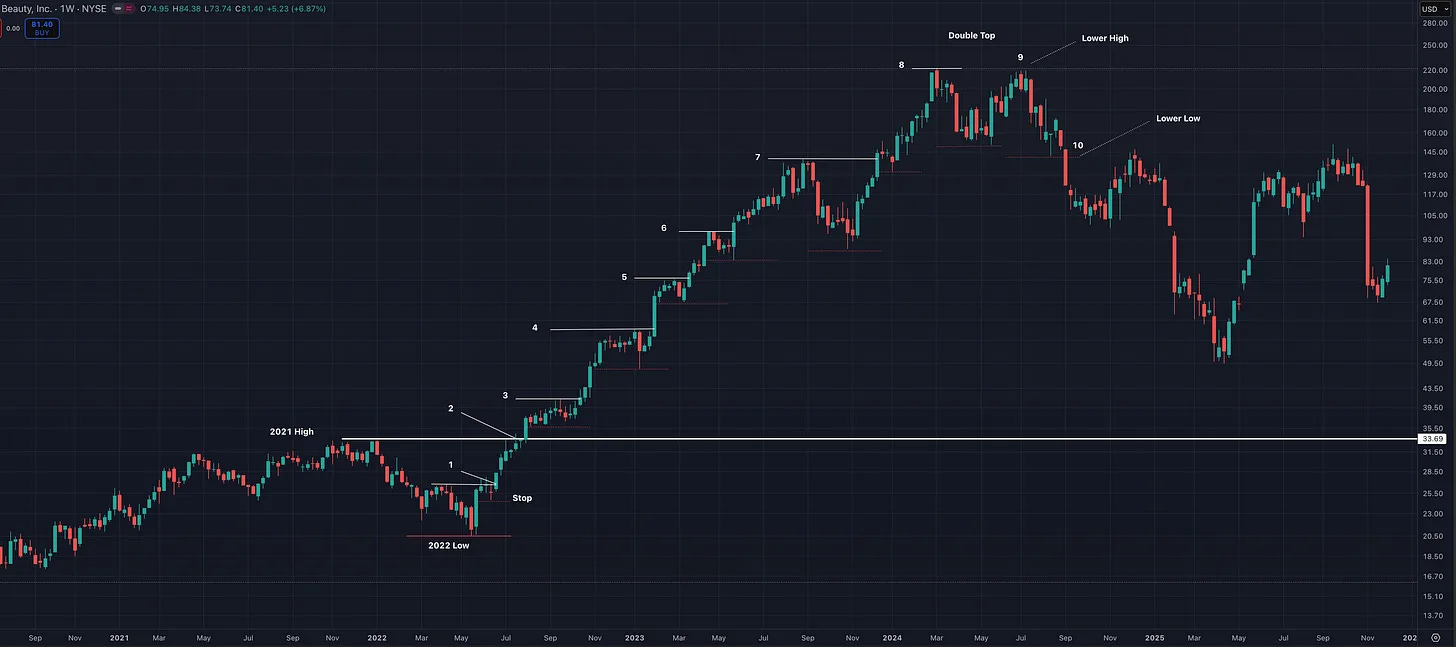
At point 3
Price forms a new higher low, breaks higher, confirms trend strength. You raise your stop to the low under point 3.
At point 4
Another consolidation and another breakout. Raise the stop again.
This continues through 5, 6, 7, and 8
This creates a staircase of higher lows and higher highs. You stay in the trend while others panic out.
This method:
- Captures the middle 70 to 80 percent of a huge move
- Avoids premature exits
- Keeps you aligned with the market
- Requires zero predictions
Your final sell signal is obvious
At point 9, ELF fails to make a new high and forms a double top.
At point 10, ELF breaks the most recent higher low.
The trend is over.
You exit.
No emotion. No bargaining. No hesitation.
Professionals follow these signals. Amateurs ignore them and pray.
4. Trade Management Method 2: Moving Average
This method filters out noise and keeps your focus on the primary trend.
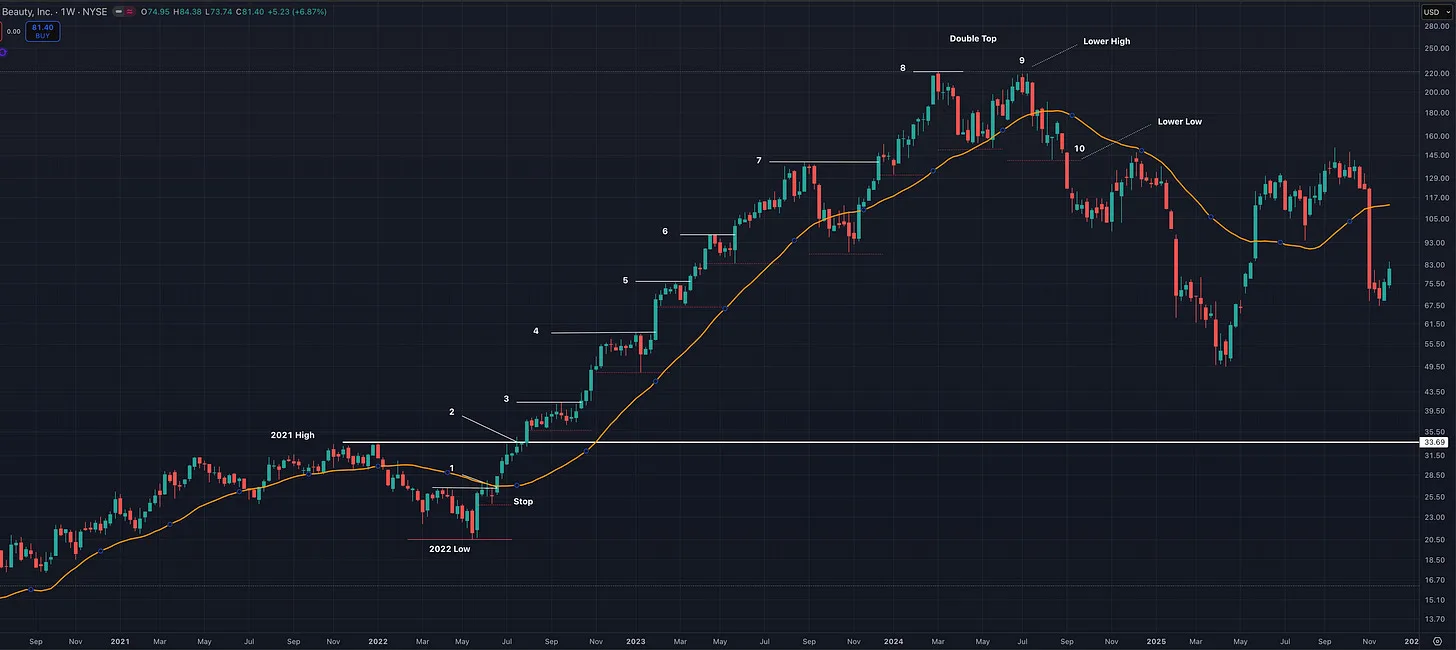
ELF rode its rising 30 week moving average for almost the entire move. If you bought at points 1, 2, or 3, the moving average kept you long until late 2023.
When price finally closed below it around point 7, combined with large red weekly bars on heavy volume, that was enough. After a multi year run, that weakness signals exhaustion.
A professional takes profits at that point and may leave a small runner to see if the trend resumes. This method has been discussed by Stan Weinstein for decades, and it works. It keeps you aligned with the big picture and eliminates overthinking.
5. Trade Management Method 3: ATR Volatility Stop
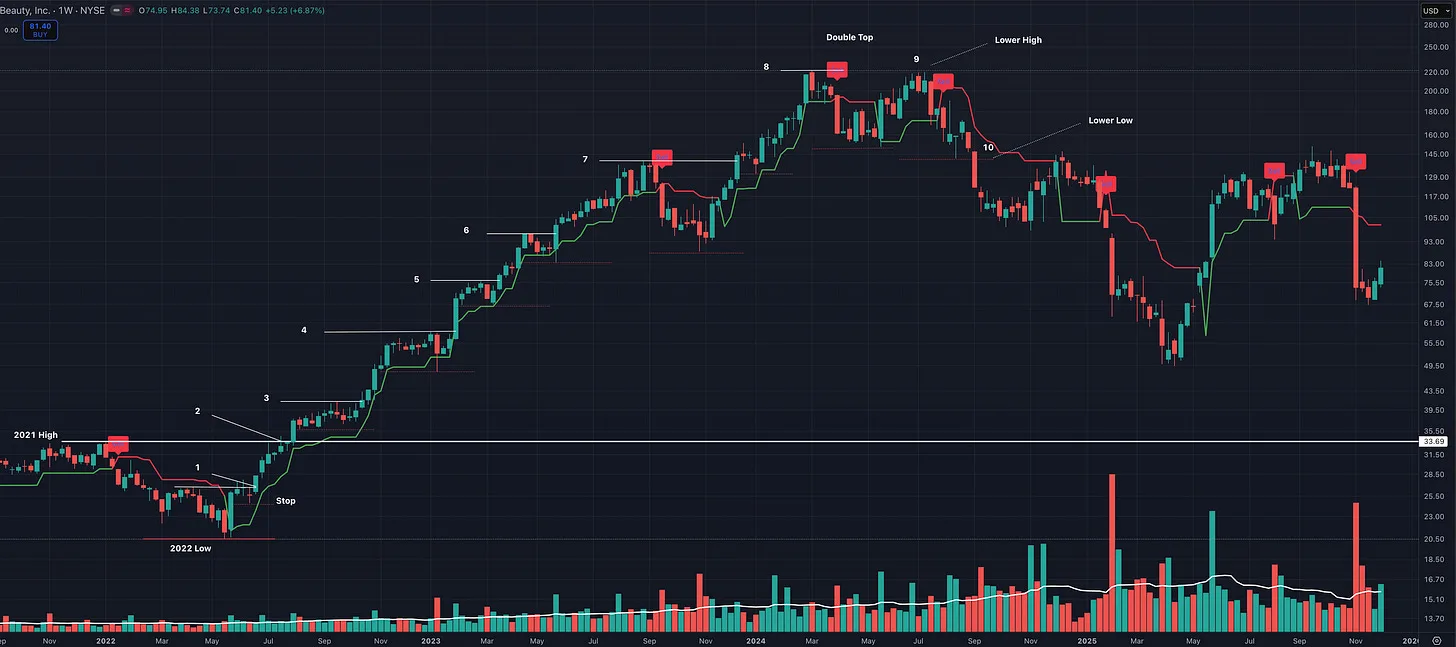
The ATR stop that triggered on the chart gave:
- First exit at point 7
- Additional exits at points 8 and 9 during the double top
ATR stops are perfect for traders who want a fully mechanical system. They allow you to manage volatility without emotion and will get you out as soon as the behavior of the trend begins to shift.
They do not catch exact tops, but they excel at protecting capital and locking in large gains.
One advantage of ATR stops is adaptability. As volatility expands deep into a trend, the ATR naturally widens, giving the stock enough room to breathe without shaking you out early. As volatility contracts, the stop tightens and moves closer to price, helping you lock in gains during late-stage strength.
Another benefit is consistency. Because ATR is rules based, it removes guesswork. You do not have to interpret candles, volume spikes, or market noise. The system tells you when the trend is no longer healthy.
This method is especially useful for traders who struggle with hesitation, emotional exits, or second guessing. ATR stops enforce discipline and help you treat every trade with the same level of objectivity.
6. Building the Position: Two Proven Approaches
There are two common and effective ways to size into a winning trade. Both approaches work. What matters most is consistency and disciplined exits, not which method you choose.
A) Minervini and Soros Style: Enter Big and Sell Some Early to Finance Risk
Example approach:
- Enter with size at point 1
- Sell a portion at point 2 to remove emotional pressure
- Ride the remainder using higher low trailing stops
This aligns with the Soros philosophy of risking profits instead of original capital. By taking a small amount off early, you lower stress and give yourself the freedom to sit through the trend with more confidence.
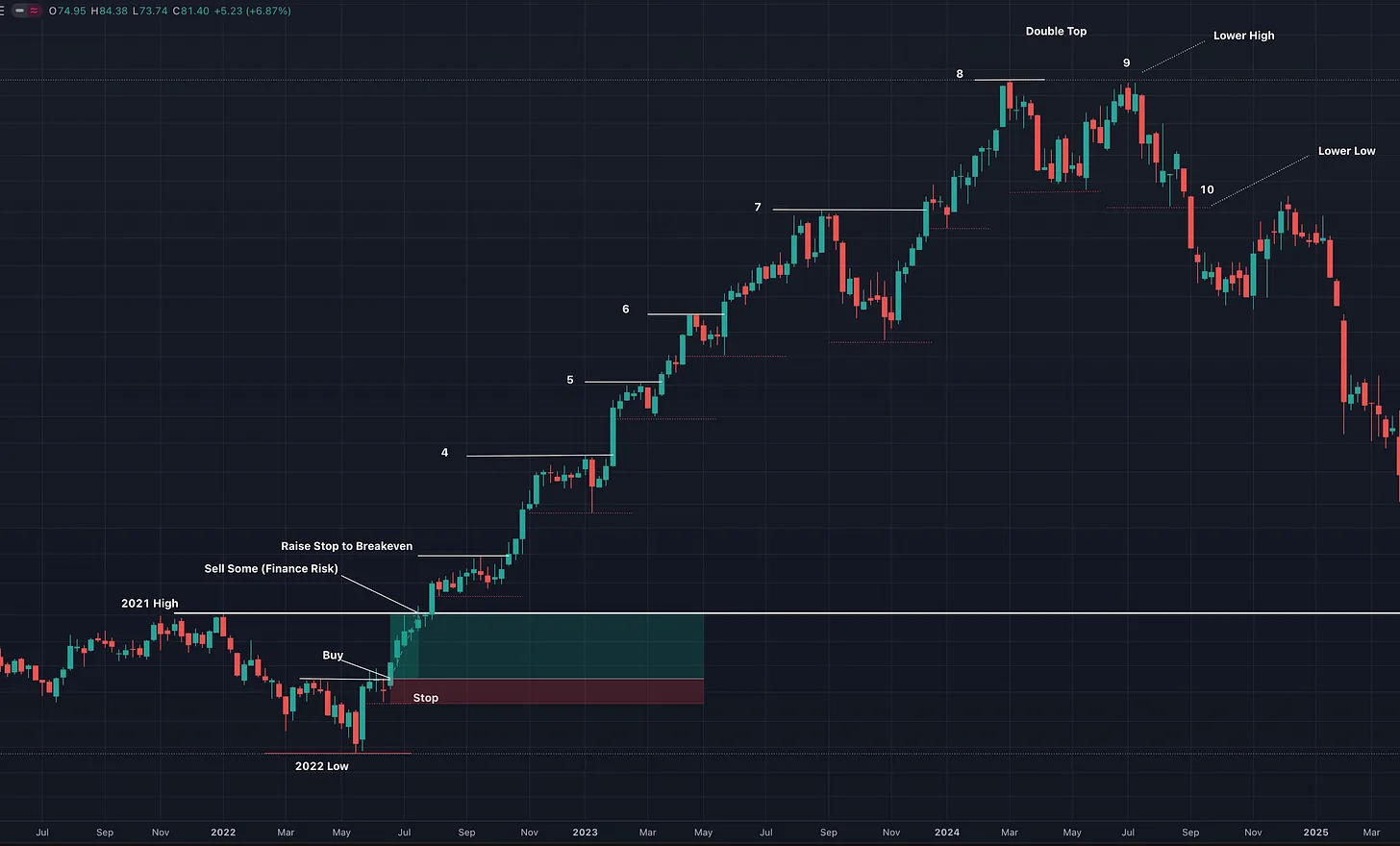
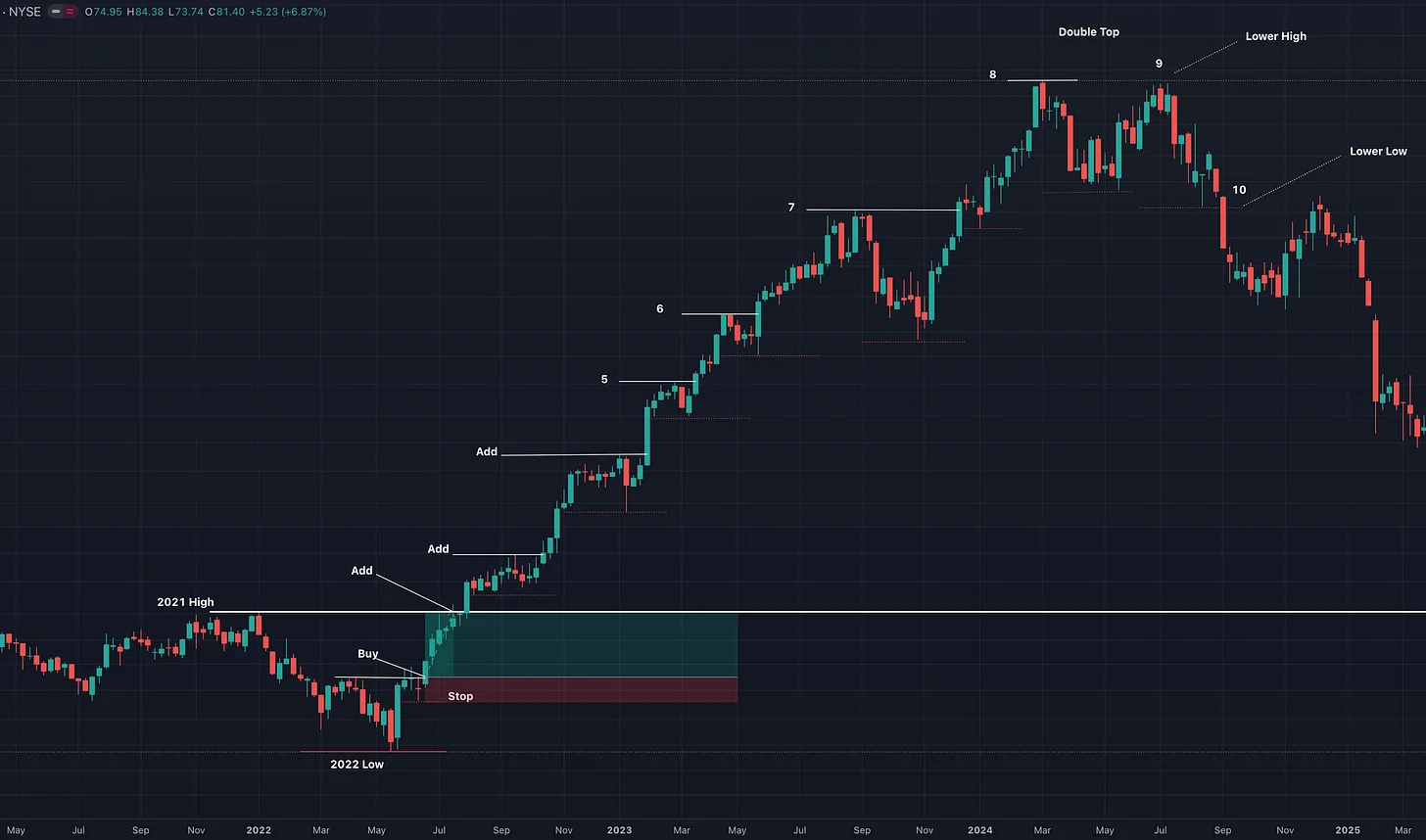
B) Turtle Trend Follower Style: Build the Position Over Time
Example approach:
- Buy at point 1
- Add at points 2, 3, and 4 as the trend proves itself
- Hold the full position until the trend structure breaks
This approach compounds strength and allows the stock to earn larger exposure through its own performance.
Both methods work, and both have been used by great traders. While this is not the exact implementation used by the original Turtle Traders, Minervini, or Soros, it reflects the basic principles behind two successful position building philosophies.
The key is choosing the approach that fits your personality and applying it with discipline.
7. The Core Principle: Trend Structure Never Lies
This is the heart of the entire post.
Higher highs and higher lows mean the trend is alive.
A lower high and a break of the prior low mean the trend is dead.
This principle sits at the center of every great trading system.
Minervini uses it.
Livermore used it.
The Turtles used it.
O’Neil used it.
Different methods, different philosophies, same foundational truth.
When price tells you the move is over, professionals exit.
Amateurs negotiate.
Amateurs hope.
Amateurs give back a year of gains in a month of weakness.
Trend structure protects you from yourself.
8. Final Thoughts: Pick One Method and Master It
You can add fundamentals, volume analysis, leadership readings, CANSLIM signals, or macro filters. Those come later.
Your first job is to master one clean, repeatable exit strategy:
- Trailing higher lows
- Key moving average
- ATR volatility stops
If you get whipsawed sometimes, that is normal. That means you are respecting risk.
If you ignore exit signals and let a 200 percent gain turn into a loss, that is not trading. That is gambling.
Your mission is simple.
Protect your capital.
Capture the bulk of major trends.
Stay consistent.
ELF Beauty is one of the best real world examples of exactly how to do this.
If you want more breakdowns like this, subscribe.
More in Strategy & Tactics
All Strategy & Tactics articles →
Oct 8, 2026 · Strategy & Tactics
Up 100% and Still Buyable? What Traders Get Wrong About Extended Stocks
How to identify proper buy points, avoid chasing stock breakouts, and manage entry risk using lessons from William O’Neil, Mark Minervini, David Ryan, and Dan Zanger.
- Momentum Trading
- VCP
- position trading
- Growth Stock Trading
- David Ryan
- Flag Pattern
- chart patterns
- Cup and Handle
Sep 27, 2026 · Strategy & Tactics
Should You Follow Leading Stocks or Wait for Market Confirmation?
How to read the market, industry groups, and individual stocks together so you can recognize opportunities, build exposure, and respond when conditions change
- growth stocks
- CANSLIM
- Trading
- position trading
- Stan Weinstein
- William O'Neil
- Momentum Trading Strategy
- Trade stocks
Sep 25, 2026 · Strategy & Tactics
Stage Analysis: How to Spot Stage 3 in Real Time
Recognize a developing Stage 3 using Stan Weinstein’s framework, with real chart examples, warning signs, and lessons for protecting your gains
- Momentum Trading
- Nasdaq
- technical analysis
- CANSLIM
- position trading
- Stan Weinstein
- QQQ
- Find True Market Leaders