
Trading articles/Up 100% and Still Buyable? What Traders Get Wrong About Extended Stocks
Oct 8, 2026 · Momentum Trading Strategy
Up 100% and Still Buyable? What Traders Get Wrong About Extended Stocks
How to identify proper buy points, avoid chasing stock breakouts, and manage entry risk using lessons from William O’Neil, Mark Minervini, David Ryan, and Dan Zanger.
Originally published on Substack.
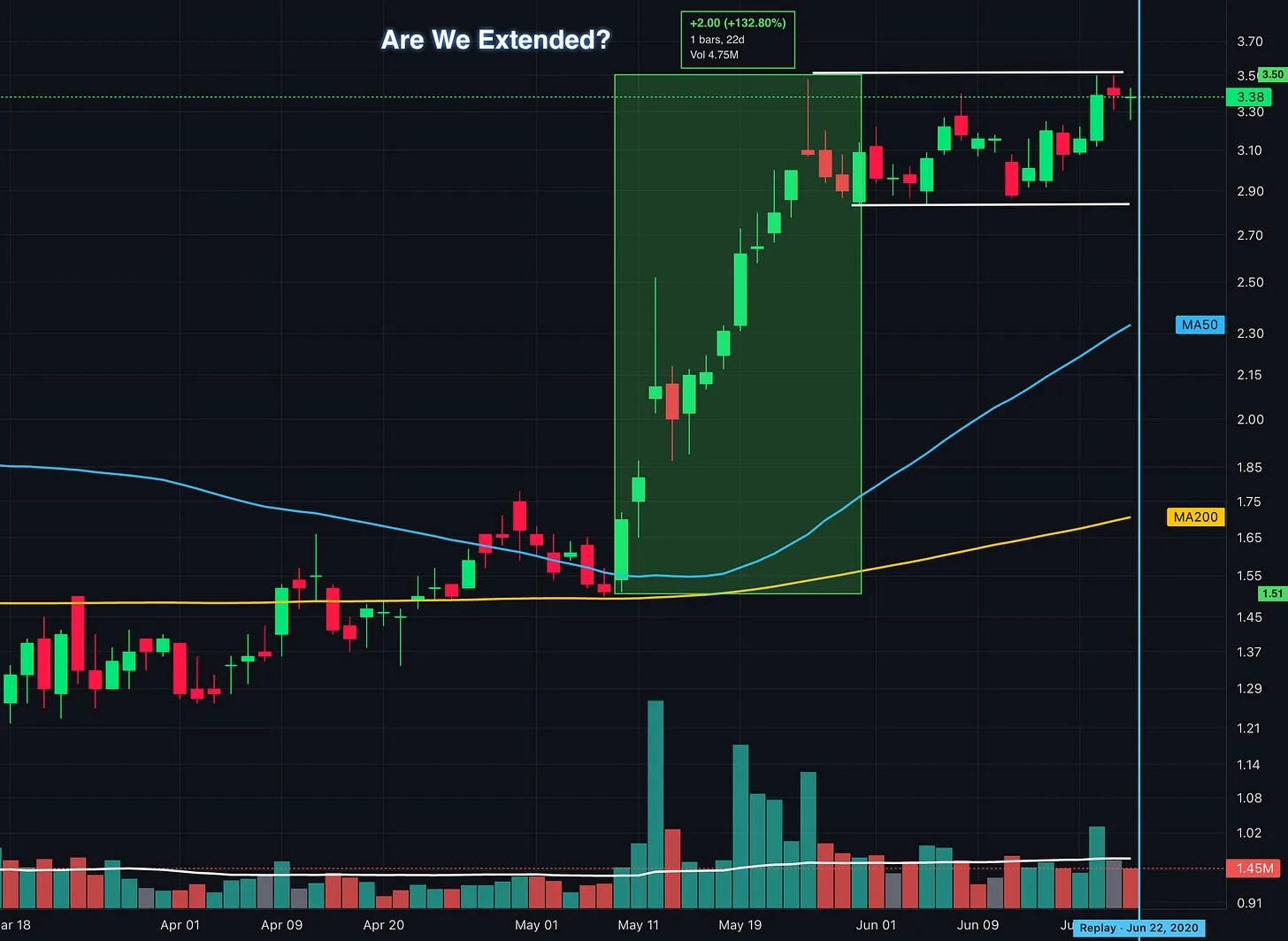
A stock doubles, builds a fresh base, and breaks out. You dismiss it because it has already gone too far. Meanwhile, another stock catches your attention after climbing 10% above its breakout, and you buy because the move finally looks convincing. Which purchase would actually be late? You cannot answer that by looking at how much each stock has gone up.
I hear some version of this confusion constantly: “How can you buy that stock? Look how much it has already run.” It is a reasonable concern, but an incomplete analysis. A large prior advance tells you where a stock has been. To decide whether you are chasing it now, you need to identify the setup, locate the valid buy point, and understand the risk at your intended entry.
For a new trade, the key question is how far price has moved beyond the proper buy point. That distinction explains how a stock can double and later offer another legitimate entry, while a much less spectacular stock can already be too extended from the entry you intended to take. It also runs through the work of O’Neil, Minervini, Ryan, and Zanger, even though their individual rules differ.
First, Identify the Buy Point
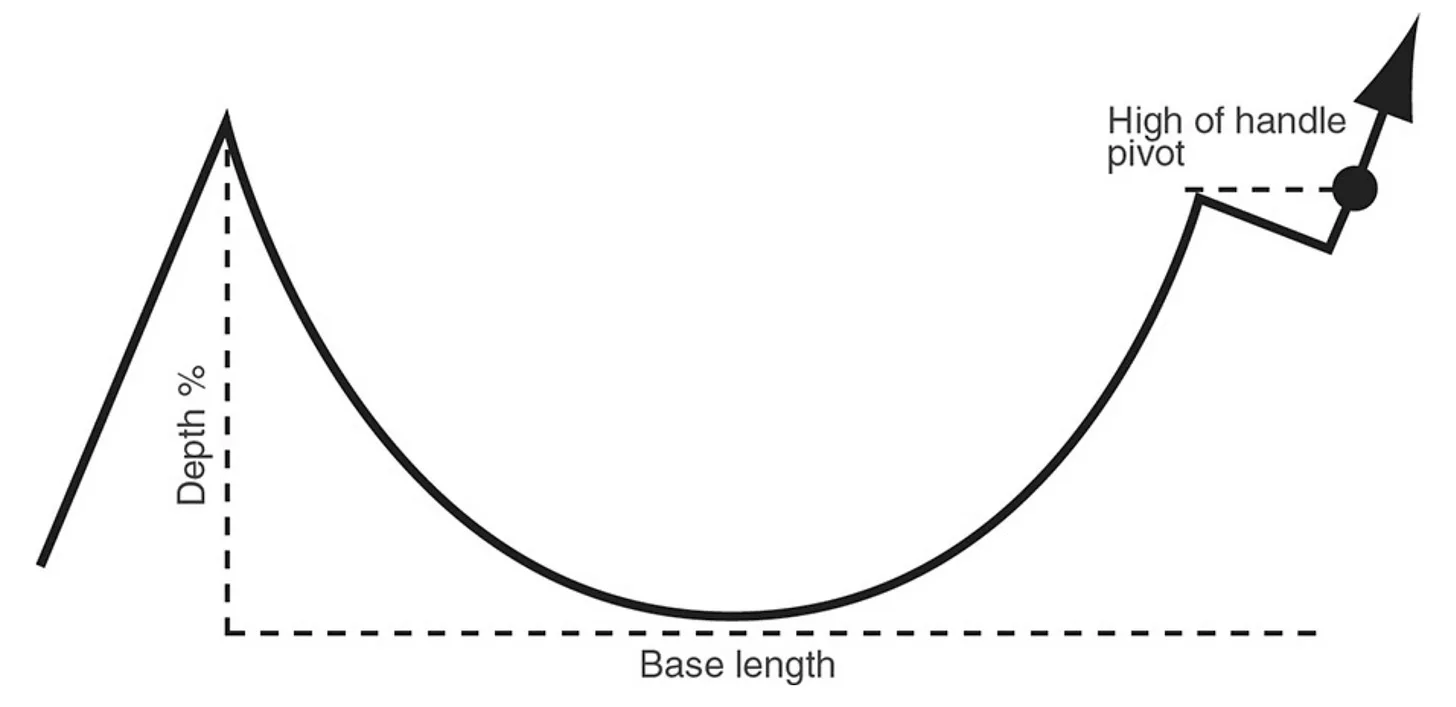
A pivot is the price level that triggers an entry from a particular setup. Depending on the structure, that might be the high of a handle, the upper boundary of a base, or the top of a final tight contraction. It does not have to be the stock’s all-time high. It does have to come from a legitimate setup that meets the requirements of your strategy.
In How to Make Money in Stocks, O’Neil explains that a cup-with-handle buy point commonly sits below the stock’s previous peak. Waiting until the stock reaches an entirely new high can therefore make a trader late to that particular entry. The correct reference point was the handle’s pivot, and some of the move had already occurred by the time the old high attracted attention.
This is why “it just made a new high” is not a complete entry plan. I want to know which structure produced the signal and where I would exit if the trade failed. Without those reference points, calling a stock either buyable or extended amounts to an impression of the chart.
O’Neil’s High, Tight Flag Challenges the Assumption
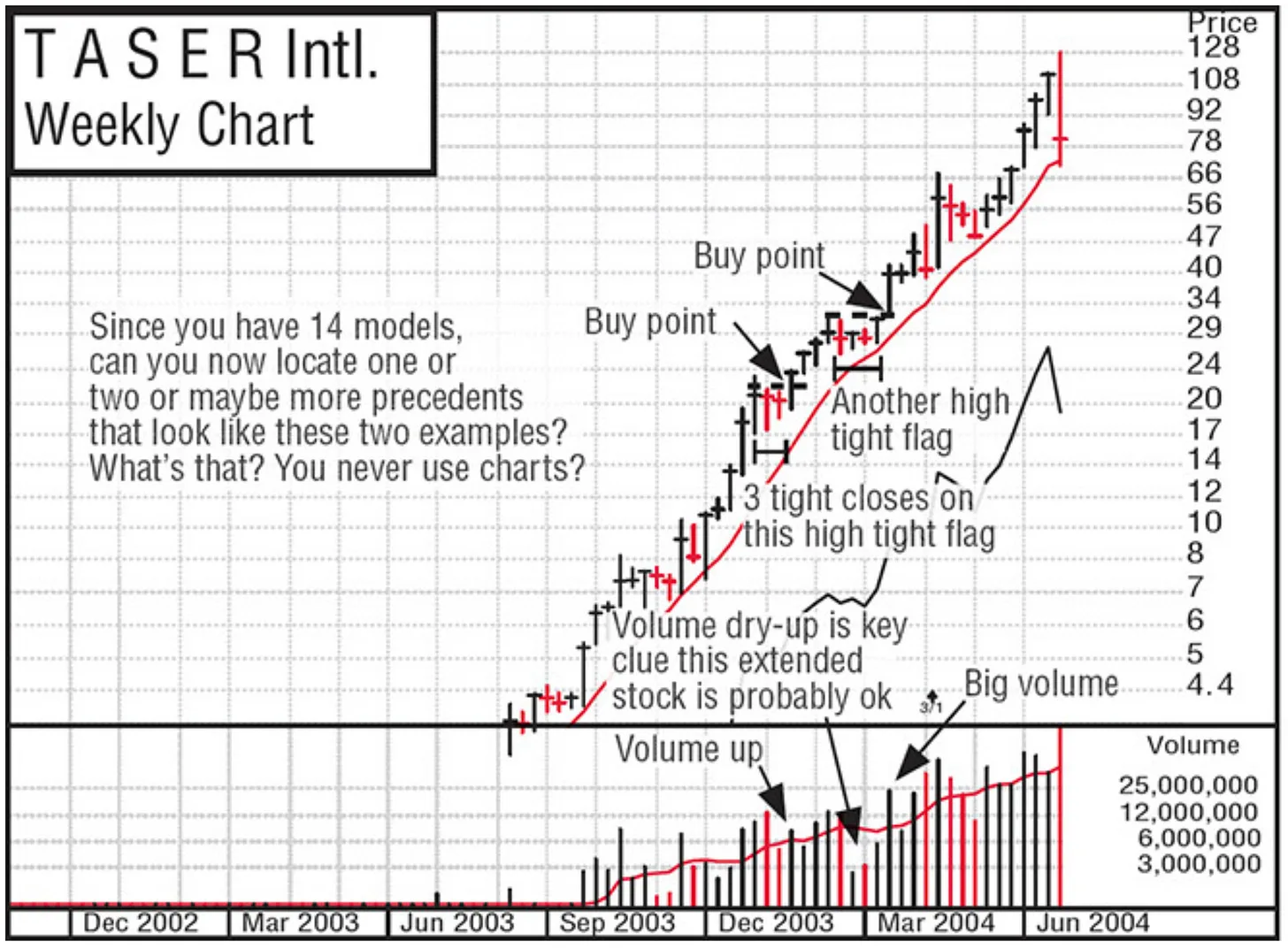
The high, tight flag is one of the clearest examples of why the prior percentage advance cannot settle the question. O’Neil describes a rare pattern that begins with a stock rising approximately 100% to 120% in four to eight weeks. It then consolidates sideways, correcting roughly 10% to 25%, generally over three to five weeks. The explosive advance comes before the setup has finished forming.
If a stock automatically became unbuyable simply because it had doubled, this pattern would have no place in O’Neil’s work. Yet he includes it among the formations associated with exceptional historical winners. He also explicitly warns that it is very risky and difficult to interpret correctly. Both parts are important: a powerful prior move can lead into a valid setup, and recognizing that setup still requires considerable judgment.
The distinction is between participating as a qualifying structure resolves and buying after price has already raced beyond its entry. A trader buying close to the new pivot may have a clearly defined trade, despite the enormous earlier advance. A trader buying another 10% above that pivot is entering under different conditions. The stock can be the same outstanding leader while the second purchase carries substantially more risk relative to the original stop.
The lesson is not to buy every stock that doubles and pauses. A brief rest does not automatically create a proper base, and proximity to a pivot does not guarantee a small or acceptable stop. The setup must earn its place on the watchlist through its structure, price and volume behavior, and the conditions surrounding it.
Minervini Makes Entry Precision Central to the Trade
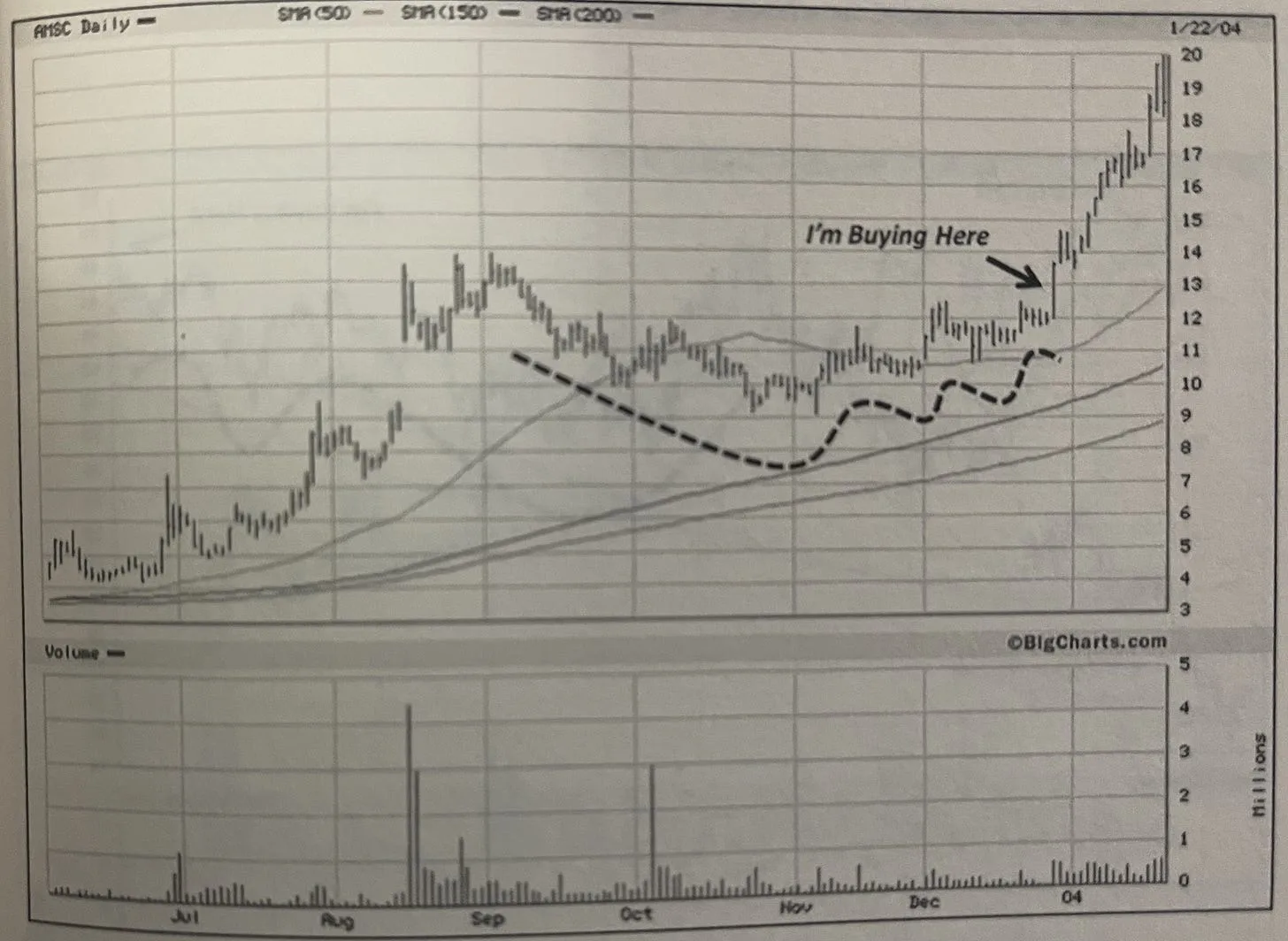
In Trade Like a Stock Market Wizard, Minervini describes the pivot as the trigger for entering a trade after the setup has developed. He emphasizes buying close to that level and avoiding a chase of more than a few percentage points. His Specific Entry Point Analysis, or SEPA, combines the stock’s technical behavior with other selection criteria to identify an attractive relationship between risk and reward.
The volatility contraction pattern (VCP) illustrates that approach. A stock advances, consolidates, and works through progressively smaller price contractions as the right side of the base develops. Volume often becomes particularly quiet during the final contraction. The trader is looking for a defined entry emerging from that structure, with a manageable point at which the trade would be considered wrong.
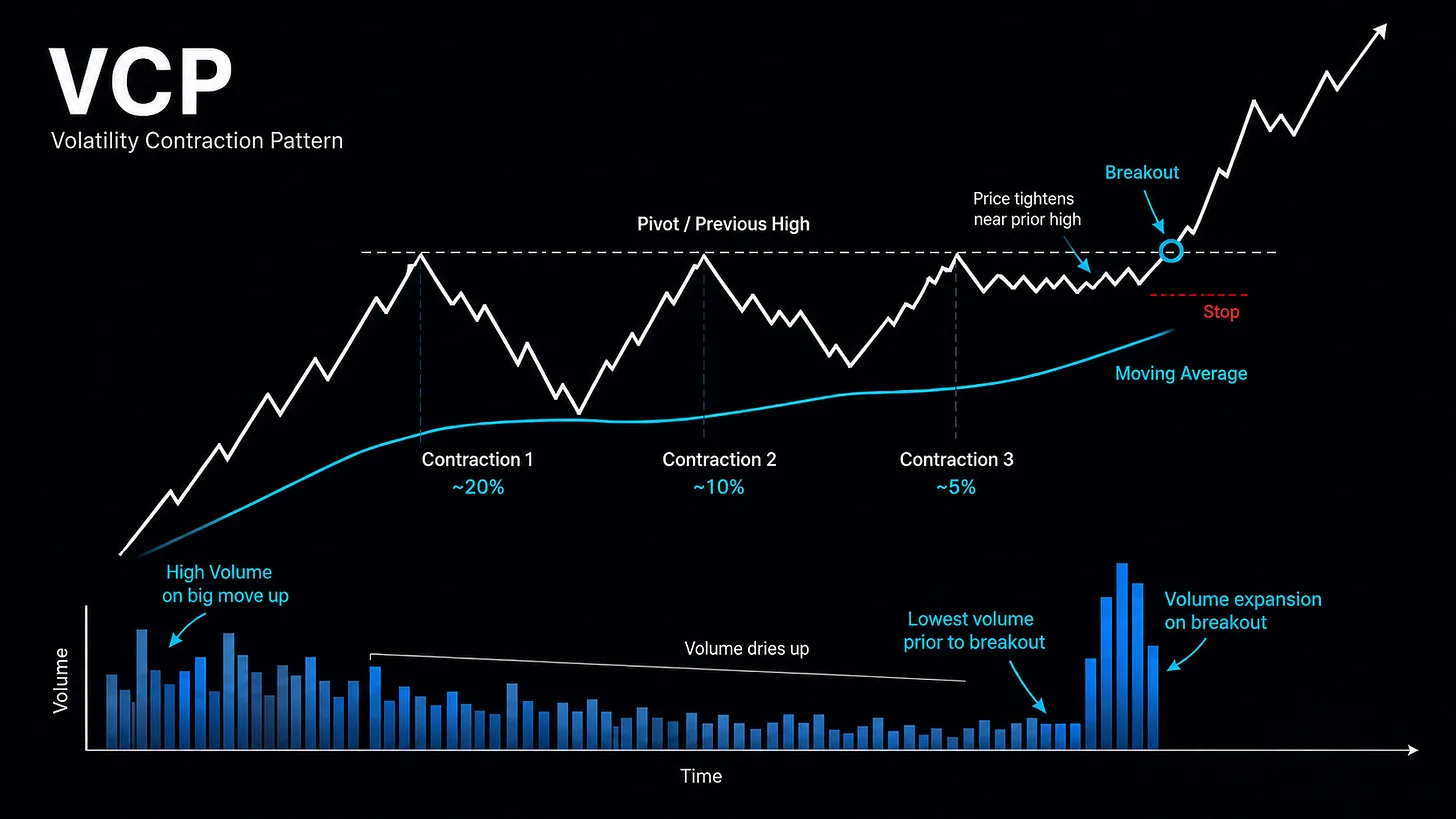
In Momentum Masters, Minervini emphasizes contracting price volatility accompanied by drying volume, while Ryan describes looking for quiet, stable, tight price action before a move. These observations give the prior advance useful context. A stock that has risen substantially and then developed a constructive consolidation deserves a different assessment from one that is still surging without a fresh setup.
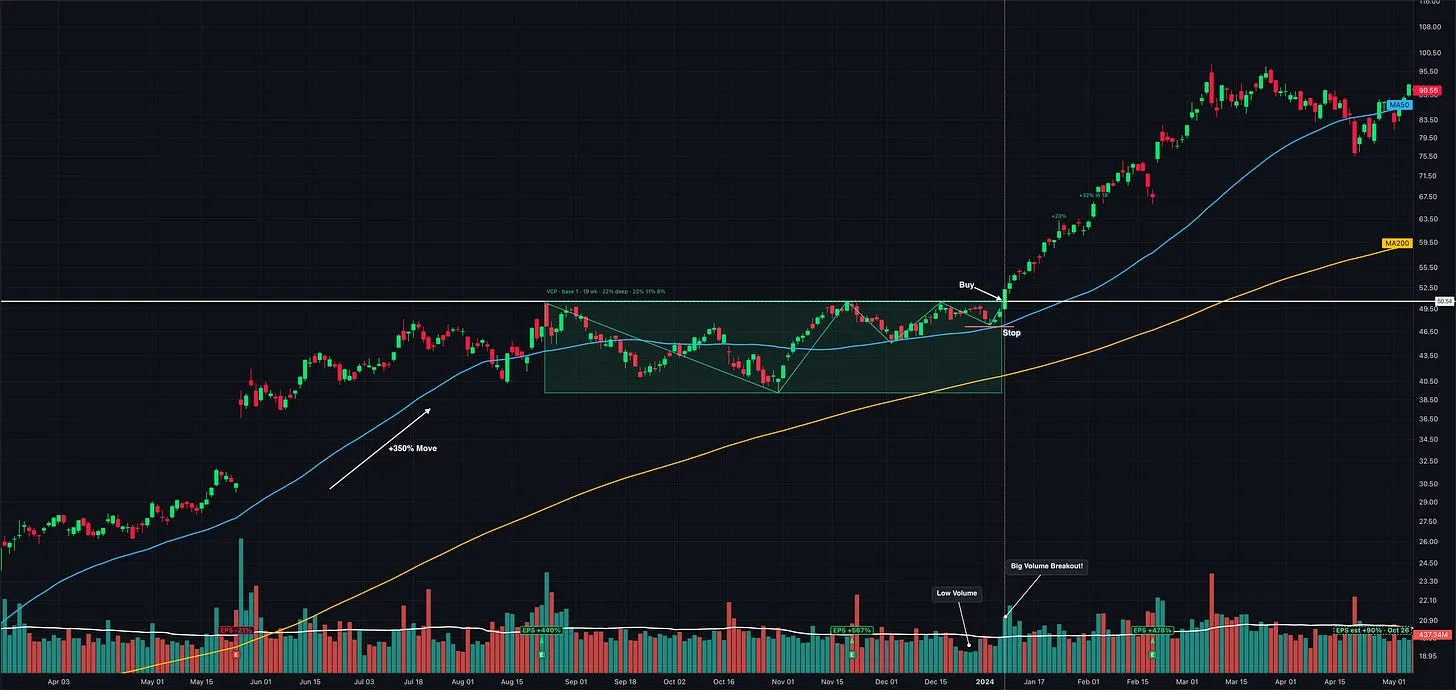
Consider the NVIDIA VCP example from the course. The important features to examine are the contractions, the final tight area, the volume behavior, and the pivot that the structure produced. Buying as that setup triggers is a different decision from waiting until price is 10% above it. NVIDIA might remain strong in both cases, but the later buyer has missed the entry being analyzed.
Ryan Learned to Buy Strength Without Chasing It
Ryan makes the distinction unusually clear in Momentum Masters. Discussing mistakes from early in his career, he says he discovered he was buying too many stocks “extended from their breakout point.” Correcting that mistake helped his performance. In the same answer, he explains that he also had to become comfortable buying stocks making new highs.
Those lessons fit together. A new high can be evidence of strength, while an entry too far beyond the relevant breakout can still be poorly timed. Learning to buy strength requires knowing where that strength becomes actionable within your strategy. It does not require paying any price once a stock starts attracting attention.
Ryan also discusses how major winners can make multiple advances over a year or two, forming additional bases along the way. That means a stock can offer more than one opportunity during a larger move. Each later setup still needs its own assessment, because a new base does not erase the stock’s history or guarantee that another advance will follow.
If the First Entry Gets Away, Wait for Another Setup
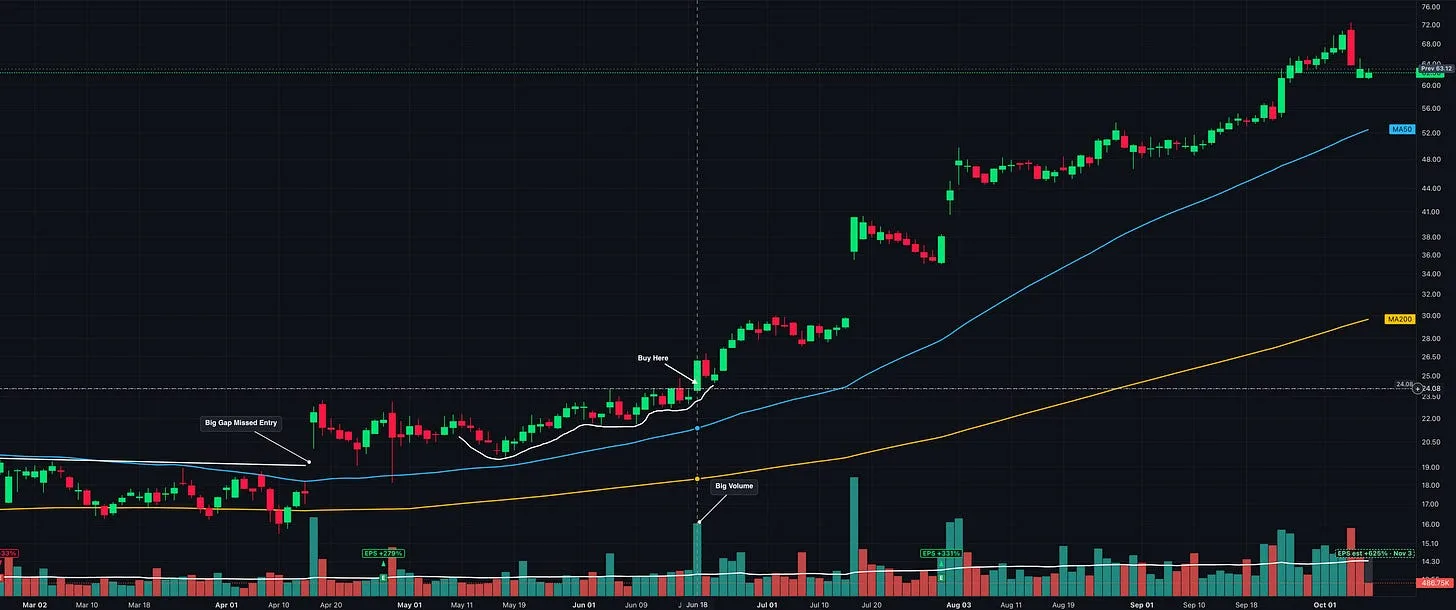
Dan Zanger describes this situation directly in Momentum Masters. He does buy gaps, but the distance above his intended entry is important. “Never chase a stock that is up more than 3–5% above its pivot or breakout area.” he explains. When that happens, his usual response is to wait: “In these high-gap situations, I will wait until a small minibase sets up and then buy as it moves above that pivot area on volume.”
That emphasis on consolidation and volume also appears in his discussion of flags and pennants. He focuses on brief pauses following strong moves, with volume generally contracting during the pause and increasing on the breakout. Zanger’s Golden Rules also make clear that reaching a listed buy point does not automatically make a stock a purchase. He evaluates the stock’s price action, its volume, and the overall market environment.
Zanger does acknowledge rare exceptions. Following an extraordinary earnings report from a major company, he has occasionally bought an initial gap beyond his usual limit. In those situations, he describes starting with about one-fifth of his normal position and potentially adding over the following days if the stock holds its gap and continues to act well. He presents those trades as exceptions to his rules; his usual response to an excessive gap is to wait for a minibase and another breakout.
Paying 5% More Can Change the Risk Dramatically
An entry a few percent above the buy point can seem harmless when a stock is moving quickly. But if the same technically justified stop and potential exit still apply, every additional dollar you pay increases the planned risk per share while reducing the remaining upside. That changes the trade’s potential R multiple: how much you could make relative to the amount you initially plan to risk.
The illustration below shows how quickly that relationship deteriorates. With a $97 stop and a hypothetical $120 exit, buying at $100 offers approximately 6.7R of potential reward. Paying $105 reduces that to about 1.9R, while paying $110 reduces it to less than 1R. The stock, stop, and hypothetical exit are identical; the entry price changes the calculation.
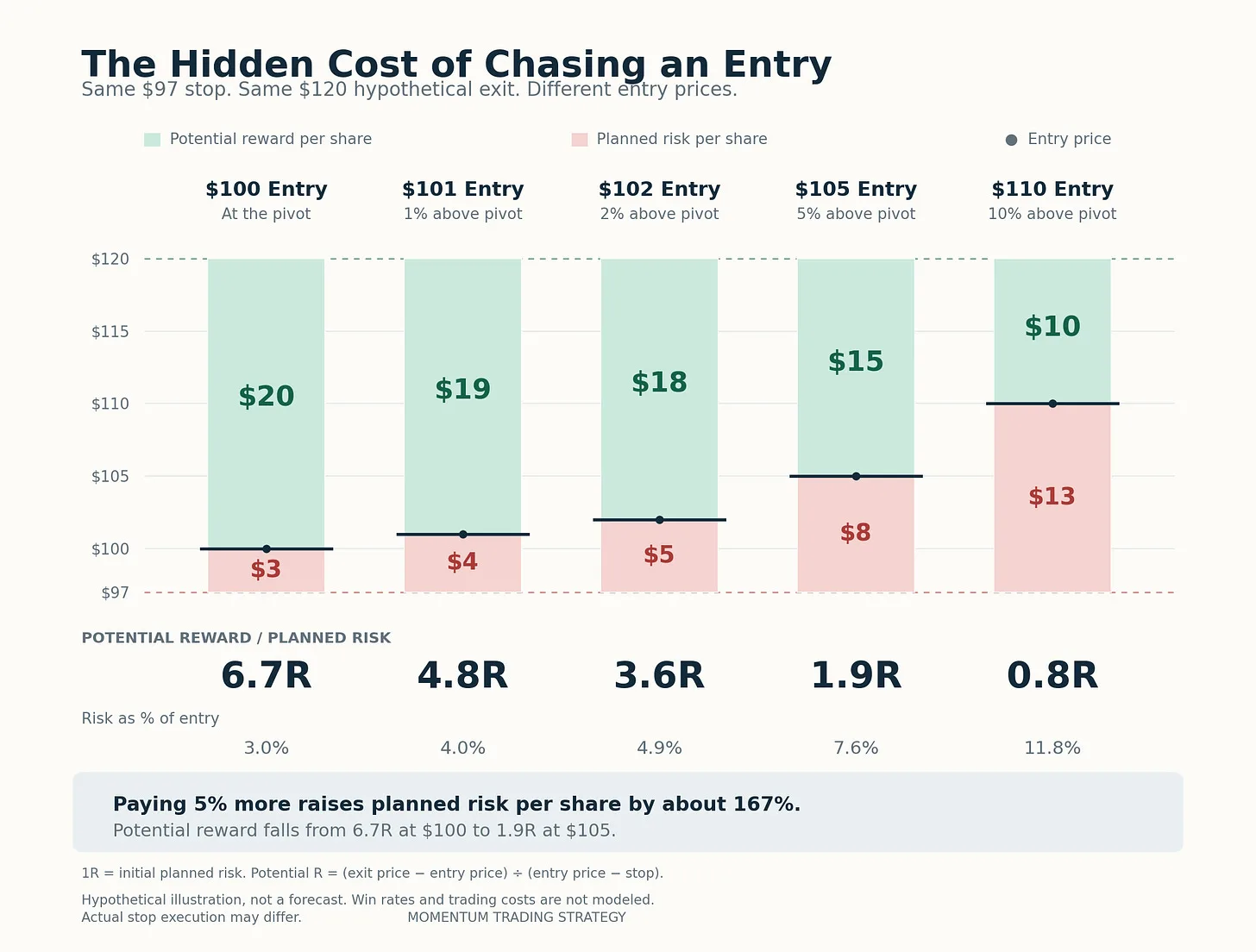
That helps explain why a published 5% buying limit should not be treated as a target. In an IBD Live interview, Mark Minervini described an even tighter tolerance, saying he did not want to buy more than 1%–2% above the pivot. Even a small difference in entry price can materially change the relationship between potential reward and planned risk.
This matters across hundreds of trades. A late entry can still produce a winner, but repeatedly paying more for the same opportunity can reduce the size of your winners measured in R. If your win rate and trade management do not compensate, that deterioration can consume an otherwise profitable edge. Long-term results depend on the combination of win rate, average gains, average losses, and trading costs.
Reducing position size can keep the account’s planned dollar risk within your limit, but it does not restore the original reward-to-risk relationship. Moving the stop closer only helps if that tighter stop makes sense for the setup. If a new consolidation develops with a new pivot and a different valid stop, you can evaluate it as a new opportunity. Until then, paying more changes the terms of the trade.
There Is No Universal Percentage for Every Setup
These traders share a commitment to buying with precision, but their stated limits differ. In an IBD Live interview, Minervini said he did not want to buy more than 1%–2% above the pivot. In Momentum Masters, Ryan’s discussion of adding to positions allows up to 10% above the original buy point in a strong bull market, with a 5% limit in a weak market lacking follow-through. Zanger’s concluding rules advise against chasing more than 3%–5% above a pivot or breakout area.
Those differences make context essential. A percentage that fits one trader’s setup, market environment, and risk controls may be too loose for another’s. A maximum allowance is not an ideal entry, and Ryan’s comments about adding to an existing position should not be presented as a universal rule for initiating one. For the tighter entries I look for, even a small delay can materially increase the distance to the stop and reduce the potential reward relative to risk.
Being within a stated buy range does not automatically make an entry attractive. I still need to evaluate the setup’s quality, the stock’s volatility, the market environment, and the risk from my actual purchase price. I aim to execute close to a valid trigger, with an appropriate position size and a stop that allows for normal price movement. If the entry no longer offers the relationship between risk and potential reward I require, I can wait for another setup.
Keep the Broader Chart in View
There is another legitimate use of “extended” that deserves attention: a stock can become stretched above a moving average or an important support area. In Secrets for Profiting in Bull and Bear Markets, Stan Weinstein describes how a Stage 2 stock can become unattractive for a new purchase when it trades far above its moving average and support, even while remaining a hold for an existing investor. His discussion addresses the broader position of the stock within its advance. That context still matters when evaluating a potential entry.
The chart below illustrates this kind of extension. The yellow dots mark extension alerts as price moves well above the 50 day moving average. Notice that the first alerts appear before the stock finishes advancing: price continues higher before the later pullback. The alerts draw attention to how stretched the move has become, without guaranteeing that the advance is over.
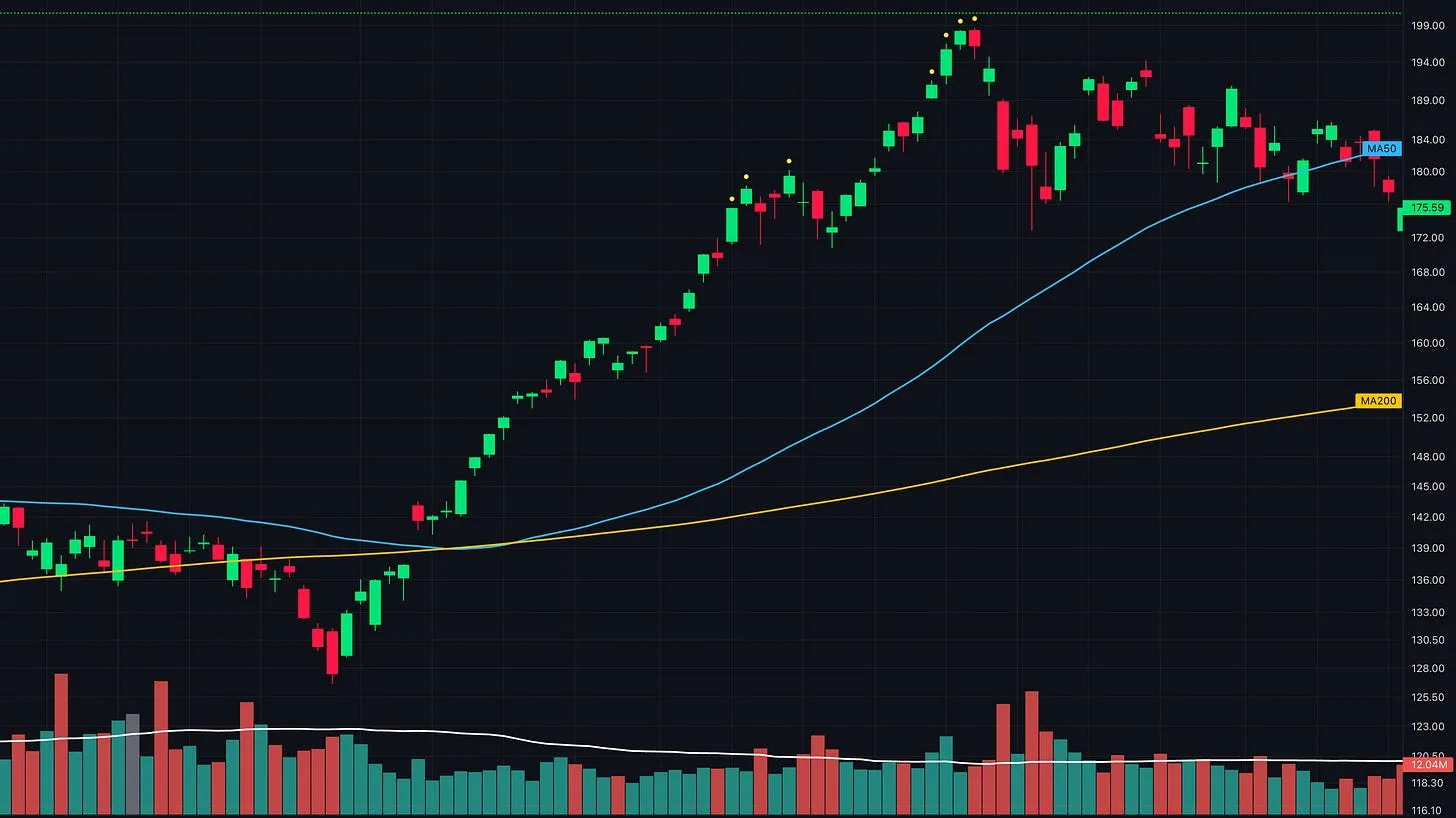
A stock can therefore sit near a new short-term pivot while still being stretched on a longer timeframe. I consider both observations when deciding whether the setup deserves capital. A fresh pivot does not erase a mature trend, a climactic advance, or an unfavorable market environment. Distance from the pivot helps me assess entry precision; the broader chart helps me judge the opportunity surrounding that entry.
The reverse matters, too. Becoming extended from an original buy point does not automatically mean an existing holder should sell. A stock can be unattractive for a new purchase while still deserving room within an existing position’s management plan.
Find the Entry Before Judging the Extension
This is why I called Module 5 of the MTS course Precision Entries. Finding a strong stock is one skill; recognizing its setup and executing while the risk remains acceptable are additional skills. You can identify an exceptional company, understand its growth story, and correctly recognize its leadership, then undermine the trade by buying too far beyond the entry you planned.
Before I call a stock extended, I want to identify the setup, the price that triggers the trade, and the level that would invalidate it. Then I compare the current price with those reference points. If the original entry is gone, I can wait for another qualifying setup or move on. There is no requirement to turn a good stock into an immediate trade.
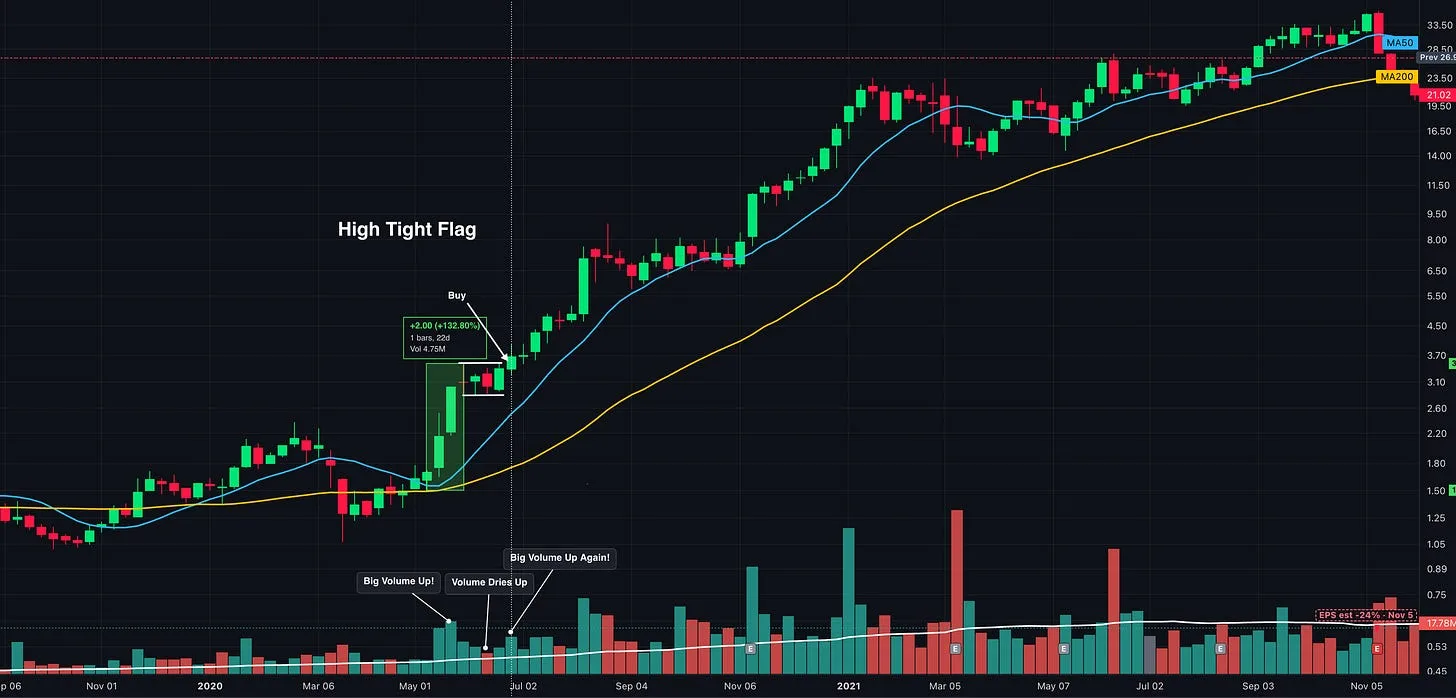
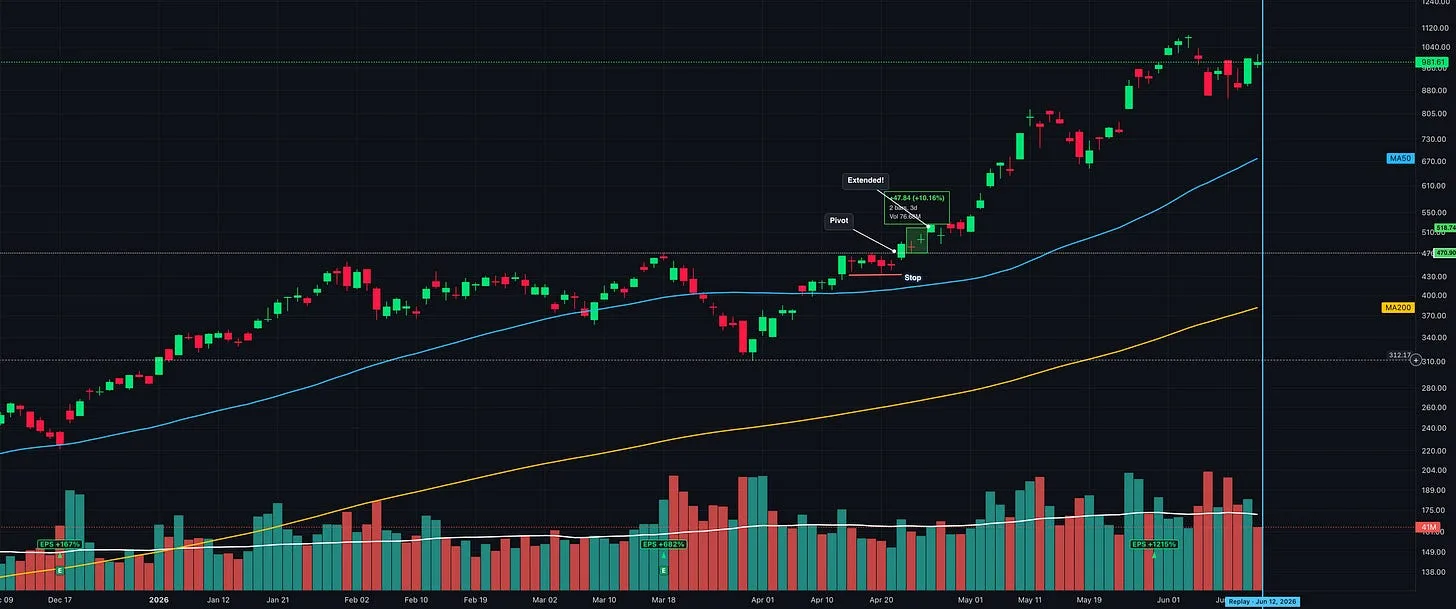
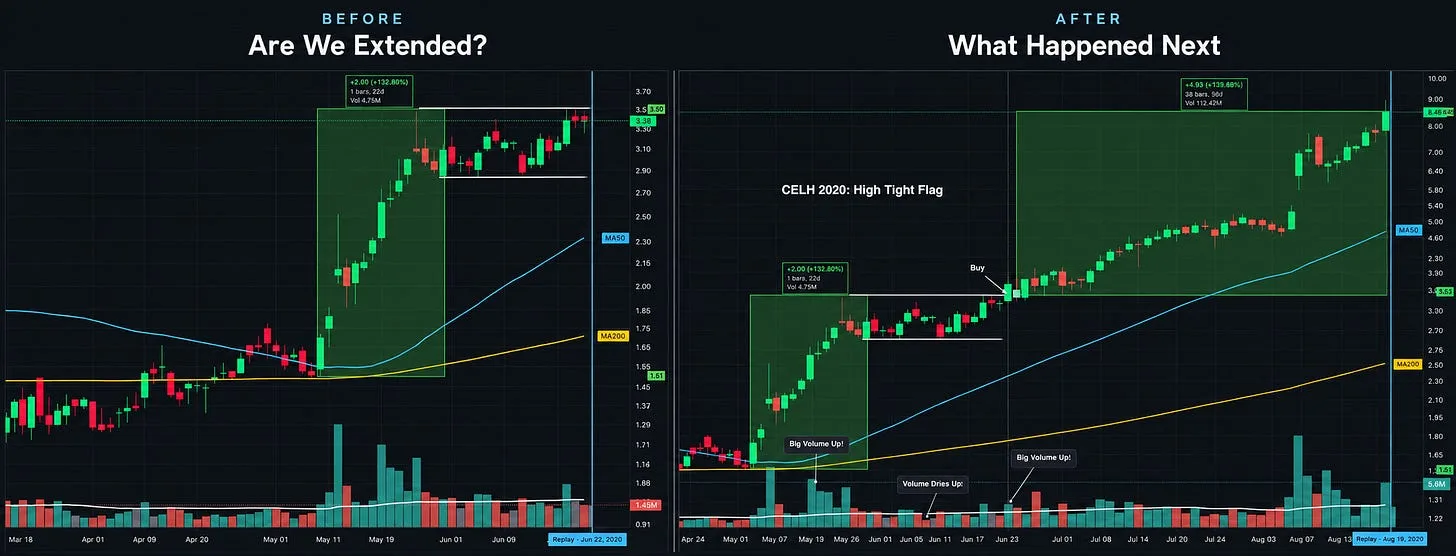
Now return to the chart that opened this article. CELH had already risen more than 100%, and when I share setups like this, I regularly hear the same objection: “It’s too extended.” But that advance was followed by a high tight flag, with a consolidation, drying volume, and an identifiable breakout level. The opportunity was to recognize that setup and prepare to act if price cleared the pivot with supporting volume and acceptable risk. Dismissing it solely because it had already doubled would have overlooked the new entry developing on the chart.
The image on the right shows what happened next. We could not have known the size of that subsequent advance beforehand, but we could have identified the setup and planned the trade. A stock that has risen 100% can develop another valid opportunity, while one that has risen much less may already be too far above its own buy point.
The useful question is: At this price, am I still getting the entry and risk profile that my setup was designed to provide? Answering that requires more than measuring how far a stock has already climbed. It requires finding the entry.
More in Strategy & Tactics
All Strategy & Tactics articles →
Sep 27, 2026 · Strategy & Tactics
Should You Follow Leading Stocks or Wait for Market Confirmation?
How to read the market, industry groups, and individual stocks together so you can recognize opportunities, build exposure, and respond when conditions change
- growth stocks
- CANSLIM
- Trading
- position trading
- Stan Weinstein
- William O'Neil
- Momentum Trading Strategy
- Trade stocks
Sep 25, 2026 · Strategy & Tactics
Stage Analysis: How to Spot Stage 3 in Real Time
Recognize a developing Stage 3 using Stan Weinstein’s framework, with real chart examples, warning signs, and lessons for protecting your gains
- Momentum Trading
- Nasdaq
- technical analysis
- CANSLIM
- position trading
- Stan Weinstein
- QQQ
- Find True Market Leaders

Sep 9, 2026 · Strategy & Tactics
100+ Years of Winning Stocks: The Patterns That Keep Repeating
A decade-by-decade video walkthrough of the trends, setups, and buy points behind some of history’s biggest stock market winners.
- how to make money in stocks
- Momentum Trading
- technical analysis
- position trading
- Growth Stock Trading
- biggest winning stocks
- William O'Neil
- Cup with handle