Momentum Trading Strategy

Notes

Short lessons on momentum trading, every day.

Every note from Substack, in one place: risk, setups, leading stocks, market conditions and the mindset behind them. Search them, browse by topic, or filter by stock.

Showing 481–500 of 1226 notes

View on Substack ↗

The Stock Market’s “Great Paradox”

William O’Neil talked about what he called one of the stock market’s great paradoxes.

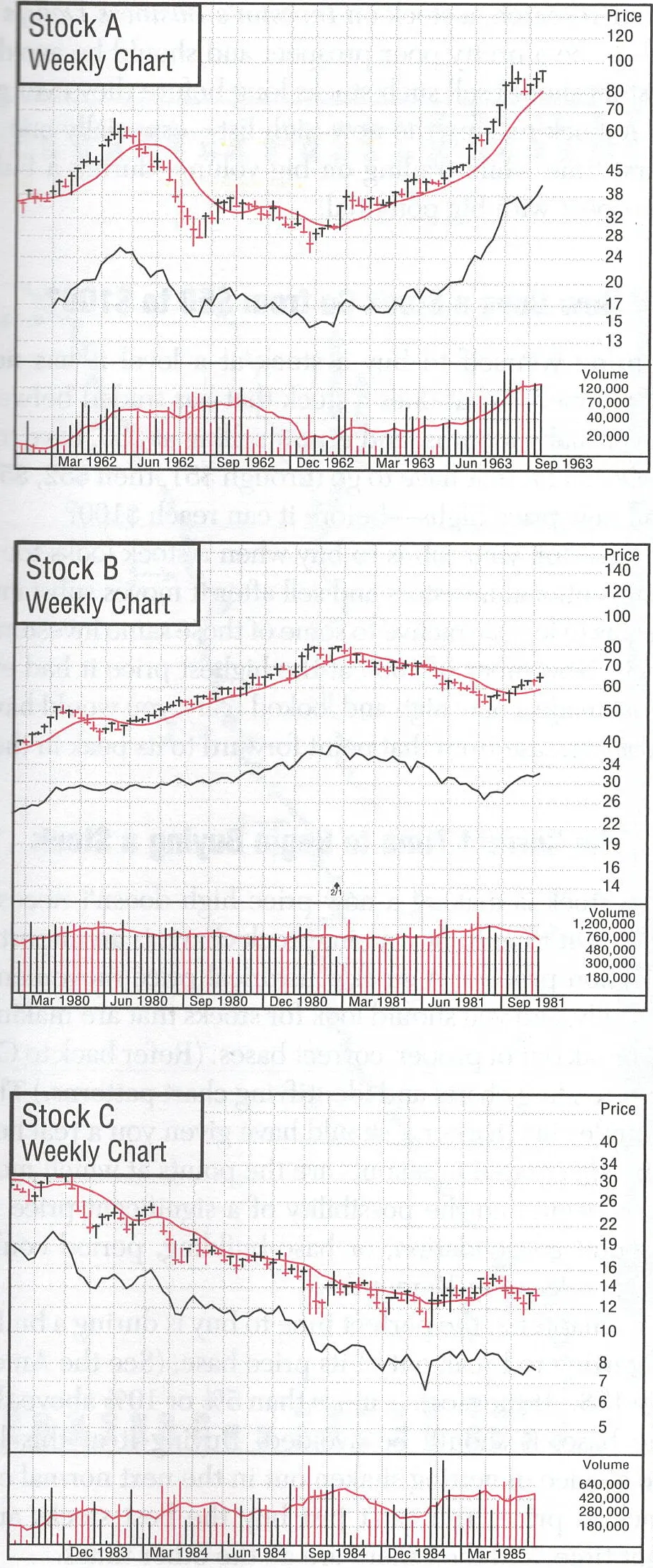
Before explaining it, he showed three charts and asked a simple question:

Which stock would you buy?

  • Stock A?

  • Stock B?

  • Stock C?

I’ll follow up with O’Neil’s answer, which I completely agree with.

But before I do, be honest:

Which one would you buy?

View on Substack ↗

The Simplest Screen Most Traders Ignore

One simple screen you can run daily and every weekend:

The New Highs List.

Look at what stocks are making new price highs.

That may sound basic, but this is how many of the greatest growth stock investors and momentum traders have found big winners for decades.

A lot of people forget this part of CANSLIM too.

The N does not just stand for new products or new services.

It also includes:

New price highs.

Remember, the strongest stocks often look “too high” before they go much higher.

View on Substack ↗

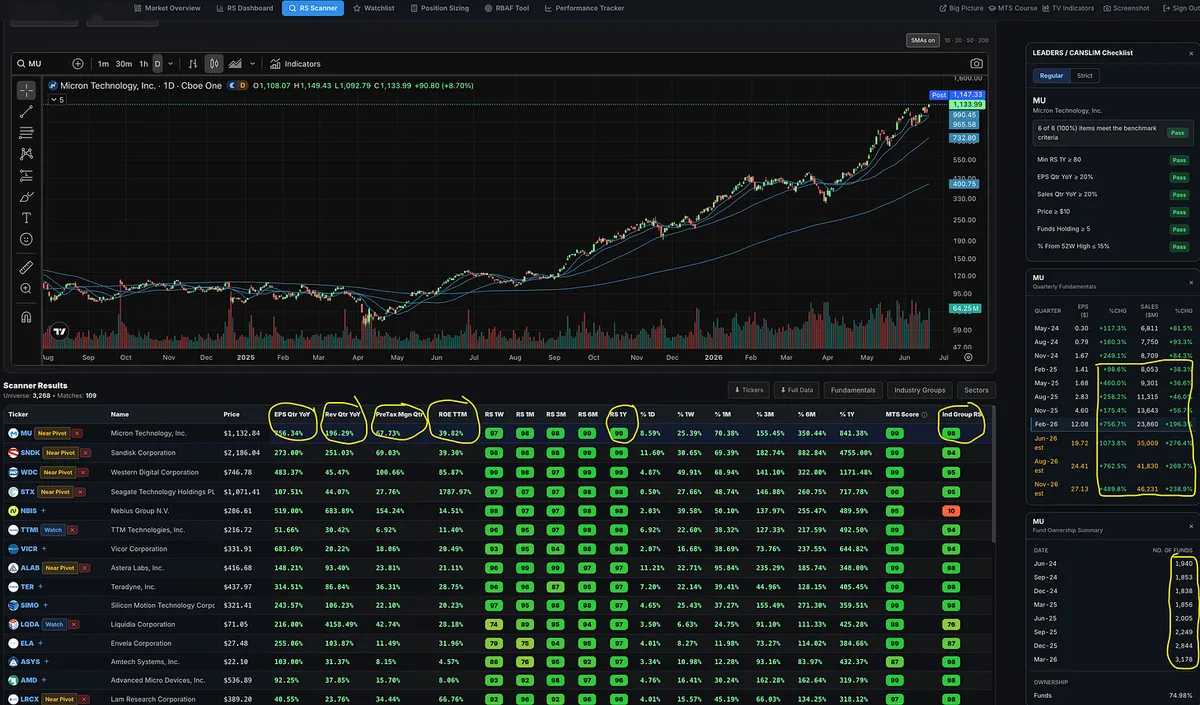
Why Waste Time on B+ Stocks When A+ Stocks Exist?

This is the type of screen I care about most.

  • Strong sales.

  • Strong earnings.

  • Strong margins and/or ROE.

  • Top-tier relative strength.

  • A leading industry group.

  • Funds increasing quarter after quarter.

  • And most importantly, price confirming with higher highs and higher lows.

That is an A+ growth stock profile.

This is not some new idea either.

This is what O’Neil taught. It is what Minervini looks for. It is what David Ryan studied. It is what Dan Zanger used.

The details may vary from trader to trader, but the foundation is very similar.

Remember, institutions drive major sustained moves. Retail does not.

When I see rising sales, rising earnings, good margins and/or ROE, and funds increasing quarter over quarter, I know the stock has the ingredients of a potential major growth leader.

Then price has to confirm it.

Plenty of names have strong fundamentals, but price is saying NO.

Plenty of names have price moving higher, but without the sales, earnings, margins, ROE, or institutional support behind it, the move is less likely to last. Think CAR in April 2026.

And yes, this is an ideal screen.

Most of the time, you will not get every single ingredient. That is okay.

Sometimes I trade stocks with big sales and earnings growth, but margins or ROE are not great yet. Sometimes fund ownership is flat instead of rising. Those stocks can still work.

But I know they are NOT as high quality as a stock that has everything lining up at once.

So if there are big liquid names showing all the characteristics, why waste time forcing trades in lower-quality stocks?

When the fundamentals are strong, funds are building positions, the group is acting well, and price is confirming, that is where I want my focus.

View on Substack ↗

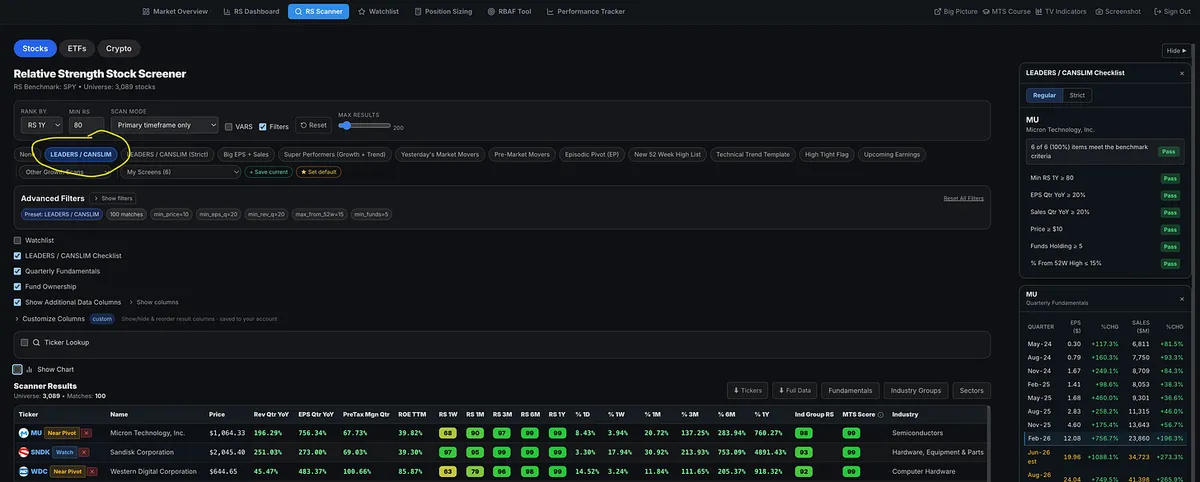
Stop Waiting for Someone to Hand You the Next Big Winner

If you are struggling to find the big winning stocks, you do not need to wait around for me or anyone else to tell you the names.

Open the Relative Strength Stock Screener and click the Leader / CANSLIM preset stock screen.

You will immediately see many of the market’s strongest names near the top of the list.

As you scroll through the list, some names will be extended. Those go on your watchlist so you can wait for the next proper pullback or setup.

Some will be near pivot points.

Some will already be actionable.

That is the entire point of the screener.

It is not there to overwhelm you with tickers. It is there to help you quickly identify where the real leadership is.

This is the same exact process I have used to find and share many of the biggest winners since January.

Names like:

SNDK

MU

AAOI

AXTI

DELL

CIEN

LITE

WDC

STX

SIMO

and many more!

Your job is to build the habit of checking the list, following the leaders, managing risk, and being ready when the setup appears.

Everything you need to learn the process is inside the Momentum Trading Strategy Course. I also provide a list of books that teach many of the same timeless principles.

Learn the process.

Use the tools.

Trust yourself.

You can do this.

View on Substack ↗

Your Trading Is Too Complicated

Steve Jobs built around focus and simplicity.

Say no. Remove what does not matter. Make the product so clean that the user knows exactly what to do.

Elon Musk has pushed a similar idea from an engineering angle.

Question everything. Delete what is unnecessary. Simplify.

Trading is not much different.

Most traders think the market is an intellectual battle.

More indicators. More opinions. More news. More podcasts. More setups. More screens. More tickers.

But more information does not always create better decisions.

A lot of the time, it creates hesitation, confusion, and emotional noise.

The brain under pressure does not need more complexity.

It needs clarity.

That is one of the biggest psychological traps in trading.

Complexity feels intelligent.

Simplicity feels too basic.

So traders keep adding more and more to their process because it gives them the feeling of control.

But feeling in control and actually being in control are two different things.

  • Understand the general market environment.

  • Find the strongest stocks in the strongest groups.

  • Wait for proper setups.

  • Define your risk.

  • Size correctly with proper position sizing strategies.

  • Cut losses.

  • Sit with winners.

  • Repeat.

That is not sexy.

But it works a lot better than constantly adding more fluff to avoid doing the boring simple things.

Steve Jobs simplified products.

Elon Musk simplifies systems.

Traders should simplify their process.

View on Substack ↗

Most Traders Only Notice the Breakout After It Is Too Late

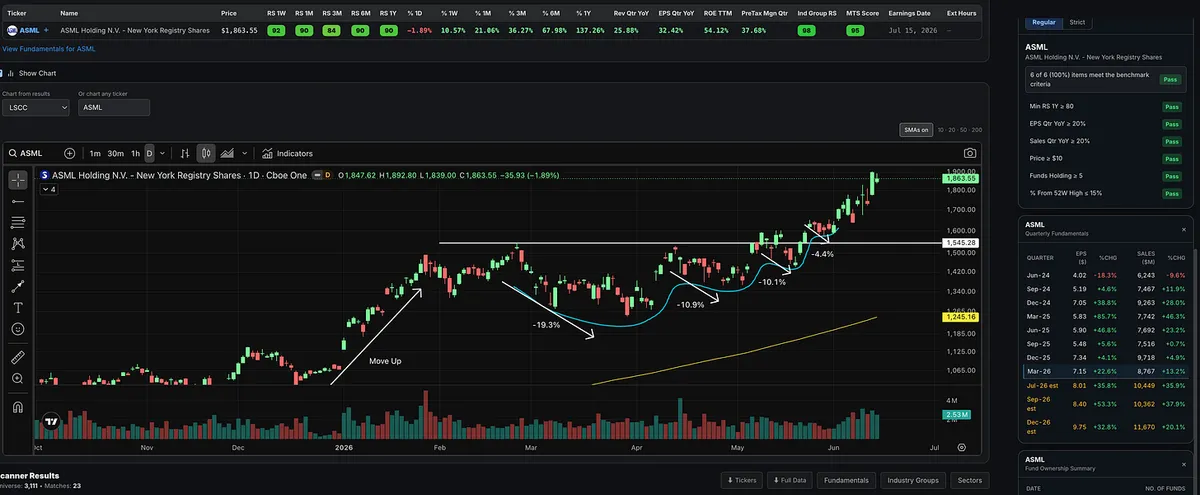
ASML is a good example of why price action matters.

Before the breakout, the stock built what looks like a Minervini-style VCP.

The contractions were roughly:

-19.3%

-10.9%

-10.1%

-4.4%

That is volatility contraction.

Not perfect, but it clearly showed the characteristics of tightening up the right side of the chart.

The stock held near the upper part of the base, tightened up, and then broke through the pivot area around $1,545.

Volume dried up on the final contraction, and demand started coming back in as price moved higher.

The breakout volume was not massive, so it was not textbook perfect, but the bigger point is that supply was drying up before the move.

That is the kind of setup growth traders should train their eyes to find.

Tighter price action.

Smaller pullbacks.

A setup that allows for tight risk and the potential to make multiples of what you risk.

View on Substack ↗

Most Traders Miss This Part of CAN SLIM

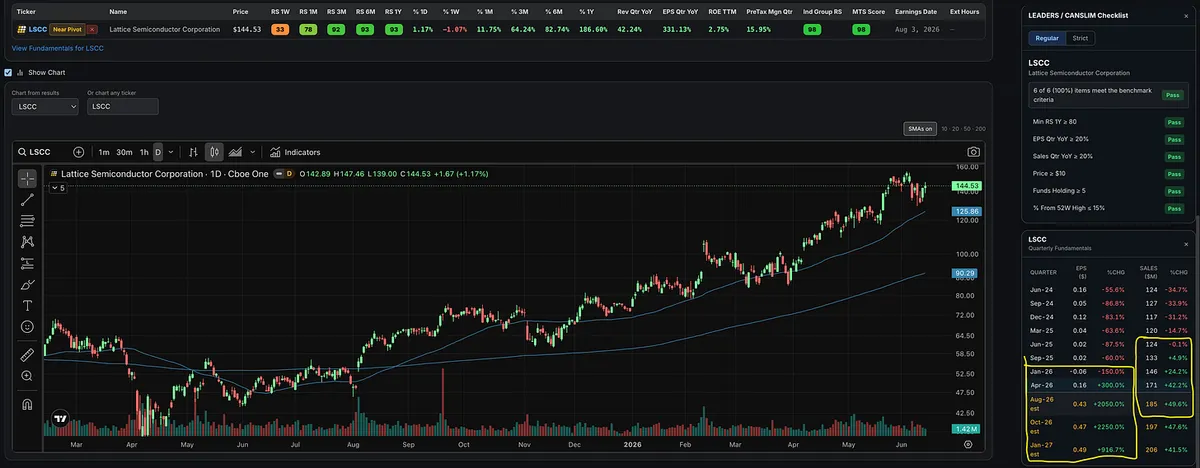
This is what acceleration looks like.

One thing I teach inside the Momentum Trading Strategy Course is that it is not just about finding stocks with big earnings and big sales.

It is also about spotting the turnaround and the acceleration.

That is exactly what you can see here with LSCC.

Sales went from negative year-over-year quarterly growth…

To positive…

To accelerating.

And as sales improved, earnings started to improve too.

Now the forward estimates are showing a major ramp.

LSCC is not just showing strong relative strength.

It is also showing the type of fundamental acceleration that growth stock traders should be paying attention to.

This is not something I made up.

William O’Neil talked about this.

Mark Minervini and David Ryan have talked about this.

The best growth traders are not only looking for big numbers.

They are looking for whether the numbers are getting better or getting worse.

A stock with decelerating growth can look great on the surface, but the market may already be moving past it.

A stock going from negative growth, to positive growth, to accelerating growth can be the start of a major institutional re-rating.

That is what I like about LSCC here.

  • Strong price action.

  • Strong relative strength.

  • Improving sales.

  • Improving earnings.

  • Big forward estimates.

That is the kind of combination I want on my radar.

View on Substack ↗

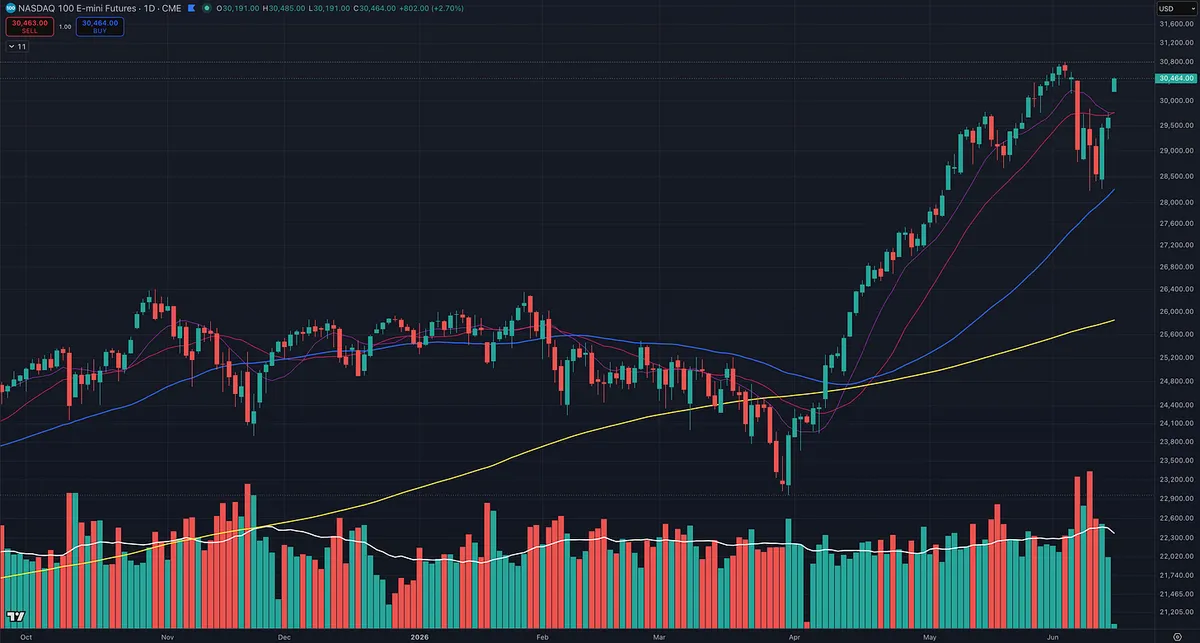
Before You Chase the Next Breakout, Step Back

Like I say every week, before you dive into individual stock screening and selection, step back and understand the market environment and the big picture.

The weekend is the perfect time to do this while the market is closed.

The Nasdaq-100 held the 10-week moving average this week, breadth improved, net new highs stayed positive, and volatility cooled.

But the market has not fully repaired last week’s warning shot. QQQ and SPY still need to reclaim the 10-day and 20-day moving averages, distribution days remain elevated, and short-term leadership is rotating beneath the surface.

Stepping back and reviewing the big picture can give you clarity before stock screening and help you ask the right questions:

  • Which stocks held up best during the pullback?

  • Which names are already moving to new highs while the major indexes are still repairing?

  • Which groups are attracting new demand?

  • Which stocks are continuing to lead?

That is where the next watchlist starts.

Read the Big Picture Market Pulse here:

https://tradingmomentum.substack.com/p/the-nasdaq-held-the-10-week-now-comes

On SubstackBig Picture Market Pulse | June 14, 2026: The Nasdaq Held the 10-Week. Now Comes the Real Test
View on Substack ↗

Everyone Wants the Next SNDK. That’s Why They Missed This One.

Most traders do not need more tickers. They need to learn how to recognize a real leader, manage risk, and stay with it until the evidence changes.

I shared SNDK back on January 22nd, and I’ve continued posting about it both publicly and inside the paid subscriber chat.

Yet I still get asked the same thing:

“What’s the next one?”

That is usually the sign of a beginning trader.

When you find a true market leader, the goal is not to immediately abandon it and go hunt for something else. The goal is to ride the move until the evidence changes.

That does not always mean you buy once and hold one full position forever.

  • You can trade around it.

  • You can sell some and hold some.

  • You can get stopped out and re-enter on a new setup.

  • You can even sell all of it and buy it back later when the stock gives you another proper entry.

But in a bull market, it is usually the same small group of names that drive most of the real performance.

Most people lose patience every time a leader pulls back, rests, or gets quiet.

Instead of waiting for the next proper entry in the strongest names, they start chasing random tickers that have not proven anything.

Meanwhile, the real leaders keep leading.

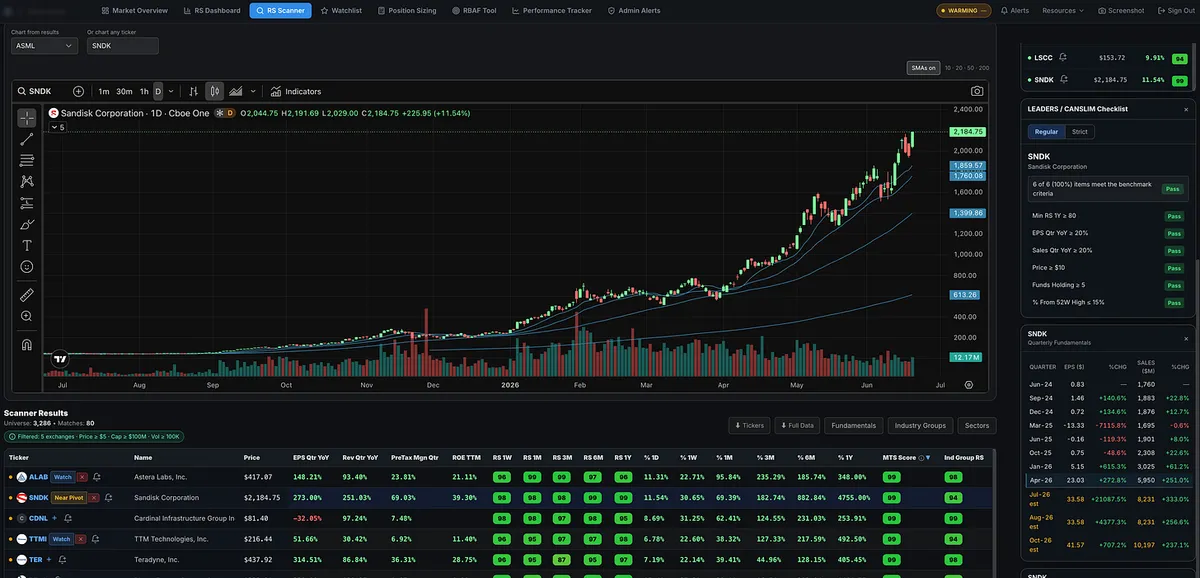
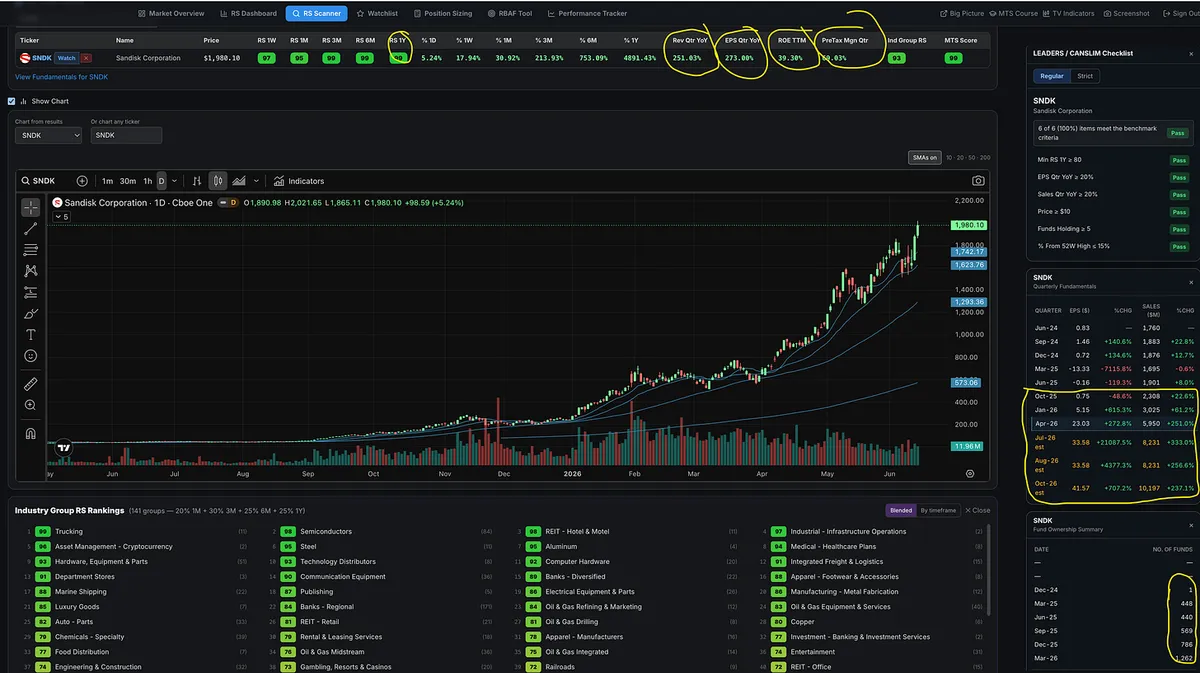
Look at SNDK.

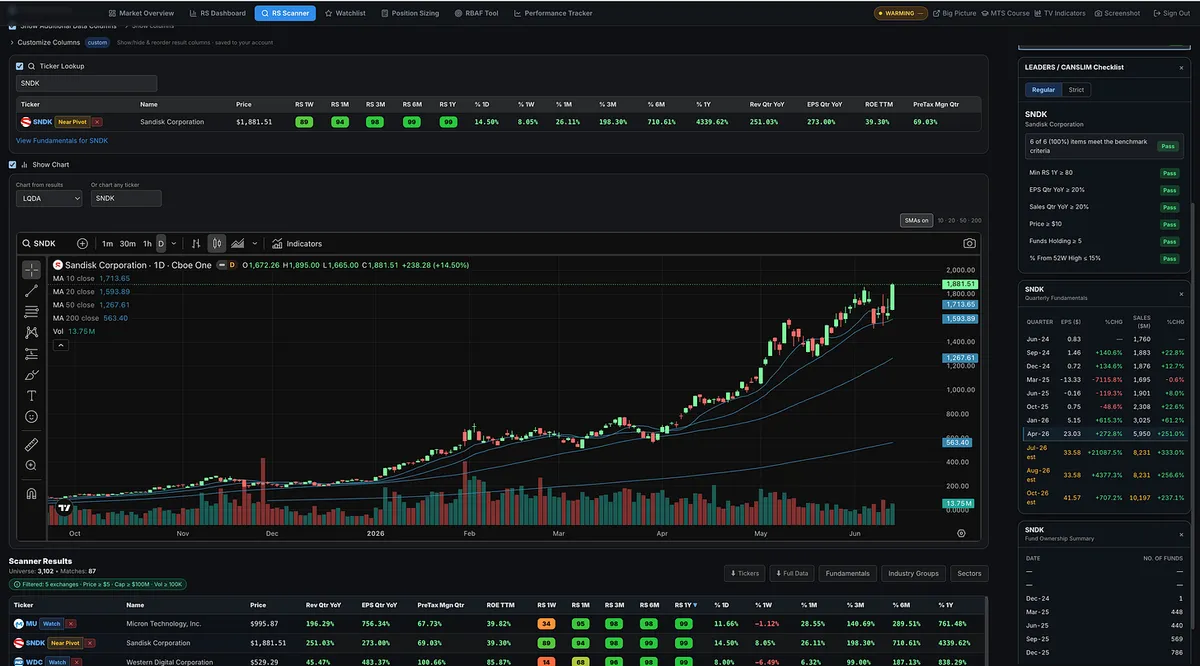
Price action has been screaming leadership. Relative strength across multiple timeframes is among the best in the market. The industry group is strong. Earnings are accelerating. Estimates are accelerating. Sales are accelerating too, which tells you this is not just a cost-cutting story.

There is real fuel behind the growth.

Funds are accumulating.

Return on equity is strong.

Pre-tax margins are strong.

The stock is tied directly into one of the biggest themes in the market: AI infrastructure and data demand.

So at some point you have to ask:

What else are you looking for?

This is CAN SLIM growth stock in real time.

And for the people who say they do not care about fundamentals, that is fine too.

It is not a coincidence that SNDK has also been showing up as a strong trend name for systematic trend followers.

Ed Seykota has had it listed on his Strong List.

One of the greatest systematic trend followers of all time is seeing the same thing CANSLIM growth stock traders are seeing.

Different methods.

Same conclusion.

Leadership.

When all of these things are lining up, the job is not to keep begging for new tickers.

The job is to recognize leadership, manage risk, and stay with the name until the evidence changes.

That is where the big money is usually made.

View on Substack ↗

Not sure how to define the current market environment?

Dr. Van Tharp broke the market down into 6 different market types:

Bull Quiet

Bull Volatile

Bear Quiet

Bear Volatile

Sideways Quiet

Sideways Volatile

The point is simple: every strategy does not work in every market.

Some environments reward aggression. Some reward patience. Some reward defense. Some should barely be traded at all.

Before worrying about individual setups, it helps to first ask:

“What type of market are we actually in?”

I wrote more about the 6 market types here:

https://tradingmomentum.substack.com/p/the-6-market-types-every-trader-must

ArticleThe 6 Market Types Every Trader Must Understand
View on Substack ↗

Uncommon Results Require Uncommon Behavior

Momentum and growth stock trading can look like following the herd.

In one sense, it is.

We are trying to identify where money is flowing, where leadership is developing, and where institutions are accumulating shares. We want to be in the strongest stocks when the market is rewarding strength.

But the actual strategy and execution are almost the complete opposite of how most people trade and invest.

Most people have no real game plan.

  • They buy because they like a story.

  • They chase tips.

  • They average down.

  • They hold and hope.

  • They do not manage risk.

  • They do not know where they are wrong.

  • They do not have sell rules.

  • They do not have a real process for position sizing, entries, exits, or exposure.

So while growth stock investors may seem like we are part of the herd, in reality, this style represents a very small part of the overall market.

The majority of investors are not operating this way.

That is one reason I believe so many U.S. Investing Champions and Market Wizards have used some version of this approach. They are not just buying strong stocks. They are applying rules, risk management, discipline, and a repeatable process.

And I think this applies to most areas of life.

  • Most people say they want freedom, but they are terrified of taking ownership of their future.

  • Most people think starting a business is risky, but I think relying entirely on one paycheck can be risky too.

  • Most people know they should eat better, exercise, and take care of themselves, but they do not consistently do it.

The person who does usually ends up with a very different life.

The point is not to be contrarian just for the sake of being contrarian.

The point is this:

If you are doing things the same way as the majority, there is a good chance you are going to get the same results as the majority.

In the market, finding strong stocks is only part of it.

The real separation comes from having a strategy, system, and process when most people do not.

Whether it is trading, business, health, or life, the rule is usually the same:

If you want uncommon results, you cannot follow common behavior.

View on Substack ↗

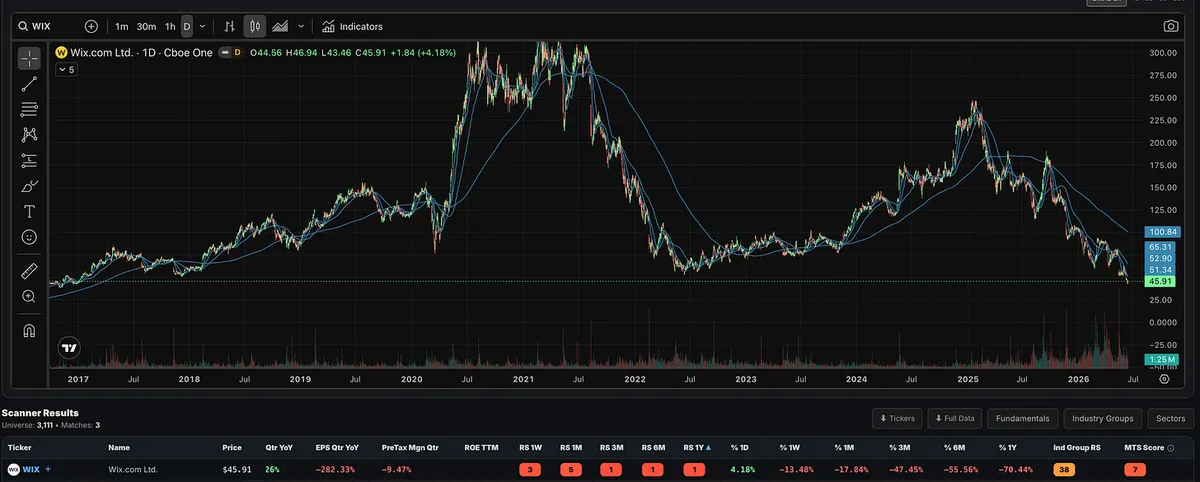
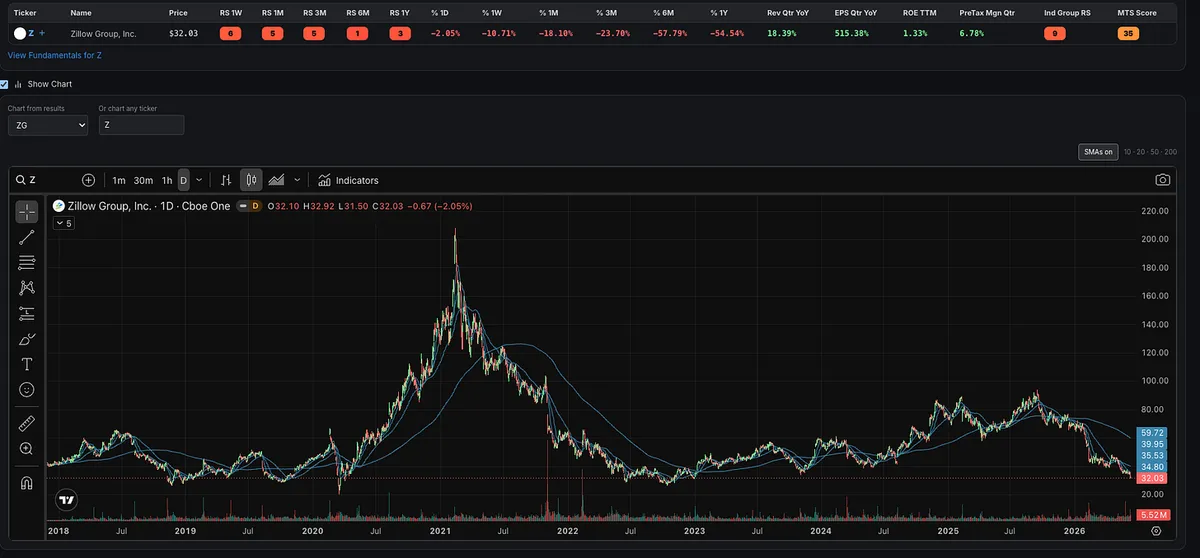
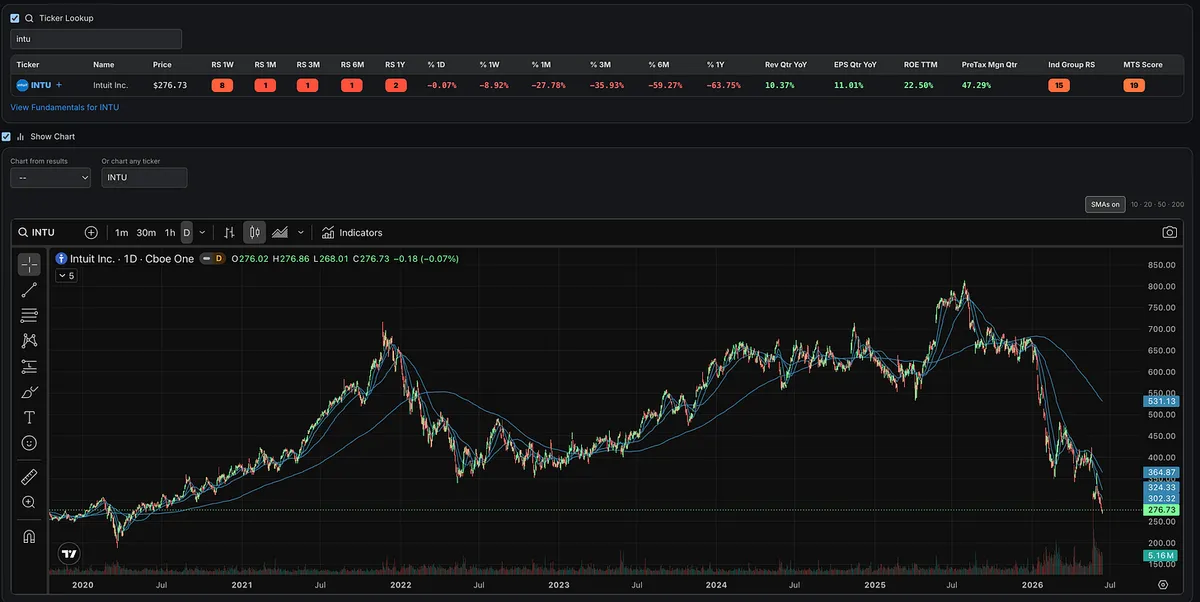
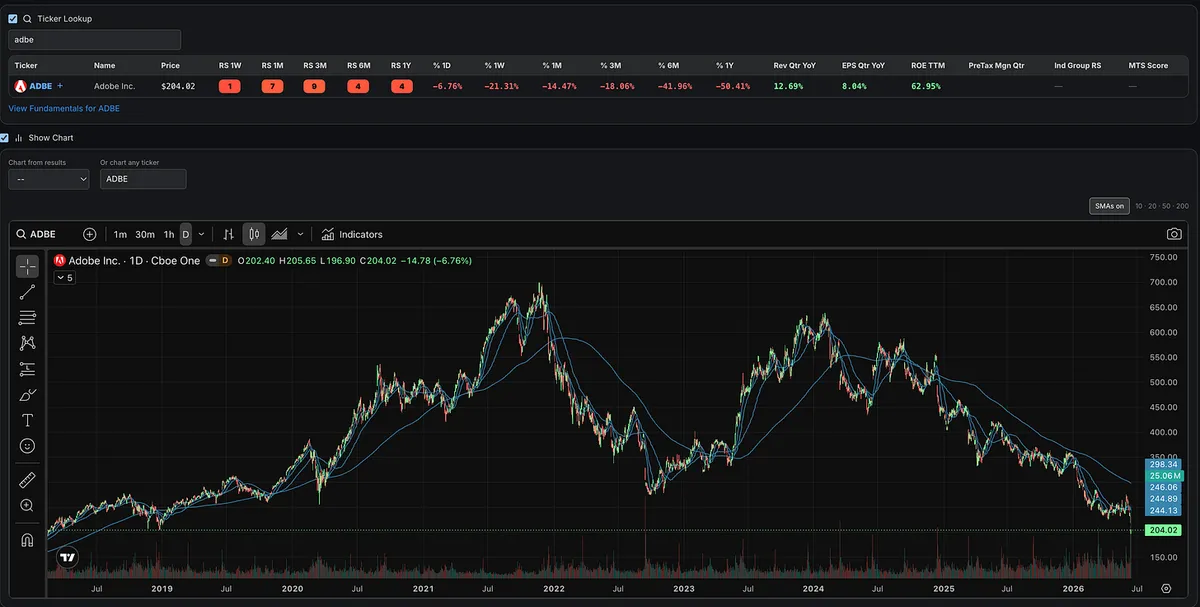
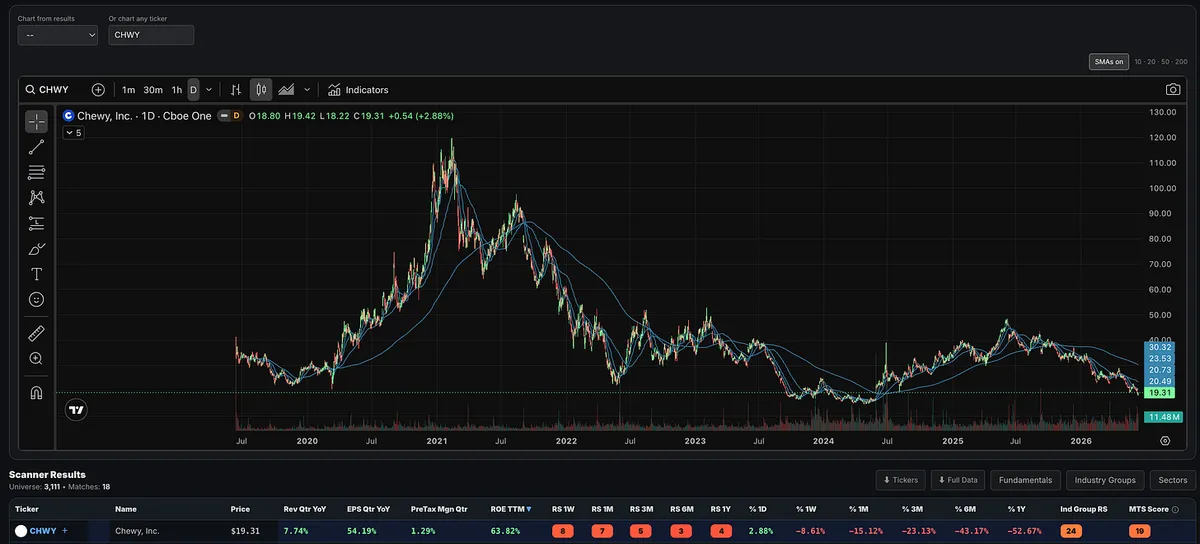
Anyone going long WIX?

It’s wild to pull up some of the old 2020–2021 favorites and see where they are now.

CHWY

ADBE

INTU

Z

WIX

Feels like yesterday these were the “must-own” growth names everyone was chasing.

Good reminder: old leaders are not always new leaders. Most of the time, they aren’t.

A stock can still be a great company. It can have a familiar story. It can have a past run that everyone remembers.

But if the price action, relative strength, and trend are broken, nostalgia is not a setup.

The market always rotates. Our job is not to fall in love with yesterday’s winners. It’s to find what is leading now.

View on Substack ↗

The Trading Account That Saved Me From Myself

I love trading and markets.

Some people might even call it an obsession.

But a long time ago, I analyzed my own trading data and realized something important:

Most of my money came from a small number of trades.

The A+ setups. The best market environments. The times when I was extremely selective.

The rest of my trades?

Small losses. Flat trades. Small gains. A lot of activity that did not really move the needle.

So why take them at all?

Because I love the markets.

But here’s the key: I separated that activity from my serious trading account.

I have my primary account, where I only want my best ideas, best setups, proper position sizing, and strict risk management.

Then I have a smaller account where I can stay engaged, test ideas, experiment, and have fun.

It is money I am willing to lose. If that account went to zero, it would not affect my wealth, my mindset, or my real trading process.

I think a lot of traders could benefit from this kind of honesty.

Many people say they are trading to make money, but their behavior says they are really trading for action.

For excitement. For stimulation. For the feeling of being involved.

And if you are not aware of that, it can cause a lot of damage.

Sometimes the answer is not pretending you suddenly have perfect patience.

Sometimes the answer is building a system around who you actually are.

Know yourself.

Know which trades actually make you money.

Know when you are trading for edge and when you are trading for fun.

View on Substack ↗

Trading Might Be the First Thing You’ve Ever Truly Failed At

A lot of successful people struggle with trading because it may be the first thing they have ever truly failed at.

Not struggled with.

Failed at.

In most areas of life, hard work usually creates progress.

  • You study more, you improve.

  • You work harder, you get better.

  • You stay disciplined, and eventually, results show up.

Trading does not work that cleanly.

You can study all weekend and still lose money Monday.

You can take a perfect setup and still get stopped out.

You can make a great trade and give it all back because of one emotional decision.

That is hard for successful people to accept.

So they look for a way out.

  • “The market is rigged.”

  • “This is gambling.”

  • “Nobody really makes money doing this.”

Sometimes that is easier than admitting the truth:

“I am not good at this yet.”

I do think success in other areas of life can help you in trading.

The grit, discipline, work ethic, ability to adapt, and willingness to learn all matter.

My time in the military helped shape that.

Earning the Ranger tab taught me how to keep going when things really suck.

Starting our first business with only a few thousand dollars and building it into a million-dollar business taught me how to adapt, solve problems, and survive the early years when most people quit.

Those traits that made me succesful in those endevors obviously helped me in trading, but I have also seen people with the same type of success come to trading and fail horribly.

But I never approached trading like, “I was successful in these other areas, so I will automatically be successful here.”

That is the mistake.

The traits can transfer.

The ego cannot.

If you bring discipline, humility, patience, and the willingness to learn, your past success can help you.

If you bring entitlement, overconfidence, and the belief that success somewhere else guarantees success in the market, trading will humble you fast.

There is a reason a high school dropout or security guard can become a multimillion-dollar trader, while plenty of doctors, lawyers, dentists, executives, and business owners fail.

The market does not care about your resume.

Almost every great trader I have studied started with failure.

  • They lost money.

  • They overtraded.

  • They got emotional.

  • They repeated the same mistakes until the pain forced them to change.

The ones who made it did not treat failure as proof that trading does not work.

  • They treated it as feedback.

  • They built rules.

  • They learned risk management.

  • They stopped trying to be right and started trying to survive long enough to get good.

That is the difference.

The market will humble everyone.

The traders who make it are not the ones who avoid failure.

They are the ones who learn from it, stay humble yet determined, and keep showing up with less ego and more discipline. For many, they need to love the game to keep showing up.

View on Substack ↗

You Can Trade Without Risk Management, But You Won’t Last

I just finished the new Market Wizards book, and one thing jumped off the page again and again.

Different traders. Different time frames. Different strategies. Different markets.

Same lesson.

The traders who survived all became risk managers.

A lot of them started the way most traders start.

Chasing setups. Trying to find the perfect entry. Trying to turn a small amount of money into something meaningful. Trading too big. Ignoring risk. Blowing up, sometimes more than once.

But the ones who lasted all eventually came to the same conclusion:

Cutting losses is not optional. It is the job.

Most struggling traders are spending almost all of their time trying to find better stocks, better setups, better screens, better entries, and better indicators.

But the best traders in the world keep pointing back to the same thing:

Risk management. Position sizing. Cutting losses. Surviving long enough for your edge to matter.

If you do not have the results you want yet, it may not be because you need another setup.

It may be because you have not gone deep enough into risk management and position sizing strategies.

That is exactly why Module 6 of my course is focused on risk management, position sizing, portfolio exposure, and how to think about risk like a professional.

I also walk through how I use my position sizing tool before every trade that we have built into the Momentum Trading Strategy Web App.

Because finding the stock is only one part of the game.

Knowing how much to risk, where you are wrong, and how to survive long enough to let your winners work is what keeps you in the game.

Check out Module 6 here: https://tradingmomentum.substack.com/p/momentum-trading-strategy-risk-management

On SubstackMomentum Trading Strategy: The 100-Year Playbook Behind the Biggest Winning Stocks — Module 6 Risk Management & Position Sizing
View on Substack ↗

SNDK Is Showing the Kind of Relative Strength Marty Schwartz Looked For

SNDK is doing something serious traders pay attention to.

It is making new highs while the broader market is not.

This is the type of relative strength Marty Schwartz looked for. Stocks that can push into new high ground when the market itself is not making new highs are often giving you an important clue.

This is just one of many golden nuggets Marty Schwartz shared in his book Pit Bull, and we wrote about several of them in this article:

https://substack.com/@tradingmomentum/p-201342828

ArticleHow Marty “Pit Bull” Schwartz Turned $40K Into $20M Without Big Drawdowns