
Trading articles/How Marty “Pit Bull” Schwartz Turned $40K Into $20M Without Big Drawdowns
Jun 10, 2026 · Momentum Trading Strategy
How Marty “Pit Bull” Schwartz Turned $40K Into $20M Without Big Drawdowns
The Marine-trained trader who used moving averages, tight stops, market timing, and emotional discipline to become one of Wall Street’s most consistent performers.
Originally published on Substack.
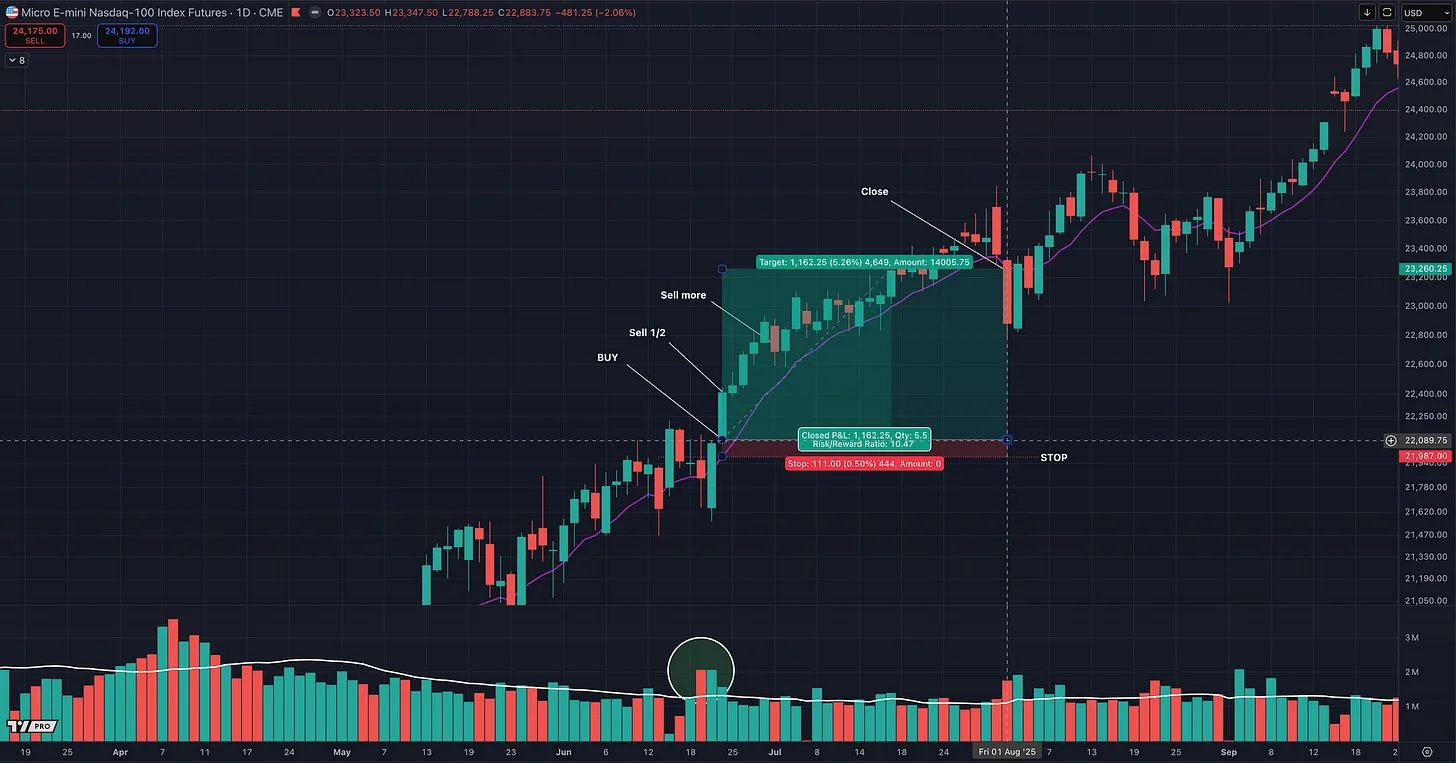
Marty Schwartz is one of the most compelling trading case studies in modern market history. Known as “Pit Bull” for his intensity, competitiveness, and aggressive short-term trading style, Schwartz built a record that remains difficult to ignore. He is widely known for turning a relatively small trading account into more than $20 million, but the more important lesson is not the size of the gain. It is how he controlled risk along the way.
In Market Wizards, Jack Schwager described Schwartz as a trader who produced enormous gains after becoming a full-time trader in 1979 while never losing more than 3% of his equity on a month-end to month-end basis. Schwartz also became widely known through his repeated entries in the U.S. Trading Championships. In nine of the ten four-month contests he entered, he reportedly made more money than all the other contestants combined, averaging 210% in those contests on a non-annualized basis. In his single one-year contest entry, he posted a 781% return.
Those numbers are extraordinary, but the real lesson is not that Schwartz discovered a secret indicator. The lesson is that he built a repeatable process around price, risk, preparation, market context, and psychology. His tools were relatively simple. His discipline was not.
Schwartz’s story matters because most traders are not destroyed by a lack of information. They are destroyed by poor execution, oversized positions, emotional decision-making, and the refusal to admit when they are wrong. Schwartz’s career offers a different model: trade with the trend, define risk in advance, cut losses quickly, adjust exposure to the market environment, and protect capital before ego gets involved.
Who Was Marty “Pit Bull” Schwartz?
“One of the most suicidal things you can do in trading is to keep adding to a losing position.” - Marty Schwartz
Marty Schwartz was a former securities analyst who became one of the most successful short-term traders documented in modern market literature. He graduated from Amherst College, later attended Columbia Business School, and served in the U.S. Marine Corps Reserve. Those three experiences shaped much of his later approach to trading: intellectual preparation, business discipline, and the ability to act under pressure.
Before he became famous as “Pit Bull,” Schwartz spent years struggling in the market. He was not an overnight success. He had education, experience, and ambition, but those advantages did not immediately translate into trading profits. In fact, he spent nearly a decade losing money while working as a securities analyst.
That part of the story is important because it separates Schwartz from the myth that great traders simply find a perfect system and start printing money. His early experience was the opposite. He had to lose, adapt, and rebuild his entire approach before his results changed.
His story is detailed in two books that serious traders continue to study: Pit Bull: Lessons from Wall Street’s Champion Day Trader and Jack Schwager’s Market Wizards. One is Schwartz’s own account of his life and trading career. The other is an outside interview that places him among some of the greatest traders ever profiled.
Together, they reveal a trader who was aggressive but not reckless, opinionated but ultimately obedient to price, and intensely competitive while remaining deeply focused on survival.
From Analyst to Trader
“I used fundamentals for nine years and got rich as a technician.”
- Marty Schwartz
Before Schwartz became one of Wall Street’s most successful short-term traders, he worked as a securities analyst. On paper, he had the type of background that should have helped him succeed. He was educated, hardworking, and deeply involved in the financial world. In practice, his early trading results were poor because he relied too heavily on analysis, forecasts, and opinions.
For years, Schwartz approached markets through the lens of a securities analyst. He studied companies, formed views, and tried to be right. But trading exposed the weakness in that approach. The market did not reward him for being intelligent, well-researched, or confident. It rewarded him only when he learned to align with price and manage risk.
This is one of the most important lessons from his career. There is a major difference between analysis and trading. Analysis is about building a case. Trading is about making decisions under uncertainty. Analysis can tolerate being early, theoretical, or incomplete. Trading cannot. A trader has to know when the idea is wrong and what to do when the market disagrees.
Schwartz’s turning point came when he separated his ego from the need to make money. He eventually realized that being right and being profitable are not the same thing. Once he stopped trying to prove his opinions and started responding to what the market was actually doing, his results changed dramatically.
That psychological shift is one of the central lessons of his story. Many traders attach their identity to their trades. They buy a stock, then defend it. They make a market call, then search for evidence to support it. They hold losing positions because selling would feel like admitting failure. Schwartz learned to do the opposite. If the trade worked, he stayed with it. If it failed, he got out.
The market does not reward the trader who argues best. It rewards the trader who adapts fastest.
The Framework Behind the Results
Schwartz did not build his success around an overly complex system. His approach relied on a handful of tools that helped him identify direction, define risk, and execute with precision. Moving averages, support and resistance, gaps, oscillators, market statistics, seasonal tendencies, and broader cycle work all played a role in his process.
The important point is that the tools were not the edge by themselves. The edge came from how he used them. A simple tool in the hands of a disciplined trader can be powerful. A complex system in the hands of an undisciplined trader usually becomes dangerous.
Schwartz’s approach was built around several basic questions.
- What is the current direction of the market?
- Is price confirming the trade idea?
- Where is the trade wrong?
- How much should be risked if the trade fails?
- What is the broader market environment telling me about how aggressive I should be?
Those questions forced him to stay grounded in reality. He was not trying to predict every turn. He was trying to trade when the odds were favorable and exit quickly when the odds changed.
This is why his framework remains useful for modern traders. Markets have changed, but human behavior has not. Traders still chase strength too late, bottom fish too early, average down when they should exit, increase size after emotional winning streaks, and let opinions override price. Schwartz’s process was designed to prevent those behaviors from taking over.
The 10-Day EMA as a Green Light or Red Light
One of Schwartz’s most important tools was the 10-period exponential moving average. In many discussions of his approach, this is described as his “red light, green light” indicator. If price was above the moving average, he viewed the environment as more constructive. If price was below it, he viewed the environment as more defensive.
This was not a prediction tool. It was a positioning tool.
When price was above the 10-day EMA, Schwartz was more willing to look for long opportunities. When price was below the 10-day EMA, he became more cautious or looked for short-side opportunities. The moving average gave him a simple way to stay aligned with momentum instead of constantly fighting it.
Most traders want a tool that tells them what will happen next. Schwartz used tools that helped him understand what was happening now. The goal was not certainty. The goal was alignment.
When price is above key moving averages and acting well, the wind is usually at the trader’s back. When price is below key moving averages and sellers are in control, the trader is usually fighting resistance. Schwartz understood that trading against the trend can feel intelligent, especially when a trader believes he sees something others do not, but it is often expensive.
The moving average helped him avoid one of the most common trading mistakes: forcing trades against the dominant direction. A stock above the 10-day EMA and acting well deserved a different posture than a stock below the 10-day EMA and breaking down.
That simple filter helped him trade with momentum instead of ego.
Support, Resistance, and Confirmation
Schwartz also used support and resistance, but he did not treat those levels as magic lines on a chart. He treated them as areas where supply, demand, fear, and greed had previously shown up. Support represented a zone where buyers had stepped in before. Resistance represented a zone where sellers had previously taken control.
The key was confirmation. Schwartz did not blindly buy every pullback into support or short every rally into resistance. He wanted the market to prove itself first. A long setup required price to pull back into a logical area, stabilize, and then show evidence that buyers were regaining control. A short setup required price to rally into resistance, stall, and then confirm weakness.
This approach gave him a clear place to define risk. If he bought near support after confirmation, the stop could be placed below the level that invalidated the setup. If he sold short near resistance after confirmation, the stop could be placed above the level that proved the trade wrong.
That is the difference between professional trading and guessing. Many traders enter because a stock looks attractive, but they do not know exactly where the trade is wrong. Schwartz wanted the opposite. He wanted a trade with a logical entry, a defined invalidation point, and a loss that could be controlled if the market disagreed.
This is why support and resistance mattered to him. They were not just chart lines. They were decision points. They helped define the trade, the risk, and the moment when the idea should be abandoned.
Reading Relative Strength During Market Weakness
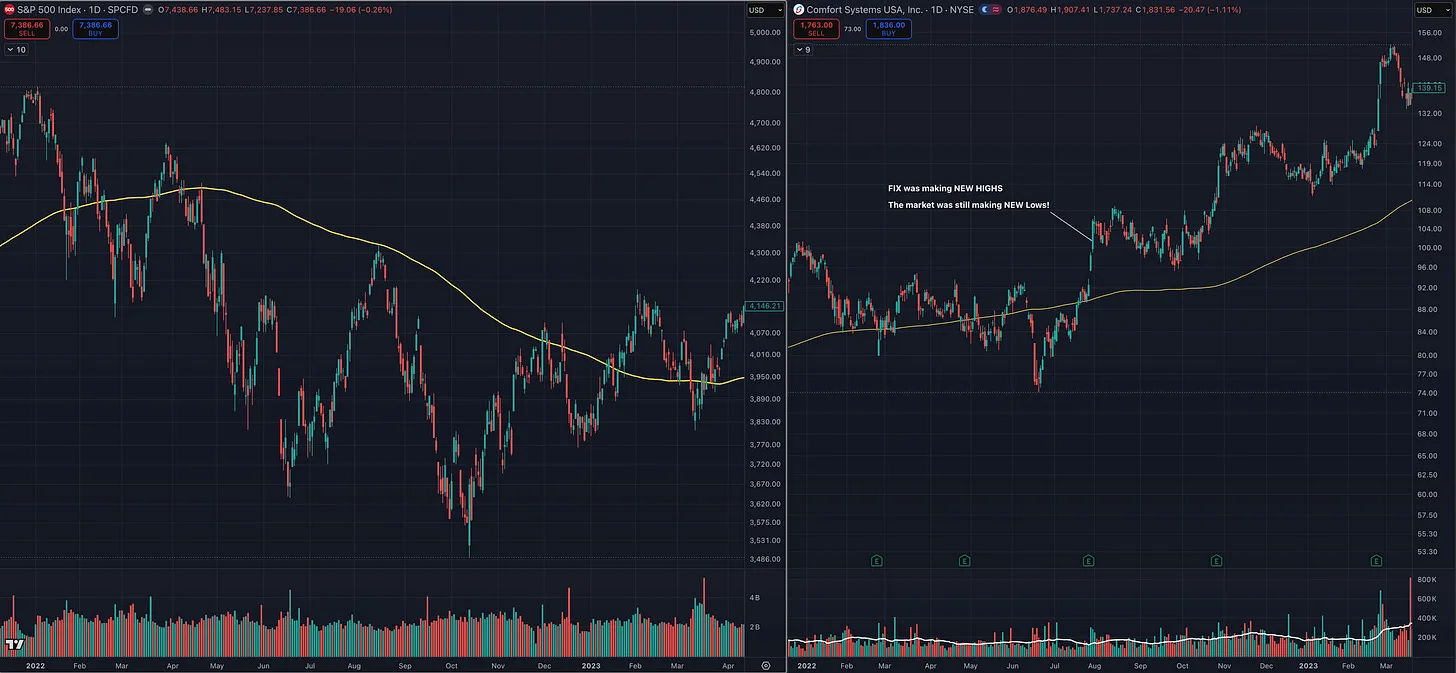
Another important part of Schwartz’s process was relative strength. He paid attention to stocks that held above their recent lows while the broader market broke below its own recent low. That type of divergence can signal that a stock is healthier than the general market.
This idea remains highly relevant for growth and momentum traders. The strongest stocks often reveal themselves during market weakness. They do not fall as much, they recover faster, and they begin attracting demand before the major indexes fully recover.
Most traders focus only on what is going down. Strong traders watch what refuses to go down. A stock that can hold up while the market is under pressure may be showing institutional support. It may also become one of the first names to emerge when conditions improve.
This principle connects directly to the way many great growth traders study leadership. The goal is not to buy every stock that looks strong. The goal is to identify the stocks showing unusual strength when the broader environment is testing them.
A stock that holds support while the market breaks down is giving the trader valuable information. It may be under accumulation. It may be a future leader. It may be telling you that demand is stronger than the headline weakness suggests.
Schwartz understood that relative strength is not just a ranking. It is a clue.
Gap Trading and Crowd Emotion
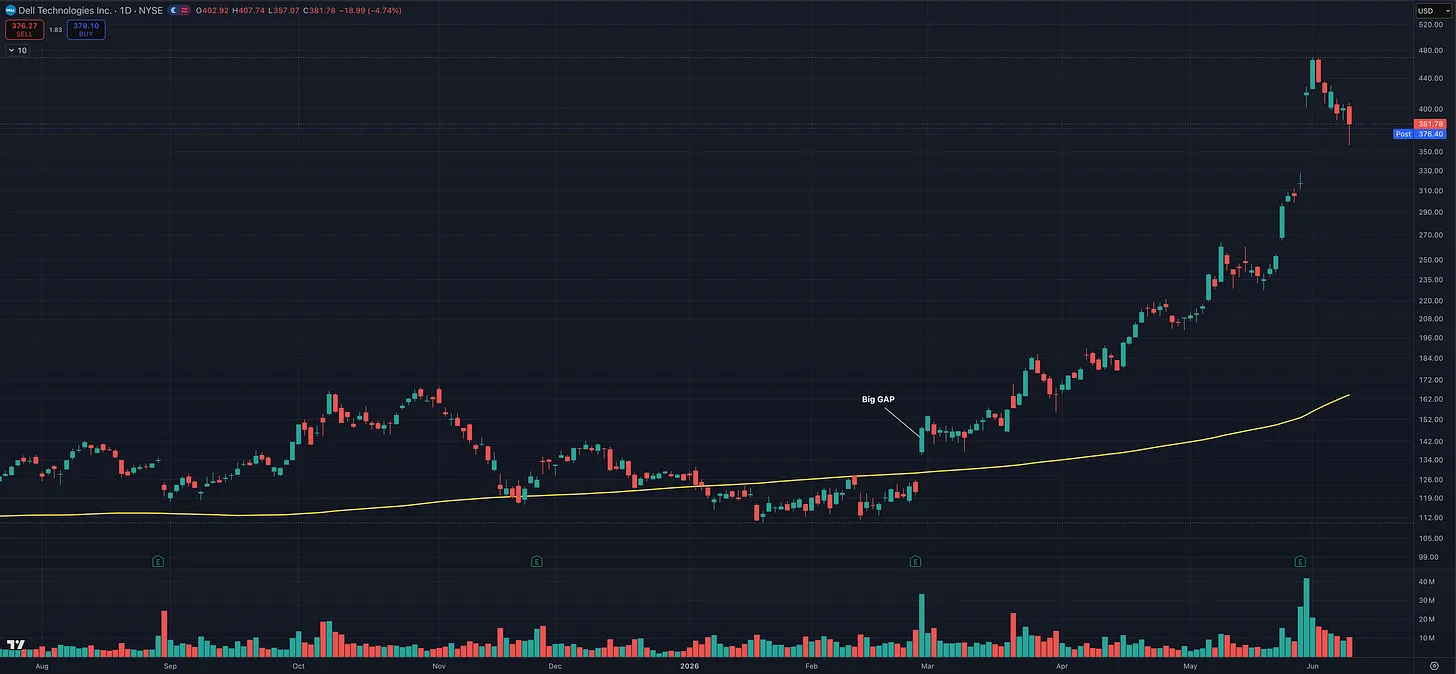
Schwartz also paid attention to gaps because gaps reveal emotion. A gap is not just empty space on a chart. It is a sudden repricing of expectations. Something changed, and buyers or sellers were aggressive enough to move price sharply before normal trading resumed.
He studied three major types of gaps: breakaway gaps, continuation gaps, and exhaustion gaps. Each one told a different story about crowd behavior.
A breakaway gap typically occurs after a base or consolidation. The stock has been quiet, supply has been absorbed, and expectations may be low. Then price gaps higher on strong demand. This can mark the beginning of a new trend because it signals a change in character. The mistake many traders make is assuming a stock is too extended simply because it gapped. In a true breakaway gap, the gap can be the beginning of the move, not the end.
A continuation gap occurs after a trend is already underway. The stock is moving higher, demand remains strong, and price gaps again in the direction of the trend. This type of gap can confirm that momentum remains alive. Schwartz paid attention to whether the market respected the gap after it formed. If price could remain above the gap area, that added evidence that buyers were still in control.
An exhaustion gap usually appears late in an extended move. The stock has already gone a long way. Sentiment is excited. Volume expands. Price gaps higher again, but this time the move may represent the final burst of demand rather than the start of a new leg. This is where traders need to be careful. The same gap that looks exciting to the crowd may be a warning sign to a professional.
By classifying gaps this way, Schwartz was not just reading price. He was reading crowd behavior. A chart is not just a collection of lines and bars. It is human emotion turned into price.
Military-Grade Risk Management
Schwartz’s Marine Corps background shaped the way he thought about pressure. Trading is not combat, but it does create stress, fear, hesitation, and the temptation to freeze. A trade moves against you. A position gaps lower. A winning trade starts to reverse. A losing streak develops. The untrained trader often reacts emotionally. Schwartz built his process around preparation and response.
One of his most important risk concepts was the “uncle point.” This was the level where the trade was no longer acceptable. It was the point where he had to admit that the trade was wrong and exit.
That idea is simple, but it is not easy. Most traders know they should cut losses. The problem is that they decide to be disciplined only after the trade is already moving against them. By then, emotion has entered the decision. Hope starts to replace process. The trader begins negotiating with the market.
Schwartz understood that risk has to be defined before entry. Before the trade is placed, the trader is usually more objective. After the trade is placed, emotion becomes harder to control. That is why the exit plan must exist before the position is opened.
This is also why Schwartz reduced size after large losses and after strong winning streaks. Reducing size after a loss is easy to understand. A large loss can destabilize a trader and lead to revenge trading, but reducing size after a winning streak is just as important. Big wins often create overconfidence. Overconfidence leads to larger positions. Larger positions expose sloppy execution. Sloppy execution gives back profits.
Schwartz recognized that many traders suffer their worst losses after their best periods. Winning makes traders feel invincible. That feeling is dangerous.
For modern traders, the principle is clear. Know your exit before you enter. Keep losses small. Do not increase size just because you feel hot. Reduce exposure when your rhythm is off. Step away when your emotions start running the process. The goal is not to avoid every loss. The goal is to make sure no single loss can damage you.
Macro Awareness, Cycles, and Seasonality
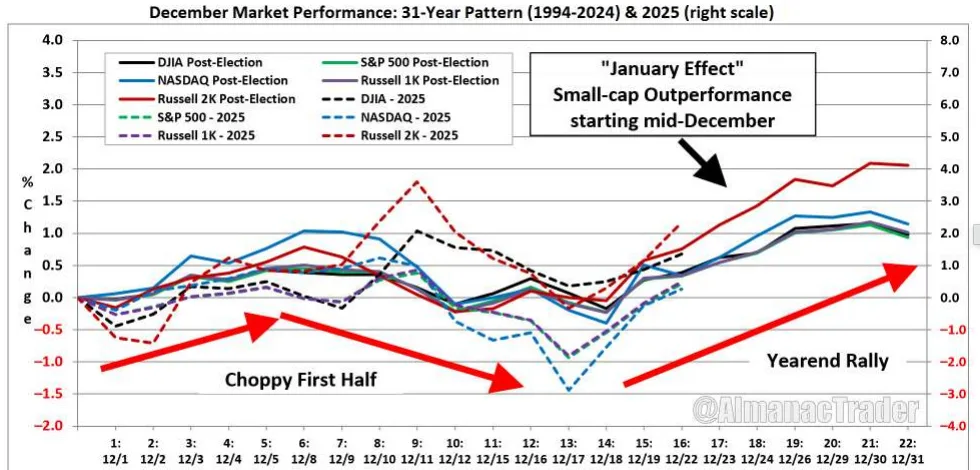
Schwartz was a short-term trader, but he was not blind to the larger market environment. He studied market statistics, calendar tendencies, and historical patterns. He used tools such as the Stock Trader’s Almanac to understand how markets had behaved during certain periods of the year.
The important point is that he did not use seasonality as a standalone trading signal. He used it as a risk-adjustment tool. If a certain period of the year had historically been difficult, he might become more cautious. If a certain window had historically been favorable, he might be more willing to press when his technical work also confirmed strength.
That is the proper role of the market environment. It should influence risk, position size, and level of aggression, but it should never replace price confirmation.
Many traders make the mistake of letting a macro opinion override what the market is actually doing. They hear recession talk and ignore strength. They hear bullish forecasts and ignore distribution. They become convinced that a market “should” move a certain way, then they hold onto that belief even when price disagrees.
Schwartz respected the environment, but he still traded what price confirmed. That balance is important. The broader market environment can influence probabilities, but price still has to confirm the trade.
This is one reason his process was so effective. He was not just looking at individual setups in isolation. He wanted to know whether the broader tide supported or fought the trade.
The Magic T Theory and Market Rhythm
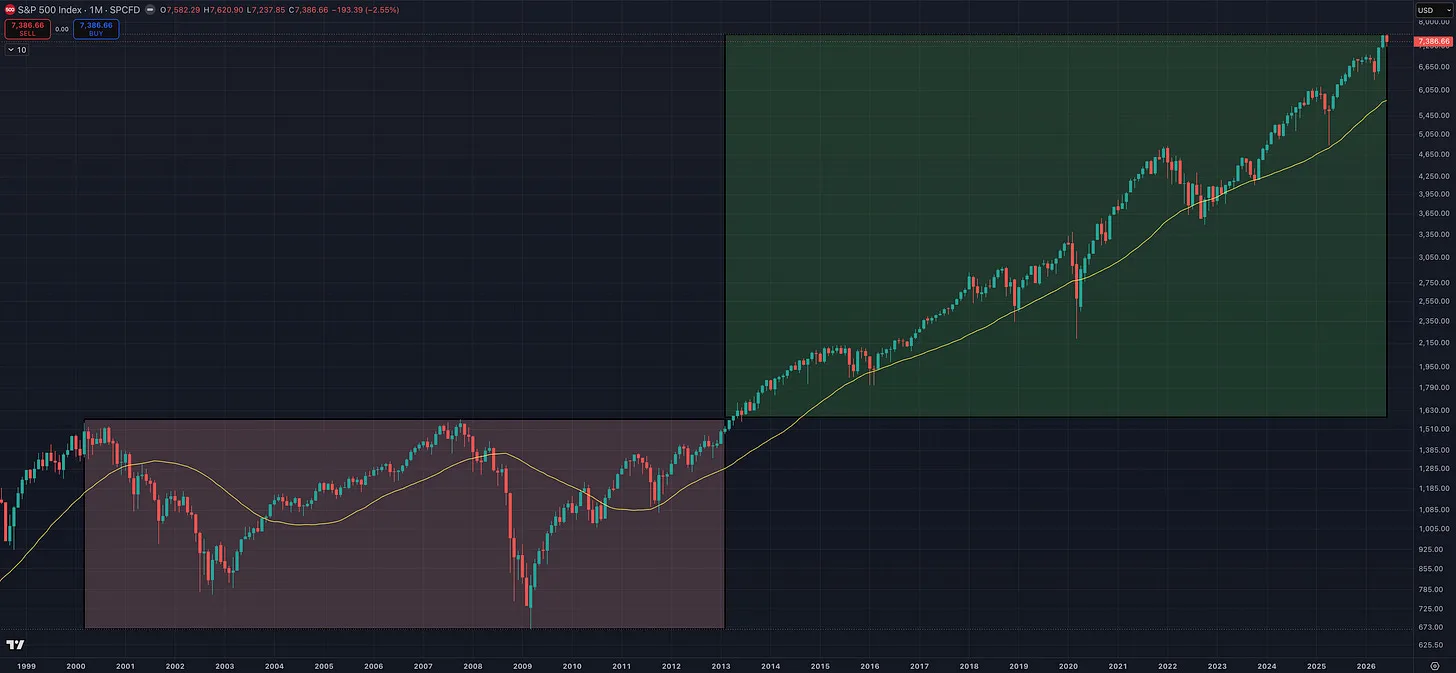
Another major part of Schwartz’s big-picture thinking was Terry Laundry’s Magic T Theory. The theory gave him a way to think about market rhythm, time symmetry, and longer-term cycles. While not identical, the concept overlaps with what I discuss in Module 2 of the Momentum Trading Strategy Course, Market Environment and Market Cycles, where we study secular and cyclical bull and bear markets to better understand when conditions favor offense, defense, or patience.
The basic idea behind the Magic T is that markets often move through periods of frustration and reward. A market may spend a long period producing sub-normal returns, moving sideways, or frustrating investors. That period can create the base for a later period of superior returns. The “T” represents the relationship between the left side of the cycle and the right side of the cycle.
The left side of the T represents the base-building or underperformance phase. This is when the market frustrates investors, absorbs supply, and builds energy. The right side of the T represents the advance or superior-return phase. This is when that stored energy is released through rising prices and improving optimism.
The center of the T marks the transition between the two phases. The longer and more meaningful the left side, the more important the right side can become.
In longer-term applications of T Theory, traders often use broad moving average references, including the 150-week moving average, to help judge whether the market is in a favorable or unfavorable long-term position. No moving average predicts every turn, but a long-term reference point can help define whether the market is operating above or below a major trend baseline.
That is what mattered for Schwartz. The Magic T was not a stock-picking tool. It did not tell him exactly what to buy or where to place every stop. It helped him think about the market’s larger rhythm.
Markets do not move in straight lines forever. They contract. They frustrate. They build energy. Then, when conditions change, they expand. The best advances often come after long periods when most investors have given up.
Case Study: 1964 to 2000
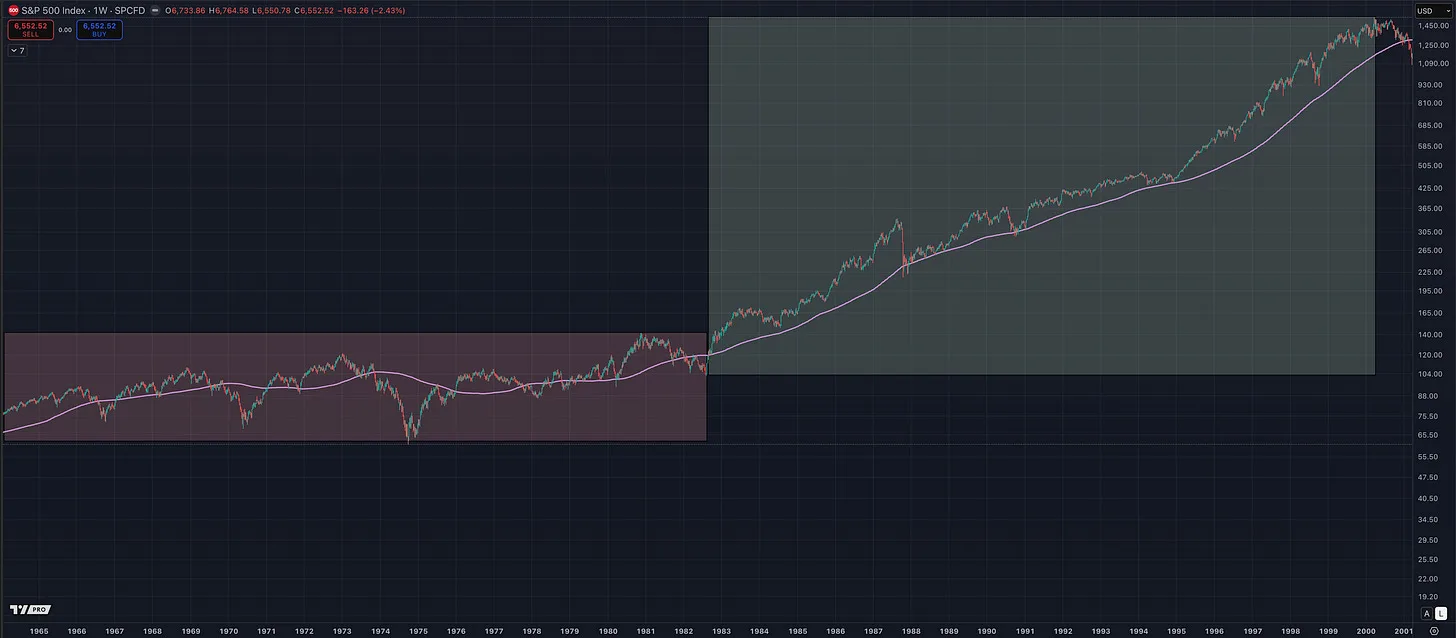
One way to understand the concept of market regimes is to look at the long cycle from the mid-1960s through 2000. From roughly 1964 to 1982, the market went through a long, frustrating secular bear market. Inflation rose, valuations compressed, interest rates moved higher, and the major indexes made little lasting progress for nearly two decades.
That period can be thought of as the left side of the T. It was the frustration phase. Investors were worn down. Stocks were not loved. Expectations were low. The market spent years absorbing pressure and building energy.
Then came the 1982 to 2000 secular bull market. Interest rates declined, liquidity improved, corporate profits expanded, valuations rose, and stocks entered one of the greatest advances in history. That period can be thought of as the right side of the T. The energy built during the prior period was released into a long and powerful advance.
The purpose of this example is not to suggest that every cycle repeats perfectly. They do not. The lesson is that markets have regimes. There are times when the environment rewards patience and aggression. There are other times when the environment punishes risk-taking and requires defense.
Schwartz understood that distinction. He did not need the market to be favorable all the time. He needed to know when to press and when to protect.
How Secular Bull and Bear Phases Shape Trade Tactics
Schwartz did not need to reinvent his entire system every time the market environment changed. He changed his risk throttle.
That is the right way to think about market regimes. In poor environments, defense comes first. In strong environments, offense matters more. The same setup can behave very differently depending on the broader market backdrop.
In a bear phase, traders usually need to be smaller, faster, and tighter. Profits may need to be taken sooner. Failed breakouts are more common. Pullbacks can become breakdowns. The trader has to expect more failure and protect capital aggressively.
In a bull phase, traders can often be more constructive. Strong stocks are more likely to follow through. Pullbacks are more likely to hold. Breakouts have a better chance of working. Leaders can trend longer than expected. That does not mean risk management disappears. It means the trader can give strong setups more room when the broader environment supports them.
This is why market environment matters so much. A great setup in a poor market may fail. An average setup in a powerful market may work. The tide affects almost everything.
Schwartz’s use of market environment helped him avoid applying the same level of aggression in every environment. He understood that the market decides when offense is rewarded and when defense is required.
Executing Like Marty Schwartz: Daily Discipline and Intraday Precision
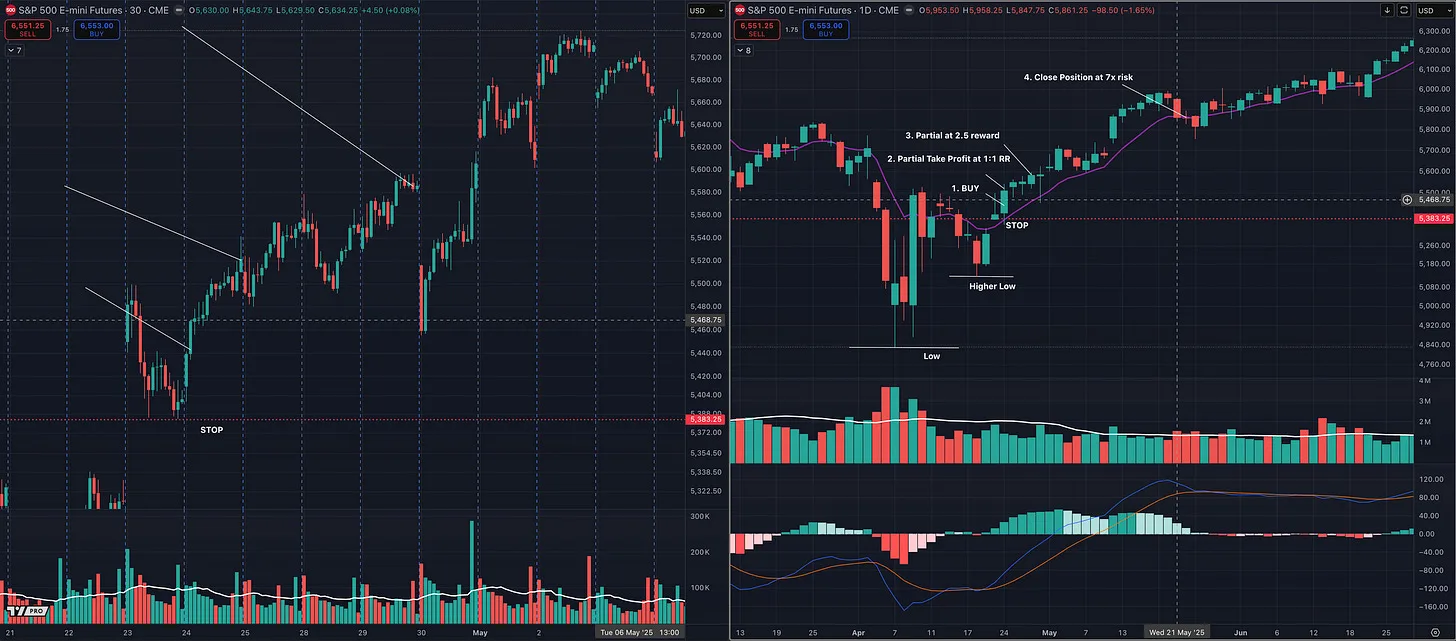
Schwartz was known as a short-term trader, but his decisions were guided by a structured process. He used the daily chart to define the trading bias, then used shorter-term price action to refine execution. The daily chart helped him determine which side of the market he wanted to be on, while the intraday chart helped him find a more precise entry.
If the daily chart was above the 10-day EMA and acting well, Schwartz had a long bias. If the daily chart was below the 10-day EMA and acting poorly, he became defensive or looked for short-side opportunities. This process helped him avoid emotional countertrend trading. He was not trying to predict every tick. He was trying to align with the dominant pressure, then execute when price confirmed.
A typical long setup might begin with price pulling back toward support while still holding above a key moving average. The stock would then need to stabilize, form a higher low, or show evidence that buyers were returning. Only after confirmation would the trade become actionable. The stop would go below the level that invalidated the setup.
That final point is critical. Risk was defined before the trade. A trader who enters first and figures out risk later is not trading with discipline. He is reacting.
Schwartz could move quickly because the preparation was done in advance. He already knew the bias, the level, and the risk. The trade was not an emotional reaction. It was the execution of a plan.
Managing the Trade
Once in a trade, Schwartz focused on protecting capital and staying aligned with price. He did not build his success by widening stops, hoping losses would recover, or turning every position into an emotional argument with the market.
A modern trader applying Schwartz’s philosophy might manage a trade by taking partial profits into strength, reducing risk once the trade proves itself, trailing stops under logical structure, and using moving averages or price action to judge whether the trend remains intact. That type of trade management is consistent with the principles Schwartz emphasized, even if the exact rules vary by trader.
The key is that the trader should have a plan for both outcomes.
- If the trade works, how will profits be managed?
- If the trade fails, where is the exit?
- If the trade moves favorably, when should risk be reduced?
- If the market changes character, what signal says the trade no longer deserves capital?
This is where many traders fail. They plan the entry but not the management. They know why they want to buy, but they do not know what they will do if the stock hesitates, reverses, gaps, or runs quickly. Schwartz’s approach was built around preparation. The trade was a mission. Plan it, execute it, manage the risk, and exit when the evidence changes.
A winning trade should not become an emotional attachment. A losing trade should not become a personal debate with the market.
The Philosophy Behind It
Schwartz’s approach combined daily trend confirmation, intraday precision, ruthless risk control, and market awareness. He was not trying to predict the future with certainty. He was reacting to what the market confirmed.
That is one of the most important distinctions in trading. Most traders want certainty. Schwartz wanted confirmation. Certainty makes traders stubborn. Confirmation keeps them flexible.
He understood that the market does not owe the trader anything. A setup can look perfect and still fail. A thesis can make sense and still lose money. A trader can do everything right and still take a loss. That is part of the business.
The point is not to be right all the time. It is to make sure that being wrong does not destroy you.
Schwartz’s record demonstrates the power of that principle. He was aggressive, but his aggression was built on risk control. He could press when conditions were favorable because he knew where he would get out if the trade failed.
That is professional trading.
Marty Schwartz’s Trading Rules
Schwartz’s rules are powerful because they are simple, direct, and grounded in experience. They do not read like theory. They read like lessons learned from years of pressure, mistakes, discipline, and real money on the line.
1. Always check the charts and moving averages before taking a position.
Schwartz wanted to know where price stood before committing capital. He paid close attention to whether price was above or below the moving average because it helped him stay aligned with the dominant direction. As he explained, going against the moving averages was often self-destructive.
2. Look for stocks that hold up better than the market.
One of Schwartz’s key observations was that if a stock held above its recent low while the broader market broke below its own recent low, that stock was showing relative strength. To him, that type of divergence suggested the stock was healthier than the general market.
3. Before putting on a position, ask: “Do I really want to have this position?”
This rule helped him avoid unnecessary trades. Many traders enter positions because they are bored, emotional, or afraid of missing out. Schwartz forced himself to pause before entering and ask whether the trade was truly worth taking.
4. After a successful period, take a day off as a reward.
Schwartz understood that strong trading periods can create overconfidence. He believed it was difficult to sustain excellent trading for more than a couple of weeks at a time, and he recognized that many of his biggest losses came after his largest profits.
5. Bottom fishing is one of the most expensive forms of gambling.
Schwartz was not interested in constantly trying to catch the exact low. He preferred confirmation, strength, and momentum. He acknowledged there may be rare exceptions, but bottom fishing without sufficient justification was dangerous.
6. Before taking a position, always know the amount you are willing to lose.
This was his “uncle point.” Before entering a trade, Schwartz knew the level where the pain threshold had been reached and the trade had to be exited. This rule kept small losses from becoming large losses.
7. Work, work, and more work.
Schwartz’s success was not built on shortcuts. He prepared, reviewed charts, studied the market, and did the daily work required to stay sharp. His edge came not only from his tools, but from the consistency of his preparation.
8. The most important thing is money management.
Schwartz repeated this idea because it was central to his survival. Position size, stop discipline, risk control, and the ability to reduce exposure when out of rhythm mattered more than any single trade idea.
9. Let gains run.
Even Schwartz admitted this was an area he continually tried to improve. Cutting losses quickly is only one side of the equation. The other side is allowing winning trades enough room to become meaningful.
10. If you are nervous about a position overnight and the market opens better than expected, you may be better off staying with it.
This rule reflects Schwartz’s ability to read pressure and expectation. If a trader is nervous about a position, especially over a weekend, and the market opens stronger than feared, that strength may be useful information. It can suggest that the market is absorbing the concern better than expected.
Why It Worked
Schwartz built a trading framework that was technically simple, risk controlled, psychologically aware, and sensitive to market context.
Technically, he used price action, moving averages, support and resistance, gaps, oscillators, historical tendencies, and broader cycle work. These tools helped him understand direction, timing, and risk.
From a risk standpoint, he knew his uncle point, honored stops, reduced size after destabilizing losses, reduced size after emotional winning streaks, and refused to let one trade get out of hand.
Psychologically, he removed ego from the process. He stopped trying to prove that he was right and focused instead on making money. He understood that many traders would rather lose money than admit they are wrong. His edge came from being willing to admit it quickly.
From a market-context perspective, he understood that environment matters. He studied seasonality, market rhythm, and larger cycles. He knew that a trader should not use the same level of aggression in every market.
That combination is what made the framework powerful. It was not just the 10-day EMA. It was not just the Magic T. It was not just tight stops. It was the integration of all those pieces into a repeatable process.
Performance and Legacy
Marty Schwartz’s legacy is not just that he made a lot of money. It is that he did it with extraordinary consistency and unusually strong risk control.
Big returns are impressive, but big returns with controlled drawdowns are rare. Many traders can produce a spectacular year by taking oversized risk. Few can compound aggressively while keeping losses contained.
That is what makes Schwartz worth studying. His story shows that aggressive trading does not have to mean reckless trading. In fact, the ability to be aggressive often depends on the ability to control risk. A trader who knows exactly where he is wrong can act with more confidence when conditions are right.
Schwartz also demonstrates that early failure does not have to define a trader. He struggled for years before finding the approach that fit him. Once he stopped trading through ego and started trading through price, discipline, and risk control, his results changed.
That may be the most useful lesson for modern traders. The goal is not to copy Schwartz trade for trade, but to understand the principles beneath his success and apply them to your own process.
Key Takeaways for Modern Traders
The first lesson is to trade price, not opinion. The market does not care about your thesis, your forecast, or how smart your argument sounds. Price is the final judge.
The second lesson is to risk small and cut fast. You cannot control whether a trade works. You can control how much damage it does if it fails. That is where professionalism begins.
The third lesson is to keep tools simple and execution sharp. A simple process followed consistently will usually outperform a complicated process followed emotionally.
The fourth lesson is to understand the market environment. The general market affects almost everything. When the tide is favorable, strong setups have a better chance of working. When the tide turns, even good setups can fail.
The fifth lesson is to remove ego and protect capital first. The goal is not to be right. The goal is to make money and survive long enough to compound.
Schwartz’s own advice can be reduced to one essential idea: do not let losses get out of hand. That sentence explains much of his success.
Final Thought
Marty Schwartz left traders with many lessons, but the most important may be this: discipline beats opinion. Simple rules beat emotional decisions. Risk control beats prediction. Market environment matters, and the best traders are not the ones who are right all the time. They are the ones who know what to do when they are wrong.
That is what made Schwartz different. He did not let the market turn small mistakes into major damage. He built a process that allowed him to be aggressive when conditions were right and defensive when conditions changed.
The real lesson is not the moving average, the Magic T, or the nickname “Pit Bull.” The real lesson is that a trader who can control risk, control ego, and stay aligned with the market gives himself the chance to survive long enough for compounding to matter.
Most traders never learn that. Schwartz did.
That is why he is still worth studying.
If This Resonated
This is exactly why I built Momentum Trading Strategy.
Most traders do not need more random stock tips, macro opinions, or predictions. They need a strong trading foundation and a repeatable process.
That means understanding the full picture: market environment, relative strength, stock selection, entries, exits, risk management, position sizing, trade planning, and trade review.
The lesson from Marty Schwartz is not that you need a complicated system. The lesson is that simple rules, applied with discipline, can create extraordinary results while protecting capital when you are wrong.
Further Reading and References
Pit Bull: Lessons from Wall Street’s Champion Day Trader by Marty Schwartz
Market Wizards by Jack D. Schwager
Stock Trader’s Almanac by Yale Hirsch
Terry Laundry’s Magic T Theory
This article is for educational purposes only and should not be considered financial advice or a recommendation to buy or sell any security.
More in Legendary Traders
All Legendary Traders articles →
Sep 17, 2026 · Legendary Traders
4 Legendary Traders. 4 Breakout Entry Tactics.
A chart-by-chart breakdown of Minervini’s VCP, O’Neil’s cup with handle, Darvas’s box breakout, and Kullamägi’s opening range breakout.
- how to make money in stocks
- IBD
- Momentum Trading
- VCP
- technical analysis
- CANSLIM
- Trading Setups
- position trading
Sep 6, 2026 · Legendary Traders
Market Wizard David Ryan: How He Made 1,379% in Three Years
Inside the growth-stock approach of William O’Neil’s protégé and three-time U.S. Investing Champion, from precise entries to holding major winners.
- IBD
- fundamental analysis
- Learn Trading
- technical analysis
- position trading
- David Ryan
- Market Wizard
- CAN SLIM
Aug 29, 2026 · Legendary Traders
Why the Market’s Biggest Winning Stocks Rarely Move Alone
Lessons from Nicolas Darvas, William O’Neil, and Mark Minervini on using industry-group strength and relative strength to find new market leaders without getting whipsawed.
- growth stocks
- CANSLIM
- position trading
- David Ryan
- stock trading
- Kristjan Kullamägi
- Nicolas Darvas
- industry groups