Momentum Trading Strategy

Notes

Short lessons on momentum trading, every day.

Every note from Substack, in one place: risk, setups, leading stocks, market conditions and the mindset behind them. Search them, browse by topic, or filter by stock.

Showing 1161–1180 of 1230 notes

View on Substack ↗

I love pullbacks like this. It either sets up the next buying opportunity, or if I have to take a small loss, it’s insignificant compared to what the market has given since early 2023. Either the bull resumes, or it ends and creates an even bigger opportunity down the road.

Shift your mindset.

View on Substack ↗

The Best Trading Book Isn’t About Trading

Just re-read Mind Gym with my teenage boys. It’s written for athletes… but honestly, it might be one of the BEST trading mindset books ever.

Gary Mack tells a story from Alex Rodriguez that stopped me:

“I visioned winning the batting title… I could see .380 flashing on exit signs…

Some nights I would tell myself 150 times: ‘I hit the ball solid. I hit the ball solid.’

I believe a champion wins in his mind first. Then he plays the game.”

A-Rod saw the outcome before it happened. He rehearsed success from different angles: the batter’s box, the dugout, even from the fans’ perspective.

And he did win the batting title.

Not because he tried harder, but because he trained his mind to perform under pressure.

As traders, we spend endless hours studying charts, entries, indicators, and news… but do we invest even HALF of that time training our mindset?

Mental skill is more than 50% of performance for elite athletes. Is it any different for us?

I wrote a new piece about how lessons from Mind Gym apply directly to trading: visualization, identity, presence, emotional control, and mental reps.

The market tests your psychology more than your strategy. You don’t conquer the market. You conquer yourself.

Read it here: 👉 https://tradingmomentum.substack.com/p/mind-gym-for-traders-why-one-of-the

ArticleMind Gym for Traders: Why One of the Best Trading Books Isn’t About Trading at All
View on Substack ↗

Trading Rules Paul Tudor Jones Lives By

from Market Wizards

  • “Don’t ever average losers.”“Losers average losers.”

  • “Decrease your trading volume when you are trading poorly; increase your volume when you are trading well.”

  • “Never trade in situations where you don’t have control. For example, I don’t risk significant amounts of money in front of key reports, since that is gambling, not trading.”

  • “If you have a losing position that is making you uncomfortable, the solution is very simple: Get out, because you can always get back in. There is nothing better than a fresh start.”

  • “Don’t be too concerned about where you got into a position. The only relevant question is whether you are bullish or bearish on the position that day. Always think of your entry point as last night’s close.”

  • “The most important rule of trading is to play great defense, not great offense.”

  • “Don’t be a hero. Don’t have an ego. Always question yourself and your ability. Don’t ever feel that you are very good. The second you do, you are dead.”

  • “Don’t focus on making money; focus on protecting what you have.”

  • “When I am trading poorly, I keep reducing my position size. That way, I will be trading my smallest position size when my trading is worst.”

  • “I think one of my strengths is that I view anything that has happened up to the present point in time as history. I really don’t care about the mistake I made three seconds ago in the market. What I care about is what I am going to do from the next moment on. I try to avoid any emotional attachment to a market.”

View on Substack ↗

The Art of Sleeping Well: Risk Management Like Bruce Kovner

“Whenever I enter a position, I have a predetermined stop. That is the only way I can sleep. I know where I’m getting out before I get in. The position size on a trade is determined by the stop, and the stop is determined on a technical basis. For example, if the market is in the midst of a trading range, it makes no sense to put your stop within that range, since you are likely to be taken out. I always place my stop beyond some technical barrier.” — Bruce Kovner, Market Wizards

The Lesson

This quote captures one of the most timeless principles in trading: control risk first, profit comes second. Kovner didn’t guess where the market might go; he defined exactly where he’d be wrong before entering the trade.

The Example: Translating the Quote Into Action

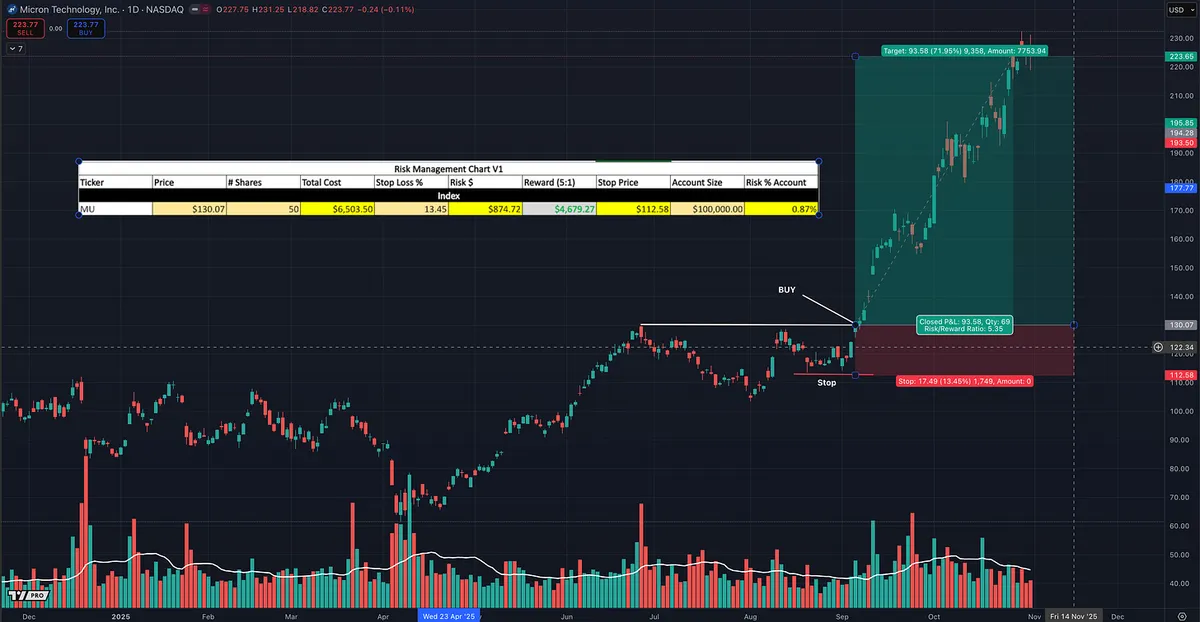
Let’s bring this to life with Micron (MU).

  • Entry: $130.07

  • Stop: $112.58

  • Stop Loss %: 13.45%

  • Account Size: $100,000

  • Target Risk per Trade: 1% (or $1,000)

If we simply bought any random number of shares, a 13.45% stop could easily blow through our target risk. But instead, we let the chart dictate where the stop goes — just below a key technical level — and then we adjust our position size so that the dollar loss stays within 1% of the account.

That’s how we arrive at 50 shares, risking $874.72 total.

Why the 13.45% Stop Makes Sense

Looking at the chart, you can see how the stop sits below prior support and the breakout zone — a level where, if price falls back through, the trade idea is invalidated. That’s exactly what Kovner meant by placing your stop beyond a technical barrier.

Setting the stop inside the range would’ve exposed us to random volatility and a likely premature exit. By respecting market structure, we give the trade room to breathe — but by managing position size, we keep risk capped and consistent.

The Takeaway

The professional mindset isn’t about predicting the next big move — it’s about controlling the downside so you can stay in the game long enough to catch the upside.

Every trade starts with two questions:

  1. Where am I wrong? → defines your stop.

  2. How much am I willing to lose? → defines your position size.

When you combine those answers, you get clarity, consistency, and, as Kovner said, the ability to sleep at night.

View on Substack ↗

Interesting Irony in Who Retail Investors Study

It’s fascinating how many retail investors try to model themselves after people like Buffett, Munger, or Dalio, investors managing tens or hundreds of billions with access, leverage, and deal flow that the average trader will never have.

And yet, there’s a whole group of traders who built wealth starting with modest capital. People like Jesse Livermore, Nicolas Darvas, William O’Neil, David Ryan, Mark Minervini, Dan Zanger, Kristjan Kullamägi, and others have frameworks that are far more aligned with what most individuals are actually trying to do: grow a small account into something meaningful.

It’s not that one approach is better than another. There are countless ways to make money in markets, and different styles fit different personalities. But it’s interesting how often people choose to follow those who play a completely different game.

Many of the big institutional names didn’t even start that way. They evolved as their capital base grew, because managing billions requires a different approach than managing thousands. So maybe it’s worth asking: Are you studying the people whose path matches where you are, or where they ended up?

View on Substack ↗

It’s Not About How Often You Win — It’s About How Big You Win.

Most people focus on being right often, not being right big. In reality, the majority of the best traders understand that you don’t need a high win rate to generate extraordinary returns. You just need to win big when you’re right and lose small when you’re wrong.

Stanley Druckenmiller is a perfect example:

“The way to build long-term returns is through preservation of capital and home runs.”

Over three decades, he averaged more than 30% annual returns managing billions, not because he was always right, but because his winners were big enough to pay for the losers. He focused on low-risk, high-reward trades.

View on Substack ↗

NVDA — Same Story, Different Cycle

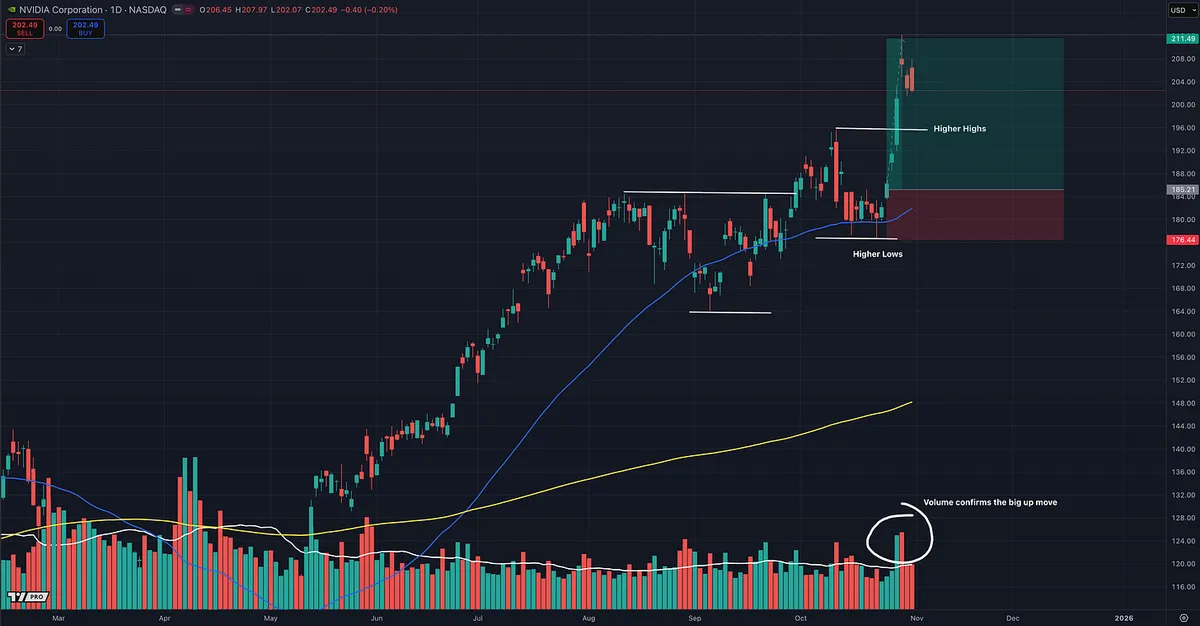
It’s always funny to see the chatter every time $NVDA consolidates. Just like people who think a stock or asset will never go down, there’s always another camp convinced “the top is in.” Then NVDA goes up, consolidates, and does it again, more times than I can count. 😂

That’s exactly why it’s so important to focus on price action and volume, and to look for good risk/reward opportunities until the trend actually confirms it’s over. Until then, the key is to stay unbiased and keep making smart, high-probability bets. If you study the greatest market winners of all time, as William O’Neil did, the pattern is clear: leaders in leading industry groups tend to dominate bull markets far longer than most people expect before finally topping out.

Plenty of bulls don’t rely on stochastics or oscillators, just price action and volume — the purest read of supply and demand. From that view, NVDA continues to show strength with higher lows and higher highs through its consolidation, and now it’s broken up out of that range, a textbook bullish continuation.

Price sits above all key daily moving averages (10, 20, 50, and 200 SMA). The last pullback found support at the 50-day on lighter volume, while the recent breakout came on big volume, confirming real institutional buying interest.

From a risk/reward standpoint, this setup is clean: defined support, strong momentum, and volume confirmation — everything you want in a continuation move.

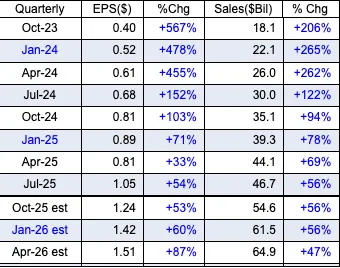
And fundamentally, NVDA remains an absolute leader. It holds an IBD Relative Strength Rating of 90, meaning it has outperformed 90% of all stocks in the market over the past 12 months. That’s not the same as the RSI or Stochastic “relative strength” indicators. IBD’s RS Rating measures true performance versus all other stocks, not short-term momentum.

When you combine that kind of technical strength with fundamental dominance like strong earnings, consistent sales growth, and market leadership, it’s hard not to stay bullish.

NVDA continues to do what great stocks do: Climb, consolidate, shake out the doubters, and climb again.

View on Substack ↗

The Market Doesn’t Care What You Think

“I think one of my strengths is that I view anything that has happened up to the present point in time as history. I really don’t care about the mistake I made three seconds ago in the market. What I care about is what I am going to do from the next moment on. I try to avoid any emotional attachment to a market. I avoid letting my trading opinions be influenced by comments I may have made on the record about a market.” -Paul Tudor Jones

View on Substack ↗

The Timeless Structure of Markets: Understanding Stan Weinstein’s Stage Analysis

In 1988, Stan Weinstein introduced a framework that still outperforms countless modern trading systems.

This comprehensive guide breaks down his Stage Analysis — how to identify where you are in the market cycle, trade in harmony with the trend, and avoid catastrophic losses.

Discover why, even decades later, simplicity — not complexity — remains a trading edge.

https://tradingmomentum.substack.com/p/stan-weinsteins-stage-analysis-the

ArticleStan Weinstein’s Stage Analysis: The Complete Guide to Understanding Market Structure
View on Substack ↗

When Volume Confirms Price

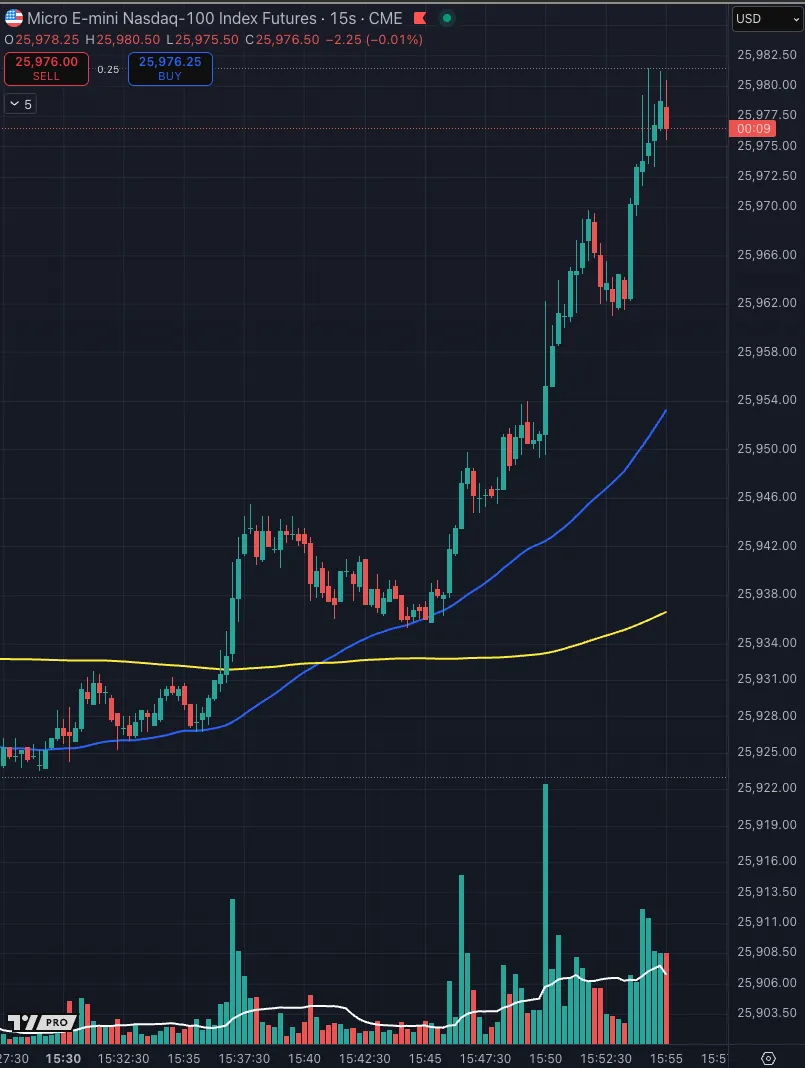
I was watching the market close on Monday and took this screenshot because it captures volume price analysis in action. It may be a 15-second chart, but the same story plays out across all timeframes. Price begins forming a series of higher lows before a surge in volume pushes the market sharply higher. On the first pullback, volume dries up, showing that selling pressure has faded. When price turns back up, volume expands again, confirming that buyers have regained control.

View on Substack ↗

When Fear and FOMO Collide

Every bubble ends, just not always when you expect it.

That’s what makes them so dangerous: the pain of staying in too long and the regret of stepping aside too soon.

You can lose when the music stops, lose by jumping in too late from FOMO, or lose by never participating out of fear.

View on Substack ↗

The Cheetah Principle

“Although the cheetah is the fastest animal in the world and can catch any animal on the plains, it will wait until it is absolutely sure it can catch its prey. It may hide in the bush for a week, waiting for just the right moment. It will wait for a baby antelope, and not just any baby antelope, but preferably one that is also sick or lame. Only then, when there is no chance it can lose its prey, does it attack. That, to me, is the epitome of professional trading.” — Mark Weinstein, Market Wizards

View on Substack ↗

The Diversification Delusion

“Diversification is a hedge for ignorance. I think you are much better off owning a few stocks and knowing a great deal about them.”

— William O’Neil

“Diversification is protection against ignorance. It makes little sense if you know what you’re doing.”

— Warren Buffett

Two completely different types of investors — O’Neil, a growth and momentum trader, and Buffett, a long-term value investor, yet both came to the same conclusion.

Most people think diversification reduces risk. But for those who actually know what they’re doing, it often does the opposite. It dilutes focus, weakens conviction, and hides bad decisions behind averages.

Real safety doesn’t come from owning more. It comes from understanding more — from knowing exactly what you own and why.

View on Substack ↗

Everyone’s a Trading Critic

In trading, everyone’s a critic.

If they don’t understand it, it’s nonsense.

If it didn’t work for them, it’s garbage.

If it worked for them, everyone else should do it too.

But here’s the truth:

Just because you haven’t learned it doesn’t mean it doesn’t work.

Just because it hasn’t worked for you doesn’t mean it’s broken.

And just because it has worked for you doesn’t mean it’s universal.

There are countless ways to make money in the markets. The trick is finding the one that fits you, and that takes time, mistakes, and a lot of learning.

View on Substack ↗

Markets Are at All-Time Highs. Why That Matters More Than the Headlines.

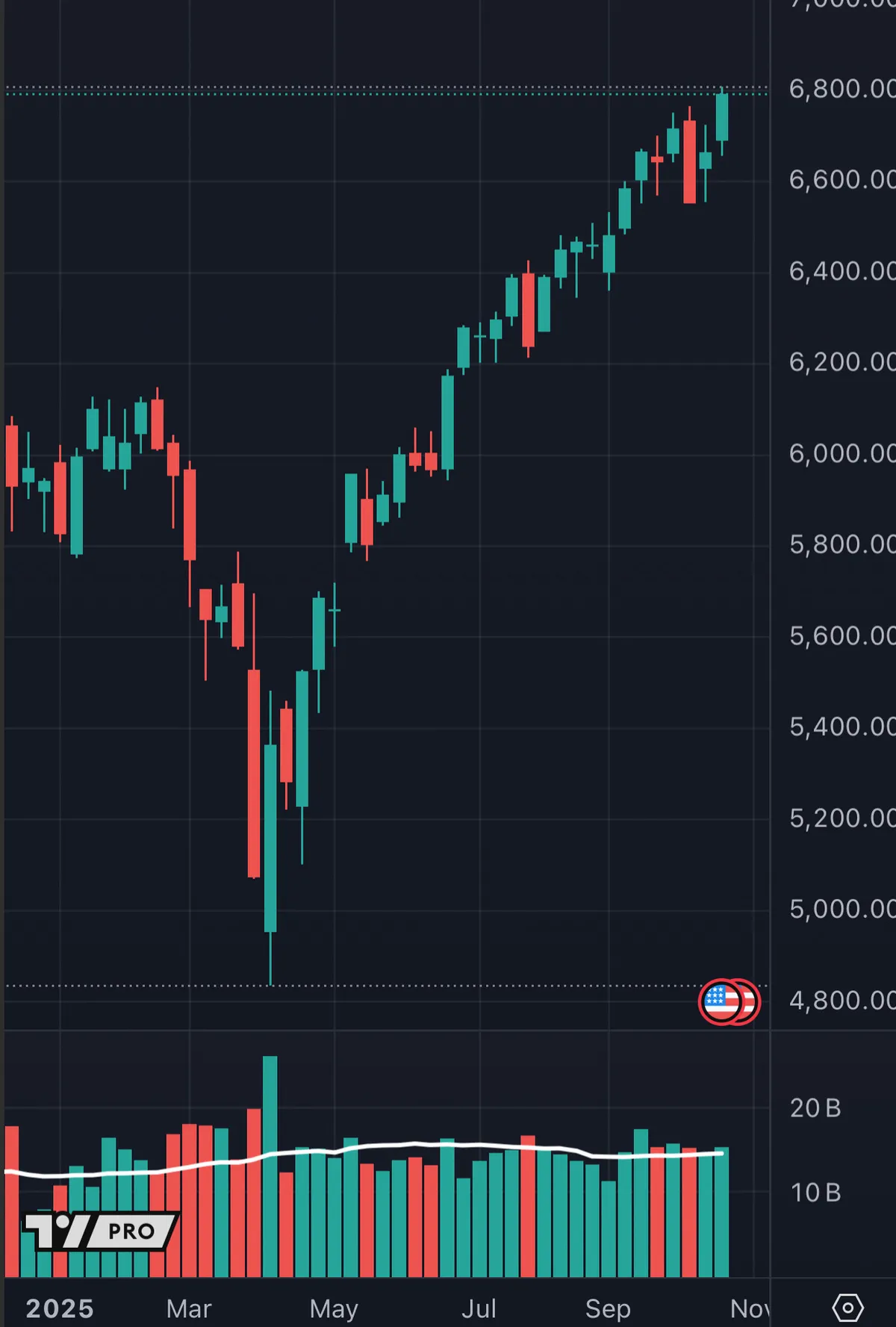
Through all the bearish macro noise, with calls for recession, stretched valuations, geopolitical tension, sticky inflation, and warnings about credit stress, markets are quietly back at all-time highs.

Those themes have been everywhere:

  • Analysts warning valuations are “disconnected from fundamentals.”

  • Economists pointing to a slowing labor market.

  • Commentators fretting over tariffs, geopolitics, and margin pressure.

  • Strategists warning of “credit cockroaches” lurking in private markets.

And yet, despite it all, prices keep climbing.

As Larry Hite once said:

“The second item is something that Ed Seykota taught me. When a market makes a historic high, it is telling you something.”

Markets don’t make new highs out of optimism alone. They do it when real capital, globally, decides risk is still worth taking.

Price action is the market’s collective intelligence. It discounts the future faster than any economist or headline can. So rather than debate every bearish narrative, it might be wiser to simply listen to what the market itself is saying.

New highs aren’t just numbers. They’re signals.

View on Substack ↗

Two traders can look at the same chart, trade the same setup, and still walk away with completely different results.

The difference usually isn’t the strategy; it’s how each trader executes it. Entry timing, position size, stop placement, and profit-taking all affect the outcome.

Even when two people aim for the same stop and target, small differences in how they enter and manage the trade can make one lose while the other wins.

As Ed Seykota said, “I can give everyone the same trading system and we’d all still make different amounts of money, because everyone would manage it differently.”

Edge matters, but execution and mindset matter just as much. How you handle losses, re-enter after getting stopped out, and stay objective under pressure is what separates consistent traders from the rest.

Systems create opportunities. Execution decides outcomes.

View on Substack ↗

Nicolas Darvas, in How I Made $2,000,000 in the Stock Market, explained one of the most profound realizations of his trading career, that consistent success didn’t come from being right all the time, but from making more when right than losing when wrong.

He accepted that no system could predict markets perfectly, even the best traders might only be correct half the time. What mattered was risk management and the ability to protect capital when wrong while compounding profits when right.

Darvas also displayed a remarkable level of self-awareness. He recognized his emotional weakness, his tendency to sell too soon out of fear, and designed a systematic solution to overcome it. As he wrote:

“There was only one answer to this danger: My profits had to be bigger than my losses.

I had learned from experience that my most difficult problem was to discipline myself not to sell a rising stock too quickly. I always sold too quickly because I am a coward. Whenever I bought a stock at 25 and it rose to 30, I became so worried it might go back that I sold it. I knew the right thing to do but I invariably did the opposite.

I decided that since I could not train myself not to get scared every time, it was better to adopt another method. This was to hold on to a rising stock but, at the same time, keep raising my stop-loss order parallel with its rise. I would keep it at such a distance that a meaningless swing in the price would not touch it off. If, however, the stock really turned around and began to drop, I would be sold out immediately. This way the market would never be able to get more than a fraction of my profits away.”

👉 Read more → https://tradingmomentum.substack.com/p/nicolas-darvas-the-dancer-who-outsmarted

ArticleNicolas Darvas: The Dancer Who Outsmarted Wall Street and the Timeless Lessons That Still Work Today