Momentum Trading Strategy

Notes

Short lessons on momentum trading, every day.

Every note from Substack, in one place: risk, setups, leading stocks, market conditions and the mindset behind them. Search them, browse by topic, or filter by stock.

Showing 1181–1200 of 1230 notes

View on Substack ↗

“The markets can remain irrational longer than you can remain solvent.” — Keynes

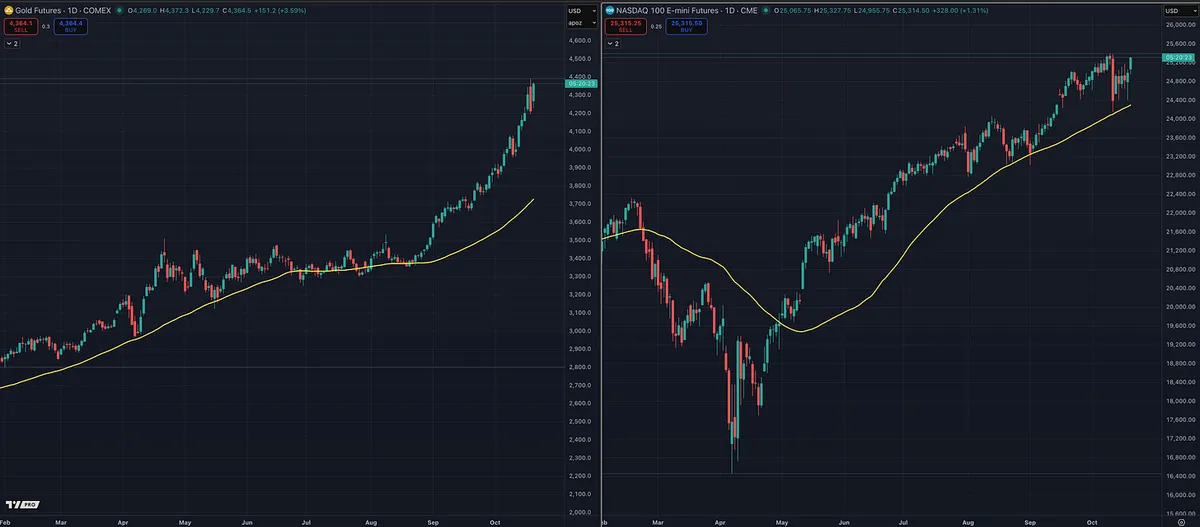
The wave of doom-and-gloom started on Friday, October 10th and continued throughout last week — bout of volatility and suddenly everyone was calling “THE TOP.”

And yet… we’re already right back near all-time highs in gold, the Nasdaq, and the S&P.

This is exactly why I don’t call tops or bottoms.

I focus on price action:

  • Are we still making higher highs and higher lows?

  • Or transitioning into lower lows and lower highs?

  • Have we actually closed below key moving averages?

  • Is there a confirmed trend change, not just intraday noise?

Until then — it’s just chatter.

Most “top calling” you see on social media is engagement farming, not strategy. A real approach is taking defined low-risk / high-reward trades when your system triggers because your edge is in the math, not the prediction.

That’s process. Not ego.

Price > opinions.

Discipline > emotions.

Signals > narratives.
View on Substack ↗

The longer you’re in markets, the more you realize sentiment drives everything — not logic or valuation, but who is still willing to buy or sell next.

• When everyone is euphoric, most people have already bought → risk is highest

• When everyone is bearish, most selling is already done → future returns improve

• When sentiment is mixed, the market quietly climbs the “wall of worry”

Tops are built on greed. Bottoms are built on fear. The middle is where the real trend happens.

View on Substack ↗

The Overbought Myth: Why Strength Is Not a Signal to Sell

Bull markets become and stay overbought in a bull market.

This reminds me of what Larry Hite, one of the original Market Wizards, said when asked about overrated indicators: “Overbought/oversold indicators. None of them seem to prove out in testing.”

Overbought isn’t a sell signal; it’s a symptom of strength. Before you jump the gun and start shorting, make sure the market confirms your hypothesis with price action. If you don’t understand this, you probably shouldn’t be shorting.

View on Substack ↗

Stanley Druckenmiller — one of the greatest investors of our time — said this about macro and fundamental data:

He uses both fundamentals and technicals. But for those who get stuck in their fundamental view and stop paying attention to the ultimate indicator — price — this one’s for you 👇

“I don’t use what traditional economists use to predict the economy, which is things like employment and a bunch of macro, top-down statistics. In fact, I started my career as a bank and chemical analyst, and over time I learned that the inside of the stock market had a very, very present message about future economic activity. And for whatever reason, stocks tend to lead the fundamentals by somewhere between six and twelve months. And you can even go beyond that and look at industries that lead the economy and industries that lag the economy.”

-Stanley Druckenmiller

https://www.youtube.com/shorts/joTuj2PVWYY?feature=share

youtube.com- YouTube
View on Substack ↗

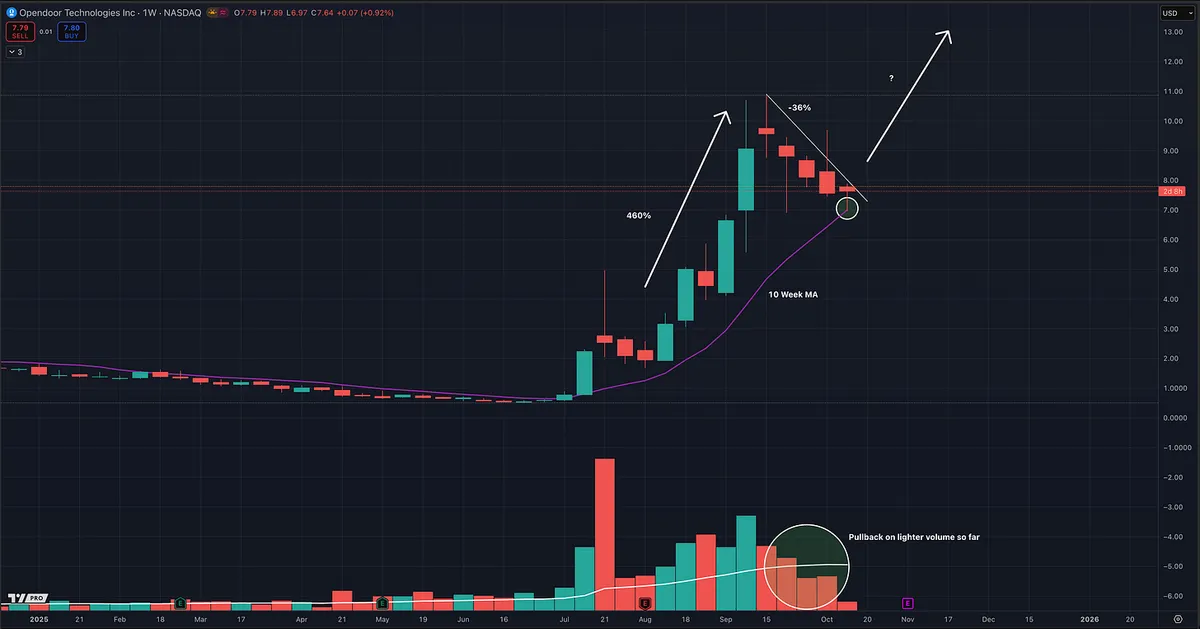
Weekly chart looks constructive — $OPEN has pulled back to the 10-week MA on lighter volume after a strong prior run. The weekly structure remains intact despite a ~36% pullback, and volume has been drying up, indicating normal consolidation.

A strong-volume breakout through the short-term downtrend could confirm a trend resumption and signal the next leg higher.

I’ll turn cautious if heavy selling volume appears and price breaks below $6.90 — that would invalidate the setup for now.

View on Substack ↗

“Most investors think that charts are hocus-pocus. Only about 5 to 10 percent of investors understand charts. Even a lot of professionals are totally ignorant about charts. Just as a doctor would be foolish not to use X-rays and EKGs, investors would be foolish not to use charts.”

— William J. O’Neil

View on Substack ↗

Reminder after yesterday’s sell-off:

I’m not a value investor like Warren Buffett, but I love when the market goes down just like he does.

If big drops or bear markets make you panic, it’s time to reassess your mindset.

Corrections and deep sell-offs create the next great opportunities — that’s when risk/reward becomes truly asymmetric.

Sometimes the hardest move — buying more or stepping back in when fear is highest — ends up being the most profitable.

The biggest gains for many traders and investors come after major corrections.

And this holds true for investors, position traders, swing traders, and even day traders — opportunity always follows panic, just on different timeframes.

⚠️ This doesn’t mean blindly buying while the market is crashing. You still need to know when buyers are stepping back in, manage risk carefully, and size positions properly.

And it doesn’t just apply to bear markets — whether it’s a bull market pullback, a longer-term base, a full-blown correction, or a new secular trend, each offers incredible opportunities if you know how to identify them and control risk.

If you don’t understand what that means, it’s time to study more — or you’ll likely become one of the next victims when volatility returns.

View on Substack ↗

Even day, swing, and position momentum traders should understand the bigger picture.

Reviewing relative strength, volatility, and breadth helps you see where to look — not just what to trade.

Every weekend I review the macro pulse before screening, building watchlists, setting alerts, and planning trades.

Read Part 1 of my weekend prep →

View on Substack ↗

Trading Wisdom from Market Wizards

“Although the cheetah is the fastest animal in the world and can catch any animal on the plains, it will wait until it is absolutely sure it can catch its prey. It may hide in the bush for a week, waiting for just the right moment. It will wait for a baby antelope, and not just any baby antelope, but preferably one that is also sick or lame. Only then, when there is no chance it can lose its prey, does it attack. That, to me, is the epitome of professional trading.”

— Mark Weinstein, Market Wizards (Jack D. Schwager)

View on Substack ↗

Everyone talks about finding their edge in trading.

Truth is, most people already have access to proven systems — from traders like William O’Neil, Dan Zanger, or Kristjan Kullamägi.

The problem isn’t the system. It’s the discipline to follow it.

Trading is no different from health or wealth. Most people know what to do — they just don’t do it.

The real edge? Discipline. Emotional control. Doing the small things right.

Because if you can’t master those, no strategy will save you.

The markets don’t just test your edge — they test you.

View on Substack ↗

Don’t let big macro narratives blind you. April’s correction looked like doom, but it extended the bull.

The catch: these same resets often show up right before secular bears.

Full breakdown inside: