Momentum Trading Strategy

Notes

Short lessons on momentum trading, every day.

Every note from Substack, in one place: risk, setups, leading stocks, market conditions and the mindset behind them. Search them, browse by topic, or filter by stock.

Showing 701–720 of 1226 notes

View on Substack ↗

Most Traders Get This Backwards

They get bullish at the top

And bearish at the bottom

That’s why they lose.

Warren Buffett said it best:

“Be fearful when others are greedy, and greedy when others are fearful.”

Most people hear that and think it only applies to value investing.

It doesn’t.

It applies to trend following.

It applies to growth stocks.

It applies to momentum.

When fear is high, leaders are quietly setting up.

When greed is everywhere, risk is at its highest.

The crowd chases emotion.

Professionals follow process.

If you can train yourself to do the opposite of what feels comfortable…

You’re already ahead of 90% of traders.

View on Substack ↗

Struggling Right Now? Good.

If you just started trading around October or November…

During this choppy, sideways Stage 3 environment and recent decline…

I know it feels frustrating.

But you’re actually lucky.

One of the worst things that can happen to a new trader…

Is beginner’s luck.

After COVID in 2020–2021, a lot of traders made life-changing money.

And then gave it all back in 2022.

Explosive bull markets feel great…

But they teach bad habits.

They build overconfidence.

They prevent you from actually learning how to trade.

So if you’ve been struggling…

Don’t wish for easier conditions.

Be grateful.

Because you’re being forced to learn this the right way.

It’s a lot less painful to struggle early…

Than to make life-changing money…

And watch it all disappear.

Learn the process now.

Put in the work.

So that story isn’t yours.

View on Substack ↗

You Don’t Believe It… Until You See It

David Ryan said it best:

“You become a believer once you actually see it work in your own account.”

That’s the key.

Not paper trading. Not watching others. Not collecting tips.

Your account.

So stop overthinking it.

Start small. So small you’re completely fine losing it.

Then do one thing:

Follow the system. 100%. No exceptions.

Only trade:

  • Stage 2 uptrends

  • High relative strength names

  • Big earnings

  • Big sales

  • Strong ROE and/or margins

  • Leading industry groups

  • Proper buy points and proper stops

  • No shortcuts. No rule-breaking.

Because once you see it work…

Everything changes.

You stop looking for tips. You start trusting the process.

And from there…

You no longer need validation. You trust your system.

That’s when you start making life-changing returns…

and actually keep them.

That’s the goal.

To get you to the point where you don’t need anyone for stock picks…

You have the skillset to find them yourself.

That’s why I built the course.

Not to give you fish…

But to teach you how to find them on your own, over and over again.

https://tradingmomentum.substack.com/p/momentum-trading-strategy-the-100

On SubstackMomentum Trading Strategy: The 100-Year Playbook Behind the Biggest Winning Stocks
View on Substack ↗

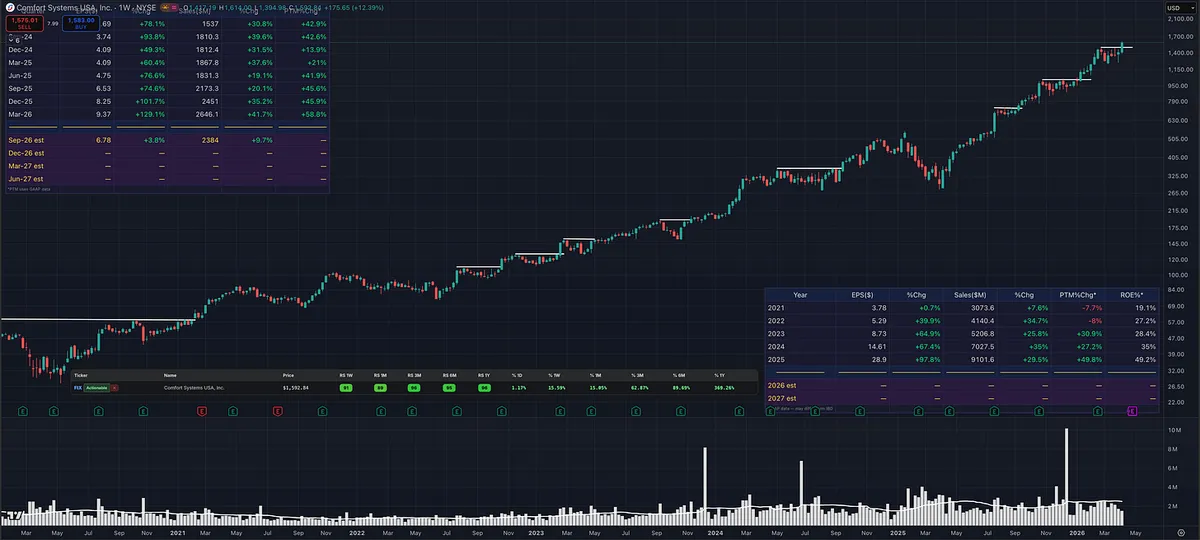
This Is What Leadership Looks Like

Most people overcomplicate stock selection.

It’s not that complicated.

Look for strength. Then confirm it.

This stock continues to climb.

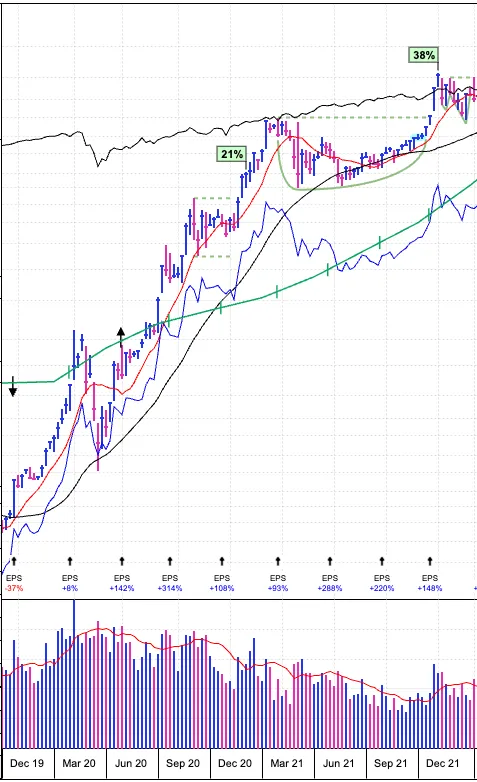
• EPS growth: +129%

• Sales growth: +41%

• Pre-tax margins: 58%

• ROE: 49%

That’s not normal.

That’s leadership.

And the chart tells the same story.

Since May 2020, it’s been doing one thing:

Higher highs. Higher lows.

The only real shakeout came during last year’s tariff scare.

And what did it do?

Recovered. Continued higher.

Now layer in the most important piece:

Demand.

Fund ownership has more than doubled since fall of 2024.

Institutions are not guessing.

They are building positions.

This is what you want to see:

Strong relative strength. Explosive earnings. Real sales growth. Elite margins. High return on equity and increasing institutional demand.

Find the leaders.

Follow the demand.

View on Substack ↗

“You’re Chasing a Pipe Dream.”

Mark Minervini said it perfectly in a Q&A:

He’d rather chase a dream than chase a job.

Think about that.

Every great trader, athlete, or entrepreneur…

Was told the same thing at some point.

Elon Musk heard it with Tesla and SpaceX.

Even early on, legends like Neil Armstrong and Gene Cernan were skeptical that commercial space companies could achieve what they were claiming.

Now look where we are.

If you’re not chasing something that sounds unrealistic to other people…

You’re probably not aiming high enough.

Most people don’t fail because they chase dreams.

They fail because they listen to people who never chased one.

View on Substack ↗

“Volume Doesn’t Matter.”

I’ve heard that from people for years.

But after going through thousands of winning stocks and setups…

I keep seeing the same thing over and over:

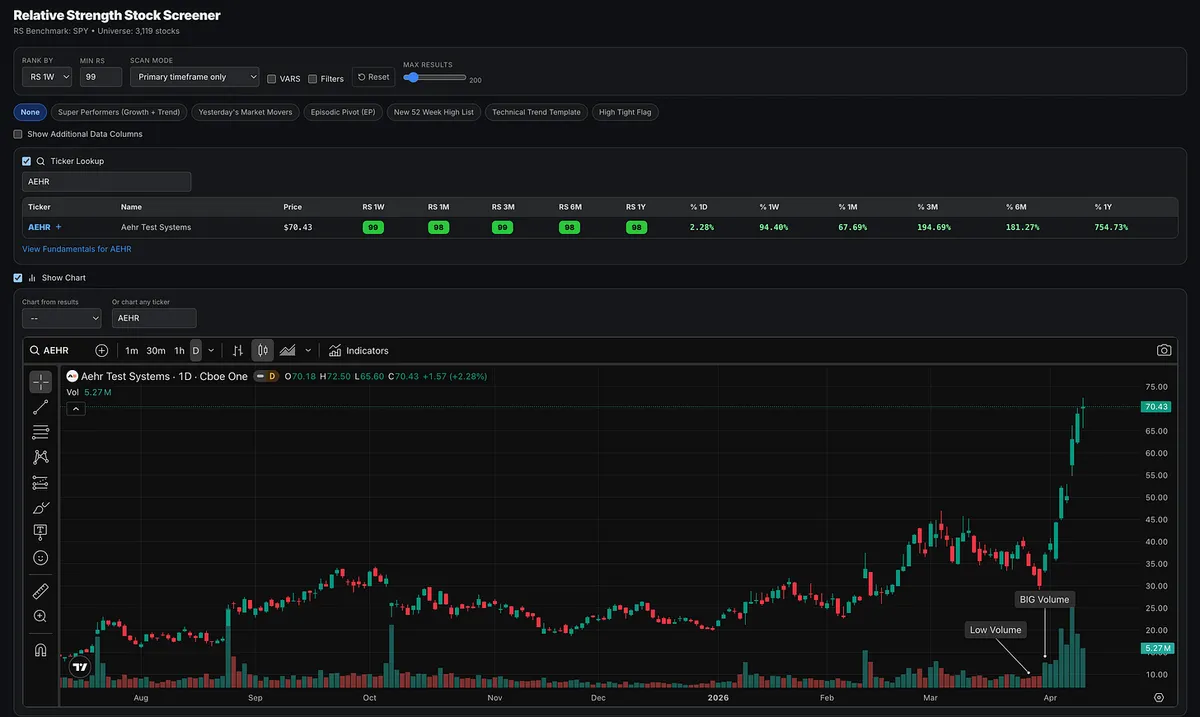
Low volume on the pullbacks.

Explosive volume on the way up.

Quiet selling. Aggressive buying.

But yeah… I guess that doesn’t matter 😉

View on Substack ↗

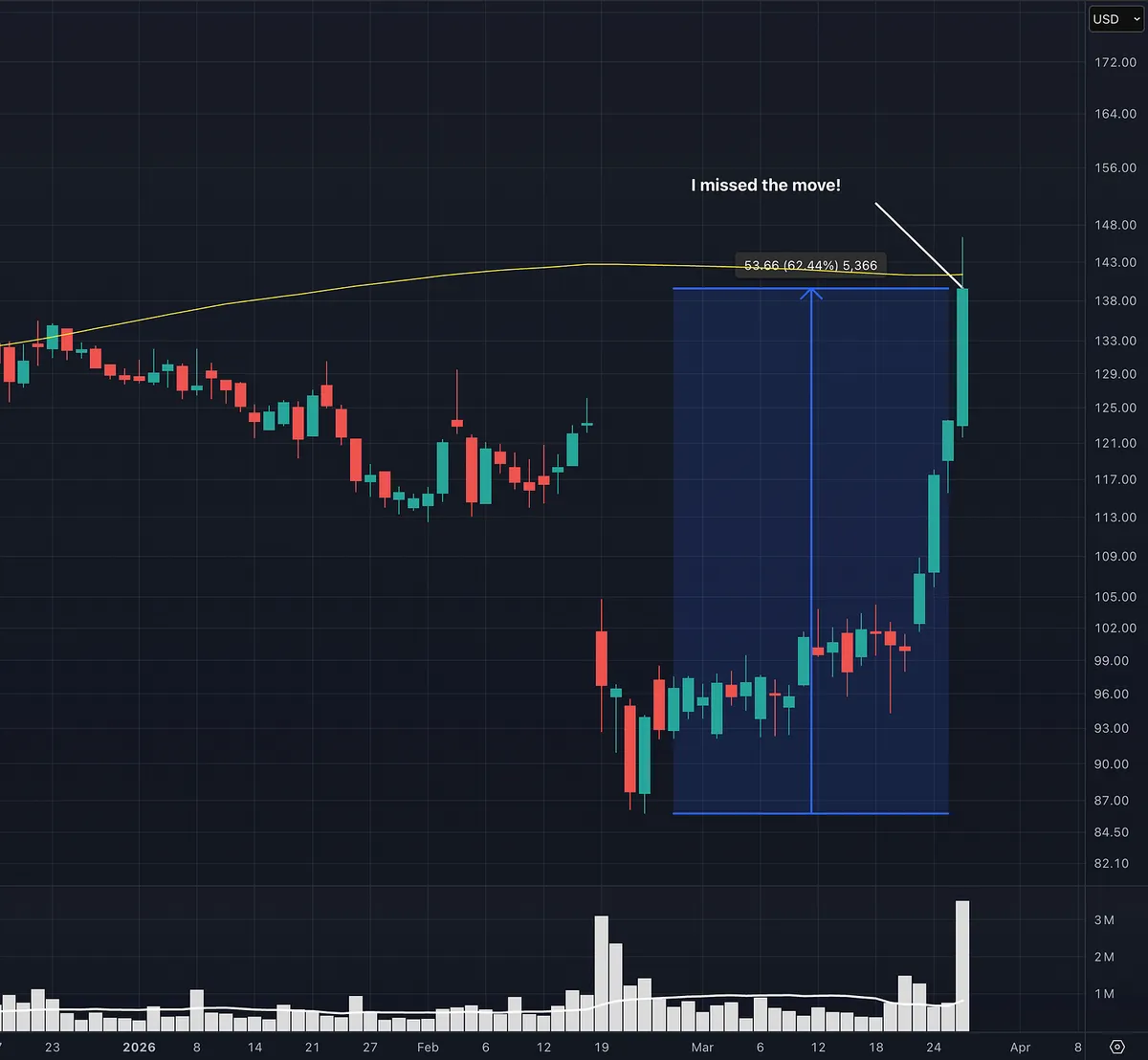
You Didn’t Miss the Move

Most traders think they missed it.

The stock is already up. It feels extended. So they move on.

But what they think is “the move”…

Is usually just the signal.

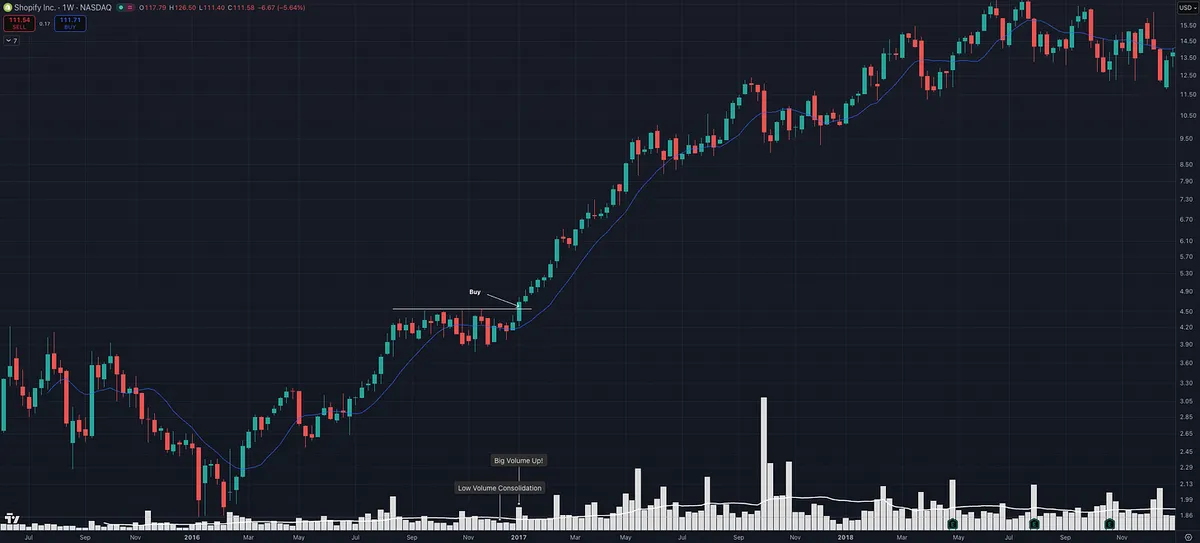
see image 1.

That first push, especially with strong relative strength and volume, is not the end.

It’s the heads-up.

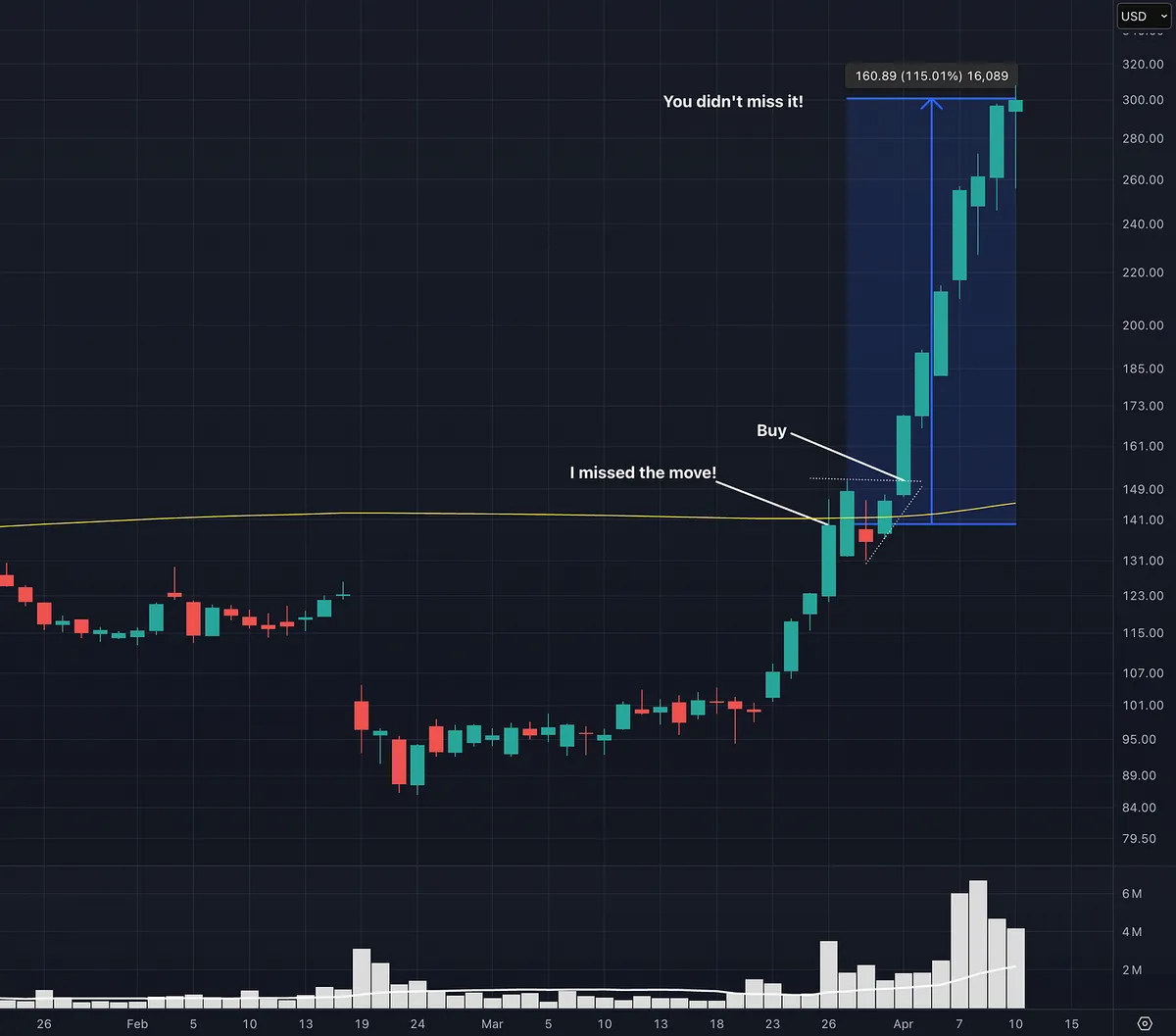
see image 2.

The real move often comes after.

The best stocks don’t move once. They move in stages.

If you’re waiting for it to look comfortable…

You’ll miss it every time.

Follow the strength.

$CAR

View on Substack ↗

The First Thing I Look At Every Single Week (And Why Most Traders Miss It)

After I finish my Big Picture Market Pulse…

I don’t jump into news. I don’t chase ideas. I don’t scroll social media looking for the next hot stock.

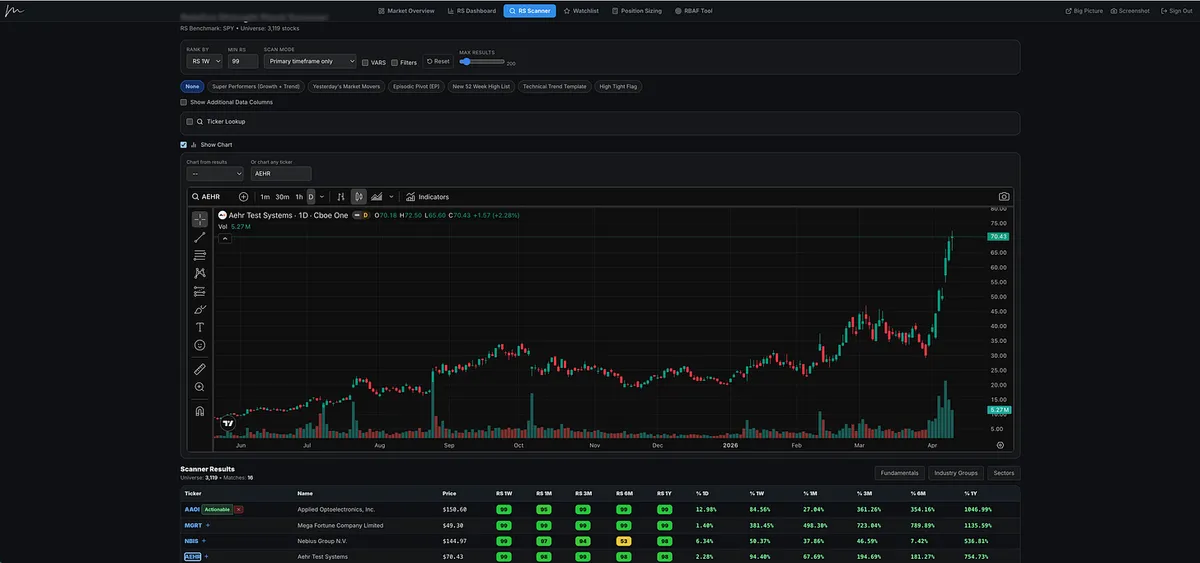
I go straight to one thing:

Relative strength.

Because before you can make money in stocks…

You have to know where the money is already going.

Every week, I run my screens across multiple timeframes:

• 1 week

• 1 month

• 3 months

• 6 months

• 1 year

I’m not just looking for stocks that are up.

I’m looking for stocks that are outperforming everything else: the S&P 500, the overall market, and most importantly, all the other stocks in the market.

Because that’s where leadership shows up first.

Most people have it backwards.

They look for “cheap” stocks. They look for what hasn’t moved yet.

But the market doesn’t reward cheap.

It rewards strength.

And the biggest winners in history?

They were already outperforming before they made their real move.

William O’Neil said:

“The best stocks were already doing better than nearly 9 out of 10 others when they were starting out on their most explosive advance yet.”

Mark Minervini said:

“As a general rule, I buy strength, not weakness. True market leaders will always show improving relative strength.”

So after I analyze the market…

I’m asking one question:

Who is actually leading right now?

Not last quarter. Not last year.

Right now.

Because when the market turns… When conditions improve… When institutions start deploying capital…

They don’t buy laggards.

They pile into leaders.

And if you’re not looking at relative strength…

You’re guessing.

This is exactly why I built my relative strength dashboard and stock screener. https://momentumtradingstrategy.app/

Not to give you random ideas…

But to show you, in real time, what’s actually leading and what’s starting to accelerate.

momentumtradingstrategy.appMomentum Trading Strategy
View on Substack ↗

The Market Just Flipped. Most People Haven’t Noticed Yet.

Big changes took place last week.

Major indexes are now back above the 200-day.

That alone should get your attention.

But here’s the problem…

Most traders skip this step entirely.

They jump straight into stocks.

Setups. Entries. Indicators.

Without ever asking:

What kind of market am I actually trading in?

It doesn’t matter if you’re:

  • Day trading

  • Swing trading

  • Position trading

  • Trading momentum, growth, or scalping

If you’re not aligned with the bigger picture… you’re fighting the market.

And that’s a losing game.

This isn’t new.

Top prop firms start with the big picture every single day.

And in Market Wizards, traders like:

  • Michael Marcus

  • Bruce Kovner

  • Richard Dennis

  • Paul Tudor Jones

All studied Martin Zweig’s work to understand one thing:

The market environment.

Right now, the environment is changing.

We’ve gone from:

❌ Under key moving averages

❌ Poor breadth

❌ Defensive leadership

To:

✅ Price reclaiming key levels

✅ Breadth expanding

✅ Growth starting to lead again

Now the question is:

Is this the start of a new uptrend… or just another failed rally?

That’s exactly what I break down in this week’s Big Picture Market Pulse.

If you’re serious about trading, this is where you start.

With the market.

👉 https://tradingmomentum.substack.com/p/big-picture-market-pulse-april-12

On SubstackBig Picture Market Pulse | April 12, 2026
View on Substack ↗

Is a 5% Stop Too Tight in Today’s Market?

I got a great comment recently:

“It’s just that -5% is not much in today’s markets. Not enough not to get whipsawed. What’s your view?”

Here’s my answer.

I disagree.

There are still plenty of setups where you can risk 5 percent or less.

If that wasn’t the case, traders like Kristjan Kullamägi wouldn’t be as successful as they are.

Same with Mark Minervini. He won the U.S. Investing Championship in 2021. He’s still finding tight entries in today’s market.

It comes down to tactics and timing.

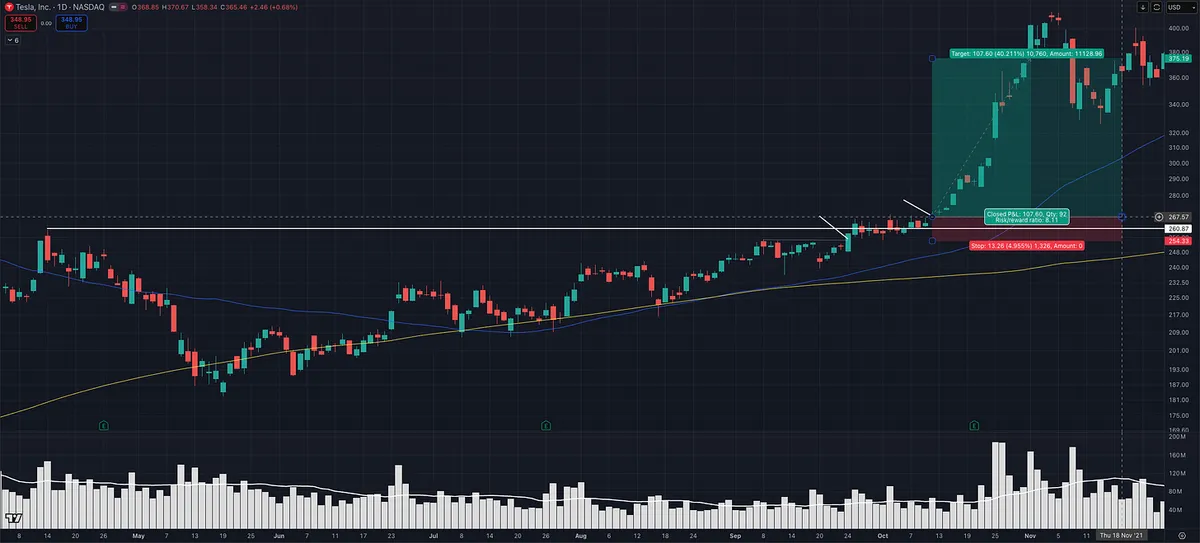
This TSLA example is a good illustration.

On the right side of the base, price was tightening and structure was clean. That created multiple opportunities where risk could be kept at 5 percent or less.

Recently (2025-2026), with many of the big winners already extended in Stage 2 uptrends, it’s a different environment.

If you’re only buying standard breakouts here, then yes, your stop likely needs to be 7 to 10 percent.

But that’s just one way to play it.

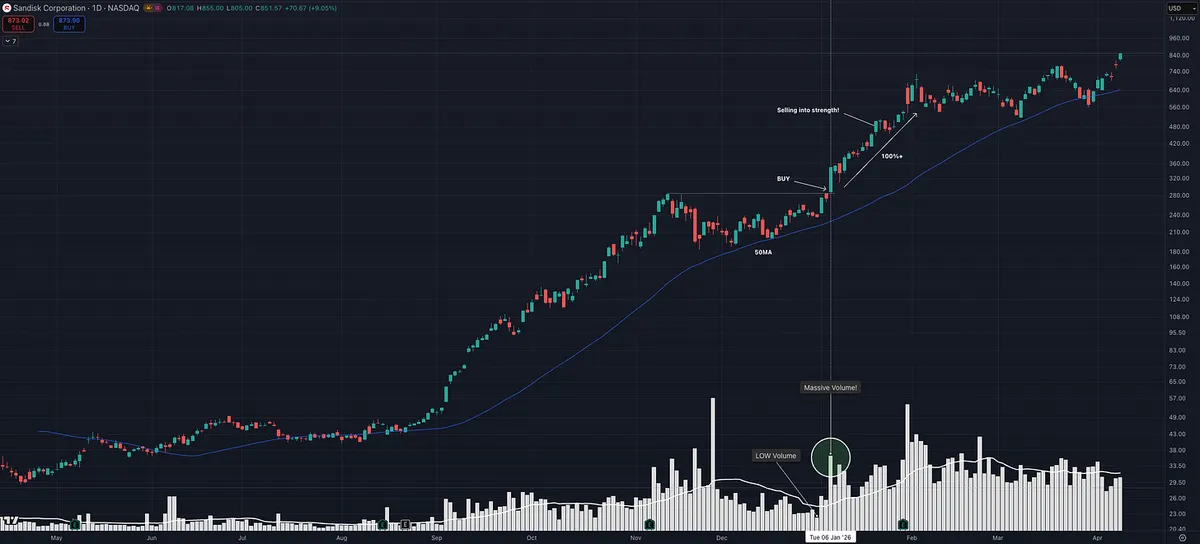
A lot of the big winners from 2025 to now in areas like computer data storage and telecom, names like LITE, SNDK, MU, CIEN, WDC, were harder to trade with tight risk using traditional breakout entries.

Their ADR% was higher, and there was less contraction into the pivot, so traders had to adapt.

Pullback entries. Low cheats. Intraday entries like ORB.

Those allow you to define risk much tighter and still participate without getting shaken out.

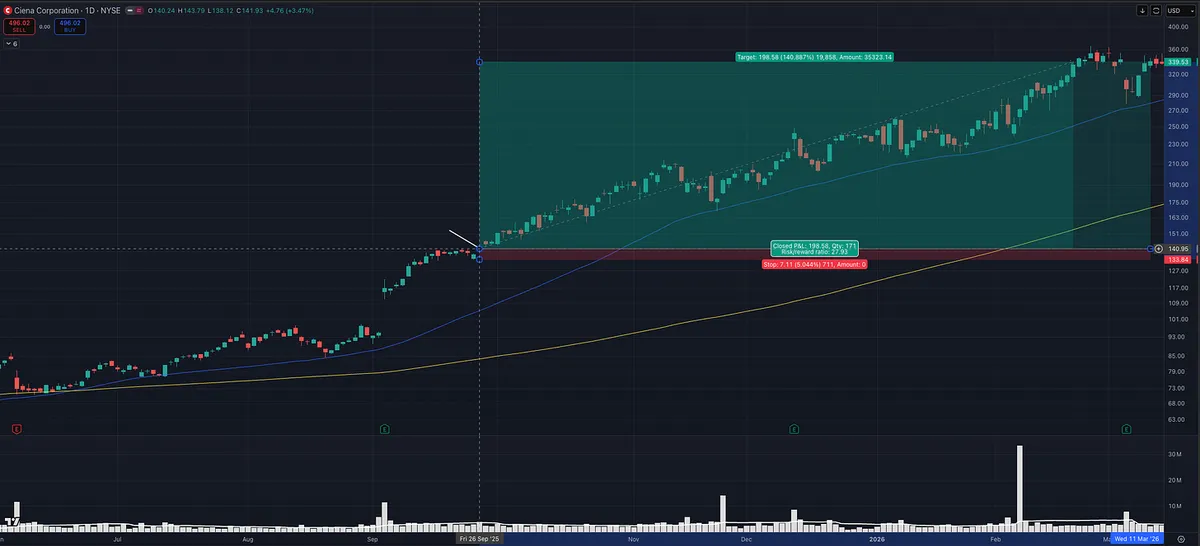
CIEN is another good example.

After an episodic pivot on earnings, price ran, then tightened sideways. That created a clean opportunity to enter with defined, tight risk.

This isn’t about forcing a fixed 5 percent stop on every trade.

It’s about finding entries with proven setups where tight risk actually makes sense.

Timeframe matters. Setup matters. Execution matters.

And just like Minervini, I’m not rigid with it.

Some trades might be 3 percent risk. Some 5 percent. Some 6 to 8 percent depending on the setup.

I’ll even go up to 10 percent and adjust position size, but I prefer tighter risk when the setup allows it.

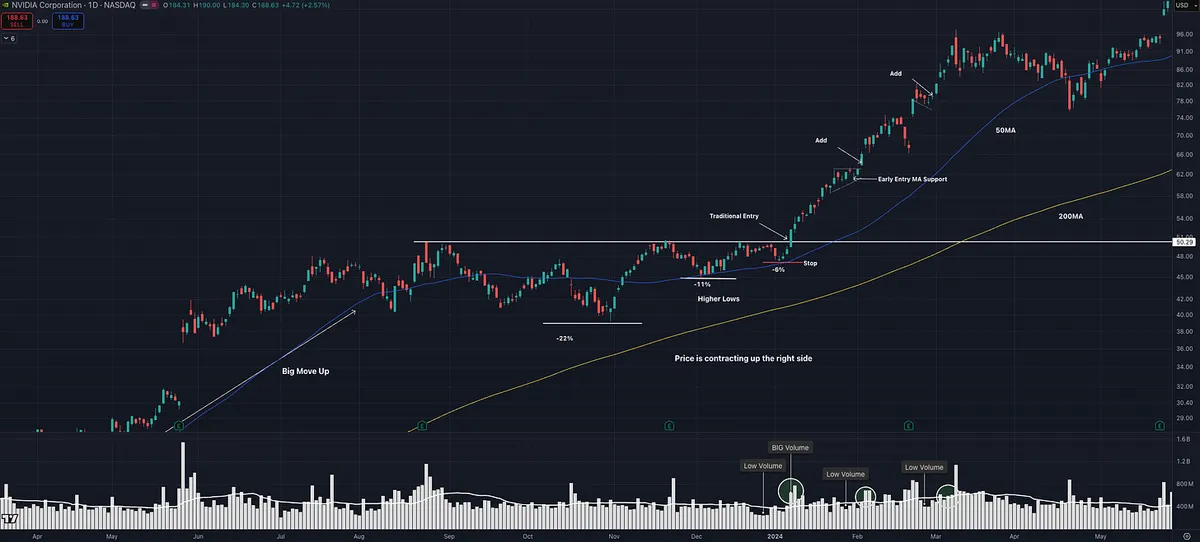
Another good example is NVDA in 2024. I had about 6 percent risk. Someone else could have taken the same trade and used the breakout day opening range low as a stop and risked closer to 1.82 percent and likely wouldn’t have been stopped out.

Like David Ryan often emphasizes, the best trades tend to be hard to buy, work right away, and don’t look back.

The principle stays the same.

Keep losses small. Don’t let one trade do real damage.

And at the end of the day, we all trade differently and that’s ok.

That’s what makes a market.

Different styles can still make money.

View on Substack ↗

The One Rule That Changed Minervini’s Entire Trading Career

Most traders spend all their time trying to find the perfect entry.

They think that’s where the money is made.

It’s not.

In Stock Market Wizards, Mark Minervini said:

“Containing your losses is 90 percent of the battle.”

Read that again.

Not entries. Not stock picking. Not indicators.

Losses.

When Minervini studied his results, he didn’t find that his winners were the problem.

He found that his losers were.

Big losses were doing all the damage.

Cutting those losses didn’t hurt his performance.

It transformed it.

Over a large sample of trades:

A -5% loss is nothing.

A -6% loss is nothing.

A -7% loss is nothing.

They are just business expenses.

But one -25% or -30% loss?

That wipes out multiple winning trades.

That’s what keeps traders stuck.

Most traders think:

“If I cut my losses tight, I’ll miss the big winners.”

Reality:

The best stocks don’t need a lot of room.

They work quickly.

They show strength early.

And if they don’t?

You’re probably wrong.

The difference between average traders and elite traders is simple:

They refuse to take big losses.

They keep every loss small and controlled.

And over time, that one decision compounds into massive performance.

You don’t need to be right all the time.

You just need to make sure when you’re wrong, it doesn’t matter.

View on Substack ↗

Why Smart People Fail at Trading (And What Steve Cohen Looks For Instead)

One of the most important traits in trading has nothing to do with intelligence.

It’s risk.

Steve Cohen said it best:

“I’m looking for people who are not afraid to take risks.”

That’s it.

Not the smartest. Not the most educated.

The ones willing to take risk.

And he doubled down on it when talking about why some people never make it:

“…he refuses to make his own decisions.”

That’s the difference.

And it’s exactly why so many brilliant people fail in this game.

They can analyze. They can break down data. They can build models.

But when it’s time to act?

They hesitate. They freeze or they don’t take the trade at all.

Because trading isn’t about knowing.

It’s about doing.

Great traders aren’t just thinkers…

They’re decision makers.

They’re comfortable putting capital at risk. They trust themselves. They act when it matters.

That’s leadership.

And that’s where most people fall short.

They approach trading like employees.

Looking for confirmation. Looking for permission. Looking for someone to tell them what to do.

That doesn’t work here.

In trading, you are the decision maker.

You have to own it.

Now this doesn’t mean reckless risk.

It’s not about gambling or going all in.

It’s calculated risk.

Defined risk. Position sizing. A plan.

But at some point, you still have to pull the trigger.

That’s the line that separates traders from everyone else.

You can teach strategy. You can teach setups. You can teach risk management.

But you can’t force someone to act under pressure if they don’t want to.

View on Substack ↗

Why I Trade Stocks Instead of the Market

Someone asked me why I focus on stocks instead of just trading indexes or futures.

The answer is simple:

There’s more edge in individual stocks.

That doesn’t mean you can’t trade the market. I trade futures at times too.

But the reality is, the overall market is harder to gain an edge in.

Why?

Because it’s more efficient.

Indexes are massive. They’re a basket of stocks. There are more participants, more eyes, more capital, and more information already priced in.

You can still time it…

But it’s harder.

Individual stocks are different.

They’re less efficient and that’s where opportunity lives.

Now, that edge only exists when a stock is in play.

Not every stock has opportunity. Most are dead money.

The real edge comes from focusing only on the names with clear catalysts and institutional demand.

What causes a stock to be “in play.”

Big earnings and sales surprises. New products. New industries. Shifts in demand or future outlook.

These are catalysts that can catch people off guard.

Institutions discover them. Then they rush in.

When that happens, you get powerful, directional moves that are much easier to capitalize on as a trader.

You’re not just trading the market…

You’re trading the leaders driving it, backed by a catalyst and real demand.

That’s where the biggest opportunities are.

That’s why I always come back to stocks.

View on Substack ↗

The Hardest Buys Are the Best Trades

The stocks that feel the hardest to buy are usually the ones you should be buying.

Why?

Because they’re showing real demand.

David Ryan, protégé of William J. O'Neil, said it best:

“The stocks that are hard to buy and immediately up that day, even that hour, are the ones that tend to be your biggest winners.”

That’s exactly what you’re seeing in this chart.

Breakout on volume → immediate follow-through.

No hesitation. No pullback or second chance.

Just demand stepping in.

The best stocks are often profitable right away.

Having a profit on day one is one of the best indicators you’re going to make money on the trade.

If you’re sitting there waiting… thinking… hoping for a better price…

You’re probably looking at the wrong stocks.

The real leaders don’t wait.

They move.

And when your timing is right, you’re in the money immediately.

That’s not luck.

That’s alignment with strength.

View on Substack ↗

Don’t Ride It Back Down

Most traders make money on a stock… and still walk away with nothing.

Why?

Because they’re waiting for the top.

From How to Make Money in Stocks:

“Only a fool holds out for the top dollar.”

That’s Joe Kennedy.

Let that hit.

“The object is to get out while a stock is up before it has a chance to break and turn down.”

And Gerald Loeb said:

“Once the price has risen into estimated normal or overvaluation areas, the amount held should be reduced steadily as quotations advance.”

Read that again.

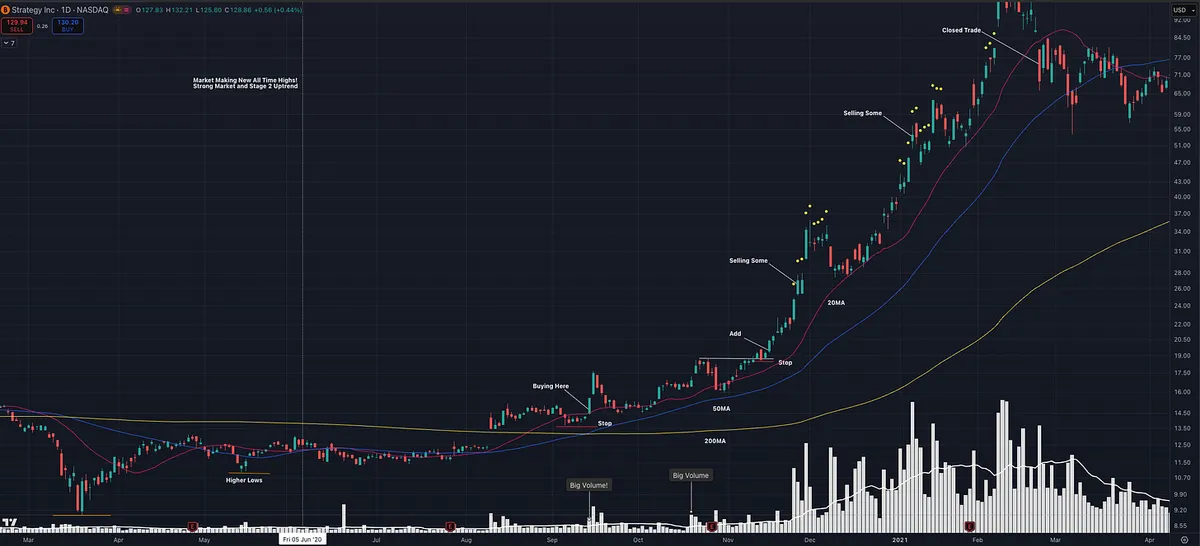
They weren’t trying to be perfect. They were selling into strength.

Not at the top. On the way up.

O’Neil summed it up best:

“The secret is to hop off the elevator on one of the floors on the way up and not ride it back down again.”

That’s the game.

You don’t get paid at the top. You get paid before the top.

Most traders won’t do this.

They’ll hold. Hope. And watch profits disappear.

The best traders?

They take money when the market offers it.

View on Substack ↗

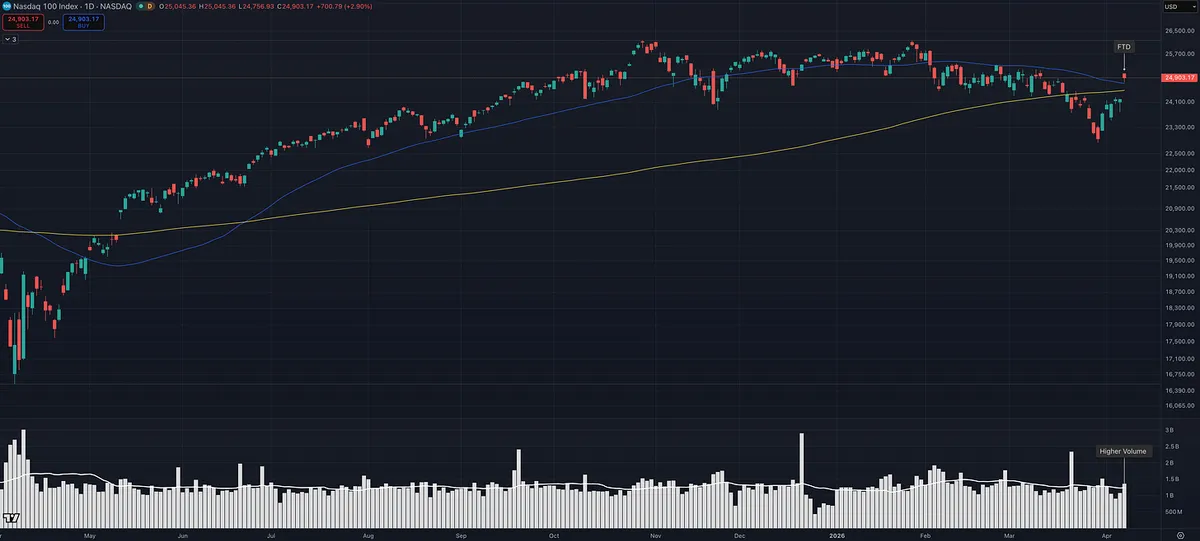
It’s Confirmed. A Follow-Through Day.

NASDAQ-100 up nearly 3% today.

Higher volume than the previous session.

Price is now above key moving averages.

View on Substack ↗

Why Macro Feels Smart but Keeps You Poor

Substack. Social media. News.

All full of macro takes that sound smart…

…but won’t make you money.

It feels intelligent. It sounds sophisticated. It gives you something to talk about.

But most of it is just mental stimulation…

Here’s the problem:

That content is designed to hook your emotions.

  • Fear headlines trigger stress, releasing cortisol and adrenaline

  • You get pulled into an amygdala hijack, reacting instead of thinking

  • Uncertainty keeps you glued to updates

  • Big narratives pull you away from price

It feels important.

But it’s noise.

And that noise leads to indecision.

On the flip side:

When the market is running, you feel great.

  • Dopamine kicks in, the same neurotransmitter tied to reward and excitement

  • Confidence rises

  • You start chasing

Now you’re driven by emotion again… just in the opposite direction.

This is the trap.

Fear when you should be getting involved. Excitement when you should be managing risk.

Most traders live in that cycle.

That’s why most traders lose.

This type of content is great for their business.

It keeps you engaged. It keeps you watching.

But it does not improve your execution.

That’s why everything I teach is built differently.

  • No narratives

  • No opinions

  • No emotional hooks

Just:

  • Price and Volume

  • Structure and Trend

  • Relative Strength and Leadership

  • Risk management and Position Sizing

Because the goal is not to feel smart.

The goal is to make money.

And those are two very different things.

That’s why I spend my time teaching a proven strategy you can actually execute.

View on Substack ↗

The News Will Keep You Broke

“I was thinking about selling… the situation looks worse than yesterday.”

That comment is one of the most valuable lessons a trader can learn from.

Because it captures exactly how most people think during turning points in the market.

The news feels urgent. The situation feels dangerous. It feels like risk is increasing.

So the natural reaction is to step aside or take profits.

I get it. That kind of news feels important in the moment.

But I’ve learned to largely ignore that type of analysis because it usually does one thing:

👉 It keeps you on the sidelines when you should be participating.

If you go back through history, this pattern shows up over and over again.

  • May 2025: Sentiment was extremely bearish. The NASDAQ-100 still rallied around 25%

  • Early 2023: Banking crisis headlines everywhere. The market pushed higher once it reclaimed key levels

  • April 2020: COVID panic. Many called it a bear market rally. “The end of the world” type of news. The NASDAQ went on to gain over 100%

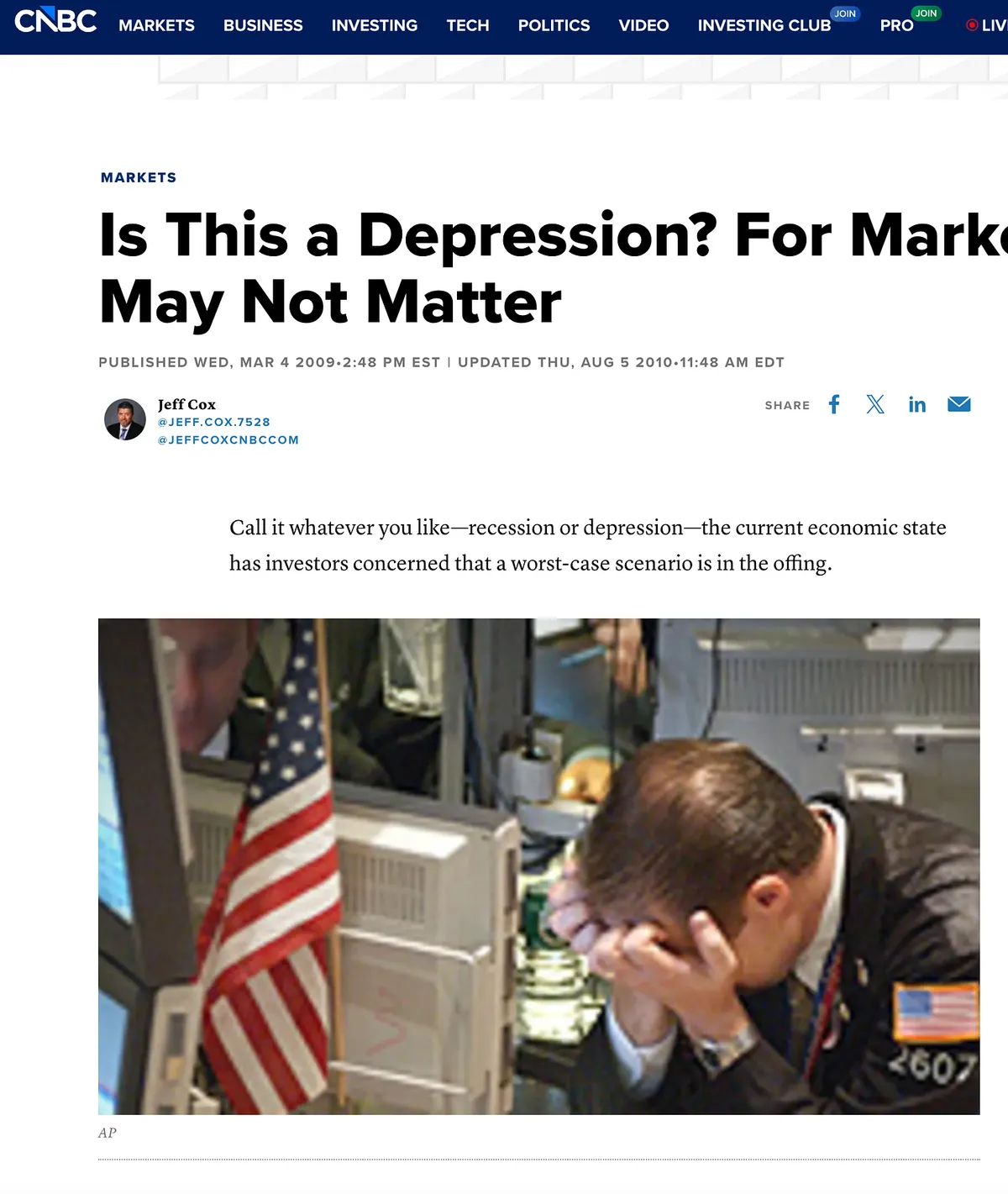
  • 2009: News flow was terrible. It turned into one of the best buying opportunities in decades

The market is almost always climbing a wall of worry.

There is always a reason not to buy.

Always.

This is the trap.

You wait for things to feel better. You wait for clarity. You wait for the news to calm down.

But the market does not wait.

By the time everything feels safe…

👉 The move is already well underway or you missed the best low risk, high reward opportunity.

So what actually matters?

  • Not headlines.

  • Not opinions.

  • Not what “should” happen.

What matters is:

  • Price reclaiming key levels 200/50 MA

  • Leading stocks breaking out

  • Strength clustering in industry groups

  • Higher Highs, Higher Lows

  • Strong Volume Price Analysis

That is the signal.

Everything else is noise.

You do not ignore risk.

You just refuse to let headlines override what the market is actually doing.

Because if you let the news dictate your decisions…

You will always be late.

And in momentum trading, late is expensive.

The next time the news feels overwhelming, remember this:

The market does not care how things feel.

It moves on supply and demand.

Follow that.

View on Substack ↗

Nothing New Under the Sun

Most traders think they need a new strategy.

A new indicator. A new system. A new edge.

They don’t.

Because what works today… worked decades ago.

Darvas figured it out long before screens, scanners, or real-time data:

“I started studying the personality of a stock in relation to its industry group. When I read the quotations of GENERAL MOTORS I automatically looked at those of CHRYSLER, STUDEBAKER and AMERICAN MOTORS.”

He wasn’t looking at stocks randomly.

He was studying groups.

He understood something most traders still miss:

Stocks don’t move alone.

They move in clusters.

Industries. Themes. Institutional flows.

And within those groups…

There is always a leader.

That’s where the money is made.

Not in the laggards. Not in the “cheap” names. Not in trying to predict what hasn’t happened yet.

But in:

  • The strongest stocks

  • In the strongest groups

  • Already moving higher

This is not a new concept.

It’s a timeless one.

And today, we just have better tools to see it:

Relative Strength. Industry Group Rankings. Stock Screeners.

Same principle.

Faster execution.

Stay focused on strength.

That’s where the opportunity is.

View on Substack ↗

This Is What Real Leadership Looks Like

It’s not a coincidence.

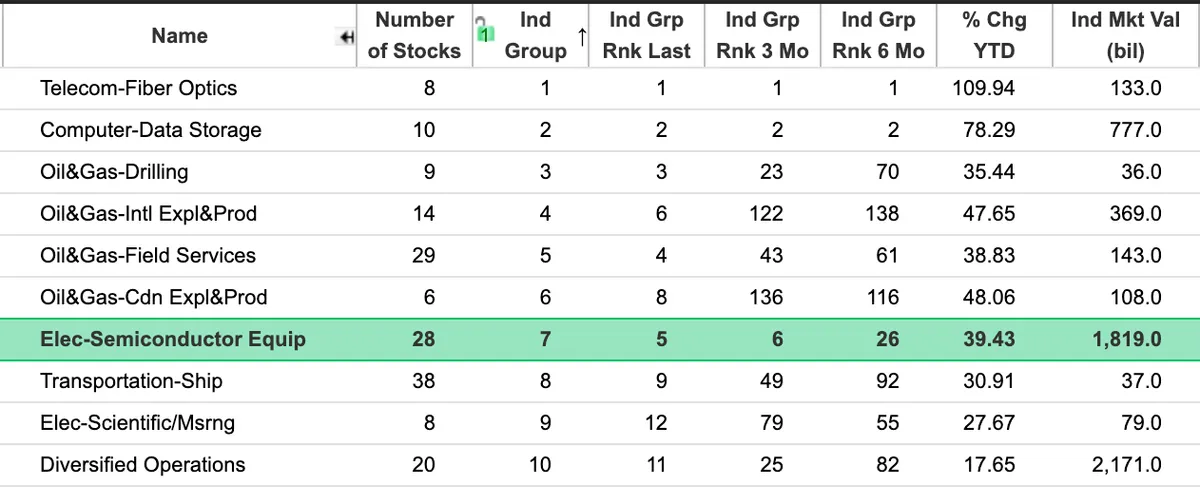
When we look at the Top 10 Industry Groups right now, we’re seeing clear clustering of strength:

  • Telecom: AAOI, LITE, CIEN, VIAV

  • Computer Data Storage: SNDK, WDC, STX

  • Semiconductors: TER, AEIS, AEHR, LRCX

All showing up in the top groups.

This is exactly how leadership reveals itself.

It’s not just one stock. It’s clusters of strength moving together.

When you start seeing multiple names across the same industry groups all:

  • Breaking out

  • Showing strong relative strength

  • Backed by strong fundamentals

That is not random.

That is institutional money flowing into a theme.

This is how real trends work.

Stay focused on where the strength is clustering, just like we teach in the MTS Course. https://tradingmomentum.substack.com/s/mts-course

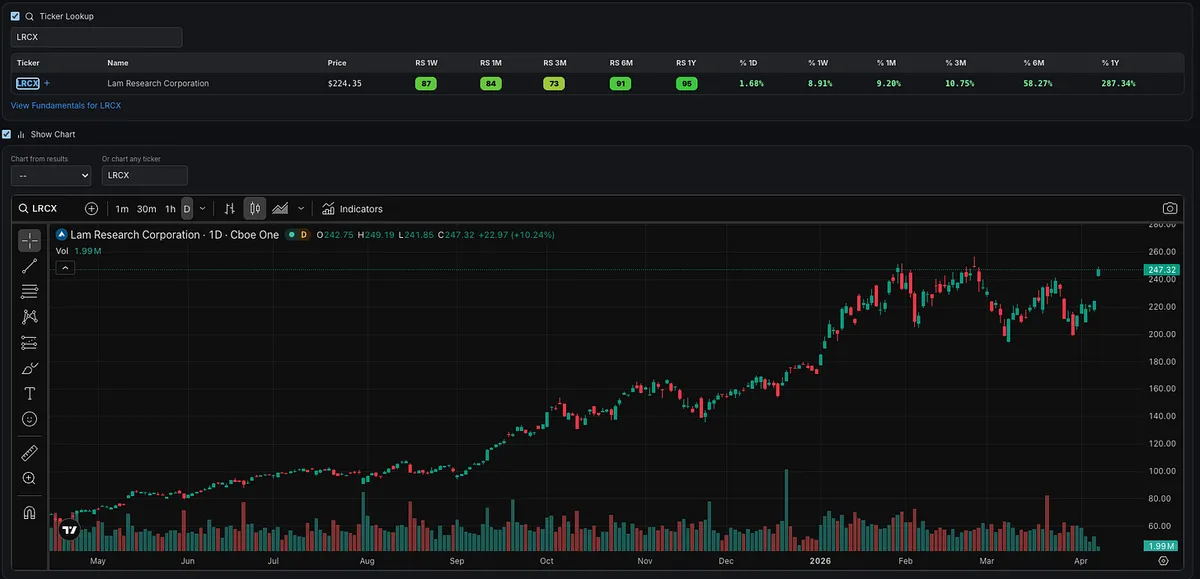
How do we find the strongest names in the strongest groups?

Relative Strength Stock Screener.

Use it now as part of the MTS Web App https://momentumtradingstrategy.app/

That’s where the opportunity is.

momentumtradingstrategy.appMomentum Trading Strategy