Momentum Trading Strategy

Notes

Short lessons on momentum trading, every day.

Every note from Substack, in one place: risk, setups, leading stocks, market conditions and the mindset behind them. Search them, browse by topic, or filter by stock.

Showing 681–700 of 1226 notes

View on Substack ↗

Why Great Setups Stop Working… And Then Start Again

The hidden cycle most traders never understand

Someone once asked Mark Minervini:

“If these setups work so well, what happens when everyone starts using them?”

It is a great question.

Because on the surface, it feels logical…

If everyone knows the setup, shouldn’t the edge disappear?

His answer was simple.

Sometimes they do stop working.

But then something interesting happens.

Traders move on.

They abandon the setup. They look for something new. They chase what is working now.

And once that happens…

The original setup starts working again.

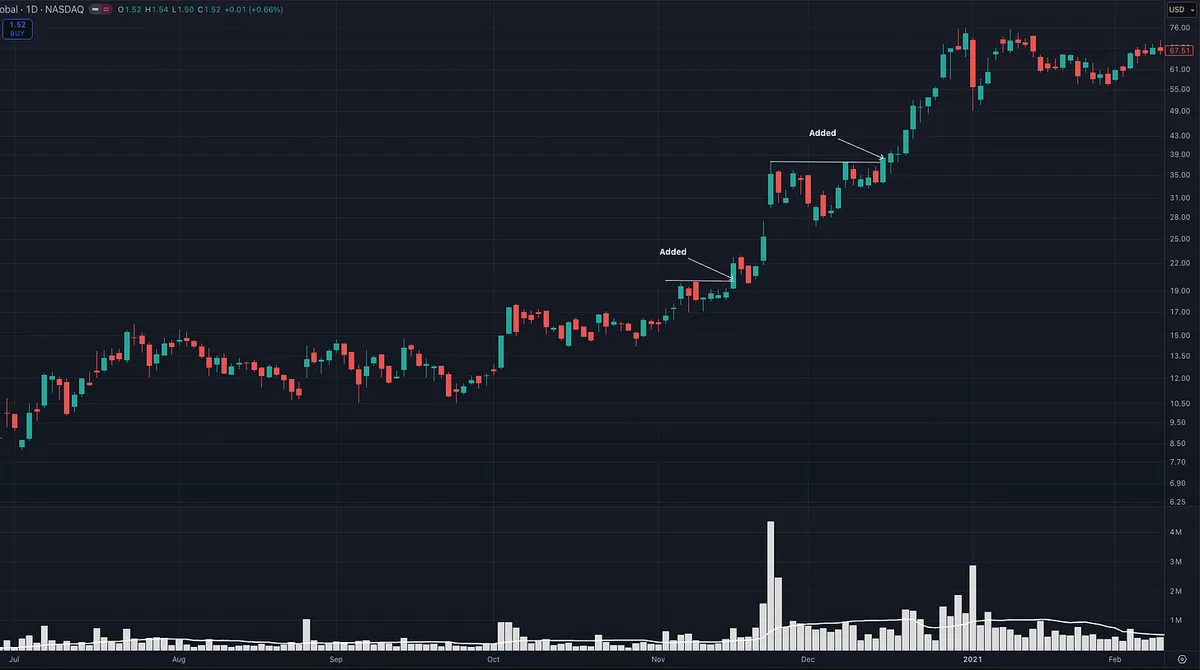
Just like no single strategy works all the time, no single pattern works all the time.

And if you are relying on just one…

You either need to be patient and wait for conditions to come back, or you will eventually hit a wall.

That is why I built a toolkit of setups over the years.

Not one setup.

A playbook.

There are bull cycles where certain setups dominate.

And others where they barely work at all.

The edge comes from knowing:

what is currently working and adapting accordingly

The goal is not to find a perfect setup.

The goal is to stay aligned with what is working right now, while still grounding yourself in what has worked for decades.
View on Substack ↗

Chart Patterns Are Not Magic They Are Math in Your Favor

Why the best setups are about risk first and reward second

Somebody asked me recently…

“What is the real importance of chart patterns?”

It is a fair question.

Because yes, people have studied patterns for decades. They have tried to assign probabilities. They have tried to label what works and what does not.

That is not why I use them.

I use them because they create asymmetric opportunity.

They show me exactly:

where I am buying where I am wrong and what I stand to gain if I am right

If I am wrong, I lose small. If I am right, I make multiples of what I risk.

That is the game.

And this is not new.

Traders like Mark Minervini, Dan Zanger, and Kristjan Kullamägi have used variations of these setups for decades. William O’Neil was documenting these patterns going back over 100 years.

This is not reinventing the wheel. This is following what already works.

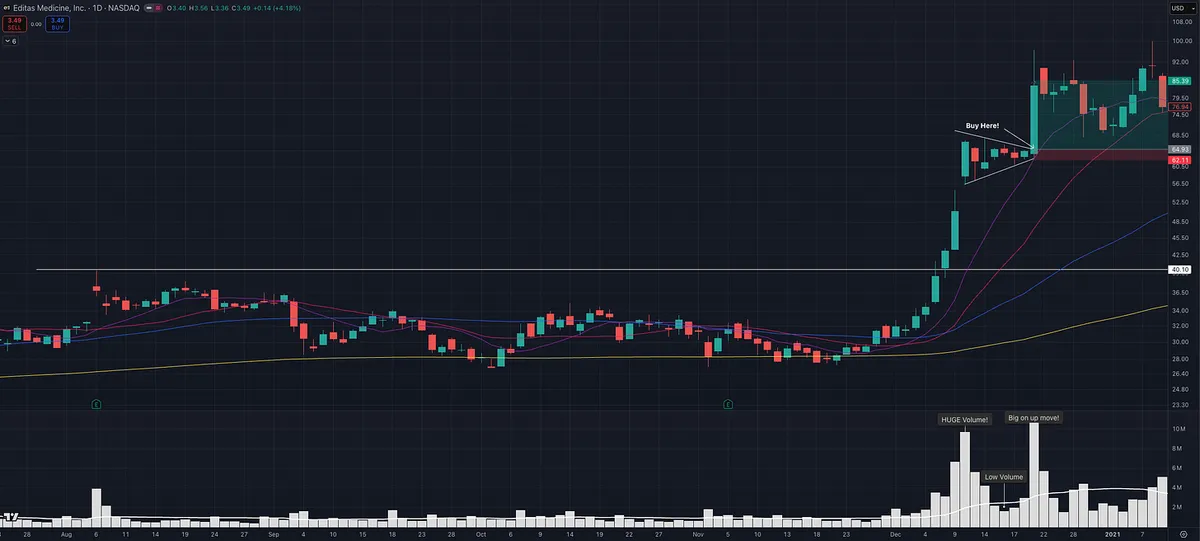
Take this example, EDIT.

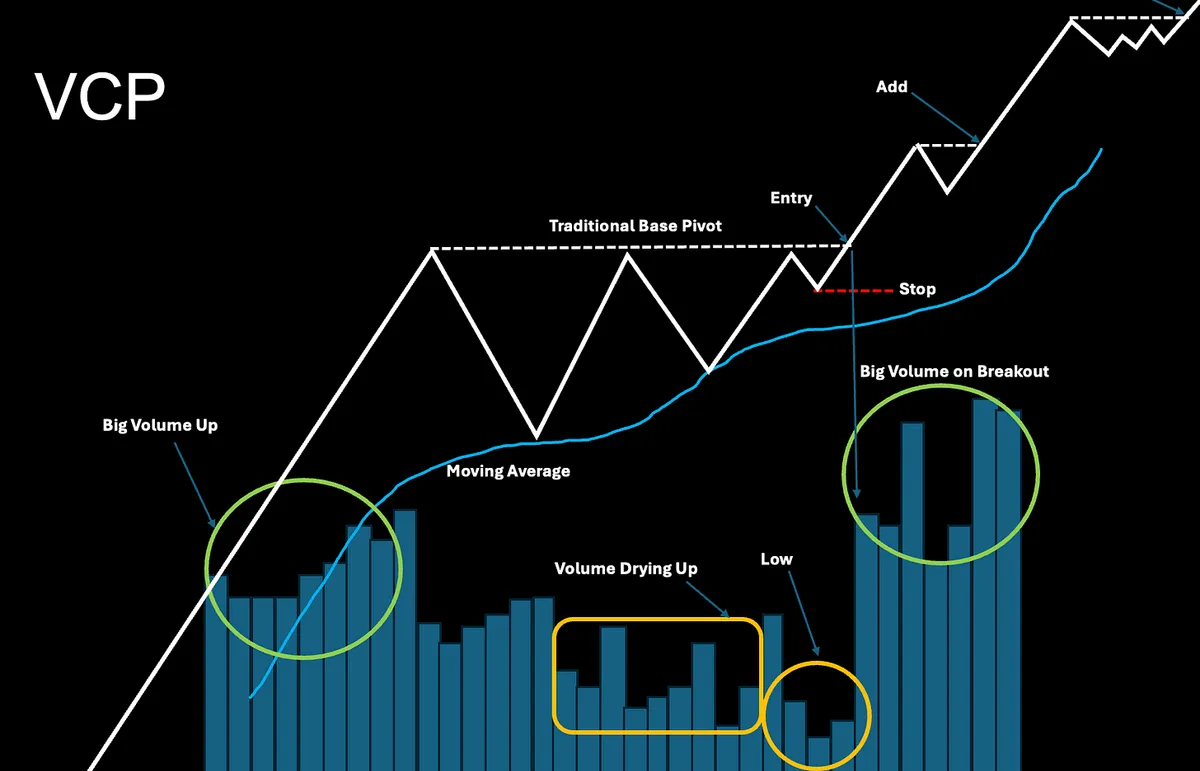
You have a stock that explodes higher on massive volume, breaking out of a long base.

Then instead of collapsing, it does something very specific.

It goes sideways. Price tightens. Lower highs. Higher lows.

A squeeze.

That is where the opportunity forms.

That is where risk becomes defined.

That is where the trade becomes asymmetric.

In this case, you are risking roughly 4 percent. If you enter intraday using an opening range breakout, that risk can shrink to 1 to 2 percent.

If you are right, the upside can be 7 to 10 times that risk (or more!).

That is not about being right all the time.

That is about being right enough with the math on your side.

This specific setup is a variation of the Power Play concept from Mark Minervini.

It shows up over and over again.

Different names. Different markets. Same behavior.

And once you understand what you are actually looking at, you stop chasing trades…

and start positioning for opportunity.

👉 This is one of the core setups I break down inside the Momentum Trading Strategy Course.

View on Substack ↗

Stop Guessing Stocks Start Reading the Market First

Why the best traders in the world zoom out before they zoom in

Ever notice how some trades just work… and others fail no matter how perfect the setup looks?

That is not random.

It is the market environment.

Before you even look at a chart, before you scan for breakouts, before you convince yourself this one is different, there is a quieter question sitting underneath everything:

Is the market actually supporting your trade?

The best traders in the world understood this long ago.

In Market Wizards, Paul Tudor Jones, Bruce Kovner, Michael Steinhardt, Ed Seykota, Larry Hite, Richard Dennis, William O'Neil, and David Ryan all approached the market differently.

But they all shared one thing.

They stepped back first.

They did not start with the stock or individual security.

They started with the environment.

Because the market is not just a backdrop. It is the force that determines whether a trade has a higher probability of working.

That is exactly why we write the Big Picture every weekend.

Not because it sounds professional. Not because it looks organized.

But because it answers the only question that really matters:

Are conditions aligned or are you fighting the tape?

When the market is strong, setups follow through. When the market is weak, even A setups fail.

Simple. Not easy. But simple.

If you are not doing this yet, it is worth asking yourself why.

Because at the highest level, everyone arrives at the same conclusion.

Understanding the environment tells you where to look, when to press, and when to step aside.

Stepping back is what allows you to focus in.

👉 Read this week’s Big Picture Market Pulse here.

https://tradingmomentum.substack.com/p/big-picture-market-pulse-april-19

On SubstackBig Picture Market Pulse | April 19, 2026: Markets Just Went From Breakdown to All-Time Highs in Weeks… and Most Traders Missed It
View on Substack ↗

All-Time Highs… and Most Traders Still Missed It

The market went from breakdown to new highs in weeks

Price led Breadth confirmed Leaders moved first

The signals were there

The problem wasn’t knowledge

It was hesitation

This is what most traders missed ↓

https://tradingmomentum.substack.com/p/big-picture-market-pulse-april-19

On SubstackBig Picture Market Pulse | April 19, 2026: Markets Just Went From Breakdown to All-Time Highs in Weeks… and Most Traders Missed It
View on Substack ↗

The Question Nobody Asks Before Buying a Stock

Most people just want the hot stock idea.

They’re willing to pay for a newsletter that gives them tips, analysis, and reasons why a stock is the next big winner.

And there’s nothing wrong with that.

But here’s why it doesn’t work for 99 percent of people.

They can’t answer these simple questions:

How are you managing your risk on that idea?

What is your position size?

When do you sell?

When do you add?

If you go in large, when do you take some off along the way?

How do you prevent it from round tripping?

And the biggest one:

Is this actually a low risk, high reward opportunity?

Meaning if you’re wrong, do you lose a little…

But if you’re right, do you make multiples of that risk?

Here’s the reality.

A lot of these stock ideas are presented in a way that makes them feel almost certain.

Like they can’t fail.

But what if they do?

And there’s another problem most people don’t realize.

Everyone is reading and acting on that same idea at different times.

One moment may offer a low risk, high reward opportunity.

The very next moment, that same stock may not.

Without understanding timing, entries, and risk, you could be buying the exact same name with a completely different outcome.

Most people aren’t factoring that in.

Most people aren’t factoring in anything that leads to long-term, consistent profitability.

They take the idea and just buy a random number of shares or allocate some percentage of their portfolio with no real plan behind it.

No structure.

No risk control.

No exit plan.

That’s the problem.

It’s not the idea.

It’s what you do after you buy it.

And that’s why the majority of investors and traders lose money.

That’s how we’re different.

Here at Momentum Trading Strategy, we’re teaching you how to fish, not just handing you fish.

When we share a name, we’re talking about potential entry points, logical stop locations, and where to sell some into strength.

And if we’re simply sharing a name, that framework has already been taught through our in-depth articles and, more importantly, the full course available to paid subscribers.

So when you enter a trade, whether it becomes a winner or a loser, you know exactly what to do.

Those questions aren’t guesses.

They have answers.

View on Substack ↗

What We Actually Do As Momentum Traders

For those of you that are new, here’s what we actually do.

Momentum Trading Strategy primarily focuses on swing and position trading, mainly in growth stocks, while following the trend.

Our strategy is rooted in principles that have worked for over 100 years.

The foundation comes from traders such as Jesse Livermore, Gerald Loeb, Bernard Baruch, Richard Wyckoff, Nicolas Darvas, William O'Neil, and more modern traders like Mark Minervini, David Ryan, Dan Zanger, Kristjan Kullamägi, along with many U.S. Investing Champions.

Different eras.

Same principles.

So what are we primarily looking for?

When the market is bad, we are preserving capital.

We are mostly in cash.

We are preparing for the next Stage 2 uptrend.

When the market is healthy, we are looking to participate in the strongest industry groups.

This changes cycle to cycle.

More recently, we’ve seen strength in areas like computer data storage with names like SNDK.

Telecom with LITE.

And semiconductors with AAOI.

Within these hot industry groups, we are looking to trade the biggest names and the best leaders.

These tend to have high relative strength (RS), meaning they are outperforming the index and most other stocks in the market.

They also have fuel driving that strength.

That fuel usually comes from:

  • Strong earnings

  • Strong sales

  • Or acceleration in earnings and sales

Also, something that might catch the market off guard.

These stocks are typically making new highs repeatedly.

If you look at the chart, they are consistently forming higher highs and higher lows.

So what we are doing is aligning:

  • The overall bull market theme

  • The hottest industry groups

  • The strongest stocks within those groups

All while looking to enter at points that offer low-risk, high-reward opportunities.

If we are wrong, we lose a small amount.

If we are right, we make multiples of that risk.

3x. 5x. 10x. 15x. 20x.

That’s the entire game.

My goal is to provide you with all the tools necessary to actually do this.

Paid subscribers get access to:

  • A web app with a Relative Strength Stock Screener to find these types of stocks

  • A weekly market newsletter to help you stay aligned with the market

  • A Relative Strength dashboard

  • A watchlist feature and additional risk management tools

  • Shared stock ideas and scans

  • And a full course that breaks all of this down in depth.

All for $120 per year.

That’s only $10 per month.

If that’s too expensive, then frankly, you probably shouldn’t be trading.

View on Substack ↗

Price Gave the Signal. Not the News

I didn’t decide to get back into the market based on a feeling.

Or a belief.

I wrote in a Substack note and told subscribers:

It’s time to start getting involved again and slowly increase exposure.

That decision was based on price.

We had a follow-through day.

Not just one or two up days…

Several days of strength.

Price reclaiming the 200-day. Price reclaiming the 50-day. Leading stocks breaking out to new highs.

That’s the signal.

And there was a major learning lesson over the last couple of weeks.

Some of you leaned into it.

Some of you ignored it.

I had people tell me they were staying out because of the news.

The situation looked worse. The ceasefire failed. More uncertainty.

But this is exactly the trap.

In the long run, not every time, but in the long run, that type of thinking keeps you on the sidelines when you should be participating.

Could the follow-through day have failed?

Of course.

That’s why we don’t go all in.

That’s why we start small.

That’s the entire purpose of the follow-through day.

It’s not certainty.

It’s a signal to begin.

Even if it’s 1% of your capital, it’s about putting a toe back in the water and letting the market prove itself.

When price is above key moving averages and leadership is emerging, sitting on the sidelines “waiting for clarity” usually means missing the move.

This is a perfect example of how human emotion can prevent you from doing the right thing.

Price gave the signal.

The question is… did you listen?

View on Substack ↗

Low Risk. High Reward. That’s The Game

Every style of investing is chasing the same thing:

Asymmetric opportunities.

  • Macro traders.

  • Value investors.

  • Momentum and growth traders.

Different approaches.

Same goal.

Risk a small amount to make a multiple of that risk.

5x. 10x. 15x.

That’s the edge.

George Soros explained this when talking about his famous sterling trade.

He put on a massive position and made over a billion.

But he wasn’t risking the entire amount.

He was risking a small percentage of it.

“the most we could have lost would have been let's say 2 or 3% because it was a you know a high reward, low risk bet.”

That’s the mindset.

Not how much you can make…

But risking a low amount that has high reward opportunity.

This is another concept we teach and show how to implement in the Momentum Trading Strategy Course.

View on Substack ↗

Everything Changes When You’re Playing With Profits

You don’t really get momentum in trading until you have profits to work with.

Because there’s a big difference between risking your capital…

And risking your profits.

This is nothing new. George Soros talked about this in a 1995 interview:

“You can't really get the dynamic going until you have a little profit under your belt because it's very different when you're risking your principal than when you're risking your profit.”

But once you build a cushion…

Everything changes.

You can think clearer. You can let trades work. You can scale properly.

That’s when real runs happen.

The key is protecting your capital early.

When things aren’t working, you reduce risk. You step back. You retrench.

You don’t press.

Because the goal isn’t just to make money.

It’s to get to a position where you’re trading with profits instead of your principal.

And this ties directly into a concept Mark Minervini talks about called financing your risk.

On the individual trade level, when a position moves in your favor and you take partial profits, you’re not just locking in gains.

You’re reducing risk.

In many cases, you’re now financing the rest of the trade with your profits.

You’re no longer risking your original capital. You’ve created a cushion and you can let the remaining position work with far less pressure.

This is one of the main reasons top traders sell into strength.

Not to exit…

But to put themselves in a position where they can stay in the trade longer.

The same principle applies at the portfolio level.

When your trades are working and the market is healthy, you gradually increase exposure.

When your trades start struggling and the market weakens, you reduce exposure.

So you’re managing risk in two ways:

At the individual trade level by financing risk and at the portfolio level through progressive exposure

Same idea.

Protect capital when things aren’t working. Press when they are.

That’s how you stay in the game long enough to catch the big moves.

To learn how to apply this in real time, Module 5 breaks down exactly how to finance risk, including entries, initial stop placement, and how to manage the trade as it develops.

https://tradingmomentum.substack.com/p/momentum-trading-strategy-the-100-026

On SubstackMomentum Trading Strategy: The 100-Year Playbook Behind the Biggest Winning Stocks — Module 5
View on Substack ↗

Same Principles. Different Voices.

“My favorite book is How to Make Money in Stocks by William O’Neil. For me, it’s the stock market Bible.” — Dan Zanger

He didn’t stop there.

  • How to Trade in Stocks

  • Reminiscences of a Stock Operator

Different books. Same core principles.

The edge isn’t finding new information.

It’s mastering the same concepts over and over again.

View on Substack ↗

You Don’t Need More Information. You Need Repetition

One of the best traders I’ve studied said his favorite book was How to Make Money in Stocks by William O’Neil.

Not because he read it once.

Because he read it over and over again.

Front to back 6 or 7 times early on. Then certain sections 20… 30 times over the years.

That’s the difference.

Most people read a book once. Read an article once. Watch a video once.

And then move on.

That’s not how this works.

You don’t need new information.

You need to master the same information.

We are all studying the same core concepts with slight variations:

  • Price

  • Volume

  • Trends

  • Risk management

  • Leadership

The edge comes from how deeply you understand it and how well you can execute it in real time.

I personally paid thousands of dollars for a course that covered many of the same concepts found in a $20 book.

Most people would say that’s a bad deal.

It wasn’t.

Because it reinforced the material.

It helped engrain it through repetition, visuals, and application.

It gave me more clarity. More confidence. More “ah-ha” moments.

That’s one of the main reasons I built the Momentum Trading Strategy Course.

Not because the information is secret.

It’s not.

You can learn the same concepts from the books I’ve read.

But the course is designed to help you absorb it faster, see it on real charts, and internalize it through repetition.

This is true for almost all courses.

Mark Minervini’s course is around $5,000.

And yet, most of the concepts are in his book for $20.

Ask anyone who has taken it… they’ll still tell you it was worth it.

Because mastery doesn’t come from exposure.

It comes from repetition.

And eventually, execution.

The material is out there. The real question is… are you willing to master it?

https://tradingmomentum.substack.com/p/momentum-trading-strategy-the-100-026

On SubstackMomentum Trading Strategy: The 100-Year Playbook Behind the Biggest Winning Stocks — Module 5
View on Substack ↗

Trading Isn’t Easy… But It’s Worth It

Stop wasting time chasing get-rich-quick schemes or thinking you’ll find some magical indicator that makes you rich overnight.

Most people want trading to be simple.

Quick wins. Easy money. A few indicators and they’re set.

That’s not how this works.

Dan Zanger said it best:

“I love it… I wouldn’t trade it in for the world. Every day is new. It’s exciting… but it takes years and years of learning, hard work, long hours… a lot of ups and downs before you can put it all together.”

That’s the reality.

Not weeks. Not months.

Years.

Long days. Mistakes. Losses. Frustration.

And this is where most people go wrong.

They waste time and money chasing shortcuts that don’t exist.

Every legendary trader says the same thing…

But you still think you’re going to be the one who finds the easy way.

The indicator. The system. The hack.

Something that prints money without the work.

It doesn’t exist.

And most people learn that the hard way.

Here’s the truth:

It’s not about adding more.

It’s about stripping everything down.

Zanger again:

“Get rid of all the stupid indicators out there… all this MACD stuff and volume accumulation and money flow. I don’t use any of it. It’s totally worthless. It’s price action, it’s volume, it’s chart patterns, it’s spectacular earnings… and that’s all.”

No shortcuts.

No magic formula.

Just:

• Price

• Volume

• Chart patterns

• Earnings & Sales

And years of experience applying it.

If you’re struggling right now…

Good.

That means you’re in the part most people quit in.

The difference is simple:

Stay long enough to figure it out.

View on Substack ↗

How to Spot Institutional Buying Before the Big Move

Most traders try to predict the next big move.

The best traders?

They follow the money.

Dan Zanger said it best:

“I want to go with the institutions when they go… I see massive volume, not just petty volume. If a stock is trading 4 or 5 million shares a day and all of a sudden it’s trading 15 or 20 million…”

That’s the tell.

Not opinions. Not headlines. Not indicators.

Volume.

But not just any volume…

Unusual volume. Massive volume.

Zanger takes it a step further:

He looks for percent change in volume. If a stock normally trades 4M shares and it’s already traded that in the first couple hours… it could finish the day at 12M, 16M or more. That’s a 300%–600% surge.

That doesn’t happen by accident.

Retail doesn’t do that.

Institutions do.

Hundreds of millions of dollars flowing into a name…

That’s what creates real trends.

And when you combine that with:

• Strong earnings and sales growth

• High relative strength

• A stock breaking out or acting right

You don’t just have a stock…

You likely have a market leader.

This is where most traders mess up.

They look for “cheap” setups. They overanalyze indicators. They ignore the one thing that actually matters:

Demand.

Massive demand.

If institutions want it badly…

You want it badly.

If they’re not there…

You shouldn’t be either.

Scan for volume.

Look for 300%+ spikes.

Find the leaders.

Then follow the money.

View on Substack ↗

The Strongest Stocks Don’t Go Down (Even When the Market Is Falling)

Most traders wait for the market to confirm the move.

By the time it does… the best stocks are already gone.

Dan Zanger explained it simply:

“Leadership stocks will be sitting near new highs while the market is still falling.”

Think about that.

The market looks weak… headlines are negative… everything feels like it’s going lower.

But a few stocks?

They refuse to go down.

They sit near highs. They break out. They explode on earnings and volume.

By the time you’re waiting for the S&P 500 or Nasdaq to break resistance…

The leaders have already moved.

The real tell is this:

• 3–5 stocks holding near highs during a weak market

• Powerful earnings driving explosive moves

• Breakouts on massive volume

• Gap ups while the market is still struggling

That’s where you focus.

On the strongest industry groups… and the strongest stocks within those groups.

They’ll tell you when the market is about to turn.

View on Substack ↗

Trade Less. Make More.

Most traders don’t lose because they miss opportunities…

They lose because they trade too often.

Back in 2005, Dan Zanger was asked his biggest lesson. He said:

“The market may have two big moves during the year… they last 6 to 12 weeks. The rest of the time, the market is just consolidating the gains… the big lesson for me has been to trade less.”

Two real opportunities a year.

The rest? Noise.

And this isn’t coming from a long-term investor.

This is coming from a swing trader who compounds through frequency… not just time.

A guy who turned $18K into over $18 million.

He understood something most traders don’t:

It’s not always time to press.

It’s time to wait for the conditions to press hard.

Yet most traders are in the market every day… forcing trades… giving it all back.

The play is simple:

• Wait for good market conditions

• Focus on a few true leaders

• Ride the move

• Then go to cash and wait again

Trade less.

Wait for the real move.

Then press.

View on Substack ↗

Strength Tells You Where to Look

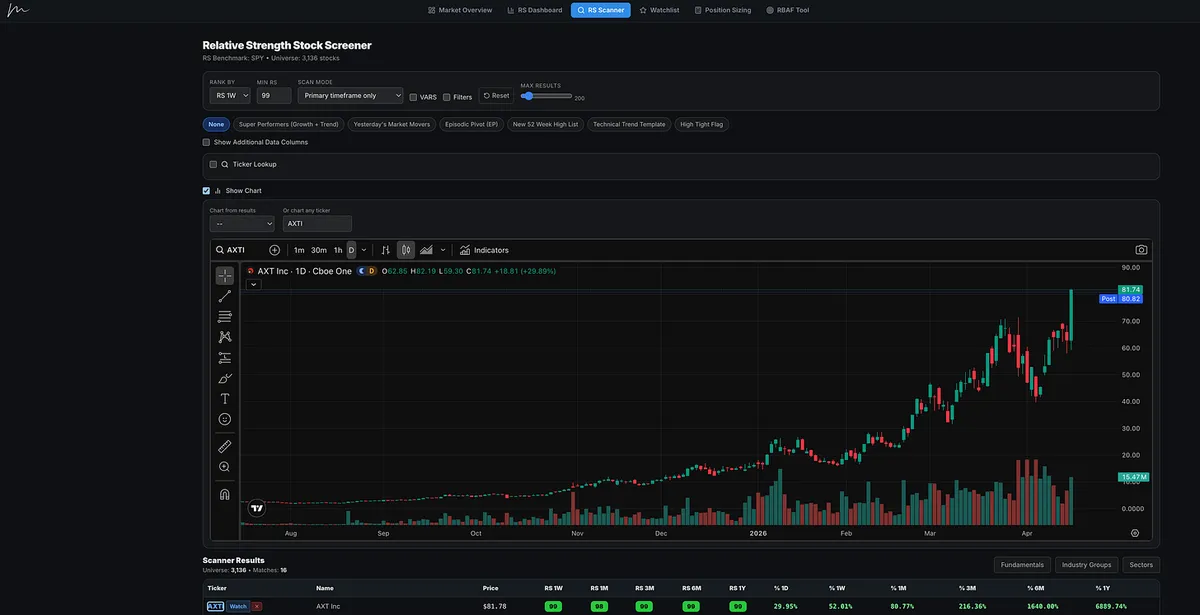
AXTI continues to show strong relative strength and trend higher.

This is what leadership looks like:

  • Higher highs

  • Higher lows

  • Strong price action

  • Demand on pullbacks

While most traders chase headlines, the real signal is already on the chart and showing up in relative strength.

And for those who think the window is small, it’s not.

AXTI has been showing up on the Relative Strength screener for months.

This isn’t new.

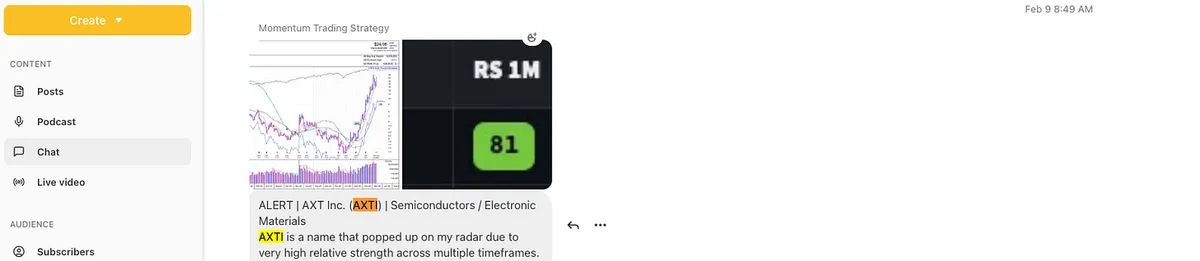
Shared in the subscriber chat back on February 9th. Now up 200%+.

If you’re not using relative strength to find leaders like this, you’re making trading harder than it needs to be.

View on Substack ↗

From Entry to Exit, This Is What Matters

If you struggle with precision entries, position sizing, and knowing what to do once you’re in a trade, you’re not alone.

Most traders can find a setup.

But they don’t know how to structure the trade before they enter, where their stop should go, how much to risk, or how to manage the position once it starts moving.

That’s where everything breaks down.

Module 5 is built to fix that.

This is a comprehensive class that walks you through the entire process from start to finish.

Before you enter:

  • How to identify precise entries

  • Where your stop should logically go based on the chart

  • How to define your risk

  • How to size your position correctly

Once you’re in:

  • How to manage the trade as it develops

  • How to raise stops as the trade works

  • How and when to add to a position

  • How and when to take partial profits

  • How to sell into strength and weakness

  • How to recognize when the stock is changing character

And finally:

How to close out and exit trades the right way

All of this is shown using real chart examples so you can see exactly how it works in practice.

Not theory.

Actual execution.

This is where most traders struggle, and it’s the difference between just finding setups and actually making money.

If you’re serious about improving, this is the part you can’t skip.

Start here:https://tradingmomentum.substack.com/p/momentum-trading-strategy-the-100-026

On SubstackMomentum Trading Strategy: The 100-Year Playbook Behind the Biggest Winning Stocks — Module 5
View on Substack ↗

This Is Where Most Traders Get It Wrong

Most traders know how to buy.

Very few know what to do after they’re in the trade.

Module 5 is live.

This one covers everything from entries to stops, position sizing, trade management, and exits using real charts.

Fair warning: it’s over 3 hours long, because it’s complete.

Watch the full lesson in the latest post.

If you’re not a paid subscriber yet, this is exactly what you’re missing.

https://tradingmomentum.substack.com/p/momentum-trading-strategy-the-100-026

On SubstackMomentum Trading Strategy: The 100-Year Playbook Behind the Biggest Winning Stocks — Module 5
View on Substack ↗

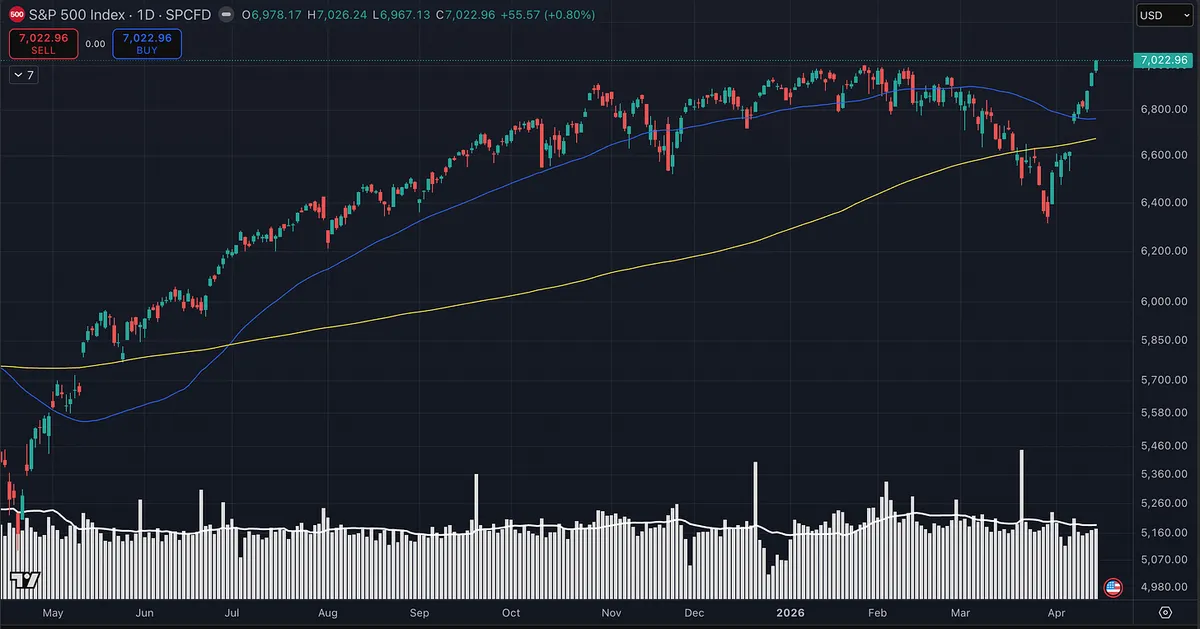
All Time Highs and You’re Still Waiting?

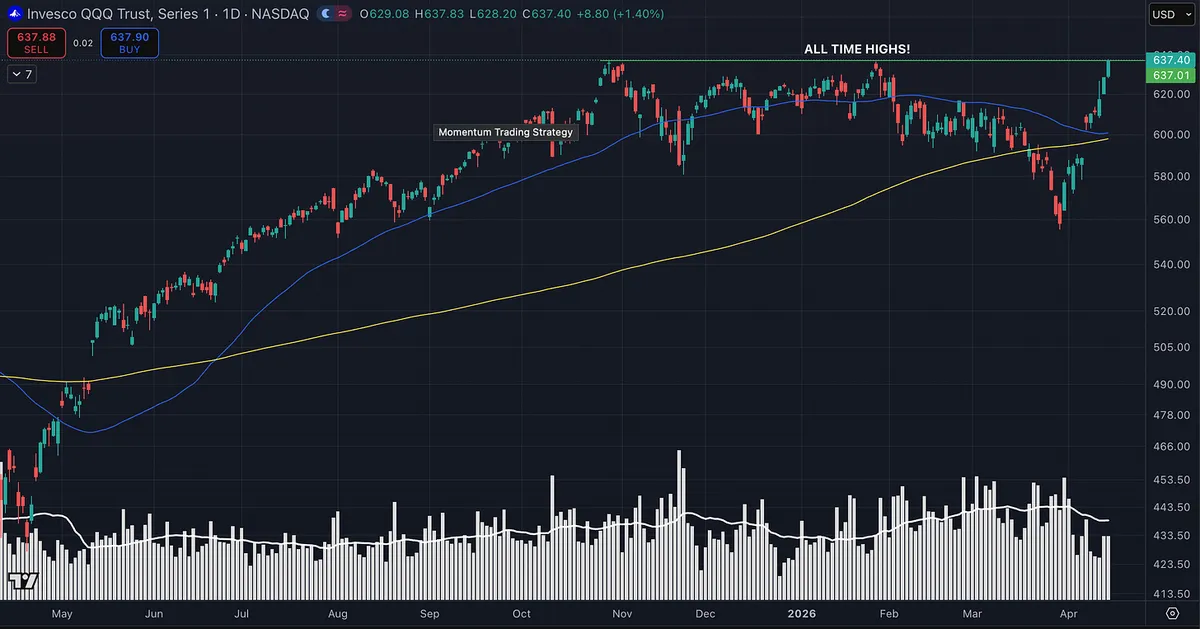
The S&P 500 and Nasdaq-100 are at all time highs.

A few weeks ago, both were below their key moving averages.

Strength showed up off the lows. Then we reclaimed the 200-day. Then came the follow through day.

That was the signal.

Not certainty. A signal.

If you saw my last note, you know exactly when that happened.

Look at the charts.

While headlines stayed negative, the market moved higher, reclaimed key levels, and never looked back.

A lot of people were saying things like, “But the Iran news… the ceasefire fell through… there’s no deal.”

And that’s exactly the point.

By the time you’re reacting to the news, the market has already priced it in… or decided it doesn’t matter.

Don’t let politics or doom and gloom headlines keep you on the sidelines.

Look back through history. During many periods of war and uncertainty, the market quickly absorbs the information and moves higher while most people are still expecting a crash.

Most people waited for confirmation from the news. The move had already started.

That’s the difference.

The market doesn’t care about narratives. It reflects reality faster than we can interpret it.

Your edge isn’t predicting headlines. It’s learning to read price.

If you were waiting for everything to make sense, you missed it. If you were following the signal, you were already getting involved.

👉 https://substack.com/@tradingmomentum/note/c-240105017?r=5ccg85&utm_source=notes-share-action&utm_medium=web

Quoting Momentum Trading StrategyAnd Just Like That… We’re Back And just like that, the market flips the script. The NASDAQ-100 (with futures already up 3.55% today) is now back above all key moving averages and up nearly 10% since last Tuesday. That is a powerful move in a very short period of time. Now the question becomes simple: Does it hold? B…