Momentum Trading Strategy

Notes

Short lessons on momentum trading, every day.

Every note from Substack, in one place: risk, setups, leading stocks, market conditions and the mindset behind them. Search them, browse by topic, or filter by stock.

Showing 661–680 of 1226 notes

View on Substack ↗

Euphoria Is as Dangerous as Fear

Richard Dennis was asked in Market Wizards:

“So you are able to avoid the emotional trap?”

His answer was gold:

“Yes, but the flip side is that I also avoid the emotional elation when things are going well. There is no way to play just one side of that street. If you feel too good when things are going well, then inevitably you will feel too bad when they are going poorly. I wouldn’t claim that I realized that after three years of trading, but after you’ve done it for twenty years, it either drives you crazy, or you learn to put it into perspective.”

-Richard Dennis

Most traders think managing emotions only matters when they are losing, but it matters just as much when you are winning.

Get too high during the good streaks, and the market will humble you.

View on Substack ↗

New System Will Not Fix Bad Discipline

If you are a newer trader, this is one of the most important things you will read.

It is not fancy. It is not some secret indicator, but many of us took years to understand it, and I wish I had learned it sooner.

A lot of traders study CANSLIM, O’Neil, Minervini, Darvas, and other great growth traders, then jump in before they have the full foundation.

They know what a breakout looks like. They can spot relative strength. They understand the idea of buying leaders.

But they have not mastered the part that keeps you alive.

Position sizing. Risk management. Cutting losses. Managing winners. Knowing when to press and when to back off.

That is where the damage happens.

They take a loss that is too big. They sell a winner too soon. They chase. They ignore stops. They slowly bleed through death by a thousand cuts.

Then they say, “This strategy does not work.”

Or maybe deep down they know it works. They just know they cannot follow the rules.

So they go looking for a new system.

More indicators. More signals. More backtests. More automation.

They think removing discretion will remove emotion.

But even systematic traders need discipline.

Ed Seykota and Richard Dennis did not succeed because their systems replaced discipline. They succeeded because they had enormous discipline.

Seykota could have written a book focused only on coding, backtesting, optimization, or the exact mechanics of trend following. Instead, his major standalone book is about trading psychology.

That alone tells you something.

The system is not usually the hard part. Following it is.

And it is no coincidence that Richard Dennis is often credited with the idea that you could publish trading rules in the newspaper and most people still would not follow them.

Why?

Because the real key is consistency and discipline.

The system fit their personality, but they still had to follow it.

That is the part traders miss.

A systematic approach can work. A discretionary approach can work. CANSLIM can work. Trend following can work.

But none of them work if you cannot follow the rules.

Most of the time, the system is not the real problem. The trader’s behavior is.

How do I know?

Because I have made these mistakes myself, and after years around other traders, I have seen the same patterns repeat over and over.

The root issue is usually simple.

Traders are trying to make too much money too fast. They size too big. They get emotional. Then they blame the strategy when they cannot execute it.

They are not willing to put in the time and effort required to get the results they want, so they drift into gambling.

Maybe not consciously.

But that is what it becomes.

I am not here to tell you what you want to hear. I am here to tell you what you need to hear.

If your position is too large, your rules will feel impossible to follow.

That does not mean the strategy is broken.

It means the risk is too big.

And this is not something you outgrow.

Highly skilled traders still define risk, control exposure, and respect the fact that any trade can fail.

That is the entire point of position sizing.

It keeps you in the game long enough for your system to work.

This is why I created the Momentum Trading Strategy Course.

This is not one trader’s strategy. It is a collection of principles pulled from hundreds of profitable traders, legendary operators, and real market experience.

I am just trying to consolidate it into one place in hopes of saving some traders from wasting the same years many of us wasted before we found the way.

And even if you do not learn from me, maybe I can point you toward other great educators teaching the same principles in a way that finally clicks for you.

The answer is not always to find a new system.

Sometimes the answer is to become the type of trader who can actually follow one.

View on Substack ↗

The Bull Is Still Alive, But It Needs to Breathe

This week’s Big Picture Market Pulse is out.

Like I say every week, the weekend is the best time to step back and review the big picture before diving into your stock screening.

Zoom out first. Then zoom in.

That process is always easier when the market is closed.

The major indexes are at or near all-time highs, growth stocks are leading, and the AI theme remains firmly intact.

That is bullish.

But after four straight powerful weeks higher off the lows, the market is no longer early in the move.

That does not mean the market is bearish.

It means the next phase requires more patience and selectivity.

Inside this week’s report, I cover:

• Why the bull trend remains intact

• Why growth stocks are clearly leading

• Which groups are leading now

• Why breadth cooling matters, but is not bearish yet

• Why chasing extended names is the biggest risk right now

• What I want to see next for the rally to remain healthy

The trend is bullish.

Growth is leading.

But after a move this fast, the best opportunities will likely come from discipline, not chasing.

https://tradingmomentum.substack.com/p/big-picture-market-pulse-april-26

On SubstackBig Picture Market Pulse | April 26, 2026: The Bullish Trend Is Intact, But the Chase Is Getting Riskier
View on Substack ↗

Stop Trying to Invent a Trading System

Reminder:

There is no right or wrong way to trade.

There is only the way that works for you.

With that being said, a lot of traders do not actually have a system that can produce profitable results over the long run.

They may have short-term success.

They may catch a few good trades.

They may even think they have figured it out.

But lucky results and repeatable results are not the same thing.

If you do not have a system with positive expectancy, the easiest path is not to invent one from scratch.

The easiest path is to study someone who already has one.

That is not weakness.

That is wisdom.

Most great businesses are built this way. They study what has already worked, copy proven models, make them profitable, and then slowly add their own flavor over time.

Trading is no different.

You do not need to create some revolutionary new strategy.

You need to learn a strategy that already works, practice it, apply it, and manage risk long enough to let the math play out.

And here is the little secret nobody wants to admit:

Almost every successful trader you follow copied someone before them.

Maybe they package it like it is brand new.

Maybe they renamed it.

Maybe they added a tweak, a filter, or a different acronym.

But the core ideas usually existed long before them.

Breakouts existed before them.

Trend following existed before them.

Relative strength existed before them.

Earnings and sales growth existed before them.

Price and volume existed before them.

Risk management existed before them.

The best traders are not usually the ones inventing something completely new.

They are the ones who take proven principles, study them deeply, apply them consistently, and make them their own over time.

You would probably experience a lot less pain if you did the same.

I know I did.

Learn the markets.

Study what has already worked.

Copy proven principles.

Make some money.

Build consistency.

Then, once you are profitable, start experimenting with your own style.

This is a marathon, not a sprint.

The goal is not to look original.

The goal is to survive long enough to get good.

View on Substack ↗

How I Find Stock Market Leaders

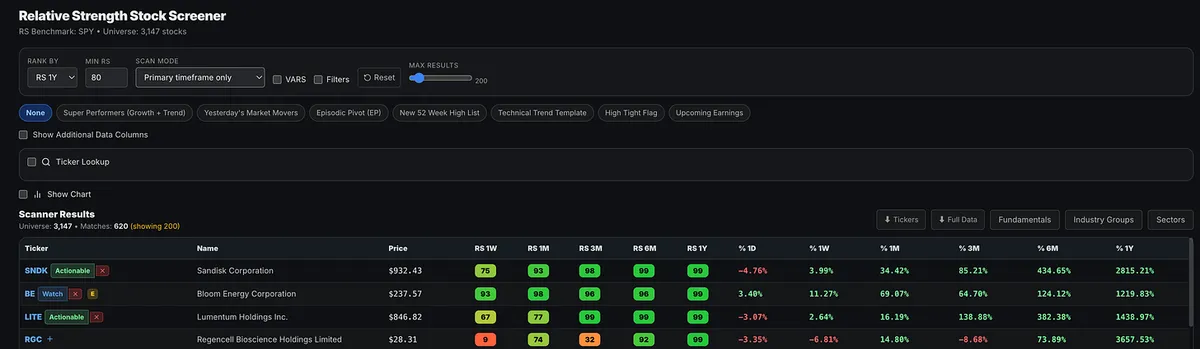
Did a quick 20-minute walkthrough video of the Relative Strength Stock Screener and Web App for those who’ve been asking about it.

This is exactly how I’m finding leading stocks each week. Nothing fancy. Just a structured process that actually works.

If you’ve been wondering how I use relative strength, fundamentals, and industry groups together, it’s all in here.

Watch it here ↓ https://tradingmomentum.substack.com/p/find-the-leaders-a-structured-approach

ArticleFind the Leaders: A Structured Approach to Relative Strength
View on Substack ↗

How to Stay in Big Winners Without Guessing the Top

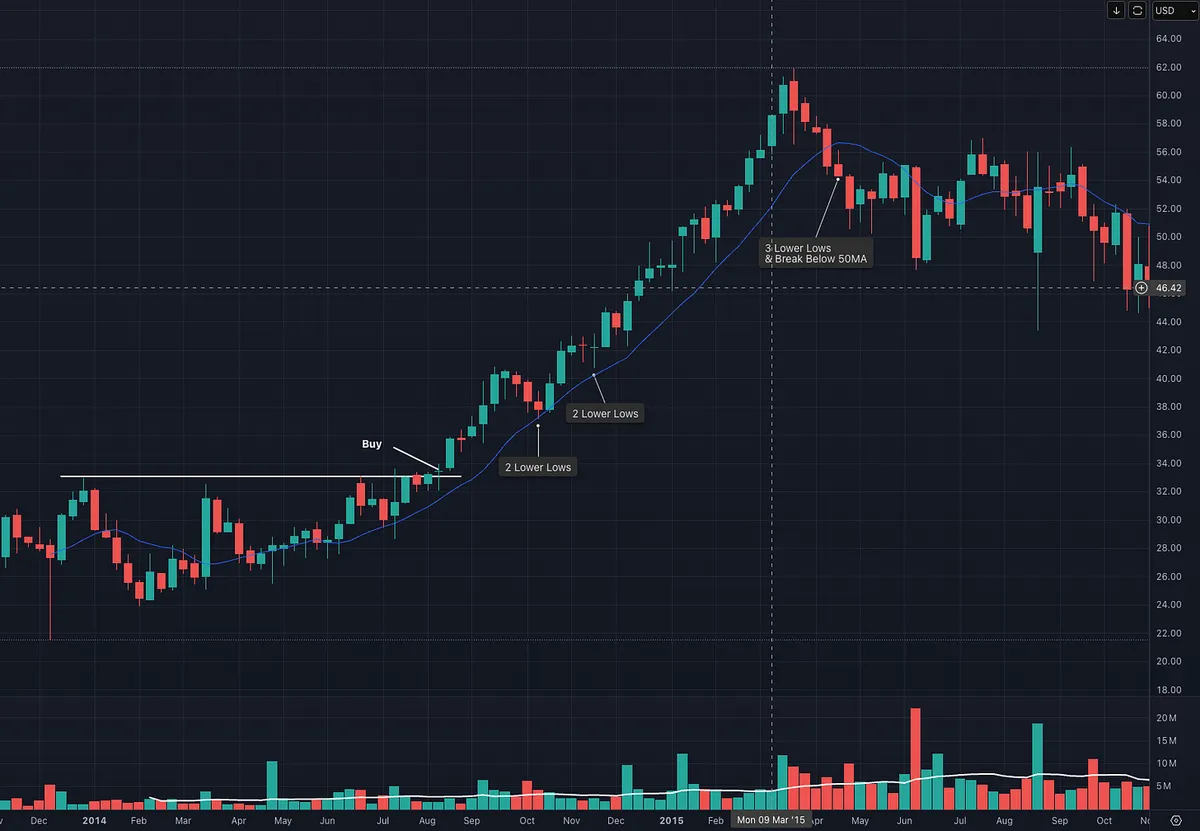
David Ryan shared something simple, but incredibly powerful.

His research on past market leaders showed a consistent pattern.

The best winning stocks rarely have three weeks of lower lows in a row.

They might pull back. They might have one or two weak weeks.

But three in a row?

That is where things start to change.

He used this insight to build a rule.

A combination of structure and trend.

First, a 50-day trailing stop (explained here… https://substack.com/@tradingmomentum/note/c-248429380?r=5ccg85&utm_source=notes-share-action&utm_medium=web)

This keeps you aligned with the primary trend.

It gives the stock room to move. It prevents you from getting shaken out too early.

Then he added a second condition.

If the stock puts in three consecutive weeks of lower lows, he exits the trade.

But this is the key nuance.

It is not just any three lower lows.

They are looking for a meaningful change in character.

That usually includes:

  • A break below the 50-day (or 10-week) moving average

  • A more significant percentage decline, not just minor pullbacks

  • Expansion in volume on the downside

When those conditions line up, that is the signal.

Not noise. Not normal consolidation.

A real shift in behavior.

This is what makes it powerful.

It allows you to stay through normal pullbacks.

But it gets you out when weakness becomes persistent and meaningful.

Most traders sell too early.

They exit on the first pullback. They cut their winners before the real move happens.

This is one way to help solve that.

You sit through one week. You sit through two.

But when that third week shows up with real pressure, you act.

It is not about predicting the top.

It is about recognizing when a strong trend is no longer acting like one.

That is how you stay in big winners long enough to matter.

And still protect yourself when the trend finally breaks.

View on Substack ↗

Trade the Market You’re In, Not the One You Want

Something Mark Minervini said in the Master Trader Program really stood out to me.

It was about understanding the market environment… and how that should impact your trading.

A lot of traders label themselves.

“I’m a swing trader.” “I’m a position trader.”

And for years, you hear the same advice.

Pick one. Master it.

But that is not how the best traders actually operate.

Minervini does both.

And the reason is simple.

The market changes.

There are environments where shorter-term trading makes more sense.

You take quicker profits. You manage risk tighter. You stay nimble.

This often shows up in more extended markets. Middle to later stages of a bull cycle.

You are not trying to hit home runs.

You are taking what the market is giving you.

Then the environment shifts.

After a major correction. After a bear market. Early stages of a new bull cycle.

That is when the opportunity changes.

That is when the best stocks can make outsized moves.

That is when it makes sense to press. To hold longer. To think more like a position trader.

This lines up with how traders like William O’Neil and David Ryan approached the market.

And it aligns directly with what Van K. Tharp taught.

Understand the environment. Adjust accordingly.

This is what separates professionals from everyone else.

Most traders stay rigid.

They try to force one style onto every market.

But the reality is simple.

Different environments require different tactics.

You do not need to pick a label.

You need to read the market.

And when you do that, everything starts to make more sense.

View on Substack ↗

How to Hold Winners Longer Without Guessing the Top

In the Master Trader Program, Mark Minervini talked with David Ryan about something every trader struggles with.

How do you hold on to a great stock… longer?

Not just take a quick gain. But stay in it when it has the potential to make a much bigger move.

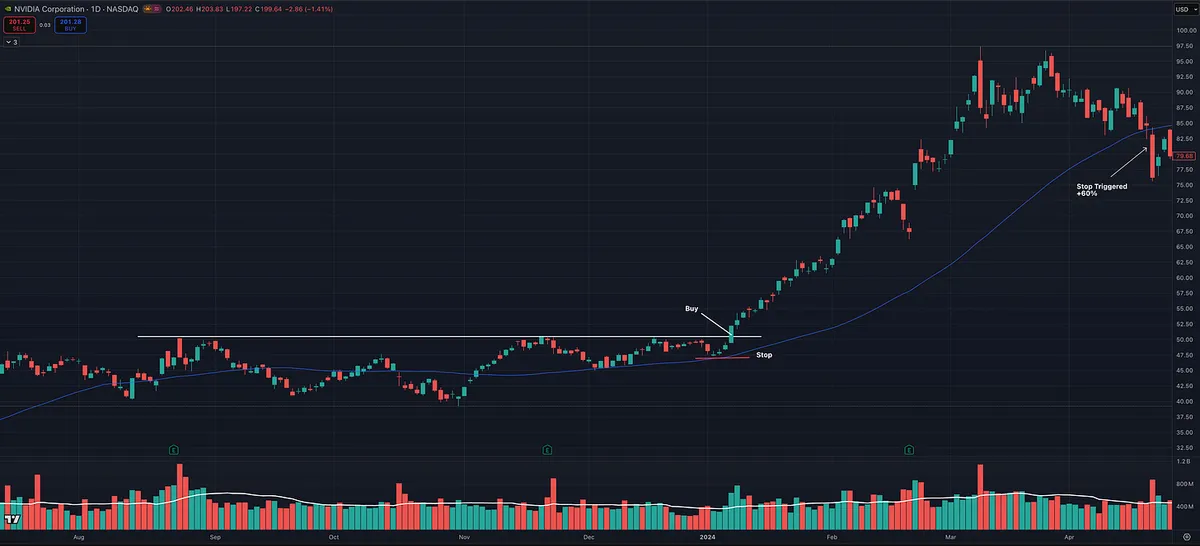
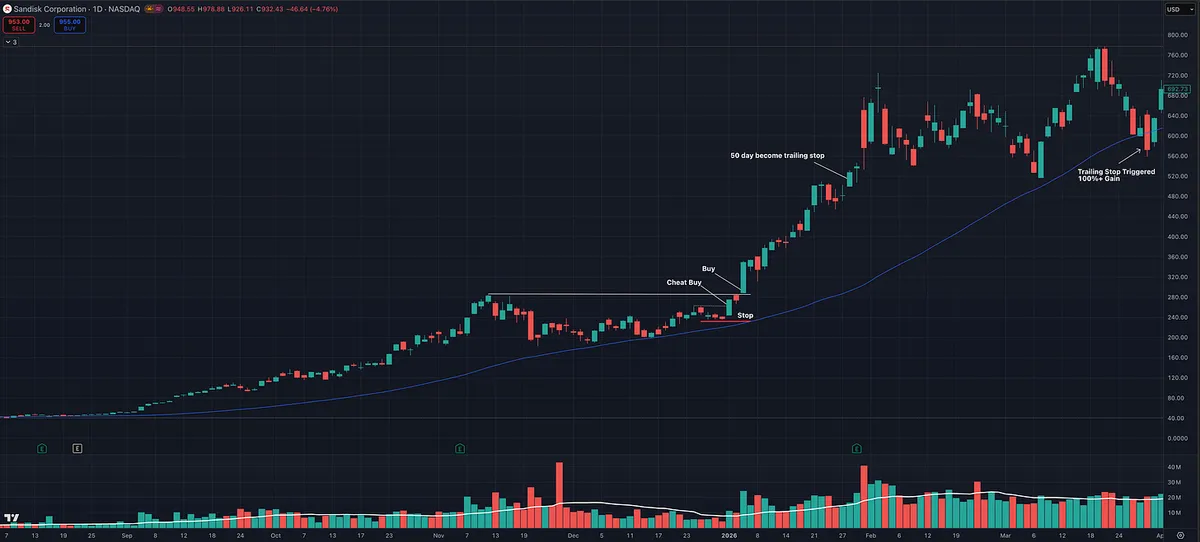
He introduced what he calls the 50-day breakeven or better rule.

It is simple.

And it is powerful.

This is not how you enter the trade.

You still take your entry the same way. You still define your risk the same way. You still place your initial stop based on the chart.

Nothing changes there.

The shift happens after you are in a winning position.

As the stock moves higher, the 50-day moving average starts to rise.

At some point, that 50-day will catch up to your breakeven.

That is the key moment.

Once the 50-day reaches breakeven or better, it can become your trailing stop.

From there, you let the stock work.

You are no longer guessing where to sell. You are letting the trend decide.

Minervini even said he does not rely heavily on moving averages.

But in the early stages of a bull market, this is where it becomes extremely useful.

Because the best stocks can go a long distance before they ever break the 50-day.

That is the whole idea.

Give strong trends room to develop.

Without giving back your gains.

Now look at these examples.

One from NVIDIA in 2024. One from SanDisk in 2025–2026.

Both show the same thing.

A proper entry. A defined stop. Then the 50-day catching up… and taking over as the trailing stop.

That is how you stay in a winner long enough to matter.

Most traders sell too early.

Not because the stock is done.

But because they do not have a process to stay in it.

This solves that.

It is not about predicting the top.

It is about staying with the trend as long as it remains intact.

If you want to go deeper, I cover this and several other ways to manage trades using a few key indicators in Module 5 of my course, available to all paid subscribers.

View on Substack ↗

Why My Relative Strength Screener Finds Leaders Earlier

People have asked what the difference is between my Relative Strength Stock Screener and Investor's Business Daily.

Short answer: same concept, better execution.

Both measure performance vs SPY and rank stocks on a percentile basis.

But the differences are what matter.

First, I allow multiple timeframes.

Not just the standard 12 month view.

You can see 1 week, 1 month, 3 month, 6 month, and 1 year relative strength.

That 1 month view has consistently helped surface names before they show up on traditional RS rankings.

It also lets me track acceleration vs deceleration across timeframes.

That has been one of the biggest edges. You can quickly spot when leadership is gaining momentum… or when it is starting to fade.

Second, and more important:

I filter the universe before assigning an RS rating.

IBD ranks against 11,000+ stocks.

I start there, but remove low price, low volume, and low cap names that do not meet CANSLIM-style criteria.

So instead of ranking against everything…

You are ranking against stocks you would actually trade.

Bottom line:

The concept is the same.

But the signal is cleaner.

And cleaner signals lead to better decisions.

View on Substack ↗

The Market Is Telling You Where To Look… Are You Listening?

You want the #1 stock.

The one that defines the cycle. The one everyone talks about. The one that goes 300%+.

And yes, if you land in that name, that is where life-changing returns come from.

But here is what most traders miss.

You do not need the #1 stock.

You can win big with #2, #3, #4, and so on.

How the market actually moves

Trends do not show up in isolation.

They show up in clusters.

Strong stocks inside strong industry groups. Aligned with powerful themes.

This is not new.

Nicolas Darvas was doing this in the 1950s.

He focused on stocks that stood out like a beacon above weaker names and moved into powerful advances.

He was not chasing random stocks.

He was following where strength was concentrating.

What the market is showing right now

Top groups:

  • Telecom Fiber Optics

  • Computer Data Storage

  • Semiconductor Equipment

That is where institutions are putting money.

That is where trends are forming.

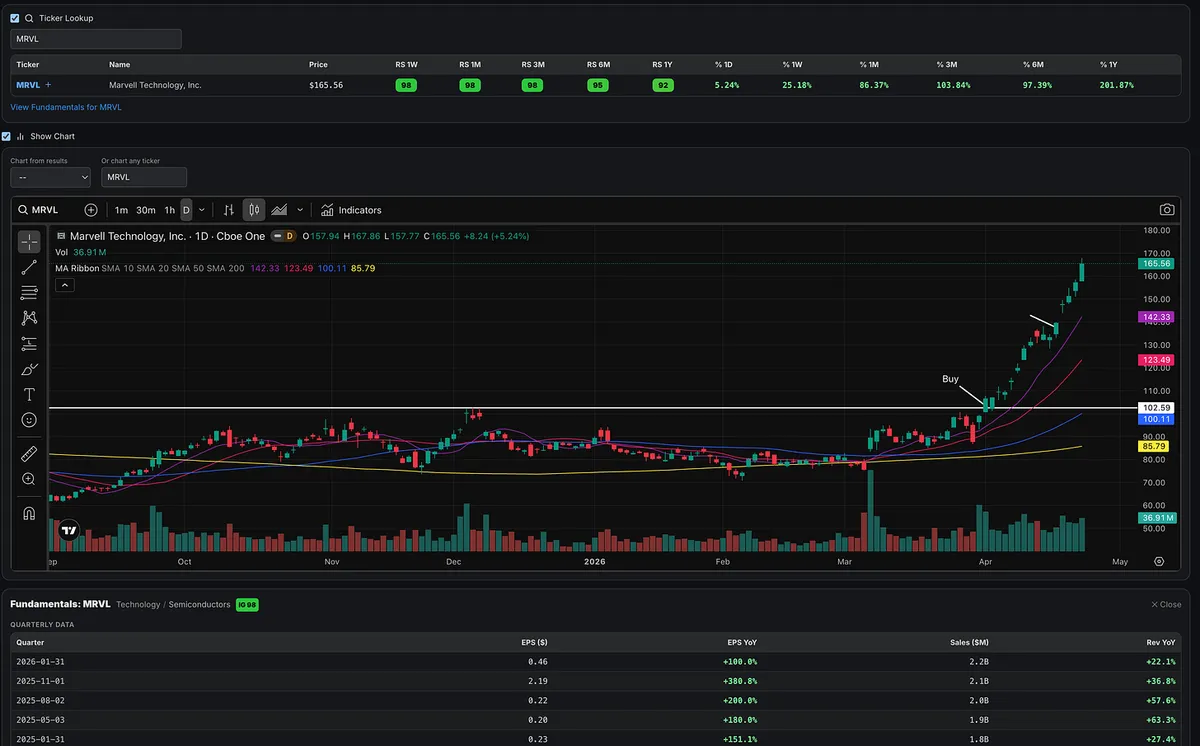
Then you look at Marvell Technology.

Now everything lines up.

  • Relative strength in the highest percentile across timeframes

  • Strong earnings and sales growth

  • High return on equity

  • Strong pre-tax margins

  • Leader inside a top ranked group

This is what alignment looks like.

Not just a good stock.

A strong stock in the right place at the right time.

What most people miss

It is not just about the stock.

It is also about the group.

The takeaway

Focus on:

  • Leading stocks

  • In leading groups

  • With real fundamental strength

You do not need to find the one.

You just need to be positioned where strength is already working.

View on Substack ↗

The Chart Said Yes. The Process Said No

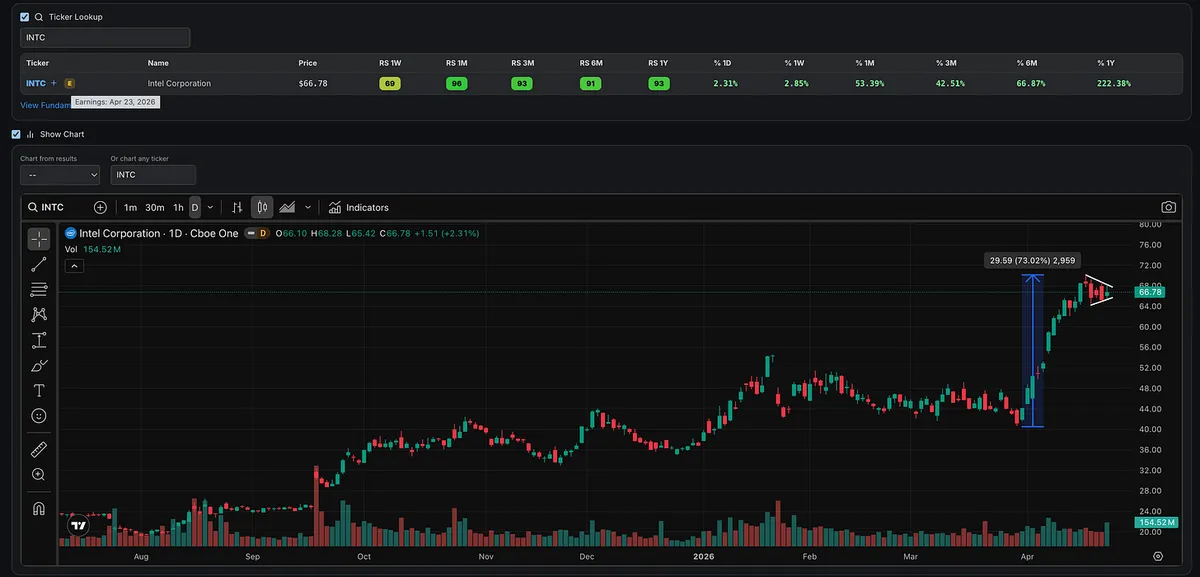
This is exactly the type of setup I look for.

Strong move up. Tight flag/pennant pattern. Volume low in the pullback, then came in at the close.

Everything about this chart was actionable.

But I still said no.

Why?

Because earnings were after the close.

This is where discipline matters most.

Not when the setup is messy. Not when the market is unclear.

But when everything looks perfect… except for one thing.

“Never trade in situations where you don’t have control. For example, I don’t risk significant amounts of money in front of key reports, since that is gambling, not trading.” — Paul Tudor Jones

I wanted to take this trade today.

But that is not part of my process.

The moment you start bending your rules for a “perfect” setup is the moment you start to lose consistency.

Earnings remove control.

Intel can gap up 20%.

It can also gap down 20%.

That’s not trading.

That’s gambling.

View on Substack ↗

The AI Trade Isn’t Over. It’s Just Moving Deeper

The theme expands… and so do the leaders.

One of the most important principles in growth investing and momentum trading is simple:

Align yourself with the dominant theme of the market.

This bull market has had a clear driver. AI.

But what matters is not just identifying the theme. It is recognizing how that theme expands over time.

It started where you would expect.

Semiconductors led the way as demand for compute exploded.

Then the theme broadened.

Capital flowed into the software layer, where AI moved from concept to real world application.

After that, the market pushed further down the chain.

From software into infrastructure:

  • Data centers

  • Data storage

  • Networking and telecom

  • Energy infrastructure

Because once demand surged, a new problem showed up.

Supply could not keep up.

And that brings us to what is still in the highest demand today.

Data centers.

The buildout is not slowing down. If anything, the gap between demand and supply is becoming more obvious.

This is all part of the same theme. The need for compute.

What we are seeing now is not a new theme. It is a broadening of the same one.

More capital flowing into the smaller pieces that make the entire system work.

Electronic components. Power systems. The underlying infrastructure that allows these data centers to operate and scale.

There are many sub industries involved in this buildout.

This is just one piece of that puzzle.

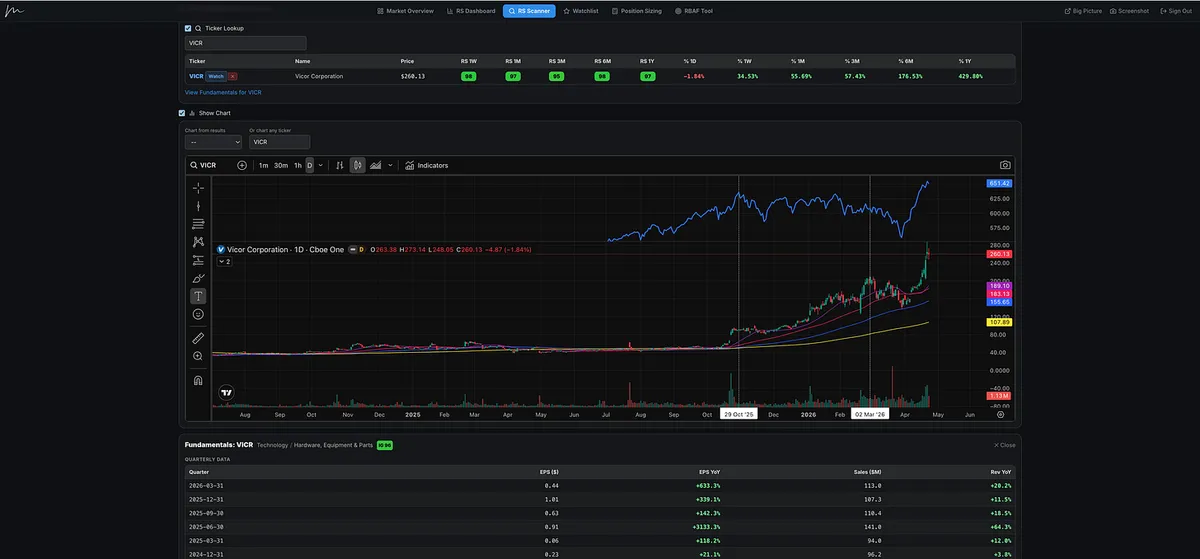
Now look at the chart.

While the market was going sideways from November to December, this stock was moving higher.

As the market drifted lower in January and February, it continued making new highs.

That is not normal behavior.

That is relative strength.

It was not until the broader weakness in early March that it pulled back with the market.

But once the market bottomed around March 30th and started to rally, it did not just bounce.

It accelerated.

Up significantly from those lows.

This is exactly what we look for:

  • Leaders out performing the market

  • They resist weakness during pullbacks

  • And they lead coming out of corrections

That is where institutions are allocating capital.

And when you combine that with:

  • Strong earnings

  • Improving sales

  • Solid margins

  • Good return on equity

  • New demand

  • Strong industry group

  • Alignment with the dominant theme

You get market leaders.

View on Substack ↗

This Is How Fast It Can All Disappear

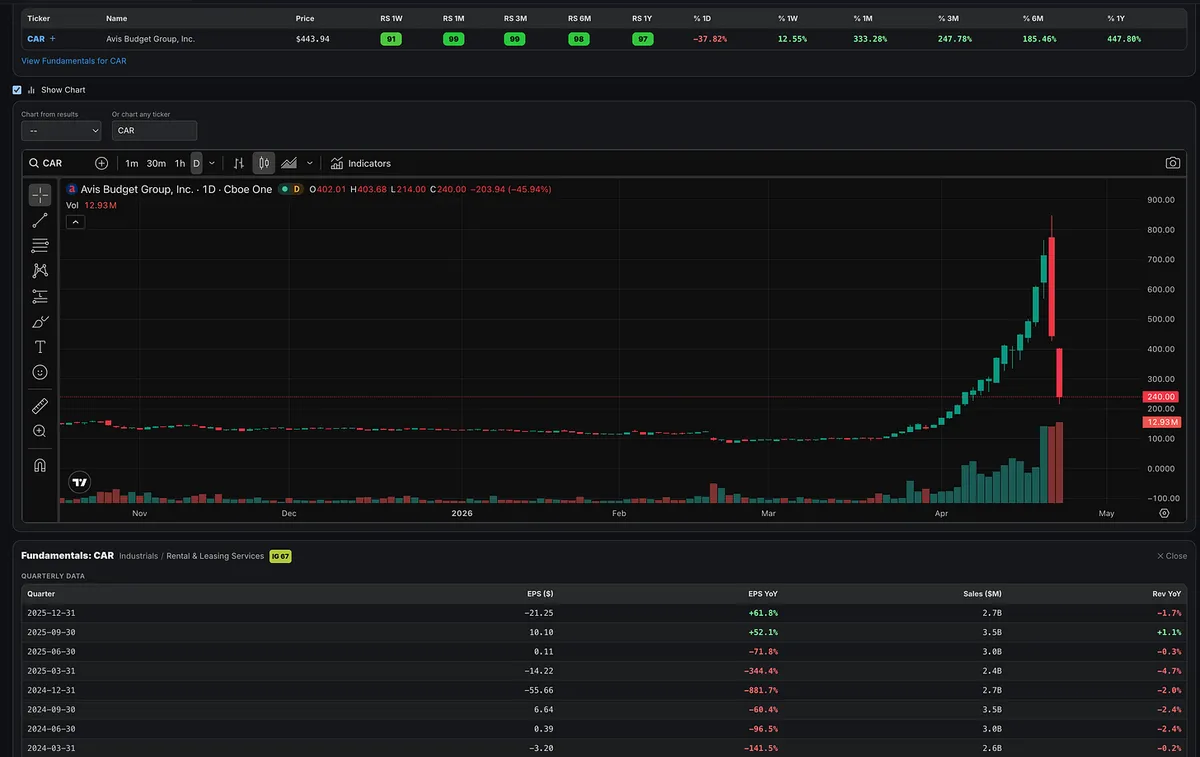
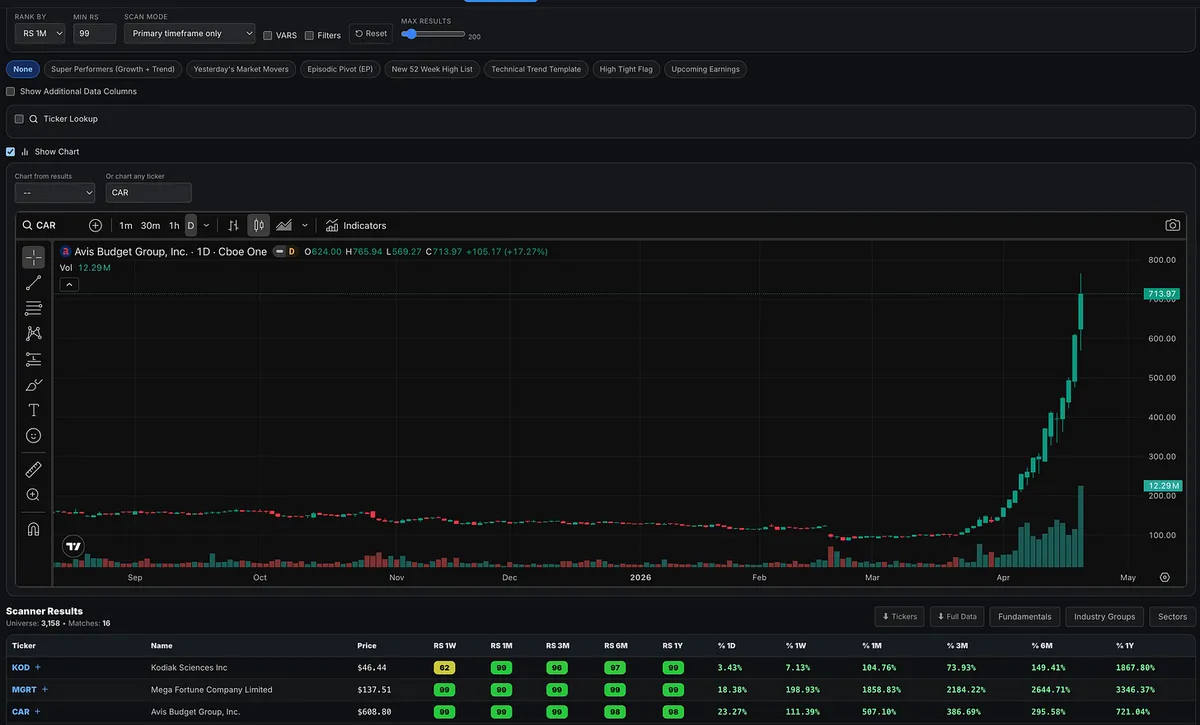
A few days ago I wrote this about CAR:

"But the same mechanics that launch a squeeze can unwind just as fast. What feels like a once in a lifetime move on the way up can turn into a sharp lesson in downside volatility."

Since then, it dropped nearly 70%.

This is the market doing what it always does. Teaching the same lesson over and over, just in different ways.

You are never going to sell the exact top. That is not the goal. The goal is to participate in the move and get out when weakness shows up.

These are some of the best lessons you can study.

I did not trade CAR. It did not fit my core criteria. I spend most of my time focused on stocks with real drivers behind them. Big earnings. Big sales growth. Something new. New product, new service, new demand, or a real shift in the industry.

CAR did not have that.

What it did have was extreme relative strength. That is enough for a short term move. That is not enough to sustain one.

And that is where most people get trapped.

They see the move. They feel the urgency. They chase it with no plan.

But the entire edge in trades like this is not the entry. It is the exit.

This stock was massively extended from the 50 day. It went parabolic.

For 15 straight days, CAR did not break the prior day’s low.

That is your guide.

Even if you chased it halfway up, even if you felt the FOMO, if you simply used a rule like “sell on a break of the prior day’s low,” you would have exited clean.

If you used an Opening Range Breakout entry on April 13th, you risked around 5% and had the potential to make 80% into that first real break of weakness.

No guessing. No hoping.

Just reacting to price.

And here is the part most people miss.

Even entering late, with a stop below the prior day’s low, you could still make multiples of your risk. Easily 4x or better.

That is the power of having a plan.

If you are going to play high volatility names, you have to respect what they are.

Fast up. Faster down. The stairs up, the window down.

Most people do not lose money because they picked the wrong stock.

They lose money because they had no exit plan and held onto losers.

Cut losers fast. Let winners run.

That is the difference between a great trade and a painful lesson.

View on Substack ↗

This Is Not A Normal Rally: Inside CAR’s Wild Short Squeeze

What a wild ride.

Since April 1, Avis Budget Group (CAR) has ripped nearly 400% higher, trading more like a speculative momentum name than a traditional rental car business.

This isn’t about a great quarter or a few positive headlines.

This is what happens when positioning collides with supply.

The setup was there.

A large percentage of shares were sold short, while a concentrated group of holders controlled most of the stock.

Once buyers stepped in and price started moving, short sellers were forced to cover.

That covering pushed price higher.

Which forced more covering.

And just like that, a feedback loop formed.

At some point, the narrative flipped.

It stopped being about what the business is worth…

…and became about how far positioning could push it.

Under the surface, the business didn’t change in three weeks.

Avis Budget Group is still operating in the same cyclical, capital-intensive industry, with the same long-term dynamics.

There’s no meaningful growth shift here.

The move was driven by positioning.

From the sidelines, it’s easy to feel like you missed the trade of the year.

But the same mechanics that launch a squeeze…

…can unwind just as fast.

Once shorts are covered and late buyers become the marginal holders, liquidity often disappears on the way down.

What feels like a once-in-a-lifetime move on the way up…

can turn into a sharp lesson in downside volatility.

So how do you actually find these?

Start with what most people ignore:

Float and short interest.

Squeezes are not driven by valuation.

They are driven by supply and positioning.

A simple framework:

Tier 1: Ultra-tight float names

  • Float: 1M to 25M

  • Short interest: 20-30%+

These are your classic small float squeezes.

But CAR didn’t fit that mold.

Its float was closer to 34–35 million shares.

Too big for most “low float” scans.

But the key was how crowded the short side was:

  • ~8–9 million shares sold short

  • Roughly 50–60% of the float

That’s an explosive setup.

Then comes the trigger.

You don’t just buy because short interest is high.

You wait for:

  • A powerful upside move

  • Massive volume expansion

  • A clear shift in behavior

That’s when demand overwhelms supply.

That’s when squeezes start.

CAR checked every box.

And once it started moving…

The feedback loop took over.

For traders, this is the takeaway:

Float.

Short interest.

Watching for that big price and volume surge.

View on Substack ↗

MBAs Won’t Make You Money

Everyone thinks an MBA is a cheat code.

A shortcut to success. A faster path to money. A way to get ahead.

That might be true… in the corporate world.

But in trading and entrepreneurship?

It’s almost useless.

And I’m not saying that from the outside.

I have an MBA.

I’ve also built a business from zero to well into seven figures.

So I’ve seen both sides.

The MBA helped in exactly one area, getting a foot in the door for traditional careers.

That’s it.

When it comes to trading?

It did nothing.

Everything I know about trading came from doing the work. Studying the greats. Reading, watching the market, making mistakes, and refining a process

No classroom teaches that.

No professor can simulate real risk.

No textbook can replicate the psychological pressure of having money on the line.

Trading is earned through experience, not credentials.

Entrepreneurship is no different.

You don’t learn how to build a real business in a lecture hall.

You learn by:

  • Launching products

  • Working with manufacturers

  • Figuring out pricing and margins

  • Testing ads on Google, Instagram, and Facebook

  • Spending money

  • Adjusting

  • Trying again

I’ve learned more about finance running my own company than I ever did in business school.

More about marketing from spending real dollars than any case study.

More about product development from actually building something people will pay for.

And the truth is, most of what’s taught is already outdated.

By the time it hits a curriculum, the people actually doing it have already moved on.

And here’s the part no one talks about…

This is why I love trading and entrepreneurship.

There’s no politics.

No ladder to climb. No one to impress. No office games.

You don’t get paid for connections. You don’t get rewarded for talking. You don’t get promoted for being liked.

You get paid for results.

That’s it.

You can’t hide behind a title. You can’t fake performance. You can’t blame a boss.

It is one of the purest merit-based systems that exist.

It doesn’t care where you came from. It doesn’t care who you know. It doesn’t care what degree you have.

The market doesn’t care about your résumé.

Your customers don’t care about your credentials.

They only care about one thing, do you deliver or not?

So if you’re thinking:

“I need an MBA to become a better trader…”

You don’t.

You’d be better off saving that money.

Use it to fund your learning.

Your mistakes.

Your reps.

Because in trading and entrepreneurship, the only education that matters…

Is the one you earn.

View on Substack ↗

Why Growth Stock Investors Don’t Focus on Cash Flow

I’m going to be very honest with you.

Cash flow is one of the most important metrics in a business.

I know that because I actually run one.

I own a skincare brand with my wife, and the way we operate is very simple.

We focus on:

  • Sales

  • Cost of goods sold

  • Operating expenses

  • Profit

That’s it.

And since we don’t take investor funding, because we don’t want to give up ownership, we accepted something a long time ago:

We are okay with slower growth if it means we keep 100% of our business.

We’ve watched other skincare brands explode in growth, pass us, and then disappear when investors shut them down.

We chose control over speed.

So our model is simple.

Sales minus costs of goods sold minus operating expenses equals profit.

And that profit is what we live on and what we reinvest.

Because we don’t carry much debt, our profit is usually very close to our cash flow.

The only things that really change that are:

  • Loan payments

  • Large one-time investments

If we take on a loan, the monthly payment reduces our cash.

If we open a store or buy something big, that reduces our cash.

But those are decisions we make after the profit is already there.

That’s a completely different model than most high-growth companies.

Now let’s talk about growth stocks.

When you look at growth companies in their early stages, their cash flow often looked terrible.

Not because they were bad businesses.

Because they were aggressively reinvesting.

They were spending ahead of profits.

They were using debt and investor capital to scale as fast as possible.

Investors weren’t focused on today’s cash flow.

They were betting on what those businesses could become years down the road.

That’s the key difference.

As small business owners, cash flow is about survival and control.

As growth investors, it’s about future potential.

Eventually, those companies mature.

Cash flow improves.

That’s when a different type of investor steps in.

People like Warren Buffett start paying attention.

So it’s not that cash flow isn’t important.

It is.

In many cases, it’s everything.

But for the type of trading we’re doing, focusing on high-growth, high-momentum companies early in their lifecycle, it’s simply not the primary metric.

Different game.

Different rules.

View on Substack ↗

There’s No Escaping Pain If You Want to Grow

Everyone wants the result.

Nobody wants the process.

You want to get in great shape? You’re going to feel it.

Lifting. Cardio. Discipline. Saying no to junk food when it’s right in front of you.

That’s pain.

Business is no different.

The ones who make it aren’t the smartest. They’re the ones who don’t quit when it gets hard.

Growth hurts. Always has.

And trading?

Trading might be the most painful of all.

There’s not a single trader I’ve studied or met who made it… without going through it.

Losses. Doubt. Frustration. Blown accounts. Questioning everything.

But here’s the part most people miss:

A lot of the pain is self-inflicted.

If you sized positions correctly… If you accepted losses as part of the game… If you stopped tying your identity to outcomes…

You’d still have pain.

But it would be a lot less, and it wouldn’t break you.

That’s why two traders can go through the same market…

One is calm. Focused. Process-driven. The other is emotional. Reactive. All over the place.

Same environment. Different mindset.

Like Viktor Frankl wrote in Man’s Search for Meaning:

Suffering is unavoidable. But how you respond to it is a choice.

Most people spend their lives trying to avoid discomfort.

They quit when it gets hard. They tell themselves stories:

“The market is rigged.” “This isn’t for me.” “No one actually makes it.”

It’s easier than facing the truth.

They just didn’t push through.

If you want this…

You have to embrace the uncomfortable.

Take responsibility. Learn from every mistake. Stop making excuses.

No blaming capital. No blaming time. No blaming your situation.

The knowledge is out there.

The edge is out there.

The only question is:

Are you willing to go through the pain long enough to earn it?

Because on the other side…

The reward is worth far more than the pain it took to get there.

View on Substack ↗

He Won 3 Years in a Row… Then Broke the Only Rule That Matters

Everyone talks about David Ryan and his three U.S. Investing Championship wins.

But almost nobody asks what happened next.

He came back the fourth year.

And something changed.

Not his knowledge. Not his skill. Not his experience.

His focus.

He put pressure on himself to perform again. Started thinking about results instead of process. Took larger position sizes than normal. Deviated from what made him successful in the first place.

Two big losses later…

He finished the year flat.

That’s one of the most important lessons in trading.

Even the best can fall off their process.

Not because they forgot how to trade…

But because they stopped doing what works.

This is where most traders get it wrong.

They think success comes from finding better setups, better indicators, better entries.

It doesn’t.

It comes from doing the same things… over and over… with discipline.

Position sizing correctly. Managing risk. Following your system.

That’s it.

The moment you start focusing on outcomes…

You start forcing trades. You size too big. You break your rules.

And the edge disappears.

This is the paradox of trading:

If you focus on the process, you usually get the results.

If you focus on the results, you almost guarantee you won’t.

Ryan didn’t lose his edge.

He just stopped following it.

After that, he went back to his process. Back to proper sizing. Back to discipline.

And the next year?

He finished 2nd.

View on Substack ↗

Everyone’s Asking Why I Like TER… You’re Asking the Wrong Question

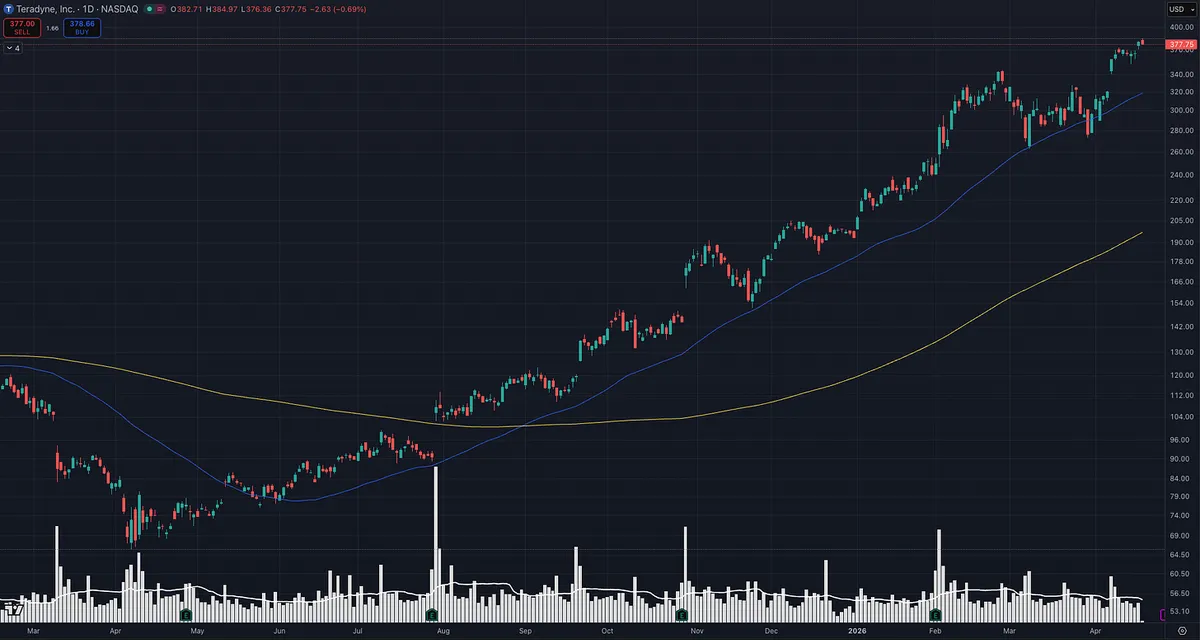
Somebody asked me why I like TER.

Honestly… what is there not to like?

99 Relative Strength.

89% EPS growth last quarter.

44% sales growth last quarter.

That alone puts it in elite territory.

But it gets better.

Sales are accelerating. Earnings are accelerating. ROE is pushing 20%. Pre-tax margins are above 20%.

This is exactly what real leadership looks like.

Then you look at the chart.

Clean uptrend. Higher highs. Higher lows. No mess. No confusion. Just strength.

And while the market was breaking down?

TER held up well.

That tells you everything you need to know about demand.

This isn’t just a good stock.

It’s part of a powerful theme in a strong industry group and more importantly, it’s a leader within that group.

That’s where the real money is made.

So again… why do I like TER?

Wrong question.

The real question is… why don’t you?

View on Substack ↗

Most “Smart” Content Is a Complete Waste of Your Time

Most content you’re consuming isn’t making you better.

It’s just making you feel like you’re learning.

I saw a post recently about taxes. Tons of likes. Tons of comments. Catchy title. Even got me to click and read.

It went deep into the history of taxes… why the system is broken… why it’s unfair.

And at the end?

Nothing.

No actual strategies. No actionable takeaways. No way to pay less in taxes.

Just… entertainment disguised as intelligence.

Most people hear things like:

“The rich don’t pay taxes.”

And their reaction is to complain.

Mine was different.

I thought: “How are they doing that?”

So I went and figured it out.

I started treating taxes like a game… How can I legally structure my life and businesses to pay as little as possible?

Same system. Different mindset.

And trading is no different.

Most people say:

“The market is rigged.”

“Algos are hunting stops.”

“Insiders have the advantage.”

Maybe that’s true.

But again… my reaction was different.

Instead of complaining, I picked up Market Wizards and asked:

“What are the people who actually win doing?”

Then I went to work trying to do exactly that.

You have two choices:

  1. Become an expert at complaining

  2. Become an expert at operating within reality

You’re probably not changing the tax code.

You’re probably not changing how markets operate.

But you can change how you play the game.

The people who win:

• Learn the rules

• Study what works

• Apply it consistently

Same with taxes. Same with trading. Same with life.

You can fight the system…

Or you can learn how to benefit from it.

Most people choose to complain, which doesn’t do anything.

That’s why most people stay stuck.