Momentum Trading Strategy

Notes

Short lessons on momentum trading, every day.

Every note from Substack, in one place: risk, setups, leading stocks, market conditions and the mindset behind them. Search them, browse by topic, or filter by stock.

Showing 721–740 of 1226 notes

View on Substack ↗

“I Missed the Move” Already? Not So Fast

Every time the market snaps back like this, you start hearing it immediately:

“I missed it.”

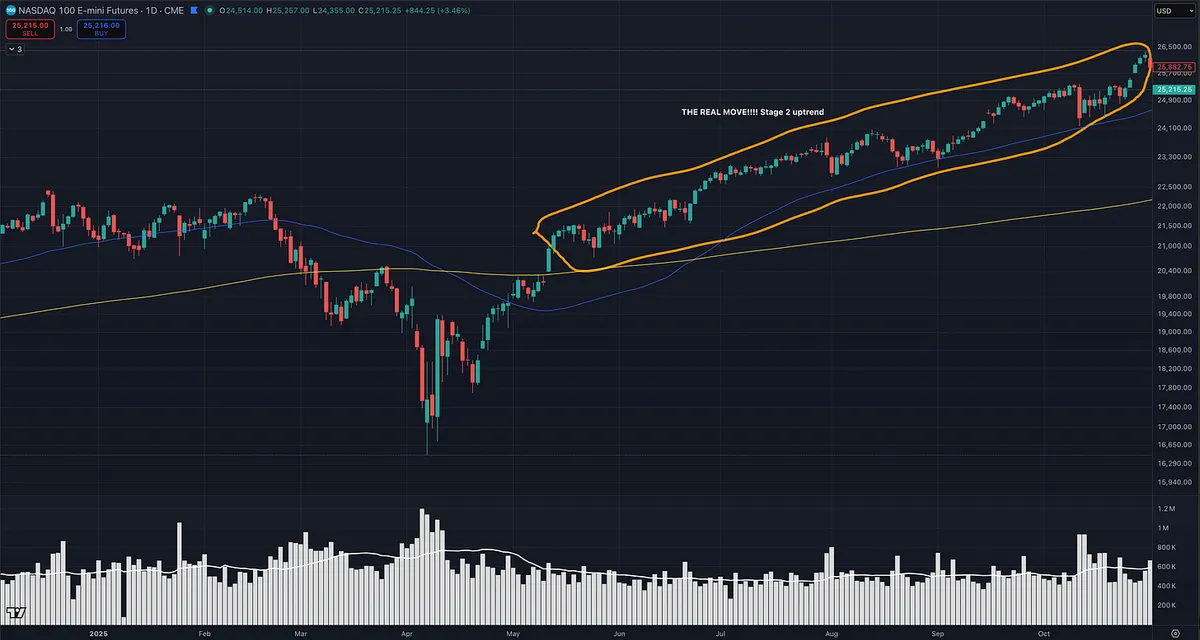
Funny… because this is exactly what people were saying last year coming off the tariff scare lows.

And yet, that was just the beginning of the real move.

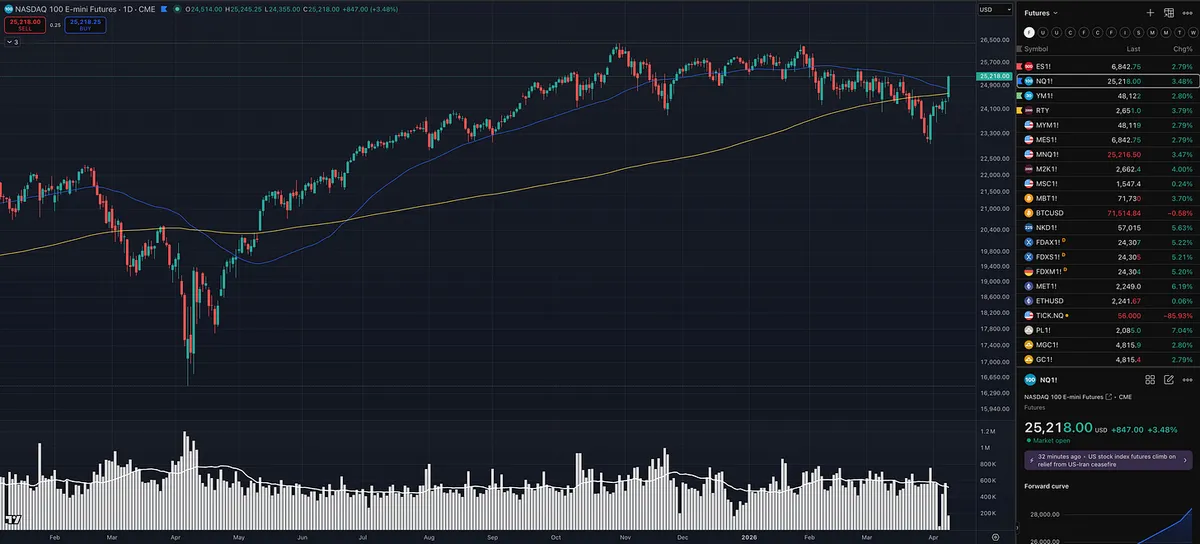
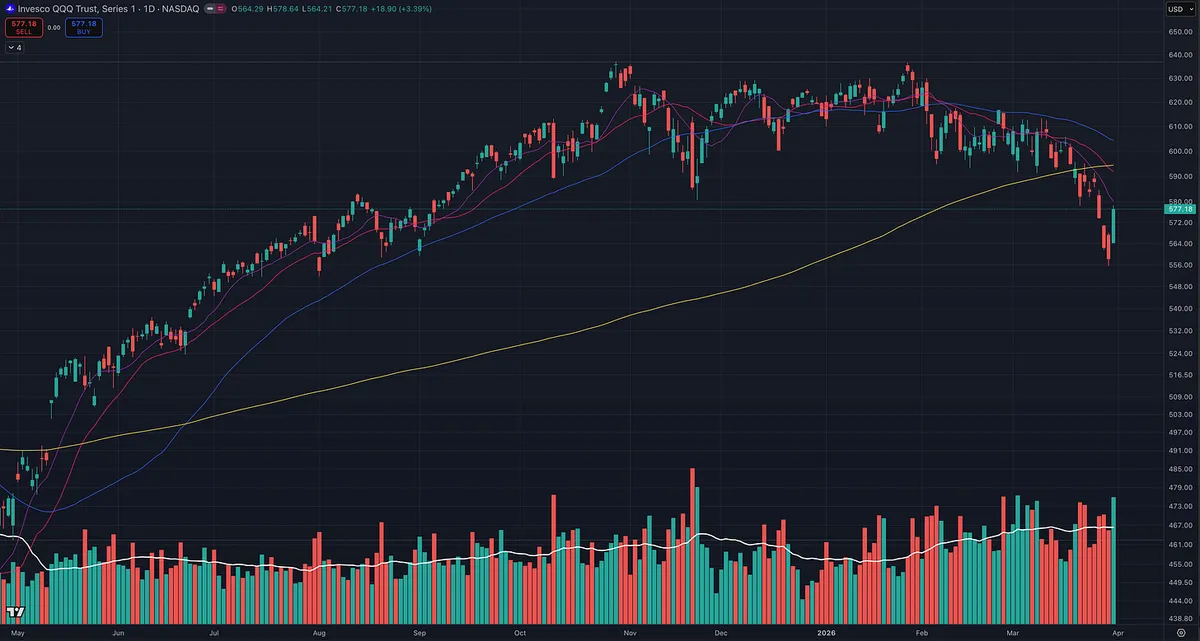
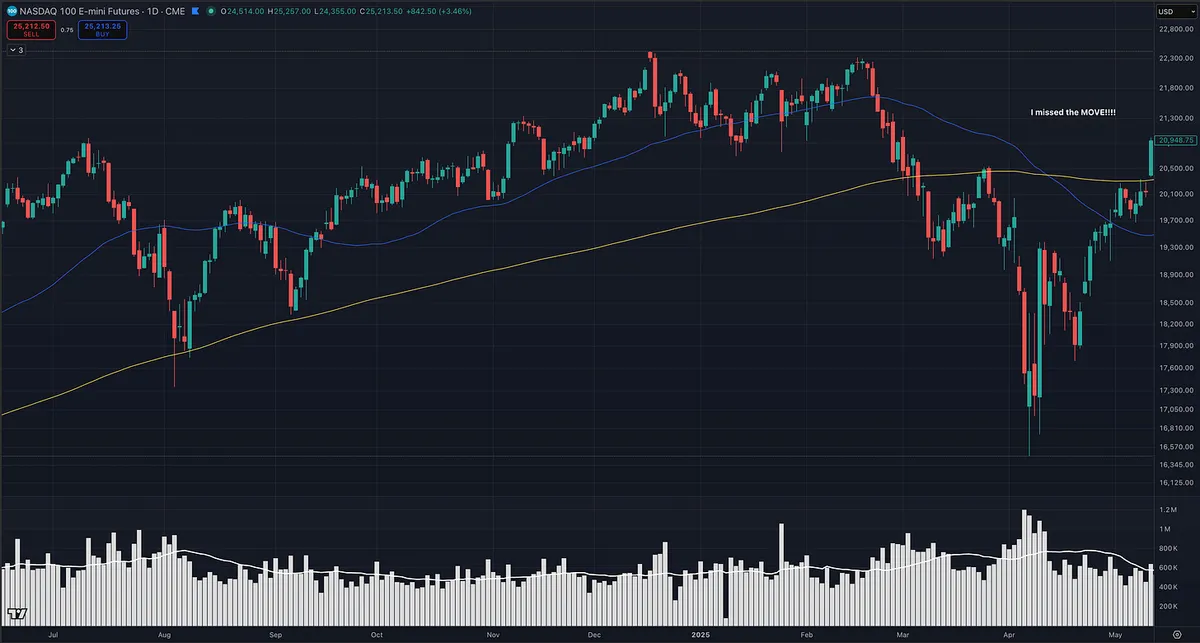
Right now, the NASDAQ-100 is reclaiming key moving averages and showing strong momentum. That initial thrust off the lows is not the end of the move… it is often the start of a new trend.

This is where most traders get it wrong.

They think the opportunity was in the bottom.

But the bottom is where uncertainty is highest, volatility is extreme, and risk is hardest to define.

The real money is made after the market proves itself.

When:

  • Price reclaims key moving averages

  • Strength starts to concentrate in leading stocks

  • Institutions begin stepping back in

That is when trends develop.

That is when Stage 2 uptrends begin.

And that is when you want to be involved.

The irony is:

When it feels like you missed it… you are often just early in the move.

So instead of chasing the past, shift your focus to the present:

  • Is the market confirming and holding?

  • Are leaders breaking out to new highs?

  • Is relative strength expanding across sectors?

Because if those answers are yes…

Then you did not miss the move.

You are watching it begin.
View on Substack ↗

And Just Like That… We’re Back

And just like that, the market flips the script.

The NASDAQ-100 (with futures already up 3.55% today) is now back above all key moving averages and up nearly 10% since last Tuesday. That is a powerful move in a very short period of time.

Now the question becomes simple:

Does it hold?

Because if it does, the conversation shifts quickly from defense to offense.

Today has the potential to be a follow-through day. For that to confirm, you want to see:

  • A gain of 1 - 1.25% or more(ideally closer to 1.5% to 2%)

  • Higher volume than the prior session

  • Between Day 4 and 7

If those conditions are met, it signals institutional demand stepping back in, and historically, that is when you start leaning back into the market.

But here is the part most traders overlook:

This move is also news-driven.

That matters.

News-driven rallies can be powerful, but they can also be fragile. They can reverse just as quickly as they begin if the underlying demand is not there to support it.

So while this looks constructive on the surface, you still need to:

  • Respect the signal

  • But confirm the follow-through

  • And stay aware of the catalyst behind the move

This is where discipline separates professionals from everyone else.

Let the market prove it.

If it confirms, you step in and increase market exposure. You cannot allow emotions or opinions to keep you on the sidelines. When sentiment is most bearish, the market often moves higher. When sentiment is most bullish, that is when breakdowns tend to happen.

Price back above short-term and long-term moving averages is giving a green light.

Now the focus shifts to execution:

Find the leading stocks that are setting up.

If it breaks down, we get defensive again.

View on Substack ↗

You Don’t Have a Trading Problem… You Have an Excitement Addiction

The brutal truth most traders refuse to admit

Ever notice how some traders say they want to be profitable…

…but keep doing the exact thing that’s losing them money?

You’ve seen it. Maybe you’ve lived it.

You review your trades. The data is obvious.

One pattern keeps showing up. One behavior is dragging your entire equity curve down.

So you tell yourself:

“I’ll just stop doing that.”

But you don’t.

Why?

Because deep down… you don’t actually want to.

There’s a story from Stock Market Wizards that exposes this perfectly.

Mark D. Cook reviewed a trader who had an 84 percent win rate…

…and still lost money.

When he dug into the data, the problem was obvious:

Just five trades caused almost all the damage.

Four of them happened on the same type of day.

Expiration Friday.

So the solution was simple:

Stop trading that day.

Problem solved.

Right?

Wrong.

The trader already knew.

And when Cook told him to stop, here’s what came out:

“Those are the most exciting trading days.”

Read that again.

He knew what was making him lose.

He was told exactly how to fix it.

And he refused.

Because it was exciting.

Six months later, he was bankrupt.

This is where most traders get exposed.

They say they want consistency. They say they want discipline. They say they want freedom.

But what they actually want…

is stimulation.

Fast moves. Big swings. Adrenaline.

The market becomes entertainment instead of a business.

Here’s the hard truth:

If you need excitement, you will sabotage your edge.

This is why the best traders, from William J. O'Neil to Tom Basso, build systems that are boring.

Because boring makes money.

Excitement costs you everything.

So here’s the question you need to answer honestly:

Are you trying to make money…

Or are you trying to feel something?

Because the market will give you both.

But never at the same time.

View on Substack ↗

You Can Be Right… And Still Blow Up Your Account

The dangerous illusion that destroys even elite traders

Let me ask you something…

Have you ever had a trade where your analysis was perfect… but you still lost money?

Not a small loss.

A painful one. The kind that sticks with you.

If you study Market Wizards, you’ll notice a pattern that shows up again and again.

The big drawdowns. Some of their worst years. The trades they regret the most.

They didn’t come from being wrong.

They came from being right… at the wrong time.

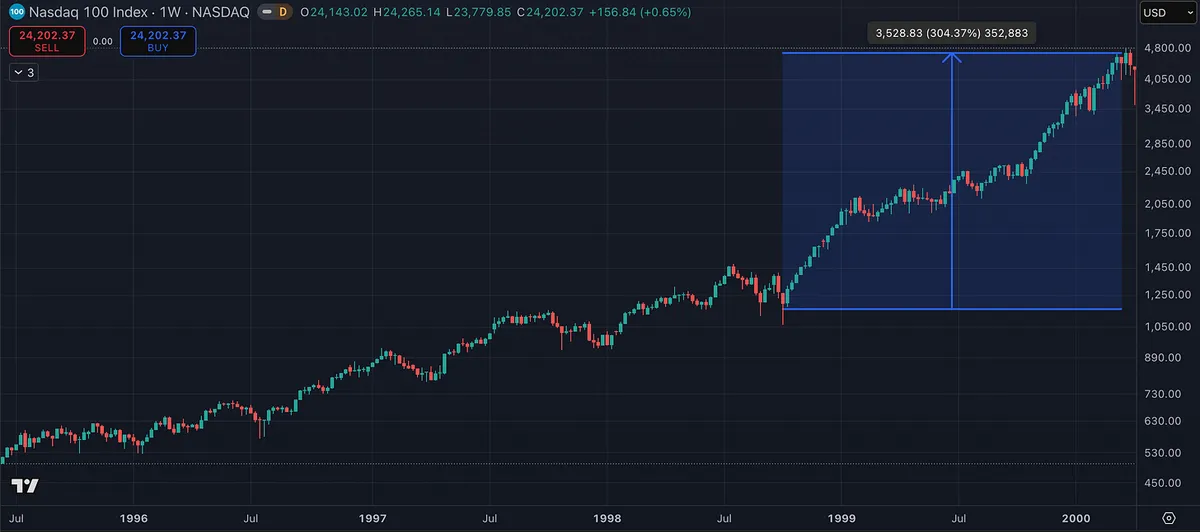
Traders saw the late 90s tech bubble forming.

The analysis was solid.

Valuations were insane. Sentiment was euphoric. The logic checked out.

And yet…

They got crushed.

Why?

Because price kept going higher and they fought it.

They argued with the market.

They were early.

And in trading, being early is the same as being wrong.

This is where most traders break.

You do the research. You build conviction. You feel certain.

And that certainty becomes your biggest mistake.

Remember, the market does not care about your thesis.

It only respects timing and risk.

There’s a principle echoed across almost every top trader:

You can be right on direction and still lose money.

That’s why traders that align with many of the market wizards I write about obsess over one thing:

Risk management.

Because once you understand this, everything changes:

• You stop trying to prove you’re right

• You start reacting to what price is actually doing

• You accept small losses quickly instead of defending bad positions

• You time entries where risk is defined and controlled

And most importantly…

You stop arguing with price.

This is how you survive and build a long career.

Not intelligence. Not research. Not conviction.

But instead managing risk through executing with proper position sizing and timing.

The market will always do one thing better than you:

Stay irrational longer than you can stay solvent.

So the next time you feel certain…

Ask yourself one question:

Am I managing risk…

Or am I trying to be right?

View on Substack ↗

Most Traders Miss This Before Every Market Move

Right now is a perfect time to study how the market actually behaves.

Not just how it warns you before a decline… but also what real recoveries look like and when it is actually safe to step back in.

Most traders focus on entries. The best traders focus on environment first.

If you understand the signals before the move, you stop reacting late and start positioning early.

I just made this post completely free for a limited time so you can go through it:

https://tradingmomentum.substack.com/p/how-the-market-warns-you-before-the

The market doesn’t move randomly. It leaves clues.The question is whether you’re trained to see them.

ArticleHow the Market Warns You Before the Crash (and When It’s Safe to Get Back In)
View on Substack ↗

Stop Hunting Cheap Stocks. Start Buying Strength

What has worked in my style of trading has worked for decades.

I am not buying bargains. I am not searching for what looks cheap.

I am buying strength.

Here is the part most people struggle with.

The hardest thing to do is often the right thing to do.

For some reason, even though this approach is simple, it is very difficult in practice. We are wired to look for deals. We want to feel like we are getting something cheap.

Buying an expensive stock feels wrong.

It feels like we missed it. It feels like we are late. It feels risky.

But in reality, strength is often just getting started.

The stocks I focus on are already moving higher. They have strong relative strength, often look expensive, and are being accumulated for a reason.

There is usually a catalyst behind the move. Big earnings. Strong sales growth. A new product or service. A shift in demand.

Something is driving institutional money into the stock.

But the key is not just the story. It is how price behaves.

I want stocks that go up on positive news and refuse to break on negative news. That tells you demand is in control.

I look for clean, tight price action. NOT wide, loose, erratic charts.

Volume matters too.

I want to see expansion on the way up, and contraction on pullbacks and consolidations.

That is the footprint of accumulation.

Above all, I care about the market.

You can find the best stock in the world, but if the general market is weak, it becomes much harder to make money.

Everything works better when the wind is at your back.

The ideal scenario is simple:

The market is strong. The industry group is strong and the stock is a leader within that group.

That alignment is where the biggest moves come from.

This is not a new approach. It is how many of the best traders over the last 100 years have operated.

Strength, not cheapness.

View on Substack ↗

Trading and Entrepreneurship Follow the Same Playbook

Most people think trading is about predicting.

It’s not.

It’s about testing.

Great entrepreneurs don’t wait for certainty. They move with conviction, knowing they could be wrong. Even someone like Jeff Bezos didn’t know which ideas at Amazon would become massive winners. They tested constantly. Many failed. A few changed everything.

That’s exactly how we operate as traders.

We’re not here to be right 100% of the time. That’s impossible.

We’re here to:

• Test ideas with real capital

• Cut losses quickly when we’re wrong

• Add when something proves itself

• Let the real winners run

Our strategy is built on what has worked for decades, but even then, no individual trade is guaranteed to be a winner.

The market decides what works.

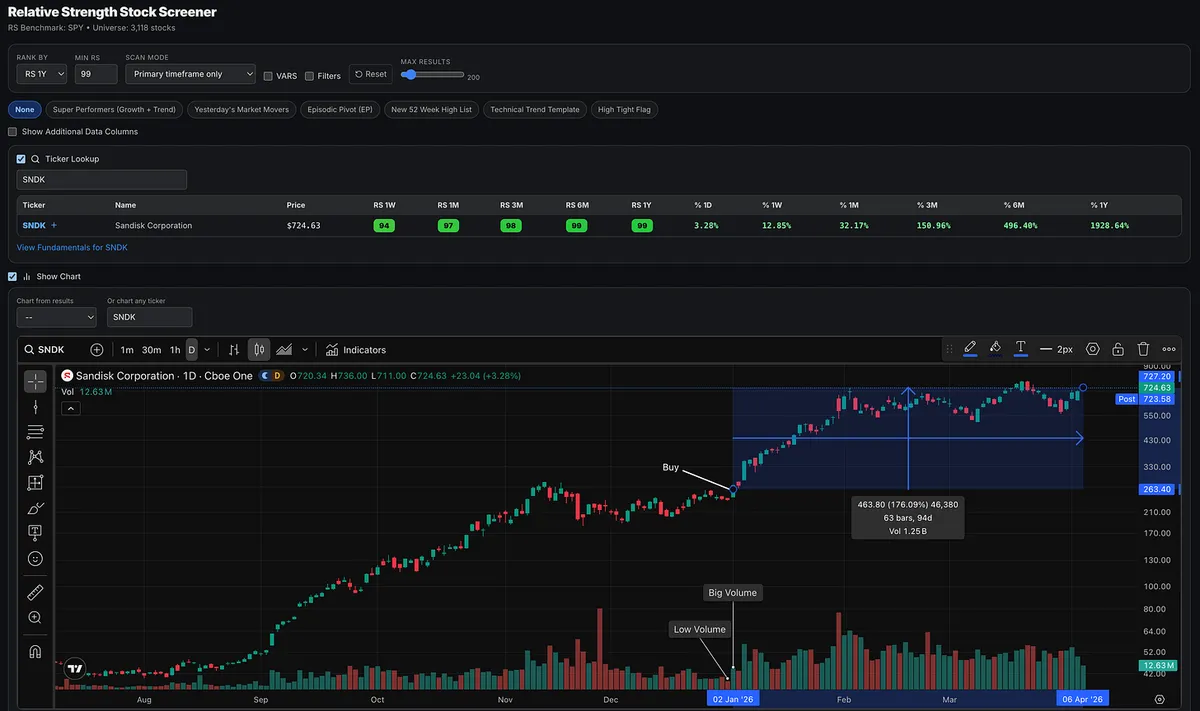
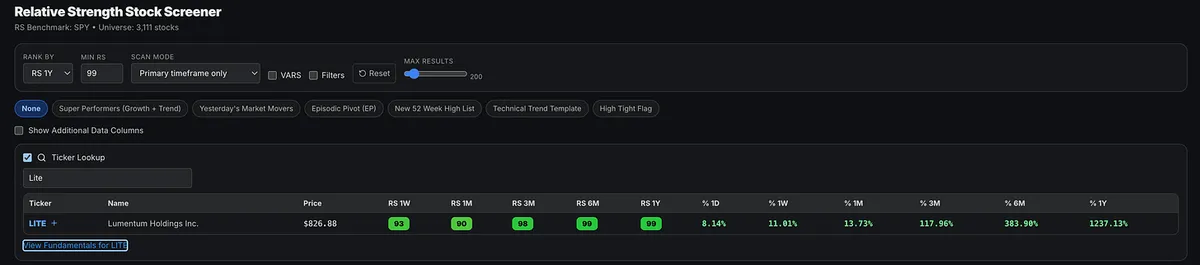
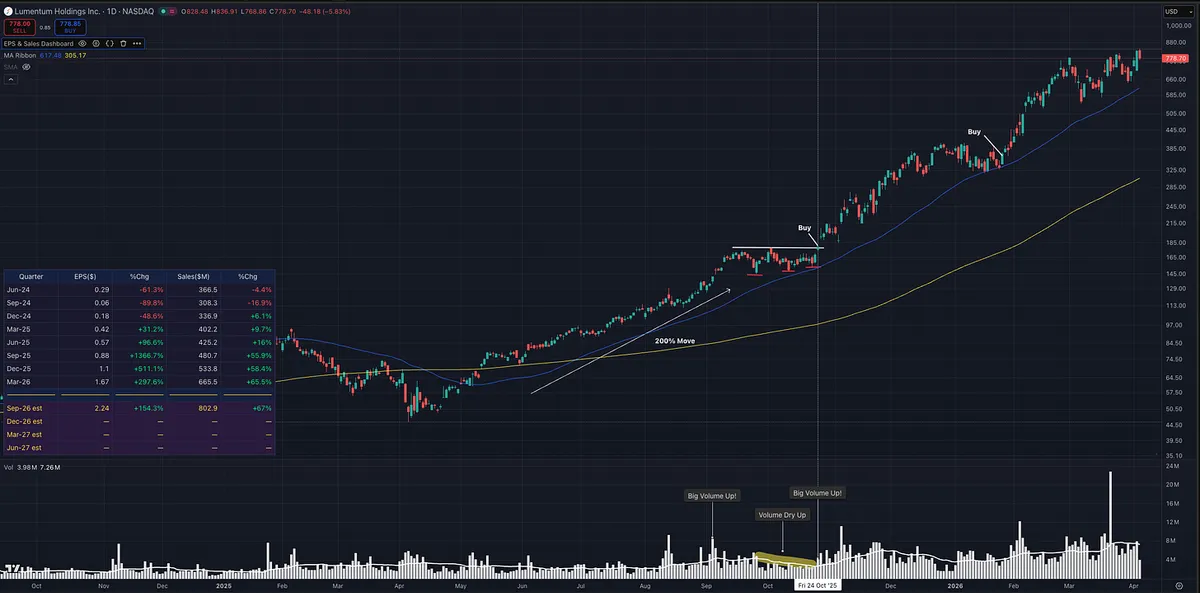
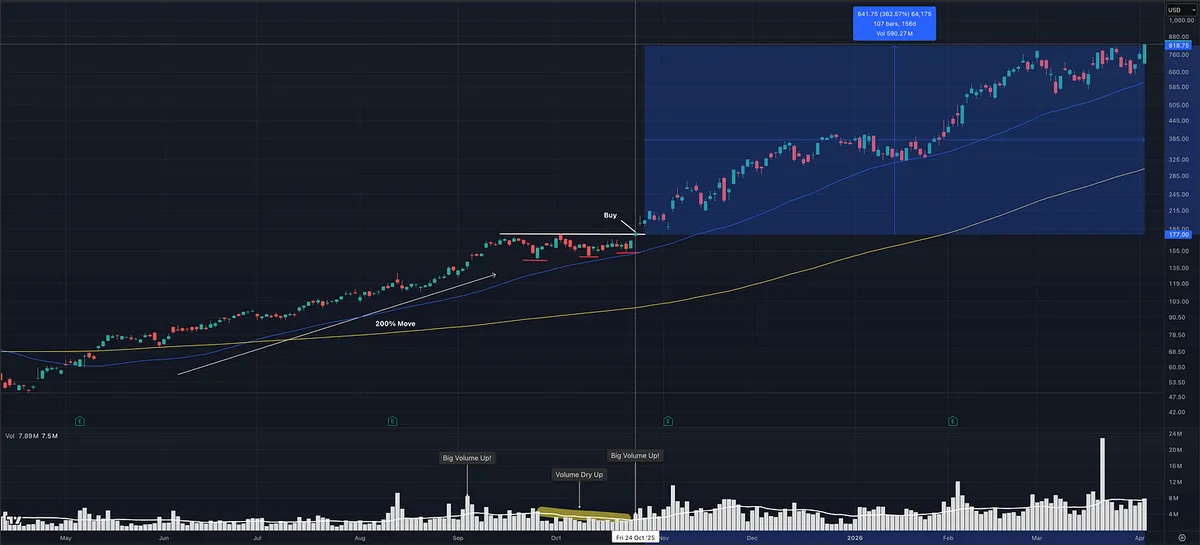
For example, those of you who are paid subscribers heard me talking about LITE back in January, and it has gone up over 125% since then. But here is the honest truth. It was one of many names I was looking at and trading.

There were plenty of other stocks with big earnings, strong sales, and high relative strength just like LITE that did not move.

The difference is simple.

I cut the losers and added to the ones that worked.

I will even continue trading that same name off and on until it clearly shows the move is over.

Just like in business, you don’t go all in on every idea. You place small, calculated bets, watch what gains traction, and then press your advantage when something starts working.

In fact, this is even more important in trading. In business, you can take action to influence outcomes. In the market, you cannot. Once you enter a trade, the market is in control.

So start treating trades like a series of small tests, and let the market tell you which ones deserve more capital.

Cut losers. Press winners.

Whether you're building a company or trading stocks, the principle is the same.

View on Substack ↗

How Dan Zanger Turned $10K Into $18 Million With Simple Chart Patterns

Most traders look at charts every day and still miss the real move.

The edge usually is not more indicators. It is learning to recognize a small number of explosive patterns again and again.

Dan Zanger did not trade on hope. He focused on repeatable setups, managed risk, and pressed when the odds were in his favor.

That is still how top traders operate today.

Simple patterns. Strong trends. Ruthless discipline.

If you are serious about becoming a better trader, read this:

👉 https://tradingmomentum.substack.com/p/dan-zangers-golden-rules-for-trading

Study it. Screenshot it. Re-read it.

ArticleDan Zanger’s Trading Strategy: Chart Patterns, Breakouts & 10 Golden Rules
View on Substack ↗

Big Up Week… But Don’t Get Trapped Here

Professionals don’t start their week by chasing stocks.

They step back first.

They study the big picture.

Then they dive deeper.

That’s exactly what this week’s Big Picture Market Pulse is built for.

👉 https://tradingmomentum.substack.com/p/big-picture-market-pulse-april-5

Take some time this weekend to zoom out and understand what’s really happening beneath the surface before you jump into stock screening.

Yes, the market had a strong week.

But here’s what most people miss…

Some of the biggest rallies happen below the 200-day moving average.

And many of them fail.

They look like the start of something new…

Until they’re not.

We’ve seen it before. Sharp bounces. Excitement returns. Then the market rolls over again.

That doesn’t mean this move can’t turn into something real.

It might.

But right now, the evidence is still mixed.

This is where discipline matters.

This is where you step back, not speed up.

Get control of your emotions. Look at the structure. Understand the environment.

Then prepare for the week ahead with clarity, not hope.

If you’re serious about improving your results, this is where it starts.

Read the full breakdown before Monday.

On SubstackBig Picture Market Pulse | April 5, 2026
View on Substack ↗

You Can Absolutely Time the Market. Most People Just Don’t Know How

Timing the market is not impossible. It is a skill that can be developed.

For decades, the mainstream narrative has told you that you cannot time the market.

That is simply NOT true.

Does it take skill? Yes. Is it required if you want to trade at a high level? Also yes.

Timing broad indexes is more difficult. They are more efficient.

But individual stocks, especially small and mid caps, are different.

They are less efficient and that inefficiency creates more opportunity.

Great traders do not just buy good stocks. They master when to buy them.

They study supply and demand in real time.

They look for supply drying up as price tightens on the right side of a base. They watch volume contract on pullbacks and expand on advances. They wait for confirmation through higher highs and higher lows.

They align multiple timeframes. They read the tape with discipline.

This is not luck. It is pattern recognition built through repetition.

When you learn to time your entries, everything changes.

Risk gets tighter. Reward expands. Drawdowns shrink.

And most importantly, you stay in the game long enough to compound.

Timing is part of how you manage risk.

The traders who have done this for decades are not lucky. They are executing a repeatable edge.

Timing is part of that edge.

View on Substack ↗

Everything You Get as a Paid Subscriber to Momentum Trading Strategy

For those considering upgrading, a paid subscription is $120 per year, which comes out to just $10 per month.

With that, you get full access to everything inside the Momentum Trading Strategy ecosystem, including all paid content here on Substack, the subscriber chat, a comprehensive course, and the full suite of tools within the Momentum Trading Strategy Web App.

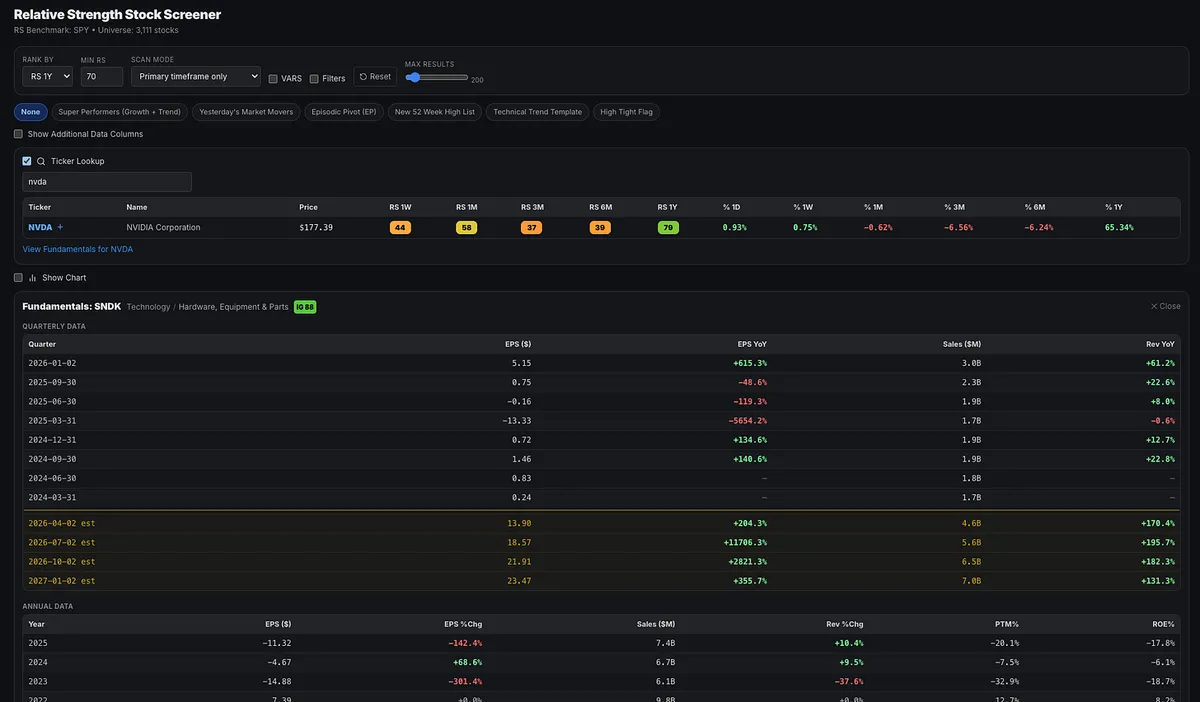
This includes the market overview dashboard, the relative strength dashboard, and a robust relative strength stock screener that integrates earnings, sales, pre-tax margins, return on equity, relative strength, and a wide range of additional filters. You also have access to a built-in watch list, position sizing tools, risk management tools, and ongoing platform enhancements.

The Relative Strength Stock Screener alone provides functionality comparable to many platforms that charge between $50 and $150 per month.

In addition, you get access to the Momentum Trading Strategy course, which teaches the complete framework built on the principles used by traders such as Jesse Livermore, Nicolas Darvas, William O’Neil, Mark Minervini, and Dan Zanger, along with insights drawn from many of the greatest market participants. The depth of this material is comparable to courses that cost hundreds or even thousands of dollars.

When market conditions are favorable, you will also receive stock ideas with defined buy zones and risk levels, along with shared screens and ongoing insights into how to apply the process in real time.

This is not just access to content or tools. It is a complete, integrated framework designed to help you identify market leaders and execute with discipline.

This is only the beginning.

View on Substack ↗

Standing on the Shoulders of Momentum Giants

Mark Minervini learned from the traders who came before him, like William O’Neil, William L. Jiler, and Richard Love, and he has said many times that he stands on the shoulders of giants. We are no different.

The momentum lineage runs from Jesse Livermore and Gerald Loeb, to William O’Neil and Nicolas Darvas, to Mark Minervini, David Ryan, and Dan Zanger. This is the tradition that shaped the Momentum Trading Strategy Course and how we trade.

That is why I am featuring Mark Minervini in my latest article and breaking down his SEPA blueprint, with modern examples you can actually trade.

Read it here: https://tradingmomentum.substack.com/p/the-minervini-blueprint-the-sepa

ArticleThe Minervini Blueprint: The SEPA Framework And Volatility Contraction Pattern That Turn Small Accounts Into Superperformers
View on Substack ↗

The Quiet Clue Before Every Big Move

How shrinking volume signals supply exhaustion before explosive breakouts

Most traders stare at price.

The best traders watch price and what’s disappearing.

Because the biggest moves don’t begin with excitement.

They begin with silence.

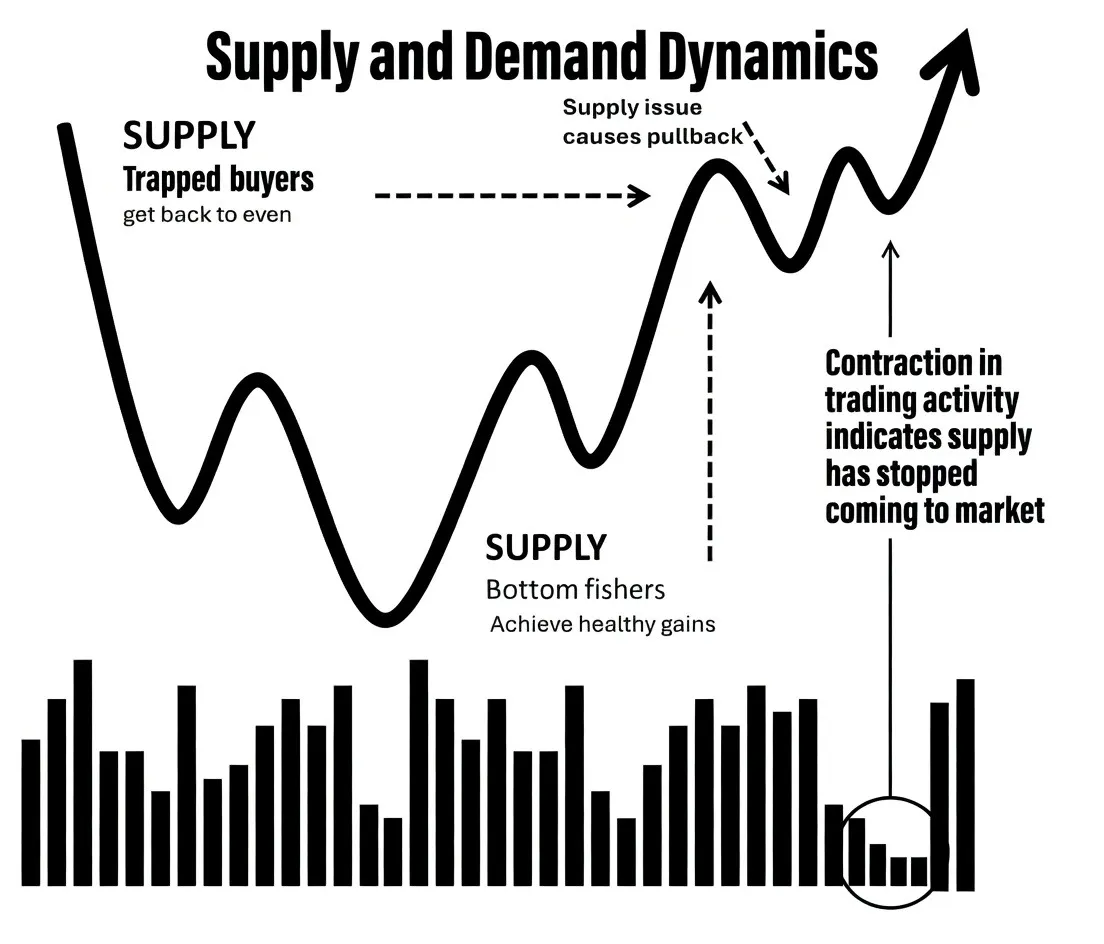
Look at the image.

Price pulls back.

Weak hands get shaken out.

Trapped buyers sell just to break even.

Supply comes into the market.

This is where most people lose interest.

But this is where the real signal begins.

Something subtle happens.

Volume starts to dry up.

That is not random.

That is the market communicating clearly:

The sellers are running out.

And when supply disappears, price does not need much demand to move higher.

This is straight from the Minervini playbook.

Early pullbacks create supply from trapped buyers.

Repeated tests absorb that supply.

Tight price action combined with declining volume signals that supply is nearly gone.

Now the equation changes.

You are no longer buying strength.

You are buying after weakness has already been removed.

That is a completely different edge.

Ask yourself this:

If nobody is left willing to sell, what happens when buyers step in?

Price expands.

Breakouts hold.

Trends accelerate.

This is how asymmetric opportunities are created.

Not by chasing.

But by waiting for pressure to disappear.

Next time you study a chart, focus on one thing:

Is supply drying up or is it still present?

Because price is just the result.

Supply and demand is the driver.

And the traders who understand that are the ones who catch the real moves early.

View on Substack ↗

The News Is Loud. Price Pays.

I’ve made money from news catalysts.

Earnings surprises.

FDA approvals.

Government contracts.

But…

Most of my trading comes down to following price and trend.

A lot of the stocks I trade still have strong fundamentals. Big earnings. Strong sales. Expanding margins. Usually something new driving those numbers.

They often check the CANSLIM boxes.

So it’s not that the news doesn’t matter.

But price and volume tell you if institutions are actually acting on it.

That’s what I’m focused on.

I’m not trying to predict the news.

I’m reacting to what price does after it hits.

It’s actually kind of funny.

I don’t trade macro.

I don’t try to figure out geopolitics.

I don’t position based on what I think is going to happen in the world.

I don’t try to predict long term debt cycles or shifts in the global order.

But I do enjoy it.

I’ll listen to it. Watch it. Think about it.

It’s interesting. It’s mentally stimulating.

It’s just not how I make money.

And honestly, I don’t think many traders are consistently successful that way. There are a few. But for most, there are simpler and more repeatable approaches.

For me, it always comes back to the same thing.

Price.

View on Substack ↗

What Is a Follow Through Day? The Signal William O’Neil Used to Get Back Into the Market

Most traders try to call the bottom. William O’Neil didn’t. He waited for confirmation, and that confirmation is called a follow through day.

After a market correction, you will almost always get a bounce. The problem is most of those bounces fail. So O’Neil studied over 100 years of market winners and found that real bull markets don’t start quietly, they start with power backed by volume.

A follow through day only counts if it happens at the right time. It must come on day 4 through day 7 of a rally attempt. Anything earlier is usually just a reflex bounce and far less reliable.

Then you need price strength. A major index like the Nasdaq or S&P 500 should rise roughly 1.5% to 2% or more. Earlier in O’Neil’s work 1% was acceptable, but over time that threshold increased to filter out weaker signals.

Finally, and most important, you need volume confirmation. The day’s volume must come in higher than the prior day, ideally above average. That is what tells you institutions are stepping in, not just retail noise.

This concept comes directly from O’Neil’s research in, where he found that this combination of timing, price, and volume often marked the early stages of a real market uptrend.

Here is the nuance most people miss. A follow through day is not a guarantee and it is not a signal to go all in. In fact, O’Neil would tell his traders they didn’t need to suddenly increase exposure. You could start very small. Just buy something. Begin testing the market.

Even when a follow through day checks all the boxes, you still proceed carefully. One of the biggest mistakes is jumping in too early or too aggressively before a proper signal is confirmed. Another is ignoring weak volume. If the index moves up but volume is light, that is a red flag. It suggests institutions are not behind the move.

You also want to see broad participation. A real uptrend is not carried by a handful of stocks. If only a few names are working, the rally is fragile and just as important, you have to watch what happens after the follow through day. If the market cannot build on it and quickly rolls over, that tells you the signal failed.

As O’Neil emphasized, a follow through day is just the beginning. You still need to see continued strength to confirm the uptrend.

Anyone can buy a bounce. Professionals wait for proof.

View on Substack ↗

The Setup Isn’t the Problem… The Environment Is

The same pattern that works today can fail tomorrow if you ignore context.

Ever notice how a setup works great for a while… then suddenly stops?

It’s not random.

It’s the environment.

Most traders obsess over patterns but ignore when those patterns actually work.

Coming out of a correction or bear phase, you will see a lot more cup and handle setups.

Why?

Because stocks are rebuilding. They need time to repair damage, shake out weak hands, and form proper bases before moving higher.

That’s Stage 1 transitioning into Stage 2.

But once you’re inside a strong Stage 2 uptrend…

You’ll typically see fewer deep cup and handles and more tight, constructive consolidations.

The market is no longer rebuilding.

It’s expanding.

Now you start seeing:

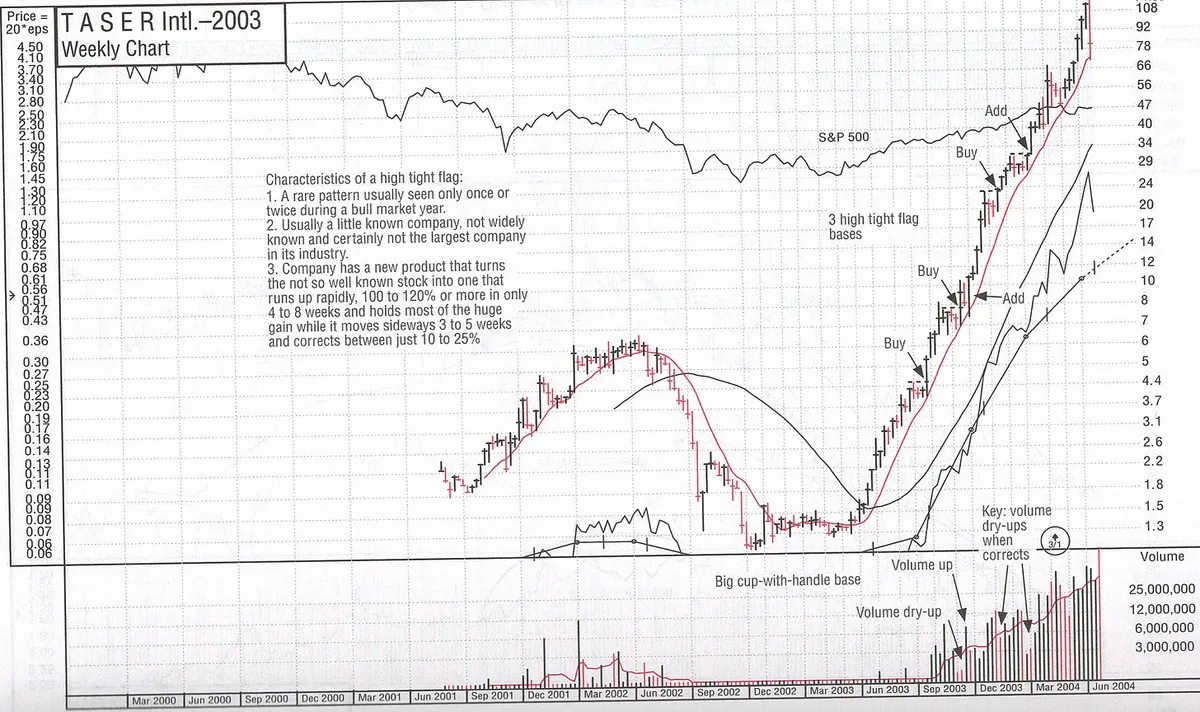
  • Flags and Pennants

  • VCPs

  • Flat bases

  • Tight area breakouts

These tend to be shorter, tighter, and shallower than early-stage bases.

These are not bottoming patterns, they are continuation patterns forming within strength.

If you’re still looking for deep bases in a strong uptrend, you’re going to feel like “nothing is setting up” when in reality, everything is.

You’re just looking for the wrong thing.

The pattern doesn’t matter as much as the quality of price action and trend strength behind it.

This is one of those simple nuances that separates amateurs from pros.

Great traders don’t just learn setups.

They learn when those setups show up.

Same bull market. Same charts. Different lens.

Completely different results.

View on Substack ↗

If You Can’t Name the Stage… You Shouldn’t Be in the Trade

Most traders overcomplicate the market.

More indicators. More opinions. More noise.

But the truth is, the market has been operating the same way for decades.

And Stan Weinstein gave us one of the cleanest frameworks to understand it in Secrets for Profiting in Bull and Bear Markets

“One glance is worth a thousand earnings reports.” -Stan Weinstein

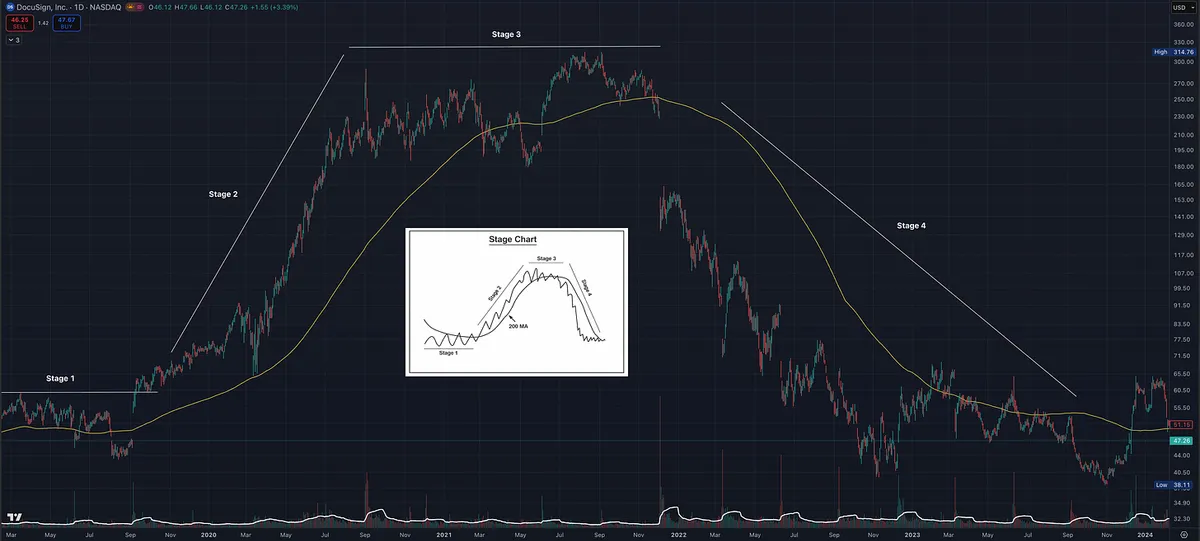
Stan Weinstein broke every stock into four stages.

Stage 1: Basing This is where a stock goes sideways. Quiet. Boring. Institutions are accumulating but price is not moving much yet.

Stage 2: Advancing This is the money phase. Price breaks out, trends higher, and demand is in control. This is where strong stocks separate from the rest. Higher highs, higher lows.

Stage 3: Topping Momentum slows. Volatility increases. The trend starts to stall as distribution begins under the surface.

Stage 4: Declining The downtrend. Lower highs, lower lows. Broken structure. This is where capital gets destroyed. Price is below the 200MA and the moving average starts declining.

Here’s the key.

You don’t need to trade all four stages.

You only need one.

Stage 2.

Weinstein made it clear that the goal is to align with strength, not anticipate it.

One of the simplest ways to identify a true Stage 2 uptrend:

Price is above key moving averages.

The 50 day is above the 150 day.

The 150 day is above the 200 day.

That alignment tells you institutions are in control and the trend is working.

This concept didn’t come out of nowhere.

Weinstein built on the work of Richard Schabacker, who studied price behavior as far back as the 1930s. The best traders don’t reinvent. They refine.

Mark Minervini took this same foundation and made it a core part of his process.

Same principle.

Different generations.

Nothing new.

If the stock is not clearly in Stage 2, you are forcing it.

And forced trades are where most losses live.

Name the stage first.

Then decide if it’s worth your attention and capital.

View on Substack ↗

The Next Leaders Are Being Built Right Now

Whenever the market gets messy, I don’t try to force trades.

I go back to the basics. I slow down. I do the homework.

Going through my notes, this stood out:

“Usually leaders that led in a prior cycle don’t lead in the next cycle. Their best move is behind them.” — Mark Minervini

Most people will keep going back to the same names.

The ones that worked before. The ones that made the big moves.

But that’s not where the next opportunity is.

The next leaders are usually different stocks. New names. New stories. New strength.

And this is exactly why we pay attention during corrections.

When the market pulls back, I’m watching closely:

  • Which stocks are holding up

  • Which names are not breaking down

  • Which stocks are hitting relative strength new highs

Because that’s often where the next leaders come from.

They’re showing strength before the market turns.

View on Substack ↗

The Smart Money Shows Its Hand Before the Market Turns

If you knew where the next leaders were before the market turned… you would look at them differently right now.

That is exactly what Mark Minervini teaches.

He focuses on stocks that are not breaking down with the market. In fact, some are quietly doing something even more powerful.

They are holding steady. Moving sideways.

A stock does not need to go up to show strength. It just needs to go down less.

When the market is correcting and a stock is moving sideways, the relative strength line is rising.

This is how true leaders reveal themselves early by outperforming, even before a new uptrend begins.

What this is telling you is simple:

When conditions improve, these stocks are already in position to move first and move fast.

They have been under accumulation while everyone else was distracted.

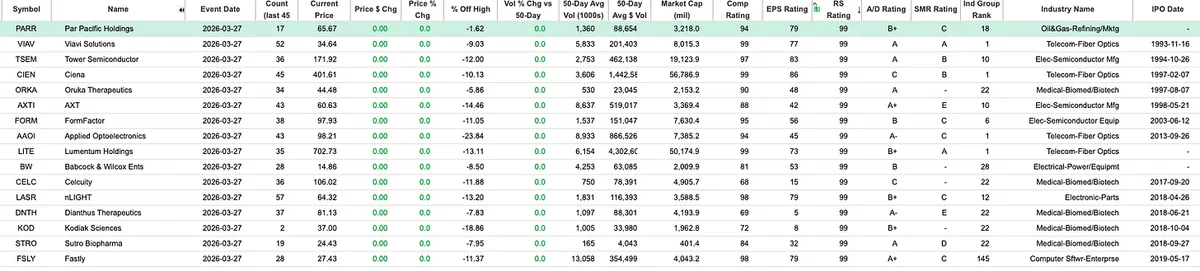
This is why I screen and track stocks with RS lines hitting new highs.

If you are a paid subscriber, look at this list that I share and update regularly.

View on Substack ↗

As Jim Rogers put it,

“I just wait until there is money lying in the corner, and all I have to do is go over there and pick it up.”

This is not that type of market environment.

With roughly 75% of stocks following the general market direction, there is no edge in fighting the current. Patience and cash is a position.

Protect capital now so you are ready to take advantage of better conditions when they appear.

For a full breakdown of the current market environment, including indexes, sectors, and internals, read this week’s Big Picture Market Pulse.

https://tradingmomentum.substack.com/p/big-picture-market-pulse-march-29

On SubstackBig Picture Market Pulse | March 29, 2026