Momentum Trading Strategy

Notes

Short lessons on momentum trading, every day.

Every note from Substack, in one place: risk, setups, leading stocks, market conditions and the mindset behind them. Search them, browse by topic, or filter by stock.

Showing 401–420 of 1222 notes

View on Substack ↗

Everyone Tells You to Diversify. Buffett, Druckenmiller, and O’Neil Said the Opposite.

Many investors believe strongly in diversification and do not understand why I prefer to concentrate my capital in a select few names, ideally the strongest market leaders.

But I did not come up with this idea out of nowhere.

Some of the most respected investors and traders in history have expressed the same belief. Maybe these three quotes explain it better than I can.

Stan Druckenmiller said:

“Put all your eggs in one basket and watch the basket carefully.”

William O’Neil said:

“Diversification is a hedge for ignorance. I think you are much better off owning a few stocks and knowing a great deal about them. By being very selective, you increase your chances of picking superior performers. You can also watch those stocks much more carefully, which is important in controlling risk.”

Warren Buffett said:

“Diversification is protection against ignorance. It makes little sense if you know what you are doing.”

Concentration does not mean blindly putting everything into one stock and hoping for the best.

It means being highly selective, knowing what you own, understanding why you own it, controlling your risk, and allocating more capital to your best ideas instead of spreading it across dozens of mediocre ones.

Diversification may reduce the damage caused by being wrong, but excessive diversification can also dilute the rewards of being right.

I would rather closely follow a small number of exceptional market leaders than own a large collection of mediocre stocks I barely understand.

View on Substack ↗

The Longer You Trade, the Less You Trade

The longer you trade, the more you may notice that you trade less.

This may not apply to everyone, but many highly experienced traders will tell you the same thing. As you gain experience and trading wisdom, you become more selective, not only about the stocks you trade, but also about when your strategy works best.

You stop trying to force trades during unfavorable periods. You begin to recognize the market environments where your setups have the greatest edge, and you become more comfortable sitting on your hands when those conditions are missing.

The interesting part is that even with less activity, you may make just as much, if not more, while taking fewer trades.

Beginners often believe they need to be constantly active. They either do not yet understand when their strategy works best, or they keep trying to force it during less desirable market conditions.

So how do you learn when you trade best?

Track your data.

Study how your results change across different market environments. Look at when your setups perform well, when they struggle, and when you should reduce exposure or stay out completely.

This is closely related to what Dr. Van Tharp taught when he described six different market types. It is unrealistic to expect one trading strategy to work equally well in every market environment.

The goal is not to trade more.

The goal is to trade when your edge is actually present.

View on Substack ↗

Place Your Bets: Which Way Does the Nasdaq 100 Break?

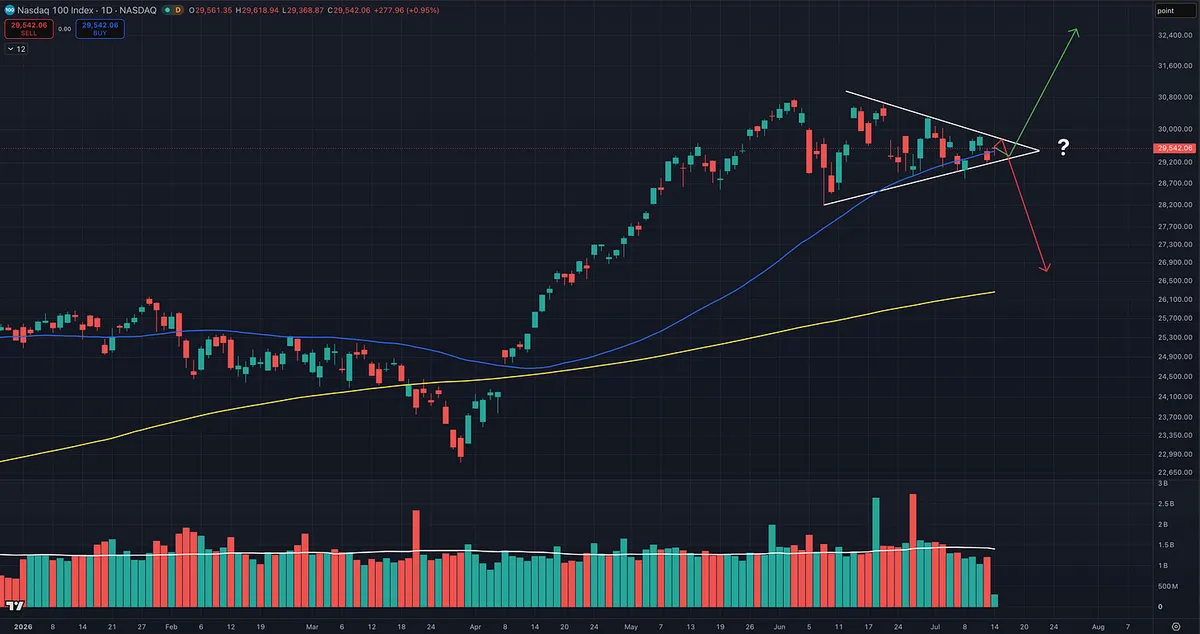
Let’s have a little fun. I know trying to predict market direction like this doesn’t really matter, but let’s make a call anyway.

The Nasdaq 100 is coiling into a tight pennant, and it looks like we’re about to get an answer soon.

Breakout or breakdown?

Place your bets.

Which way does the Nasdaq 100 break from this pennant?

  • Higher

  • Lower

PollHigher · LowerVote on Substack →
View on Substack ↗

Nothing Lasts Forever. Don’t Fall in Love With Any Stock.

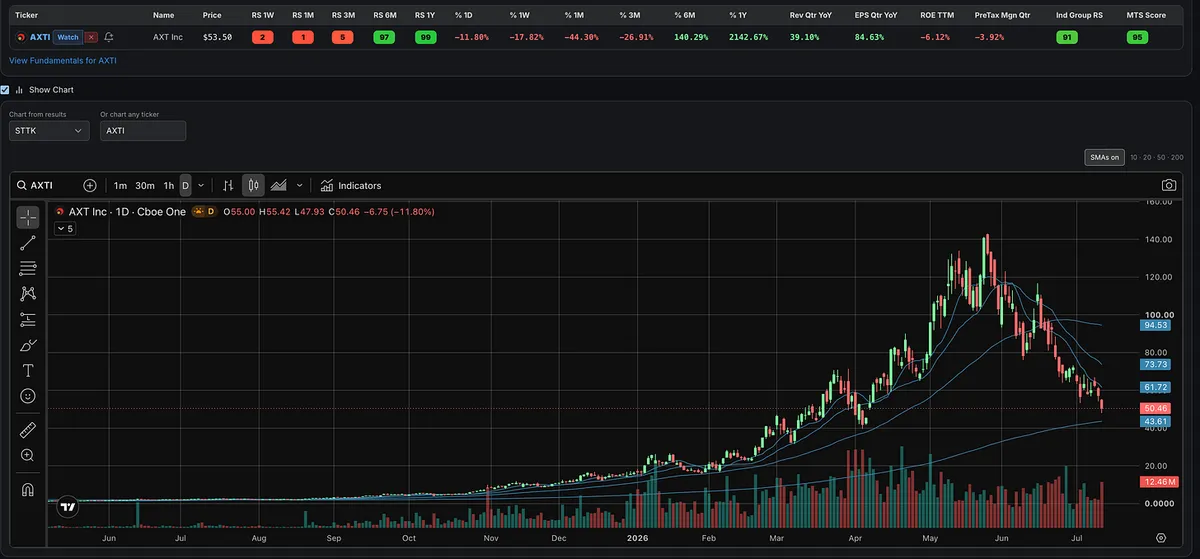
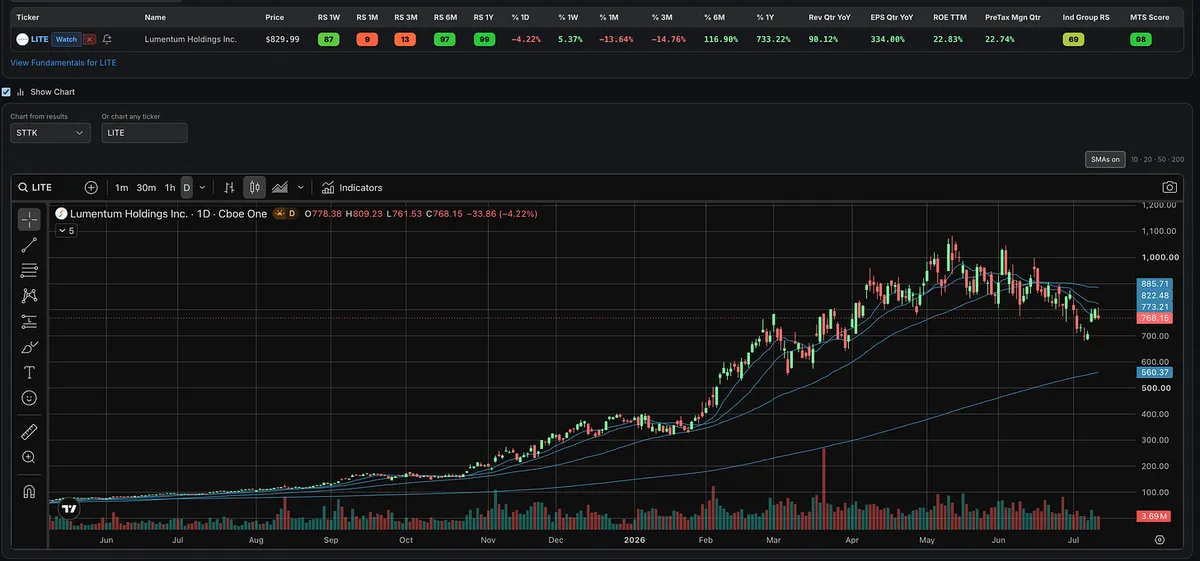
Some of the market’s biggest winners over the past year have now broken down. At least for the moment, their runs appear to be over.

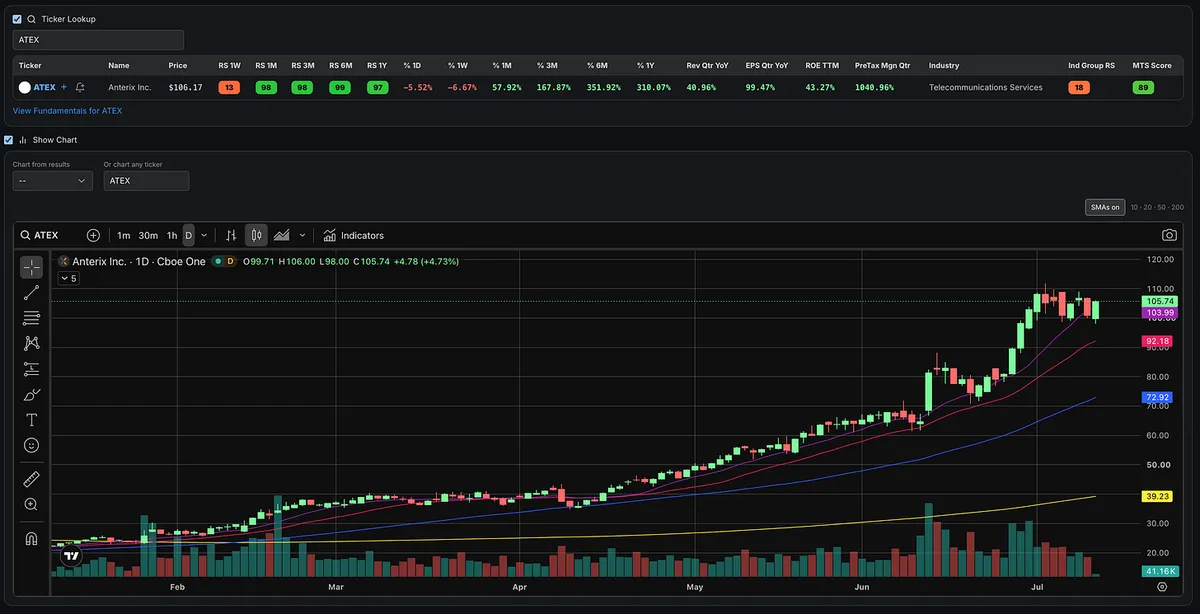
AXTI delivered enormous gains over the last year, but it has now fallen below its 50-day moving average and is heading toward the 200-day. Its 10-day and 20-day lines are declining, and the 50-day is beginning to roll over.

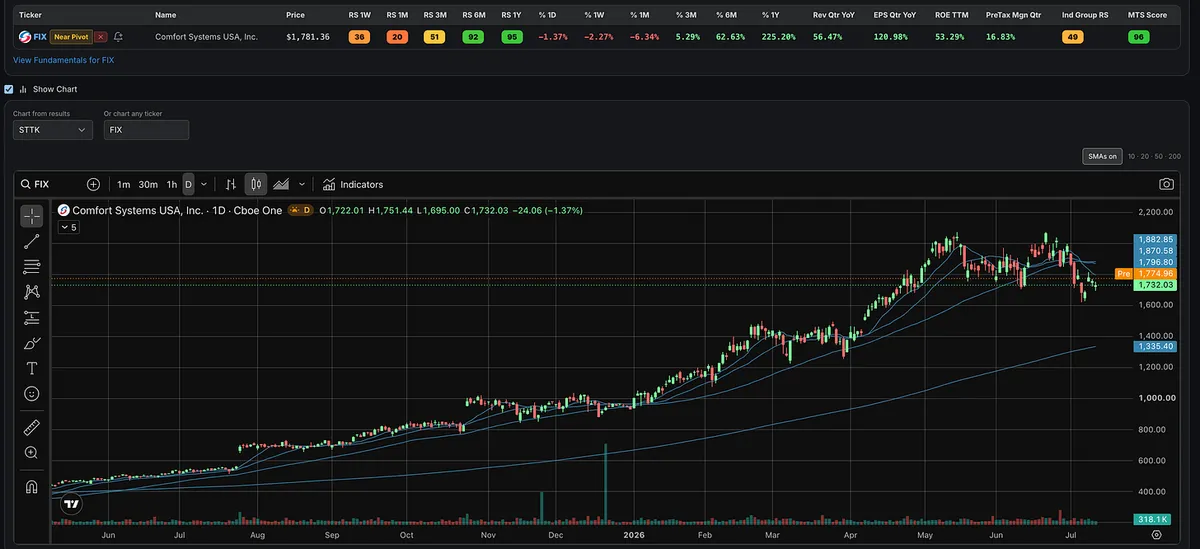
LITE, CIEN, VICR, AAOI, VIAV, TTMI, FIX, COHR, and several other former leaders have also broken down or suffered significant technical damage.

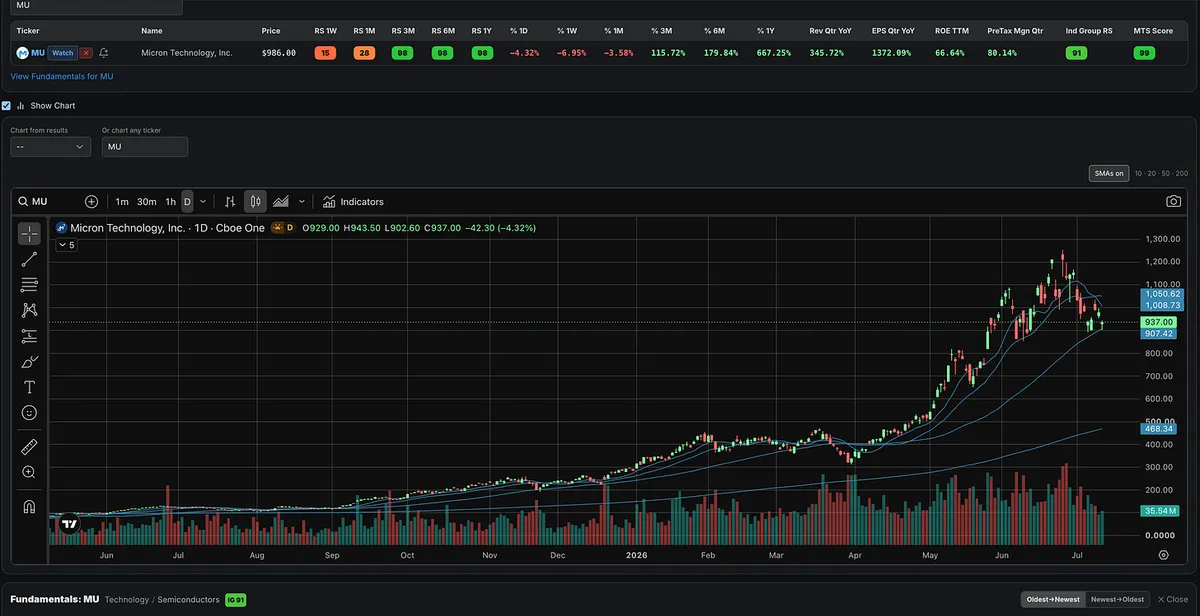
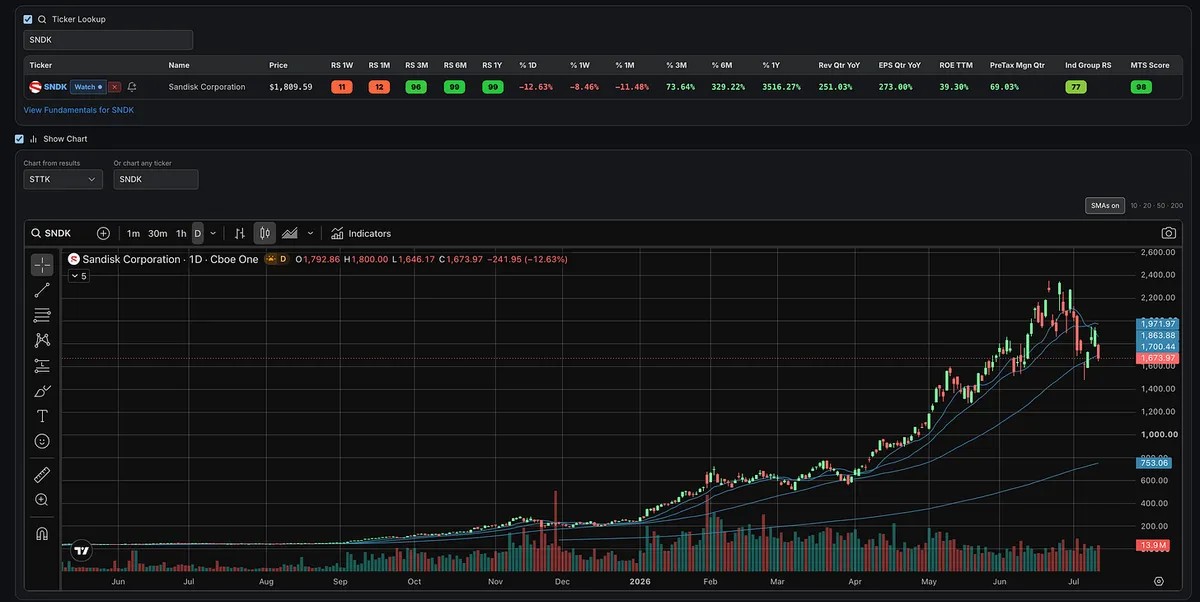
Many more are sitting in the danger zone near their 50-day moving averages. That includes the memory names SNDK, WDC, STX, and MU, along with other hot names from hot groups VPG, MBIS, MXL, LSCC, MRVL, TER, VSH, STM, ADI, INTC, TSM, LRCX, COHU, PDFS, and others.

The bottom line is that many of the stocks that have driven this market, particularly the memory, semiconductor, and telecom names, have either already broken down or are now testing a critical area around their 50-day lines.

I have not needed to share many new tickers from week to week because the same names I have discussed throughout the year continued to lead. There was no reason to constantly search for something new when the existing leaders were still working.

But nothing lasts forever.

Many of the stocks that worked all year are now either ending their runs or approaching a decisive point. Do not fall in love with any stock. Respect the price action and let the market tell you whether the trend is still intact.

View on Substack ↗

But SpaceX Was Different... Right?

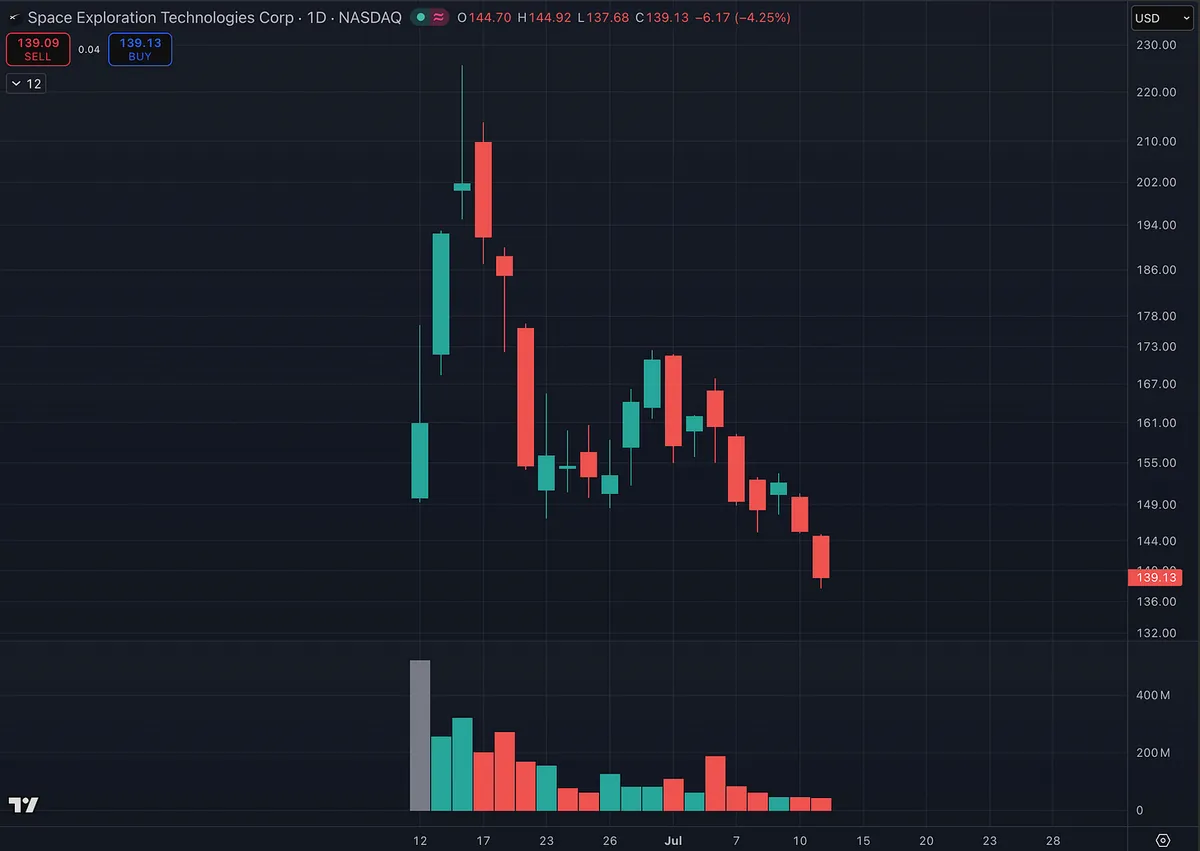
SpaceX surged after its IPO, the hype exploded, and anyone warning about chasing it probably sounded overly cautious.

Now, the entire move has been erased.

The company may be different.

Human emotion is not.

This is exactly why I wrote this.

Quoting Momentum Trading StrategyThe IPO Trap Most Traders Fall For A lot of people are getting excited about a potential SpaceX IPO. And I get it. Big company. Big story. Big hype. Lots of emotion. But this is where a lot of inexperienced investors get caught. They buy on day one with no game plan. No entry strategy. No risk plan. No understanding…
View on Substack ↗

When the Screens Go Cold, Hit the Books

You can always find something moving in any market, but the quality of what is showing up on my screens has changed significantly from April, May, and even early June.

When you run the same screens every day, you can see the change in real time. The number of high-quality growth setups has narrowed, and the overall opportunity set is simply less attractive.

That does not mean there is nothing to trade. Some traders will always find something. For me, though, this is usually a signal to reduce activity, step back, study, refine my watch lists, and relax until the individual stocks on my screens begin improving again.

Time to hit the beach and hit the books.

View on Substack ↗

Volume and Price Characteristics I Look For

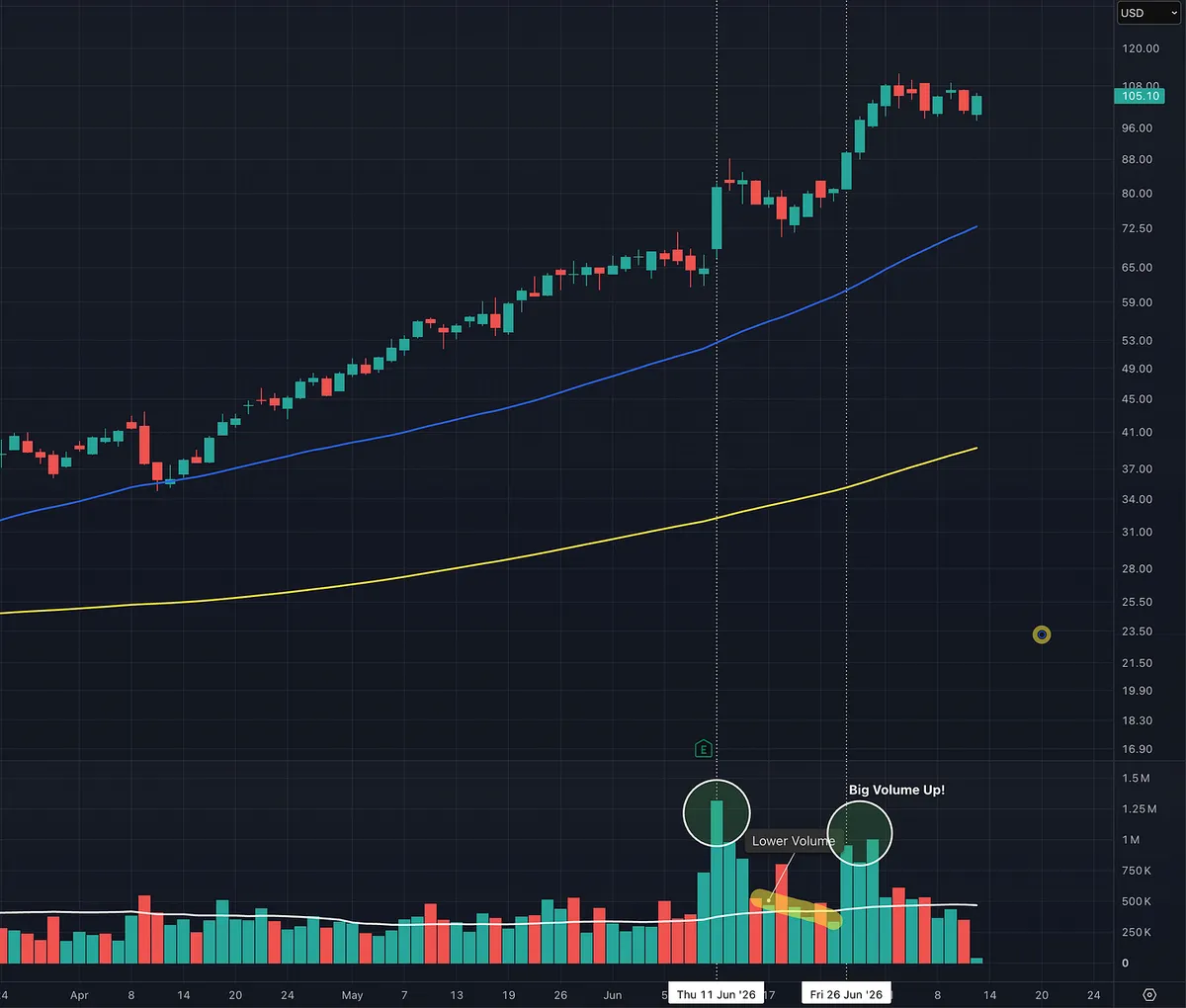
I want to see price advance on expanding volume, showing strong demand, followed by a controlled pullback on lighter volume. The lower-volume decline suggests sellers are not pressing aggressively, while the next surge in volume confirms buyers are stepping back in. That combination often signals healthy accumulation within an ongoing uptrend.

View on Substack ↗

From Episodic Pivot to Pullback Entry: RSI’s 50-Day Upside Reversal

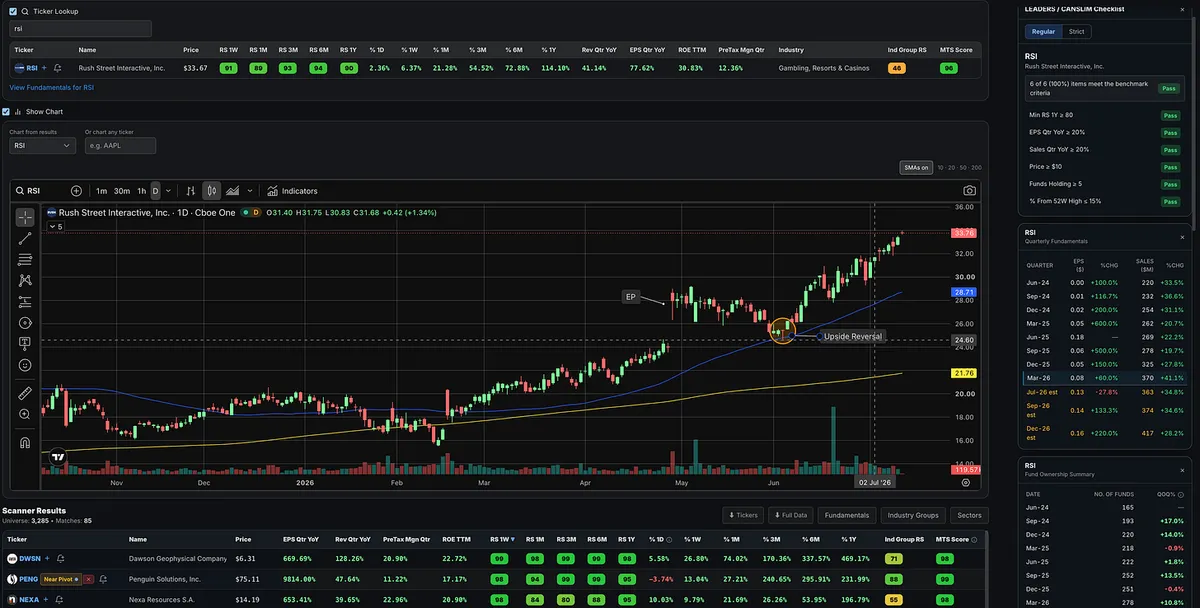
RSI had an episodic pivot following earnings on April 29, then gradually drifted back toward the 50-day moving average on light volume. At that point, the stock produced an upside reversal, creating a potential entry for traders who had been waiting for an opportunity to get involved.

This is a good example of why building and maintaining organized watch lists is important. Many traders probably found RSI on an episodic pivot or relative strength scan, watched it for a few days, and then lost track of it before the actual entry developed. By keeping the stock on a focused watch list, you would have been prepared when it finally tested support.

Was this a perfect textbook upside reversal? No. Those are much rarer. Ideally, the reversal would have occurred on heavier volume and closed above the prior day’s high. Even so, it still qualifies as an upside reversal. The long lower wick shows that price established a low near the 50-day, rejected that weakness, and closed near the top of the day’s range at or slightly above the prior day’s close. Since then, RSI has continued to trend higher.

View on Substack ↗

You Can Have 20 Years of Trading Experience and Still Be Blind to Market History

You can have 15 or 20 years of trading experience and still have spent your entire career inside one secular bull market.

You did not trade through 2008. You did not trade the dot-com collapse. You did not experience many of the bubbles, crashes, and violent market periods that came before.

That should humble every trader.

Even I almost fell for the idea that today’s leaders, with their huge price moves and high ADRs, were somehow different from the past.

They are not.

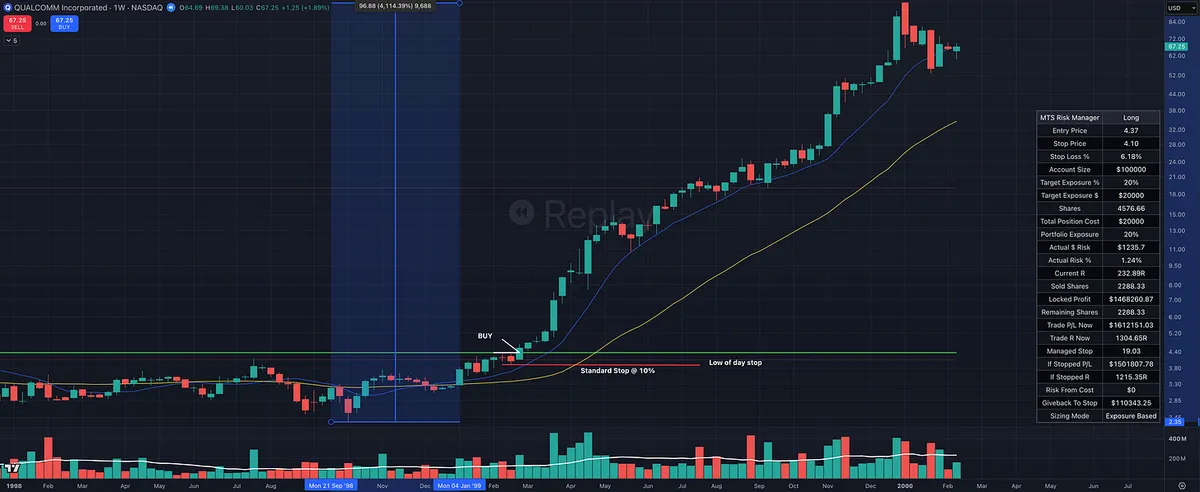
Pull up Qualcomm from 1999 and early 2000. The volatility was just as extreme, if not more.

That is why William O’Neil’s work remains so foundational.

The tickers change. The market does not, because human nature does not.

View on Substack ↗

I’ve received a lot of comments from people who believe today’s market is fundamentally different, that O’Neil did not trade stocks with this level of volatility, and that past leaders did not have comparable price swings, ADRs, or ATRs.

Qualcomm in 1999 directly challenges that assumption.

O’Neil absolutely traded highly volatile stocks during highly volatile market periods. The names, industries, and technology may change, but powerful leaders with wide price swings are NOT new.

I added an important Qualcomm 1999 example to this post that I left out when I originally published it.

When I recreated O’Neil’s Qualcomm setup using historical data, I found that a stop below the most recent higher low would have been about 10.1%, outside his traditional 7% to 8% guideline.

But a stop at the low of the high-volume breakout day would have been roughly 6.2%, keeping the trade comfortably within O’Neil’s framework.

Qualcomm was highly volatile and still went on to produce an extraordinary advance. It is a strong reminder that fast-moving market leaders are not unique to today’s market.

The lesson is not that O’Neil ignored his rule. We do not know the exact stop he used. The lesson is that a more precise entry and stop location can sometimes allow you to participate in a volatile leader without accepting a wider stop loss.

I added all three Qualcomm charts and the full breakdown to the article. Take another look at the updated post.

ArticleDoes O’Neil’s 8% Stop Rule Still Work Today?
View on Substack ↗

The Flashy Stuff Gets Attention. The Boring Stuff Makes Money.

Most traders want the same things.

  • The next big stock.

  • The perfect setup.

  • A new indicator.

  • A screenshot of someone else’s exact buy and sell.

That is the content that gets attention.

It is also why so many traders stay stuck.

If following someone else’s trades were enough, far more traders would already be rich.

They are not.

Nearly every great trader I have studied has warned against searching for shortcuts, yet beginners continue doing the exact opposite.

Why doesn’t it work?

Because identifying the stock was never the hardest part.

The hard part is knowing how to enter, position size, manage risk, sit through normal volatility, sell into strength, raise stops, and avoid destroying the trade with emotion.

That is the boring stuff.

Learn the characteristics shared by history’s greatest growth stocks, and you will not need someone else to hand you tickers.

Learn what real setups look like, how supply and demand appear on a chart, and how to identify low-risk, high-probability entries. Then you can make your own decisions.

Study what the best traders consistently teach about risk management, position sizing, cutting losses, protecting capital, and managing winners.

Understand expectancy and trading metrics so you can evaluate your own results.

There are many different trading systems that work, but none work without mastering the basics.

The military taught me the same lesson.

Elite special operations units do not succeed because they discovered secret versions of physical fitness, marksmanship, communication, or battle drills.

That is what the movies show and what most people believe.

The reality is that they master the same fundamentals at a much higher standard.

They train harder.

They repeat the basics more often.

They remain disciplined when tired, stressed, and uncomfortable.

They master what everyone else overlooks.

Trading is no different.

Great traders are not great because they found one magical setup or gained access to a secret indicator.

  • They are great because they execute the basic principles better than everyone else.

  • They cut losses.

  • They size positions correctly.

  • They protect capital.

  • They follow their rules.

  • They review their trades.

  • They repeat the process long after everyone else gets bored and starts searching for another shortcut.

The flashy content may help you discover a stock.

The boring work is what allows you to profit from it.

You do not need another ticker.

You need to master what happens before you buy, while you hold, and after you sell.

That is where consistent profitability is built.

Unfortunately, it is also the part almost nobody wants to hear about.

Until they finally realize there is no shortcut around it.

View on Substack ↗

The Hottest Stock in the Market Can Still Be a Bad Trade

You find a true market leader.

Big earnings. Strong sales. High relative strength. A quality setup. Volume dries up, demand comes in, and the stock is ready to break out.

Everything looks right.

Then you measure the distance from your entry to the logical technical stop.

It is not 6%, 7%, or 8%.

It is 11%, 12%, or even 15%.

Now what?

  • Do you force a tighter stop into normal price action?

  • Reduce your position size?

  • Use a more precise intraday entry?

  • Wait for another setup?

  • Or pass completely?

This is where finding a great stock ends and structuring a great trade begins.

You do not need to follow CAN SLIM or even know who William O’Neil is to face this problem. Every serious trader must understand how the setup, technical stop, position size, account risk, and potential reward fit together.

I just published a deep dive into O’Neil’s 7% to 8% rule, how to handle more volatile stocks, position sizing, concentration, staggered stops, tighter entry tactics, and managing risk without forcing the chart to fit an arbitrary percentage.

The chart determines the stop.

The stop determines the position size.

The position size determines your account risk.

Read: https://tradingmomentum.substack.com/p/does-oneils-8-stop-rule-still-work

ArticleDoes O’Neil’s 8% Stop Rule Still Work Today?
View on Substack ↗

Most Traders Learn the Pieces. Few Put Them Together.

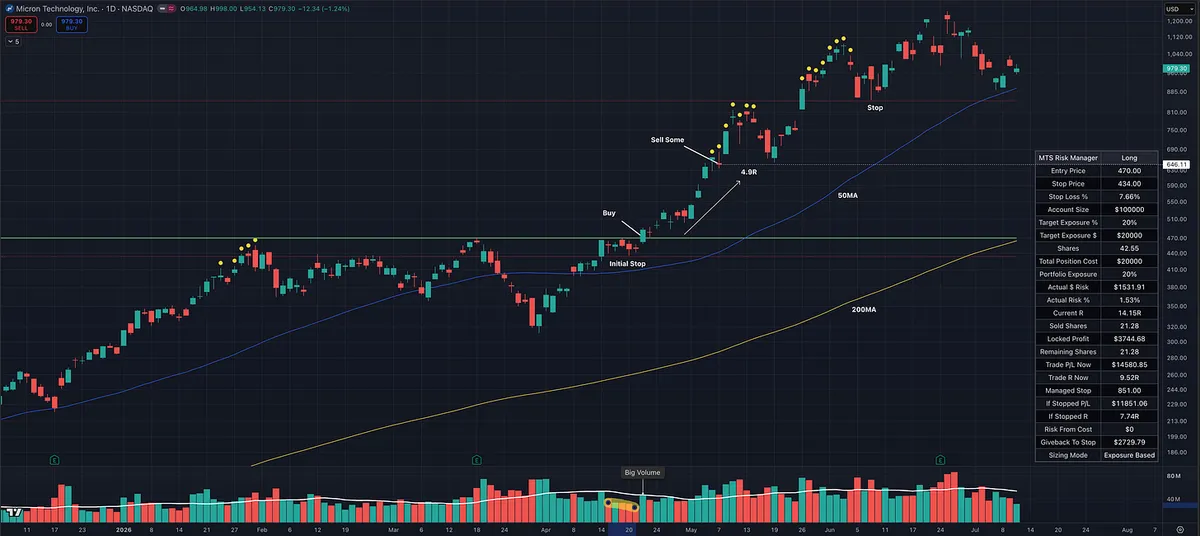
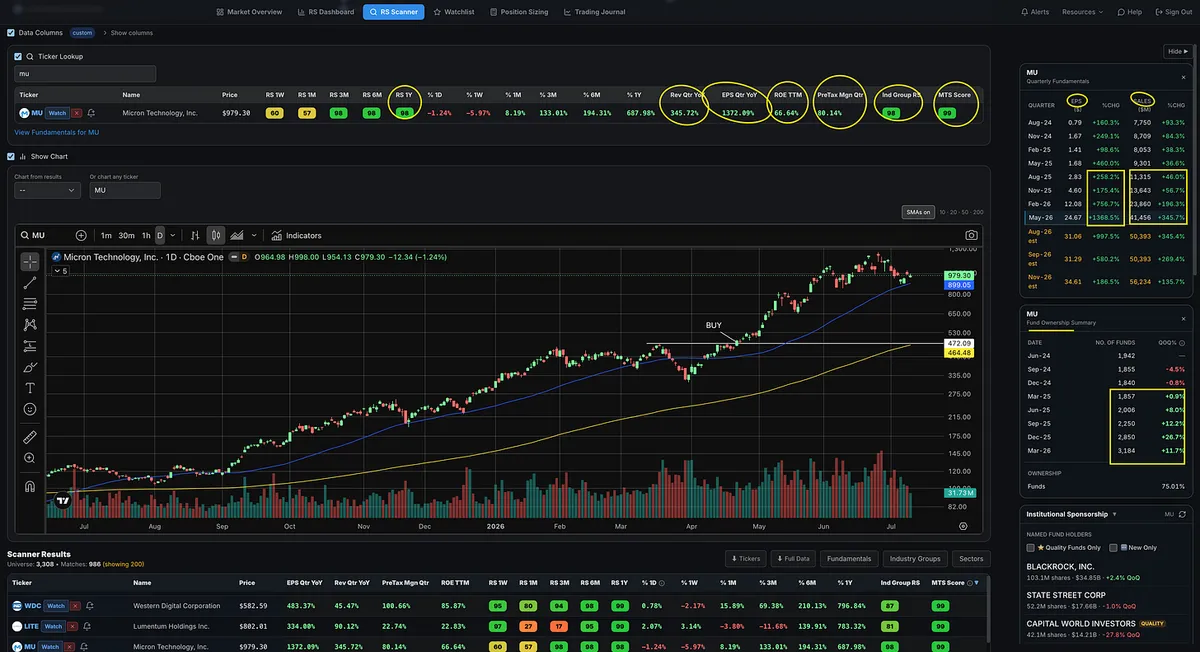
This chart shows how several critical trading principles can come together in one trade.

William O’Neil: Use relative strength, growth fundamentals such as powerful earnings and sales growth, institutional sponsorship, and industry leadership to find stocks with the characteristics of history’s biggest winners. Then wait for a proper setup and let the chart determine the initial stop.

Anna Coulling: Study the relationship between price and volume. Volume dried up as the stock tightened in the handle, then expanded as it broke into new highs.

Dr. Van Tharp: Define the risk first, calculate the correct position size, and measure the trade in R multiples.

Mark Minervini: Sell some into strength, raise the stop as the trade proves itself, and finance the rest of the trade.

George Soros: His risk-first philosophy reinforces the goal of protecting principal and reaching a point where you are managing accumulated profits instead of continuing to risk your original capital.

The process shown on this chart:

  1. Use the RS Scanner to identify the leader.

  2. Wait for a proper chart setup.

  3. Confirm the setup through price and volume.

  4. Identify the initial stop from the chart.

  5. Position size based on the technical stop level and acceptable account risk.

  6. Sell some into strength to reduce the remaining risk.

  7. Raise the stop to breakeven when the price action allows.

  8. Manage the trade through higher highs and higher lows.

  9. Add to the winner when another low-risk setup appears, or sell some more to lock in additional profits along the way.

  10. Repeat.

This is not the entire trading process. A complete system also includes understanding the general market environment, positive expectancy, analytics, journaling, mindset, continuous review, and more.

But this chart shows how stock selection, chart analysis, position sizing, risk management, and trade management can begin working together within a single trade.

To dive deeper into how these principles fit together, take the Momentum Trading Strategy Course.

View on Substack ↗

Don’t Miss the Trade Trying to Save 5 Cents

I’ve had quite a few beginner traders DM me asking about order types, so I figured I’d share this for anyone who is new to momentum investing.

As growth stock and momentum traders, we do not care about getting the perfect penny. We care about getting into the right stock at the right time.

If I’m watching the breakout live, I simply use a Market Order. I’m not going to risk missing a quality breakout because I was trying to save a few pennies with a limit order.

If I cannot be at my computer, I’ll place a Buy Stop Order at my breakout or pivot price.

For example, if a stock is trading at $98 and my breakout level is $100, I’ll set a Buy Stop at $100, or slightly above it.

If the stock reaches that level, the order is triggered automatically.

I’ll also attach a Sell Stop as a bracket order at my predetermined stop-loss level. That way, as soon as I’m filled, my protective stop is automatically active.

Keep it simple.

As momentum traders, the main order types we use are:

Market Orders

Buy Stop Orders

Sell Stop Orders

You do not need to overcomplicate things with a dozen different order types.

And you definitely do not want to miss a great trade because you were trying to save a few pennies with a limit order.

View on Substack ↗

Comparison Is the Thief of Trading Progress

You have probably heard the saying, “Comparison is the thief of joy.”

It is also one of the biggest traps in trading.

I have seen traders finally turn the corner, become profitable, improve their discipline, and make real progress, yet still live in a constant state of frustration.

Why?

Because instead of appreciating how far they have come, they are focused on someone making more money, posting bigger gains, or progressing faster.

That comparison can destroy your confidence and pull you away from the process that is actually working.

Keep the blinders on.

Focus on your execution, your discipline, your risk management, and your own growth.

When you see someone doing better than you, do not use their success as evidence that you are behind. Use it as proof of what is possible.

Be grateful that they are showing you how much potential still exists.

Then leave it there.

Get back to your own work, your own process, and your own journey.

As Tom Basso often says, “enjoy the ride.”

View on Substack ↗

The Fastest Way to Improve at Trading Is to Stop Trying to Make Money

Most struggling traders don’t have a strategy problem.

They have a sizing problem.

They’re risking enough money that every trade becomes emotional. They hesitate on losses, move their stops, hold winners too long, sell too early, and obsess over every tick.

Then they wonder why they can’t follow the system they already know.

The solution is simple, but most people are too stubborn to do it:

Trade smaller.

Reduce your position size and overall portfolio risk to the point where you almost don’t care whether any individual trade works.

Long term, you can’t trade tiny forever. Eventually, your winners need to be large enough to meaningfully grow your account. That’s why position sizing and risk management are so important.

But when you’re still building confidence, your primary goal should not be to make as much money as possible.

Your goal should be to execute correctly.

Smaller size gives you more reps with less emotional pressure. It becomes easier to:

Take losses without hesitation.

Respect your initial stops.

Sell some into strength.

Avoid holding too long out of greed.

Stop regretting a sale just because the stock keeps running.

Follow your process instead of reacting to your emotions.

Ironically, once you stop trying so hard to make money, you may surprise yourself and start making more of it.

But the bigger win is that you begin building confidence in yourself and in the system.

A lot of traders ignore this advice. They spend five years or even ten trading too large, breaking rules, repeating the same mistakes, and letting emotion control every decision.

Some quit.

Others finally hit rock bottom and decide that enough is enough.

The traders who make meaningful progress in 18 months to 2 years usually aren’t more talented.

They’re simply less stubborn.

They accept that the goal at the beginning isn’t to maximize profits.

It’s to master the process.

Once consistent execution becomes second nature, increasing your size is the easy part.

Confidence isn’t built through one huge winner.

It’s built by doing the right thing, over and over again.

View on Substack ↗

Do You Actually Want to Be a Trader?

A lot of people say they want to become traders.

But when you watch how they spend their time, what they enjoy studying, and what naturally holds their attention, many of them seem far more interested in being analysts.

Those are not the same job.

Traders still need to perform analysis. If you trade momentum growth stocks, you need to understand the market environment, price and volume, relative strength, earnings and sales growth, industry leadership, risk, and the quality of the setup.

But the analysis is only there to support the trade.

At some point, the trader must make a decision, accept risk, execute, manage the position, and respond when the market does something unexpected.

A great analyst does not automatically become a great trader.

Read enough of the Market Wizards books and you will see this repeatedly. Someone can understand a company, industry, or market better than almost anyone and still struggle to turn that knowledge into profitable trades.

Meanwhile, a great trader may occasionally look like a terrible analyst.

They can buy something and quickly sell it when the price action changes. They can sound bullish today and cautious tomorrow. They are not trying to defend a prediction or prove how intelligent their original thesis was.

They are trying to make money while controlling risk.

I am not saying this to scare anyone away from trading. I am simply saying that you should step back and ask yourself what you actually want to be.

Some people are pursuing trading primarily because of the money, but their behavior shows that what they truly enjoy is researching, forecasting, studying companies, and explaining the market.

There is nothing wrong with that.

You may be better suited to becoming an analyst, writing a newsletter, building a research service, or sharing your ideas through a platform like Substack.

This is where “know thyself” becomes so important.

For anyone following Momentum Trading Strategy, I want to be clear about what I am.

I am a trader at heart.

You should not follow me because you believe I am the greatest market analyst. There are people who are much better at producing detailed economic forecasts, company research, and deep fundamental analysis.

The Big Picture Market Pulse simply shows you how I evaluate the market as a trader. It is similar to how William O’Neil and Mark Minervini incorporate the market into their trading process through the “M” in CANSLIM.

My software is also an extension of how I trade.

It takes much of what I was already doing through MarketSurge and TradingView and combines it with the features, organization, ratings, risk tools, and workflow I always wished I had.

The software supports the system.

The Momentum Trading Strategy course teaches the system.

The market analysis helps guide you through the environment in which that system is being applied.

Over time, because I love the markets, I have gone deeper into certain areas of market analysis. I have learned from traders and authors such as Martin Zweig and incorporated some of those ideas into the way I view the bigger picture.

But at the end of the day, I am still a trader.

I was a trader before Substack.

And whenever I eventually get tired of posting on Substack, I will still be trading.

That is what brings me joy.

That is what I am good at.

That is what I genuinely want to do.

A lot of people are trying desperately to become traders when, deep down, they may simply love being analysts.

There is nothing wrong with either path.

Just make sure you are pursuing the one that actually fits you.