
Momentum Trading Strategy

Notes

Short lessons on momentum trading, every day.

Every note from Substack, in one place: risk, setups, leading stocks, market conditions and the mindset behind them. Search them, browse by topic, or filter by stock.

Showing 1–2 of 2 notes

$QCOM ×
View on Substack ↗

You Can Have 20 Years of Trading Experience and Still Be Blind to Market History

You can have 15 or 20 years of trading experience and still have spent your entire career inside one secular bull market.

You did not trade through 2008. You did not trade the dot-com collapse. You did not experience many of the bubbles, crashes, and violent market periods that came before.

That should humble every trader.

Even I almost fell for the idea that today’s leaders, with their huge price moves and high ADRs, were somehow different from the past.

They are not.

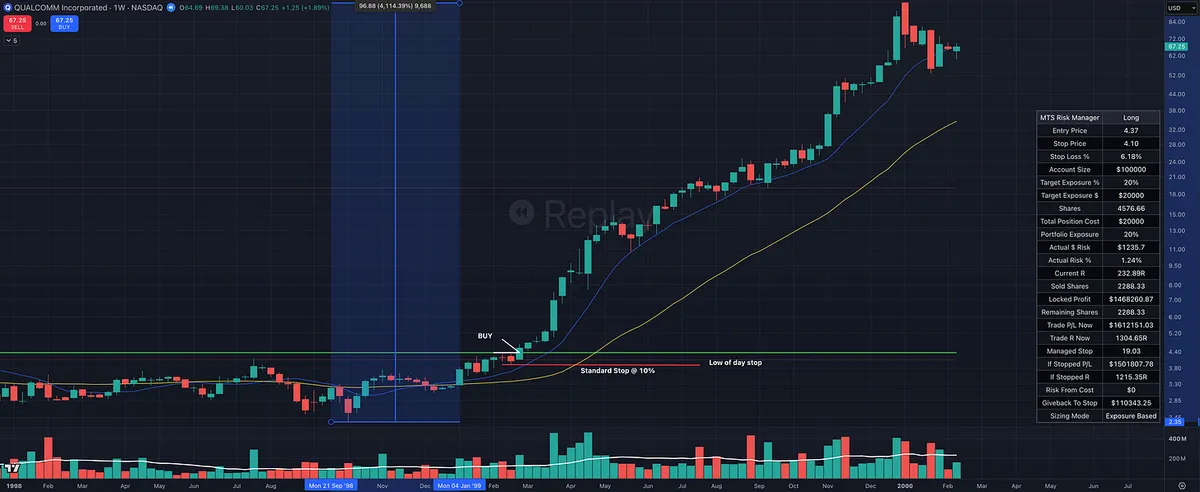
Pull up Qualcomm from 1999 and early 2000. The volatility was just as extreme, if not more.

That is why William O’Neil’s work remains so foundational.

The tickers change. The market does not, because human nature does not.
View on Substack ↗

I’ve received a lot of comments from people who believe today’s market is fundamentally different, that O’Neil did not trade stocks with this level of volatility, and that past leaders did not have comparable price swings, ADRs, or ATRs.

Qualcomm in 1999 directly challenges that assumption.

O’Neil absolutely traded highly volatile stocks during highly volatile market periods. The names, industries, and technology may change, but powerful leaders with wide price swings are NOT new.

I added an important Qualcomm 1999 example to this post that I left out when I originally published it.

When I recreated O’Neil’s Qualcomm setup using historical data, I found that a stop below the most recent higher low would have been about 10.1%, outside his traditional 7% to 8% guideline.

But a stop at the low of the high-volume breakout day would have been roughly 6.2%, keeping the trade comfortably within O’Neil’s framework.

Qualcomm was highly volatile and still went on to produce an extraordinary advance. It is a strong reminder that fast-moving market leaders are not unique to today’s market.

The lesson is not that O’Neil ignored his rule. We do not know the exact stop he used. The lesson is that a more precise entry and stop location can sometimes allow you to participate in a volatile leader without accepting a wider stop loss.

I added all three Qualcomm charts and the full breakdown to the article. Take another look at the updated post.

ArticleDoes O’Neil’s 8% Stop Rule Still Work Today?