Momentum Trading Strategy

Notes

Short lessons on momentum trading, every day.

Every note from Substack, in one place: risk, setups, leading stocks, market conditions and the mindset behind them. Search them, browse by topic, or filter by stock.

Showing 381–400 of 1222 notes

View on Substack ↗

You Don’t Need Your Own Trading System Yet

I received a few comments from people who thought this contradicted something I have said before: every trader eventually needs to find their own way.

It does not.

What I am saying is that beginners can find enormous success by first learning and following someone else’s proven system as closely as possible.

Look at David Ryan.

Ryan learned directly from William O’Neil, worked as his assistant, and achieved extraordinary success applying O’Neil’s methodology. Decades later, Ryan said:

“I have never really deviated from the basic high-growth stock approach I’ve used since working at William O’Neil & Co.”

That is important because developing a completely original trading style is not a requirement.

Some traders eventually branch off, make adjustments, and develop a style that becomes distinctly their own. Others may continue trading the same proven methodology for their entire careers.

Both paths are legitimate.

The key distinction is that successful traders usually do not begin by changing rules they barely understand.

They first learn the system. They follow it. They gain experience across different market environments. They study their trades and understand why the rules exist.

Only then are they qualified to decide whether a change is actually an improvement.

Beginners often reverse that process.

They start with a proven strategy, immediately alter the entries, exits, filters, position sizing, and risk rules, and then blame the original system when their modified version fails.

They believe they are expressing their individual trading style. In reality, they may be removing the very components that gave the strategy positive expectancy.

There is nothing wrong with adapting a system, but every meaningful change creates a new version of that system, and that new version must be tested and validated.

You need to know whether it works over a meaningful sample of trades, across different market environments, and after accounting for losses, drawdowns, and execution mistakes.

Until you have that evidence, the modification is not an improvement. It is an unproven idea.

Many traders learned that lesson by blowing up accounts, suffering years of unnecessary losses, or abandoning strategies that would have worked if they had simply followed the rules.

You do not have to learn that lesson with your entire account.

Test your changes with small amounts of capital. Track the results. Compare them against the original system. Prove that the adjustment improves expectancy rather than merely making the strategy feel more comfortable.

Yes, every trader may eventually find their own way.

But that does not mean every trader must invent a new methodology.

For many traders, the smarter path is to first master a system that has already been proven to work.

Saying, “I trade my own way,” does not automatically make that way valid. A personal trading style is not a real edge simply because it feels natural or makes sense to you. Unless you have tracked it over a meaningful sample of trades, measured its expectancy, studied its drawdowns, and verified that it works across different market environments, you are not trading a proven personal system. You are trading an untested idea.

You may eventually adapt a proven methodology, or you may never need to, but do not use “finding your own way” to justify ignoring proven rules without doing the work required to prove that your changes actually work.
Quoting Momentum Trading StrategyMost Traders Are Using an Unproven System Without Realizing It Many beginner traders do not start with a real system at all. They trade what feels right, copy ideas they see online, combine random setups, or change rules before they fully understand them. Others begin with a proven system, but quickly start modifyin…
View on Substack ↗

Most Traders Are Using an Unproven System Without Realizing It

Many beginner traders do not start with a real system at all.

They trade what feels right, copy ideas they see online, combine random setups, or change rules before they fully understand them.

Others begin with a proven system, but quickly start modifying the entries, exits, filters, and risk rules.

There is nothing wrong with adapting a system to fit your own style. Many successful traders started with William O’Neil’s methodology and refined it over time.

But they spent years studying, testing, tracking results, and validating those changes.

Beginner traders often skip that work entirely.

They change the rules, never prove the new method has positive expectancy, and then wonder why they are not finding success.

If you are not willing to put in the work required to build and validate your own system, you are probably better off mastering one that has already been proven to work.

William O’Neil’s CAN SLIM system is one I highly recommend.

View on Substack ↗

The Juice Isn't Always Worth the Squeeze

One of the biggest mistakes traders make is believing they always need to be trading.

Nothing works in every market environment all of the time. The key is recognizing what type of environment you're in and adapting accordingly.

Can you still find trades in difficult markets? Absolutely. There are almost always opportunities, and I've made money in environments like this before. But they're harder to find, there are fewer of them, and the probabilities are simply lower.

That's exactly why I spent this week in the Appalachian Mountains with my wife and four kids. Stepping away didn't hurt my portfolio one bit.

After a great few months, there was no reason to fight the market just to stay busy. That reminded me of an old saying:

The juice isn't always worth the squeeze.

If you took advantage of the favorable environment when the odds were in your favor, you don't need to force trades now.

Sometimes the highest-probability decision is to hold cash, protect your gains, and wait for the market to confirm a healthier environment with genuine leadership.

The market will still be there.

View on Substack ↗

The Best Traders Are Not Chasing What Is Working Today

The best traders and investors across every style have one thing in common.

They have dedicated themselves to a strategy.

They are not constantly abandoning their approach to chase whatever has performed best over the past few months.

Value investors do not suddenly become growth investors because growth stocks are leading.

Growth investors do not suddenly become value investors because defensive stocks are holding up better.

Trend followers do not become bottom fishers every time the market pulls back.

They understand something most newer traders completely miss.

No strategy works in every market environment all of the time.

Dr. Van Tharp emphasized this repeatedly. Every trading system performs differently depending on the market environment.

A strategy built for strong, trending markets will often struggle during sideways, rotational, or highly volatile periods.

That does not automatically mean the strategy is broken.

It may simply mean the current environment is not providing the conditions the strategy was designed to exploit.

Most traders never stay with one approach long enough to understand this.

They use a strategy during the wrong environment, experience a difficult stretch, assume it no longer works, and jump to the next shiny object.

Then they repeat the same cycle again.

They are always learning something new, but never mastering anything.

The goal is not to find a strategy that works perfectly in every environment.

That strategy does not exist.

The goal is to understand your strategy deeply enough to know when conditions are favorable, when to press harder, when to reduce exposure, and when to protect your capital.

Mastery comes from dedication, repetition, review, and adaptation.

Not constant reinvention.

The traders who survive long enough to become great usually stop searching for the perfect strategy.

They commit to a proven one and learn exactly when it should be used.

View on Substack ↗

Experience Can Make You Worse at Trading

Most traders assume that more years in the market automatically means more skill.

It doesn’t always.

William O’Neil warned that “experience is harmful if it continuously reinforces your bad habits.”

Read that again.

If you never seriously review your entries, exits, losses, position sizes, missed trades, and broken rules, you are not gaining experience.

You are likely repeating the same mistakes with more confidence.

You have probably spent hundreds of hours studying the greatest winning stocks.

But how many hours have you spent studying your own decisions?

A trader with two or three years of honest review can become far more dangerous than a trader with twenty years of repeating the same mistakes.

Your losses are only tuition when you actually learn from them.

Otherwise, you are just paying the same bill again.

There is a popular saying that insanity is doing the same thing over and over while expecting different results.

Don’t do that.

This is not a bureaucratic government job that promotes you based on time served.

The market does not pay you for experience.

It pays you for corrected experience.

View on Substack ↗

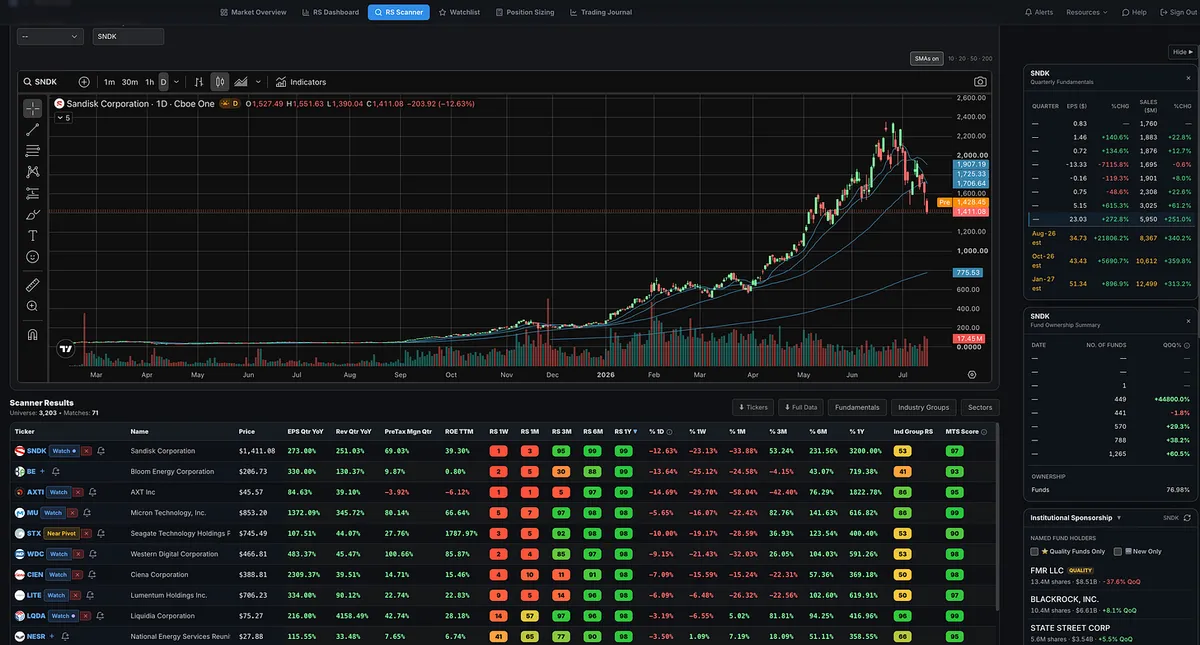
Leadership changes before most traders notice.

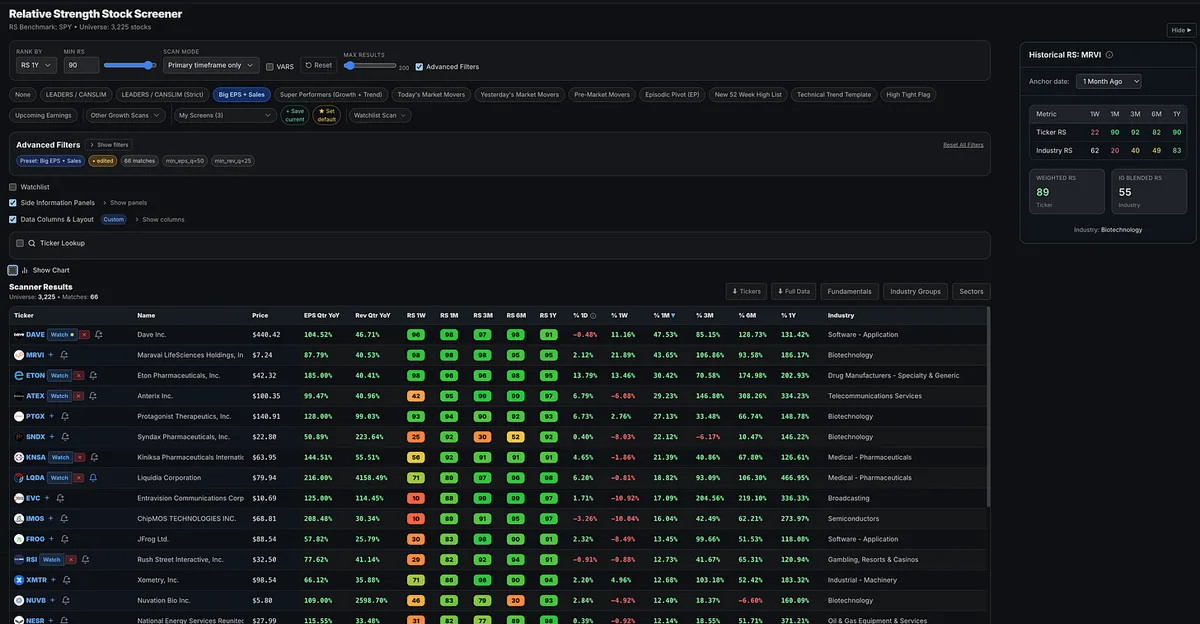
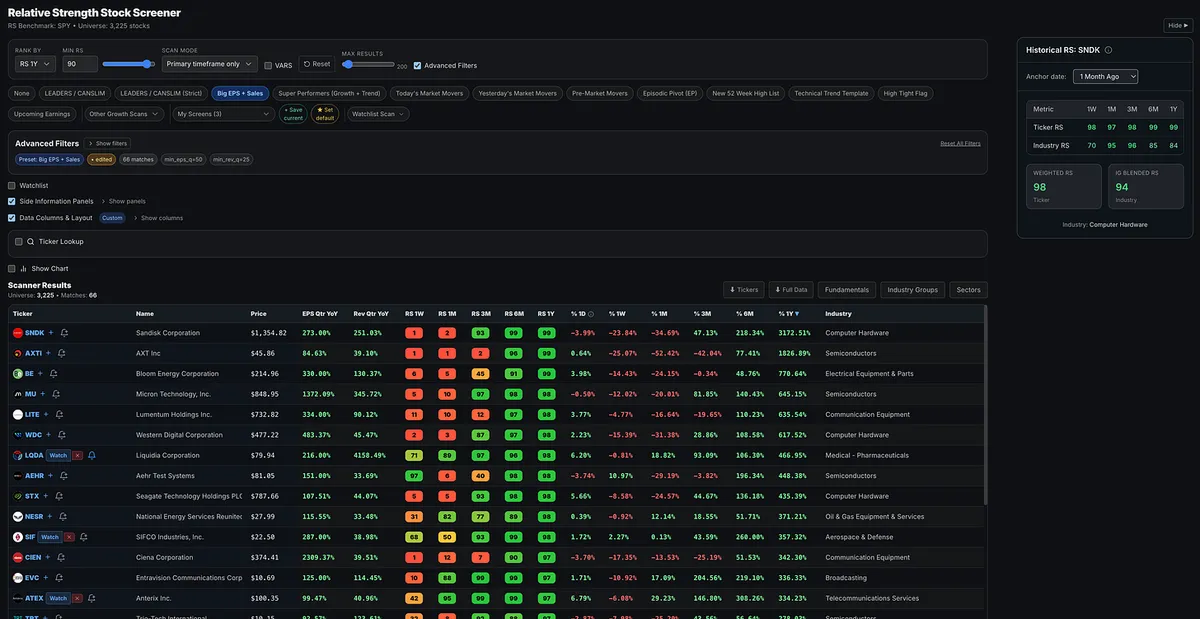
Run the Big Earnings and Big Sales screen, then compare one-year relative strength with one-month relative strength.

The shift is unmistakable.

Many of the stocks that dominated the last year still carry elite long-term RS ratings, but their short-term rankings have collapsed:

SNDK: 1yr RS = 99 / 1m RS = 2

AXTI: 99 to 1

MU: 98 to 10

WDC: 98 to 3

LITE: 98 to 10

CIEN: 97 to 12

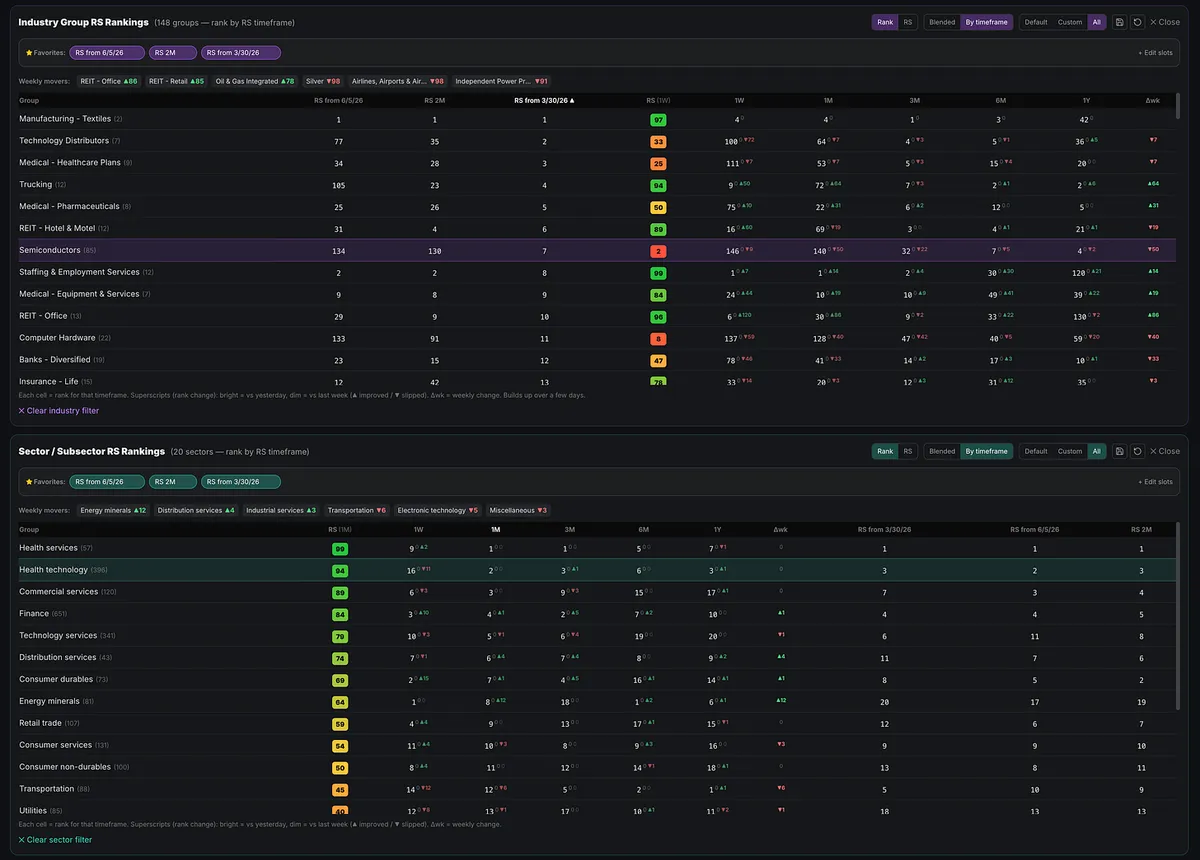
At the same time, biotechnology, pharmaceuticals, software, and other emerging groups are moving toward the top of the screen.

That is what leadership rotation looks like in real time.

The market doesn’t send a memo. It leaves clues in relative strength, and industry-group rankings.

View on Substack ↗

Before you zoom in on individual stocks, zoom out on the market.

There is a reason William O’Neil put the M in CAN SLIM.

There is also a reason traders as different as Paul Tudor Jones, Bruce Kovner, Michael Marcus, David Ryan, and Marty Schwartz studied, followed, or deeply respected Martin Zweig’s work.

Even the best short-term traders understood that individual setups do not exist in a vacuum.

Market direction and Industry-group leadership matters. Liquidity, rates, breadth, momentum, and institutional behavior matter.

O’Neil emphasized buying leading stocks in leading groups. Nicholas Darvas understood the same principle decades earlier.

So before opening the stock screener and planning this week’s trades, take a few minutes to study the bigger picture.

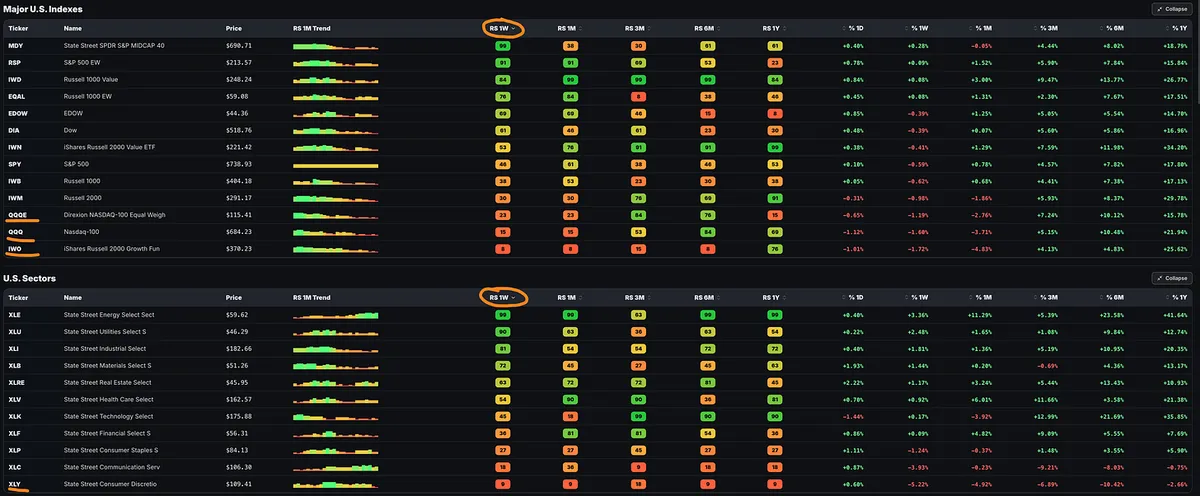
This week’s Big Picture Market Pulse examines the major destruction across former leading growth stocks and industry groups, the rotation in the indexes, and the impact on growth stock investors and momentum traders.

Zoom out before you zoom in.

https://tradingmomentum.substack.com/p/major-destruction-across-leading

On SubstackBig Picture Market Pulse | July 19, 2026: Major Destruction Across Leading Industry Groups and Growth Stocks
View on Substack ↗

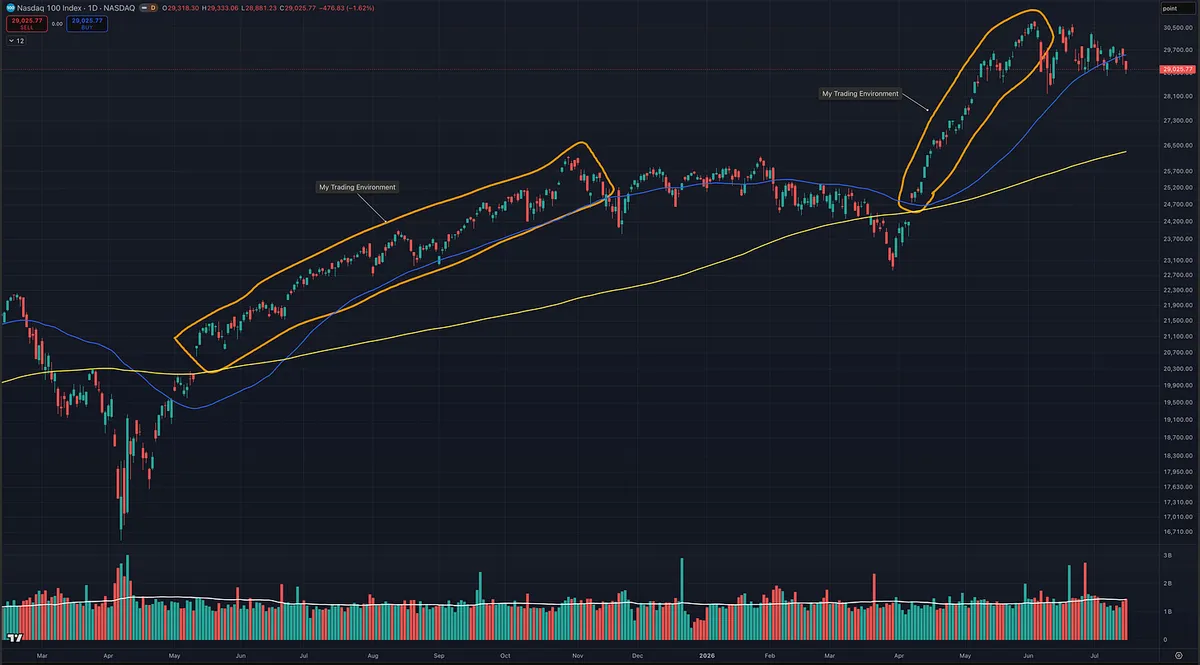
Why Some Traders Panic During Market Pullbacks

If you are freaking out during market pullbacks, corrections, or bear markets, or constantly trying to force trades to work in those environments, it may be because you missed the market move when conditions were actually good.

I have written and talked about this several times.

The market climbs a wall of worry.

The best opportunities often appear while most people are still nervous, skeptical, or waiting for everything to feel safe.

By the time everyone finally starts getting bullish, the trend is often much closer to the end than the beginning.

If you participated in April and May into early June, you should not care much about what the market is doing right now.

You participated when conditions were favorable. Now you can protect your gains, reduce exposure, and patiently wait for the next proper opportunity.

As growth stock investors, we are trend followers.

We are not trying to buy the exact bottom, sell the exact top, or predict every market turn.

We are trying to capture the middle meat of the move, which is often the most profitable portion.

That may sound like we are simply following everyone else, but we are not.

Most people do not participate when they should.

They hesitate while conditions are improving, finally become confident after the move is obvious, and then begin forcing trades because they feel like they missed out.

The answer is not to chase harder.

Participate when conditions are favorable.

Protect your capital when they deteriorate.

Then remain patient until the market gives you another proper opportunity.

View on Substack ↗

There Is No Shortcut to Becoming a Better Trader

I get a lot of trading questions, and I can usually tell who has built a real foundation and who is trying to learn everything from short videos, alerts, and scattered articles.

That is one of the reasons I created the Momentum Trading Strategy Course.

But you still have to do the work.

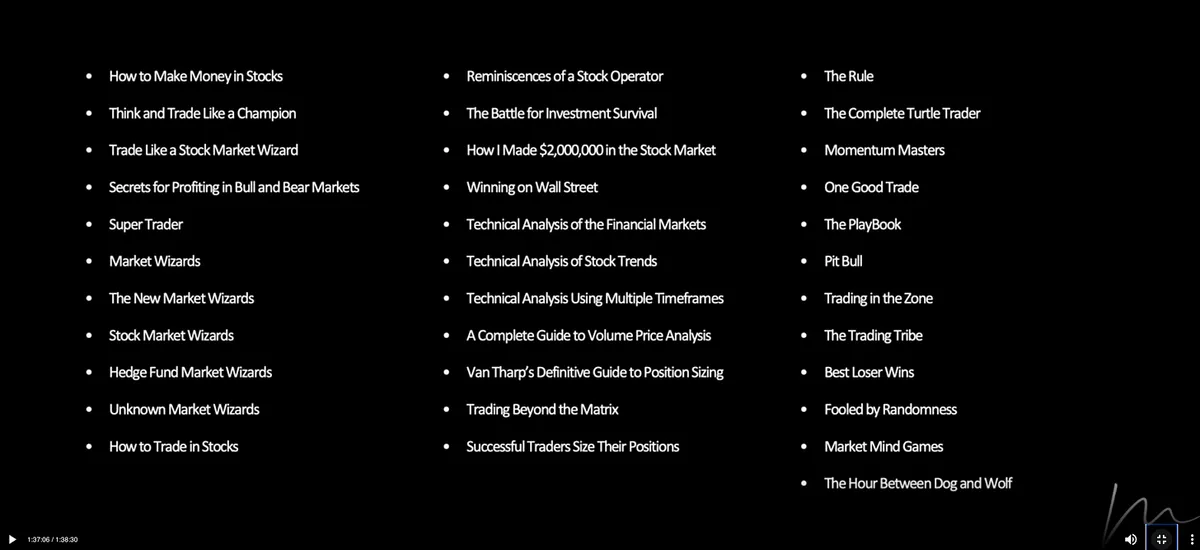
You have to watch the two and three hour lessons. You have to read the great trading books several times. I cannot remember how many times I have read William O’Neil’s How to Make Money in Stocks, and I still continuously review it like a user manual.

That foundation is what makes shorter-form content useful. You can connect each takeaway to a larger process instead of simply collecting random tips.

I was fortunate enough to take a course that cost around $5,000 and use software that cost roughly $150 per month. Many traders are not in a position to do that, so I created a more affordable course covering many of the same foundational concepts, along with software that provides many of the same capabilities.

I did not create another alert service because alerts did not help me achieve long-term success. I have also never heard a Market Wizard say that blindly following someone else’s trades is the path to becoming a great trader.

Momentum Trading Strategy is not here to replace William O’Neil, Mark Minervini, great trading books, or any other legitimate resource.

It is here to add to them.

I do not believe there is one book, one course, or one mentor that will take you to the level you want.

The good news is that everything stacks.

The hard truth is that there is no shortcut.

View on Substack ↗

The Traders Who Can't Lose Will Never Win

"I've missed more than 9,000 shots in my career."

- Michael Jordan

Michael Jordan didn't become one of the greatest athletes of all time because he avoided failure. He became great because he was willing to keep taking the next shot after missing the last one.

Trading is no different.

One of the hardest psychological hurdles for new traders is accepting that losing is part of the profession. They expect a good strategy to produce mostly winners. Then reality arrives. Even exceptional trading systems can generate long strings of losing trades.

That is why Tom Hougaard titled his book Best Loser Wins.

The best traders are not the people who avoid losses. They are the people who have conditioned themselves to handle losses without losing confidence, discipline, or the willingness to execute the next valid setup.

Think about the greatest athletes.

A player misses several times in a row. The crowd starts groaning. Social media piles on. Commentators question their decisions.

The elite players still want the ball.

They trust the process that made them successful over thousands of attempts, not the outcome of the last few possessions or games.

Great traders think the same way.

They know a losing trade says very little about the quality of their edge. Their focus is on executing a strategy with positive expectancy over hundreds of trades, not judging themselves by the last one.

If every loss feels personal, you'll hesitate on the next entry.

If you hesitate on the next entry, you'll eventually miss the handful of trades that produce the majority of your returns.

Your goal is not to become someone who never loses.

Your goal is to become someone who can lose repeatedly without losing discipline.

Condition yourself to be wrong often.

Execute anyway.

This is also why position sizing is so important. Proper position sizing keeps any single loss from doing enough financial or emotional damage to prevent you from taking the next valid setup.

It allows you to keep taking the shot.

Because just like Michael Jordan had to keep shooting after a miss, every great trader must be able to keep executing after a loss.

View on Substack ↗

The Best Trades Usually Don't Give You Much Time to Doubt

Have you ever noticed that your biggest winners often seem to work almost immediately?

That's not just your imagination.

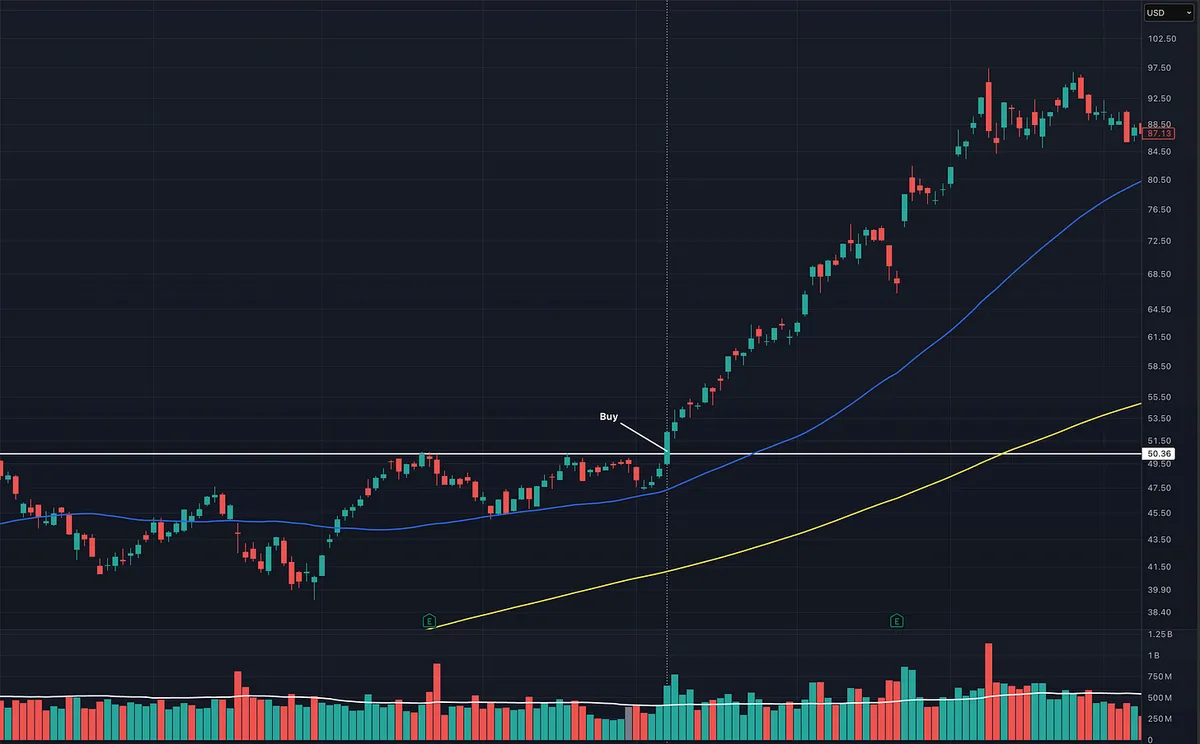
William O'Neil, David Ryan, and Mark Minervini all studied their greatest winning trades and reached a similar conclusion. The vast majority moved in their favor almost immediately after the breakout. A few came back to test the entry, but most simply took off and never looked back.

What's interesting is that Peter Brandt, a classical chartist who trades differently and focuses primarily on commodities rather than growth stocks or fundamentals, arrived at the same conclusion after decades of reviewing his own results.

He found that roughly 20% of his trades produced the majority of his profits. And those exceptional trades? Most never looked back after entry. Only a small percentage returned to test the breakout.

  • Different markets.

  • Different strategies.

  • Different decades.

  • The same lesson.

The biggest winners often tell you they're winners early.

That's why these legendary traders all preach the same principle:

Cut your losses quickly and keep them small. Then give your winners the time and space to become exceptional.

The next monster winner probably won't spend much time asking for your permission. It will simply go.

View on Substack ↗

One of the biggest mistakes traders make isn’t buying the wrong stock.

It’s becoming emotionally attached to an idea.

Eventually, what began as an investment thesis becomes part of your identity.

You see it everywhere:

  • Gold bugs.

  • Tesla loyalists.

  • Bitcoin maximalists.

  • Crypto communities.

The asset doesn’t matter. The psychological mistake is always the same: people stop evaluating the evidence and start defending the belief.

Legendary traders like Stanley Druckenmiller and Paul Tudor Jones have spoken about this for years. They can research an idea, build enormous conviction, and expect it to play out over the next 18 months, then exit days or weeks later when the evidence changes.

The best traders didn’t survive because they were always right.

They survived because they knew when to change their minds.

Strong opinions. Weakly held.

View on Substack ↗

What Leader Is Still Standing?

The market looks ugly, but the individual stock scans may look even worse.

Many of the leading stocks from the past year have suffered meaningful technical breakdowns. With SNDK now confirming its breakdown below the 50-day moving average, it joins MU, STX, WDC, and a growing list of former leaders that have lost important support.

Since the market set its low on March 30 and began a new Stage 2 uptrend, which leaders are actually still standing?

Post a chart of a leading stock in a leading industry group that has not suffered a meaningful technical breakdown. Let’s see which former leaders are still holding up, if there are any.

View on Substack ↗

Finding Episodic Pivots

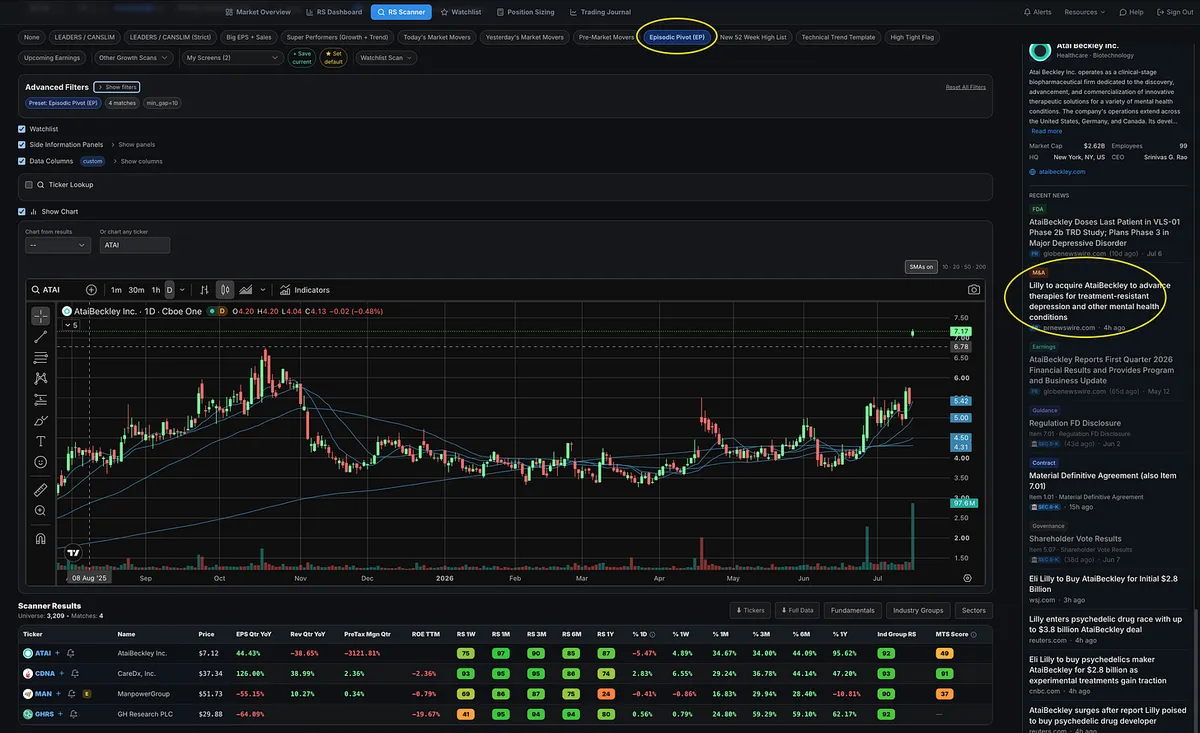
For those who like to track episodic pivots, simply select the EP preset filter and check it each day. There are usually only a handful of stocks to review, making it easy to identify potential opportunities without searching through thousands of names.

For example, ATAI recently appeared in the EP scan. From there, you can scroll down to the Ticker Info & News panel to review the latest headlines and quickly identify the catalyst behind the move, whether it is earnings, a major company announcement, or another significant event.

In ATAI’s case, the catalyst was the announcement that LLY would acquire the company.

View on Substack ↗

The Outliers Are the Edge

I saw someone suggest removing the few percent of trades from a backtest. Their argument was that if the strategy falls apart, then a few lucky outliers were carrying the entire equity curve, and that is not something they want to see.

That test may fit their style. It can also be a useful way to understand how dependent a strategy is on its largest winners, but for many growth stock investors, momentum traders, and trend followers, those outliers are exactly what the strategy is designed to capture.

The strategy is asymmetric by design:

Many small losses. Plenty of scratches. Some modest winners and a small number of exceptional trades that drive a large portion of the long-term returns.

The goal is not to predict which trade will become a 10R, 20R, or even larger winner. The goal is to control risk on every trade, remain consistent, and stay positioned long enough to capture those rare moves when they appear.

A strategy that depends on a few major winners is not automatically the result of luck. When a disciplined process repeatedly captures outlier winners across a meaningful number of trades, different market environments, and many years, those winners are evidence of how the edge expresses itself.

They are not separate from the edge. They are the edge.

The broader principle runs through the approaches associated with traders and investors such as Stanley Druckenmiller, Mark Minervini, William O’Neil, and many of the Market Wizards: protect capital, cut losses, and allow exceptional opportunities to make a meaningful difference.

That is exactly how an asymmetric strategy is supposed to work. The outlier winners are not flaws in the system. They are the payoff the system is designed to capture. When the process produces them repeatedly across years, that is not merely luck. That is the edge.

View on Substack ↗

You Can Lead a Trader to the Truth, but You Can’t Make Them Follow It

You have probably heard the saying:

You can lead a horse to water, but you cannot force it to drink.

That definitely applies to trading and investing.

  • You can teach someone the importance of cutting losses.

  • You can explain position sizing, risk management, expectancy, and the dangers of overtrading.

  • You can give them a proven strategy, specific rules, historical examples, and lessons from some of the greatest traders who ever lived.

But you cannot force them to follow any of it.

Richard Dennis, one of the greatest traders featured in Market Wizards, understood this perfectly:

“I always say that you could publish trading rules in the newspaper and no one would follow them.”

That is the uncomfortable truth.

Many traders do not fail because the information was unavailable.

  • They fail because they refuse to consistently do what the information requires.

  • They want the winning stocks without the discipline.

  • They want the returns without accepting the losses.

  • They want the confidence without putting in the work.

The market can teach you the same lesson repeatedly, but eventually, you must decide whether you are actually going to learn it.

The knowledge is available.

The rules are available.

The water is right in front of you.

But nobody can make you drink.

View on Substack ↗

You Can Be Right About the Market and Still Lose Money

Everybody gravitates toward the person on social media who seems to make the best calls.

They called the breakout.

They predicted the selloff.

They posted the winner before it ran.

So naturally, people assume that person must be a great trader.

But correctly predicting whether a stock or the market will go up or down is not what ultimately determines whether you make money.

The market does not pay you for being right.

It pays you for how much you make when you are right, how little you lose when you are wrong, how you size your positions, and how consistently you execute a process with positive expectancy.

Many highly successful traders have win rates below 50%. Some operate with win rates in the 20% to 35% range.

They are wrong more often than they are right, yet they still extract enormous amounts of money from the market.

On social media, their results might look terrible.

They may post several losing trades in a row, get criticized for being wrong, and have people question whether they know what they are doing.

Some successful traders deal with this constantly because many of their critics simply do not understand expectancy.

Meanwhile, a trader can be right 70% of the time and still lose money.

Amateurs obsess over predictions because predictions are visible, exciting, and easy to understand.

Experienced traders focus on expectancy, risk management, position sizing, and executing favorable risk-to-reward opportunities because those are the things that determine whether they survive and become profitable.

Once you understand this, you begin separating yourself from the majority.

The majority are searching for someone who can tell them what will happen next, even though predictions alone will never teach them how to make money consistently or keep it over the long run.

The minority are executing a process that makes money without needing to be right most of the time.

Become the minority.

View on Substack ↗

Three New Research Panels Are Now Live

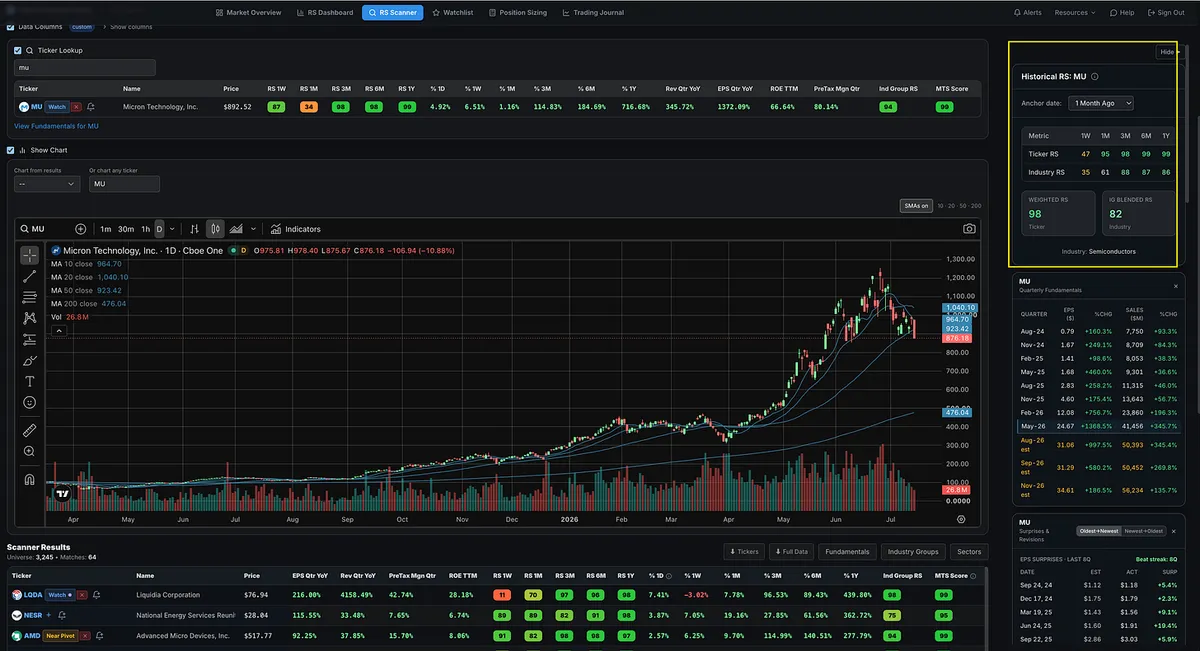
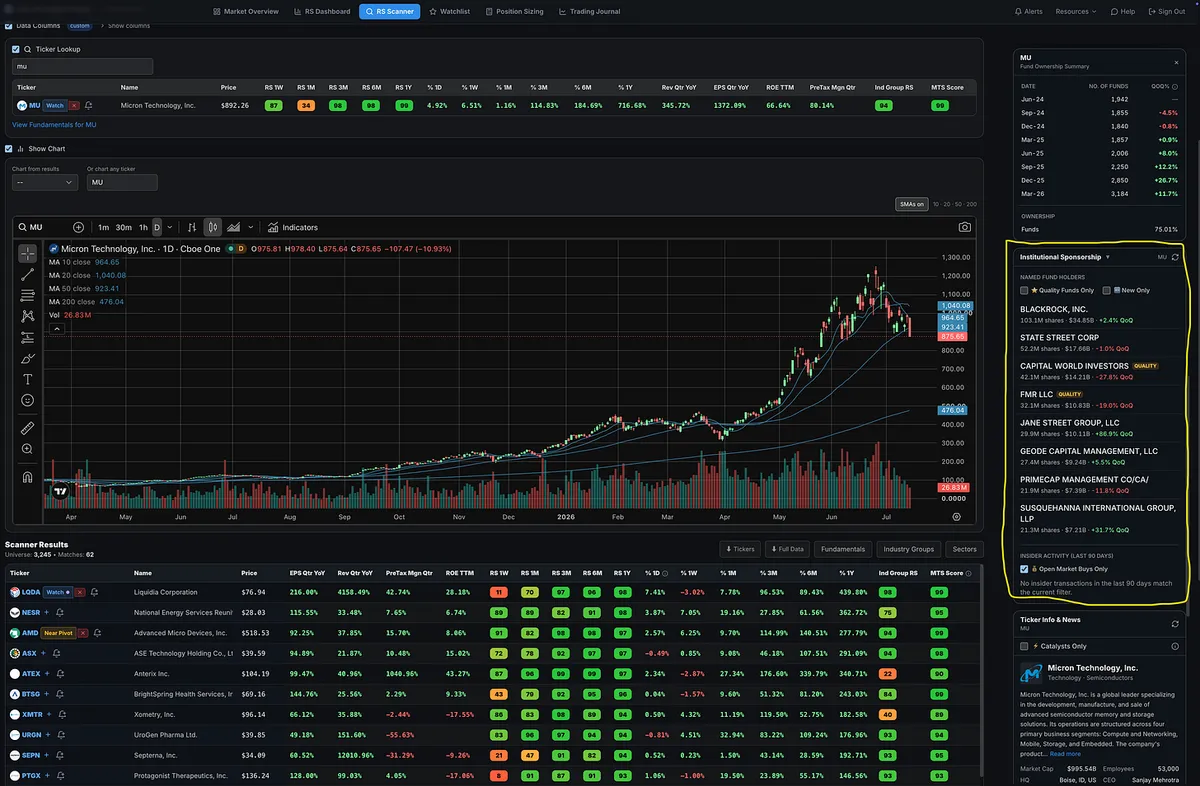
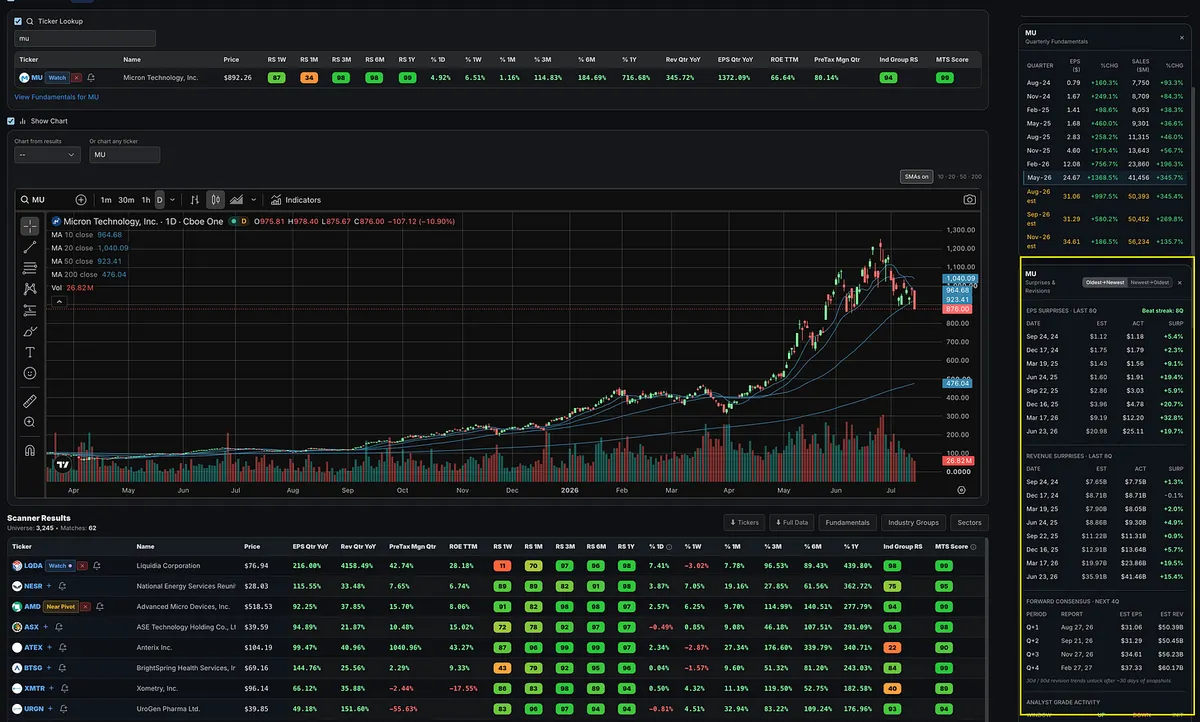
We added three new side panels to the Momentum Trading Strategy software this week: Historical RS, Institutional Sponsorship, and Surprises & Revisions.

Each panel is designed to provide an additional layer of research beyond the headline earnings, sales, relative strength, and fund ownership numbers you already see in the scanner.

Historical RS

The Relative Strength readings currently displayed in the software show a stock’s performance ending today.

For example, the one-month RS measures relative performance over the month ending today. The three-month RS measures the three months ending today, and the same applies to the one-week, six-month, and one-year readings.

The new Historical RS panel allows you to change the anchor date and see what those readings looked like at an earlier point in time.

For example, you can select one year ago and see what the stock’s one-month, three-month, six-month, and one-year RS readings were as of that date. You could also go back six months and see what the three-month RS looked like at that specific point.

The panel also displays the stock’s Weighted RS score, its Industry Group Blended RS score, and the company’s industry.

Institutional Sponsorship

We already displayed quarterly fund ownership, including the number of funds holding a stock and the quarter-over-quarter percentage change.

That allows you to see whether institutional ownership has been increasing or decreasing over several quarters.

The new Institutional Sponsorship panel takes the research one level deeper by showing the specific institutions involved in the stock.

O’Neil explained that it is not enough to know how many institutions own a company. Investors should also examine which institutions are involved, whether better-performing funds are participating, whether those funds have recently established positions, and whether the overall number of sponsors is increasing.

The panel gives you a clearer view of who is behind the ownership numbers and provides a starting point for evaluating the quality of that sponsorship.

A recognizable fund name does not automatically make the sponsorship high quality, but seeing the specific institutions involved gives you considerably more information than the fund count alone.

Surprises & Revisions

Strong quarterly earnings and sales growth remain the primary fundamental numbers we care about.

However, O’Neil also discussed the value of tracking earnings surprises and changes in analyst estimates as a secondary layer of research.

The new Surprises & Revisions panel displays earnings surprises, sales surprises, estimate revisions, and recent analyst upgrade and downgrade activity.

Some of the market’s strongest growth stocks can repeatedly report results well above expectations while analysts continue raising their future estimates. We saw this in names such as MU and SNDK during their strongest periods of earnings and sales growth.

That combination can help identify a company whose business is improving faster than the market originally expected.

Analyst upgrades and downgrades are also included because an unexpected change in opinion can sometimes act as a short-term news catalyst. However, these ratings should never be treated as standalone buy or sell signals. O’Neil repeatedly warned against blindly following analyst recommendations.

These panels do not replace the primary work of studying the chart, earnings and sales growth, price action, market direction, industry-group leadership, and the primary CAN SLIM criteria.

They simply give you more ways to dig beneath the surface and better understand the companies you are researching.

View on Substack ↗

The Most Important Part of Trading Is the Part Nobody Wants to Study

Paul Tudor Jones described the trading process in five parts:

  1. Analysis

  2. Instrument selection

  3. Position sizing

  4. Execution

  5. Risk management

Stanley Druckenmiller was then asked what separated him from other traders across those five areas.

His answer was position sizing.

Not analysis. Not stock selection. Not execution.

Position sizing.

This is why I have written articles and created videos about it. It is why I cover it extensively in Module 6, Risk Management, of the Momentum Trading Strategy course.

It is also why I developed the Optimal Sizing Calculator and added Dr. Van Tharp’s Marble Game to the Momentum Trading Strategy software. You can run countless simulations using different trading strategies to see how position sizing changes the final outcome.

You can even play against other people. Everyone receives the exact same trades, entries, stops, winners, and losers. The only difference is how much each person chooses to risk before every trade.

Some produce Market Wizard-type performance. Some finish flat. Others blow up their accounts.

Same trades. Completely different results.

Use these resources, and study books such as Dr. Van Tharp’s The Definitive Guide to Position Sizing Strategies.

Spend some time learning the part of trading nobody wants to study.