Momentum Trading Strategy

Notes

Short lessons on momentum trading, every day.

Every note from Substack, in one place: risk, setups, leading stocks, market conditions and the mindset behind them. Search them, browse by topic, or filter by stock.

Showing 881–900 of 1230 notes

View on Substack ↗

How Mark Minervini Buys After a Big Run

Minervini calls it tennis ball action.

It shows up after a stock has already made a strong advance.

Price runs.

It pulls back.

Volatility contracts.

Tight price action forms.

Like a tennis ball forced underwater and then let go. It shoots up.

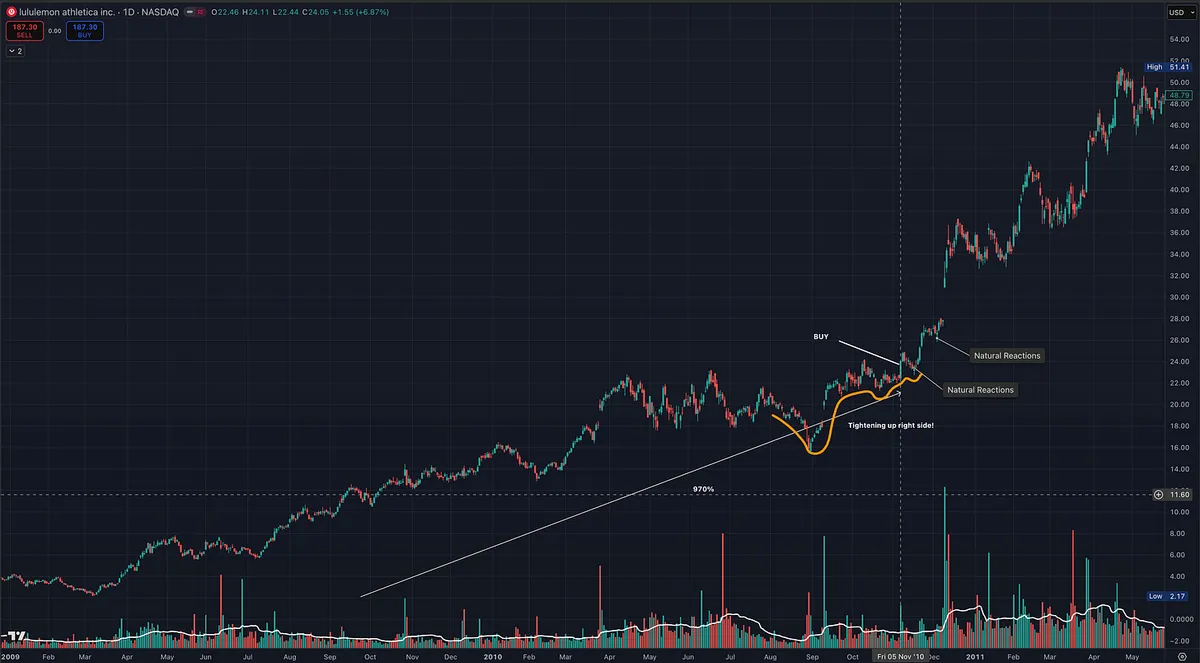
In LULU 2010, the key was the tightening on the right side of the base.

Pullbacks became smaller. Volume dried up.

That tells you supply is being absorbed.

The buy came after:

• Higher lows

• Clear volatility contraction

• Expansion higher on powerful volume

The edge was recognizing the compression before the move.

Study the right side of bases in leading stocks.

View on Substack ↗

Most Traders Do Not Have a Contingency Plan

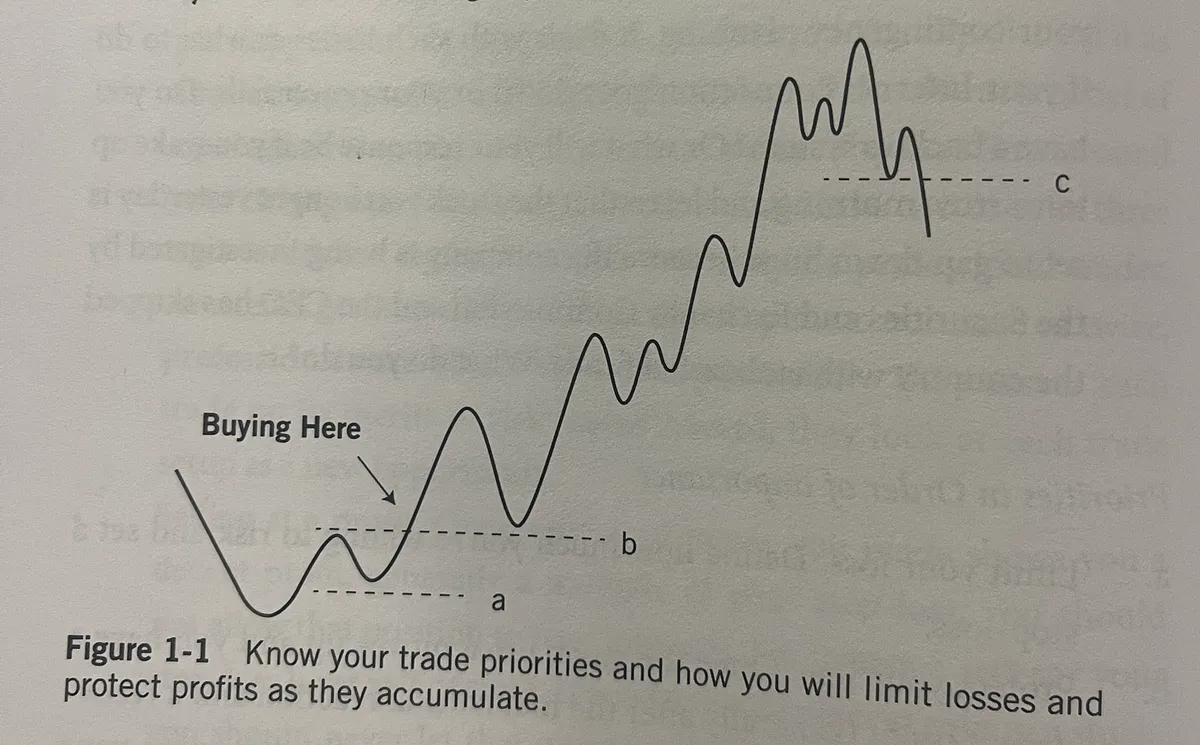
When you enter a trade, do you know exactly what you will do if you are wrong?

Not roughly. Exactly.

Always go in with a plan.

Before you enter, you must define:

• Your entry

• Your stop

• Your dollar risk

• Your position size

• How you will manage the trade

• How you will sell into strength

• What invalidates the setup

• Your disaster plan

• Your reentry criteria

If you cannot answer those six questions, you are not trading.

You are reacting emotionally.

Good trading requires preparation, just like any other professional discipline.

Risk first thinking changes everything. The first question is not how much you can make. The first question is how much you will lose if you are wrong.

Position sizing is essential because we do not argue with the chart. Price reflects supply and demand. Your stop belongs below support or at the level that proves you are wrong.

Without proper position sizing, you either:

• Place stops based on arbitrary percentages

• Risk more than your tolerance allows

• Or move stops when pressure builds

Position sizing allows you to keep losses small and controlled.

Small losses preserve confidence. Large losses create trauma.

Contingency planning is what professionals do.

You do not rise to the level of your ambition. You fall to the level of your preparation.

Many of you are not treating trading like a business and then wondering why you do not have consistent results.

Study what great traders did. Focus on their preparation and planning, not just their returns.

The market rewards preparation.

View on Substack ↗

Build Your Own Playbook

Most traders show up every day reacting.

Professionals show up prepared.

In The PlayBook, Mike Bellafiore makes a simple but powerful point: elite traders know their best setups. They catalog them. They study them. They build a personal playbook of trades that work for them.

Not someone else. For them.

A PlayBook is not theory. It is evidence.

It answers:

  • What setups produce my biggest gains?

  • What market conditions suit my style?

  • Where do I consistently lose money?

  • When should I press?

  • When should I sit out?

Instead of chasing random opportunities, the professional waits for their A+ setup.

They know:

  • The entry trigger

  • The risk level

  • The add point

  • The exit plan

And when the setup appears, they size appropriately.

Most traders fail because they trade everything.

Professionals succeed because they trade selectively.

Your job is not to trade more.

Your job is to build proof.

Review your best trades from the last 12 months. Find the pattern. Define the setup. Write the rules. Repeat it until it becomes automatic.

Your edge is not hidden in a new indicator.

It is hidden in your data.

Build your PlayBook.

View on Substack ↗

The Fastest Way to Build an Edge Is to Borrow One

Zoom out 100 years and you see a pattern.

The greats did not reinvent trading. They modeled it. Refined it. Executed it.

Livermore mastered price and the big swing.

Loeb made survival the first objective.

O’Neil turned those lessons into a technical and fundamental framework. Minervini and Zanger refined the execution with precision and structured risk.

Different decades. Different tools. Same blueprint.

Do not waste years trying to figure it out from scratch.

Stand on proven shoulders.

Study the greats. Apply the principles. Build your rules. Execute consistently. Refine over time.

Livermore taught us the power of reading the tape. Loeb taught us the importance of protecting our capital. O’Neil gave us a technical and fundamental framework to identify true leaders. Minervini expanded those teachings into precision, timing, and structured risk.

Many of the great traders of today built their careers on that foundation.

Why not you?

View on Substack ↗

Survival Before Performance

Most traders focus on making money.

Gerald Loeb focused on survival.

He made that clear in The Battle for Investment Survival when he wrote that the reader should understand “the hazards of preserving capital and why the book is entitled, The Battle for Investment Survival”.

Loeb framed investing as a battle. Capital must be defended first. Without capital, there is no opportunity to compound.

William O’Neil carried that lesson forward.

In How to Make Money in Stocks, O’Neil recounts discussing loss cutting directly with Loeb:

“In his first work, The Battle for Investment Survival, Loeb advocated cutting all losses at 10%. I was curious and asked him if he always followed the 10% loss policy himself. ‘I would hope,’ he replied, ‘to be out long before they ever reach 10%.’ Loeb made millions in the market.”

That exchange is foundational.

Loeb emphasized survival. O’Neil refined it.

O’Neil tightened the rule even further:

“Always, without Exception, Limit Losses to 7% or 8% of Your Cost.”

This is not defensive thinking. It is offensive discipline.

Loeb warned against reckless attempts to “make a killing,” noting that such efforts carry the same supercharged speed on the downside . O’Neil similarly teaches that holding big losses clouds judgment and prevents objective decision-making .

The connection between the two books is clear:

Preserve capital. Cut losses quickly. Let strength prove itself. Compound only when conditions are favorable.

Survival is not separate from performance.

Survival makes performance possible.

Protect capital first. Performance follows.

View on Substack ↗

Most Traders Track P&L. Pros Track MAE and MFE.

Everyone talks about returns.

Very few talk about what happened inside the trade.

That’s where MAE and MFE live.

MAE — Maximum Adverse Excursion

How far a trade went against you before it closed.

MFE — Maximum Favorable Excursion

How far a trade went in your favor before it closed.

These two numbers quietly expose everything.

A trade that closed +30% might have been down -30% first.

That tells you something about entry quality and risk control.

A trade that closed +10% might have been up +55% at one point.

That tells you something about exit logic.

Returns show outcomes.

Excursions show behavior.

If your average MAE is larger than your planned stop, that’s not market volatility. That’s process drift.

If your average MFE is consistently higher than what you capture, you may be cutting winners too quickly.

MAE protects capital.

MFE improves efficiency.

Track them for a month and you’ll learn more about your trading than from any single big win.

Full post soon on how to use all the key performance metrics together.

View on Substack ↗

Rotation Is Not the End. It Is the Reset.

Technology, software, and semiconductors led this bull market.

Now they are under pressure.

Distribution has shown up. Relative strength has cooled. Former leaders are correcting hard.

That is not abnormal.

It is exactly how bull markets mature.

O’Neil showed that industry leadership rotates, but powerful themes often resurface with new companies driving the advance. Innovation does not disappear. It shifts hands.

Minervini teaches that leaders top first, correct deeply, and later the strongest stocks rebuild proper Stage 2 bases before emerging again.

The key distinction:

Old leaders rarely reclaim leadership. Strong industry themes often do.

After extended advances, superperformance stocks frequently decline 50 percent or more. That decline is not the death of the group. It is the reset that clears weak hands and allows new accumulation.

The next tech advance will not be led by stocks trying to recover broken charts.

It will be led by:

New bases New earnings acceleration New relative strength leaders New institutional accumulation

This is normal cycle behavior.

Capital rotates out of extended leaders. Groups consolidate. New names rise from the same ecosystem.

Semiconductors led before. Software led before. They can lead again.

But leadership must be proven again through price, volume, and earnings.

That is the process.

And that process is what creates the next superperformance opportunity.

View on Substack ↗

Selective Participation > Constant Trading

Most traders grind all year.

The best returns often come from a few windows.

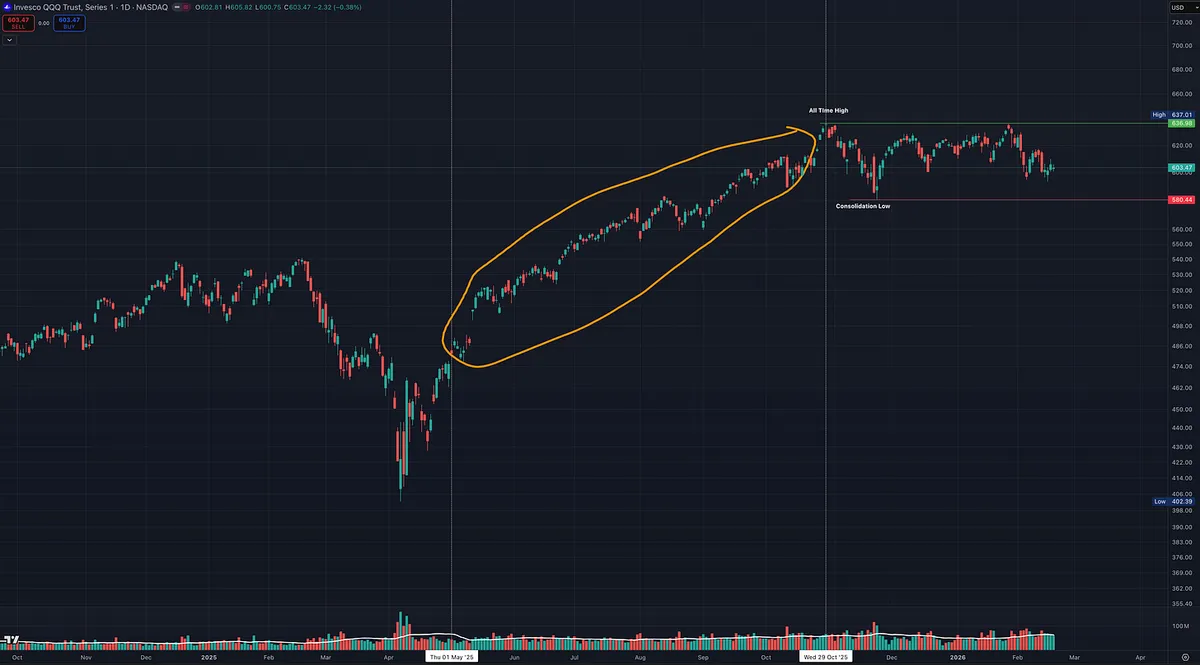
These charts are the proof.

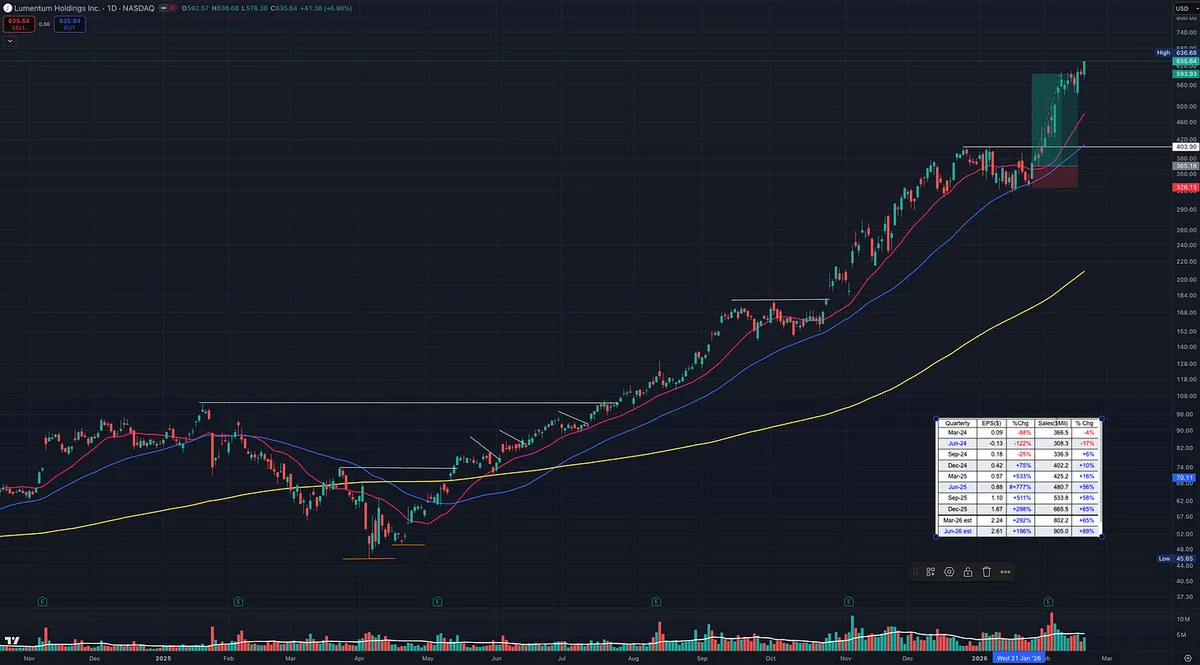
Look at the structure after the April flush:

  • Deep correction

  • Explosive move off the lows

  • Reclaim of key moving averages

  • Higher low

  • Breakout into expansion

  • Sustained trend above rising 20 / 50 / 200

The April flush looked horrible. It created immense fear.

Below the 200-day. Headlines negative. Sentiment weak.

But what actually happened?

QQQ made an explosive move off the lows right at prior major levels. It pulled back, set a higher low, and then accelerated.

That’s character change.

Leaders stopped breaking down. Pullbacks held. Breakouts followed through.

Even entries 15–20% off the lows worked because the environment improved and we got a reset.

From May through September, that move was enough to make the year.

Selective participation means:

Trade less during noise. Save capital for when it’s time to press.

Markets don’t distribute opportunity evenly.

They cluster it.

The edge isn’t trading more.

It’s trading when conditions are exceptional.

Why fight current conditions?

Wait.

We will get another great environment.

View on Substack ↗

The Dangerous Obsession With Win Rate

Be honest.

You feel better when you win often.

That’s why win rate feels important.

But the market doesn’t pay you for being right.

It pays you for asymmetric outcomes.

I just published a deep breakdown showing:

• Why 50% win rate can lose money

• Why 30% can outperform 70%

• How compounding explodes when winners are larger than losers

• Why controlling drawdowns is everything

With real numbers. Real math.

If you trade or invest, this is required reading.

https://tradingmomentum.substack.com/p/why-your-win-rate-is-lying-to-you

ArticleWhy Your Win Rate Is Lying to You
View on Substack ↗

You Don’t Need To Be An Analyst To Make Money In The Market

One of the biggest myths in investing is that you need to be a brilliant analyst to make money.

You don’t.

In fact, there is a reason many of the greatest traders were not traditional analysts.

And there is a reason many brilliant analysts never made consistent money.

In Market Wizards, Paul Tudor Jones makes it clear what matters most:

“Don’t focus on making money; focus on protecting what you have.”

Notice what that is not about.

It is not about forecasting GDP. It is not about dissecting balance sheets. It is not about predicting earnings five quarters out.

It is about risk.

Across Market Wizards, the common thread among the top traders is not analytical brilliance.

It is discipline.

It is risk control.

It is reacting to price.

Many of them openly admit they are not economists. They are not trying to predict the future. They are responding to what the market is doing now.

William O’Neil makes a similar distinction in How to Make Money in Stocks.

He emphasizes that the market is driven by institutional accumulation and supply and demand. The greatest winners are identified through price, volume, and earnings growth, not personal opinion or deep macro forecasts .

O’Neil built an entire system around this criteria.

Relative strength. Quarterly earnings acceleration. Industry group leadership. Chart patterns.

Not intellectual debate.

Mark Minervini reinforces this in Trade Like a Stock Market Wizard. His framework is not about predicting which company “should” succeed. It is about identifying when institutions are accumulating and managing risk with precision.

There is a subtle but critical difference between being an analyst and being a trader.

Analysts try to be right.

Professional traders try to manage risk.

Analysts often anchor to their thesis.

Professional traders anchor to price behavior.

Many of the brightest minds on Wall Street have produced extraordinary research and still failed to generate consistent returns.

Because analysis alone does not equal execution.

Execution requires:

Defined risk. Position sizing. Sell discipline. Adaptability.

You do not need to be the smartest analyst in the room.

You need to:

Identify institutional demand. Align with leadership. Cut losses quickly. Let winners run.

The market does not reward intelligence alone.

It rewards disciplined execution applied over time.

And that is why so many of the greatest market operators were not known for analysis.

They were known for managing money.

View on Substack ↗

Trade Your Biggest When You’re Trading Your Best

Most traders do the opposite of what they should.

They press when they are cold.

They hesitate when they are hot.

Professionals do the reverse.

When you are trading well, seeing the market clearly, executing cleanly, and building a cushion, that is when you can responsibly increase exposure.

When you are struggling, you cut back.

If you keep struggling, you cut back more.

If you are really off, you go to cash and step away.

This is not about ego.

It is about self-awareness.

You earn the right to trade bigger.

You lose that right when your performance deteriorates.

High conviction trades. A+ setups. Strong market tone. A cushion of profits behind you.

That is when size can increase.

But when you are out of sync, even good setups can fail in your hands.

That is your signal.

Reduce exposure.

Lower position size.

Simplify.

Zoom out.

Both O’Neil and Minervini emphasize capital preservation and staying aligned with market conditions. They stress that no setup works in all environments and that risk control is always first.

But here is the part nobody can give you:

No book can tell you exactly when to scale up.

No system can automatically tell you when to step back.

IBD cannot tell you.

I cannot tell you.

You have to develop the awareness to recognize when you are in sync and when you are not.

Because no strategy, no pattern, no edge works if the operator behind it lacks self-management.

This is a performance business.

Size is a privilege.

You build it through discipline.

And you protect it through restraint.

View on Substack ↗

Trading Is Like An Insurance Company…

An insurance company cannot predict which specific house will burn down this year.

But it can predict, with remarkable accuracy, how many houses out of 100,000 will burn down.

That is how it stays in business.

Trading works the same way.

You cannot predict with certainty which individual trade will become a huge winner.

You cannot know in advance which breakout will fail.

But over a large enough sample size, if you have a structured edge and controlled risk, you can predict that your system will produce positive expectancy.

Now here is the nuance.

We are not randomly insuring houses.

We are underwriting selectively.

When we see:

A powerful expansion in price on heavy volume. Followed by orderly contraction. Volatility tightening with volume drying up. Then a breakout on explosive demand. Combined with strong earnings, sales growth, and institutional sponsorship.

That is not random.

That is supply being absorbed.

That is institutions accumulating.

That is probability increasing.

In that sense, we are forecasting.

We are identifying conditions that historically precede large moves.

We are stacking the odds in our favor.

But we still operate with humility.

Even the cleanest VCP setup can fail.

Even the strongest CANSLIM characteristics can disappoint.

That is why we never base our performance or confidence on a single trade.

Insurance companies do not rely on one policy.

They rely on the law of large numbers.

Professional traders operate the same way.

Over hundreds or thousands of trades:

There will be small losses. There will be break-even trades. There will be modest winners. And occasionally, there will be outliers.

Those outliers drive performance.

You do not predict them with certainty.

You position for them with probability.

The goal is not to be right every time.

The goal is to consistently take high-quality setups where:

If you are wrong, the loss is small. If you are right, the upside can be significant.

That is not gambling.

That is asymmetric probability applied over time.

You increase the odds.

You control the downside.

And you let the math work in your favor.
View on Substack ↗

Why Most Traders Fail Before They Even Enter The Trade

Let me ask you something.

Before you enter a trade, do you know:

Exactly where you are wrong?

Exactly what you will do if stopped out?

Exactly how you will reenter if it resets? Exactly how you will sell into strength?

Exactly what happens if the market gaps against you?

If you hesitated on any of those, you are not trading.

You are hoping.

Mark Minervini makes this crystal clear in Trade Like a Stock Market Wizard:

“Before entering any trade, you should have a specific plan that includes your entry point, your initial stop-loss, your profit objective, and your contingency plan.”

That is the difference between professionals and amateurs.

Professionals operate on contingencies.

1. The Initial Stop Loss

The only certainty in a trade is risk.

Minervini defines the stop first. Position size is calculated from that stop. If the stock violates the level that invalidates the setup, you exit.

No debate. No emotion.

2. The Reentry Plan

Most traders make this mistake:

They get stopped out and emotionally discard the stock.

Minervini teaches that a failed breakout can reset into a new entry. A pivot failure does not always mean base failure.

If fundamentals remain intact and structure repairs itself, you reenter.

This is how you catch the move that makes your year.

3. Selling At A Profit

You do not sell because you are up.

You sell because the stock becomes extended, climactic, or abnormal.

You sell partial positions into strength.

You protect gains when character changes.

You let the remainder work.

4. The Disaster Plan

This is what separates serious traders from hobbyists.

What happens if the stock gaps below your stop?

What happens during a market event?

Minervini plans for that in advance.

Hope is not a strategy.

Contingencies are.

View on Substack ↗

Leadership Leaves Clues — Relative Strength Is One of Them

Relative Strength isn’t the whole story.

But it’s often the first clue that institutional money is moving in.

William O’Neil’s research into the greatest stock market winners showed that leading stocks typically displayed superior relative price strength before their biggest advances .

Not after.

Before.

Mark Minervini builds on that same principle, focusing on stocks already outperforming the market and making new highs before they emerge from proper bases .

Relative Strength doesn’t replace:

• Earnings growth

• Proper structure

• Risk management

But it narrows the field to potential leaders.

And in a market with thousands of stocks, narrowing the field correctly is an edge.

I just released a full breakdown of how I use Relative Strength, along with the Relative Strength Stock Screener available to paid subscribers.

Read the full post and watch the walkthrough below.

https://tradingmomentum.substack.com/p/the-relative-strength-screener-just

On SubstackThe Relative Strength Screener Just Leveled Up
View on Substack ↗

The Only Thing You Control In A Trade

I am always surprised by how much emphasis traders place on price targets.

It is one of the clearest signs of inexperience.

The only thing that is certain in any trade is how much you are willing to lose.

Everything else is speculation.

William O’Neil built an entire system around cutting losses quickly. He was clear that you must always know where you are wrong before you enter a trade. Protecting capital is not optional. It is foundational.

Mark Minervini reinforces this in Trade Like a Stock Market Wizard. Risk is defined first. Position size is calculated from the stop. Expectancy is built over a large sample of trades.

Neither of them teach predicting how far a stock will go.

Because you cannot know.

Anyone who has traded long enough understands this reality:

Some stocks you expect to be huge winners fail.

Some trades you had modest expectations for become extraordinary.

The outliers are unpredictable.

Over hundreds and thousands of trades, positive expectancy is built from:

Small, controlled losses.

Breakeven trades.

Modest 1R to 3R gains.

And occasionally, a very large winner.

That large winner is what drives performance.

You do not identify it in advance with a price target.

You identify it by letting it act right and continue to hold as long as it behaves constructively.

Rigid price targets can interfere with this process.

They can cause you to:

Sell your best stock too early.

Refuse to trim when weakness appears because the target was not reached.

Anchor to a number instead of reading price and volume.

Professionals think in terms of risk and probability.

They focus on the downside because that is what they can control.

They let the market determine the upside.

When fundamentals, technical structure, and market tone align, the probability increases. That is the edge.

But the size of the move is never known in advance.

Define the risk.

Manage the position.

Let strength prove itself.

The only certainty in a trade is the loss you are willing to take.

Everything else is earned by discipline.

View on Substack ↗

When All The Forces Line Up

Mark Minervini says it simply:

“You want all the forces behind you, fundamental, technical, and market tone.”

That is the edge.

A stock can be fundamentally strong and still go nowhere.

Earnings can be growing. Revenue can be accelerating. The story can be compelling.

But if supply and demand have not aligned, the stock is not ready.

A good company is not always a good stock.

Price must confirm.

Institutions must be accumulating.

The overall market must support risk.

Minervini makes this distinction clear throughout his work. Fundamentals create potential. Technicals confirm timing. Market tone determines probability.

You can be right about the company and still lose money if you are early.

Because what moves stocks is not your opinion.

It is institutional demand.

Big funds control the majority of volume. When they perceive value, price moves. When they are not interested, even the best story stalls.

That is why you want:

Strong earnings and sales growth. Constructive base structure. Tight price action. Volume drying up before breakout. A healthy general market.

When all three align, fundamental strength, technical setup, and favorable market conditions, probability shifts in your favor.

When one is missing, risk increases.

You are not just buying a stock.

You are aligning yourself with institutional perception and market momentum.

When all the forces are behind you, the path of least resistance is up.

View on Substack ↗

Getting Stopped Out Does Not Mean the Stock Is Dead

One of the biggest mistakes traders make is emotionally discarding a stock after getting stopped out.

You take a small loss.

It feels like failure.

You move on.

Then weeks later, that same stock breaks out again and becomes the leader that defines the year.

Mark Minervini addresses this directly in Trade Like a Stock Market Wizard:

“Don’t discard a stock just because it stops you out if the fundamentals remain intact. Stay on the lookout for a failure reset. The failure pivot reset is similar to the base reset, except that it occurs during the formation of the entry point over a shorter period of time than the base reset. A pivot failure doesn’t necessarily cause an outright base failure. Instead, it can reset a new entry point, usually within a number of days or weeks.”

Read that carefully.

A failed breakout does not automatically mean the story is over.

Sometimes it simply resets the setup.

A pivot failure can shake out weak hands.

It can absorb supply.

It can create a cleaner, tighter entry.

Some of your biggest winners will not work the first time.

They will stop you out.

They will reset.

Then the next breakout will be the one that runs.

If the fundamentals remain intact and the structure repairs itself, the stock deserves another look.

Professionals do not take losses personally.

They take them as information.

The goal is not to avoid getting stopped out.

The goal is to stay objective enough to re-enter when the setup reappears.

Because sometimes the trade that stops you out is simply preparing you for the one that makes your year.

View on Substack ↗

Big Move. Tighten Up. Then Explode.

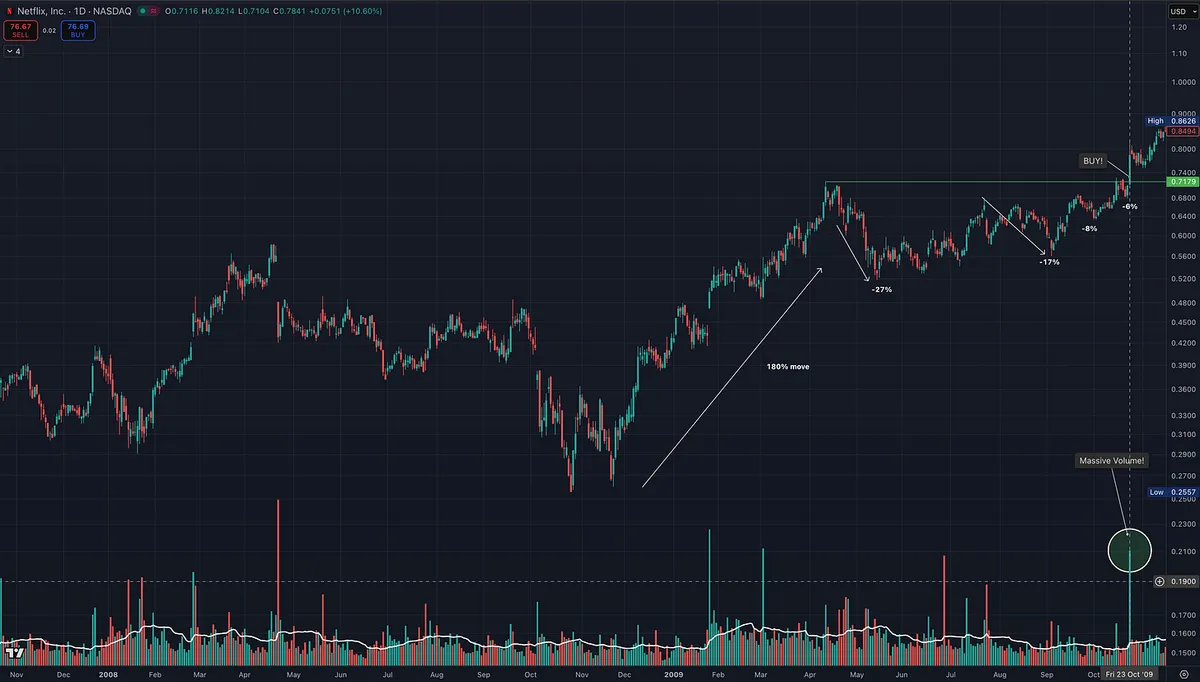
This is exactly what we want to see.

First, a powerful advance.

In this case, roughly a 180 percent move.

That move tells you institutions are involved. It establishes leadership.

Then something important happens.

The stock does not collapse.

It tightens.

Each pullback becomes smaller.

Minus 27 percent. Then minus 17 percent. Then minus 8 percent. Then minus 6 percent.

That is volatility contraction.

That is supply being absorbed.

During the tightening phase, volume dries up.

Fewer shares are coming to market. Sellers disappear.

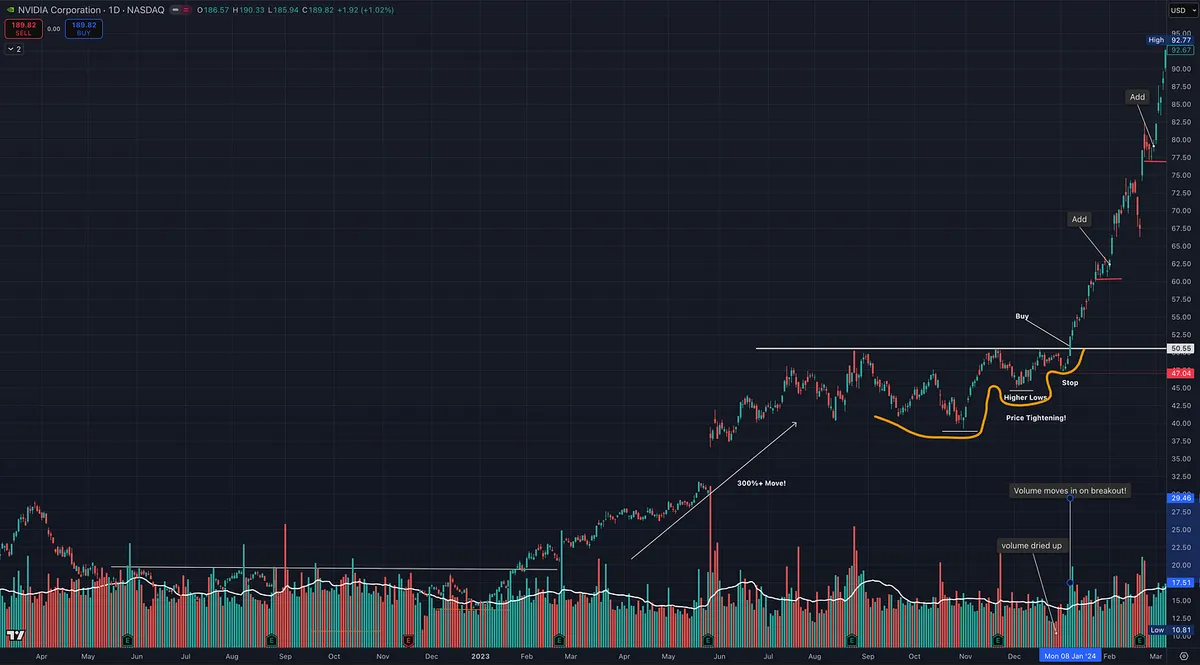
This is exactly what Mark Minervini describes in Trade Like a Stock Market Wizard when he explains that volume should contract during the tightest portion of consolidation before a breakout .

Strong expansion. Orderly digestion. Tighter contractions. Volume dry-up. Breakout on powerful volume.

When the breakout finally came, volume exploded.

Demand overwhelmed limited supply.

The result?

NFLX then ran another 500 percent.

That is what happens when compression resolves higher.

Big winners do not move randomly.

They prepare.

Compression precedes expansion.

If you learn to recognize tightening after a major advance, you stop fearing pullbacks.

You start positioning for superperformance.

View on Substack ↗

When Volume Dries Up, The Move Is Coming

Most investors get nervous when volume disappears.

They see declining activity and think:

No interest. No liquidity. No demand.

Mark Minervini teaches the opposite.

In Trade Like a Stock Market Wizard, he writes:

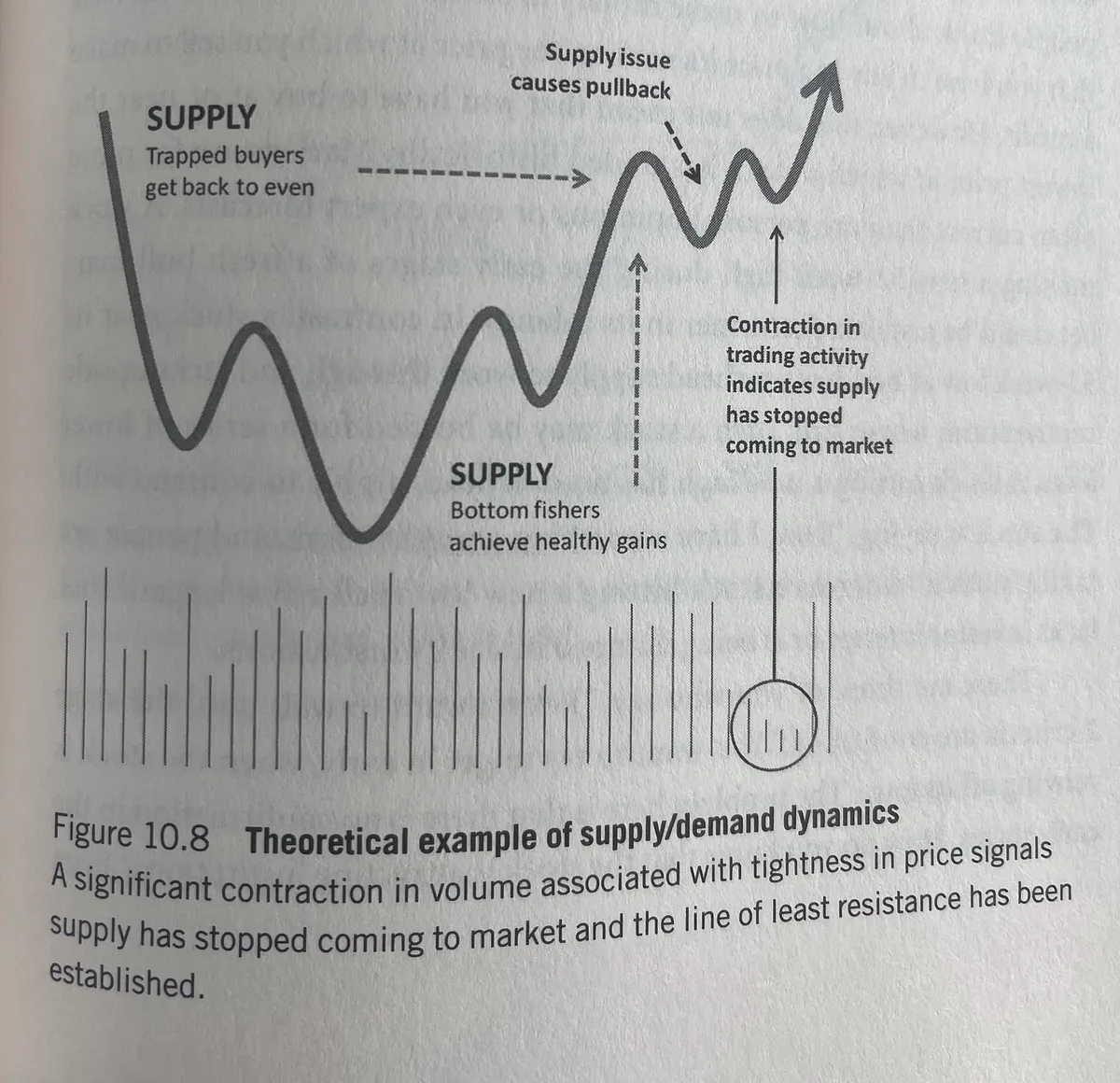
“In fact, we want to see volume on the final contraction that is below the 50-day average with one or two days when volume is extremely low. This may not always occur in the largest cap stocks, but in some of the smaller issues, volume will dry up to a trickle. Viewed as a lack of liquidity, this worries many investors. However, this is precisely what occurs right before a stock is ready to make a big move. Why? Because the decreased volume means that stock has stopped coming to market. With very little supply of stock in the market from sellers, even a small amount of buying can move the price up very rapidly. During the tightest section of the consolidation, the pivot point volume should contract significantly.”

Read that carefully.

Volume drying up is not weakness.

It is supply disappearing.

When a stock forms a tight base and volume contracts below the 50-day average, especially with one or two extremely quiet days, that tells you something important:

Sellers are gone.

Supply has been absorbed.

Now it does not take much demand to push price higher.

This is basic economics.

Low supply plus new demand equals expansion.

Minervini also highlights footprint analysis, such as an 8-week base with successively tighter pullbacks of 22 percent, then 8 percent, then 2 percent.

That tightening is compression.

Compression precedes expansion.

The quietest moments often come right before the loudest moves.

If you learn to recognize volume drying up during tight consolidations, you stop fearing inactivity.

You start recognizing opportunity.

Because when supply disappears, price does not need much encouragement to move fast.

View on Substack ↗

The Only Way a Stock Goes Up 8000 Percent

Most investors are afraid of new highs.

They think the move is over.

They think they are late.

Mark Minervini explains why that thinking is backwards.

He writes:

“Keep in mind that the only way a stock can become a superperformer—moving from, say, $20 to $80 and then to $180—is for that stock to make a series of new highs all the way up.”

That is not opinion. That is how markets work.

A true monster stock must make repeated new highs.

It cannot go from cheap to extraordinary without breaking out again and again.

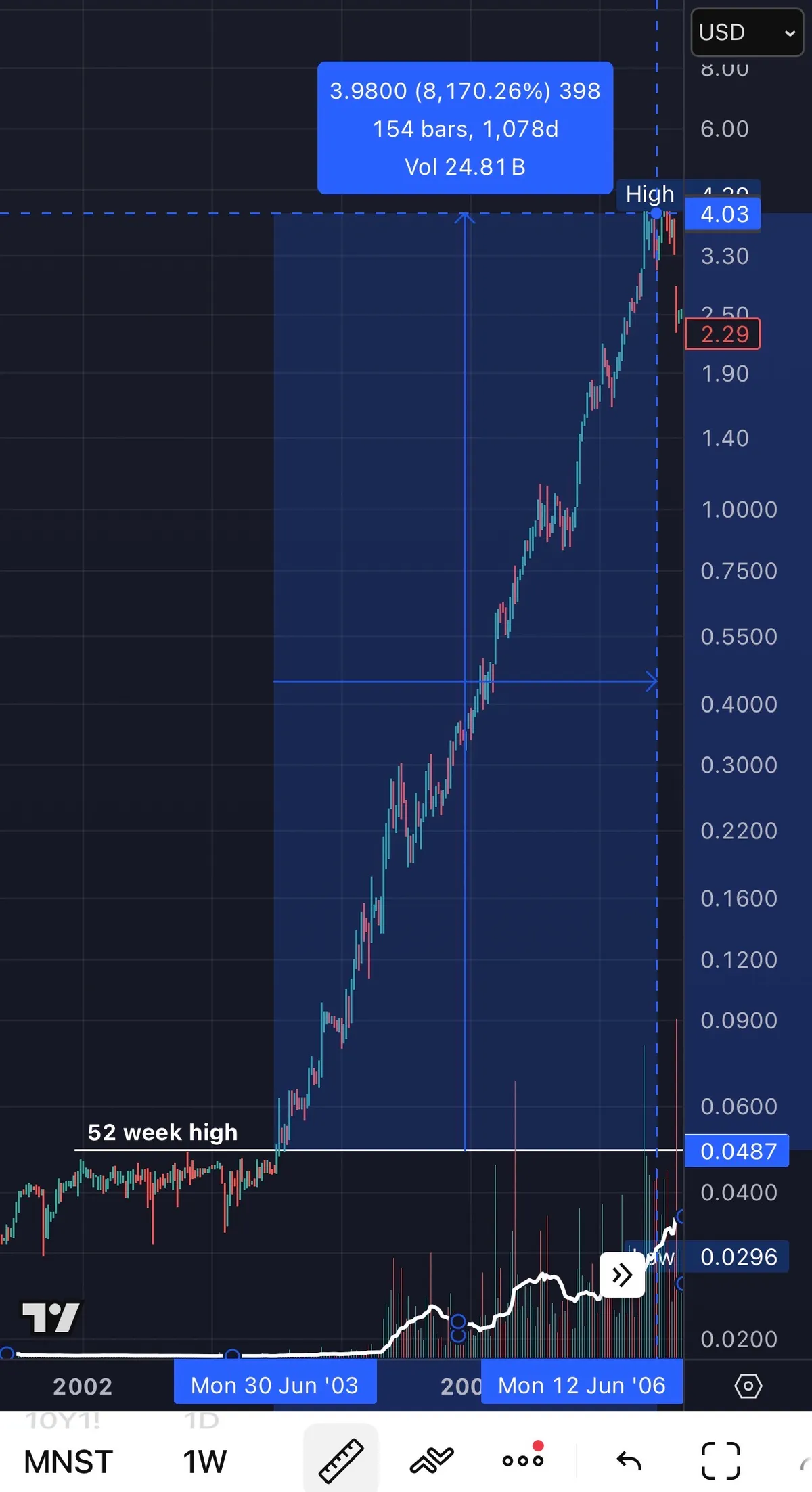
Minervini gives the example of Monster Beverage:

“Monster Beverage (MNST) registered an all-time high in late 2003. If you were afraid to buy the stock because it appeared too expensive or too ‘high,’ you would have missed a huge opportunity: The stock price advanced 8,000 percent by early 2006.”

Eight thousand percent.

And it started with a new high.

Here is the uncomfortable truth.

If you refuse to buy strength, you automatically eliminate the biggest winners from your portfolio.

Superperformance requires:

Breaking out

Consolidating

Breaking out again

Repeating the process

The stock that feels extended early in a cycle is often just beginning.

The crowd waits for pullbacks that never come.

Professionals understand something different.

Great stocks look expensive before they look obvious.

If you want superperformance, you must get comfortable buying strength.

Because the only way a stock becomes extraordinary is by making new highs all the way up.