Momentum Trading Strategy

Notes

Short lessons on momentum trading, every day.

Every note from Substack, in one place: risk, setups, leading stocks, market conditions and the mindset behind them. Search them, browse by topic, or filter by stock.

Showing 901–920 of 1230 notes

View on Substack ↗

Why Elite Traders Work on Winners More Than Losses

After reading and listening to thousands of hours of interviews with great traders, one pattern stands out.

Many of them say they are working to improve getting more out of their winners.

I cannot recall many saying they struggle with cutting losses.

That tells you something.

Now, do not misunderstand.

These traders absolutely let winners run. That is why they survive. That is why they can pay for their losers. Most of them have win rates under 50 percent.

They already understand that a small number of trades drive the majority of profits.

And yet, they still analyze how they can extract more from their best positions.

Why?

Because of how they are wired.

Paul Tudor Jones said it clearly:

“The most important rule of trading is to play great defense, not great offense.”

The best traders think about risk first.

Where am I wrong? How much can I lose? How do I protect capital?

That mindset makes cutting losses almost automatic.

Defense becomes instinct.

But letting winners expand requires tolerating open profit volatility.

It requires sitting through pullbacks.

It requires not grabbing gains too quickly.

For someone focused on protecting capital, open profit feels like something that must be defended.

So even elite traders study how to stay in their best trades longer.

Not because they are bad at it.

But because their default setting is risk control.

Protect the downside first.

Then learn to press your advantage when the market gives it.

Play great defense.

Then allow offense to work when it matters.
View on Substack ↗

Last Year’s Leaders Are Slowing Down

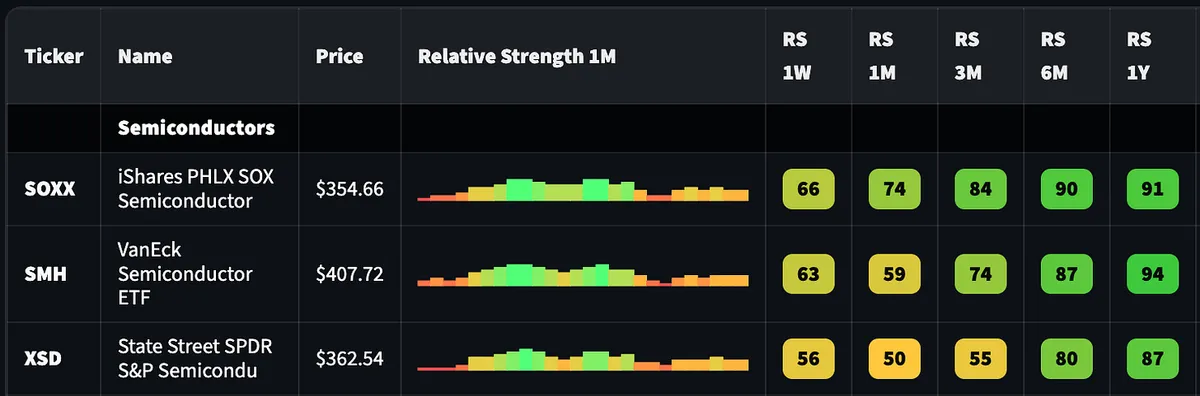
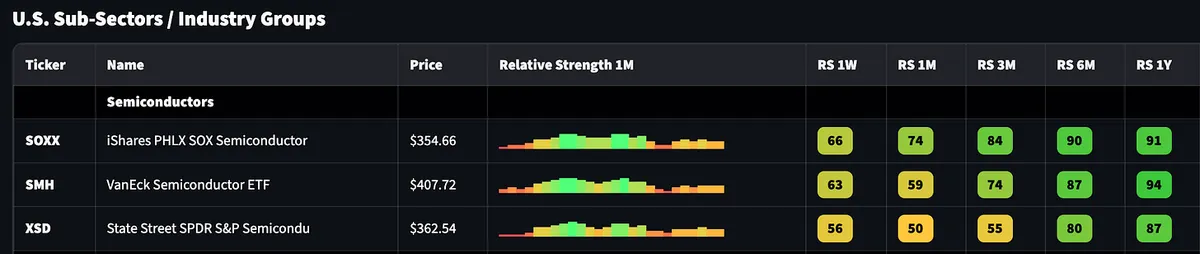
Semiconductors are no longer the clear leaders.

One year relative strength was in the 90s. Three months dropped into the 70s and 80s. Last week printed in the 50s and 60s.

That is deceleration.

Yes, there are still individual winners, but the group is no longer dominant.

Leadership is not about a few stocks making noise. It is about sustained institutional sponsorship across the group.

When the strongest group in the market begins to cool, you do not panic.

You observe.

You rotate with capital.

The question is simple:

Are you still trading last year’s leaders, or are you following where money is flowing now?

Rotation does not announce itself loudly. It shows up in relative strength before most traders feel it in their P&L.

Pay attention to the groups.

View on Substack ↗

Feeling the Death by a Thousand Cuts Market? Here Is What the Rotation Is Really Telling You

The new Big Picture Market Pulse | February 16, 2026 is live.

Distribution is building in the Nasdaq. Sector rotation is accelerating beneath the surface. Mega caps are stalling while small caps, mid caps, and value quietly take leadership.

If the market has felt frustrating, choppy, and difficult to make progress in, you are not imagining it. Many traders are stuck trading last cycle’s leaders while capital is flowing elsewhere.

This week’s market analysis breaks down:

• Nasdaq distribution days and what they mean

• Sector rotation into small caps, mid caps, and value stocks

• Market breadth and relative strength trends

• How to adjust exposure in a rotational bull market

• A top down to bottom up trading framework for the week ahead

This is not reactive trading. This is structured preparation.

Top down market analysis followed by bottom up stock screening, scanning, and watchlist refinement.

If you want clarity on market direction, leadership shifts, and how to position for the week instead of reacting emotionally, start here.

https://tradingmomentum.substack.com/p/big-picture-market-pulse-february-01c

On SubstackBig Picture Market Pulse | February 16, 2026
View on Substack ↗

Yesterday’s Leaders Become Tomorrow’s Laggards

You’re late to the party.

Look out below.

The same stocks that went up the most can go down the most.

Technology led the 1998 to 2000 bull market.

From 2000 to 2002, those same leaders became the biggest losers.

During the next bull market, they recovered only a fraction of what they lost.

Financials and housing led from 2003 to 2007.

In 2008, they suffered the steepest declines.

History is clear.

The leaders of one bull market are rarely the leaders of the next.

If history is any guide, former leaders should generally be abandoned as buy candidates during bear market recovery rallies and for the next bull market.

There is one exception.

If leadership stocks or sectors began emerging near the end of the prior bull cycle, they can sometimes continue into the next advance.

But that is not common.

Very often, the next bull market leaders emerge from the most unlikely areas.

They quickly reveal themselves through price.

Strong relative strength. Constructive bases. Powerful breakouts. Institutional demand.

Follow the leaders.

Buy strength.

Avoid laggards.

Because markets reward alignment with emerging leadership, not loyalty to the past.

View on Substack ↗

Leadership Is Measured, Not Assumed

The relative strength dashboard shows short-term deceleration in semiconductors.

That is information.

It is not a conclusion.

William O’Neil teaches that the biggest winners come from leading industry groups, and that you must stay aligned with true market leaders, not laggards .

Mark Minervini teaches that market leaders do one of two things during an advance:

“The price advance of the market leader will do one of two things: it will continue its advance while the group propels it even higher, or it will consolidate in a sideways fashion and digest its previous gains while the group and other stocks in the group play catch-up.”

Consolidation is normal.

Loss of leadership is confirmed.

O’Neil makes clear that leading stocks show deterioration before major tops and that you must recognize those signals through price and relative strength behavior .

Minervini is equally direct: a leader that begins to act abnormally, with loose price action or repeated failure, is no longer a leader.

Short-term relative strength cooling does not by itself prove leadership is over.

What proves leadership is over is:

• Sustained deterioration in relative strength

• Repeated distribution

• Failed breakouts

• Violation of key support levels

• Abnormal price and volume behavior

Until those conditions appear, the proper posture is observation, not prediction.

O’Neil and Minervini do not forecast tops.

They monitor leadership and react when evidence changes.

If semiconductors remain structurally sound, tighten up, and re-accelerate, that confirms ongoing leadership.

If relative strength continues to deteriorate and price action becomes abnormal, that confirms a change.

The rule is simple and unchanged:

Stay with leaders while they act like leaders.

Exit when they stop.

View on Substack ↗

Every Bull Market Is Dominated By One Sector And A Few Sub-Sectors

This is not opinion.

It is how markets work.

As Mark Minervini points out, a bull market is always dominated by at least one sector and several subsectors.

Always.

Capital does not flow evenly.

It concentrates.

Money crowds into themes. Themes create leaders. Leaders create momentum.

That is why we track sector and subsector relative strength.

Not because it sounds sophisticated.

Because it tells us where institutional money is flowing.

If a stock is strong but its sector is weak, odds drop.

If the sector is strong but the subsector is weak, odds drop.

But when:

• The overall market is in an uptrend

• The sector is leading

• The subsector is accelerating

• And the stock is breaking out

Now you have alignment.

That alignment is where outperformance lives.

We are not just buying stocks.

We are buying stocks inside the dominant theme of the bull market.

That is why our relative strength dashboard matters.

That is why we prioritizes leaders inside leading groups.

Bull markets do not reward random stock picking.

They reward concentration inside strength.

The question is simple:

Are you trading the strongest part of the strongest sector…

Or are you guessing?

View on Substack ↗

The Problem With Bubbles That Most Investors Don’t Understand

Everyone screaming “AI bubble” is likely right.

But so what?

Bubbles can last for years.

In the meantime:

Are you sitting on the sidelines scared, missing one of the strongest profit environments of the decade?

Or are you blindly buying every dip pretending it can never end?

Both extremes lose.

Here’s the uncomfortable truth:

Some of the greatest wealth-building periods in history were bubbles.

The 1920s. The dot-com era.

For the disciplined trader or investor, those weren’t disasters.

They were life-changing.

Not because bubbles are safe.

But because strong trends plus expanding emotion create massive opportunity.

The mistake isn’t participating.

The mistake is participating without a plan.

Yes, bubbles eventually pop.

They always do.

But disciplined operators don’t ride them all the way back down.

They exit to cash.

They lock gains.

They protect capital.

Often making more in one bubble cycle than they made in several prior years combined.

Don’t fear bubbles.

Fear being unprepared for them.

Markets are human emotion.

Emotion is not rational.

And bubbles will always exist because human emotions make up the market.

The real question is simple:

Are you trading the bubble…

Or is the bubble trading you?

View on Substack ↗

The Market Pays You on the Sell Not the Buy

Anyone can buy a hot stock.

Newsletters have been selling “the next big winner” for decades.

Beautiful analysis. Strong fundamentals. Conviction everywhere.

That is not the hard part.

The hard part is keeping the money.

Even real super performers collapse.

As Mark Minervini said:

“History shows that one-third of super performers give back all or more of their entire advance. On average, their subsequent price declines are 50 to 70 percent.”

Read that again.

50 to 70 percent.

You can be right… And still end up back at zero.

Take profits too early and your winners never pay for your losers.

Take profits too late and you round trip the entire move.

This is where most traders fail.

Not entries.

Exits.

Without a sell plan you are not managing risk.

You are hoping.

Momentum expands. Crowds chase. Then gravity returns.

Your edge is not finding leaders.

Your edge is not giving it back.

So the real question is simple:

Do you have written sell rules?

Or are you just acting on feelings?

Because the market only rewards one of those.

View on Substack ↗

Study. Execute. Review. Repeat.

Many traders study but never execute.

They read books.

Watch videos.

Take notes.

But they never put real risk on the table.

Others do the opposite.

They execute constantly.

They trade every day.

They get tons of screen time.

But they never truly studied their craft.

Both paths lead to frustration.

Great performers in any field do both.

They study the greats.

They model proven frameworks.

They build knowledge before they build size.

And then they execute.

They are not afraid to act.

They are not afraid to fail.

They are not afraid to review their own mistakes.

Execution without study is reckless.

Study without execution is fantasy.

You need both.

Study the craft.

Execute the craft.

Then study your own execution.

That feedback loop is where real edge is built.

View on Substack ↗

Why Most Traders Fail When They Go Live

I recommend traders use a simulator first.

Not to pretend trade.

Not to chase dopamine.

But to prove they actually have an edge.

If you cannot demonstrate profitability in a simulator over a meaningful sample size, going live will not magically fix that.

Simulation builds two things:

  1. Proof of edge

  2. Confidence in your process

Both matter.

But here is where many traders get blindsided.

They crush it in sim.

Then they go live… and fall apart.

Why?

Because real money changes everything.

It introduces fear.

It introduces hesitation.

It introduces the pain of loss.

That is why I recommend that once you go live, you trade with an amount that is small but meaningful.

Small enough that you can afford to lose it.

Large enough that you feel it.

You must learn how to manage your emotions with real capital at risk. That skill cannot be simulated.

View on Substack ↗

Why Trade Alert Services Fail Most Traders

There are plenty of trade alert services out there.

Some people experience short term success following alerts.

But long term, that rarely builds consistent traders.

Why?

Because trading is deeply personal.

You can absolutely model a proven system. In fact, I recommend that for beginners and this is what I did starting out. Start with a proven system. Start with rules. Learn a framework that works. ie. CANSLIM

But eventually, you must tailor it to your personality.

Your risk tolerance. Your timeframe comfort. Your volatility tolerance. Your decision making speed.

Two traders can take the exact same stock and have completely different outcomes.

One trader holds through volatility. Another cuts quickly at the first pullback. One takes profits into strength and raises stops early. Another presses the advantage and adds to the position.

Same stock. Different psychology.

Simply copying someone else’s entries and exits does not build skill. It builds dependency.

And dependency does not survive market cycles.

Every trader who achieves long term consistency eventually learns to make their own decisions without someone telling them exactly where to buy and where to sell.

That is the turning point.

My goal here is not to run a signal service.

It is to help you think independently.

To help you recognize true market leaders. To help you identify setups that clearly define risk. To help you align trades with your own style.

Because in the end, the only edge that lasts is the one you understand deeply and can execute confidently.

Learn to fish.

The market will feed you for a lifetime.

View on Substack ↗

The Leaders Always Leave First. That Does Not Always Mean The Top Is In.

Jesse Livermore built his fortune trading leading stocks.

“I made most of my money in leading stocks.”

That principle has not changed.

This bull market from late 2022 through now has had clear leadership. Stocks that institutions crowded into. Stocks that drove the indexes. Stocks that felt unstoppable.

And now we are seeing something subtle.

Rotation.

Money moving into metals. Consumer names. Defensive groups. Areas that typically do not lead early in expansion phases.

That gets people nervous.

But here is the nuance most miss.

Rotation does not automatically mean market top.

Sometimes it signals late cycle distribution. Sometimes it signals digestion before the next leg higher. Sometimes bulls simply run much longer than logic suggests.

This is what makes it hard.

The market rarely rings a bell. It shifts character.

Mark Minervini wrote in Trade Like a Stock Market Wizard:

“Market leaders tend to foretell turns to the downside as well.”

Notice what that means.

Leaders tell the story first. Not the headlines. Not the index.

If true leaders stall while the averages grind higher, that is information. If leadership reasserts and breaks to new highs, that is also information.

Rotation is not confirmation. It is context.

The job is not to predict the top. The job is to stay aligned with true leadership and adjust if character changes.

The market whispers before it screams.

Are you listening?

View on Substack ↗

Time Flies Anyway. Start Today.

You’ve heard the saying.

People overestimate what they can accomplish in one year.

And underestimate what they can accomplish in five to ten.

That is especially true in trading.

Many quit because it doesn’t make them rich in one or two years.

They expect mastery. They expect consistency. They expect financial freedom.

Fast.

But trading is a skill.

And real skill compounds.

If I told you that five to ten years from now you could have financial freedom from this skill… would you call that a waste of time?

Of course not.

Yet people walk away because it didn’t happen in twelve months.

Here’s the uncomfortable truth:

Five years will pass anyway.

Ten years will pass anyway.

The only question is whether you will look back wishing you had spent that time learning… or wishing you hadn’t wasted it.

Imagine doing something every day that builds skill.

Studying charts. Reviewing trades. Managing risk correctly. Improving process.

Small progress daily.

That is how real traders are built.

Not in months.

In years.

Time is going to pass no matter what.

Start today.

View on Substack ↗

Earnings Quality Is What Separates Leaders From Pretenders

Strong earnings growth is important.

But earnings quality is what really matters.

In Trade Like a Stock Market Wizard, Minervini emphasizes that the biggest winners are backed by real, sustainable growth.

Not one-time accounting gains.

Not aggressive cost cutting.

Not a one-off product cycle.

Not one large customer order that temporarily inflates revenue.

True earnings quality means:

• Strong and expanding revenue growth backing the EPS

• Expanding profit margins

• Consistency across multiple quarters

• Broad customer demand, not concentration risk

• Institutional sponsorship increasing

If earnings are rising but sales are flat, be cautious.

If growth depends on one big contract, be cautious.

If margins are expanding while revenue grows consistently, that is powerful.

Institutions pay up for durability.

They want growth they can project forward.

The market rewards companies building something sustainable, not something temporary.

Quality creates conviction.

Conviction creates big moves.

View on Substack ↗

Acceleration Matters More Than Big Numbers

In Trade Like a Stock Market Wizard, Mark Minervini emphasizes something most investors overlook.

It is not just strong earnings and sales that drive big stock moves.

It is acceleration.

He writes:

“More than 90 percent of the biggest stock market winners showed some form of earnings acceleration before or during their huge price moves.”

Acceleration means growth is increasing quarter over quarter.

For example:

10% → 28% → 56%

That is powerful.

But 80% → 65% → 28%

Even though those are still strong numbers, that is deceleration.

And deceleration often marks the beginning of a stock topping process.

Minervini also makes clear that earnings should be supported by sales:

“In addition to strong, accelerating earnings per share growth, you want to see sales exhibit the same characteristics.”

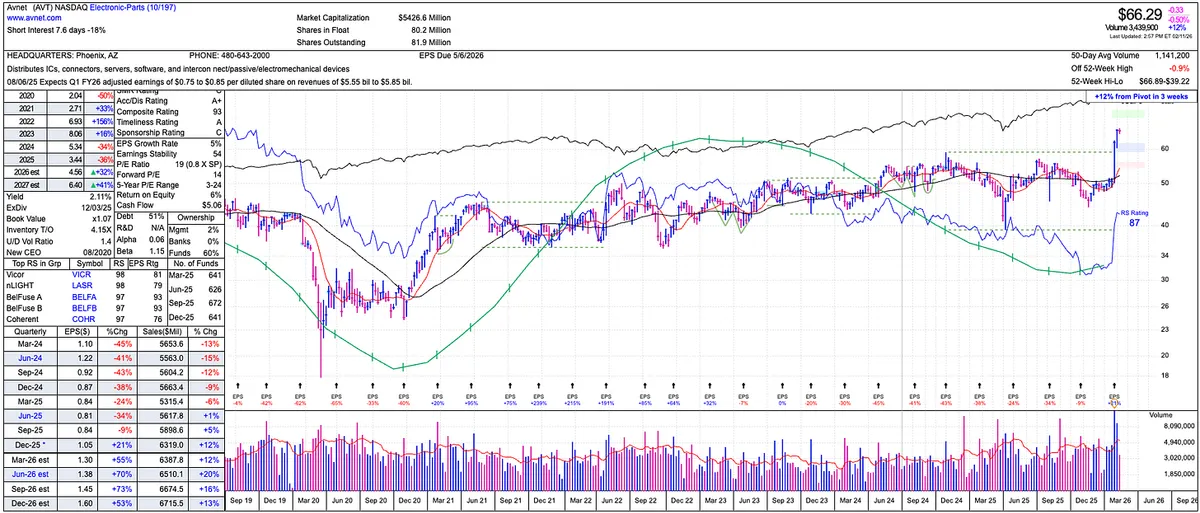
AVT is an example of this.

Estimates are improving.

Earnings growth is projected to accelerate.

Sales growth is turning higher.

That shift in trajectory is often more important than the absolute number.

Acceleration signals expansion.

Deceleration signals caution.

That is why I focus not just on good fundamentals, but on improving fundamentals.

It’s not just about finding growth.

It is finding growth that is speeding up.

View on Substack ↗

Results Are Nice. Skill Is Better.

If you’ve been following the Notes and seeing the results, imagine seeing the setups before the move.

For $10 a month on the annual plan, you get:

• Full market breakdowns

• Real-time setups with defined risk

• Clear entry and stop levels

• Structured trade management

• Ongoing chat access to discuss setups, risk, and execution

• Education built into every position

This is not about stock tips.

It’s about learning how to identify leadership, manage risk, and build positions yourself.

For $100 a month on the annual VIP plan, you get:

• Everything above

• Detailed Zoom calls breaking down markets, entries, risk, and management

• One-on-one guidance

• Personal process refinement

• Help building your own repeatable system

This is not about dependency.

The goal is skill.

Invest in yourself.

View on Substack ↗

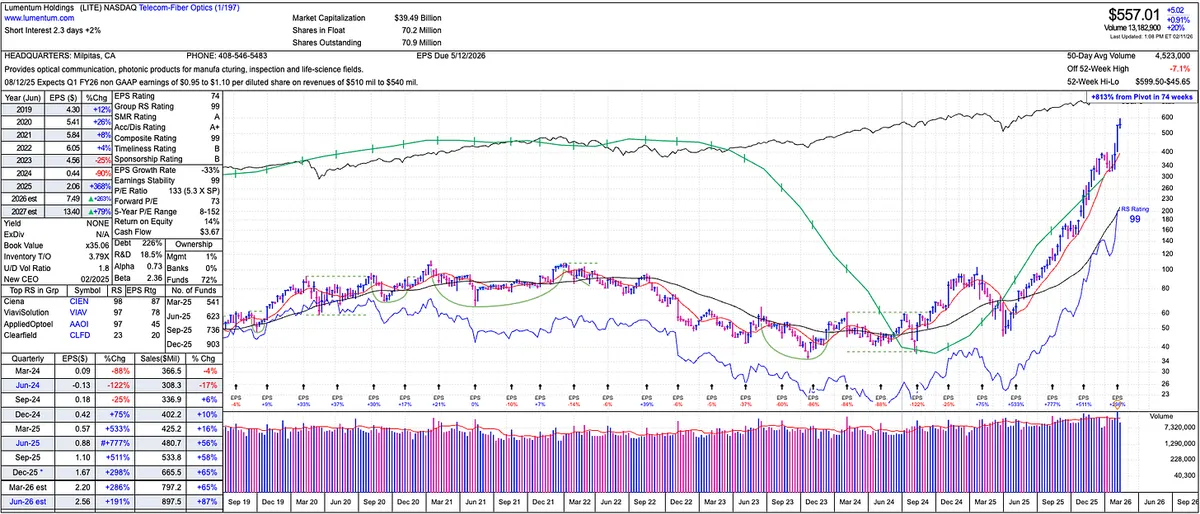
From RS Screener to Weekly Paid Newsletter to 55% Gain

We have been talking about buying pullbacks and upside reversals.

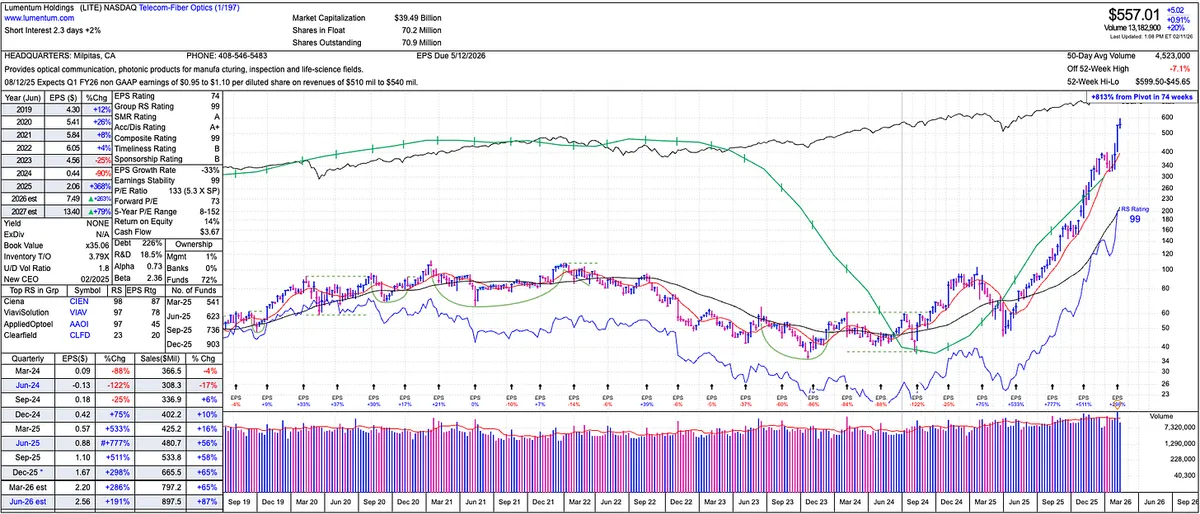
LITE just gave a textbook one.

What is interesting is how it first came onto our radar.

It showed up on our relative strength screener weeks before the breakout, while it was still setting up.

  • Top tier relative strength.

  • Strong on multiple timeframes.

  • Fund ownership accelerating.

  • Big earnings. Big sales.

You would have missed it on the MarketSurge O’Neil scan, which highlights the importance of casting a wider net. That is what I do when using the relative strength screener. First I scan for strength, then I dive into the chart and the fundamentals.

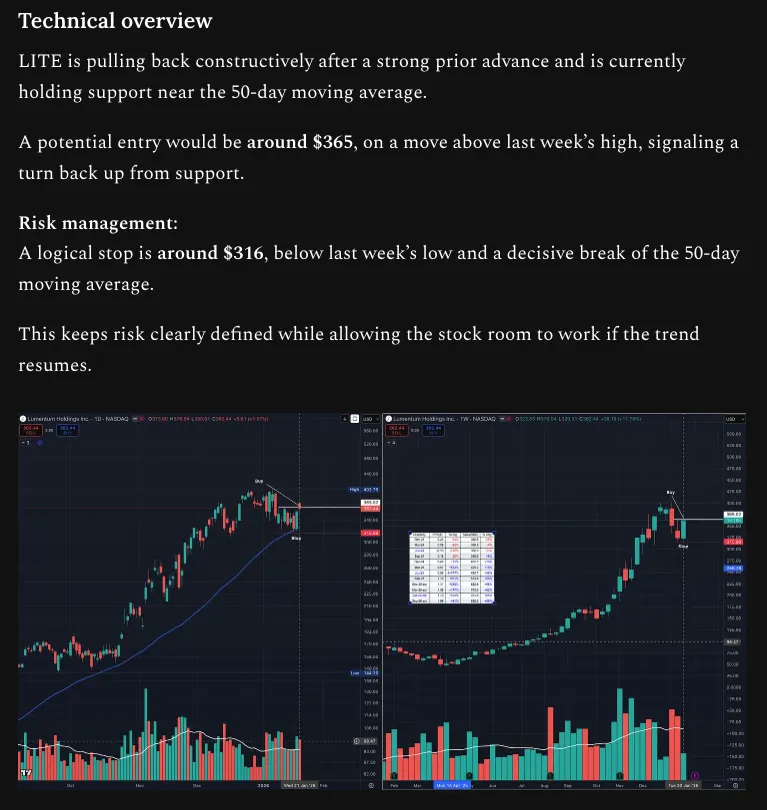
When we walked through this setup with paid subscribers, it was pulling back constructively after a strong advance and sitting near the 50 day moving average.

The plan was simple.

Entry around $365 on a move above the prior week’s high. Stop below the weekly low. We were also looking for follow through at the breakout level around $400.

We defined our risk, like we do with every trade.

No guessing.

Now it is up 55 percent from that area.

Here is the important part.

I am not some guru. I did not know LITE would be a winner. It simply met the criteria of big winners. Plenty of stocks meet the criteria and fail. When they do, I take a small loss.

But when a stock with elite relative strength sets up technically, offering a low risk, high reward opportunity, combined with strong CANSLIM type fundamentals, those are the kinds of names that can become major winners. You take them.

One stock like this can cover multiple failed attempts.

That is why we scan for strength.

Look for low risk, high reward technical setups.

Align with big sales, big earnings, accelerating fund ownership, and a bull market theme.

This is why we focus on process.

And that process produces the results.

View on Substack ↗

Buying Pullbacks vs Buying Breakouts

Most traders think you have to pick one.

You don’t.

You just need to know what each one does for you.

Buying Breakouts

You buy strength.

You buy as price clears resistance.

You buy as the stock moves into new high ground.

Why I use it:

• It confirms demand

• Overhead supply is gone

• Risk is clearly defined below the pivot

• Momentum is aligned

Breakouts increase probability.

When the market is in a strong uptrend, this is the cleanest way to initiate a position.

But there is a tradeoff.

• You pay up

• Everyone sees the same level

• Shakeouts are common

• Cost basis rises quickly if you keep adding

Breakouts are powerful.

They are also crowded.

Buying Pullbacks

You are not buying weakness in a downtrend.

You are buying weakness inside a confirmed uptrend.

Higher highs. Higher lows.

Rising 10-day, 21-day, or 50-day moving average.

Why I use it:

• Lower cost basis

• Better risk to reward

• Easier to accumulate shares

• Less competition

• Opportunity to add size without chasing

But the key to buying pullbacks is not guessing.

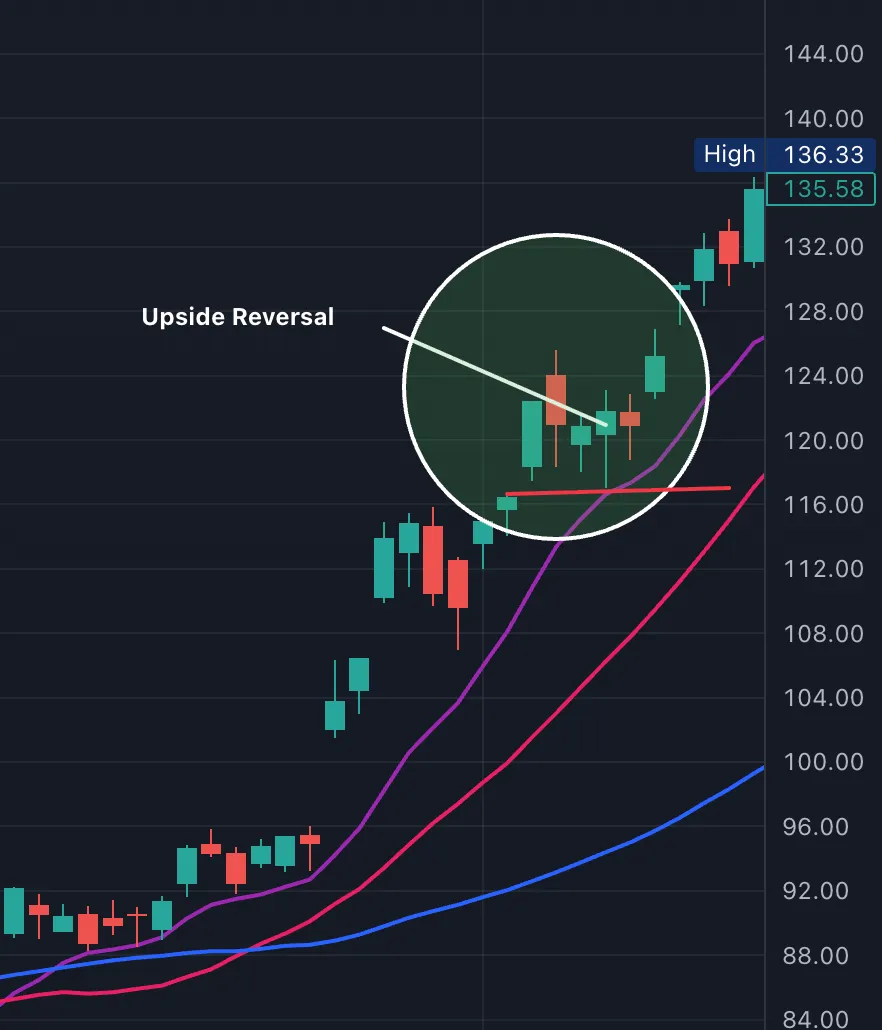
It is waiting for an upside reversal at support.

A shakeout.

A reclaim.

A strong close near the highs of the day.

That upside reversal becomes your signal.

The low of that reversal day becomes your stop.

If price undercuts it, you are wrong.

Without that trigger, you are just catching a falling knife.

Pullbacks improve positioning.

But they require:

• A strong general market

• A stock in a defined uptrend

• Clear support levels

• Absolute risk control

If support breaks, you are wrong.

How I Actually Trade It

Many times I do both.

I buy the traditional breakout.

Then I add on pullbacks.

Breakouts get me involved. Pullbacks help me build size.

If the stock is truly a leader, it will:

• Break out

• Pull back to the 10, 21, or 50

• Stage an upside reversal

• Resume higher

That is where real position building happens.

The goal is not to be right once.

The goal is to build size in the right stock while controlling risk.

Some uptrends reward breakouts more.

Some reward pullbacks more.

You need to be aware of what is working best right now.

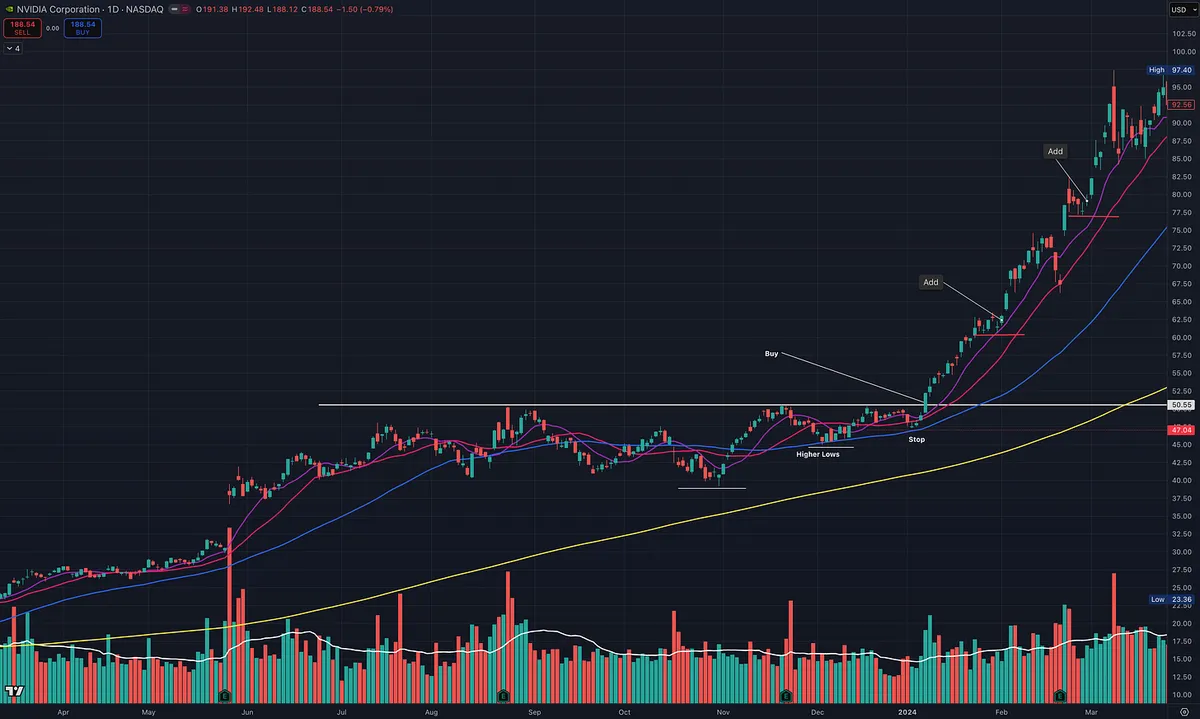
NVDA Example

NVDA provided a textbook example of this sequence.

Flat base breakout from VCP to initiate.

Then a controlled pullback into the rising 10-day.

On that pullback, price:

• Touched support

• Reversed higher

• Closed above the prior day’s close

• Traded above the prior day’s high

That is buying a pullback within an uptrend.

The low of that reversal day or low of pullback becomes the stop.

Breakout to get involved.

Pullback to add.

That is how real leaders let you build a position.

View on Substack ↗

Struggling Right Now? Raise Your Standards.

“I just wait until there is money lying in the corner, and all I have to do is go over there and pick it up.”

—Jim Rogers

If you are struggling, the answer is usually not more trades.

It is better trades.

When performance slips, standards quietly slip with it.

A base that is almost clean.

Volume that is decent.

Market conditions that are mixed but maybe fine.

Close enough becomes good enough.

That is where drawdowns grow.

Raise the bar.

Only take A plus setups.

Clear structure.

Tight risk.

Explosive volume.

Strong relative strength.

Make sure the time frame you are trading aligns with the bigger time frame.

Make sure your stock aligns with the general market.

Make sure the wind is at your back.

If it is not obvious, skip it.

Selectivity protects capital.

Patience preserves clarity.

Alignment increases odds.

When in a slump, do less.

And do it better.

View on Substack ↗

Transportation Shows Up

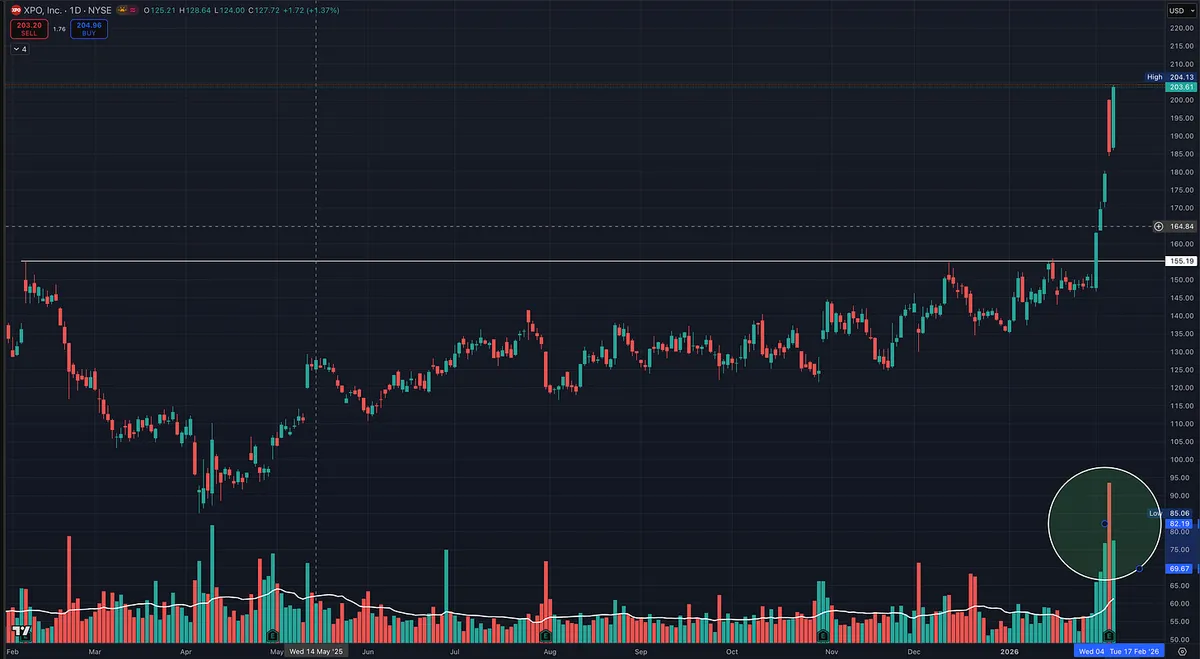
Transportation had a big week. Now the question is whether relative strength continues.

Leadership is starting to separate from the rest of the market.

One name to watch is XPO Logistics.

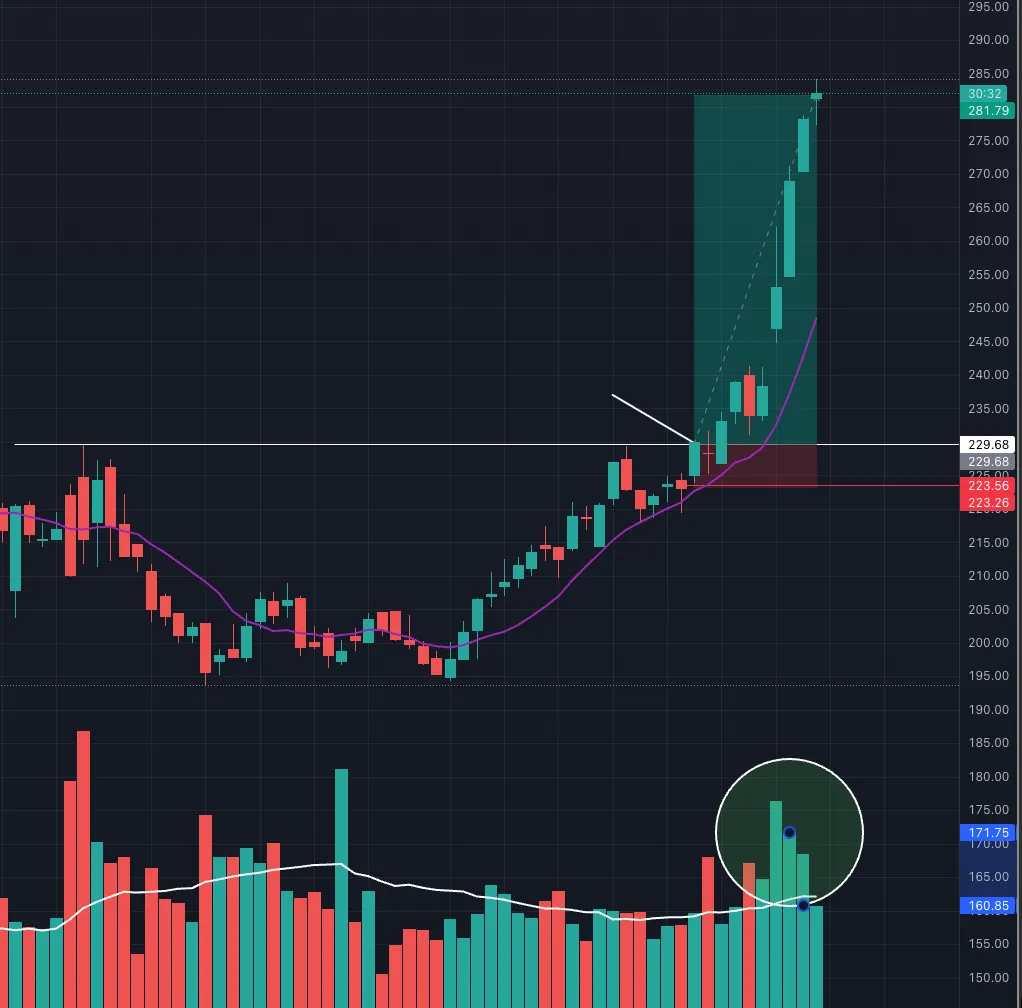
XPO broke out of a flat base with clear volume expansion.

That matters.

Big moves often start when:

  • a group shows strength

  • leaders emerge within that group

  • price breaks out on volume