Momentum Trading Strategy

Notes

Short lessons on momentum trading, every day.

Every note from Substack, in one place: risk, setups, leading stocks, market conditions and the mindset behind them. Search them, browse by topic, or filter by stock.

Showing 181–200 of 1222 notes

View on Substack ↗

The Best Stocks Often Show Their Strength Before the Market Does

One of the things I love about studying the old masters is how often the same ideas show up decades apart.

Nicholas Darvas wrote about sitting on the sidelines during the 1957 market decline and watching for stocks that refused to go down with everything else.

“I tried to detect those stocks that resisted the decline. I reasoned that if they could swim against the stream, they were the ones that would advance most rapidly when the current changed.”

That is relative strength in its purest form.

Darvas noticed that while most stocks were falling with the general market, a small group began giving ground reluctantly. He later found that many of those companies also had sharply improving earnings trends. His conclusion was that capital was already flowing into them even while the broader market was weak.

That is exactly why I spend so much time looking for stocks holding up near their highs during corrections.

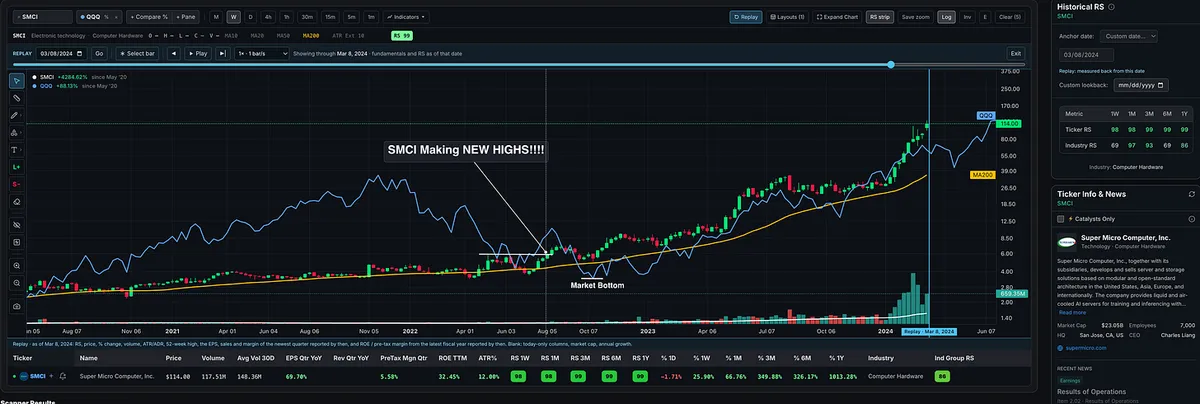
This is exactly what I did with SMCI back in 2022.

While the broader market was still in much worse shape, SMCI was already showing unusual strength. It was holding up far better than the indexes, its relative strength was improving, and as the market began to bottom and turn higher, SMCI was already pushing into new highs.

That strength was information.

The stock that refuses to break while everything around it is getting hit is telling you something.

Then, when the market finally turns, you often don’t have to go searching for leadership from scratch.

The leaders may have already identified themselves.

Darvas later described Lorillard doing exactly this. While most stocks were drifting or falling, Lorillard rose from 17 into a tight 24–27 area with a huge increase in volume. He called its strength in the face of a weak market “very impressive,” then bought as it pushed toward a higher range.

Different decade. Different stocks. Same behavior.

When the market gets weak, don’t only look at what is falling. Pay close attention to what refuses to fall.

Those stocks may be showing you where the next leadership is forming.
View on Substack ↗

You Can Always Find a Reason to Stay Wrong.

“Unfortunately, in the stock market, there is always some bearish evidence and some bullish evidence. You never have difficulties in unearthing clues to back your viewpoint.”

-Martin Zweig

Being wrong isn’t always the most dangerous part of trading. Finding enough reasons to stay wrong can be.

Zweig gives a revealing example: even if 80 out of 100 market indicators were bullish, a committed bear could cling to the 20 that were still negative. There would be plenty of evidence to defend a bearish opinion, even though the overall picture pointed the other way.

You can find evidence that supports your view without the weight of the evidence being on your side.

And this works both ways. Zweig admits that in 1974, he searched for indicators supporting his bullish outlook while the weight of the evidence remained bearish. He recognized that he was wrong, but his ego kept him attached to the idea that the bottom was close.

That’s the reminder I take from this: be committed to your process, not married to your prediction. There’s a difference between following a disciplined method and searching for reasons to avoid admitting a mistake.

You don't need to change your mind with every market fluctuation, but be willing to change your stance when the evidence behind it changes.

Before searching for another reason you’re right, ask yourself: “What would convince me I’m wrong?”

Then be willing to act when it happens.

View on Substack ↗

Want to Know Where the Strength Is? Rank the Entire Market.

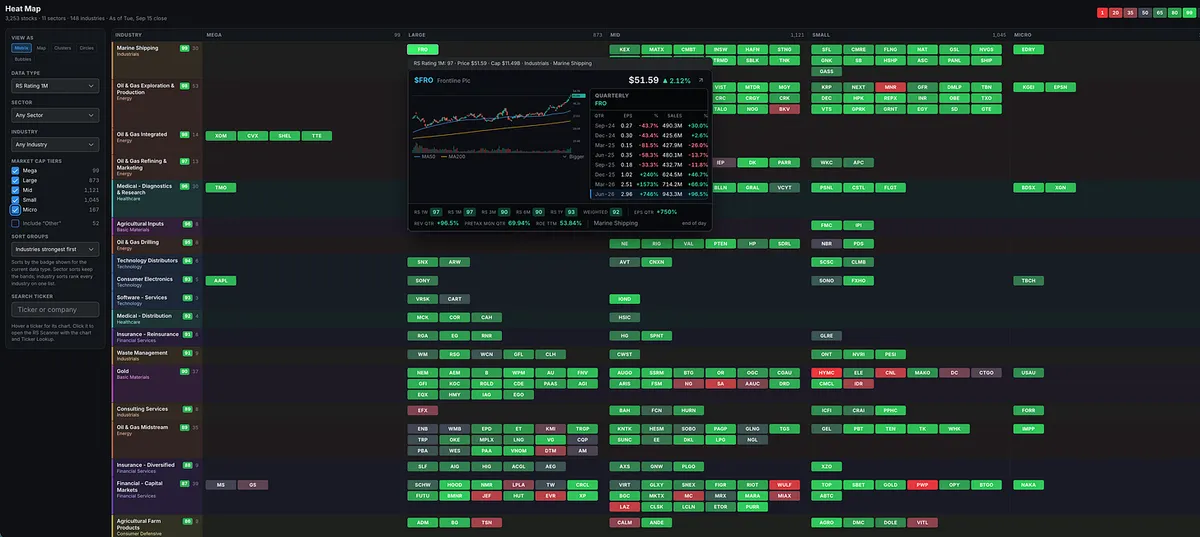
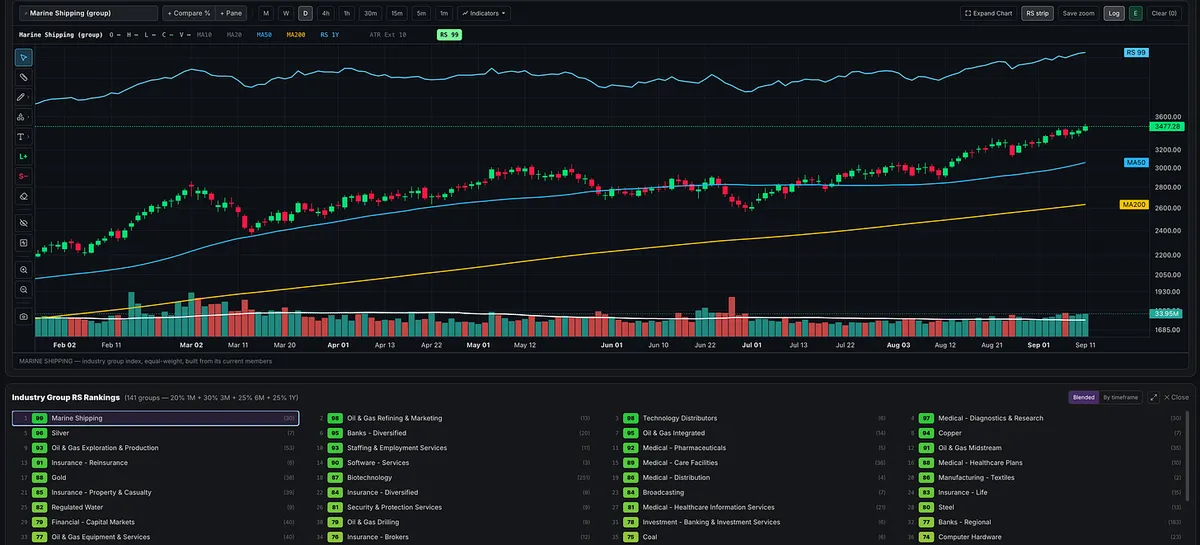
One of the simplest things I do in MTS Velocity is ask: show me the strongest industry groups first.

This is the market ranked by 1-month Relative Strength across 140+ industry groups.

Look at what rises to the top.

Marine Shipping: 99 RS

Oil & Gas Exploration & Production: 98

Oil & Gas Integrated: 98

Oil & Gas Refining & Marketing: 97

Oil & Gas Drilling: 95

You don’t have to guess where strength is developing.

Rank the groups. Find where relative strength is concentrating. Then drill down into the strongest stocks inside them.

Leadership leaves clues. Your job is to find them.

View on Substack ↗

I Asked MTS Velocity for Growth. It Gave Me Oil.

I started with my normal tradable universe of roughly 3,300 NYSE and Nasdaq stocks, after basic price, liquidity, and market-cap filters.

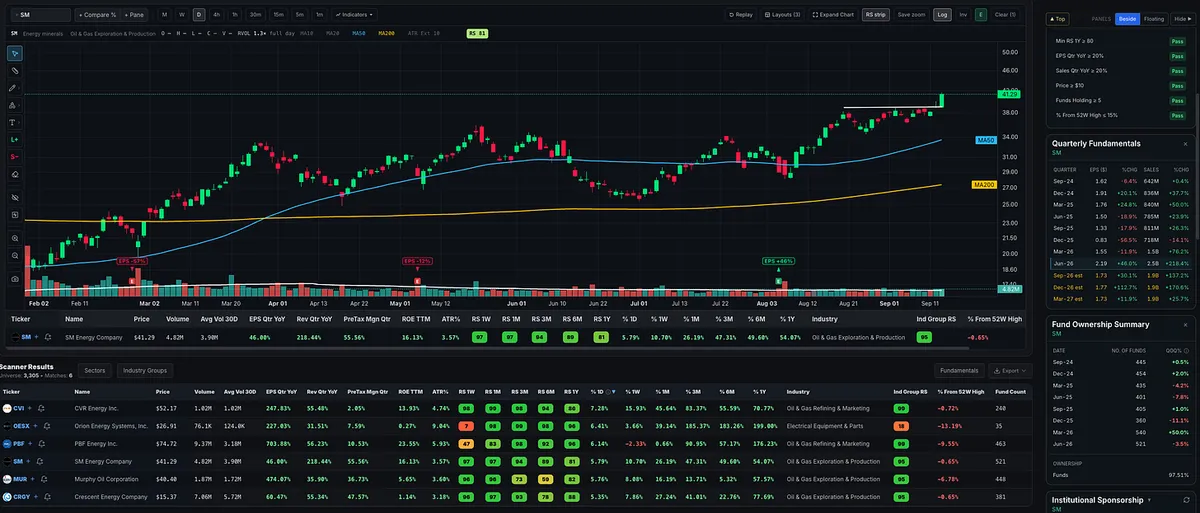
Then I ran a simple scan in MTS Velocity: show me stocks moving higher that also have high relative strength, big earnings growth, big sales growth, and are within 15% of their 52-week highs.

Almost every stock that made the final list was oil and gas.

Not AI. Not software. Not semiconductors.

Oil and gas.

Your stock screens will tell you what is actually happening in the market more than any headline, narrative, or opinion ever could.

View on Substack ↗

“It’s Already Gone Up Too Much.” Look Again.

Sometimes, the move that makes you dismiss a stock is the move that should put it on your watchlist.

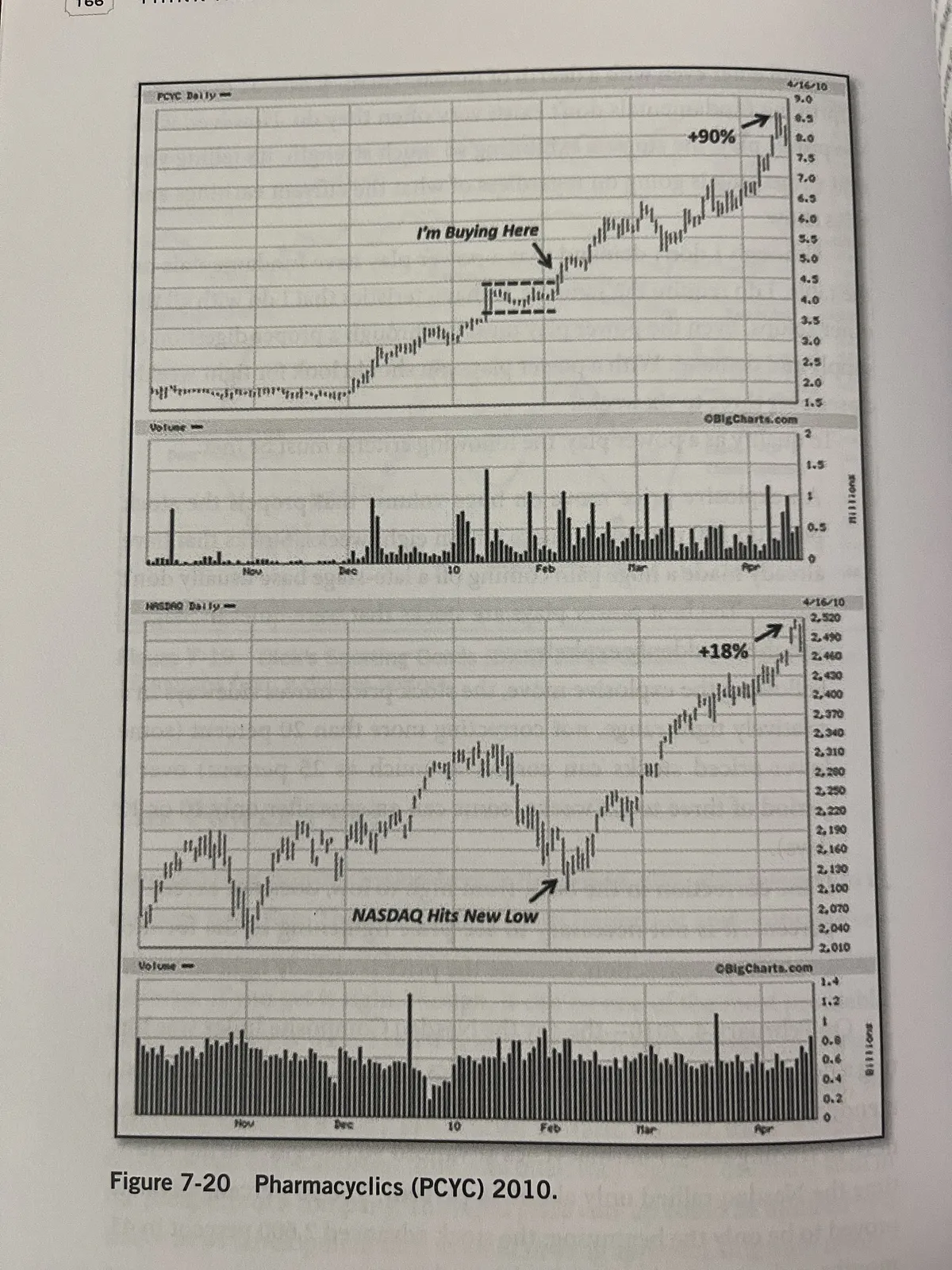
Look at Pharmacyclics (PCYC) in this 2010 chart from Mark Minervini’s book. The stock had already made a powerful advance before settling into a tight, sideways pause. While the Nasdaq was selling off toward a correction low, PCYC was holding up remarkably well.

That’s a form of relative strength. The market was struggling, but the stock was refusing to give back much ground.

When the market bottomed and started turning higher, PCYC was already breaking out to new highs. Notice where Minervini marks his purchase. He wasn’t buying the bottom or chasing the initial surge. He was buying as the stock emerged from that tight consolidation.

A lot of people look at the earlier advance and think, “I missed it. It’s already made its run.” But that strength can be the first evidence of a potential market leader, not proof that the opportunity is over.

There’s a difference between a stock that has already made a big move and a stock that is extended from a proper entry.

The prior advance gets my attention. The way the stock handles its next pause helps determine whether there’s a trade. Does it hold up while the market weakens? Does it tighten up rather than fall apart?

This is exactly what I still look for today. Many of the stocks I’ve shared had already made substantial advances before forming their next setup. During that quiet pause, when other people lose interest and move on, I’m often paying closer attention.

Not every setup works. But the same patterns and characteristics continue to appear.

Don’t automatically cross a stock off your list because it already ran. Watch what it does next.

View on Substack ↗

A Winning Strategy Can Still Be Wrong for You.

I didn’t start out as a growth stock and momentum trader. I started with The Intelligent Investor by Benjamin Graham and spent a lot of time studying Warren Buffett. Value investing was my starting point.

So I’m not here to convince everyone that my way is the best way. There are many ways to make money in markets. Sometimes the struggle isn’t that a method doesn’t work. It’s that it doesn’t work for you.

Your personality, goals, time frame, and life circumstances all play a role. A strategy needs a real edge, but you also need to be able to execute it consistently. The approach you admire isn’t always the approach you can live with.

That’s why I’m resharing my article on growth stock and momentum trading: what it is and what it isn’t. It doesn’t explain everything. It’s a brief introduction to an approach that might resonate with you.

My free articles on Mark Minervini, William O’Neil, Dan Zanger, and David Ryan offer more insight into the work that shaped my approach. Module 1 of the Momentum Trading Strategy Course goes deeper. There’s plenty to explore beyond this introduction.

Maybe you’ll read it purely out of curiosity. I still enjoy learning about other disciplines, not because I’m looking to jump from system to system, but because markets are fascinating. You can study another approach without abandoning your own.

Or maybe something will click. Maybe this becomes your introduction to the same work and teachers that helped me find my path. Not because you need to trade like me, but because you recognize something that fits your goals and the trader or investor you want to become.

Start with the article. If it resonates, keep exploring. You might find an approach that fits you better than you expected.

Regardless of which path you choose, I wish you all the best in this amazing game of markets.

https://tradingmomentum.substack.com/p/growth-stock-and-momentum-trading

ArticleGrowth Stock and Momentum Trading: What It Is and What It Isn’t
View on Substack ↗

Watch What They Do. Not What They Say.

People ask why I pay more attention to the put/call ratio (PCC) than popular sentiment surveys.

It’s the same reason I study price instead of letting someone on television tell me what to think.

I care less about what investors say and more about what they actually do with their money.

The PCC compares put option activity with call option activity. Higher readings can reflect greater fear or caution, while lower readings can reflect greater optimism. It isn’t perfect, but it gives me a window into actual market behavior rather than simply asking investors how they feel.

The VIX gives me another perspective. It reflects the volatility being priced into S&P 500 options. It isn’t a direct measure of money flowing into or out of the market, but it shows what options market participants are actually pricing, rather than what they’re telling a survey.

I use both for context, not as standalone buy or sell signals.

Price still gets the final vote.

And this goes far beyond indicators.

Trading has a way of teaching you very quickly how much of what people say is bullshit. A compelling story is not evidence. Someone sounding certain does not make them right. If you can easily be influenced by what everyone around you thinks, trading is going to be a very difficult game.

Now, you might say: “But you’re a growth momentum trader. Aren’t you buying stocks when everyone else is buying them?”

Sometimes, absolutely.

My style of trading is heavily influenced by William O’Neil, Mark Minervini, Dan Zanger, and David Ryan. I’m looking for growth stocks with characteristics such as big earnings and sales growth, high relative strength, strong price and volume action, leadership within strong industry groups, and proper technical setups.

Sometimes the stock everyone is talking about is exactly the stock I want to own.

I bought NVDA in early 2024 when it was one of the biggest stories in the market because the evidence supported it. Big earnings. Big sales. High relative strength. New highs. A powerful market theme. A strong industry group.

It met the criteria.

Other times, the stock everyone is talking about doesn’t meet my criteria, and I’m perfectly comfortable watching it go without me.

The purpose isn’t to disagree with the crowd.

That’s just another form of letting the crowd control your thinking.

The goal is to develop enough independence that whether everyone agrees with you or disagrees with you becomes largely irrelevant.

You follow the evidence.

You follow your process.

And you make your own decision.

There’s a funny but revealing YouTube clip I’m going to share below showing just how powerful the human desire to conform can be. People begin standing up simply because everyone around them is standing up.

As you watch it, ask yourself:

Would I eventually stand up too, even if I had no idea why everyone was doing it?

Then ask yourself the trading version.

Am I buying because I see a legitimate opportunity, or because everyone else is excited?

Am I selling because the evidence changed, or because everyone around me is scared?

Am I holding because my analysis still supports the trade, or because someone else keeps reassuring me?

Trading can be a lonely game. Even when you have a great community around you, ultimately it’s you, your decisions, and the market.

You have to learn to lead yourself.

Let the crowd have its opinions. Let your process guide your decisions.

https://youtu.be/X6kWygqR0L8?si=8LV0dgTlNFxQ_DpN

youtube.comBrain Games Conformity Waiting Room
View on Substack ↗

3 Matches. One Standout.

A stock moving higher is not enough. I want to see earnings, sales, relative strength, and volume backing the move.

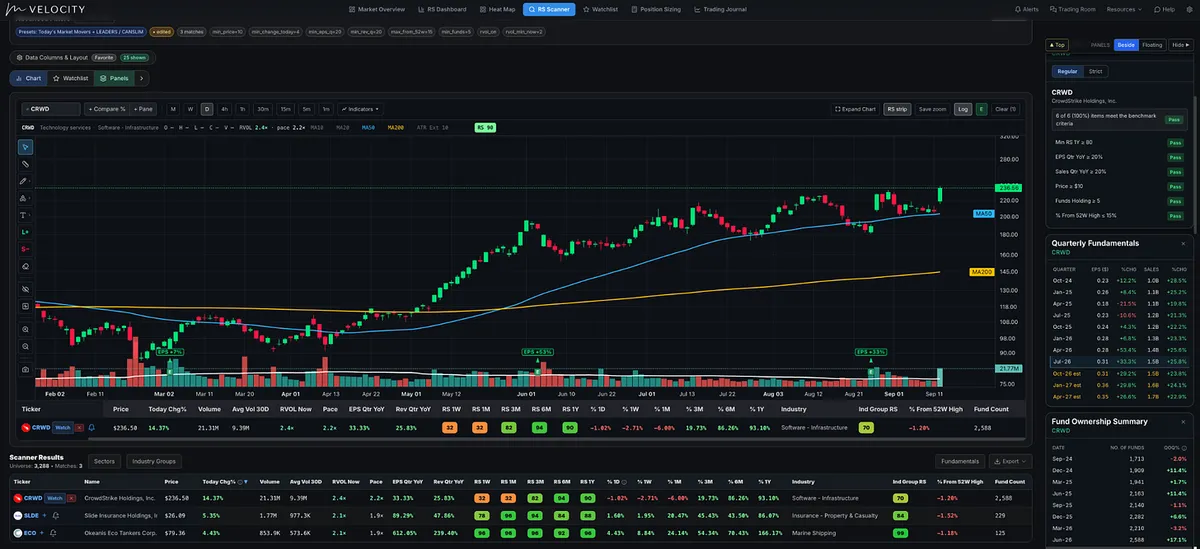
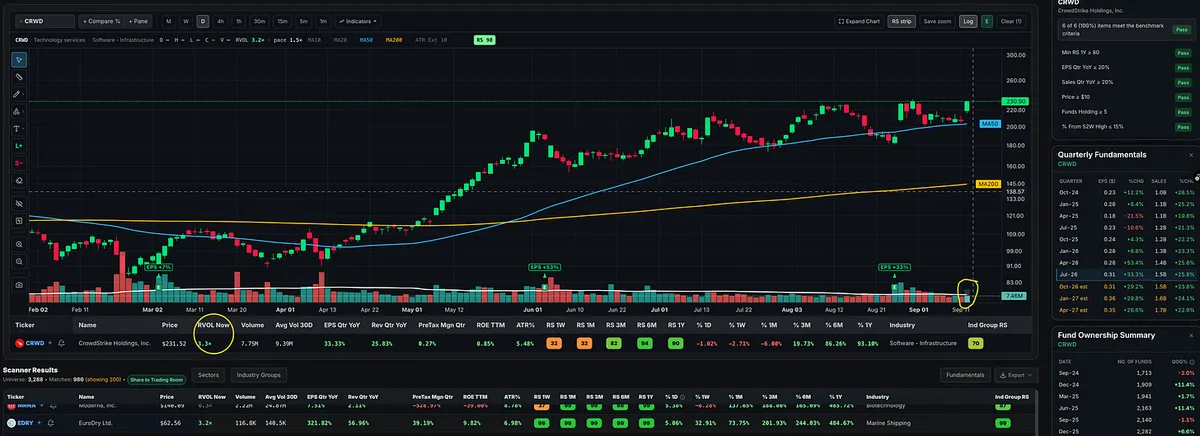
Today’s scan in MTS Velocity: find market movers meeting my CANSLIM-based earnings and sales growth criteria, with high relative strength, prices within 15% of their 52-week highs, and RVOL of at least 2.0.

My starting universe already excluded OTC stocks, stocks below $5, and names that didn’t meet my minimum volume and market cap requirements.

3,288 stocks. Just 3 matches.

The standout: $CRWD.

We spotted it near the open using RVOL Now. CrowdStrike is up 14.37%, with 2.4× RVOL Now and a 90 Relative Strength rating. Quarterly earnings per share grew 33.33% and sales grew 25.83% year over year.

Here’s why RVOL Now matters.

At say 10:15 AM, a stock’s daily volume bar can still look small. Most of the trading day hasn’t happened yet but that stock could already be trading at three times its normal volume for that time of day.

Comparing partial-day volume with a full day’s average can hide that activity.

RVOL Now compares the volume traded so far with what that stock normally trades by the same minute of the day. It uses the stock’s own last 20 sessions or whatever lookback you choose, with earnings days and half days excluded, and updates every minute.

A 3× reading at 10:15 means three times its usual volume by 10:15. You don’t have to wait for the daily volume bar to look impressive.

View on Substack ↗

You Can Lose Most of Your Trades and Still Make Money.

Mark Minervini explains that he would rather be able to remain profitable at a 25% win rate than depend on a 75% win rate.

He calls this “building in failure.”

Your stock selection, timing, and execution influence your win rate but you cannot make the next trade a winner. In a difficult market, your win rate can fall and your average gains can shrink.

If your strategy depends on being right most of the time, what happens when those conditions change?

Minervini’s approach is to keep losses small relative to gains, giving his system room to absorb losing trades.

Consider a simple example: one $400 winner and three $100 losers leave you $100 ahead before trading costs. You lost on 75% of your trades and still made money.

What matters is how your win rate, average win, and average loss work together after costs.

Build a process that leaves room for being wrong.

View on Substack ↗

Are Options Keeping You a Rookie?

In Momentum Masters, Dan Zanger says he didn’t really start making money in stocks until he stopped playing with options. Then he delivers this line:

“Rookies love options, which is why they stay rookies.”

He’s far from alone in expressing caution.

William O’Neil, Dan Zanger, and David Ryan have all described their own options use as rare. O’Neil explicitly advised investors to demonstrate success trading stocks before considering limited options use. Ryan emphasized the problem of time decay, while Zanger acknowledged occasionally finding a stock worth buying calls on.

Mark Minervini and Kristjan Kullamägi have both publicly stated that they don’t trade options. Minervini described too many factors working against the trader. Kullamägi strongly cautioned beginners against them, while acknowledging that options can add value in certain situations.

All five have expressed caution about options. That deserves attention when you’re still learning to trade.

It’s easy to understand the attraction. You have a small account, you see enormous percentage gains, and buying shares starts to feel too slow. The temptation is to reach for a bigger payoff before you’ve built a repeatable process.

But buying an option adds expiration, time decay, and changing implied volatility to the challenge of getting the stock right. You can correctly anticipate the direction and still lose money.

My takeaway: learn to trade stocks first. Build your screening criteria, study quality setups, and organize your watchlists and alerts. Refine your entries, control your position size and risk, and follow clear selling rules. Develop a repeatable process you can evaluate and improve.

View on Substack ↗

“I’ll Sell When It Comes Back.”

In How to Make Money in Stocks, William O’Neil shares a story from Fred C. Kelly that every trader should remember.

A man sets a turkey trap. Twelve turkeys walk inside, and all he has to do is pull the string.

But one walks out.

He decides to wait for it to return. Then two more leave. Now he wishes he had settled for eleven, but tells himself he’ll pull the string if just one comes back.

He keeps bargaining until every turkey is gone.

How often do we do the same thing with a stock?

You had a healthy profit. The stock starts breaking down, but you’re anchored to what the position was worth. You tell yourself, “If it just gets back to where it was yesterday, I’ll sell.”

Then yesterday’s price gets farther away, and you lower the price you’re willing to accept. The selling rule you had before entering the trade gets replaced by a negotiation with yourself.

The market has no obligation to return to the price you wish you had sold at.

Give a stock room according to your strategy. When your selling rules trigger, follow them. Hoping to recover a previous gain or avoid admitting a loss is not a reason to keep holding.

As O’Neil put it:

“To reduce your stock market risk, stop counting turkeys.”

View on Substack ↗

New in Velocity: RVOL Now

Volume is the best tell that something is happening in a stock. The problem is that at 10:15 AM, the daily bar always looks small, because most of the day hasn't traded yet. A stock can be doing three times its normal volume and you'd never know it from the chart.

RVOL Now fixes that. It compares today's volume with what that stock normally has traded by this exact minute of the day, based on its own last 20 sessions (earnings days and half days left out). 3× at 10:15 means three times its usual volume for 10:15, whether or not the daily bar shows it yet. It updates every minute.

Where you'll find it

Two new columns, RVOL Now and Pace, under Data Columns & Layout → Volume. Pace is where the day finishes if the rest of it is ordinary, so 1.4× means "already on track for a 40% above-normal day".

A new preset, Today's Vol Movers: every stock trading at 2× or more its normal volume for the time of day, sorted biggest first, live all session.

A Live Volume filter in Advanced Filters: set your own minimum, choose up or down movers only, and pick the lookback (5 to 60 sessions, or any number you like).

Ticker Lookup gives you the plain-English version: "3.5× its normal volume by 10:04 AM · on pace for 1.4× a normal day."

On the chart: intraday volume bars glow brighter when they're well above normal for that time slot and dim when below. On the daily chart, today's bar shows a faint projection of where it's heading, and the legend reads RVOL and pace.

Both chart visuals are on by default; turn them off in the Volume settings if you prefer the classic look.

Why it matters

Big volume early in the day, before the daily bar shows it, is often the first sign of institutional buying or a real breakout. This shows you that while it's still happening, not at 4 PM when everyone can see it.

View on Substack ↗

The Hard Years May Be Building Your Best Ones.

It’s hard to keep putting in the work when the reward still feels so far away. You’re trying to improve, but some days it feels like you’re standing still. Other days, it feels like you’re going backward.

But progress has never moved in a straight line. Look at human history.

There have been periods of extraordinary advancement, long stretches of stagnation, and painful transitions. Industries changed. Livelihoods disappeared. People had to adapt to a future they couldn’t yet see clearly.

Sometimes the generations enduring those difficult transitions weren’t the ones who benefited most. Their children and grandchildren inherited opportunities that the people before them had struggled to create. Looking backward, we see the progress. Living through it, they felt the uncertainty.

Your development as a person and a trader can follow a similar path, just on a smaller timescale.

You have periods when things click and you move forward quickly. Then come stretches when progress slows, weaknesses surface, and the next step demands more from you than the last one did. That doesn’t automatically mean you’re on the wrong path.

Maybe you’re learning to manage risk before chasing bigger returns. Maybe you’re refining your screening process, studying charts, or developing the patience to stop forcing trades. Sometimes you’re finally understanding a lesson you thought you had learned years ago.

That work may not immediately show up in your results. But when you use a difficult period to learn, adapt, and change your behavior, you can emerge better prepared for the opportunities ahead.

Sometimes you have to work through a tough chapter to become capable of making the most of a more prosperous one.

Not because suffering guarantees success, but because the lessons and habits you develop through it can serve you long after the struggle has passed.

Don’t judge the value of today’s work only by today’s reward. Your future self may benefit from the work your present self is struggling through.

What’s a difficult period that taught you something you still benefit from today?

View on Substack ↗

There Is No Holy Grail. Only Trade-Offs.

“There are no solutions, only trade-offs.”

—Thomas Sowell

Beginner traders can spend years searching for the holy grail: huge winners, a high win rate, tiny drawdowns, constant opportunities, and very little downside.

Eventually, the question must change from “How do I find the perfect strategy?” to “Which trade-offs am I willing and able to accept?”

But the order matters:

Choose among systems with a genuine edge, then consider which trade-offs you can sustain. Personality fit cannot substitute for positive expectancy or disciplined execution.

You are choosing among systems with evidence of positive expectancy after costs, not assuming a system works because it feels comfortable.

One system may win more often with smaller gains. Another may lose more frequently but profit from fewer, much larger winners. What matters is how your wins and losses work together.

Active intraday trading offers short-term opportunities but demands attention, quick decisions, and screen time. Holding for major trends requires patience through normal pullbacks and some giveback of open profits. Giving a winner room is not the same as letting a losing trade get out of control.

A wider initial stop gives price more room but requires a smaller position to maintain the same planned dollar risk. A tighter stop leaves less room for fluctuations.

Proven rules and disciplined risk management remain essential. As O’Neil emphasizes, adapt yourself to the market, not the market to you.

Don’t ask only, “Which system could make me the most money?” Ask, “Can I handle its losing streaks, drawdowns, holding periods, and time demands without abandoning its rules?”

A profitable system you can execute sustainably is better for you than one with higher potential returns whose demands you cannot tolerate long term. But sustainable does not mean comfortable every day.

Stop searching for a strategy with no weaknesses. Find a genuine edge, then choose the trade-offs you can live with in exchange for the strengths you want.

View on Substack ↗

Momentum and trend have worked for more than 100 years.

They’ve been studied academically, traded successfully by some of the greatest individual traders, and used systematically by major firms for decades.

That doesn’t mean they work all the time.

There are periods when momentum dominates and periods when it struggles. But over the long run, momentum and trend have continued to reappear because the forces behind them haven’t disappeared: human behavior, institutional money flows, and supply and demand.

The mistake is thinking that means you trade every market the exact same way.

Different environments favor different setups.

There are markets where momentum is working, but pullbacks, low cheats, and middle cheats are producing most of the opportunities.

Then there are markets where flat-base breakouts, VCPs, and stocks pushing into new highs are dominating.

Same underlying philosophy.

Different execution.

That’s why I believe in having a playbook, not just one setup.

Know your strategy. Know the market environment. Then adapt your execution to what the market is actually rewarding.

View on Substack ↗

He Gave You Belief in Yourself, Not Hype

One thing I always loved about William O’Neil was the integrity I saw in his teaching. I admired him as an investor, trader, businessman, and educator. But what stayed with me most was that he came across as a straight shooter, not someone willing to tell you anything to sell another IBD subscription.

Watching his old videos or reading his book, I never felt like I was being sold a fantasy. He made me believe I could learn this. He didn’t make me believe I was one secret hack away from becoming a millionaire.

In How to Make Money in Stocks, he wrote:

“You can definitely learn to invest wisely.”

But he paired that encouragement with responsibility. He emphasized serious study, learning from mistakes, and revisiting the material rather than expecting one reading to be enough. The opportunity was real, but so was the work.

The world needs more of that. Encouragement without deception. Confidence without guarantees.

That’s the message I want to pass along here.

You can learn this. Study the good books I share, work through the MTS course, and revisit the articles. But don’t confuse finishing the material with learning the skill. Don’t just read it, listen to it, or watch it once.

Absorb it. Study the charts. Practice with small risk. Review your decisions, especially the uncomfortable ones. Give yourself time to turn what you understand into what you consistently do.

You’re going to make mistakes. You’re going to have frustrating stretches. That doesn’t automatically mean you aren’t capable. It means you have something to examine, learn from, and improve.

O’Neil also wrote:

“No one can hold you back but yourself. Think positive.”

I take that as a call to take responsibility, not a promise that success is guaranteed. This is a marathon, not a sprint. Your willingness to study, practice, and keep improving matters.

You don’t need someone to convince you that trading is easy. You need to believe you can learn something difficult, then be willing to do the work.

View on Substack ↗

Before You Pick the Stock, Understand the Market.

When I read Market Wizards, one name kept catching my attention: Martin Zweig.

Michael Marcus, Bruce Kovner, Richard Dennis, Paul Tudor Jones, David Ryan, and Marty Schwartz all discussed his work, whether through praise for his analysis, recommendations, or direct consultation. That respect across very different trading styles motivated me to read Winning on Wall Street.

Zweig’s work, combined with William O’Neil’s How to Make Money in Stocks, helped shape the weekend analysis behind my Big Picture Market Pulse. O’Neil’s emphasis on market direction, the M in CAN SLIM, is central to that process.

Over the years, I kept encountering the importance of market context across different approaches, from day trading to swing trading and position trading.

Dr. Van Tharp stressed that traders need to understand the conditions in which their strategy works. Expecting the same system to perform well in every market environment is a mistake he repeatedly warned against. His explanation of market types is worth reading.

Even for intraday traders, context matters. Mike Bellafiore, co-founder of SMB Capital and author of One Good Trade, places understanding the big picture at the beginning of his trade-analysis framework in The PlayBook.

That is why I spend time each weekend studying the indexes, industry groups, market indicators, relative strength leadership, and macro backdrop. It helps me decide whether conditions support my style of trading.

A promising stock setup still needs to be considered in the environment surrounding it.

Before you dive into screening stocks and planning next week’s trades, take a step back. Look at what the broader market is doing, whether leading stocks are following through, and how your own trades are behaving.

That preparation is the purpose behind every Big Picture Market Pulse.

View on Substack ↗

See the Entire Market in 10 Seconds

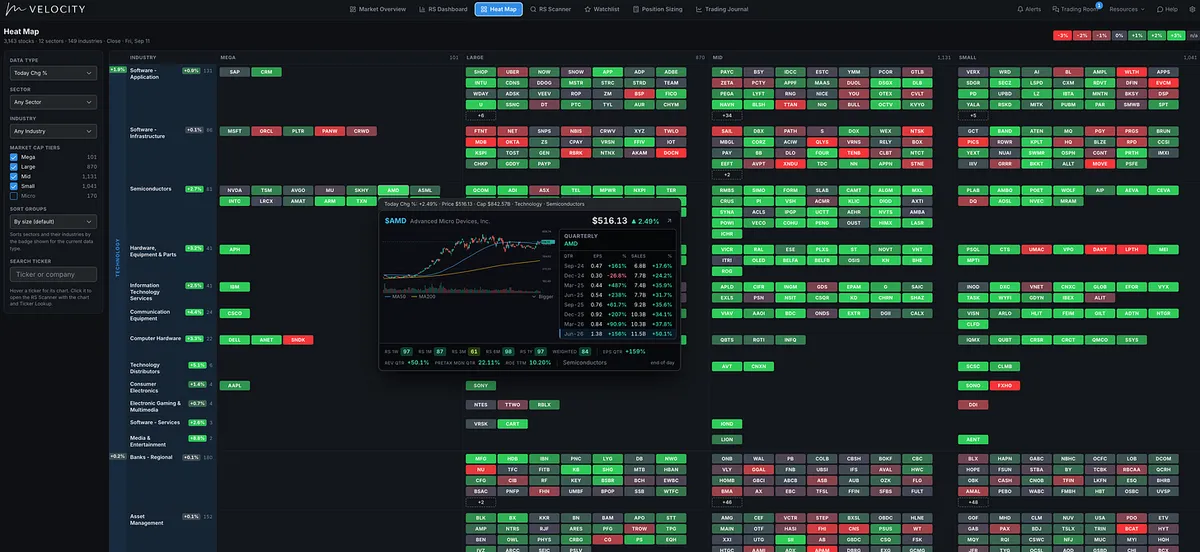
We just pushed a new Matrix Heat Map live inside MTS Velocity, and this is quickly becoming one of my favorite ways to scan the market.

Instead of flipping through hundreds of charts trying to figure out where strength is concentrating, you can see it immediately across sectors, industries, and market-cap tiers.

You can sort the entire market by:

• Price performance

• Relative Strength across multiple timeframes

• Custom Relative Strength periods

• MTS Score, our proprietary composite ranking

• Market cap and size

The real value is being able to quickly answer questions like:

Where is the money flowing?

Which industries are showing broad strength?

Are the leaders mega caps, small caps, or somewhere in between?Which stocks are separating themselves from their peers?

Hover over a ticker and you can instantly see the chart, Relative Strength readings, earnings and sales growth, margins, and other key data.

Then, if something catches your eye, just click the ticker and it opens directly inside the RS Scanner for deeper research.

Big shoutout to Raj for suggesting this feature. So many of the best additions to MTS Velocity have come directly from ideas shared by MTS members, and I really appreciate everyone helping shape the platform into something better.

If you already have access to MTS Velocity, go give the new Heat Map a whirl and let me know what you think.

View on Substack ↗

The Earnings Catalyst That Can Start a Major Move

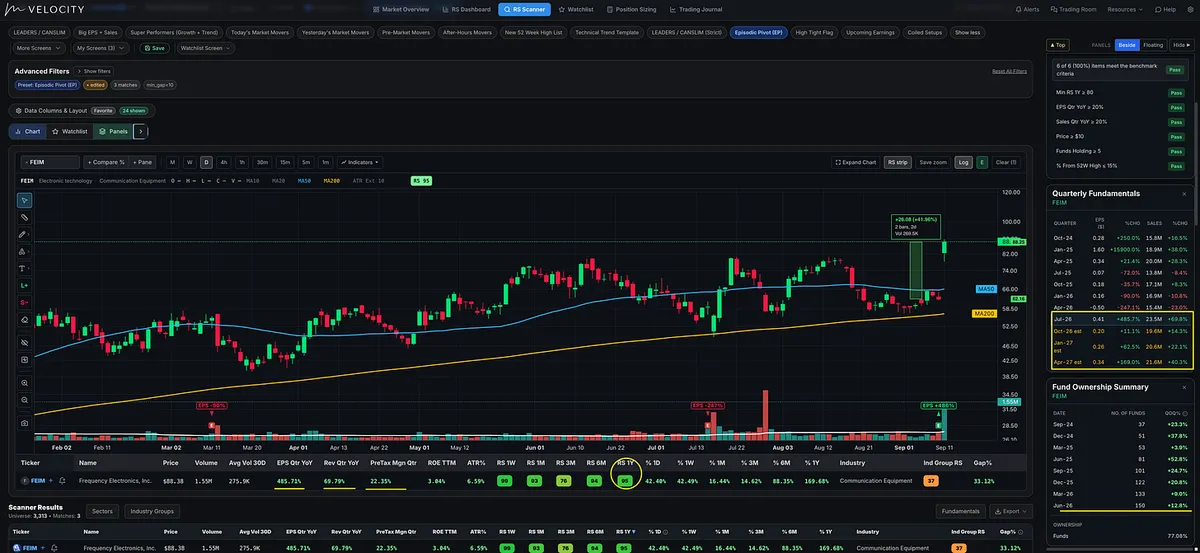
FEIM is a great example of what I mean by an earnings catalyst. The company reported roughly +486% EPS growth and +70% sales growth, and the stock responded with an explosive move on heavy volume.

This is the type of earnings catalyst that has shown up repeatedly in the work of O’Neil, Minervini, Zanger, and Kullamägi.

Different traders, different terminology, but the same underlying idea: a major fundamental surprise can cause the market to rapidly reprice a stock, and the resulting price and volume expansion tells us institutions may be paying attention.

View on Substack ↗

Your Last Five Trades May Tell You More About the Market Than the Index

William O’Neil made a point that I think is one of the most useful market indicators there is:

Pay attention to what is happening with your own recent trades.

If you’ve bought four or five quality setups and none of them are gaining traction, breakouts are failing, stocks are reversing after entry, and positions that should be working simply aren’t, the market may be telling you something before it becomes obvious in the indexes.

There is an important caveat.

This only works if you have learned how to trade, have a defined system, are selecting legitimate setups, managing risk correctly, and have your emotions under control.

If you’re chasing extended stocks, forcing trades, buying mediocre setups, or breaking your rules, your results may be telling you more about your trading than the market.

But once your process is sound and repeatable, I believe the behavior of your individual stocks is one of the best market indicators you can have.

This is also why Mark Minervini talks so much about watching individual stocks. The indexes can look healthy while fewer leaders are setting up, breakouts are failing, and your initial positions aren't gaining traction. Conversely, leading stocks can begin acting well before the indexes make the turn obvious.

The stocks often have the final word.

If I put out a few pilot positions and they immediately start working, holding gains, and offering additional opportunities, I can progressively increase exposure.

If those positions repeatedly fail, I don't need to argue with the market.

I back off.