Momentum Trading Strategy

Notes

Short lessons on momentum trading, every day.

Every note from Substack, in one place: risk, setups, leading stocks, market conditions and the mindset behind them. Search them, browse by topic, or filter by stock.

Showing 1021–1040 of 1230 notes

View on Substack ↗

10 Jesse Livermore Quotes That Still Run the Market

Markets change. Technology changes. Instruments change. Human behavior does not.

More than a century ago, Jesse Livermore distilled the market down to a handful of rules rooted in psychology, discipline, and price behavior. What is remarkable is not how old these ideas are, but how perfectly they still describe modern markets. If you study the great traders who came after him, the Market Wizards, you will find these same principles repeated again and again in different words. Different styles, same foundation.

  1. Markets vs opinions “Markets are never wrong, opinions often are.” Price is the final authority, not forecasts or beliefs.

  2. Cut losses immediately “Profits always take care of themselves, but losses never do.” This is the foundation of all real risk management.

  3. Never average down “Never average losses. Let that thought be written indelibly upon your mind.” Averaging down destroys capital and judgment.

  4. Wait for confirmation “Do not anticipate and move without market confirmation. Being a little late in your trade is your insurance that you are right.” Confirmation beats prediction every time.

  5. Big money is made by sitting “The real money made in speculating has been in commitments showing a profit right from the start.” Great trades work early and are held, not micromanaged.

  6. Let winners run “As long as a stock is acting right, and the market is right, do not be in a hurry to take a profit.” Most traders exit winners far too early.

  7. Speculation is a business “Anyone who is inclined to speculate should look at speculation as a business and treat it as such, not as a gamble.” Rules and process separate professionals from gamblers.

  8. Few opportunities matter “There are only a few times a year when you should allow yourself to make a commitment at all.” Overtrading destroys edge.

  9. Follow leaders, not laggards “If you cannot make money out of the leading active issues, you are not going to make money out of the stock market.” Leadership is where real money flows.

  10. Patience is the edge “It was never my thinking that made the big money for me. It was my sitting.” Patience compounds returns.

These ten rules quietly sit beneath nearly every successful trading approach that followed. You will hear them echoed by trend followers, growth investors, macro traders, and discretionary operators alike. The language changes, the charts change, but the principles remain untouched. Markets still reward discipline, patience, and alignment with price.

Ignore these rules and the market will eventually teach them to you the expensive way. Internalize them, and you begin to see price differently. Not as noise, but as information.

Markets reward patience, regardless of timeframe.
View on Substack ↗

Nobody wants to hear this in the trading community, which is exactly why it needs to be said.

Trade smaller. Reduce position size.

This one change solves more problems than almost anything else.

Trading smaller: • Drastically reduces emotional mistakes • Allows for proper stop placement • Gets you comfortable taking small losses • Makes it easier to let winners run • Keeps you in the game long enough to actually learn

Most traders are not losing because of bad ideas. They are losing because they are trading too big.

Instead of just hearing it from me or reading it in books, you eventually get to see it work in real time once you commit to it.

Bruce Kovner said it best:

“First, I would say that risk management is the most important thing to be well understood. Under trade, under trade, under trade is my second piece of advice. Whatever you think your position ought to be, cut it at least in half. My experience with novice traders is that they trade three to five times too big. They are taking 5 to 10 percent risks on a trade when they should be taking 1 to 2 percent risks.”

And Richard Dennis:

“Trade small because that’s when you are as bad as you are ever going to be. Learn from your mistakes. Don’t be misled by the day to day fluctuations in your equity. Focus on whether what you are doing is right, not on the random nature of any single trade’s outcome.”

This is common sense. But many are not doing it.

And then they wonder why they are not getting the results they want.

If you fix position size, everything else becomes easier.

View on Substack ↗

Great question from a reader today that every trader should think about.

Hard stops vs soft stops.

If you are even asking this question, you are already ahead of most traders.

The short answer is this: For most people, especially beginners, hard stops are the right default. They remove discretion, protect capital, and prevent small losses from turning into devastating ones.

Soft stops can make sense on daily and weekly charts when your strategy is based on closing prices, not intraday noise. But they require experience, discipline, and the ability to execute without hesitation. Most traders are not there yet.

One important alternative many overlook is placing a hard stop slightly beyond the obvious technical level and reducing position size. Wider stop, smaller size, same risk. This accounts for intraday volatility while keeping protection in place.

Getting stopped out and watching a trade work later is frustrating. Taking a large loss because you hesitated is far worse.

Capital protection is not optional. It is the price of staying in the game.

Awesome question. The fact that traders are thinking this way tells me they are moving in the right direction.

View on Substack ↗

Great question, and the fact that you are thinking this through is exactly what is needed.

I would need to see more of your trading to answer this fully, but here is what I will say.

For most people, especially beginners, hard stops are the correct answer. I think the majority of Market Wizards would support that in practice, even if their execution evolved over time.

Yes, traders like Paul Tudor Jones used discretionary or soft stops, but he was the exception, not the norm, and that came after years of experience and strict risk discipline. His success was not because he avoided hard stops, but because he had the ability to exit immediately when something was wrong.

I have seen far too many traders misuse soft stops. What starts as discretion often turns into hesitation, rationalization, and small losses becoming devastating ones.

If a hard stop is placed with enough room for the trade to breathe, aligned with the technical breakdown of the trade, and at the same level where you would exit anyway using a soft stop, there is little reason not to make it a hard stop.

Now, on daily and weekly charts, many traders base decisions on the closing price, not intraday volatility. A stock can dip below support intraday, trigger stops, and still close strong at or above that same level. This is one reason I support soft stops when the strategy is built around closing prices and the goal is to avoid getting shaken out by normal intraday noise.

That said, this also depends heavily on the ADR of the stock and the size of its normal swings. There are plenty of scenarios where waiting for the close would have resulted in far more damage than exiting intraday. In those cases, an intraday hard stop would have been the correct decision.

Ultimately, this comes down to strategy and style. Timeframe, volatility, and execution all matter.

There is also a third option that many traders overlook.

Instead of choosing between hard and soft stops, you can place a hard stop further away than the exact technical level to account for normal intraday volatility and potential stop runs. When you do this, the adjustment is not the stop itself, but the position size.

You intentionally:

• Place the hard stop beyond the obvious technical level

• Assume intraday spikes and noise can happen

• Reduce position size more than usual so the wider stop still fits within your risk limits

This approach keeps the discipline and protection of a hard stop while reducing the chance of being shaken out by noise. The tradeoff is a smaller position and lower emotional pressure.

If you are conflicted about which approach to use, that is usually a sign that a hard stop is the right starting point. Hard stops remove discretion while you are still building experience and emotional consistency. Soft stops work best only after you have proven, over time, that you can execute exits without hesitation.

Getting stopped out and then seeing a trade work is simply part of trading. That outcome is far preferable to the alternative, which is holding through a real breakdown and taking a loss that damages or ends your ability to continue trading.

Hard stops protect capital. Capital protection is non-negotiable.

Quoting James dozier
View on Substack ↗

Great question and a very real challenge.

This is exactly why I always come back to the full CANSLIM framework, not price action alone.

To filter out meme stocks, I start with the fundamentals.

• Strong and accelerating earnings, sales, and margins

• A real catalyst, such as a new product, service, or structural shift in the business

• Alignment with a leading industry group or market theme

• Rising institutional sponsorship, quarter over quarter

All of this data is readily available on tools like MarketSurge and will usually eliminate pure meme stocks very quickly.

Where it gets tricky is with small and mid-cap leaders, because they can look similar to meme stocks in the early stages. These names are naturally more volatile and often move fast when institutions begin building positions.

That is where risk management and position sizing matter.

Relative strength on its own can absolutely capture meme stocks. That is why RS should never be used in isolation. When you combine relative strength with CANSLIM fundamentals, you dramatically reduce false positives and improve the odds that you are participating in a real institutional move, not a temporary crowd driven spike.

Price tells you when to act.

Fundamentals tell you what is worth acting on.

That combination is what separates leaders from noise.

ArticleThe Best Trades Put You in the Money Immediately and Never Look Back
View on Substack ↗

Most traders don’t lose because they’re wrong.

They lose because their stops don’t match how markets actually move.

Stops placed for comfort get hit. Stops placed with structure survive volatility.

This is why you keep getting stopped out even when your idea is right, and how professionals actually think about stops, position sizing, and risk.

Read it here 👇 https://tradingmomentum.substack.com/p/why-you-keep-getting-stopped-out

ArticleWhy You Keep Getting Stopped Out Even When You Are Right
View on Substack ↗

Why Stock Screens Find Candidates but Charts Find Winners

One of the biggest mistakes traders make with stock screening is treating it like a final answer instead of a starting point.

Screens are powerful.

They narrow the universe.

They save time.

They force discipline.

Every great trader uses them.

But screens alone do not make you money.

Mark Minervini talks extensively about screening for strength, earnings, sales, and leadership. What often gets missed is what comes next. Screening is only the first filter, not the decision.

Even today, with AI, algorithms, and real time data, nothing replaces visually screening stocks yourself.

Charts reveal things screens cannot:

- Tight price action

- Volatility contraction

- Subtle accumulation

- Clean support behavior

- Where risk is actually defined

Screens are binary. Charts are contextual.

Another common mistake is taking screening criteria too far.

Make your rules too strict and you eliminate future leaders before they ever have a chance to appear. Many great stocks do not look perfect yet. They evolve into leaders.

A stock may meet 9 out of 10 requirements and still become a major winner, but you will never see it if your filters demand perfection. That is why separating scans matters.

Run one scan for relative strength.

Run one for earnings and sales.

Run one for price action.

Sometime you will see the same names on multiple scans, which can be a powerful signal.

Looser screens do not lower standards. They allow you to spot leaders earlier, before the crowd.

Make your rules too loose and you drown in noise.

The goal is balance.

Use screens to find potential.

Use charts to confirm behavior.

Use judgment to decide timing and risk.

This approach is not new. Minervini did not invent it. He refined it by studying the same greats who came before him.

This is why trading is both an art and a science. There is no perfect formula I can give you, but this may help you recognize whether your screening is too strict or not strict enough.

View on Substack ↗

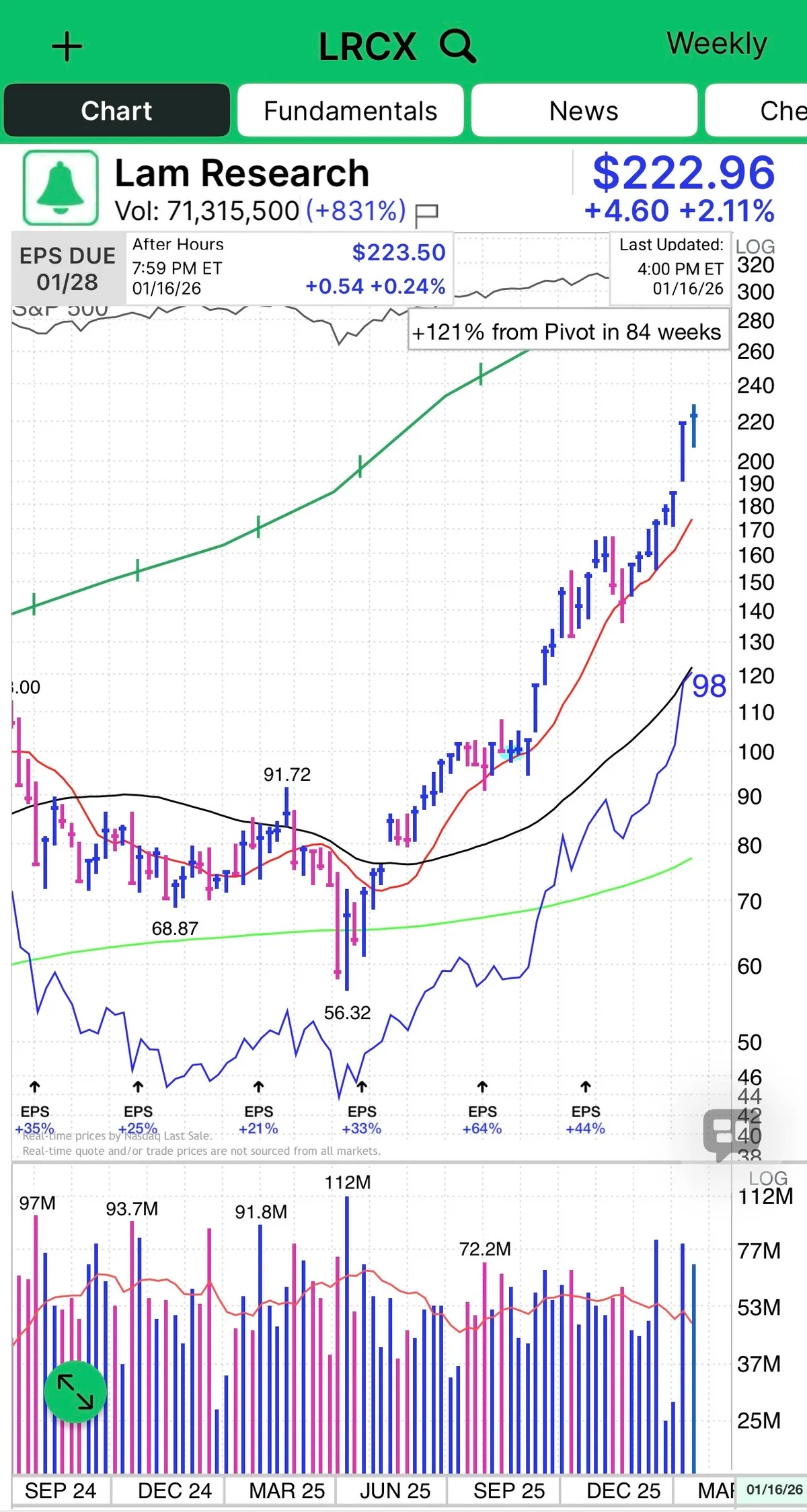
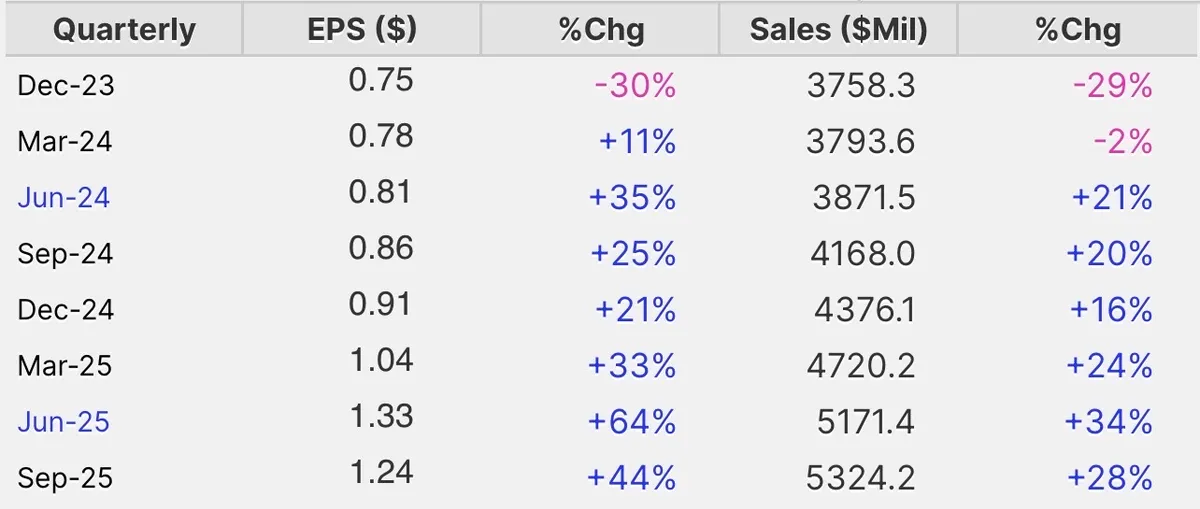
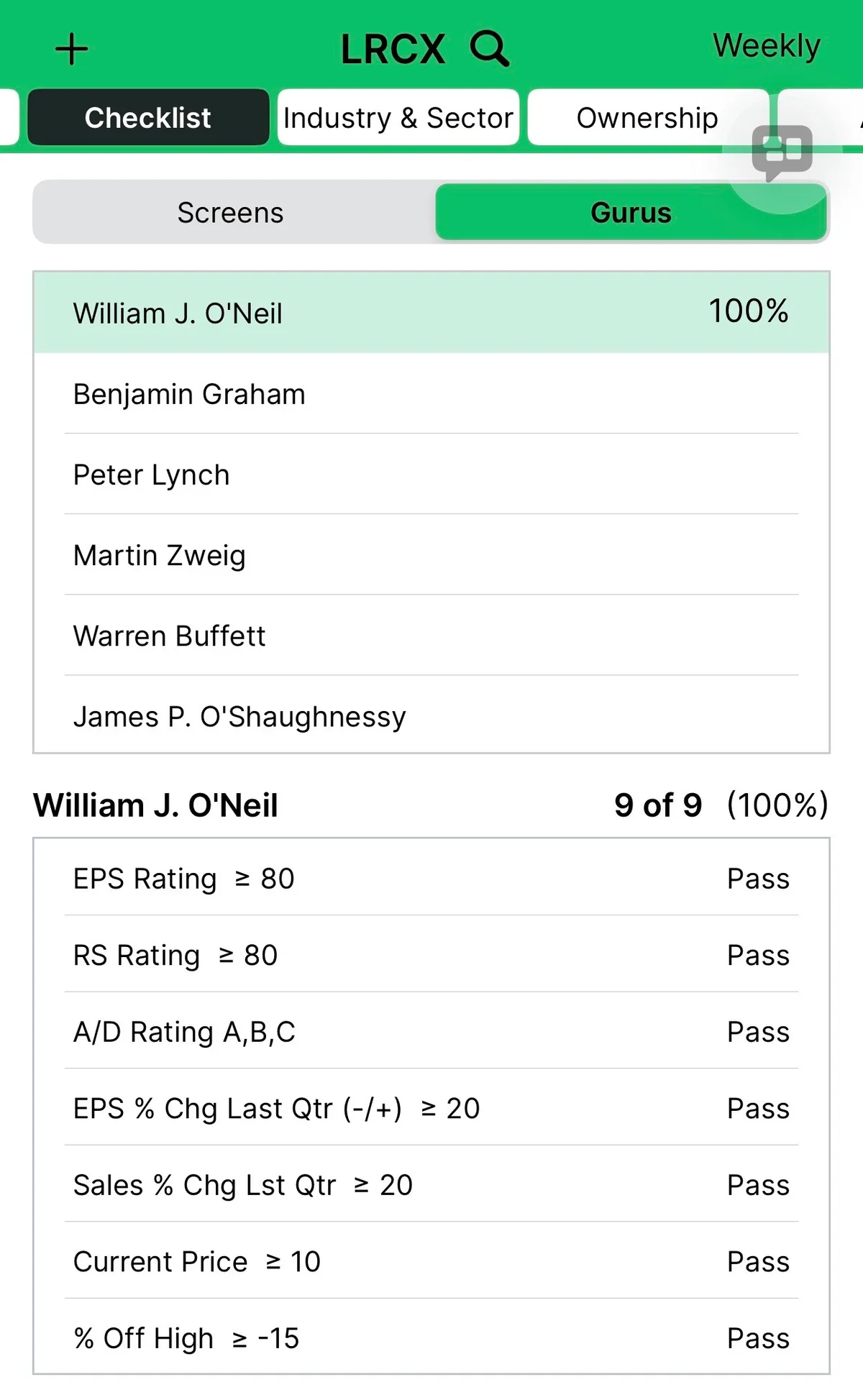
LRCX: A Textbook CANSLIM Leader With Ideal Price and Volume Action

Lam Research is a textbook CANSLIM name and a clean example of how price and volume tell the story before headlines do.

This is what leadership looks like.

  • Strong earnings and sales growth.

  • High ROE.

  • RS in the upper 90s.

  • Institutional sponsorship building.

  • Industry group strength tied directly to the AI Theme.

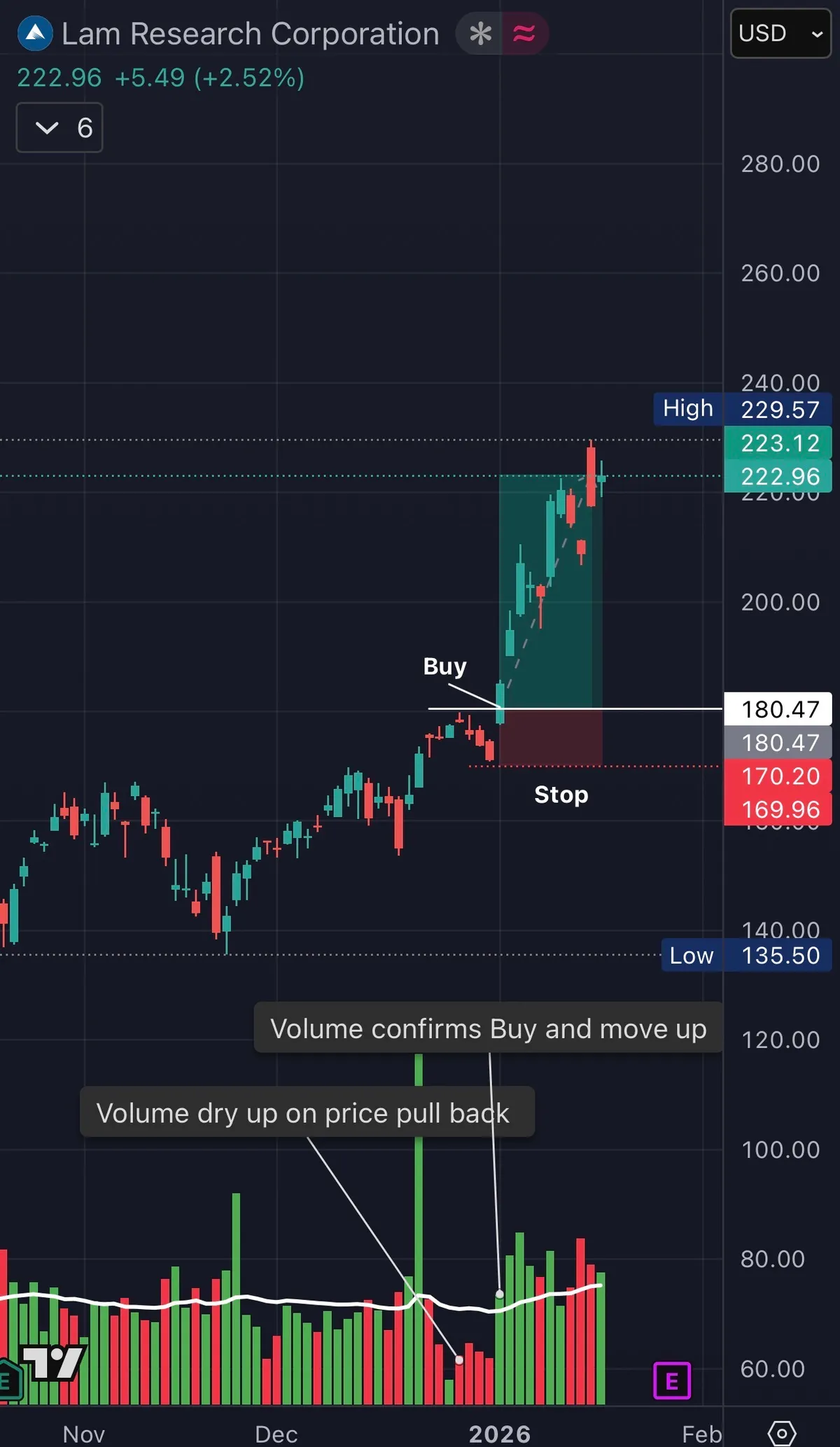
But the real tell is the volume price relationship.

You get volume drying up on pullback.

You get volume confirmation on the breakout.

Strong chart on the weekly and daily timeframe.

That combination is not random. That is professional accumulation.

This is how winners behave:

  • Demand shows up when price moves up

  • Supply disappears when price pulls back

  • Relative strength expands before most traders notice

Semiconductor equipment is one of the engines behind this bull cycle, and LRCX sits right in the middle of the AI buildout. When a stock checks every CANSLIM box and then confirms it with clean volume behavior, you pay attention.

This is not prediction.

This is recognition.

Price action is bullish with higher highs and higher lows. Volume is an indicator and confirms the move. Fundamentals support.

That is how real leaders are identified.

View on Substack ↗

Most Profitable Traders Spend More Time Doing Nothing

One of the most misunderstood edges in trading is inactivity.

Most traders believe success comes from constant participation. More scans. More trades. More action. That mindset quietly destroys performance.

Markets do not offer opportunity evenly. They compress it.

A large portion of meaningful gains tend to occur in short windows when conditions align. Strong trends. Expanding volume. Clear leadership. Broad participation. Outside of those windows, the market mostly produces noise.

This is why overtrading is so dangerous. You spend capital and emotional energy during low-quality periods and arrive exhausted when the real opportunity finally appears.

Jesse Livermore understood this long before modern markets existed.

“There are only a few times in a year when a trader should make a commitment.”

And

“It was never my thinking that made the big money for me. It was my sitting.”

Great traders internalize this idea. They wait. They observe. They protect capital. They accept boredom as part of the process.

This behavior aligns with how trading returns actually work. Outcomes follow power law dynamics. A small number of trades and a small number of market phases drive most long-term results. The rest are largely irrelevant or harmful.

By staying selective, you preserve capital, confidence, and focus so you can act decisively when conditions improve. You are not trying to force profits from an average market. You are waiting for moments that justify risk.

This is also why many traders feel like they are always late. They burn themselves out during the wrong phases and miss the right ones.

The answer is not trading more.

The answer is knowing when not to trade.

View on Substack ↗

Power Law Dynamics Explain Why A Few Trades Matter More Than All the Others

Most traders misunderstand their results because they assume trading returns behave like averages.

They do not.

Trading returns follow power law dynamics. A small number of large winning trades account for the majority of long-term profits, while most trades produce small gains, small losses, or break-even outcomes.

This is why averages are misleading. The mean return is not representative of how money is actually made. One or two exceptional trades can outweigh dozens of ordinary ones and completely skew the statistics.

Those big winners are not a bonus. They are a requirement.

In power law systems, success is driven by extremes, not consistency around the average. Markets behave this way because price movement is driven by feedback, momentum, and participation. When conditions align, trends extend far beyond what feels reasonable, and those rare extensions dominate returns.

This is also why many traders struggle even with solid systems. They cut winners early, reduce size as trades work, or stop trading before the outliers appear. By doing so, they remove the very outcomes their edge depends on.

Markets are also fractal in structure. The same price behavior appears across all timeframes. Trends, consolidations, breakouts, and failures repeat whether you are looking at a five-minute chart or a multi-year chart. The structure stays the same. Only the scale changes.

Power law returns explain why a few trades matter most. Fractal structure explains why the same setups keep appearing.

Put together, the lesson is simple.

Most trades are noise. A few trades drive nearly all meaningful results. Your job is not to optimize for the average trade. Your job is to manage risk well enough to survive the noise and stay positioned for the rare but decisive move.

The goal is not to be right often.

The goal is to still be in the trade when the big winner shows up.

View on Substack ↗

If Your Watchlist Is Too Big, You Are Not Being Strict Enough

I received a great question recently about how to slim down a watchlist that has grown too large.

First, having too many names is not a bad problem. In fact, it often signals a healthy market. Especially now, when leadership is broader and no longer limited to just a handful of mega-cap stocks like earlier in the bull cycle.

The challenge is not finding ideas. The challenge is filtering them.

For me, the answer is simple. Get stricter with CANSLIM.

Tightening your criteria will usually shrink your watchlist down to just a few names, and that is a good thing. Nothing works 100 percent of the time, but I have found that the probabilities improve as your standards move closer to the characteristics of the biggest market winners in history.

Fifty percent earnings growth is better than twenty five percent. Surging volume is better than average volume. Accelerating institutional demand is better than slow or stagnant ownership.

In How to Make Money in Stocks, William O’Neil goes deep into each letter of CAN SLIM and clearly separates what the greatest winners actually had from what was merely acceptable.

A large watchlist means the market is healthy. A refined watchlist means you are focused.

The goal is not to find stocks that qualify. The goal is to find stocks that stand out.

Do you have a scanner that helps you do that? I use MarketSurge, and I also build my own custom scanners in TradingView to aggressively filter for the highest-quality setups.

This is a reminder to revisit the chapters that go in depth on each letter of CAN SLIM. You may realize you have been overlooking powerful filters O’Neil discussed, such as the relationship between sales and earnings, along with the importance of healthy margins and strong return on equity.

View on Substack ↗

“There are only a few times a year when you should allow yourself to make a commitment at all.” — Jesse Livermore

Many people try to treat trading like a job where they earn a consistent paycheck. That is not how markets work. You may go six months where conditions are not conducive to your strategy, and then make your entire year in a one to three month window.

Livermore said this over a century ago, and it is still true today. Entrepreneurs understand this instinctively, and so do successful traders and investors.

Markets reward patience at every timeframe.

View on Substack ↗

“The real money made in speculating has been: ‘IN COMMITMENTS IN A STOCK OR COMMODITY SHOWING A PROFIT RIGHT FROM THE START.’” — Jesse Livermore

This one sentence reveals a trading behavior most professionals have known for decades and most retail traders still miss.

I break down why this matters, and how the biggest stock winners in history behave exactly this way.

If your trade needs time to work, it’s already telling you something.

👉 https://tradingmomentum.substack.com/p/the-best-trades-put-you-in-the-money

ArticleThe Best Trades Put You in the Money Immediately and Never Look Back
View on Substack ↗

The best trades work from the start.

They put you in the money immediately and never look back.

I break down why the biggest stock winners over the last 100 years behave this way, and how Jesse Livermore figured it out long ago.

If your trade needs time to work, it is already telling you something.

The full article is live:

https://tradingmomentum.substack.com/p/the-best-trades-put-you-in-the-money

ArticleThe Best Trades Put You in the Money Immediately and Never Look Back
View on Substack ↗

Why Risk Control Comes Before Everything

Most traders obsess over entries. Some obsess over indicators. Almost none obsess enough over risk.

“Risk control is the most important thing in trading.” — Paul Tudor Jones

That sentence explains why some traders last decades and most don’t.

You can be wrong and survive with good risk control. You can be right and still fail without it.

Risk control:

  • Keeps you in the game

  • Protects you from emotional decisions

  • Turns mistakes into tuition instead of disasters

The market does not reward boldness without survival.

If you can control risk, everything else has time to improve.

If you can’t, nothing else matters.

View on Substack ↗

Trading Is Hard. That Doesn’t Mean It Can’t Be Done.

Trading can be learned.

It is difficult. The odds of success are low. Most people quit.

But that is true of many demanding professions.

Very few succeed, not because it is impossible, but because it requires discipline, mentorship, and years of deliberate practice.

The best way to shorten the learning curve is not guessing. It is modeling.

The greatest traders did not invent success from scratch. They studied others. They borrowed frameworks. They refined what already worked.

“Right now, I consider myself to be an expert modeler. By that, I mean that if someone can do something well, then I can figure out how they do it and teach those skills to anyone else.” — Dr. Van K. Tharp

That is the mindset.

You do not need to be a genius. You need to study people who have already done it well.

Trading is not magic. It is a skill.

And like any difficult skill, it rewards those willing to learn from the best, put in the work, and stay in the game long enough to master it.

View on Substack ↗

Why Great Traders Hold Two Opposing Beliefs at Once

You need confidence to take a trade, but also humility to survive.

Lose either one, and trading breaks down.

“You need to believe in something, but at the same time, you are going to be wrong a considerable number of times. The balance between confidence and humility is best learned through extensive experience and mistakes. There should be a respect for the person on the other side of the trade. Always ask yourself: Why does he want to sell? What does he know that I don’t? Finally, you have to be intellectually honest with yourself and others. In my judgment, all great traders are seekers of truth.” — Michael Steinhardt, Market Wizards

That word matters: balance.

Confidence without humility becomes arrogance. Humility without confidence becomes hesitation.

Great traders hold both at the same time.

They believe enough to put risk on. They doubt enough to manage it.

They respect the trader on the other side of the trade. They assume opposing information exists.

This is not weakness. It is professionalism.

The market does not reward certainty. It does not reward doubt either.

It rewards balance of the two.

View on Substack ↗

Why Price Targets Quietly Sabotage Traders

If you have ever sold too early because you “hit your target,” If you have ever watched price keep going without you, If you have ever been right on direction but wrong on outcome, this is for you.

“I’m also a firm believer in predicting price direction, but not magnitude. I don’t set price targets. I get out when the market action tells me it’s time to get out, rather than based on any consideration of how far the price has gone.” — Linda Bradford Raschke

Direction is a thesis. Magnitude is unknowable.

Most traders try to predict both. That is where problems begin.

Price targets feel responsible. They feel disciplined. They feel like control.

But markets do not move in neat, predictable distances.

They move until they don’t.

When you anchor to a target, you stop listening to price. You exit because a number was reached, not because the market changed.

That is how traders cut winners short.

The best traders do not ask, “How far can this go?” They ask, “Is the behavior still intact?”

As long as structure holds, they stay. When behavior changes, they leave.

No guessing. No attachment. No arbitrary exits.

This is not about being reckless. Risk is still defined. Stops still exist.

The difference is how profits are handled.

Targets assume you know the future. Market action tells you what is happening now.

Professionals choose now.

Manage risk. Let the market decide magnitude.

That is how big winners happen.

View on Substack ↗

Why One Trade Should Never Matter to You

If one trade can ruin your day, if one loss can change how you trade the next setup, if one win makes you feel invincible, this mindset will change everything.

“I would tell that trader to think of each trade as one of the next one thousand trades he’s going to make. If you start thinking in terms of the next one thousand trades, all of a sudden you’ve made any single trade seem very inconsequential. Who cares if a particular trade is a winner or a loser? It’s just another trade.” — Tom Basso, Market Wizards

One trade is not special. One trade is not important. One trade does not define you.

It is simply one data point in a very long series.

Most traders do the opposite.

They give one trade too much meaning. They attach emotion to the outcome. They let a single result influence the next decision.

That is how discipline breaks down.

When you zoom out to the next one thousand trades, something powerful happens.

Fear loses its grip. Ego gets quieter. Patience increases.

You stop trying to be right on this trade. You start trying to execute well over time.

That is how professionals think.

When you think in thousands, losses feel smaller. Wins feel less intoxicating. Consistency becomes possible.

And here is the part most traders miss.

Many of your biggest winners will not be the ones you anticipated. They rarely feel special at entry. They only become special because you stayed disciplined long enough to let them work.

If you try to predict which trade will matter most, you will almost always be wrong.

So stop assigning importance to individual outcomes. Manage risk. Execute the process. Let the probabilities decide.

One trade does not matter.

The next thousand do.

View on Substack ↗

Stop Letting Your Last Trade Ruin the Next One

If you have ever replayed a mistake in your head, If you have ever hesitated because of the last loss, If you have ever traded differently just to “make it back,”

You know this feeling all too well.

You are not trading the market. You are trading your memory.

“I think one of my strengths is that I view anything that has happened up to the present point in time as history. I really don’t care about the mistake I made three seconds ago in the market. What I care about is what I am going to do from the next moment on. I try to avoid any emotional attachment to a market. I avoid letting my trading opinions be influenced by comments I may have made on the record about a market.” — Paul Tudor Jones

This is not about ignoring mistakes. It is about handling them correctly.

You learn the lesson. You take the information forward. And then you let it go.

Because if you do not, the mistake does not stay in the past. It starts trading for you.

The best performers in every field understand this.

The greatest baseball players fail about 70 percent of the time at the plate. The best soccer players only score on 10 to 20 percent of their shots.

Yet they step back into the box. They take the next shot. They do not carry the last miss into the next attempt.

They have what professionals call short-term memory.

Not because they do not care. Because they care enough to protect their performance.

Most traders do the opposite.

They hesitate after a loss. They overtrade after a win. They defend opinions instead of managing risk.

Not because they lack strategy. Because emotion from the last trade is driving the next one.

But the market does not reward memory. It rewards clarity.

The professionals reset. They detach. They respond to what is happening now, not what just happened.

When you stop trading your past: You manage risk instead of ego. You execute instead of react. You follow process instead of emotion.

That is real trading psychology. That is discipline. That is how consistency is built.

Learn from the mistake. Take the lesson with you. Then let it go.

The next decision is all that matters.