Momentum Trading Strategy

Notes

Short lessons on momentum trading, every day.

Every note from Substack, in one place: risk, setups, leading stocks, market conditions and the mindset behind them. Search them, browse by topic, or filter by stock.

Showing 1001–1020 of 1230 notes

View on Substack ↗

The Fastest Way to Lose Is to Focus on Money

One of the biggest mistakes traders make is focusing on making money before they focus on making good trades.

Money is an outcome. Process is the input.

If your position size is large enough to make you emotional, it is too large. When size is too big, fear and greed take over. You hesitate on entries, cut winners early, let losers run, and abandon your rules at the worst possible time.

The solution is simple. Reduce your position size so small that the outcome barely matters.

When the pressure is gone, you can finally focus on what actually improves performance: Entry quality Risk management Following your rules Reducing mistakes

This is how skill is built.

Once you can execute your process consistently and you start to see positive expectancy, then and only then do you increase size. Gradually. Intentionally. Without changing the way you trade.

Most people skip this step. They jump straight into trading big size because they want results fast. The problem is they never last long enough to see their system work. Or worse, they find out it does not work after they have already lost too much capital to continue.

The traders who survive and eventually thrive all do the same thing. They protect their capital. They master the process. They let size come last.
View on Substack ↗

The Pullback That Pays

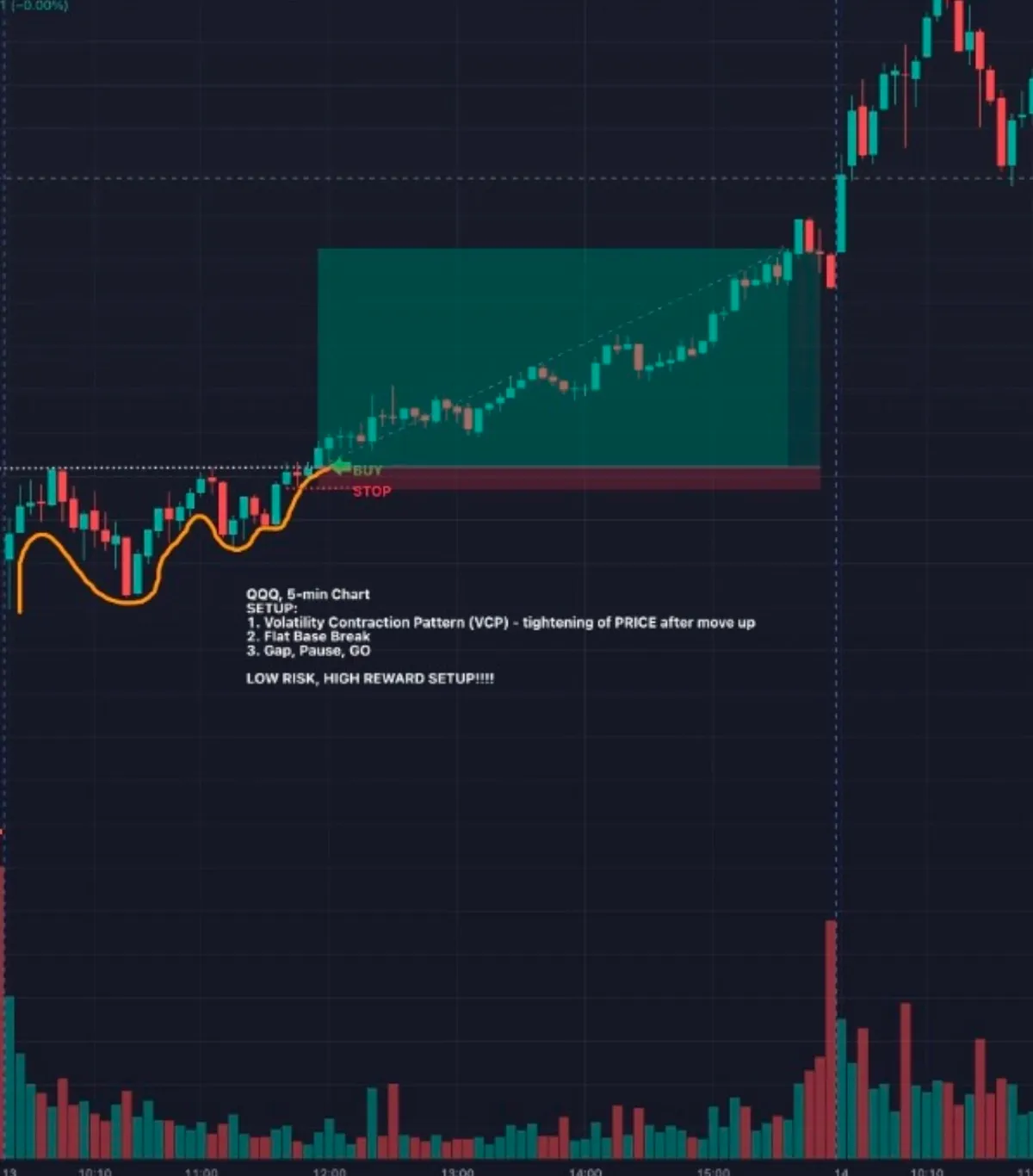
One of the cleanest and lowest risk setups you will ever see.

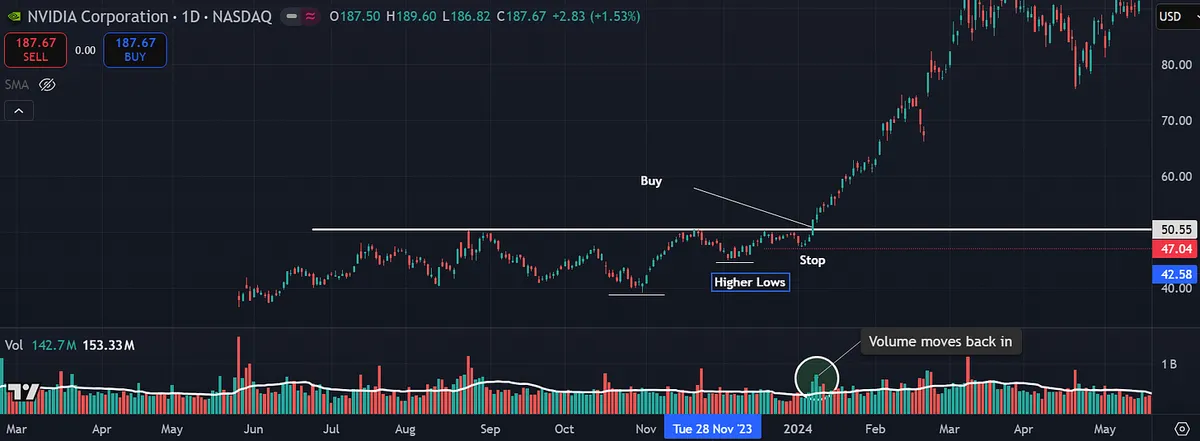
A big move up on heavy volume.

Then something important happens. Price begins to contract. The pullback is orderly. Volume dries up. Selling pressure fades instead of accelerating. You often see a series of higher lows, even while price moves sideways.

That combination matters.

It tells you the move is being absorbed, not rejected.

When price finally breaks out above the prior high and volume starts to move back in, you get the next leg higher.

This is one of the best low risk, high reward setups in trading.

Risk is tight. The invalidation point is clear. If it fails, you are out quickly. If it works, the upside can be significant.

These setups are rare, which is what makes them valuable. You cannot force them. You wait. You prepare. You act when price confirms.

The best part, this works on all timeframes. Intraday, swing, position. The structure does not change.

Rare, but gold.

View on Substack ↗

Lesson from Stanley Druckenmiller

Druckenmiller was often early in forming a view.

What he learned the hard way was NOT to fight the trend.

In 1999, he believed the market was topping. Valuations were extreme. The risks were obvious. He tried to short.

Price kept going higher.

He later explained that fighting the trend was the mistake. The market did not care about his logic, and staying aligned with price would have made far more money than trying to be right early.

The lesson was simple.

You can have an opinion. You can see excess building. But you cannot fight the tape.

Druckenmiller learned to wait for price to confirm before pressing a view.

View on Substack ↗

This Is Not Bottom Fishing. It’s a Character Change.

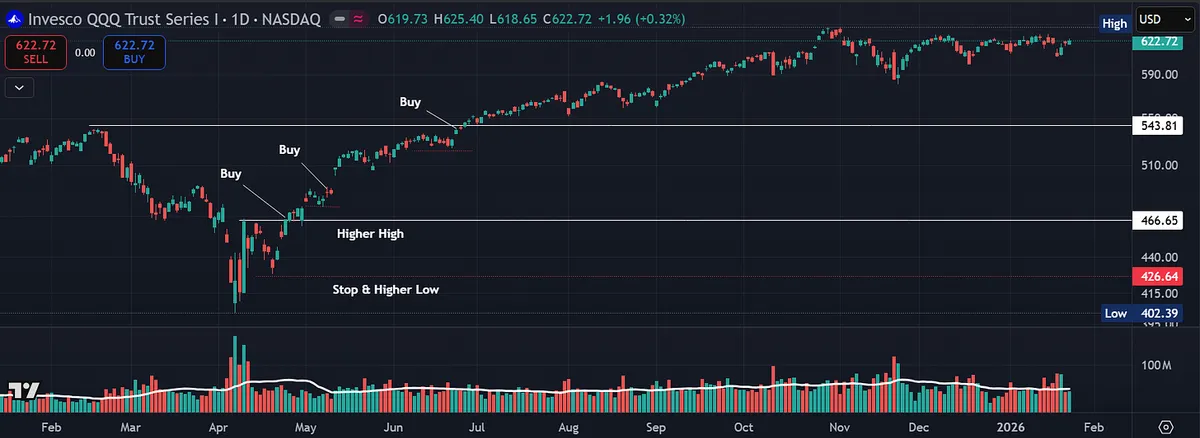
This chart is not an example of buying because price looks cheap.

That is how people get trapped.

What matters is the change in character.

Buying the break of the prior high, with a stop below the higher low, is what defines risk.

These are often the best low-risk, high-reward opportunities.

They occur off lows and at new highs, when many are still trying to short and assume the move cannot continue.

The goal is not to guess the bottom. The goal is to wait for the market to prove the trend has changed.

View on Substack ↗

Nothing in the Market Is New

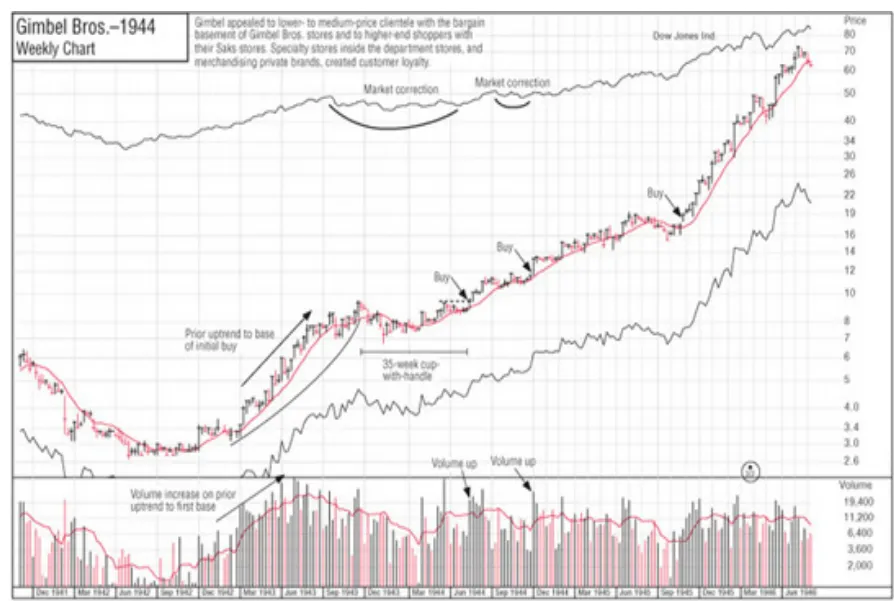
O’Neil studied winners going back to the 1880s.

What shocked him was not change. It was sameness.

  • Cup with handle.

  • Flat base.

  • Double bottom.

“The patterns you see today were there 20, 40, 60, even 100 years ago.”

Different companies. Different industries. Same structure.

View on Substack ↗

Big Picture Market Pulse is live.

Before screening charts or chasing individual stocks, it’s important to understand what kind of market we’re actually in.

This update breaks down:

  • Why leadership rotation matters

  • How to align risk during consolidation near all-time highs

  • What would change the bullish thesis and force a defensive stance

  • How I’m thinking about patience, selectivity, and preparation for the week ahead

This is the framework I use before looking at individual setups.

Paid subscribers can read the full breakdown here 👇

https://tradingmomentum.substack.com/p/big-picture-market-pulse-january

On SubstackBig Picture Market Pulse - January 24, 2026
View on Substack ↗

Where the Easy Money in Bull Markets Usually Lives

When William O’Neil studied decades of market history, he noticed something important.

The biggest percentage gains in most bull markets tend to occur in the first one to two years coming off a true bear market low.

That’s not because bull markets end after two years. It’s because the early phase is when pessimism is still high, institutions are forced back in, and new leadership breaks out from deep bases.

If you look at long-term charts, the most explosive annual moves often appear early. After that, markets can continue higher, but gains usually become slower, choppier, and more selective as leadership narrows and rotations increase.

The takeaway isn’t to predict tops. It’s to understand where the highest velocity opportunities usually show up and why early bull phases reward preparation, not hesitation.

Knowing where you are in the cycle helps you adjust expectations, risk, and selectivity, not abandon the trend.

View on Substack ↗

The Difference Between a Tip and a Professional Idea

“Few people ever make money by trading on the occasional tips or recommendations of others.” — Jesse Livermore

Livermore was not saying ideas are useless. He was warning people about how they use them.

There is a big difference between how experienced traders share ideas and how newer traders consume them. Professionals talk in themes, sectors, and names, but every trader still does their own work. They plan their own entry, define their own risk, and decide how to manage the trade with confidence. The idea is just a starting point, not an instruction.

Newer traders often do the opposite. They hear a name, feel urgency, and treat it like a signal. They buy because they trust someone else’s process more than their own. When the trade moves against them, they do not know where they are wrong, what to do next, or why they were in the trade to begin with.

That difference matters.

This is why I share watchlists, hot areas, sectors, themes, and sometimes individual stocks, but not as blind buy or sell signals. The intent is education. Sometimes someone mentions a stock I missed. I go do the homework. I build my own plan. Sometimes it aligns closely with how they are trading it. Sometimes it does not. Either way, the decision is mine.

As you gain experience, tips stop feeling like answers and start feeling like prompts. That is when they become useful. That is also what Livermore was warning people about over a century ago.

Signals are easy to give. Education is harder.

One creates dependency. The other builds confidence.

Learn to fish.

View on Substack ↗

Why Risk Management Really Matters

Risk management and position sizing are everything.

Not because they help you avoid losses but because they give you the ability to try again.

Sometimes the right stock does not work on the first attempt.

Or the second.

Lose small.

Lose small again.

Try again.

Then it finally goes.

One big winner pays for the earlier losses and then some.

Without proper position sizing, most traders never get that chance. They get scared, widen stops, or quit right before the move happens.

Risk management keeps you in the game long enough for probabilities to work.

Lose. Lose. Lose. Win big.

That is not failure. That is the business of trading.

View on Substack ↗

Leadership Is Rotating. Your Screener Should Too.

The market has slowed recently, but small- and mid-cap stocks continue to act well. You can see this clearly in the price action, with IWM outperforming both the S&P 500 and the Nasdaq. While the major indexes have struggled to make sustained upside progress, capital has been quietly rotating out of the mega-cap leaders and into smaller names.

This is a normal and healthy part of a market cycle. At some point, every investor has to let go of what worked in the past and focus on where capital is actually flowing today. Leadership does not last forever, and markets reward those willing to adapt.

The Relative Strength Dashboard has been signaling this shift for some time. Strength has been broadening beneath the surface, with smaller stocks and select industry groups steadily moving into leadership while many of the former mega-cap leaders consolidate or lose momentum.

As a result, I’m becoming less interested in crowded mega-cap trades and increasingly focused on areas that are less familiar, less followed, and smaller in size. This is often where new leadership emerges and where the best risk-reward opportunities begin to form.

The good news is that this shift is easy to reflect in your process. A simple adjustment to your screener, such as tightening market cap ranges, float, or shares outstanding, can quickly realign your universe with where the market is allocating capital today.

Markets change. Leadership rotates. Your job is not to predict it, but to recognize it and follow the money.

I have a detailed post coming soon that will walk through the different screens I use to help identify these names.

View on Substack ↗

Why Great Investors Buy at New Highs

In an old interview, William O’Neil talked about the people who had the biggest impact on his thinking.

One name stood out: Jack Dreyfus.

Dreyfus ran an extremely successful fund, and O’Neil had the opportunity to study his actual trades in detail.

What surprised him most?

When he reviewed the fund’s biggest winners, a clear pattern emerged.

The largest gains came from stocks that were purchased as they were breaking out from new highs.

This flies directly in the face of what most investors are taught.

Many people feel uncomfortable buying stocks at new highs or all-time highs. It feels risky. It feels late. It feels like you are chasing.

But O’Neil’s research showed the opposite.

When you are buying the right stocks, in the right market, strong breakouts to new highs are often where the biggest institutional moves begin.

New highs are not a reason to avoid a stock.

They are often the signal that something important is happening.

The market does not reward comfort. It rewards strength.

And historically, the strongest stocks tend to show that strength first… at new highs.

View on Substack ↗

What a Leading Trading Coach Learned About Top Traders

“Generally, I find that top traders believe:

• Money is not important

• It is OK to lose in the markets

• Trading is a game

• Mental rehearsal is important for success

• They’ve won the game before they start.”

— Van K. Tharp, Market Wizards

When money stops being the focus, risk stays controlled.

When losing is accepted, discipline improves.

When trading becomes a game, emotion loses its grip.

By the time a great trader places a trade, the hard work is already done.

Execution is simply the final step.

View on Substack ↗

Why Relative Strength Matters

William O’Neil studied the biggest stock winners over decades and found this:

“The 500 best performing stocks during the 1953–1985 period had an average relative strength of 87 before their major price increase actually began.”

Before the breakout. Before the crowd. Before the headlines.

Relative strength is not confirmation after the move. It is evidence of leadership already in place.

The biggest winners almost never come from laggards. They come from stocks already outperforming the market.

Relative strength does not tell you when to buy. It tells you where to look.

Leaders lead for a reason.

View on Substack ↗

The Most Ignored Letter in CANSLIM and Why It Is Stopping You Out

If you keep getting stopped out, or you feel like there are no good stocks to buy right now, the problem might not be your entries.

It might be the M.

In CANSLIM, the M stands for Market, and it matters more than most traders want to admit.

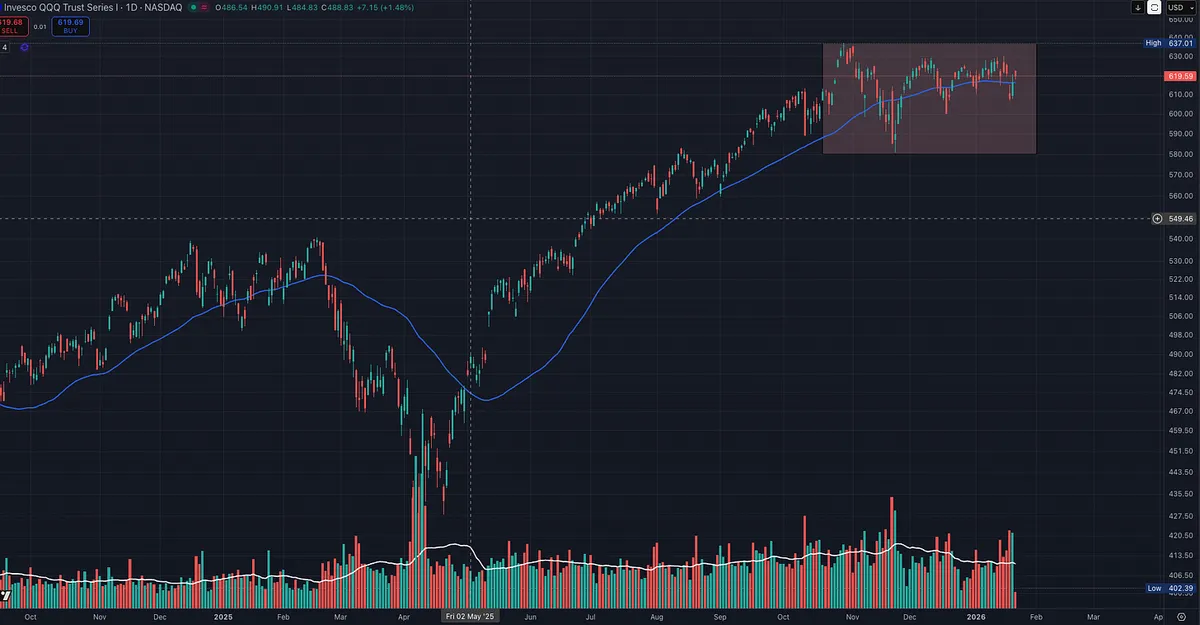
When the market is chopping sideways, whipping above and below key moving averages, even the best setups struggle. Breakouts fail. Tight stops get hit. Clean trends disappear. This is exactly the type of environment where traders start questioning their strategy, when in reality the issue is conditions, not skill.

Remember this simple truth:

Most stocks move with the market. All ships rise and fall with the tide.

When indexes are stuck in wide, whipsaw consolidations, individual stocks feel that pressure. That is why so many traders experience death by a thousand paper cuts during these phases. You can do everything right and still lose money because the market is not offering follow through.

This is often a signal to slow down, not force trades.

That does not mean do nothing. It means do the right things.

Set alerts instead of chasing. Study past leaders and bases. Review risk management and position sizing. Let patience become a position.

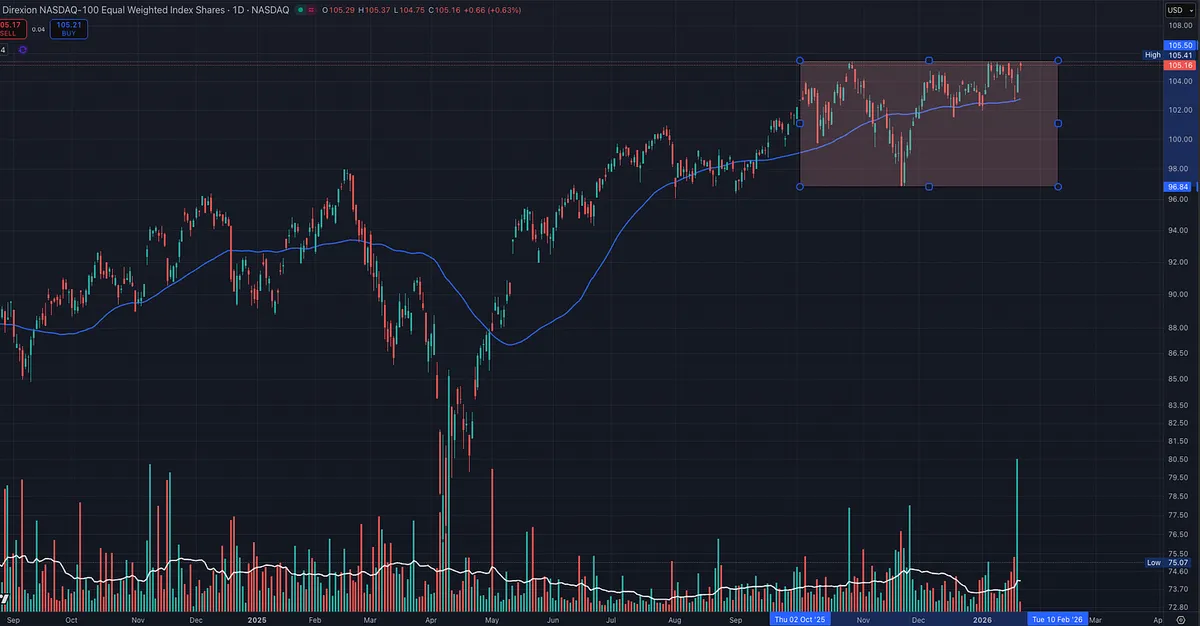
For growth investors especially, many strong CANSLIM names are tightly linked to the Nasdaq and tech leadership. That is why watching QQQ and QQQE matters. QQQ has been locked in a choppy consolidation that has made sustained upside difficult. QQQE, on the other hand, is showing constructive action, compressing with higher lows and pressing toward all time highs.

That divergence is important.

When the market improves, leadership tends to move fast. Being prepared matters more than being early.

If the market is not cooperating, there is no shame in waiting. Some of the best trades come after long periods of frustration, when conditions finally align.

Respect the M. Be patient. And be ready when the tide turns.

View on Substack ↗

Why Charts Matter More Than Predictions

One of the biggest misunderstandings about charting is that it is about predicting the future.

It is not.

Charts exist to help us define risk.

Markets do not move in straight lines. They move in swings. Advances and pullbacks. Higher highs and higher lows in uptrends. Lower highs and lower lows in downtrends.

This behavior shows up everywhere.

On monthly charts. On weekly charts. On daily and intraday charts.

The structure looks different in size, but not in nature.

This is what people mean when they say markets are fractal.

The same stair step behavior repeats across all timeframes.

That repetition is not random. It is the result of human behavior cycling between optimism and fear.

This is why technical frameworks like Elliott Wave matter, not because they forecast exact prices, but because they help identify structure.

And structure is what allows us to do the most important thing in trading.

Manage risk.

Paul Tudor Jones once explained it this way:

“The reason he has been so successful is that the Elliott Wave theory allows one to create incredibly favorable risk/reward opportunities. That is the same reason I attribute a lot of my own success to the Elliott Wave approach.”

Notice what he emphasized.

Not prediction. Not certainty. Risk and reward.

When markets move in waves, they naturally create logical areas where a trade idea is wrong.

That is why we use charts to define a clear buy and a clear stop.

The entry aligns with strength and structure. The stop defines where the pattern breaks.

If the pattern holds, the upside can be many multiples of the risk. If it fails, the loss is small and controlled.

This is where the fractal nature of markets becomes a tool, not a theory.

A pullback on a daily chart functions the same way as a pullback on a weekly chart. A breakout failure looks the same across timeframes.

That consistency is what allows traders to survive long enough to compound.

Charts are not about being right. They are about knowing when you are wrong.

View on Substack ↗

Stop Chasing Money. Start Building Skill.

Most traders obsess over outcomes.

P&L. Big winners. Fast money.

That obsession is usually the reason they struggle.

The best traders flip the priorities completely.

They do not focus on making money first.

They focus on process.

Here is the mindset shift that changes everything.

Instead of trying to make money → focus on preserving capital

Your job is survival first. Capital is opportunity. Once it is gone, the game is over.

Instead of hunting home runs → follow a repeatable process

Big winners are a byproduct, not the goal. Consistent execution is what creates them.

Instead of cutting winners and holding losers → cut losers fast and let winners run

Losses are the cost of doing business. Winners are where the edge shows up.

Instead of buying weak stocks → buy strong stocks

Strength attracts more strength. Leaders outperform laggards for a reason.

Instead of trying to get rich quick → compound over time

Small edges, applied over and over, beat one lucky trade every time.

Make these changes and you may realize how much less stressful and more enjoyable trading becomes.

When your focus shifts from money to process, pressure fades. Decisions get clearer. Emotions quiet down.

Then something interesting happens.

Trades begin to compound quietly in the background, building into an account you once thought was unrealistic.

Not because you chased it.

But because you finally focused on doing the right things, consistently.

View on Substack ↗

Why Great Traders Can Imagine the Impossible and Why Most People Can’t Hold Winners

Bruce Kovner once said:

“First, I have the ability to imagine configurations of the world different from today and really believe it can happen. I can imagine that soybean prices can double or that the dollar can fall to 100 yen. Second, I stay rational and disciplined under pressure.”

That quote explains more about real trading skill than most indicators ever will.

The edge is not prediction. The edge is imagination plus discipline.

Great traders can mentally allow prices to do things that feel uncomfortable, unlikely, or extreme. They can imagine a stock going far higher than today’s price even when it already feels expensive. They can also imagine it going far lower and accept that reality without denial.

This matters because markets move further than logic suggests and longer than emotions can tolerate.

Most traders cut big winners early because they simply cannot imagine how much higher a stock can go. The move feels abnormal. It feels greedy. It feels unsafe. So they sell.

At the same time, those same traders hold losers too long because they cannot imagine how much further down price can fall.

That is the trap.

Being able to imagine extreme outcomes is not about forecasting. It is about trade management. It allows you to sit in winners and let trends work, while cutting losses quickly because you respect how violent downside can be.

We have seen this repeatedly in recent years. Metals and mining runs. AI and semiconductor leaders. Entire groups that looked stretched, over owned, and “done” before they even reached the halfway point of their move.

The people who made real money were not smarter. They were not better predictors. They were better at mentally accepting that price could do something bigger than their comfort zone.

If you struggle to hold winners, this is usually why.

Train yourself to think in ranges that feel uncomfortable. Allow for upside that sounds unreasonable. Respect downside that feels unlikely.

View on Substack ↗

Most traders don’t struggle because they can’t find stocks. They struggle because they’re looking in the wrong places.

I built a Relative Strength Dashboard to fix that.

It’s a top-down snapshot of the market that starts with major U.S. indexes and works down through sectors, industry groups, global markets, commodities, bonds, and large-cap stocks.

The goal is to quickly see where strength is building, where it’s fading, and what areas of the market are actually in play.

Unlike most tools that only show one timeframe, this dashboard lets you view relative strength across:

  • 1 week

  • 1 month

  • 3 months

  • 6 months

  • 1 year

That makes it much easier to separate:

  • Real leadership

  • Acceleration vs deceleration

  • Short-term noise vs sustained trends

Think of it as a market radar, not a replacement for your scans.

Once you know where strength is developing, you can build smarter watchlists and focus your energy where it actually matters.

Access the Relative Strength Dashboard (paid subscribers):https://tradingmomentum.substack.com/p/relative-strength-dashboard

On SubstackRelative Strength Dashboard
View on Substack ↗

When emotions run high, zoom out

I’m a short-term trader.

I run a day trading account. I also run a swing and position trading account built around O’Neil and CANSLIM and I also have an account that does nothing fancy and consistently invests into SPY and QQQ.

You would think someone like me would be the most emotionally affected by short-term market moves.

I’m not.

A 2% down day like today is no big deal. It is not the end of the world, no matter how financial media or influencers try to frame it.

When in doubt, zoom out.

What always surprises me is how emotional people get over pullbacks, corrections, and even full bear markets. Most of these people are not short-term traders. They claim to be long-term investors with long time horizons, yet they panic at exactly the moments that long-term investors should expect.

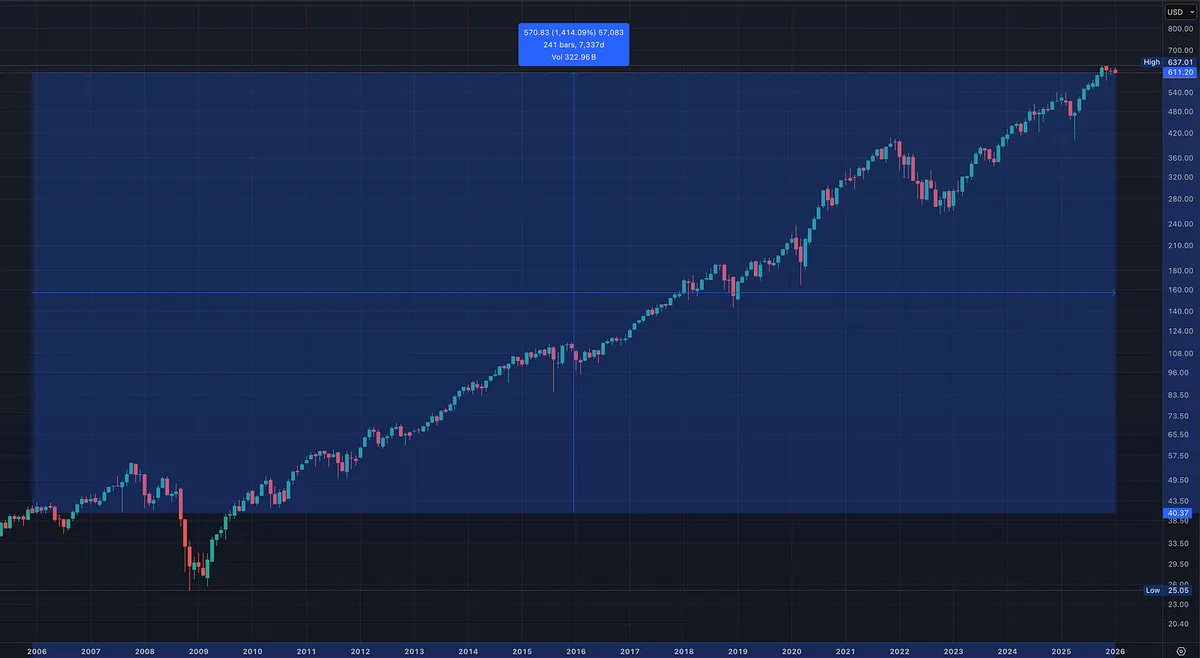
Look at the last 20 years.

  • Tariff scares.

  • COVID.

  • The 2022 bear market.

  • 2018.

  • 2015.

  • 2011.

  • The Great Financial Crisis.

Even with all of that, the Nasdaq-100 is up over 1400% in the last two decades.

That perspective changes everything.

If normal volatility makes you emotional, that is feedback. It usually means one of two things. You are either gambling, struggle emotionally, or you do not truly understand markets or risk management.

Long-term investing is boring. It requires patience, discipline, and the ability to ignore noise.

The market does not reward emotional reactions. It rewards time, consistency, and perspective.

Zoom out.

View on Substack ↗

Most investing content online is mentally stimulating, interesting, or entertaining, but it does very little to actually make you a better investor or trader.

Not all of it. But the majority of what I see.

I have fallen into this trap many times myself.

In the beginning, there is a lot to learn. The learning curve is steep, the information is overwhelming, and consuming content feels necessary. You are trying to understand how markets work, how risk works, and how to even participate correctly.

That phase is real. And it is unavoidable.

But once you get through it, something interesting happens.

What actually works starts to look very simple and very mundane.

Our brains are wired to keep chasing the exciting stuff. The get rich quick ideas. The complex strategies. The endless stream of “knowledge” that feels productive.

We fool ourselves into believing that this level of stimulation is required for success.

It isn’t.

Real progress comes from the boring, repetitive process.

Risk management.

Position sizing.

Patience.

Consistency.

Doing the same things over and over when nothing feels exciting.

That is the part almost no one wants to focus on. And that is exactly why it works.

The content you enjoy consuming is often not the content that actually improves your results.

Once you understand the basics, improvement comes from doing less, not more.

The mundane beats the exciting every time.