Momentum Trading Strategy

Notes

Short lessons on momentum trading, every day.

Every note from Substack, in one place: risk, setups, leading stocks, market conditions and the mindset behind them. Search them, browse by topic, or filter by stock.

Showing 821–840 of 1227 notes

View on Substack ↗

The Leaders Bottom First

While the market was still falling in 2022, the biggest winner of the next cycle had already turned.

This is exactly what Mark Minervini talks about in Think & Trade Like a Champion. True leaders often bottom before the indexes and start building higher lows while everyone else is focused on the bear market.

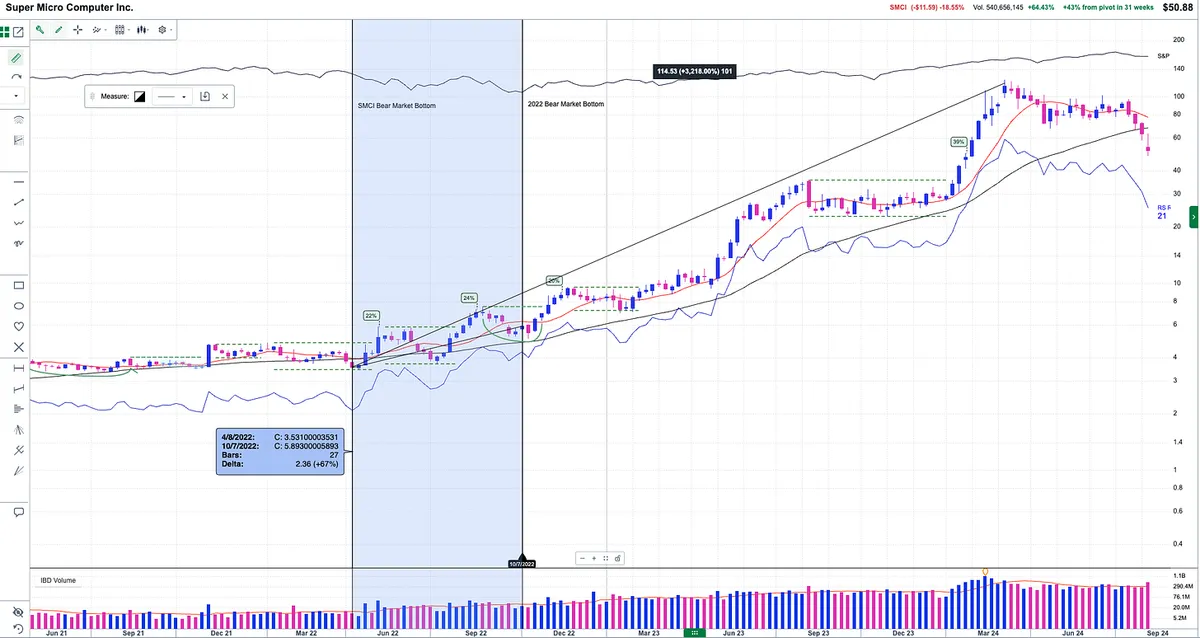
Look at SMCI.

• April 2022 — SMCI bottoms

• October 2022 — S&P 500 finally bottoms

During that same period, SMCI had already rallied about 70%.

While the market was still weak, the stock began doing what leaders do:

• Forming higher highs and higher lows

• Holding key moving averages

• Building an ascending base

• Showing a rising relative strength line

By summer 2022, SMCI was already acting like a Stage 2 leader.

The market had not even bottomed yet.

From that early leadership signal to the peak in March 2024, SMCI went on to run over 3,200%.

The lesson is simple.

The next super performer can show itself while the market is still struggling. Pay attention to this. O’Neil highlighted the importance of this too!

Even if you waited until the market showed a clear character change in early 2023 with a confirmed higher low, higher high, and price back above the 200 day moving average, you still could have captured roughly 1,200% of the move from there.

Because the best stocks can tell you where the next bull market is going before the headlines do.
View on Substack ↗

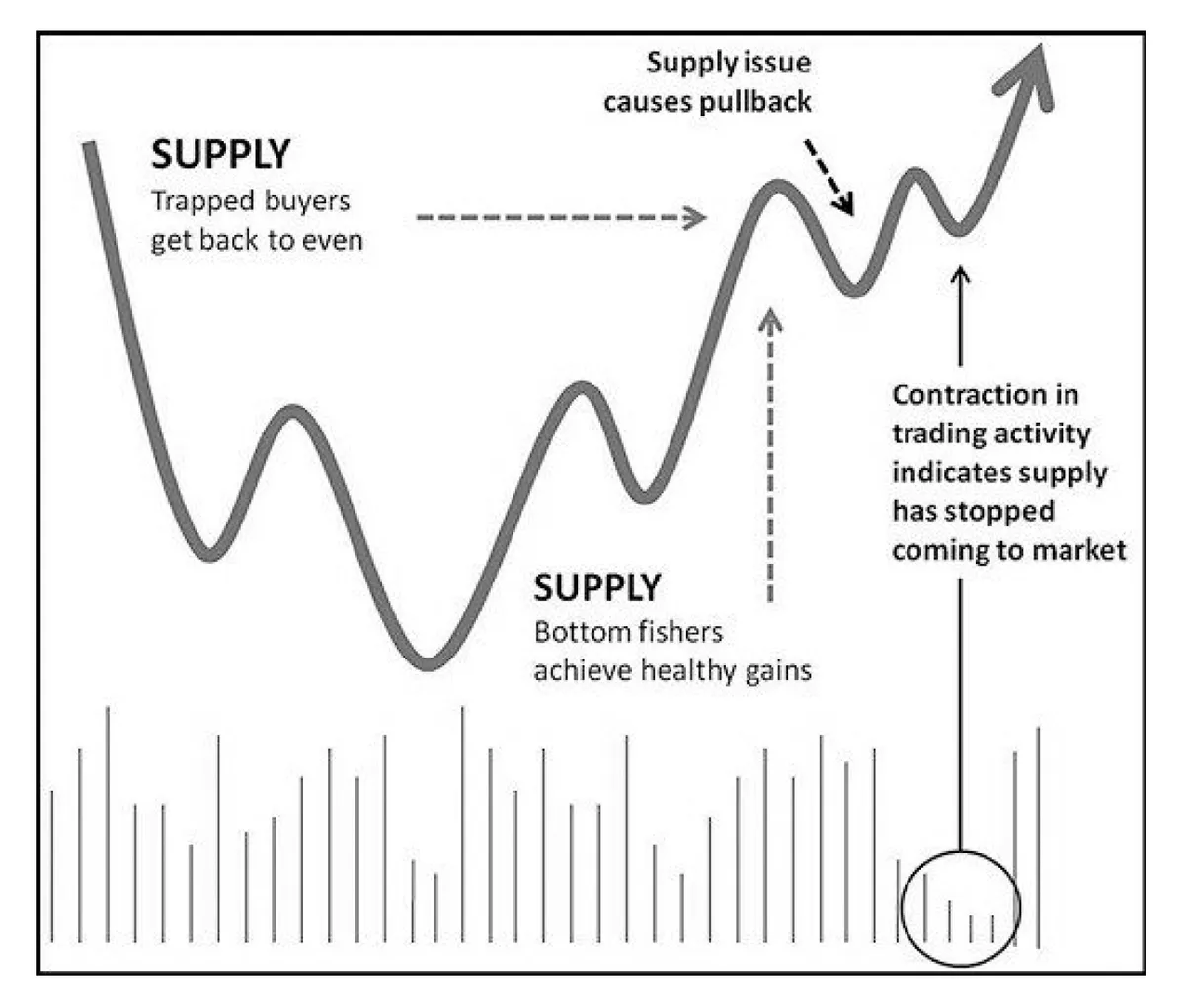
An Example of the Supply and Demand Dynamics a Stock Goes Through

A concept from Think & Trade Like a Champion by Mark Minervini.

“As a trader using a stop-loss, you are a weak holder. The key is to be the last weak holder; you want as many of the weak hands as possible to exit the stock before you buy.” — Mark Minervini

Inside every base there is a battle between supply and demand.

After a decline, many investors are trapped at higher prices. When the stock rallies back toward their entry, they sell just to get out even.

That selling creates supply.

Early buyers who caught the bottom may also take profits as the stock moves higher.

Each rally shakes out more weak holders.

If institutions are accumulating shares, the pullbacks begin to get smaller and trading activity contracts as supply dries up.

By the time the stock is ready to move higher, most of the weak hands are already gone.

That is when the path of least resistance becomes up.

View on Substack ↗

Wait for Stage 2

“The perfect time to enter the stock is when it breaks out above resistance.” — Stan Weinstein

A timeless reminder.

The best trades do not happen when a stock is falling.

They happen when a stock completes a base and breaks out into a new Stage 2 advance.

That is when probability shifts in your favor.

Patience is part of the strategy.

The goal is not to catch every move.

The goal is to catch the right stage of the move.

View on Substack ↗

A Good Reminder in Tough Markets

“When things aren’t going right, don’t push, don’t press.”

— Richard Dennis

A good reminder in markets like this.

When conditions aren’t right, the best move is often patience.

Not every environment is meant for heavy trading.

Sometimes, cash is a great position.

View on Substack ↗

When Everyone Loves a Stock, Be Careful

“When everybody is running around saying how great a stock is, everybody who can buy probably already has, and the only direction for the stock to go at that point is down. When it’s obvious and exciting to everyone, it’s too late!” — William J. O'Neil

One of the hardest lessons in the market.

By the time a stock is on every headline, every podcast, and everyone is talking about it… the move is usually already behind it.

Great trades rarely feel obvious at the start.

View on Substack ↗

“Winners know they are responsible for their results; losers think they are not.” — Van K. Tharp

One of the most powerful ideas in trading and in life.

The moment you take full responsibility for your results, you stop blaming the market, the news, or bad luck.

That’s when real improvement begins.

View on Substack ↗

The Trader the Market Wizards Listened To

While reading Market Wizards by Jack D. Schwager, something stood out to me.

Schwager asked Paul Tudor Jones a simple question.

“Are there any market advisors that you pay attention to?”

His answer was immediate.

“Marty Zweig.”

That made me curious.

Then I noticed something else.

Other legendary traders interviewed in the book also respected Zweig. Traders like Michael Marcus, Bruce Kovner, and Richard Dennis.

Different trading styles.

Different timeframes.

Different personalities.

Yet they all paid attention to the same man.

So I picked up Winning on Wall Street by Martin Zweig.

What stood out was not some magical indicator.

It was his focus on market environment.

Zweig believed big performance happens when the wind is at your back.

Strong liquidity. Healthy breadth. Expanding participation. A market that wants to go higher.

That idea changed the way I approach trading.

Now every weekend I run what I call my Big Picture Market Pulse.

Studying the overall health of the market first.

Because the best stocks tend to make their biggest moves when the environment supports them.

The Market Wizards understood that.

Zweig understood that.

And once you see it, you start looking at the market very differently.

View on Substack ↗

The 100-Year Momentum Blueprint: How the Biggest Stock Market Winners Actually Move

While the market has been chopping around in consolidation, it is actually one of the best times to learn.

When markets trend aggressively, traders are busy executing, but when things slow down, it is the perfect time to study, refine your process, and prepare for the next leadership cycle.

After 20 years of trading and a lot of questions about my strategy, I finally decided to turn the framework I use into a full course.

Module 1 of the Momentum Trading Strategy course is now live.

https://tradingmomentum.substack.com/p/momentum-trading-strategy-the-100

On SubstackMomentum Trading Strategy: The 100-Year Playbook Behind the Biggest Winning Stocks
View on Substack ↗

How I Think About Portfolio Exposure

Great question from someone today, so I thought I’d share the response.

Sometimes I do a poor job explaining things in my posts, so hopefully this clarifies how I think about portfolio exposure and position sizing.

—

If my portfolio is only 20-40% invested and I’m in a drawdown or my trades aren’t working, it usually means the market environment isn’t supportive. In that case it makes no sense to increase exposure. I should actually be reducing exposure or even moving to cash.

When the market environment is supportive, like during a Stage 2 uptrend, and individual trades are working, that’s when I increase overall portfolio exposure. Sometimes that can reach 100% invested, with individual positions around 25% in the best names.

When the environment is choppy or consolidating, like it has been recently, and trades aren’t working well, I reduce portfolio exposure and take much smaller positions or move to cash.

Of course this is usually a gradual process. As trades begin working better, I may go from 25% exposure to 50%, depending on the quality and quantity of names showing up in my screens.

This is where trading becomes both an art and a science. Every cycle is similar, but never exactly the same. I allow the market and the stocks themselves to guide how aggressive I get.

So results and market conditions dictate how invested I am, similar to the exposure guidelines O’Neil and IBD often talk about.

Trade small and reduce exposure when things aren’t working. Increase exposure and trade bigger when they are.

View on Substack ↗

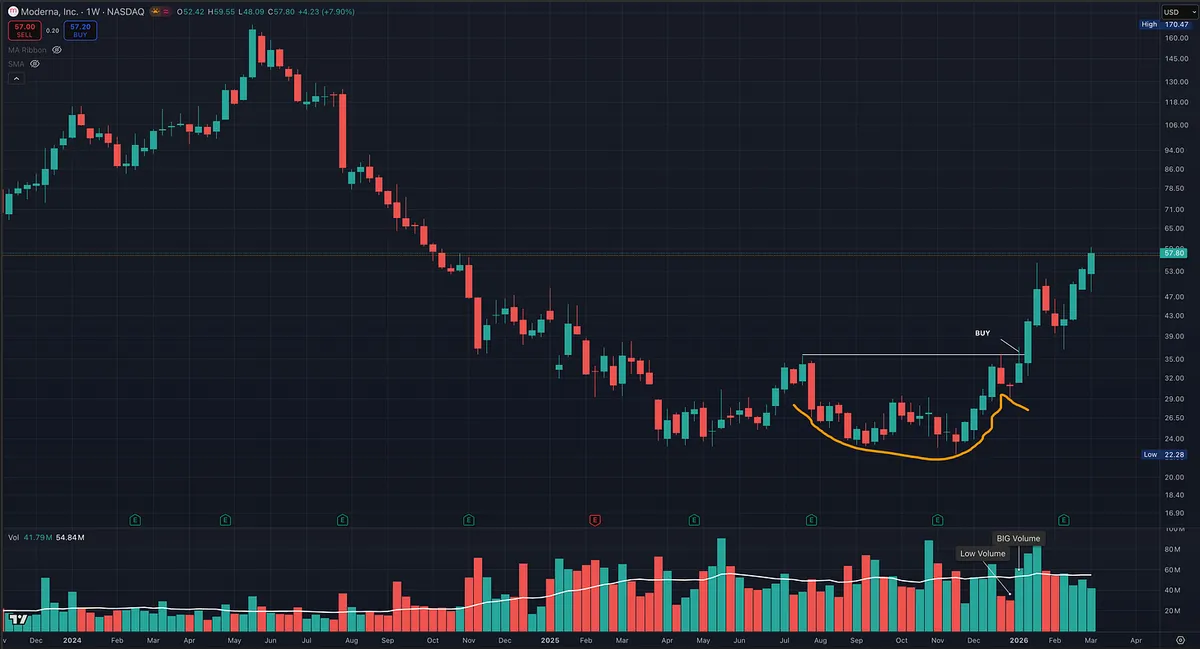
A Nice Example of a Cup Base Breakout

MRNA recently formed a cup base on the weekly chart that showed some solid volume characteristics.

First, volume began expanding off the bottom of the base as price climbed the right side. That’s often the first sign institutions are stepping in.

As price approached the prior high, it formed a short handle, drifting slightly lower on light volume.

That low-volume pullback is important because it shows supply drying up.

When price moved back toward the highs, it broke out on strong volume, confirming demand had taken control.

Now, MRNA didn’t have the earnings and sales growth we typically look for in leading stocks, but technically it was a great example of how we look for low-risk, high-reward entries.

Defined structure. Clear pivot. Logical stop.

So far the move has produced roughly 3–5 times the initial risk, depending on stop placement.

That’s the goal.

Not predicting.

Simply recognizing when supply dries up and demand takes control.

View on Substack ↗

Most Traders Don’t Fail Because of Their Strategy

They fail because of themselves.

Mark Douglas explained it perfectly:

“You don’t need to know what will happen next to make money.”

You only need an edge and the discipline to execute it.

But human nature fights that.

Fear makes traders sell winners too early. Ego makes them hold losers. Greed makes them chase extended stocks.

The strategy is rarely the problem.

Psychology is.

View on Substack ↗

Fear Spreads Faster Than Discipline

I have only been writing on Substack for a few months.

It honestly started as a place to write random thoughts about trading so I didn’t have to keep talking about it with my wife and four kids all the time.

But something interesting happened recently.

Out of everything I have written, the post that performed the best by far was titled:

“How the Market Warns You Before the Crash and When It’s Safe to Get Back In.”

Not the posts about position sizing.

Not the posts about risk management.

The one about a crash.

And that made me laugh.

Because if you study markets long enough, you realize something.

Some of the best traders probably understand human nature better than many PhDs who study it for a living.

To survive in markets for decades you have to.

You watch fear. You watch greed. You watch euphoria. You watch panic.

And if you spend enough time studying charts and the tape, you realize something else.

Human behavior repeats.

The irrational exuberance near tops.

The panic selling near bottoms.

The disbelief during the early stages of an uptrend.

It all shows up in price and volume.

Great traders spend thousands of hours watching these emotional cycles play out.

Eventually you start to recognize the fingerprints.

Another thing traders learn quickly about human nature is this.

People are far more captivated by fear than by calm, rational information.

Psychologists call this negativity bias. Humans are wired to pay more attention to threats than to positive outcomes.

Behavioral finance research shows that people feel losses roughly twice as strongly as gains.

Which explains a lot.

It explains why the news focuses on disasters.

It explains why market crash headlines travel faster than discussions about discipline.

And apparently it explains Substack engagement too.

Now, understanding topping behavior is important. William O’Neil wrote extensively about this in How to Make Money in Stocks. Protecting capital matters.

But it is no more important than risk management, position sizing, or process.

Yet that one post traveled the furthest, by far. Almost five times further than most of the others.

Maybe the algorithm liked it.

Maybe people shared it because it tapped into fear.

I honestly don’t know.

I just wrote what I was thinking that morning while drinking coffee.

When I write about trading, I’m simply sharing thoughts about a game I’m passionate about.

Most people will never use the information to their advantage.

That’s just the math of markets.

But maybe a few will.

And maybe one day they’ll become part of the next generation of Market Wizards.

And that would be pretty cool.

https://tradingmomentum.substack.com/p/how-the-market-warns-you-before-the

ArticleHow the Market Warns You Before the Crash (and When It’s Safe to Get Back In)
View on Substack ↗

This Is Not a “Foot on the Gas” Market

Growth investors are frustrated right now.

And they should be.

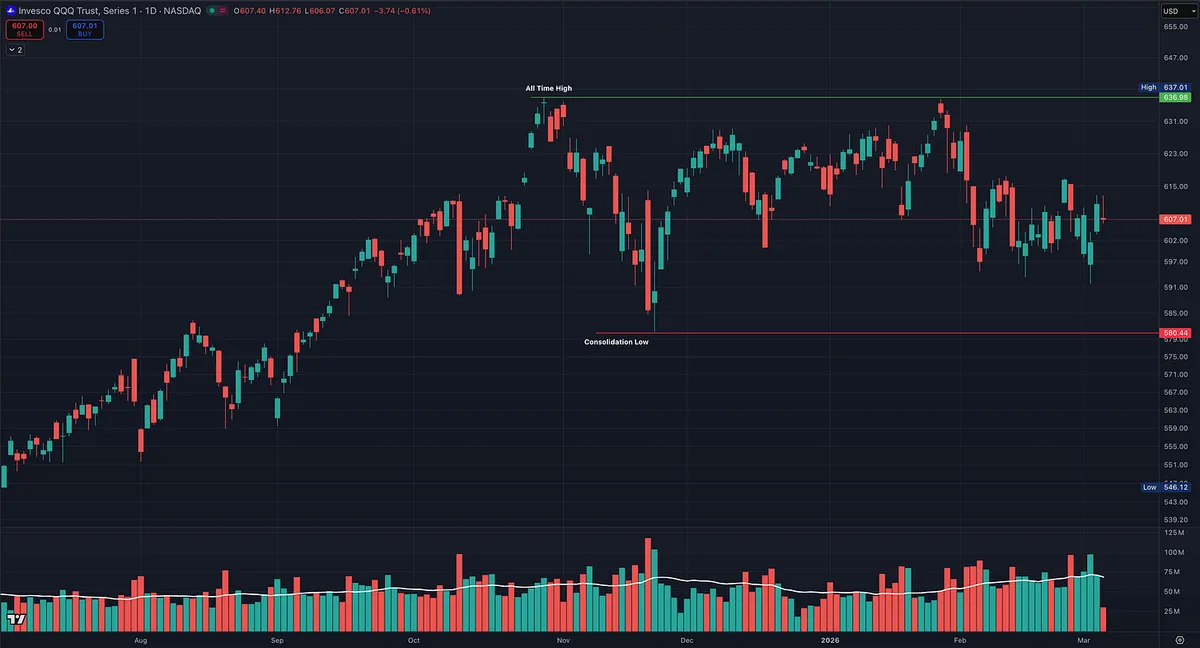
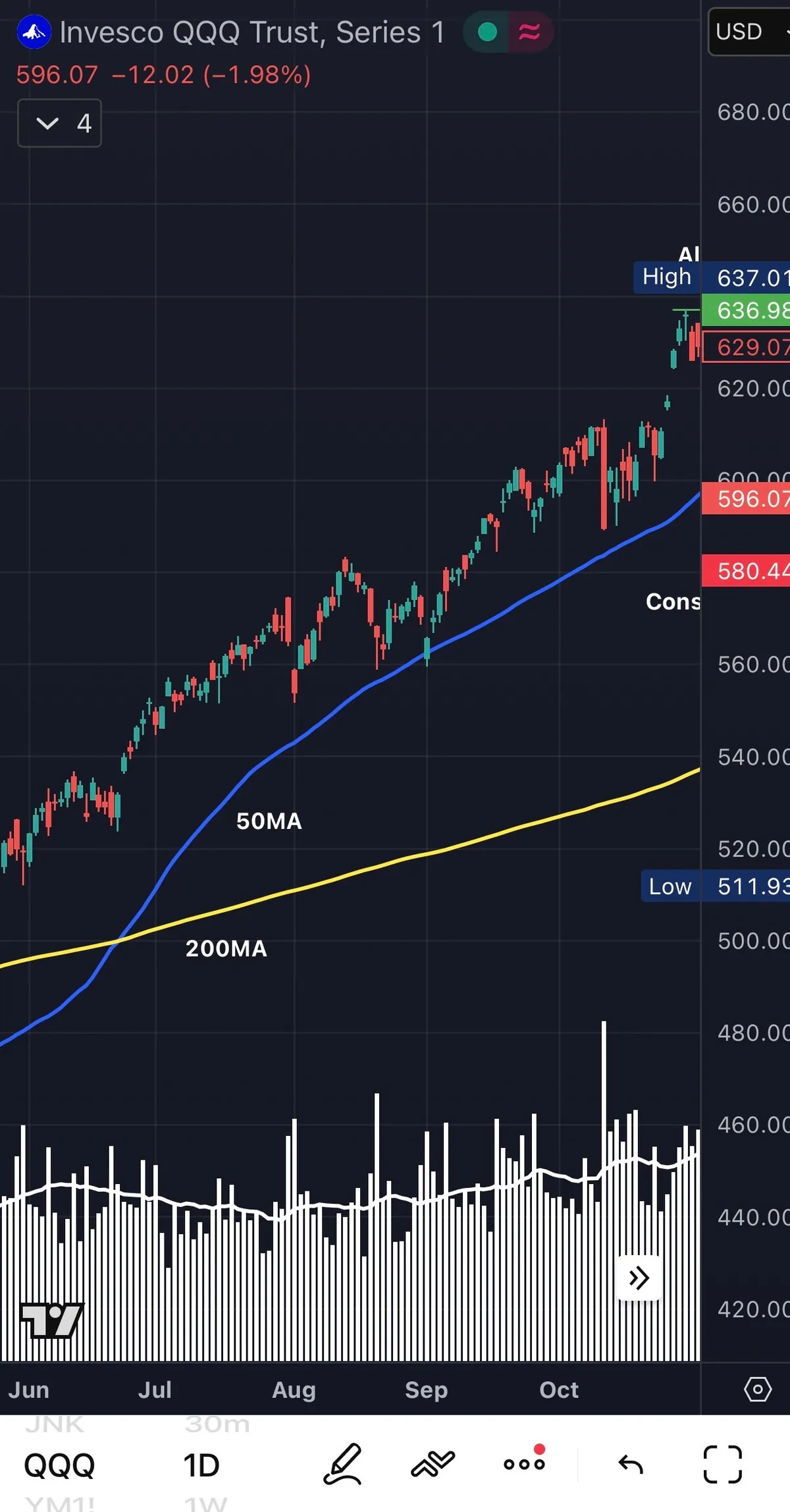
Look at Image 1.

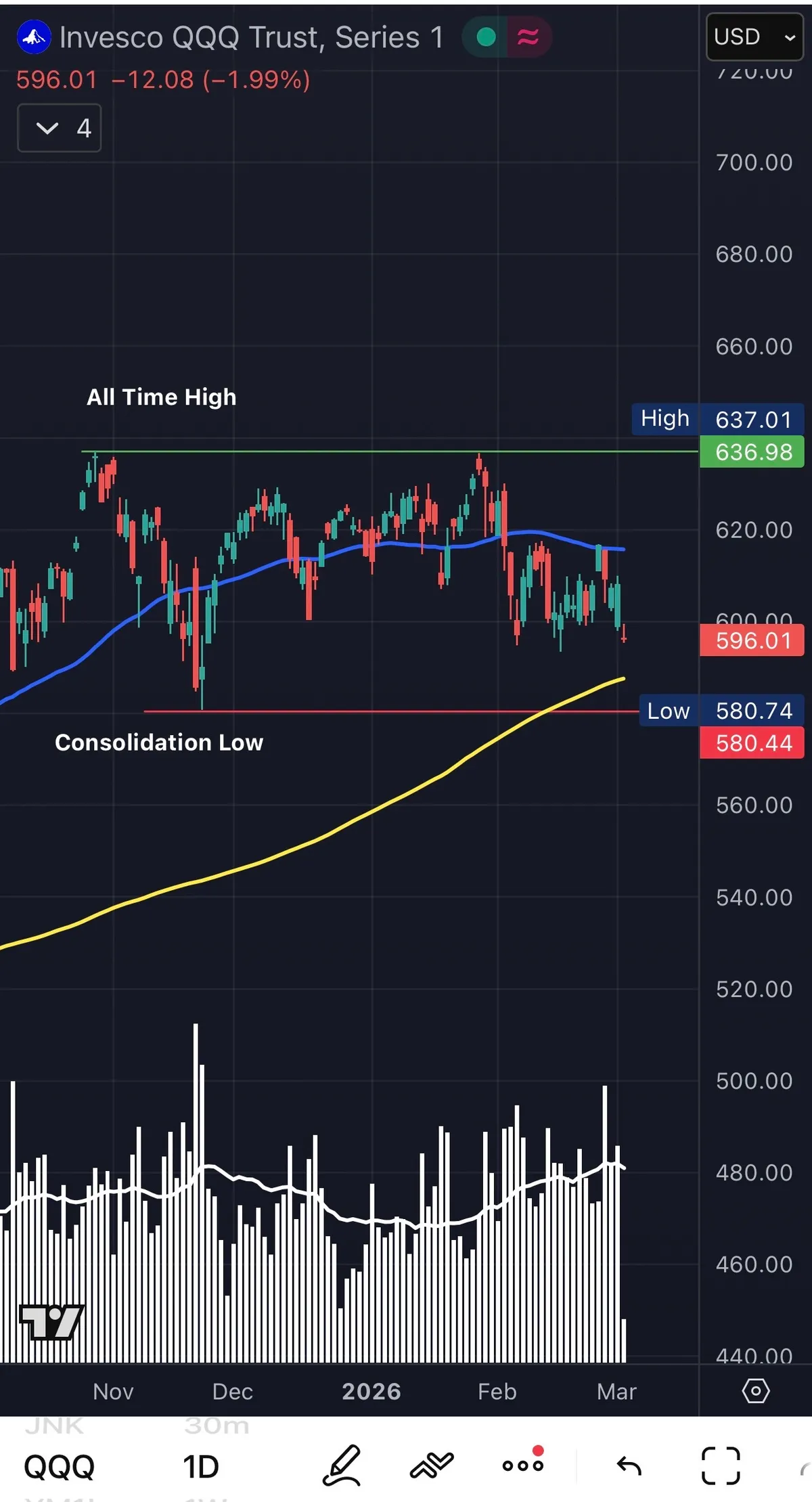
Since the fall of ’25, the QQQ has been in a prolonged consolidation.

Lower highs.

Choppy action.

Failed breakouts.

Distribution weeks mixed with weak rallies.

This is not a clean Stage 2 advance.

This is digestion.

William O’Neil was very clear in his work:

Most investors underperform not because they pick the wrong stocks…

But because they fail to align with the general market.

He studied over 1,000 of the greatest winners and found that 3 out of 4 stocks follow the direction of the general market.

Three out of four.

If the market is chopping, your growth stocks will struggle to gain traction.

And when that happens, professionals do something amateurs refuse to do:

They reduce exposure.

They raise cash.

They protect capital.

O’Neil taught that there are times to be heavily invested… and times to sit tight.

This is a capital preservation environment.

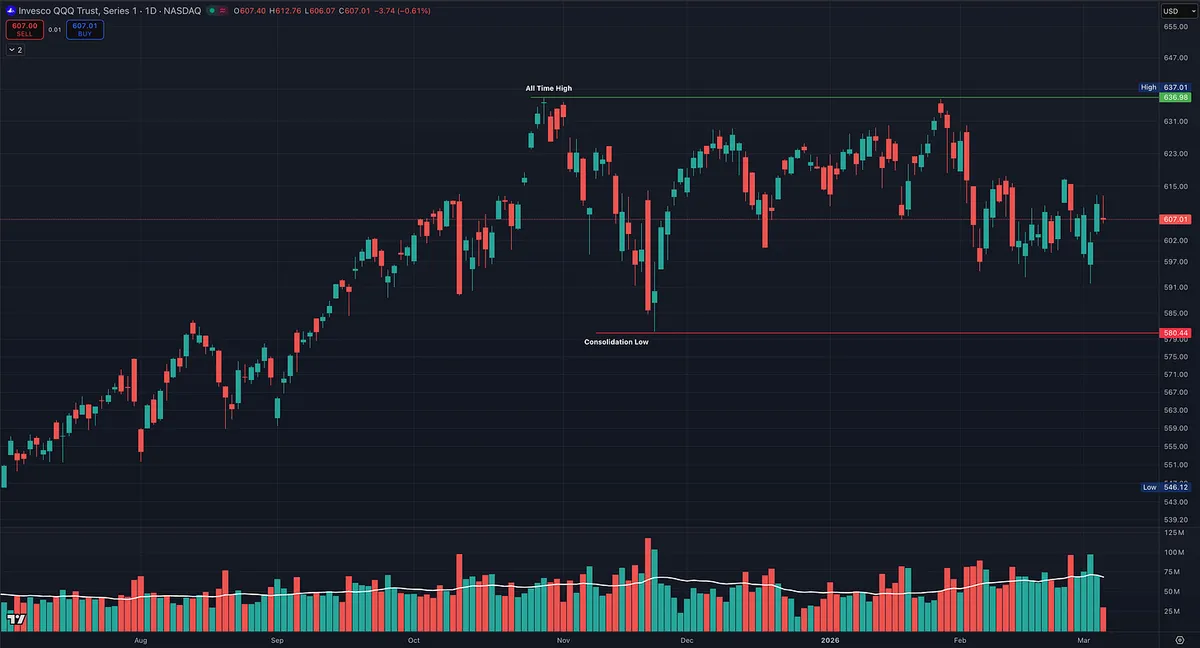
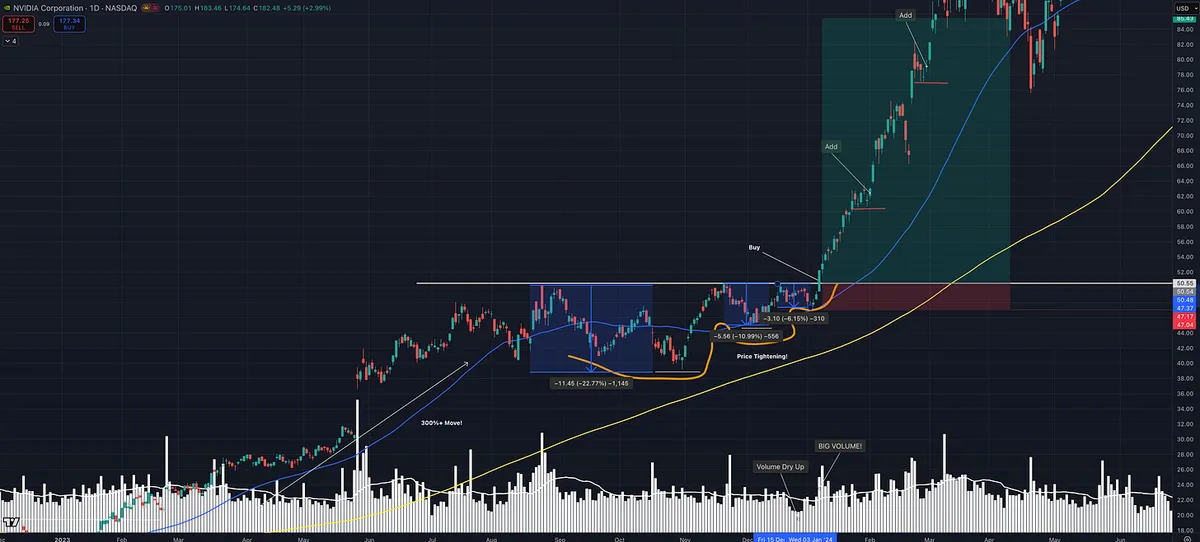
Now look at Image 2.

That is what a Stage 2 uptrend looks like.

Higher highs.

Higher lows.

50 day moving average rising cleanly.

Price respecting support.

Breakouts working.

That is when growth investors thrive.

That is when you increase exposure.

That is when you pyramid strength.

That is when you press your edge.

The mistake most traders make is simple:

They try to force Stage 2 behavior in a Stage 3 consolidation.

The market does not reward urgency.

It rewards alignment.

Professional money managers think in terms of environments, not emotions.

When the wind is at your back, you sail.

When it is not, you lower the sails and preserve the boat.

Right now, the job is not to be heroic.

It is to be disciplined.

And when the next true Stage 2 begins, you will have capital, clarity, and confidence to attack it.

View on Substack ↗

Ninety-Percent of Any Great Trader Is Going to Be the Risk Control.

Paul Tudor Jones said:

“And then at the end of the day, the most important thing is how good are you at risk control. Ninety-percent of any great trader is going to be the risk control.”

Read that again.

Not pattern recognition. Not IQ. Not predicting the Fed.

Risk control.

Most traders spend 90 percent of their time looking for entries.

The great ones spend 90 percent of their energy controlling downside.

Early in my trading, I obsessed over finding the perfect setup.

Perfect breakout. Perfect VCP. Perfect timing.

But I didn’t obsess over where I was wrong.

And that’s why my equity curve was inconsistent.

The breakthrough came when I flipped the focus.

Before entering, I ask:

Where am I out? How much am I risking? Does this position size reflect the uncertainty?

Because anything can happen.

If your loss is small, you stay in the game. If you stay in the game, you catch the outlier. If you catch the outlier, you compound.

The market does not reward prediction.

It rewards survival.

Ninety percent risk control.

Ten percent everything else.

View on Substack ↗

The Trade That Taught Me I Don’t Need To Be Right

Mark Douglas wrote five truths about the market.

Most traders read them.

Very few actually trade them.

Here’s the one that changed everything for me:

You don’t need to know what is going to happen next in order to make money.

Let that sink in.

You don’t need to predict.

You don’t need certainty.

You don’t need to be right.

Because there is a random distribution between wins and losses for any edge.

That means this can happen:

Loss.

Loss.

Small win.

Loss.

Then one monster move that pays for all of it.

And if you quit after the second loss?

You never collect the edge.

This is why most traders sabotage themselves.

They think: “If this is a good setup, it should work.”

No.

Anything can happen.

Every moment is unique.

Your job is not to predict.

Your job is to execute your edge consistently and let probability play out over a series of trades.

The amateur trades to be right.

The professional trades to express an edge.

Big difference.

View on Substack ↗

The Pullback That Steals Your Future Gains

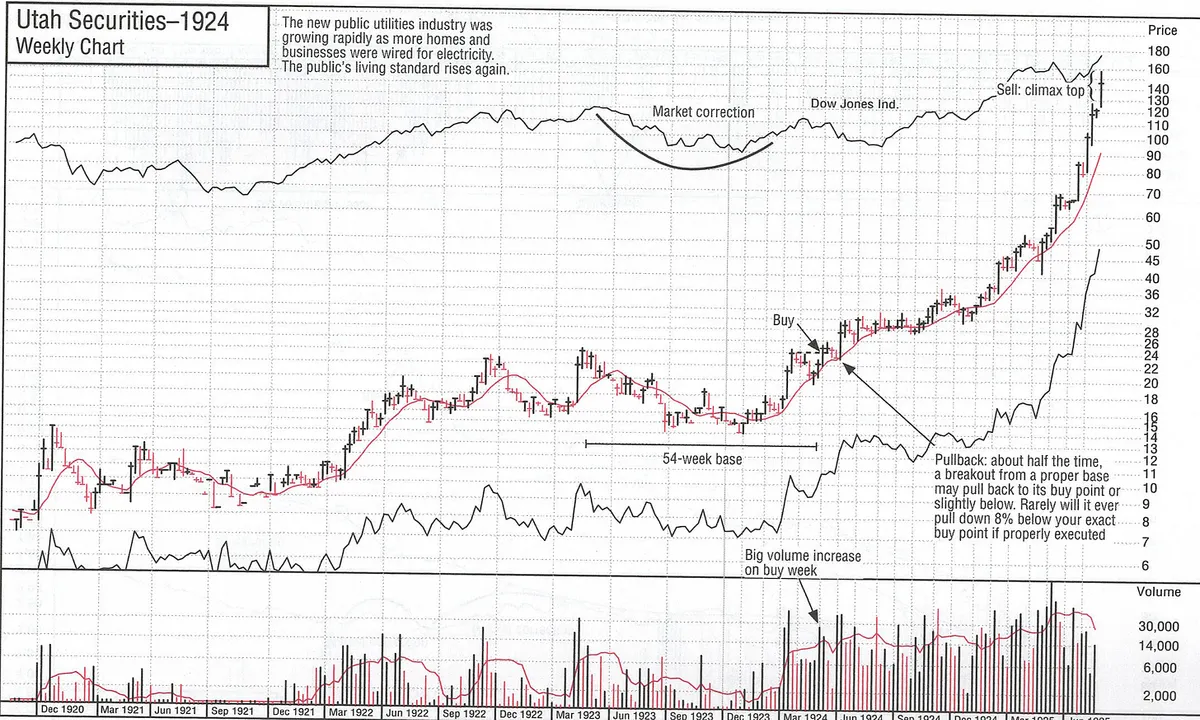
This chart is from 1924.

Different decade. Same mistake.

Look at the breakout.

Massive volume. Clear base. Institutions step in.

Then the stock pulls back into the buy zone.

Not breaking the pattern. Not violating the stop. Just pulling back enough to trigger fear.

This is where most traders sell.

They bought the breakout. They see red. They think, “I knew it. False breakout.”

So they exit.

Then the stock tightens.

Volume dries up.

And it begins a relentless advance.

The move they wanted. Without them.

William O’Neil studied over 1,000 of the greatest winners in history.

He found that about half the time, a proper breakout will retest the pivot or slightly undercut it.

Rarely will it drop more than 7 to 8 percent if properly bought.

That pullback is not failure.

It is a test.

The amateurs react to discomfort.

The pros react to rules.

The market has not changed in 100 years.

Human nature has not changed in 100 years.

The only question is:

Are you trading emotions… or a system?

Press winners. Cut losers.

View on Substack ↗

The Market Does Not Care What You Paid

William O’Neil said something simple that most traders ignore:

Your purchase price means nothing to the market.

But it means everything to your ego.

Early on, I would hold losers because I “wanted my money back.”

The stock would drop 8 percent. Then 12 percent. Then 20 percent.

And instead of asking, “Is this acting right?”

I was thinking, “I just need it back to my cost.”

That one thought cost me more than any pattern mistake ever did.

The best traders in Market Wizards all had one thing in common:

They did not defend positions. They defended capital.

Your cost basis is not support. The 50 day moving average is. The prior breakout level is. Volume behavior is.

The market does not know where you bought.

It only knows supply and demand.

Once I stopped managing my ego and started managing risk, my equity curve changed.

Cut losses at 5 to 8 percent. Add only to strength. Never argue with price.

The market does not reward hope.

It rewards discipline.

Press winners. Cut losers.

View on Substack ↗

The Secret Signature of Superperformance

Why the Tightest Stocks Often Win the Biggest

If you could spot a future monster stock before it makes its real move, would you?

Not because someone tipped you. Not because it “looks cheap.” But because the structure is telling you something.

In Think & Trade Like a Champion, Mark Minervini explains that before explosive breakouts, the best stocks often go through a Volatility Contraction Pattern, or VCP.

Here is the key:

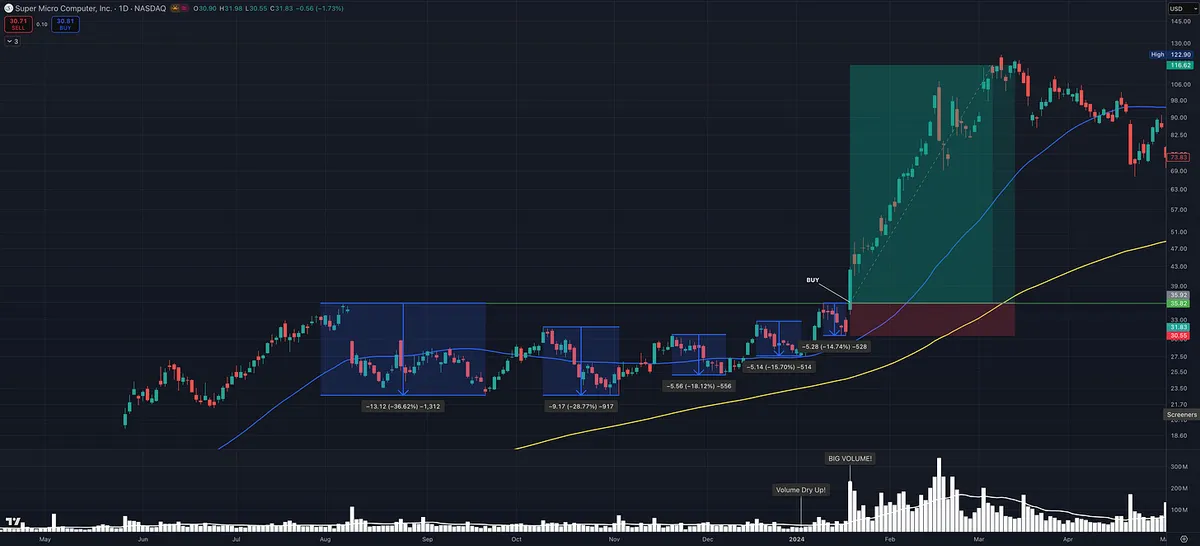
As price moves up the right side of a base, each pullback gets smaller.

The first drop might be 25 percent. The next 15 percent. Then 8 percent. Then maybe just 5 percent.

Each contraction is tighter than the one before.

That tightening is not random. It is supply drying up.

Weak holders get shaken out early. Stronger hands step in. Sellers become scarce.

The stock begins to coil.

A VCP is like a stock’s individual fingerprint. They all share the same core characteristics, but no two look exactly alike. Some have two contractions. Some have five. Some are deep early and tighten dramatically. Others are shallow the whole way through.

But the DNA is the same:

  • Higher lows

  • Declining volatility

  • Volume drying up near the pivot

  • Tight closes near the highs

The stock is under quiet accumulation.

When price finally pushes through the pivot on expanding volume, it often does so with force because there is simply less supply left to absorb demand.

You are not buying noise. You are buying compression.

And compression, when aligned with strong fundamentals and a healthy market, is often the launchpad for superperformance.

Study the contractions. Respect the tightening. Every great winner leaves clues before it runs.

View on Substack ↗

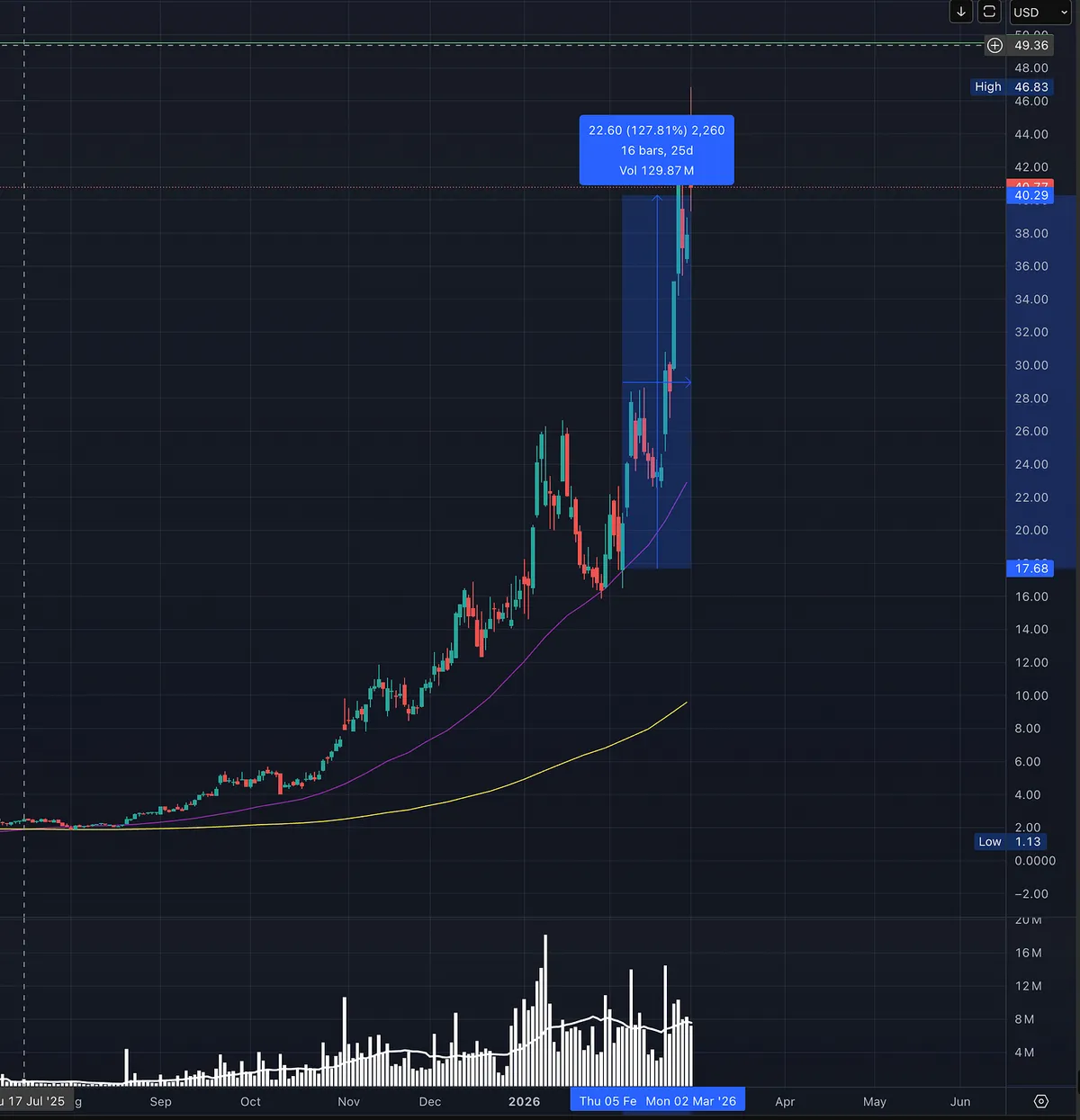
AXTI Is Up 127% Since I Flagged It in Chat

On February 5th, I mentioned AXT Inc. to paid subscribers in the chat.

Why?

It was showing up on my Relative Strength screener and pulling back to a key moving average that had been supporting price.

Nothing fancy.

No crystal ball.

Just strength plus constructive pullback.

Since then, the stock is up 127 percent.

Am I some stock picking guru?

Absolutely not.

I learned from people far more successful and intelligent than me. I just follow the process.

Here’s the truth most people do not want to hear.

I have more losers than winners.

The difference?

My winners pay for the losers and then some.

Bottom line.

I cut my losses short.

And I let my winners run.

That is the entire game.