Momentum Trading Strategy

Notes

Short lessons on momentum trading, every day.

Every note from Substack, in one place: risk, setups, leading stocks, market conditions and the mindset behind them. Search them, browse by topic, or filter by stock.

Showing 601–620 of 1226 notes

View on Substack ↗

“Nothing to Buy?” MU Was Hiding in Plain Sight

I keep hearing the same thing since the follow-through day on April 8th and the move back above the 50-day and 200-day moving averages:

“There’s nothing to buy. Everything is extended.”

I don’t think that’s true.

The issue usually isn’t that there are no stocks setting up. The issue is that most traders are not prepared before the setups happen.

If you had a proper watchlist built, many of the names breaking out right now have been showing leadership for a long time. Yes, some moved before the market gave us confirmation to start getting involved again. That happens. But some broke out after.

MU is a great example.

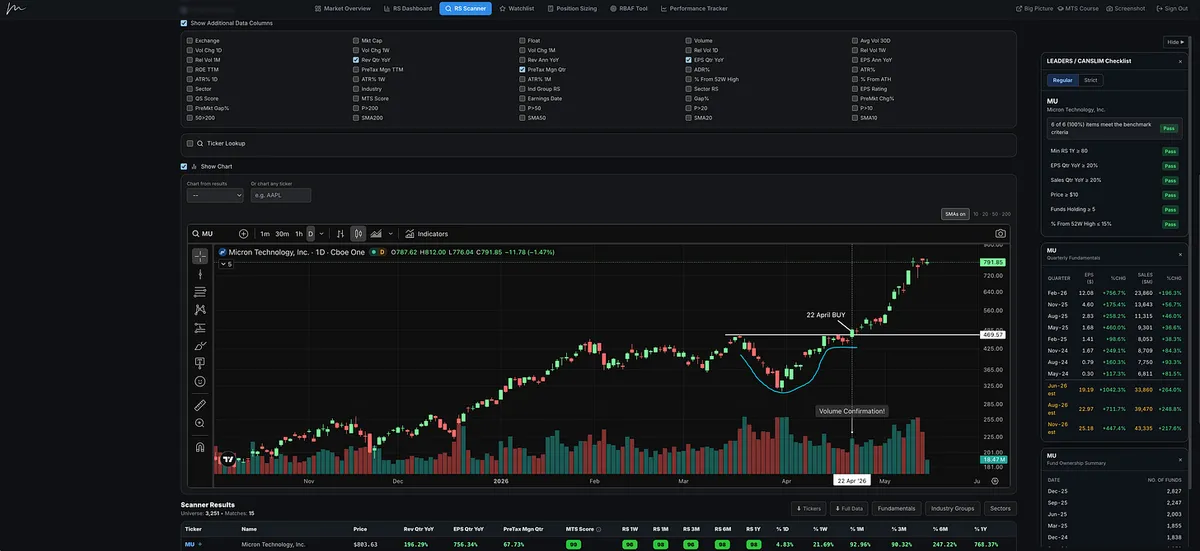
Micron had a beautiful cup-with-handle setup and broke out on April 22nd, roughly 10 to 11 days after the market gave us the signal to start getting back involved.

And this wasn’t some random laggard.

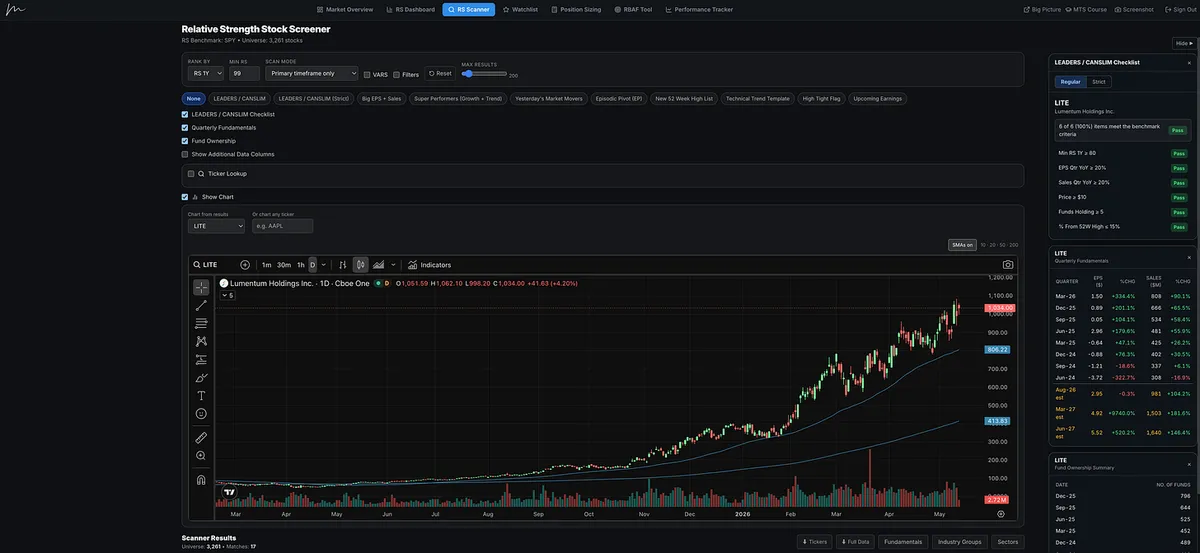
MU had strong relative strength, a hot industry group, big earnings growth, strong sales growth, powerful forward estimates, and a chart that was setting up.

This is exactly why I built the Relative Strength Stock Screener.

The goal is simple: narrow your watchlist down to the strongest leadership names before the move happens, so you don’t miss these types of setups.

Also, try using the MTS Score.

That is our proprietary leadership rating that looks at relative strength, earnings, sales, pre-tax margins, ROE, industry group relative strength, and proximity to 52-week highs.

It is designed to help you quickly separate true leadership from average names.

There have been plenty of stocks.

You just need to know where to look.

View on Substack ↗

The Indicator Rabbit Hole Is Really a Certainty Trap

When I first started trading, I went down the indicator rabbit hole.

I started with price, volume, and a few moving averages.

Then I found one indicator.

Then another.

Then another.

Before long, I had so many indicators on my chart that I could barely see price.

And the funny thing is, after all of that searching, testing, tweaking, and chasing, I eventually ended up right back where I started:

Price.

Volume.

A few moving averages.

In Market Wizards, Larry Hite was asked if there were any technical indicators he found overrated. His answer:

“Overbought/oversold indicators. None of them seem to prove out in testing.”

William O’Neil made a similar point when he said:

“I rarely pay any attention to overbought/oversold indicators.”

Jason Shapiro has said:

“There has never been and will never be a perfect indicator.”

That is the part most traders do not want to accept.

There is no perfect indicator.

There is no magic setting.

There is no tool that removes uncertainty from the market.

Once you truly learn to read supply and demand, you realize most of what matters can be seen through price and volume. Almost every other indicator is just a derivative of those two things.

That does not mean indicators are useless. Some great traders use them. Some have built specific indicators that help them see the market more clearly.

But most of those traders still keep things simple.

They are not stacking ten different indicators on a chart hoping the perfect combination will finally give them certainty.

That is the real issue.

For many traders, the obsession with finding the next great indicator is not really about analysis.

  • It is about fear.

  • Fear of being wrong.

  • Fear of taking a loss.

  • Fear of uncertainty.

  • Fear of entering without some tool giving them permission.

But the market will never give you perfect certainty. You can only build a process, manage risk, cut losses, and let your edge play out over time.

The indicator rabbit hole feels productive, but often it is just a more sophisticated way of avoiding the real work.

  • Learning price.

  • Understanding volume.

  • Reading supply and demand.

  • Building a process.

  • Accepting losses.

  • Managing risk.

  • Executing with discipline.

That is where sustainable disciplined trading is built.

View on Substack ↗

Same Trades. Same System. Completely Different Outcome.

I don’t think most traders truly understand how much position sizing can change their results.

Look at this example.

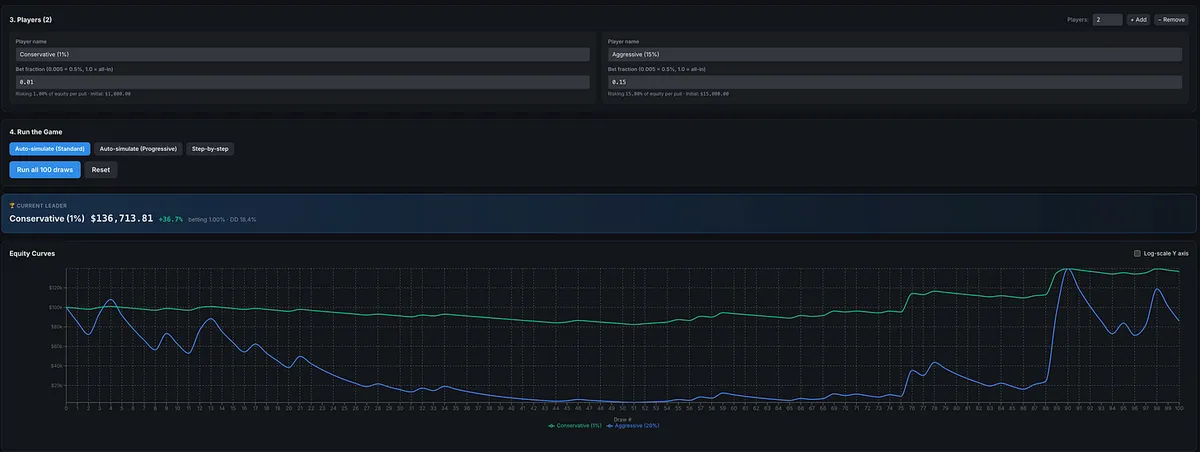
Two traders take the exact same 100 trades.

  • Same entries.

  • Same exits.

  • Same positive expectancy system.

  • Same 35% win rate.

The only difference is position sizing.

One risks 1% of equity per trade.

The other risks 15% of equity per trade.

The 1% risk model finishes up 36.7%.

The 15% risk model finishes down -14.1% and experiences a 97% max drawdown.

  • That is not because the system failed.

  • That is not because the entries failed.

  • That is not because the trader needed a better indicator.

The system had a positive expectancy. The winners were larger than the losers. The edge was there.

But the sizing changed everything.

Dr. Van Tharp spent a huge amount of time teaching this concept because position sizing is not some minor detail you add at the end of your strategy. It is one of the key pieces that determines whether your system can actually help you reach your objectives.

A trader can have a positive expectancy system and still destroy the account by betting too aggressively.

This is a drastic example, but it is exactly why many traders need to spend a lot more time understanding position sizing, R-multiples, risk per trade, drawdowns, and how much volatility their account can actually survive.

Most traders obsess over entries.

Van Tharp would tell you the real question is not just what to buy or where to enter.

It is:

How much?

Because two traders can take the same trades and end up with completely different outcomes.

That is exactly why I spent so much time on position sizing inside Module 6: Risk Management & Position Sizing of the Momentum Trading Strategy Course.

View on Substack ↗

Don’t Be One of Them

William O’Neil once said:

“I’ve known at least a dozen educated and otherwise intelligent people who were completely wiped out solely because they would not sell and cut a loss.”

Don’t be one of them.

Most traders do not fail because they are unintelligent. Many fail because they cannot do the one thing every great trader eventually learns to do:

  • Accept being wrong.

  • Cut the loss.

  • Move on.

View on Substack ↗

The Rules Are Not the Problem. Following Them Is.

Richard Dennis once said:

“I always say that you could publish trading rules in the newspaper and no one would follow them.”

Why do you think that is?

That quote gets to one of the most important, yet under-discussed, topics in trading: the psychology and mental side of the game.

Of course, if you do not have a trading strategy with an edge, nothing else really matters. You need a method. You need rules. You need a process.

But here is the uncomfortable truth.

There are plenty of well-known strategies with an edge. There are plenty of traders who understand setups, risk management, position sizing, and market environment.

Yet, many still cannot make money consistently.

That is exactly what Richard Dennis was getting at.

You can teach people how to trade. You can teach them rules. You can even teach them a strategy capable of making millions in the market.

The harder part is getting people to actually follow it.

  • Not sabotage it.

  • Not override it.

  • Not move the stop.

  • Not revenge trade.

  • Not chase because they missed the first entry.

  • Not abandon the process because one trade, one week, or one drawdown made them uncomfortable.

This is one of the biggest reasons most traders fail once they have developed enough knowledge. Beginners still need to learn the foundations, but after that, the gap is often no longer information. It is execution under pressure.

You can have all the knowledge in the world and still fail if you cannot manage your own mind.

That is what this article is about.

Read it here:

https://tradingmomentum.substack.com/p/why-most-traders-lose-even-when-they

ArticleWhy Most Traders Lose Even When They Know What to Do
View on Substack ↗

The Loss Happened Before You Sold

One of the biggest mental traps in trading is thinking a loss is not real until you sell.

But that is not true.

If you bought a stock at $60 and it is now trading at $48, you already have the loss.

Selling does not create the loss.

Selling only converts the position back to cash.

The loss happened when the stock dropped.

This is where a lot of traders get trapped.

They say things like:

  • “I do not want to take the loss.”

  • “I will wait until I get back to breakeven.”

  • “It cannot go much lower.”

But the market does not care where you bought.

The stock does not know your entry price.

And hope is not a strategy.

Every big loss started as a small paper loss.

That is the part traders need to fully understand.

A small paper loss is still a loss.

A large paper loss is still a loss.

The only difference is whether you are willing to admit it while the damage is still manageable.

One of the best questions you can ask yourself is:

If I did not already own this stock, would I buy it today?

If the answer is no, then why am I still holding it?

That question forces honesty.

Because once you are in a losing position, it becomes harder to think clearly. You start defending the stock. You start defending your original decision. You start looking for reasons to hold instead of objectively asking whether the trade still deserves your capital.

The professional does not wait for a paper loss to become a disaster.

The professional treats every loss as real, cuts it when the trade is no longer working, and moves back to cash where they can think clearly again.

That is how you stay in the game.

View on Substack ↗

You Don’t Pick the Big Winner. Your Process Finds It.

Here is something many beginners do not understand.

You can have a real strategy.

You can have a proven method.

You can know exactly what you are looking for.

And still, to find the big winner, you may have to take 10 qualified trades.

Six or seven may end up as small losses or break-even trades.

One or two may be average winners.

And then one may turn into something like SNDK or LITE.

That is the part most people miss.

The big winner usually does not announce itself in advance.

At the time of entry, it is just another name that fits the process.

That is why I do not get obsessed with any single stock.

I do not fall in love with the story.

I do not assume this has to be “the one.”

LITE was a big winner for me, but I did not know at the time it was going to be one of the one or two out of ten that really worked.

That is not how this game usually works.

Sometimes you know you have something special early, but most of the time you don’t.

Your job is not to predict with certainty which one will be the monster.

Your job is to follow the process, cut the ones that do not work, and stay with the ones that do.

That is why process beats obsession.

The beginner wants to know which stock is going to be the big winner.

The professional knows the big winner will reveal itself over time.

View on Substack ↗

The Secret Is Losing Small

William O’Neil said it best:

“The whole secret to winning big in the stock market is not to be right all the time, but to lose the least amount possible when you’re wrong.”

That is the game.

If you are taking 20% to 25% gains, then 7% to 8% losses keep the math in your favor.

But in a weaker market, where the best stocks may only give you 10% to 15%, even a normal 7% or 8% loss may be too much.

That is why O’Neil said he would cut every loss at 3%, with no exceptions.

The risk has to match the reward.

The loss has to match the environment.

You do not need to be right all the time.

You need to make sure your losses stay small enough that your winners still matter.

View on Substack ↗

The Average Trader Wants Tips. Professionals Build Process.

I get a lot of questions asking if I have an alert service, or if I plan on starting one.

Here is my answer to that.

I do share stock names, setups, market observations, and sometimes example entry areas, stop areas, and risk management thoughts.

And yes, I do plan on adding some trade alerts once the rest of the Momentum Trading Strategy Web App / software platform is fully built out.

But I want to be very clear:

Momentum Trading Strategy is NOT being built as a traditional alert service.

Alerts will never be the foundation.

It would be much easier to build a simple alert service where people are given buy and sell signals.

  • Post buys.

  • Post sells.

  • Tell people what I am watching.

  • Tell people when I am getting in.

  • Tell people when I am getting out.

But that is not the path I want to go down.

There is a famous quote from Brian Gelber in Market Wizards.

He was asked:

“What does the average trader do wrong?”

His answer:

“He overtrades and begs for tips.”

That one line explains exactly why most traders do not need another alert service.

  • They need a process.

  • They need structure.

  • They need tools.

  • They need risk management.

  • They need to learn how to think for themselves.

And it was not just Brian Gelber.

Michael Marcus warned about blindly following the advice of other traders, even good ones.

Richard Dennis said you could publish trading rules in the newspaper and most people still would not follow them.

Why?

Because the hard part is not just knowing the rules.

The hard part is having the discipline, confidence, and consistency to follow them when the market gets difficult.

Ed Seykota talked about the value of having support from experienced traders, but he also said he usually ignored advice from other traders, especially anyone acting like they had a “sure thing.”

Bruce Kovner made a similar point when he talked about why it is difficult to make money by simply following someone else.

And Jack Schwager’s broader takeaway from interviewing legendary traders over the years was that traders cannot succeed in the markets by simply copying someone else’s approach. You have to find a method that fits your own personality, risk tolerance, time frame, and decision-making style.

That is the entire point.

This does not mean you cannot learn from great traders.

You absolutely can.

Bruce Kovner learned from Michael Marcus

The Turtle Traders learned from Richard Dennis.

David Ryan learned from William O’Neil.

Many great traders were shaped by mentors, teachers, firms, books, and other serious traders.

I have learned the majority of what I do from studying William O’Neil, Mark Minervini, and other great growth stock investors, momentum trader, and trend followers.

But I am not buying and selling based on a trade alert system from them.

And neither did they.

There is a huge difference between learning from a trader and depending on a trader.

There is a huge difference between sharing ideas and blindly following signals.

There is a huge difference between being part of a serious trading community and sitting around waiting for someone else to tell you when to buy and sell.

That is why I want Momentum Trading Strategy to be built more like a professional trading environment.

At professional firms, traders share ideas.

  • They talk about names.

  • They discuss themes.

  • They study leadership.

  • They review market conditions.

  • They share setups.

They talk about relative strength, earnings, volume, sector rotation, breakouts, failed breakouts, and stocks that are acting well.

Some of my largest trades have come from ideas I missed in my own scanning that another serious trader shared with me.

But I did not blindly follow.

  • I still created my own plan.

  • I still managed my own risk.

  • I still traded my own trade.

That is the difference.

Every trader still has to own the trade and have their own trading plan.

  • Where is the entry?

  • Where is the stop?

  • How much capital is at risk?

  • What is the position size?

  • Where would you add?

  • Where would you trim?

  • What would prove the trade wrong?

  • What would make you exit?

That is the skill most alert services skip.

They give people names, but they do not build traders.

Momentum Trading Strategy is being built differently.

The goal is to create something closer to a professional trading environment.

Structured education.

  • A real course.

  • A relative strength stock screener.

  • Risk management tools.

  • Position sizing tools.

  • A trading journal.

  • Market dashboards.

  • Trade planning.

  • Market context.

And a professional-style community where serious traders can share ideas, study the market, use the tools, follow the process, and become more independent.

I am not completely against alerts.

When alerts are eventually added, they will be used as another educational tool.

  • A way to study real-time examples.

  • A way to recognize quality setups.

  • A way to understand risk/reward.

  • A way to help newer traders learn what a proper setup and trade plan can look like.

Not something to blindly follow.

The foundation will always be education, process, tools, and community.

The goal is to help traders develop the ability to think, plan, manage risk, and make decisions for themselves.

In other words, the goal is to teach traders how to fish, not create dependency by simply handing them fish.

I would rather build something that helps traders become independent than build something that keeps them dependent.

Because the goal is NOT to build a room full of traders begging for tips.

The goal is to build a professional trading environment full of traders who want to become real traders.

View on Substack ↗

Big Down Day? The Warning Signs Were Already There

Nobody should be shocked by today’s price action.

We still have to see how the market closes, but after the type of run we have had, a sharp pullback should not surprise anyone.

I wrote about this in the Big Picture Market Pulse over the weekend.

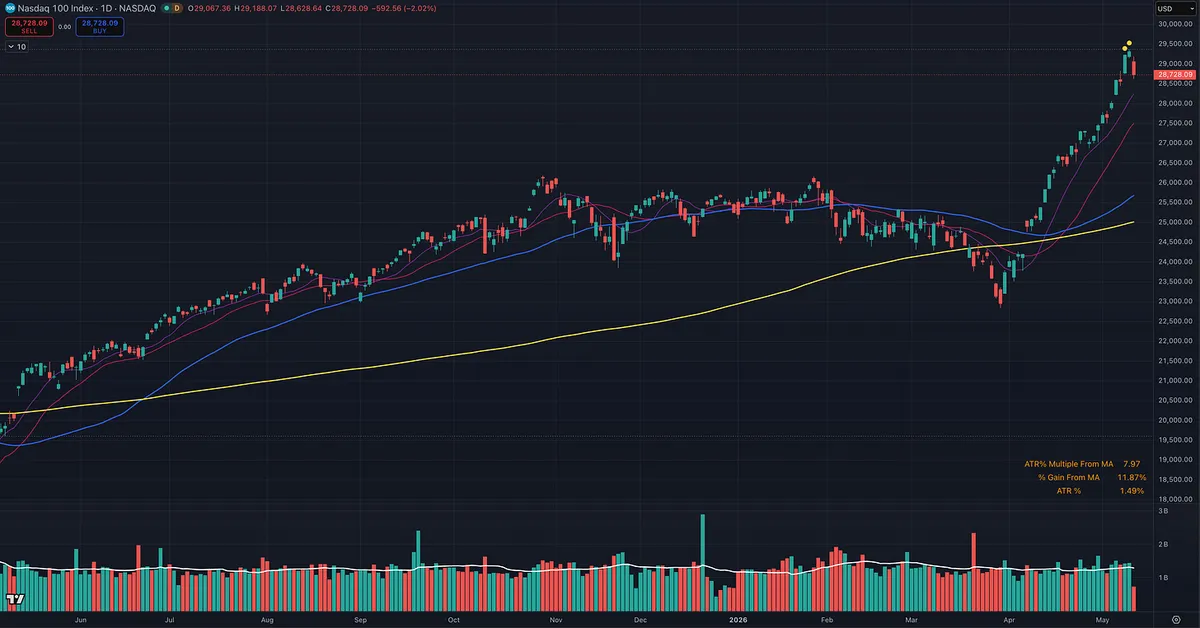
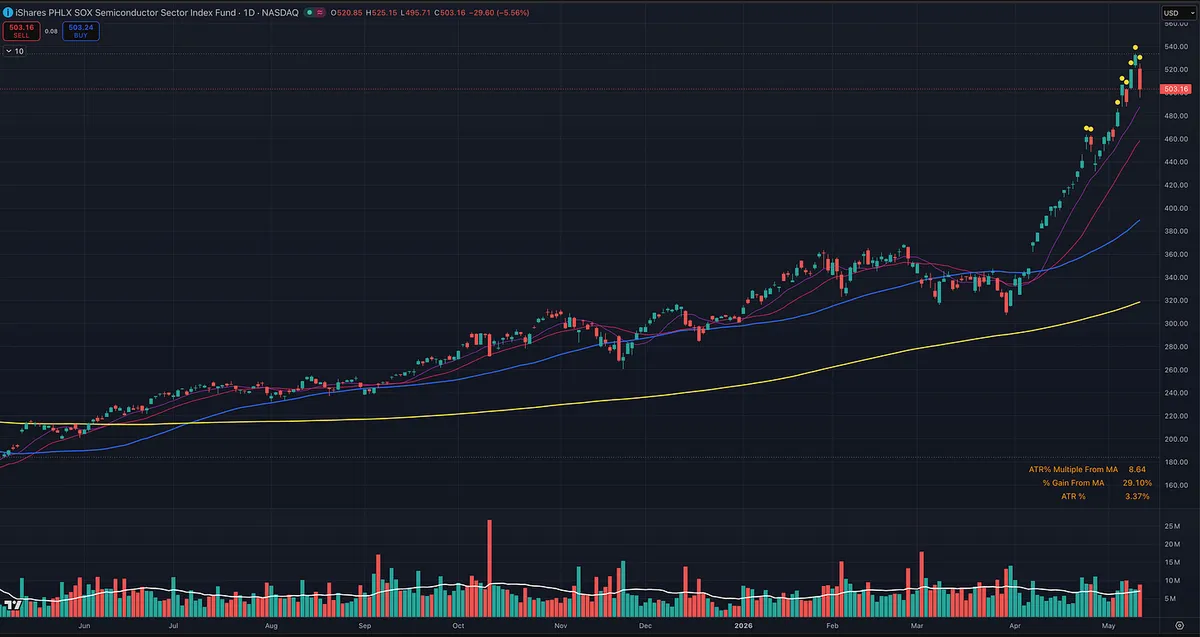
The biggest takeaway was that the Nasdaq 100 had flashed an ATR extension signal from the 50-day moving average, something that had not happened since January 3, 2000.

That does not mean the market has to crash.

It does not mean the bull move is over.

It simply means the market had become extremely extended after a powerful six-week run, and when markets get that stretched, volatility should be expected.

The Nasdaq 100 was not the only area flashing extension.

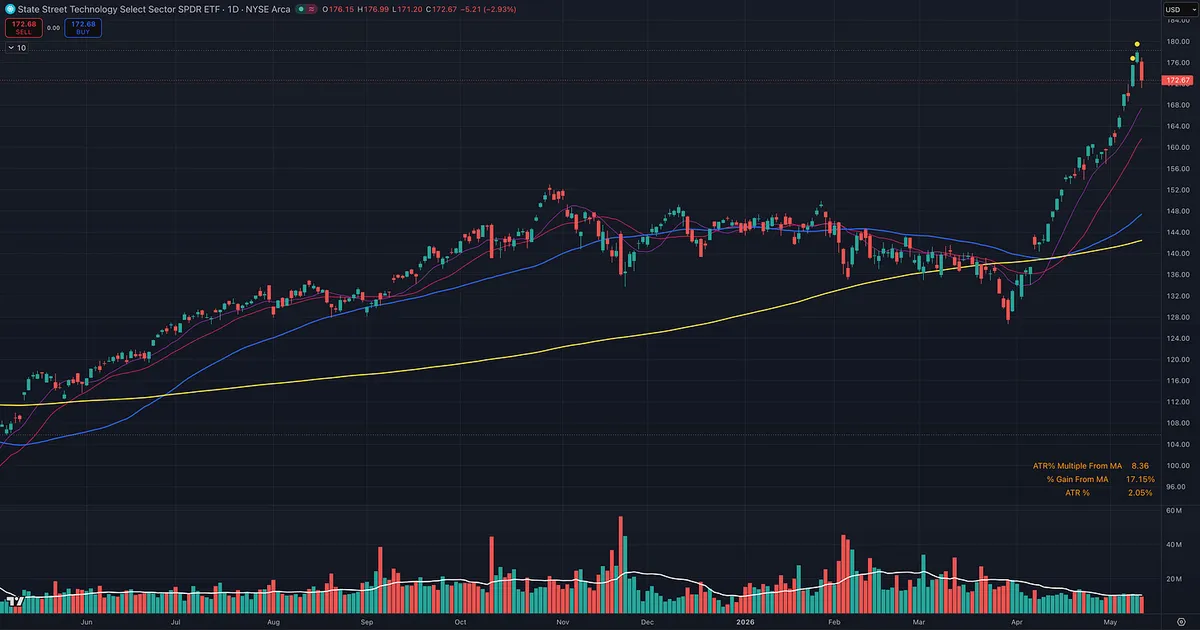
Technology, through XLK, also became extended. Semiconductors, through SOXX, have been flashing extension signals since April 24th, and that group has been one of the hottest areas driving the move.

This is why we study the big picture and market history.

William O’Neil talked constantly about the importance of understanding the general market. The “M” in CAN SLIM stands for market direction for a reason.

Strong markets create opportunity, but extended markets create risk.

That does not mean you panic.

It means you pay attention.

You watch how the indexes close.

You watch volume.

You watch whether leading stocks hold up or start breaking support.

You watch whether this is normal digestion after a powerful move or the beginning of heavier distribution.

Momentum trading is not about being surprised by every red candle.

It is about understanding the environment, knowing when the wind is at your back, and recognizing when the market is stretched enough that a pullback becomes normal, not shocking.

That is exactly why I do the Big Picture Market Pulse every weekend.

View on Substack ↗

The Trading Secret O’Neil Learned From a Book You Can Still Read Today

One of the most important lessons William O’Neil taught was the importance of having sell rules.

What I find fascinating is where he learned some of those lessons.

O’Neil talked about in 1960 picking up Jesse Livermore’s How to Trade in Stocks and learning the importance of having sell rules, averaging up, and pyramiding into winning trades.

He did NOT learn that while attending Harvard Business School.

He learned it from a book that all of us can still read today.

That is one of the biggest lessons I keep coming back to.

When you study the great traders, you are not chasing some secret that is locked away behind Wall Street doors.

You are studying the same ideas they studied.

O’Neil learned from Livermore.

Minervini studied O’Neil, Livermore, and others.

And we can study all of them today.

The knowledge is not hidden.

The hard part is studying them seriously, and then having the discipline to apply what they taught.

That is why I keep pointing back to the great books and the great traders.

Because the lessons are there.

They always have been.

View on Substack ↗

The Wall Street Figure the Market Wizards Paid Attention To

One thing that stood out to me while reading Jack Schwager’s Market Wizards was how often some of the greatest traders of the modern era mentioned the same analyst they respected and followed:

Marty Zweig.

Bruce Kovner.

Michael Marcus.

Richard Dennis.

Paul Tudor Jones.

Different traders. Different styles. Different markets. Same respect for Zweig’s work.

That is what made me pick up Winning on Wall Street.

My foundation has always been built primarily on William O’Neil, CAN SLIM, and Mark Minervini’s work. But Zweig helped me understand the “M” in CAN SLIM, market direction, at a deeper level.

O’Neil taught the importance of understanding the general market. Even Mike Bellafiore has written about why day traders need to understand the big picture. Zweig helped me connect those ideas with monetary policy, the Fed, market momentum, sentiment, and tape action.

That is one of the reasons I expanded my own Big Picture Market Pulse and why I do it every weekend.

This article breaks down Marty Zweig’s most important rules and why they still matter for growth stock investors, momentum traders, and anyone trying to stay aligned with the market’s major trend.

https://tradingmomentum.substack.com/p/marty-zweigs-rules-dont-fight-the

ArticleMarty Zweig’s Rules: Don’t Fight the Fed, Don’t Fight the Tape, and Don’t Fight Yourself
View on Substack ↗

The Traders Who Improve Fastest

This is exactly what I want to see.

A lot of people consume information. Fewer people turn that information into reps.

Henry did the part that matters most: he studied the framework, applied it in the real market, managed risk, and reviewed the process in real time.

That is how trading education turns into experience.

Learn. Execute. Review.

Repeat.

Quoting Momentum Trading StrategyHenry, this is where the real magic happens. A lot of people spend years learning, but never put what they learn into action. Then there are plenty of people who take action right away, but never really put in the time to learn. They just jump in and start trading without a real foundation. What you’re doing is comb…
View on Substack ↗

The Boring Part of Trading That Actually Changes Results

“The reason people either lose money or achieve mediocre results in the stock market is they simply make too many mistakes.”

— William O’Neil

So what is the easiest way to find out what your weaknesses are?

You track your trades.

Not just the ticker.

Not just the entry and exit.

Not just whether you made or lost money.

You track the decisions.

  • Did you follow your rules?

  • Did you size the position correctly?

  • Did you honor your stop?

  • Did you buy in the direction of the market?

  • Did you chase?

  • Did you sell too early?

  • Did you repeat the same mistake again?

This is the boring, less exciting part of trading that almost nobody wants to talk about.

But it may be one of the most important parts of getting better.

Because you cannot reduce mistakes you are not tracking.

You cannot fix weaknesses you have not identified.

And you cannot improve your process if every trade just becomes a vague memory.

That is exactly why we built the trade journal and performance tracker inside the Momentum Trading Strategy Web App software.

It does not just record trades.

It helps you review them, grade them, track performance, identify recurring mistakes, and see where your biggest leaks are coming from.

The goal is simple:

  • Find the mistakes.

  • Measure the mistakes.

  • Reduce the mistakes.

Because better trading is not just about finding better stocks.

It is about becoming the kind of trader who makes fewer unforced errors.

View on Substack ↗

Why the Best Stocks Usually Come From the Strongest Industry Groups

Most traders are obsessed with finding the right stock.

But the better question is:

Is this stock in the right neighborhood?

William O’Neil taught that the majority of leading stocks are usually found in leading industries.

That matters because studies show that 37% of a stock’s price movement is tied to the performance of its industry group, and another 12% comes from the strength of its broader sector.

In other words, roughly half of a stock’s move can be influenced by the strength of the group it belongs to.

Then add the “M” in CAN SLIM: market direction.

O’Neil also taught that roughly three out of four stocks follow the overall market trend.

So if you are buying a stock in a weak market, inside a weak sector, inside a weak industry group, you are not just making a stock pick.

You are fighting probability.

That is why I put so much emphasis on:

  • Market direction.

  • Sector strength.

  • Industry group leadership.

  • Relative strength.

Leading stocks inside leading groups.

Recently, that has meant paying close attention to areas like technology and semiconductors, because that is where a lot of the real leadership has been.

The goal is not just to find a good company.

The goal is to find a strong stock, in a strong group, aligned with the strongest market theme, while the general market is supporting risk.

Before buying a stock, ask:

  • Is the market helping or hurting me?

  • Is the sector leading or lagging?

  • Is the industry group attracting money?

  • Is this stock one of the strongest names in that group?

Because the best stock ideas usually do not happen in isolation.

Leadership clusters.

Money rotates.

The strongest stocks are often found where the strongest institutional demand is already flowing.

View on Substack ↗

What Soros Taught Druckenmiller About Big Winners, and Why CIEN Is the Point

One of the biggest misconceptions in trading is that you need to be right all the time.

You do not.

What you need is the ability to keep losses small when you are wrong and press your advantage when you are right.

That is one of the biggest lessons Stanley Druckenmiller described learning from George Soros in Jack Schwager’s The New Market Wizards.

Druckenmiller said Soros taught him that when conviction is high, “you have to go for the jugular.”

He also called Soros “the best loss taker I’ve ever seen.”

That combination is powerful:

Be aggressive when you are right.

Walk away quickly when you are wrong.

I have made plenty of wrong calls on individual stocks. I am wrong often.

But the goal is not to be right on every name.

The goal is to structure your trading so the small losses stay small, and the winners have enough room to pay for the losers and then some.

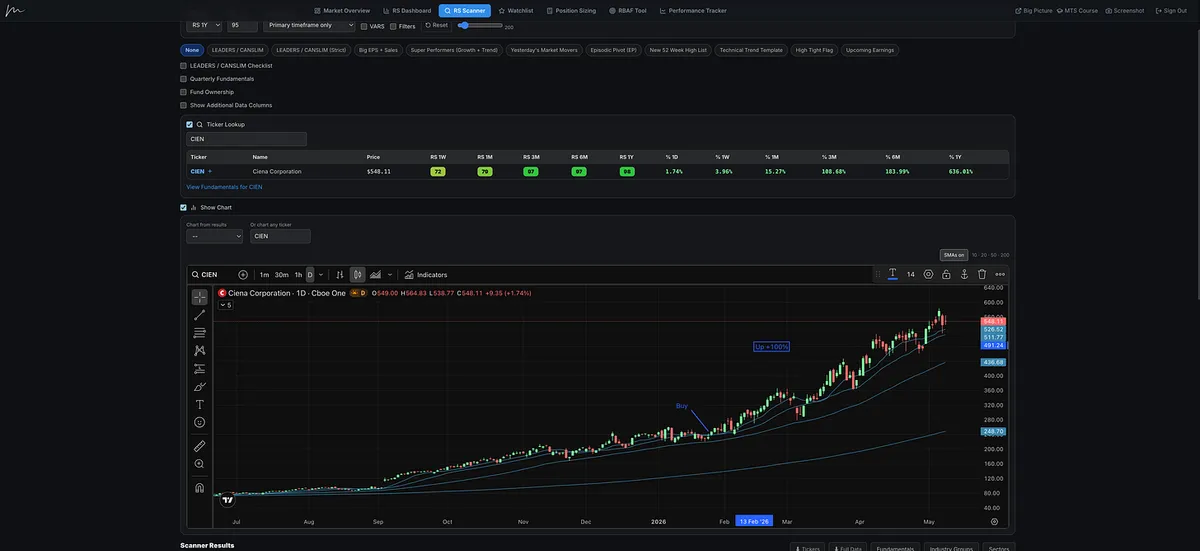
That is why a winner like CIEN, along with names like LITE and SNDK, matters so much in my trading strategy.

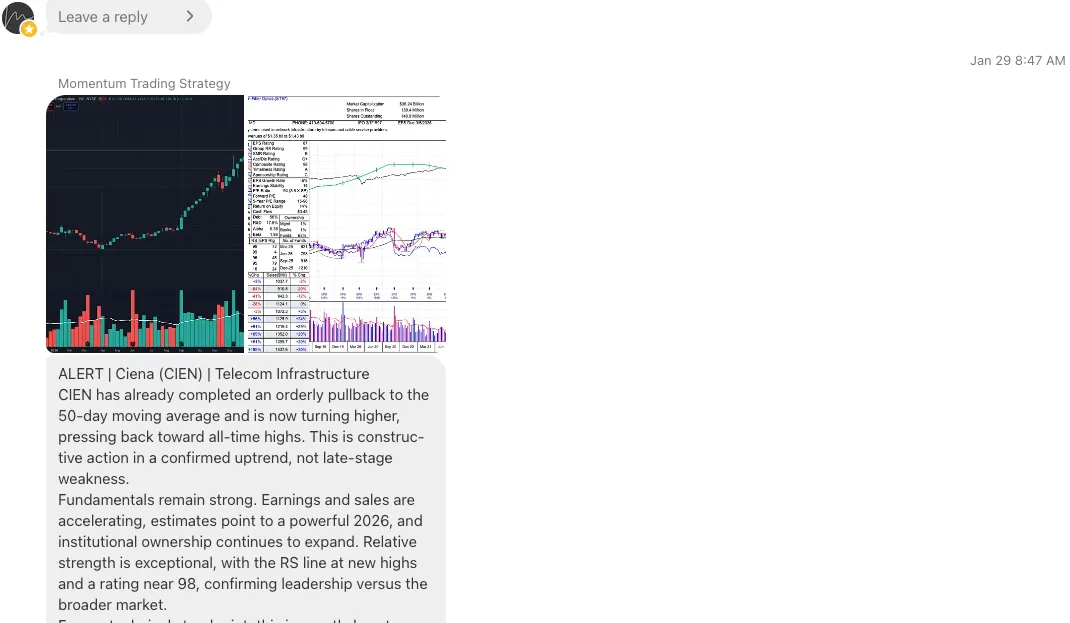
I mentioned CIEN earlier because it had the kind of relative strength, leadership, and constructive price action I look for.

Since then, it has continued to show why holding real leaders matters.

One real leader can make up for a lot of small losses.

But only if you do two things:

  • Cut the trades that are not working.

  • Hold the trades that are.

That is the hard part.

Most traders do the opposite.

They give losing trades too much room and cut winning trades too quickly.

The best traders understand the math is not about being right all the time.

It is about making sure that when you are right, it actually matters.

View on Substack ↗

The Market Wizards Lesson Most Traders Ignore

If you’re wondering why I put so much emphasis on risk management and position sizing, it’s because when you study the traders in Market Wizards, that is one of the few themes almost everyone seems to agree on.

Entries matter.

Stock selection matters.

Market direction matters.

BUT if you cannot manage risk, size positions correctly, and survive the inevitable losing streaks, none of the rest matters for long.

William Eckhardt, the mathematician and legendary futures trader who worked with Richard Dennis and helped develop the famous Turtle Trading experiment, said it clearly when asked what he would do differently if he were starting out again:

“I would concentrate more on money management. To my regret, it was something that I ignored in my early years. Ironically, even though money management is more important than the price model, mathematically, it’s the more tractable problem.”

He also said:

“You shouldn’t plan to risk more than 2 percent on a trade.”

That is why risk management is not some side topic.

It is the foundation.

A trader can have great ideas and still fail if the position size is wrong.

A trader can have a real edge and still blow up if the risk is too large.

The goal is not just to find winning trades.

The goal is to stay in the game long enough for your edge to compound.

View on Substack ↗

This Started With Morning Coffee and a Few Trading Notes

A few thoughts on momentum, growth stocks, market conditions, relative strength, risk management, position sizing, and the lessons I’ve picked up from studying some of the greatest traders over the last 100 years.

A few months later, Momentum Trading Strategy has grown to more than 6,600 subscribers and is currently ranked #45 New Bestseller on Substack.

I’m incredibly grateful for everyone who has read, shared, commented, subscribed, and helped build this community.

What started as simple writing has slowly evolved into something much bigger:

A full educational platform built around articles, market notes, a trading course, software, market dashboards, relative strength stock screener, position sizing tools, trade review analytics, and a community of traders trying to build a real process.

The goal has never been to create an alert service or tell people what to buy.

The goal is to build the resource I wish I had when I was first learning how to trade growth stocks.

A place where traders can learn how to:

  • Find leading stocks.

  • Understand market conditions.

  • Track relative strength.

  • Manage risk.

  • Size positions correctly.

  • Review trades honestly.

  • Build discipline.

And develop a repeatable process that can survive both good markets and bad ones.

There is still a lot more coming, but it has already grown far beyond what I expected in just a few months.

Thank you to everyone who has been here early.

We are just getting started.

View on Substack ↗

The Hidden Reason Your Trading Edge Isn’t Showing Up

Most traders do not actually know if their strategy works.

They think they do.

But they are not really measuring the strategy.

They are measuring the strategy mixed with fear, hesitation, boredom trades, oversized positions, early exits, skipped stops, revenge trades, and emotional decision-making.

That is a completely different system.

Van Tharp’s 95% discipline standard changed the way I think about reviewing trades.

  • A good trade is not automatically a winning trade.

  • A good trade is a trade where you followed your plan.

  • A bad trade is not automatically a losing trade.

  • A bad trade is a trade where you broke your rules.

That is exactly why I built the Performance Tracker inside the Momentum Trading Strategy App.

Because your brain can trick you in real time.

Your journal cannot.

Full post here: https://tradingmomentum.substack.com/p/your-trading-strategy-isnt-broken

ArticleYour Trading Strategy Isn’t Broken: Your Discipline Score Is