
“I have two basic rules about winning in trading as well as in life:
1. If you don’t bet, you can’t win.
2. If you lose all your chips, you can’t bet.”
- Larry Hite
Notes
Short lessons on momentum trading, every day.
Every note from Substack, in one place: risk, setups, leading stocks, market conditions and the mindset behind them. Search them, browse by topic, or filter by stock.
Showing 581–600 of 1226 notes
The Goal Was Never More Money. It Was Random Wednesdays.
My daughter told me she’s been wanting to go to the beach.
My kids work hard. They’re great kids. So today, on a random Wednesday, we went.
That’s the part most people miss.
The goal was never just to make more money.
The goal was to have more control over your time.
To say yes when your kid asks to go somewhere.
To not need permission to step away.
To build a life where a random Wednesday can become a memory instead of just another day on the calendar.
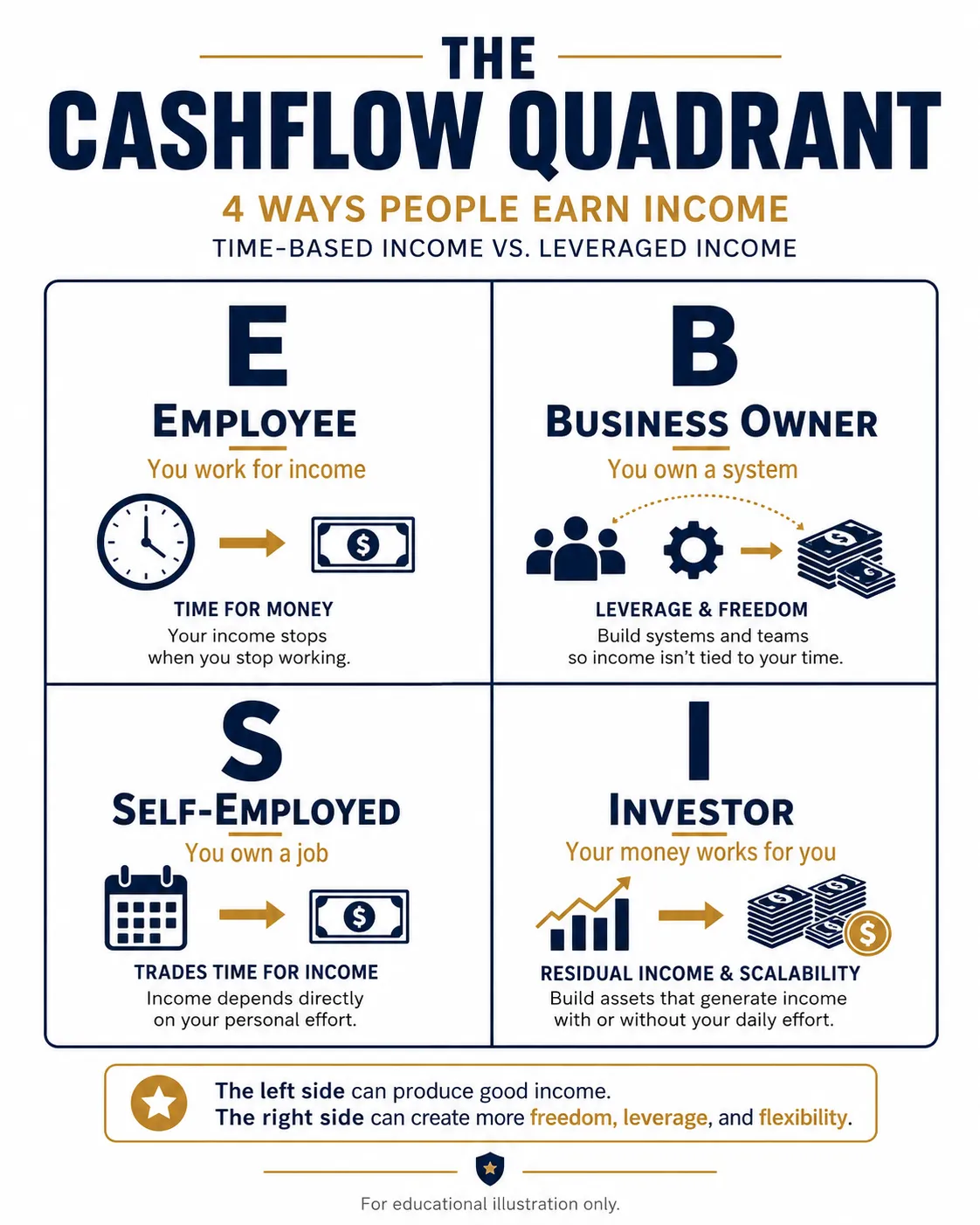
You can make plenty of money on the left side of the quadrant as an employee or self-employed person.
But the right side is different.
Business ownership and investing can give you something money alone does not always give you:
freedom, leverage, and flexibility.
Not looking rich.
Not sounding successful.
Not impressing strangers online.
The real goal is being able to take your kids to the beach on a random Wednesday.


“The common mistake most people make in designing systems is to try to find a system that works in all market conditions. That’s insane.” - Dr. Van K. Tharp
Do You Want to Feel Good, or Do You Want to Get Better?
I’m not here to make you feel good about bad habits.
There are plenty of people who will tell you what you want to hear.
That’s not what I’m here to do.
I’m here if you actually want to learn how to trade growth stocks and trade momentum.
Now, the one thing I will tell you that has some feel-good to it is this:
I genuinely believe you can do this.
If you want it bad enough and you are willing to put in the work, you can do it.
But I am not going to sell you a fantasy and make it sound easy. I am not going to tell you that you are going to get rich overnight.
And honestly, if you ever see someone promising that, you should probably run the other direction, because it is likely nonsense.
But with enough hard work, time, and commitment, you can learn this.
This is not rocket science.
It does not require some rare natural talent.
But it does require work. It requires discipline. It requires studying the right process and being honest with yourself.
So the question is simple:
Do you want to feel good?
Or do you want to actually learn something?
“This Time Is Different” Is Usually the Most Expensive Phrase in Markets
I’m sorry to tell you, but when someone says, “this time is different,” the odds are usually against them.
Most of the time, it is not different.
If you think it is, you just have not been in this game long enough to realize it yet.
Any biotech fans out there?
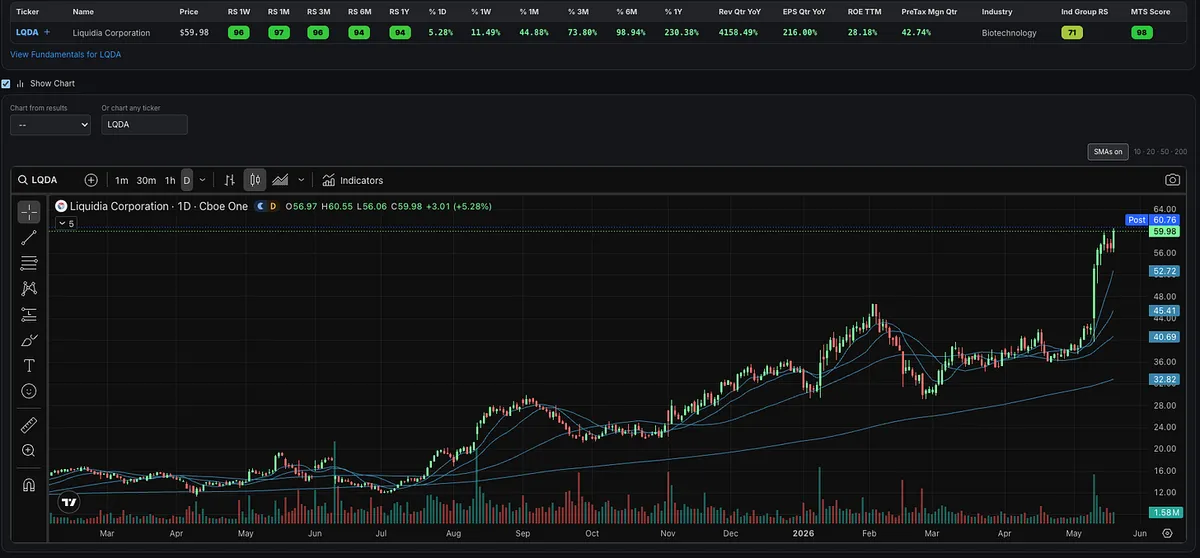
The strongest stocks often reveal themselves when the market is pulling back.
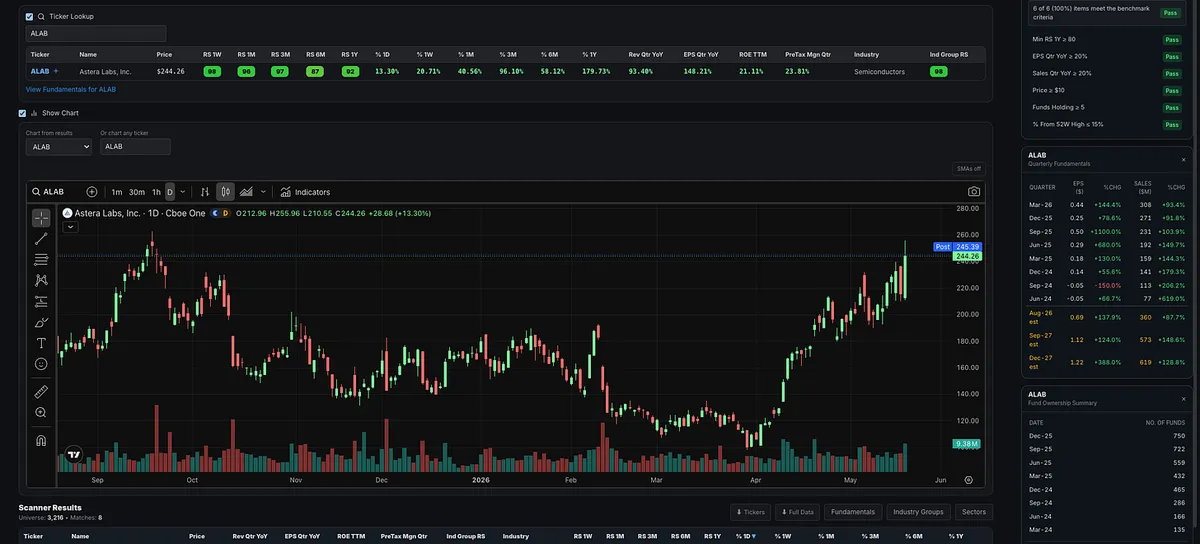
Will ALAB end up being one of them?
ALAB is up 13% today, and the earnings report is already out of the way.
Big sales growth.
Big earnings growth.
Strong ROE.
Strong margins.
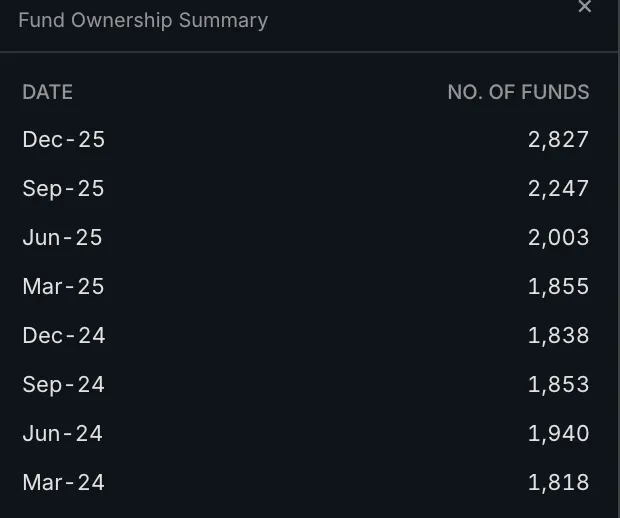
Fund ownership increasing.
Relative strength still near the top of the market.
And now it’s pushing back toward all-time highs while the broader market is pulling in.
“The institutional buyers are by far the largest source of demand for stocks. Leading stocks usually have institutional backing.”
- William O’Neil
The Diversification Myth Most Stock Pickers Still Believe
The mainstream financial media has preached diversification for decades.
Most stock pickers still believe it without question, even though most of them fail to keep up with the major indexes.
Warren Buffett, one of the greatest value investors of all time, said:
“Diversification is protection against ignorance. It makes little sense if you know what you are doing.”
William O’Neil, one of the greatest growth stock investors of all time, said:
“Broad diversification is plainly and simply often a hedge for ignorance.”
Think about that.
Buffett was a value investor.
O’Neil was a growth stock investor.
Completely different styles.
Same conclusion.
If your goal is superperformance, most of the greats did not get there by owning everything.
They got there by being selective.
By knowing exactly what they were looking for.
By concentrating when the opportunity deserved it.
By cutting losses when they were wrong.
And by letting their true winners actually matter.
That does not mean reckless concentration.
Reckless concentration is buying a few random stocks with no rules, no sell discipline, and no idea where you are wrong.
That is gambling.
Intelligent concentration is different.
Buffett did it through business quality, valuation, and waiting for exceptional opportunities.
O’Neil did it through earnings growth, sales growth, relative strength, institutional demand, price and volume, and strict sell rules.
Even systematic traders like Ed Seykota were not randomly spreading money everywhere just to feel safe.
They followed a tested edge, managed risk, cut losses, and let winners run.
That is the common thread.
The herd says own more.
The greats say concentrate wisely.
If you want diversification, make it simple. Own the index ETF.
If you are trying to achieve superior performance picking individual stocks, diversification is often NOT the answer.
It is often evidence that you do not have a real process yet.
Focus on the similarities among the greats.
That is usually where the real rules and golden nuggets are found.
Calling Yourself an Investor Does Not Remove the Risk
A lot of people believe investing is automatically safer than trading.
That is not necessarily true.
What often happens is someone fails at trading, pushes out their timeframe, stops using stops, and starts calling themselves an investor.
Now instead of taking a small loss, they are “holding for the long term.”
Instead of admitting the trade failed, they convince themselves they own a great company.
Instead of following a process, they hide behind a label.
There is nothing wrong with passive investing.
If someone does not want to trade, I completely understand buying broad market ETFs like SPY or QQQ and passively investing into the major indexes over time.
That is very different from buying individual stocks with no rules.
Individual stocks are not the same as owning the market.
A single company can break down.
A former leader can lose institutional support.
A growth story can slow.
A stock can go sideways for years.
A stock can decline 50%, 70%, or 90% and never come back.
So if you are going to buy individual stocks, even on a longer timeframe, you still need a system.
You need to know when you are wrong.
You need rules for cutting losses.
You need rules for letting winners run.
You need a process for separating normal volatility from real deterioration.
That is why so many “investors” underperform the market.
They are not really investing with a disciplined strategy.
They are just holding stocks and hoping time fixes bad decisions.
When you read Market Wizards, you see traders and investors with different styles, different timeframes, and different methods.
But almost none of them are simply buying individual stocks, holding them for years, ignoring losses, and operating with no exit plan.
They have rules.
They manage risk.
They protect capital.
They understand that being on a longer timeframe does not eliminate the need for discipline.
Calling yourself an investor does not make individual stock risk disappear.
If you do not have a plan to cut losses and let winners run, you do not have a safer strategy.
You just have a slower-moving mistake.
Stop Chasing Stocks. Start Mastering the Real Game.
I’m amazed at how much effort people put into trying to find the next big stock, while ignoring the things that actually determine whether they survive long enough to compound capital:
Risk management.
Position sizing.
Trade management.
A disciplined process.
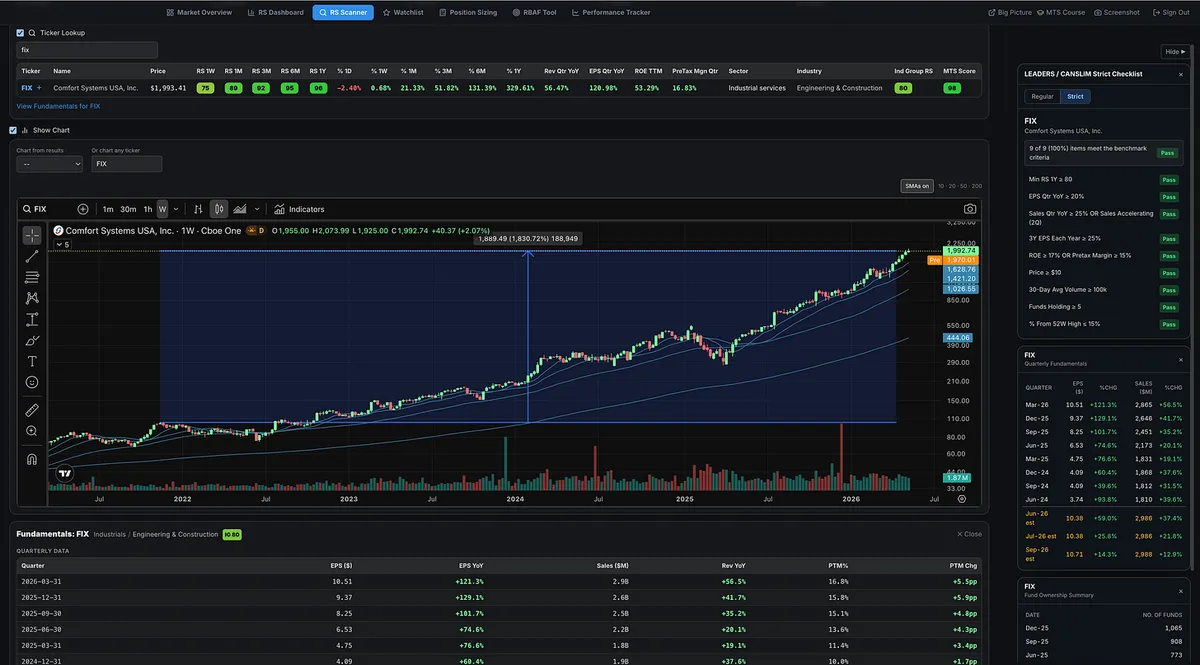
FIX is a great example.
This is not some random name that suddenly showed up on a screen. I’ve talked about FIX for a long time and have been watching it since 2022.
Why?
Because it checks many of the same boxes William O’Neil wrote about when studying the greatest winning stocks in market history.
Consistently strong relative strength. 90+
Massive quarterly earnings growth.
Massive quarterly sales growth.
Annual earnings growth of 25% or greater over the last three years.
Strong return on equity.
Strong margins.
Increasing fund ownership quarter after quarter.
At some point, what else are you looking for in a leading stock?
The problem for most traders is not that there are no good stocks.
The problem is usually one of three things:
They are looking at and trading the wrong stocks, instead of focusing on the right characteristics.
They lack discipline, risk management, and position sizing skills.
They have no clue how to manage the trade once they are in.
Or they do not have a real system or strategy.
Everyone says they want stocks.
But when strong names show up, many people still do not execute.
And the ones who do execute often do not know how to manage the trade once they are in it.
That is exactly why I decided to put so much work into the Momentum Trading Strategy Course.
Because finding the next big stock is only a small part of success in this game.
Real lasting success comes from knowing what to look for, when to act, how much to risk, and how to manage the position after entry.
Stocks matter.
Process matters more.
I Didn’t Find O’Neil and Minervini Through Blind Faith. I Found Them Through Skepticism.
I remember even 20 years ago, before YouTube, Twitter, Substack, and social media, the trading and investment world was already full of fraudsters.
People were selling the next big stock idea.
The next secret system.
The next “can’t miss” strategy.
And if I’m being honest, some of it caught my eye back then.
But that is also what sent me down the path of studying the legendary traders and going back through market history.
Now, from the outside, it may look like I am some cult-like follower of William O’Neil, Mark Minervini, Jesse Livermore, Nicolas Darvas, Bernard Baruch, Gerald Loeb, and the other great traders.
But it is actually the opposite.
I found them because I did not trust people.
I did not trust the hype.
I did not trust the gurus.
I did not trust 99% of what I saw.
So I went backward.
I studied the legendary traders to look for the similarities, not the differences.
The people who survived multiple market cycles.
The people whose methods kept showing up again and again across different eras.
And eventually, you start to realize something David Ryan quotes from the bible and has said many times:
“There is nothing new under the sun.”
Most of what works in the market has already been discovered, tested, taught, forgotten, repackaged, and rediscovered again.
Buy strength.
Cut losses.
Let winners run.
Respect the general market.
Price is always right.
Manage risk.
Use proper position sizing strategies.
Avoid the need to be right.
These ideas are not new.
They are old because they work.
So to the newer traders, especially the beginners who feel overwhelmed, do not feel bad if you are still swimming through the garbage.
A lot of us did the same thing.
A lot of the legendary traders did too.
They tested ideas. They made mistakes. They chased the wrong things. They learned the hard way. Then they eventually found the principles that kept showing up across history.
Honestly, I challenge you not to believe me.
Try to prove me wrong.
Go study market history and ALL the books I listed in the Momentum Trading Strategy Course.
Go study O’Neil, Livermore, Darvas, Baruch, Loeb, Wyckoff, Weinstein, Ryan, Minervini, Zweig, and the Market Wizards.
Study the biggest winning stocks.
Study the biggest winning traders.
Study what actually repeats.
And in trying to prove me wrong, you may end up coming to the same conclusion I did:
Most successful traders are not inventing something revolutionary.
They are building on proven principles from the people who came before them. Many just copied a proven system and followed it and there is absolutely NOTHING wrong with that.
That is true for growth stock traders.
It is true for trend followers.
It is true for value investors.
It is true for systematic traders.
Different disciplines. Different tools. Different timeframes.
But the serious people eventually stop chasing magic and start studying what has already worked.
Some of you are lucky if you are discovering this method first.
I am jealous of you.
For the rest of us, it took longer.
We had to swim through the fraudsters, the hype, the hot tips, the secret systems, and the fantasy of easy money before we finally found the way.
But once you find real principles, you stop needing the next shiny thing.
You stop looking for someone to save you.
You start integrating a proven strategy and process.
And that is when trading finally starts to work.
Making Money Is Not the Hard Part
Bernard Baruch made his fortune in the market long before the Roaring Twenties.
He was also one of the classic market operators William O’Neil studied and learned from while developing his own approach to growth stock investing.
And in Baruch: My Own Story, he gave one of the most important lessons every trader eventually has to learn:
“It’s one thing to make money, and another thing to keep it. In fact, making money is often easier than keeping it.”
That is the part most traders underestimate.
In a strong market, almost everyone can look smart.
Stocks are breaking out. Leadership is expanding. Your watchlist is working. Your account is moving higher. You start thinking the money came only from your skill, when sometimes it came from the environment.
But keeping it?
That requires a completely different level of discipline.
Can you reduce exposure when the tape changes?
Can you stop pressing after a big run?
Can you sit in cash when there is no edge?
Can you avoid turning a great month into a round trip?
That is why the old masters obsessed over risk.
Baruch understood it. Livermore learned it the hard way. Loeb wrote about it. O’Neil built rules around it.
The goal is not just to make money in a good market.
The goal is to keep enough of it that you are still around when the next great opportunity shows up.
Because the market will always offer another chance.
But only to the traders who protected their capital.
The News Was Late. The Stock Was Already Leading.
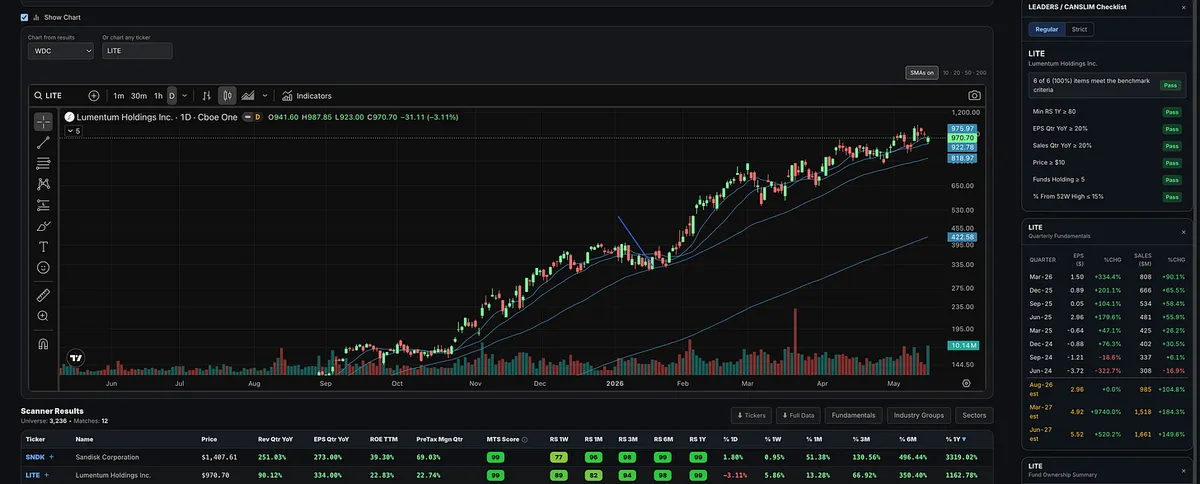
NVIDIA announced its planned $2 billion investment in Lumentum, ticker LITE, on March 2, 2026.
But LITE was already a major leader before that headline ever came out.
I was buying it and writing about it back in January when it was pulling back to the 50-day moving average.
Why?
Not because I knew NVIDIA was going to invest $2 billion.
I had no idea.
It was because LITE already had almost everything we look for:
Strong earnings growth.
Strong sales growth.
A 99 relative strength rating.
Accelerating institutional ownership.
Leadership in a top industry group.
Alignment with the broader AI theme.
That is the lesson.
You do not need to know everything about a company before the move happens.
You do not need to chase every headline.
In many cases, by the time the news confirms what is happening, the stock has already been under accumulation for weeks or months.
The process finds the clues before the headlines explain them.
Many of the biggest winners I have traded were not names I knew deeply at the time. They were not always comfortable. They were not always obvious, but they had the characteristics that big winning stocks tend to show before the crowd fully understands the story.
If you only trade names you are already comfortable with, you may miss many of the best opportunities.
The process often tells the story before the news does.
The Leaders Were Hiding in Plain Sight
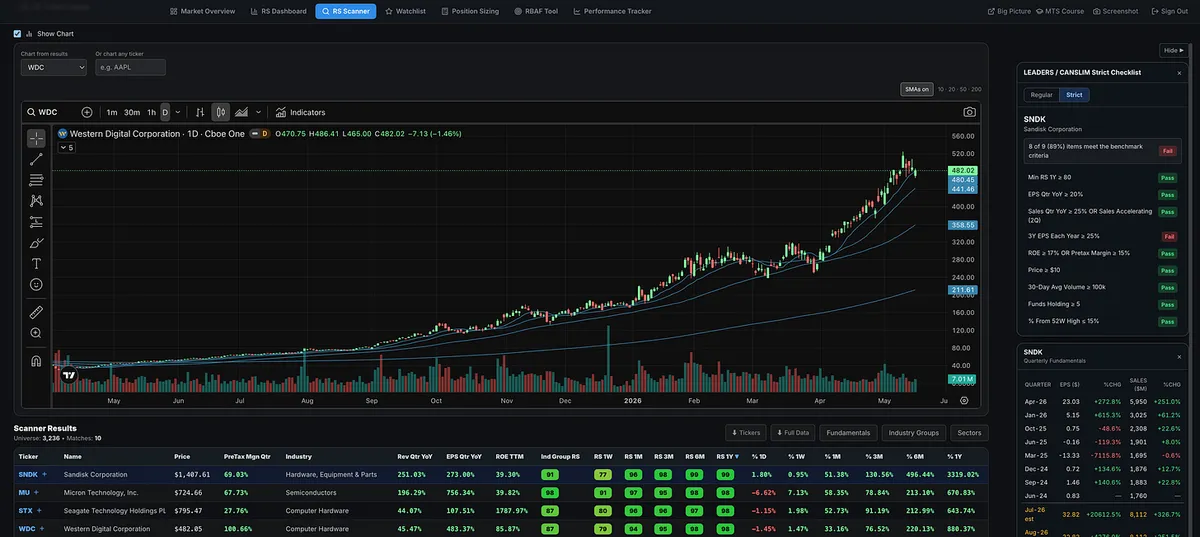
Back in January, when I first started sharing names, SNDK, MU, STX, and WDC were some of the stocks I kept coming back to.
Why?
Because they checked almost every box.
They were aligned with the dominant bull market theme: AI.
They were sitting inside a hot industry group.
They were among the strongest stocks in that group.
They had explosive earnings growth, big sales growth, strong margins, high return on equity, and elite relative strength.
That is not complicated. That is exactly what the legendary growth stock traders have been teaching for decades.
Look for the strongest stocks, in the strongest groups, supported by the strongest fundamentals, during a confirmed bull market.
Were there other high-flying names?
Of course.
But many of them did not have all the ingredients these names had.
The only major O’Neil-style box these stocks have not consistently checked is the three-year annual EPS growth requirement of 25% or greater each year.
But outside of that, they had almost everything you want to see in a potential market leader.
And today, finding these names is easier than ever.
Stop Scanning Blind: Know the Big Picture First
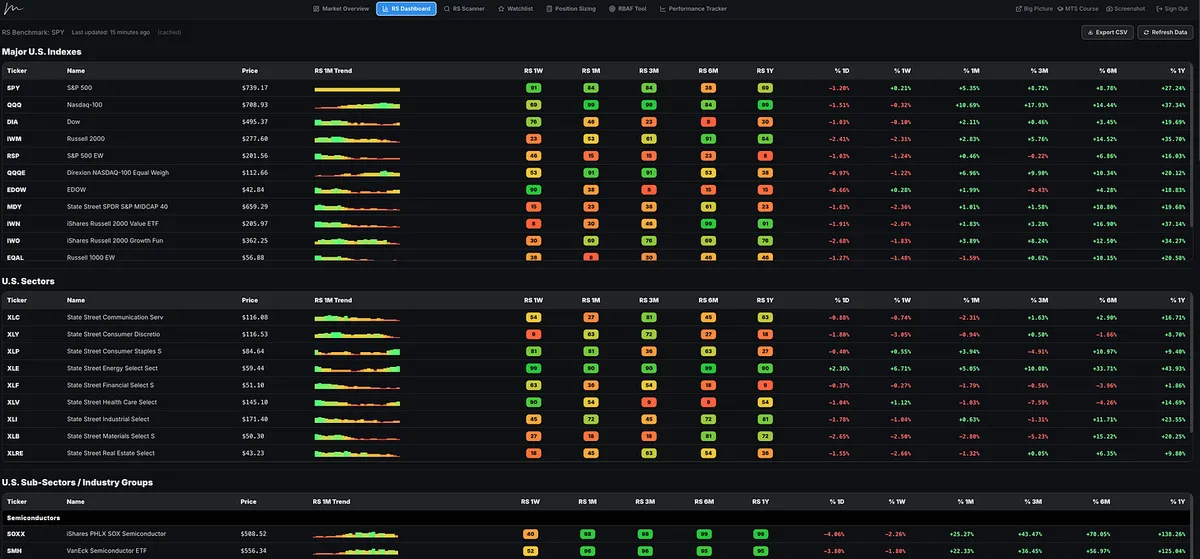
Before you scan for stocks this week, step back and ask the bigger question:
What kind of market am I trading in?
It does not matter if you are a day trader, swing trader, momentum trader, growth stock investor, macro trader, or systematic trader. The best traders do not start with random tickers. They start with understanding the big picture.
Mike Bellafiore makes this clear in The PlayBook. One of the first concepts listed in his trading process is: “The Big Picture: First Know What Is Moving the Market.” That is not coming from a long-term-only investor. That is from a proprietary trading firm built around active traders.
The same idea shows up in Market Wizards. Traders with completely different styles, including Paul Tudor Jones, Michael Marcus, Bruce Kovner, and Richard Dennis, all understood that the bigger picture matters. Jones specifically said, “I also like the market letters put out by Marty Zweig,” and Jack Schwager added, “Of the traders I have interviewed, Zweig is probably the one most mentioned.” Jones then followed with: “You always get something of value out of Marty Zweig. He is very solid.”
That matters.
Zweig was not just giving stock picks. His work focused on the bigger picture: monetary conditions, the tape, sentiment, risk, and the environment surrounding the trade. That is why traders with completely different approaches still found value in his research.
Different time frames. Different instruments. Different strategies. Same principle.
Start with the market.
The market is difficult enough. Why make it harder by scanning for stocks without knowing where strength is, what the major indexes are doing, whether volatility is expanding, whether breadth is confirming, and whether your trades are aligned with the current environment?
That is exactly why I write the Big Picture Market Pulse every week.
This is part of our Top-Down, Bottom-Up process that the best traders and investors use.
Buying Strength Is Not a New Idea
A lot of traders think buying strength is some modern momentum concept.
It is not.
Bernard Baruch understood this more than 100 years ago.
In My Own Story, he described watching Goldfield Consolidated get hit with a large sell order, but instead of crumbling under that supply, the stock barely moved.
Baruch wrote:
“Instead of being driven down, the stock held to within a fraction of a point. This showed a market strength in Goldfield Consolidated that few had dreamed possible.”
That is strength.
Not necessarily relative strength against the entire market in that exact passage, but strength against selling pressure.
And that is the same thing growth stock and momentum traders still look for today.
When a stock gets hit with supply, does it break?
When the indexes are weak, what stocks are holding key levels?
When sellers show up, where are buyers still stepping in?
Because those are often the names that can become leaders when conditions improve.
Weak stocks break under pressure.
Strong stocks absorb supply.
The amateur looks for what is down the most.
The trained trader looks for what refuses to go down when it should.
Because strength is critical information.
Trading Has Always Been a Study of Human Nature
Bernard Baruch was one of the great old Wall Street operators.
He made a fortune in the market, became known as a Wall Street legend, and later advised presidents.
But one of his best lessons still applies today:
“Above all else, in other words, the stock market is people. It is people trying to read the future.”
That was true 100 years ago.
It is still true today.
The tools changed. The speed changed. The tickers changed. The platforms changed.
But fear, greed, hope, ego, impatience, and crowd behavior did not.
That is why the same mistakes keep repeating.
Baruch also wrote:
“One could say that my whole career in Wall Street proved one long process of education in human nature.”
That is still trading.
The market may look different.
But the game is still people trying to read the future.
The Mistakes That Quietly Destroy Trading Accounts
William O’Neil’s “21 Costly Common Mistakes Most Investors Make” is one of those sections worth revisiting no matter where you are in your trading journey.
If you are newer, it will probably open your eyes to mistakes you may not even realize you are making yet.
If you are more experienced, it is a great refresher to see where you may be slipping, cutting corners, or slowly drifting away from the rules that protect your account.
Because a lot of underperformance does not come from what you do not know.
It comes from what you keep doing wrong.
The loss you refused to cut.
The stock you bought because it looked cheap.
The winner you sold too early.
The loser you gave too much room.
The position you averaged down on because you did not want to admit you were wrong.
The trade you took from someone else’s conviction instead of your own process.
O’Neil put it simply:
“The reason people either lose money or achieve mediocre results in the stock market is they simply make too many mistakes.”
In my latest article, I break down O’Neil’s 21 costly mistakes.
Read it here:
https://tradingmomentum.substack.com/p/the-21-mistakes-that-quietly-destroy
Because the goal is not just to find better stocks.
The goal is to become a better operator.
Winning Somewhere Else Doesn’t Automatically Make You a Winning Trader
“Yes, the winning traders have usually been winning at whatever field they are in for years.” — Ed Seykota
I agree with this.
BUT I also think it needs context.
People who have already won in other areas often bring traits that matter in trading: grit, resilience, work ethic, discipline, focus, the ability to learn from failure, and the willingness to keep improving after mistakes.
If they bring those same traits into the market, they have a real shot.
But I’ve also seen plenty of highly successful people come into trading and do horribly.
Doctors. Business owners. Executives. People who have built and sold companies.
The problem is not that they were not capable. The problem is that many of them assumed trading would be easy because they had already succeeded somewhere else.
They did not bring the same humility, work ethic, study, repetition, and respect for the craft that made them successful in their original field.
And trading punishes that fast.
In some cases, they were not really here to master trading. They were here for the thrill. The action. The dopamine. The feeling of being right. At that point, trading becomes less like a craft and more like gambling.
That almost always ends the same way.
At the same time, some of the greatest traders were not necessarily viewed as major winners before they found the market.
Mark Minervini has talked openly about being a high school dropout and struggling for years before he became successful. What changed was not some magic indicator. It was obsession with the craft, a willingness to study winners, admit mistakes, control risk, and keep refining his process.
Kristjan Kullamägi was a college student working as a security guard. Nothing fancy. Nothing spectacular on the surface. But he dedicated himself to learning the game, studied traders like William O’Neil, put in the reps, and eventually became wildly successful.
So I think the real lesson is this:
You do not need to already be a “winner” in some impressive outside field to become a great trader.
But you do need the traits that winners usually have.
Discipline.
Humility.
Resilience.
Passion.
Focus.
Emotional Control and Awareness.
Work ethic.
The ability to study, fail, review, adapt, and keep going.
Trading does not care what you did before.
It only cares whether you are willing to approach it like a craft.