
Trading articles/The 21 Mistakes That Quietly Destroy Trading Accounts
May 15, 2026 · Momentum Trading Strategy
The 21 Mistakes That Quietly Destroy Trading Accounts
William O’Neil’s costly investing mistakes from How to Make Money in Stocks, and why fixing your errors may matter more than finding your next stock idea.
Originally published on Substack.
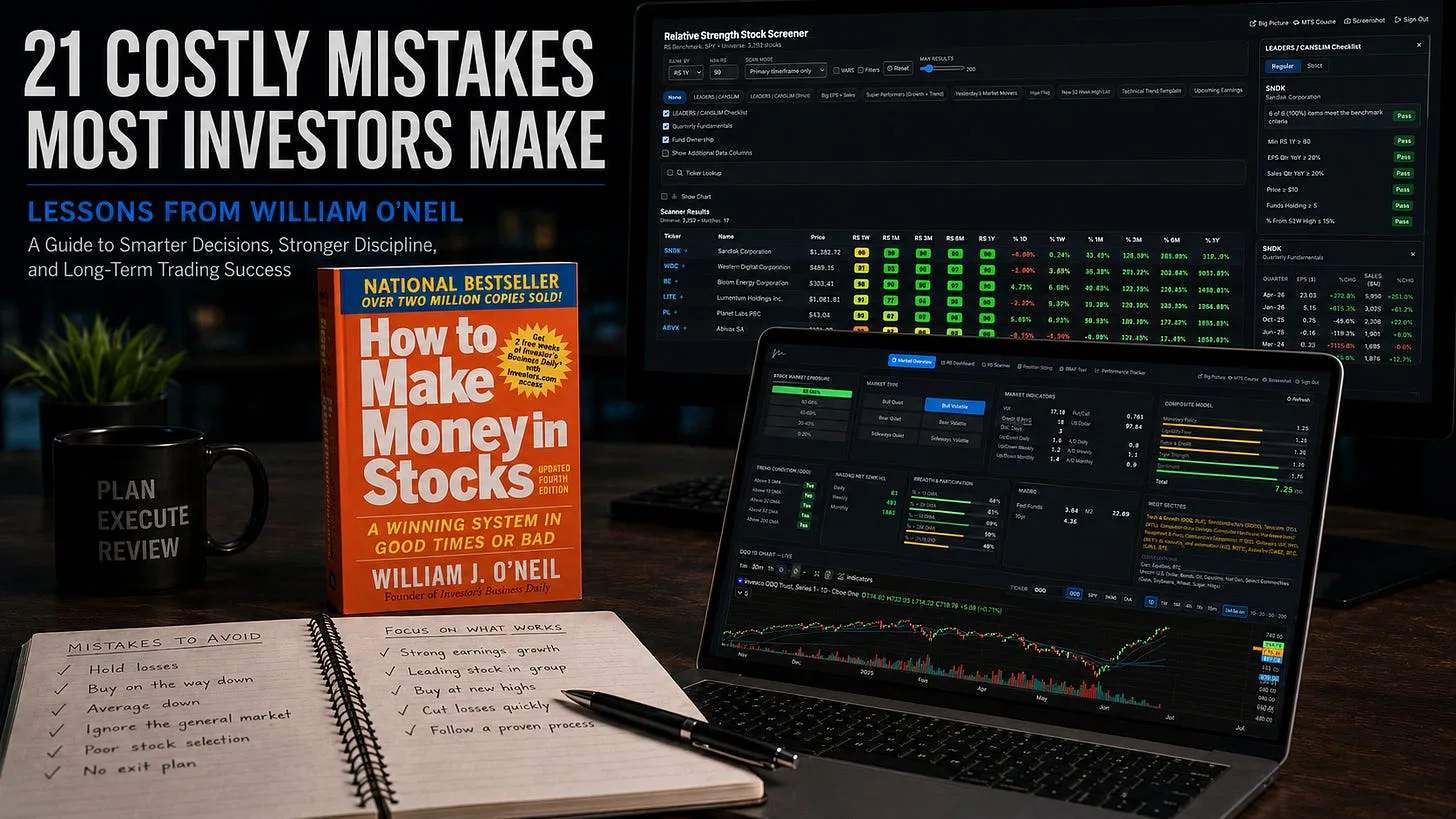
Most investors think the next breakthrough is going to come from finding something new: a better stock, a better setup, a better indicator, a better market opinion, or a better person to follow.
But after enough time in the market, you start to realize something uncomfortable. A lot of underperformance does not come from what you do not know. It comes from what you keep doing wrong.
The loss you refused to cut. The stock you bought because it looked cheap. The winner you sold too early. The loser you gave too much room. The position you averaged down on because you did not want to admit you were wrong. The trade you took from a tip, a story, a rumor, or someone else’s conviction instead of your own process.
William O’Neil put it simply:
“The reason people either lose money or achieve mediocre results in the stock market is they simply make too many mistakes.”
That sentence is simple, but the longer you trade, the more real it becomes.
In How to Make Money in Stocks, William O’Neil has a section called “Twenty-One Costly Common Mistakes Most Investors Make.” It is one of those chapters that hits differently depending on where you are in your investing journey.
When you are new, you either follow these rules blindly because O’Neil said them, or you question them because you do not yet have enough experience to know how true they are. You have not lived through enough failed breakouts. You have not watched enough “cheap” stocks get cheaper. You have not seen a small loss turn into a portfolio problem. You have not watched a stock look “too high” and then go up another 100%. You have not watched one bad market environment erase months of progress. You have not experienced a brutal bear market. You have not yet seen how many mistakes come from your own emotions, not the market.
But after years of trading, these rules stop feeling theoretical. They become real. They become practical. They become obvious and eventually, you realize O’Neil was not trying to make investing complicated. He was trying to keep people from making the same mistakes that destroy account after account.
Here are the 21 costly mistakes O’Neil warned about, rewritten through the lens of growth stock investing and momentum trading, with a focus on the discipline required to build a repeatable process.
1. Holding Small Losses Until They Become Big Losses
This is probably the most damaging mistake of all. Most investors have a chance to get out while the loss is still small and manageable, but they do not want to admit they are wrong. So they wait. Then they hope. Then they rationalize. Then what started as a small, reasonable loss becomes a much larger problem.
O’Neil’s rule was to cut losses quickly, usually when a stock falls 7% to 8% below your purchase price. The exact number may vary depending on your strategy, timeframe, and position sizing model, but the principle is timeless: do not let one bad trade become a portfolio problem.
You can recover from small losses. Large losses change the math, the psychology, and the quality of your decision-making.
2. Buying on the Way Down Because the Stock Looks Cheaper
A declining stock can feel like a bargain. It was $80, and now it is $50. It was $50, and now it is $30. It was $30, and now it is $15. At each level, it feels cheaper.
But cheaper does not mean safer.
O’Neil warned against trying to catch falling stocks because weakness often keeps creating more weakness. A stock can look like a bargain all the way down while institutions continue to sell, fundamentals deteriorate, or the overall market works against it.
The goal is not to buy what is down the most. The goal is to buy what is acting the strongest at the right time.
3. Averaging Down Instead of Averaging Up
Averaging down feels logical to many investors. If you liked the stock at $40, why not like it even more at $30?
But that thinking can be dangerous. When you average down, you are adding more money to a position that is already proving you wrong. You are increasing exposure to weakness. You are rewarding a losing trade with more capital.
O’Neil believed the opposite. Add when you are right, not when you are wrong. That one principle alone can change the way you manage risk.
4. Refusing to Learn Charts and Being Afraid of New Highs
Most people naturally want to buy stocks that look cheap. O’Neil’s research showed that many of the greatest winners did not begin their major moves from obvious bargain levels. They often broke out to new highs from proper bases before launching into their biggest advances.
That feels uncomfortable to beginners. A stock making a new high looks expensive. But in a true market leader, strength is often information.
A breakout from a sound base, especially after several weeks of proper consolidation, can signal institutional demand, improving fundamentals, and a shift in supply and demand. The public sees “too high.” The trained investor sees potential leadership.
5. Poor Stock Selection and Not Knowing What to Look For
Many investors never define what a great stock actually looks like. They buy familiar names. They buy exciting stories. They buy low-priced stocks. They buy companies with weak earnings, weak sales growth, poor return on equity, bad relative strength, or no leadership characteristics.
O’Neil’s entire approach was built around studying the greatest winners and identifying what they had in common before their biggest moves. That means earnings, sales, relative strength, return on equity, institutional sponsorship, new products or services, new management or industry conditions, and leadership within a strong group.
If you do not know what you are looking for, almost every stock can start to look interesting. That is a problem.
6. Not Having Rules for the General Market
This is one of the biggest mistakes because most stocks follow the direction of the general market. You can have a great company, a strong story, and a promising chart, but if the overall market is entering a correction, the odds can shift against you quickly.
O’Neil emphasized the importance of having specific market rules that help identify when a correction may be starting and when a new uptrend may be confirmed. This is the “M” in CAN SLIM.
Market direction is not a side detail. It is the environment your trades are operating inside. If you are buying growth stocks aggressively during a weakening market, you may not just be making a stock pick. You may be fighting probability.
7. Having Rules but Not Following Them
Rules do not help if you abandon them when they matter. This is where trading becomes less about intelligence and more about execution.
A trader can have a sound buy rule, a sound sell rule, a sound risk rule, and a sound market exposure rule. But if those rules disappear when fear, greed, ego, or impatience shows up, then the strategy is not really being traded.
The real system is not what you wrote down. The real system is what you actually do.
8. Focusing on What to Buy but Not Knowing When to Sell
Most investors spend most of their time trying to find the next stock to buy. Far fewer spend enough time defining exactly when they will sell. That is a major weakness.
Buying gets the attention because it is exciting. Selling determines the result. You need to know when you will sell if the trade is wrong. You need to know when you will sell if the trade is right. You need to know what would cause you to reduce exposure, take profits, raise stops, or exit completely.
If you only know what you want to buy, you have only done half the work.
9. Ignoring Quality, Institutional Sponsorship, and Chart Action
O’Neil did not believe in buying random stocks. He wanted high-quality companies with strong earnings and sales, market leadership, institutional interest, and constructive chart patterns.
That combination matters. Fundamentals tell you whether the company may be capable of attracting serious demand. Charts help you see whether that demand is actually showing up. Institutional sponsorship matters because major price moves usually require major buying power.
You do not want weak companies with weak charts and no sponsorship. You want strength confirmed by multiple forms of evidence.
10. Buying More Shares of Cheap Stocks Instead of Fewer Shares of Better Stocks
This mistake traps a lot of beginners. They would rather own 1,000 shares of a $5 stock than 50 shares of a $100 stock because it feels like they are getting more.
But share count is not what matters. Dollar exposure matters. Quality matters. Liquidity matters. Institutional demand matters.
A cheap stock is often cheap for a reason. Low-priced stocks can be lower quality, more speculative, more volatile, less liquid, and less attractive to institutions. They can also carry hidden costs through wider bid-ask spreads. A small spread on a low-priced stock can be a much larger percentage cost than the same spread on a higher-priced stock.
The goal is not to own the most shares. The goal is to own the best merchandise.
11. Buying on Tips, Rumors, News, or Other People’s Opinions
Tips are dangerous because they let you borrow someone else’s conviction. You did not do the work. You do not know the setup. You do not know the risk. You do not know where the trade is wrong. You do not know whether the person giving the advice has a real process or is just repeating a story.
O’Neil warned against buying based on rumors, tips, split announcements, news events, advisory recommendations, TV opinions, or supposed experts. Even if the information is true, the stock may not respond the way you expect.
The market does not care who gave you the idea. If you own the position, you own the risk.
12. Buying Second-Rate Stocks Because of Dividends or Low P/E Ratios
A low P/E ratio can make a stock look cheap. A dividend can make a stock look safe. But O’Neil warned that these factors are often far less important than earnings growth, sales growth, leadership, and price performance.
A stock can have a low P/E because the company’s record is weak or because the market does not believe the company deserves a higher multiple. A high dividend is not always a sign of strength either. Many of the best growth companies reinvest capital back into the business instead of paying it out.
And a stock can lose more than the value of its dividend in a day or two of normal price movement. Dividends and valuation are not meaningless, but they are not substitutes for quality, growth, and leadership.
13. Wanting Quick and Easy Money
This is the mistake that pulls people into bad decisions. They want big results without preparation. They want fast profits without learning risk management. They want the reward without the process. They want to skip the boring parts.
That mindset usually leads to chasing, oversizing, ignoring stops, buying too late, selling too soon, and jumping from strategy to strategy.
The market punishes impatience. If you want professional results, you need a professional process.
14. Buying Old Familiar Names Instead of New Leaders
Familiar does not mean superior. Many investors gravitate toward companies they already know because familiarity feels safe. But some of the biggest winners are newer companies, newer stories, newer products, newer industries, or newer leadership themes.
The best opportunities often feel unfamiliar at first. That is why research matters.
If you only buy what you already know, you may miss what the market is actually rewarding now.
15. Not Knowing How to Recognize Good Advice
There is no shortage of opinions in the market. Friends have opinions. Relatives have opinions. Brokers have opinions. TV guests have opinions. Social media accounts have opinions. Newsletter writers have opinions.
But O’Neil warned that only a small minority of people are actually successful enough to deserve your attention. That is a hard truth.
The hard part is not finding advice. The hard part is identifying which advice is worth following. That is why I believe it is so important to study rules and strategies that have survived multiple market cycles.
There is also a second part to this mistake: excessive leverage. Borrowed money can make you feel smart when things are working, but it can be devastating when conditions change. You do not want your survival dependent on leverage, ego, or someone else’s opinion.
16. Taking Small Profits While Holding Big Losers
This is the exact opposite of what most great traders try to do. Most investors want the comfort of locking in a small gain, but they avoid the discomfort of taking a loss.
So they sell winners quickly and give losers more room. That creates a terrible payoff structure: small wins, large losses, emotional comfort, and poor math.
The goal is the reverse. Keep losses controlled and give true leaders enough room to matter.
17. Worrying Too Much About Taxes and Commissions
Taxes matter. Commissions matter, but they should not control the trading decision.
O’Neil warned that excessive concern over taxes can lead to poor investment decisions. Some investors hold too long just to try to qualify for long-term capital gains. Others refuse to sell because they do not want to pay taxes, even as the stock starts to break down.
That is ego overriding judgment. The first job is to make good decisions. The second job is to manage taxes intelligently. But tax considerations should support the strategy, not override it.
The same is true for commissions. Today, trading costs are generally much lower than they used to be (free with many platforms today), and the ability to exit quickly is one of the advantages of owning liquid stocks. Do not let a small cost stop you from protecting capital.
18. Speculating Too Heavily in Options or Futures to Get Rich Quickly
Options and futures can be useful tools. They can also destroy an account quickly when used without experience, discipline, and risk control.
O’Neil warned against using them as shortcuts to wealth. Short-term options can be especially dangerous because time works against you. They can move quickly, expire worthless, and encourage traders to take oversized bets.
Selling naked options can be even worse because it can create large risk for a relatively small potential reward. Most beginners do not need more leverage. They need better rules.
19. Being Too Cute With Limit Orders
There is nothing wrong with using limit orders when they are appropriate. But O’Neil warned against investors who obsess over tiny price differences while missing the larger move.
Sometimes traders try to save a few cents and miss the trade entirely. Even worse, they may fail to exit a stock that should be sold because their limit order does not get filled.
If a stock needs to be sold to protect capital, the priority is getting out. Not winning a negotiation over a few cents.
20. Not Being Able to Make a Decision When It Matters
Indecision usually means one thing: you did not have a plan.
When a stock hits your stop, you should already know what to do. When a stock breaks out, you should already know whether it fits your criteria. When the market weakens, you should already know how you reduce exposure. When a position becomes extended, you should already know how you manage it.
The market is not the place to invent rules in real time. You need the rules before the emotion shows up.
21. Not Looking at Stocks Objectively
This may be the deepest mistake of all. Most investors form opinions and then defend them. They pick favorites. They fall in love with stories. They hope. They rationalize. They ignore what the stock is actually doing.
But the market does not care about your opinion. A stock is either acting right or it is not. The general market is either healthy or it is not. Leadership is either confirming or it is not.
Your job is not to prove yourself right. Your job is to see clearly.
The Longer You Trade, the More These Rules Make Sense
I feel extremely fortunate that I crossed paths with William O’Neil’s work early in my trading journey. There are a lot of trading educators out there. Some are helpful, but many are not. Some teach real principles. Others sell hype, shortcuts, alerts, predictions, and marketing stories that sound exciting but do not build real skill.
I could have easily spent years drifting down the wrong path. That is why I do not take it lightly that I found O’Neil’s book, studied it, believed it, and actually tried to adopt the rules.
At first, you do not fully know how right these principles are. You just know that someone with far more experience is telling you they matter. But after years of trading, after enough winners, losers, corrections, shakeouts, breakouts, failed breakouts, bear markets, bull markets, and personal mistakes, the rules become more real.
Cutting losses quickly is no longer just a rule. It is survival. Buying strength is no longer just a preference. It is alignment with institutional demand. Respecting the market is no longer just a CAN SLIM principle. It is humility. Tracking your mistakes is no longer optional. It is how you improve.
A lot of success in life comes from controlling what you can control. You cannot control the market. You cannot control whether a stock goes up after you buy it. You cannot control the news. You cannot control what the Fed says. You cannot control whether a breakout works or fails.
But you can control your preparation. You can control your selection criteria. You can control your position size. You can control your stop. You can control whether you chase. You can control whether you average down. You can control whether you review your trades. You can control whether you keep repeating the same mistakes.
That is where the work is.
Why I Built This Into the Momentum Trading Strategy Ecosystem
Everything I have learned from William O’Neil and other legendary traders, including these 21 costly mistakes, is embedded into the Momentum Trading Strategy ecosystem.
The course gives you the foundation. It teaches the strategy, the principles, and the process behind growth stock investing, momentum trading, risk management, market timing, relative strength, stock selection, and trade execution.
But knowledge alone is not enough.
A course can teach you what to do, but a real execution tool helps you apply it in real time. That is why I built the Momentum Trading Strategy software. The goal is to take the lessons from the course and turn them into a daily process that helps keep you aligned with the market, focused on leadership, disciplined with risk, and honest about your own performance.
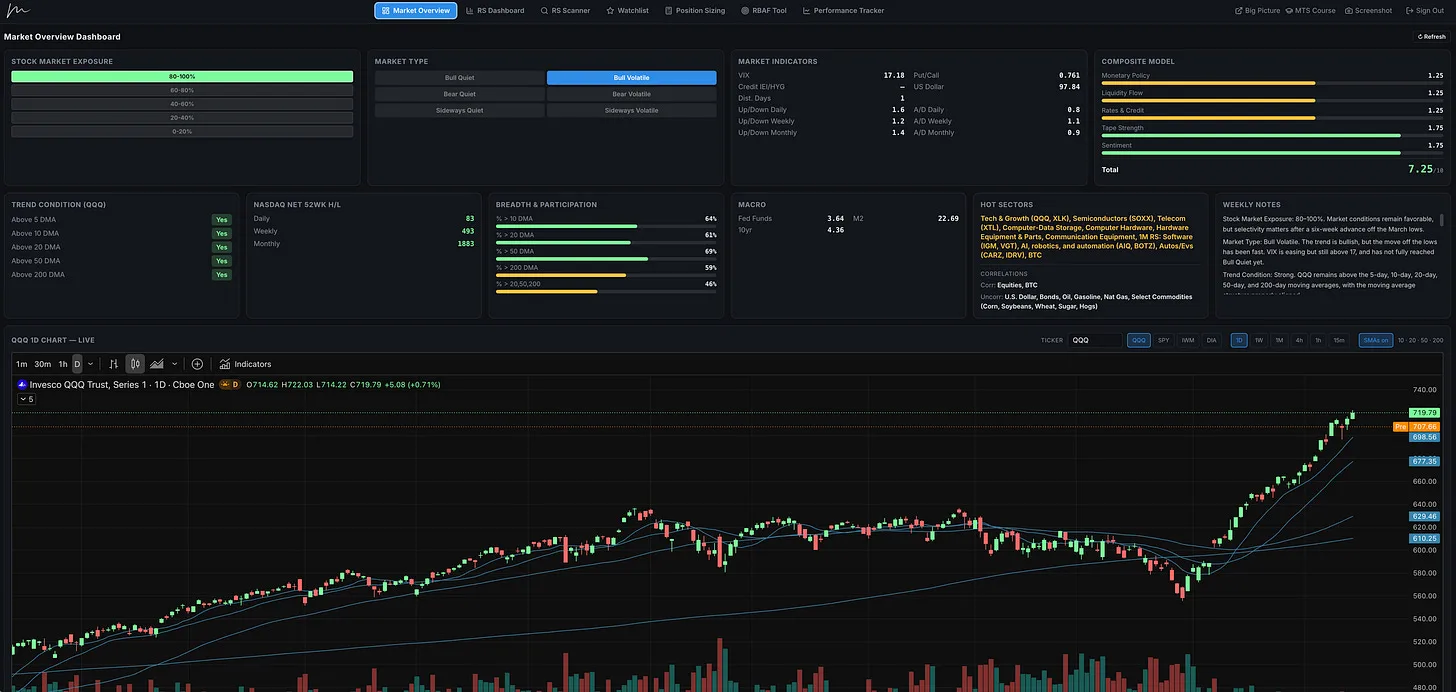
The Market Overview Dashboard, combined with the Big Picture Market Pulse I write every weekend, is designed to keep you aligned with the general market. If you understood O’Neil’s rules above, you understand how important this is. Most stocks follow the direction of the general market. You do not want to be aggressively buying growth stocks when the market is working against you.
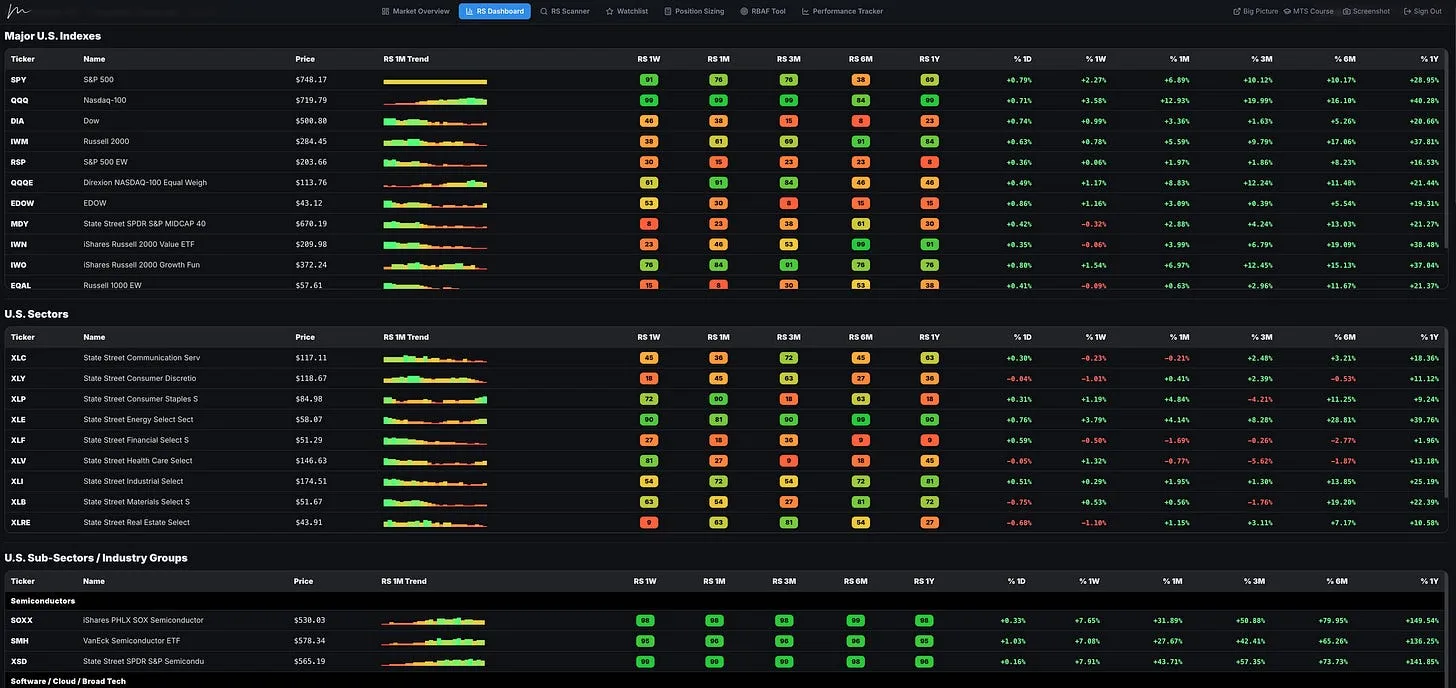
The Relative Strength Dashboard gives you a snapshot of where strength is showing up across the market, starting with the indexes, then sectors, subsectors, and industry groups. This helps answer one of the most important questions a growth trader can ask: where is money actually flowing?
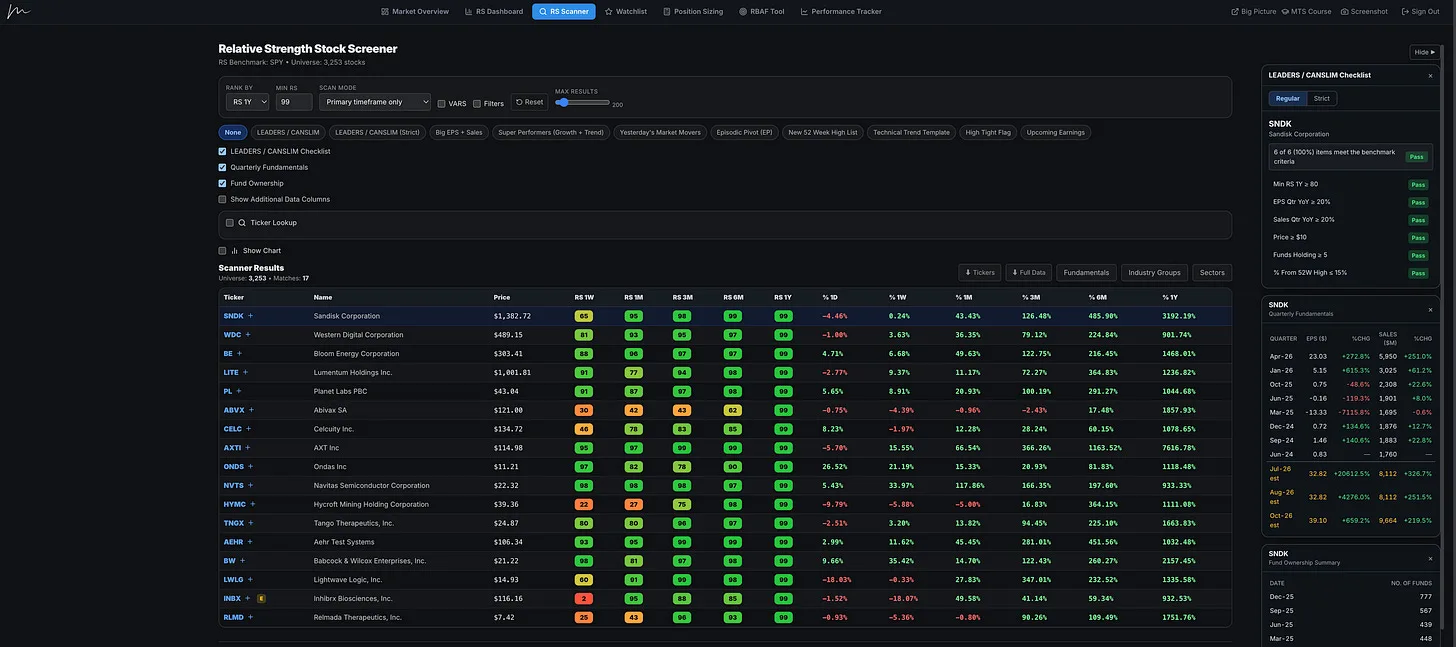
From there, the Relative Strength Stock Screener helps identify the strongest individual stocks within the strongest groups and themes. The goal is simple: find the best stocks, in the best groups, during the right market environment. That is directly aligned with O’Neil’s focus on leadership, relative strength, earnings, sales, institutional demand, and CAN SLIM-style characteristics.
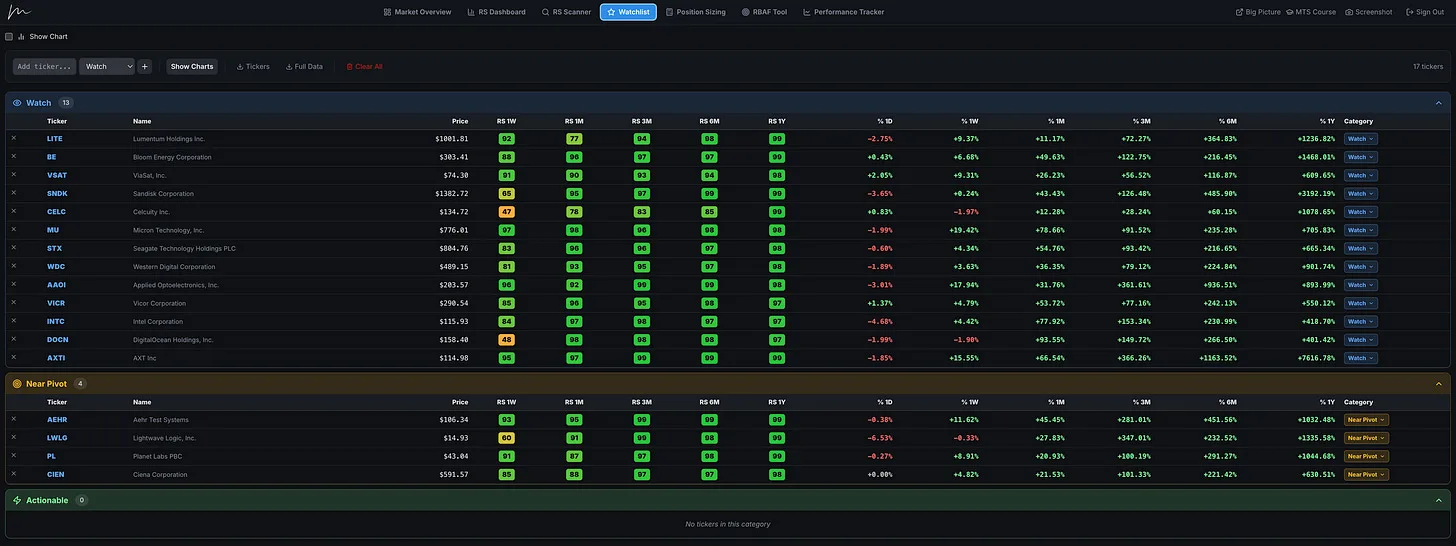
Then, once you find potential leaders, the Watchlist Tool helps you organize them by status. Some stocks are simply on watch. Some are getting closer to a pivot. Some are actionable. This helps you stay prepared instead of reacting emotionally in real time.
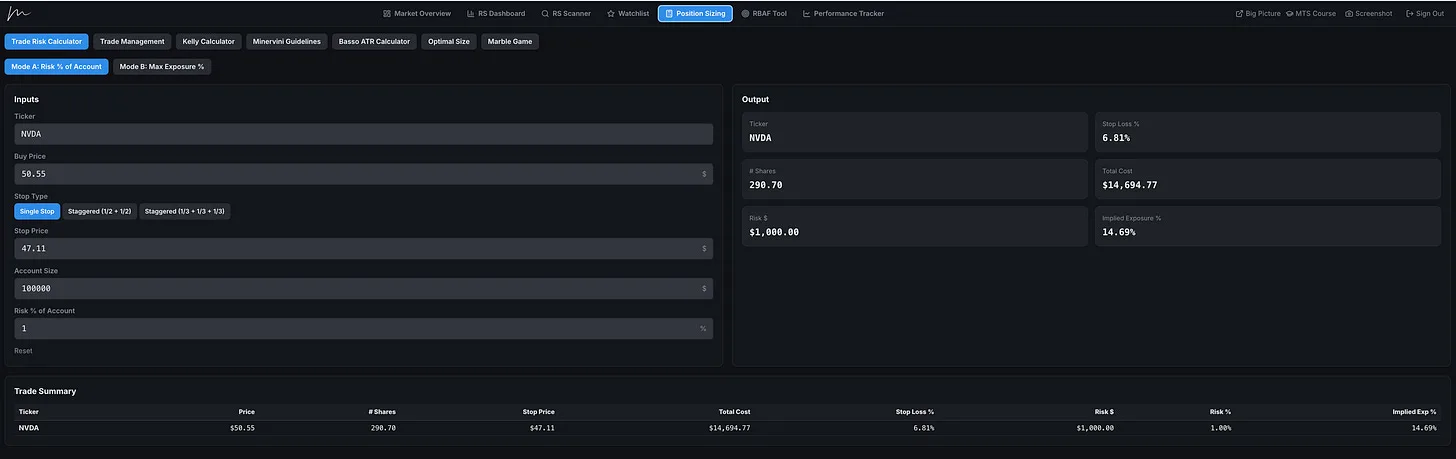
The risk tools are built for the same reason. The Position Sizing Calculator helps you define risk before the trade. The Trade Management Calculator helps you evaluate risk and reward after you are already in the trade, because the risk/reward profile changes as price moves.
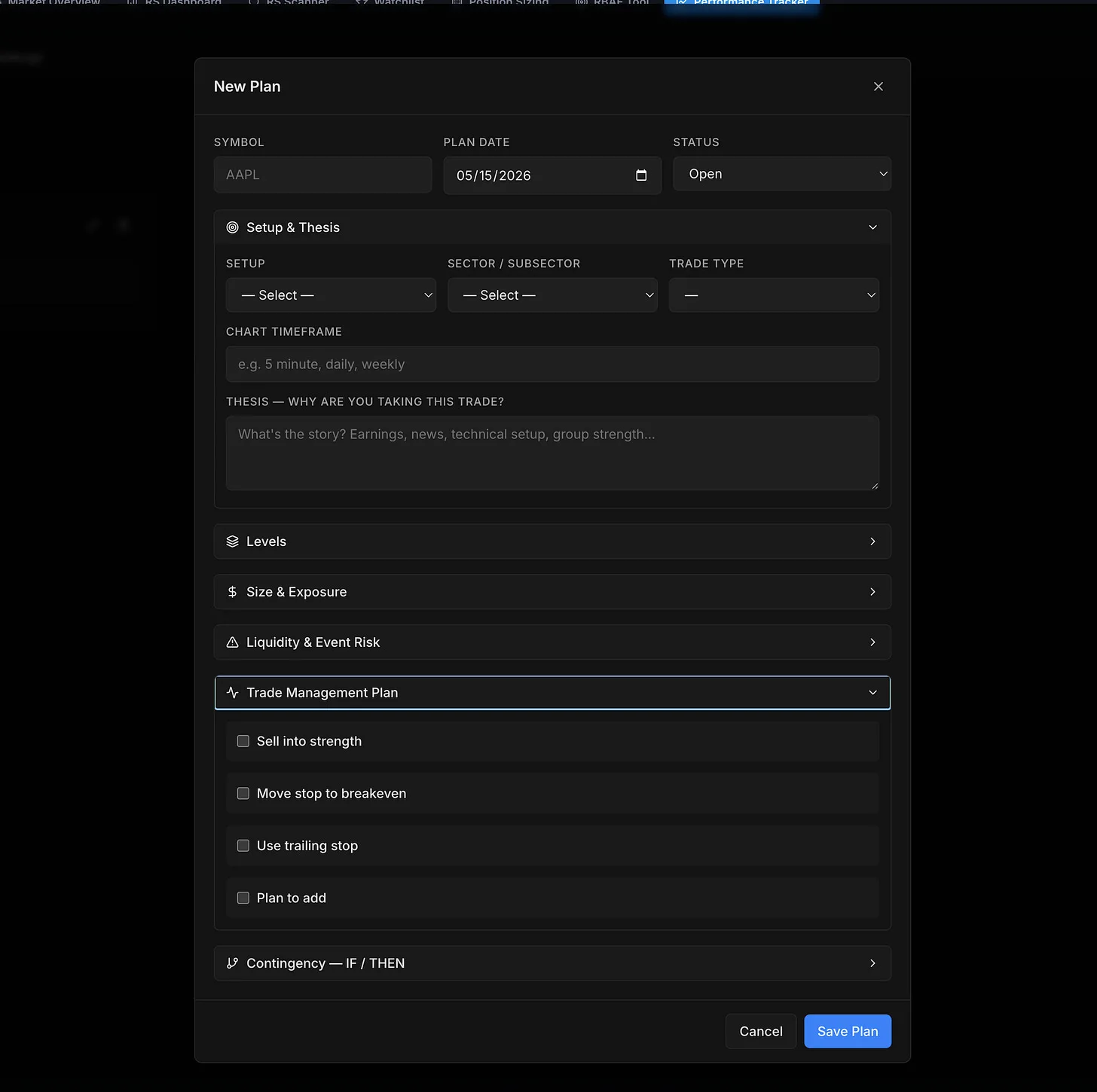
The Trade Planner is designed to walk you through the process before you put money to work. What setup are you trading? Where are the key levels? Where is your stop? How many shares should you buy? How much are you risking? Where would you add? Where would you sell into strength? When would you move your stop to breakeven? What is your if-then plan if the trade works, fails, or stalls?
That matters because many traders do not fail because they lack ideas. They fail because they lack a plan.
Then comes the part most traders skip: review.
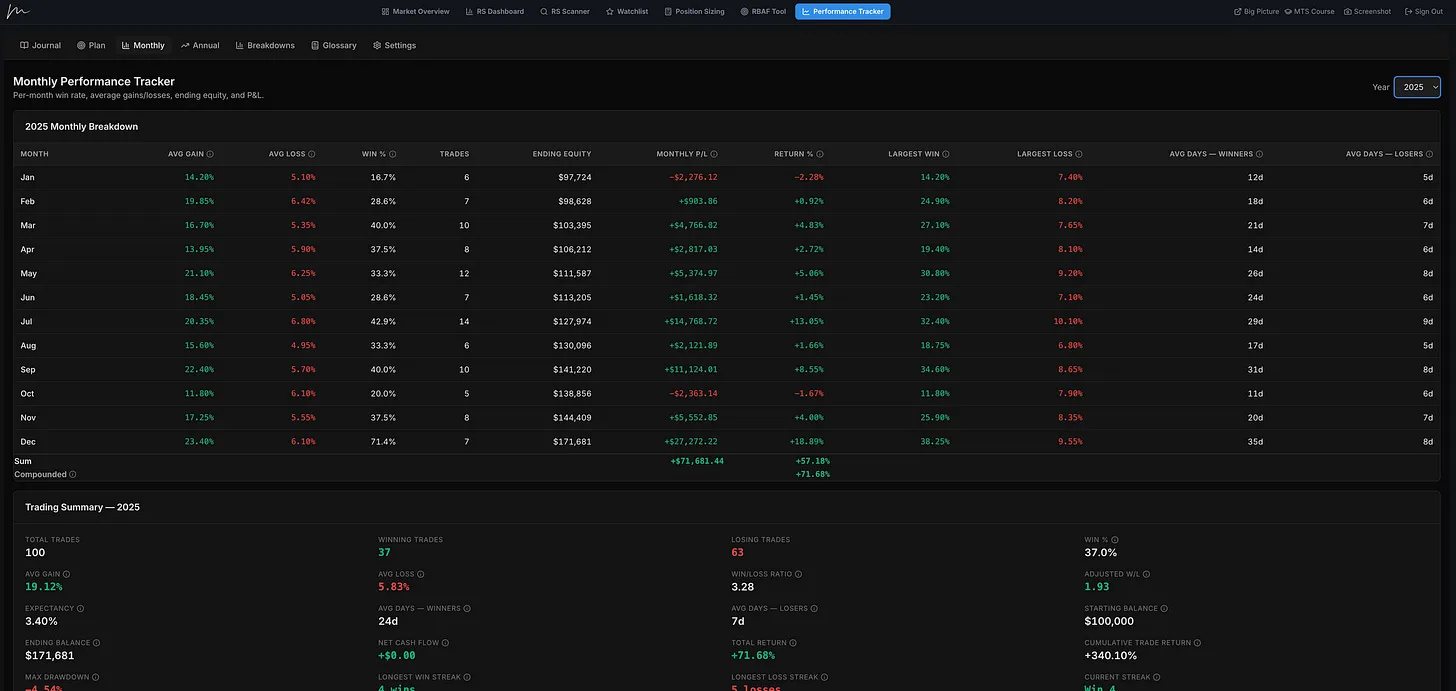
The Trade Journal, Monthly Performance Tracker, and Annual Performance Tracker are built to help you see what is actually happening in your trading. Not what you think is happening. Not what you hope is happening. What the data says is happening.
Are you following your plan? Are you only partially following it? Are you ignoring it completely? Are you taking too many C trades instead of waiting for A or A+ setups? What are your top-performing setups? What are your worst-performing setups? Are your losses coming from bad stock selection, poor entries, oversized positions, weak market conditions, emotional decisions, or failing to follow your own rules?
Each trade review is designed to force better feedback. What happened? What went right? What went wrong? What could you improve? How would you grade the trade? What mistakes were made?
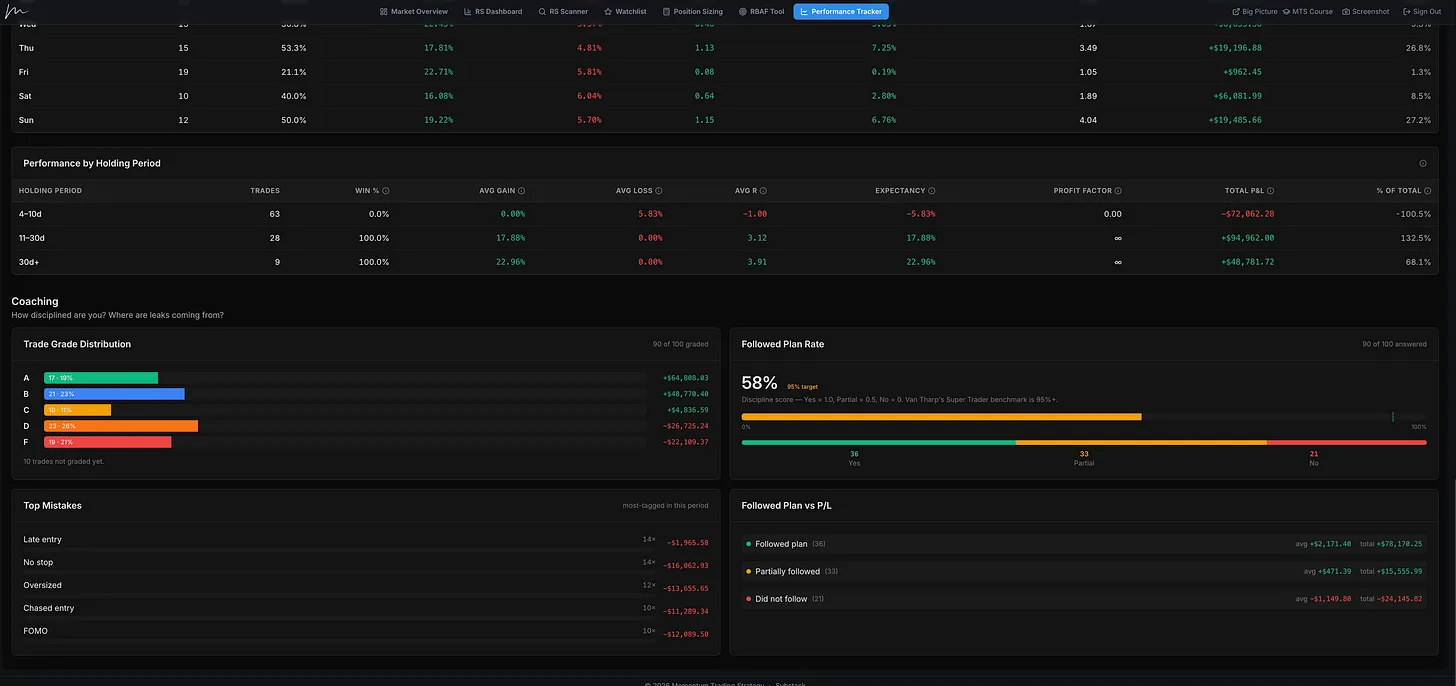
Over time, those reviews become extremely valuable because the Performance Tracker can show you the patterns. Your biggest mistakes. Your recurring leaks. Your strongest setups. Your weakest behaviors. Your actual expectancy.
Most traders do not need more opinions. They need more feedback.
That is the real purpose of the Momentum Trading Strategy ecosystem. The course gives you the foundation. The software gives you the execution tool. And the community, through our chat, gives you a more professional trading environment where serious traders can share ideas, discuss leadership, talk through market conditions, and help each other see what is developing, similar to how traders would communicate inside a professional firm.
This is not meant to be a retail alert service where someone tells you exactly what to buy and sell at exact prices. There is a reason professional trading firms do not operate that way. Traders can share ideas, discuss names, and help each other think better, but each person still has to build their own plan, define their own risk, manage their own trade, and take responsibility for their own execution.
Together, the course, software, weekly market work, and community are designed to help you apply the lessons of O’Neil, the legendary traders who influenced him, and the great traders who came after him, while reducing the odds that you keep making the same costly mistakes over and over again.
Final Thought
O’Neil ended this section by reminding investors to build up their weaknesses until they become strong points. That is the real lesson.
The market is hard enough without making it harder on yourself. You do not need to be perfect. You do not need to catch every leader. You do not need to predict every turn. You do not need to be right all the time.
But you do need to stop making the same costly mistakes over and over again.
That starts with awareness. Then it becomes preparation. Then it becomes process. Then it becomes execution. Then it becomes review, and if you stay with it long enough, those repeated reviews begin turning weaknesses into strengths.
The trader who learns from mistakes has a chance. The trader who tracks mistakes has an advantage. But the trader who corrects mistakes is the one who starts to separate from the crowd.
Because at that point, you are no longer just looking for better stocks.
You are becoming a better operator.
And in the end, that is what separates amateurs from professionals.
More in Risk Management
All Risk Management articles →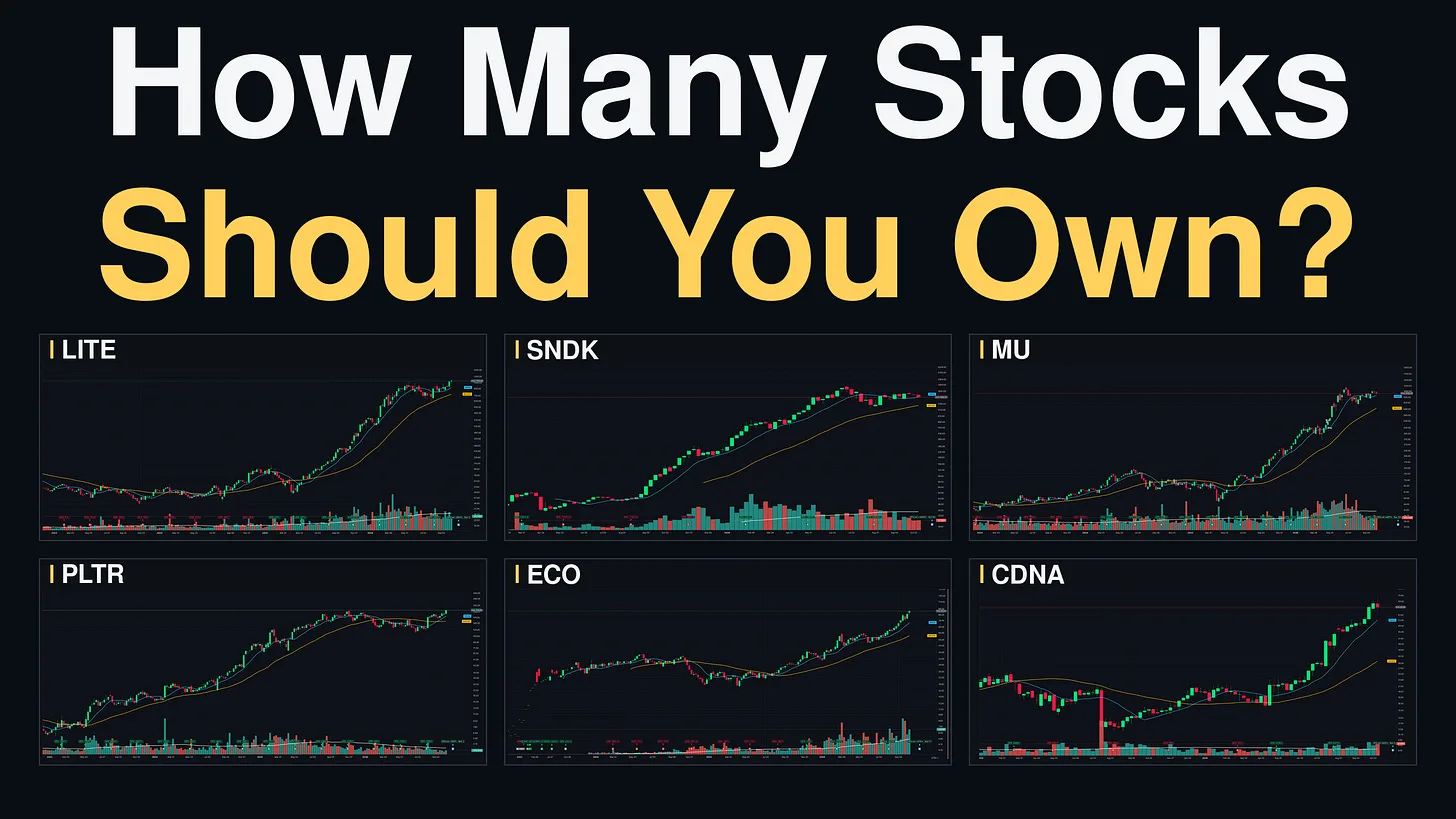
Oct 11, 2026 · Risk Management
How Many Stocks Should You Own? The Mistake That Can Cost You Your Biggest Winners
What William O'Neil, Mark Minervini, and the Market Wizards teach us about portfolio concentration, position sizing, cash management, and knowing when to stop trading.
- Momentum Trading
- Investing
- CANSLIM
- Trading
- position trading
- Growth Stock Trading
- Portfolio Heat
- David Ryan
Jul 7, 2026 · Risk Management
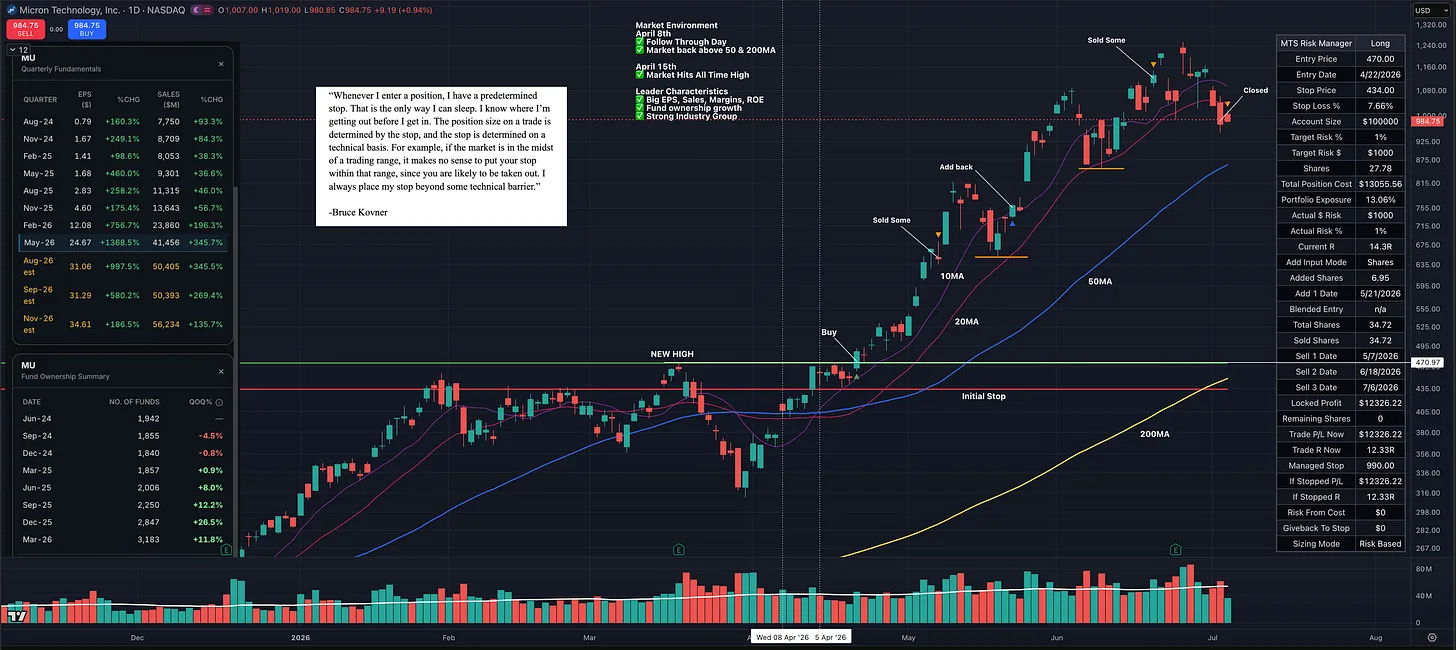
Position Size and Manage Risk Like a Market Wizard
Using Bruce Kovner’s stop-loss principle to plan the trade before the trade begins.
- growth stocks
- Momentum Trading
- fundamental analysis
- Learn Trading
- technical analysis
- Investing
- CANSLIM
- Trading
Jul 2, 2026 · Risk Management
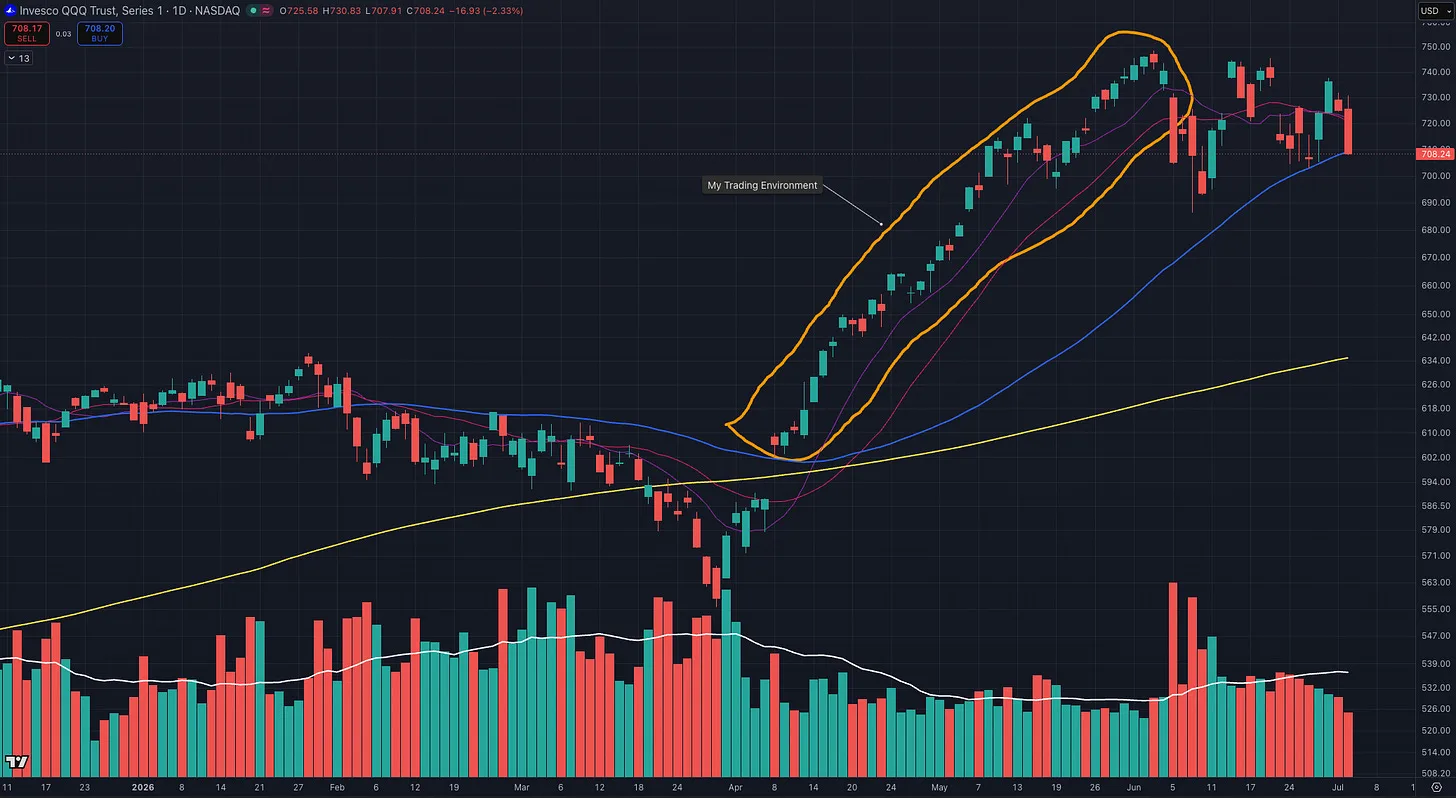
Why Great Traders Can Seem Bipolar in Choppy Markets
The best traders are not changing their minds because they are confused. They are changing their exposure because the market evidence has changed.
- Momentum Trading
- progressive exposure
- Learn Trading
- CANSLIM
- Trading
- position trading
- Growth Stock Trading
- stock trading