
Trading articles/How Many Stocks Should You Own? The Mistake That Can Cost You Your Biggest Winners
Oct 11, 2026 · Momentum Trading Strategy
How Many Stocks Should You Own? The Mistake That Can Cost You Your Biggest Winners
What William O'Neil, Mark Minervini, and the Market Wizards teach us about portfolio concentration, position sizing, cash management, and knowing when to stop trading.
Originally published on Substack.
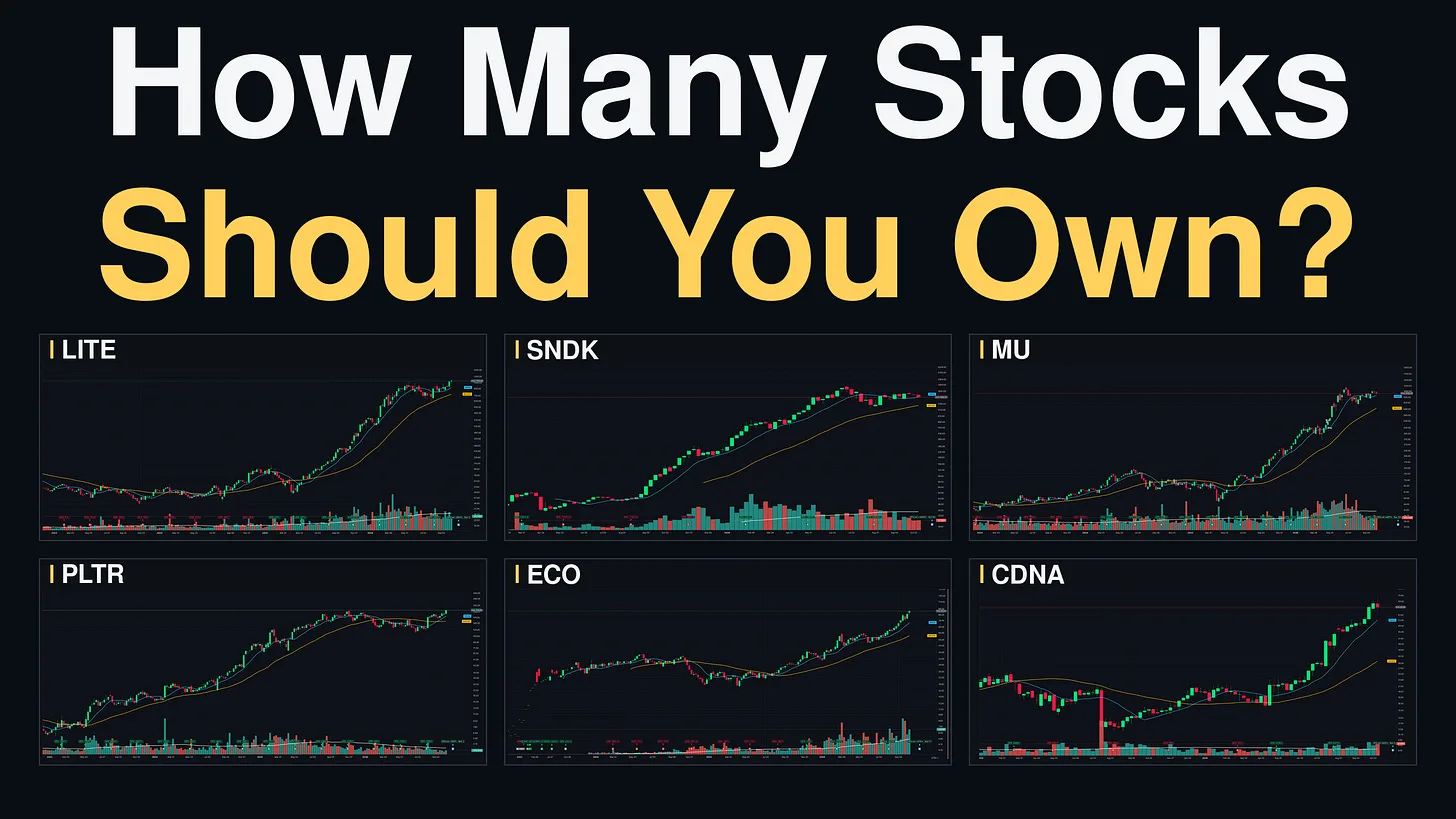
Imagine you’ve finally reached the point every momentum and growth stock trader works toward.
The market is trending higher. Your leading stocks are performing beautifully. You’ve built a concentrated portfolio of four or five strong positions, and you’re 100% invested. Your stocks are breaking out, holding their moving averages, and making higher highs and higher lows.
Then your stock screener lights up.
Another beautiful setup appears. Explosive earnings, exceptional relative strength, institutional volume, and a picture-perfect breakout. It’s everything you look for in a stock.
But you have no cash left. What do you do?
Do you sell one of your existing positions? Should you have kept 10% or 20% of your portfolio in cash for situations like this? Or do you simply let the opportunity pass?
And here’s another question. If William O’Neil recommends owning four or five stocks, does that mean you should begin by buying five stocks at 20% of your account each?
These questions reveal something important that often gets overlooked when traders discuss portfolio concentration.
There’s a big difference between building a concentrated portfolio, managing one, and knowing when to leave it alone.
I’ve spent considerable time studying the methods of William O’Neil, Mark Minervini, David Ryan, Dan Zanger, and other successful momentum traders. While their exact approaches differ, several principles consistently emerge.
Let’s explore how they fit together.
1. What William O’Neil Actually Recommended About Portfolio Concentration
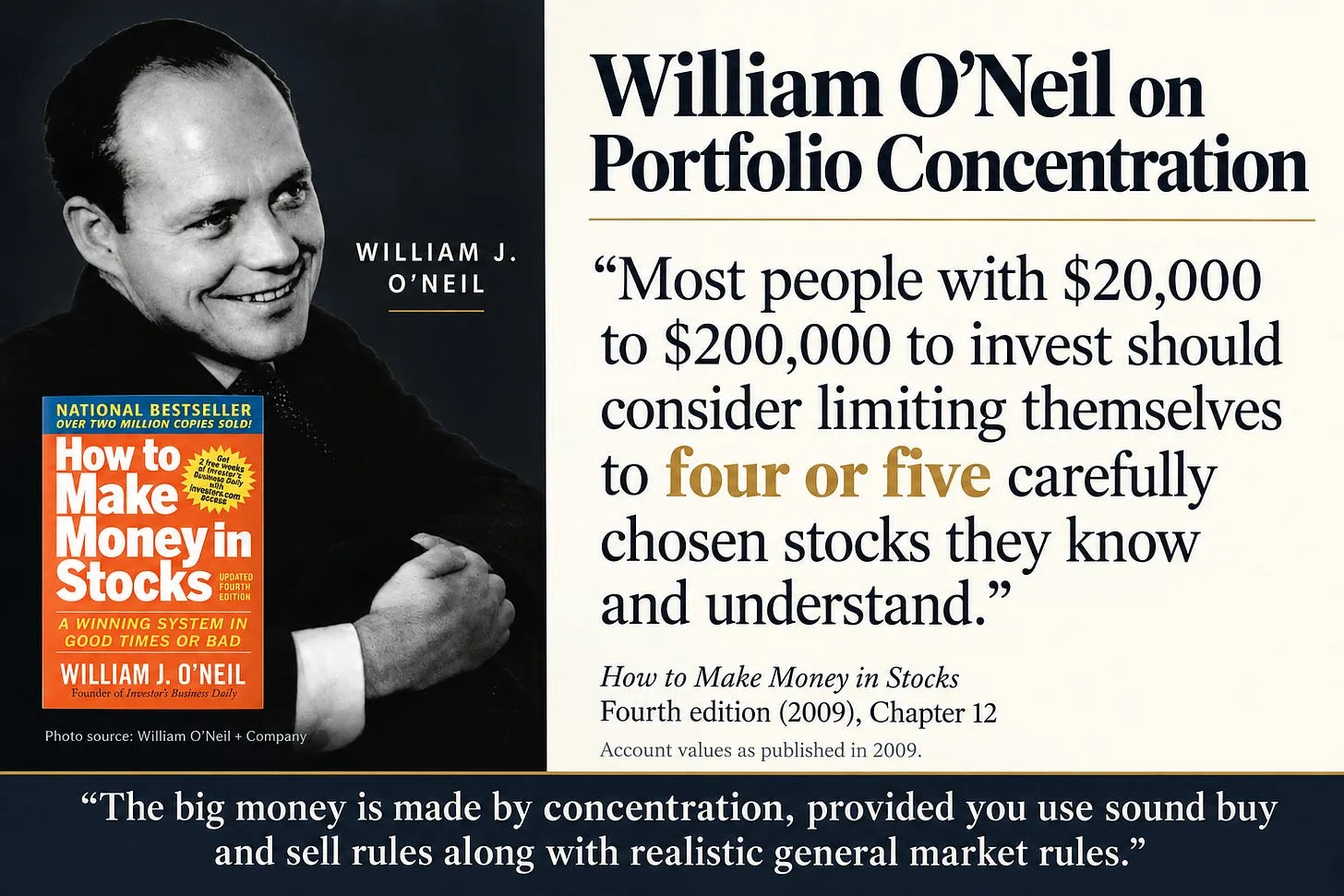
In How to Make Money in Stocks, William O’Neil argues that most individual investors would be better served by concentrating their capital in a relatively small number of carefully selected stocks rather than spreading it across dozens of holdings.
In the fourth edition, published in 2009, his recommendations included:
- $3,000 account: Approximately 2 stocks.
- $5,000–$20,000: Up to 3 stocks.
- $20,000–$200,000: Approximately 4–5 stocks.
- Over $1 million: Often 6–7 carefully selected stocks.
These are guidelines, not universal requirements. Because the book was published in 2009, we should also account for inflation when comparing its dollar amounts with today’s accounts. For perspective, the $20,000–$200,000 range would be approximately $31,000–$310,000 in 2026 dollars.
That means a trader managing $100,000 today falls comfortably within the range where O’Neil favored four or five carefully selected holdings.
But why so few?
O’Neil understood that exceptional stock market returns typically come from a relatively small number of outstanding winners. By spreading capital too thinly, traders can dilute the impact of those winners while making their portfolios increasingly difficult to monitor.
Concentration allows meaningful capital to be allocated to the strongest opportunities. But O’Neil also emphasized that concentration must be accompanied by sound buy rules, disciplined sell rules, and an understanding of the general market.
Concentration without risk management isn’t a strategy. It’s simply concentrated risk.
And this brings us to something I think deserves much more attention.
2. Owning Five Stocks Doesn’t Mean Starting With Five Full Positions
When someone reads that O’Neil recommends owning four or five stocks, it’s easy to imagine a $100,000 account divided into five equal $20,000 investments.
But that’s not necessarily how a trader should begin.
Consider three portfolios, each holding exactly five stocks.
The first has $5,000 invested in each stock, representing 25% total market exposure. The second holds $10,000 in each, representing 50% exposure. The third has $20,000 in each, representing 100% exposure.
Same five stocks. Three completely different levels of commitment to the market.
The number of holdings alone tells us very little about the amount of capital deployed, the risk being taken, or the market conditions that justified those positions.
This becomes especially important when the market is emerging from a correction, sideways market, or bear market.
You may have a confirmed market rally, multiple promising industry groups, and several leading stocks breaking out of sound bases. But after a difficult market environment, you don’t yet know how successful that new advance will become.
A trader might initially establish smaller positions, watch how those stocks behave, and gradually increase exposure if the trades begin producing profits.
That’s very different from immediately committing the entire account simply because a book recommends owning five stocks.
O’Neil himself discussed spreading purchases over time, adding to winning positions, and eliminating weaker holdings. His concentration guidelines were never a substitute for properly timing entries and managing risk.
3. Mark Minervini’s Progressive Exposure: Build on Success
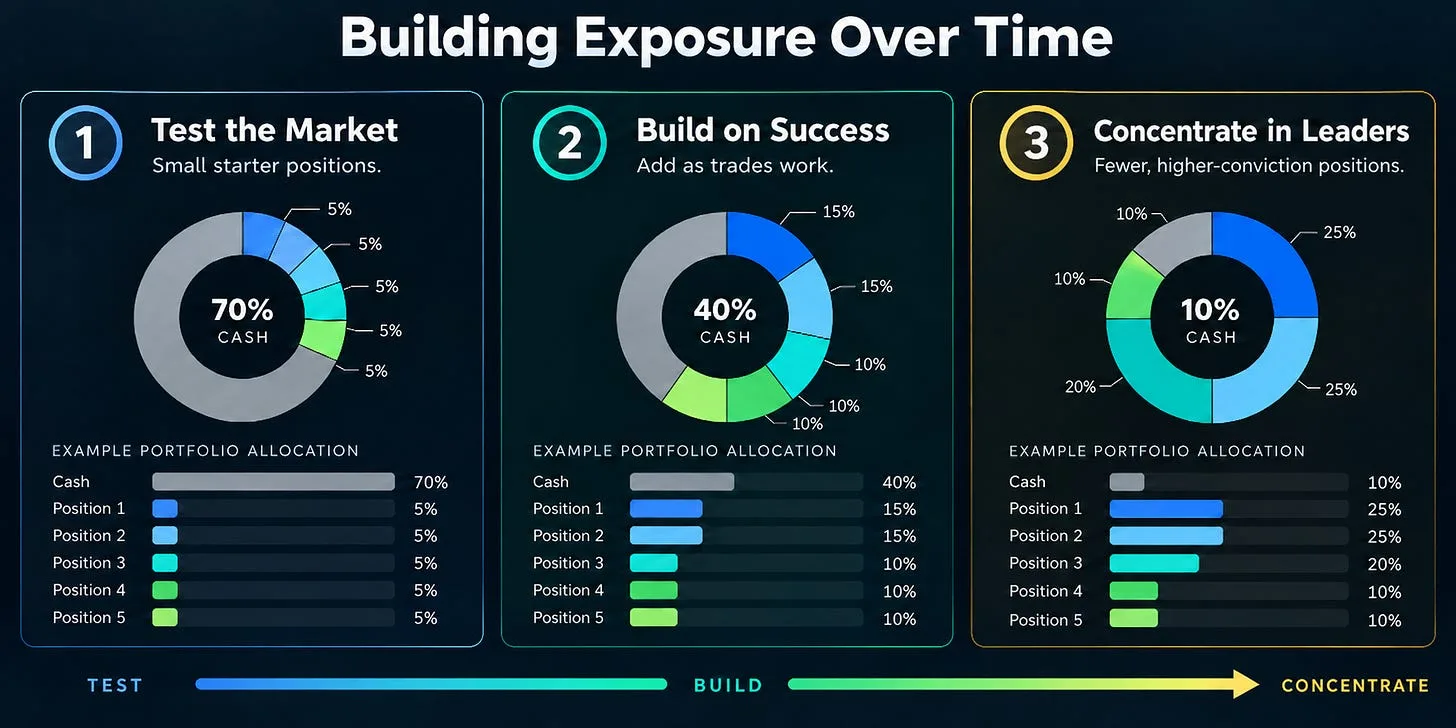
One of the clearest explanations of how to build a concentrated portfolio comes from Mark Minervini.
In Trade Like a Stock Market Wizard and Think & Trade Like a Champion, Minervini describes an approach known as progressive exposure.
The underlying principle is simple.
When you’re emerging from a defensive position or a difficult market, begin with relatively small commitments. If those trades succeed and additional opportunities appear, increase exposure. If they fail, scale back rather than becoming more aggressive.
In Trade Like a Stock Market Wizard, Minervini discusses evaluating results at 25% and 50% invested before progressing toward 75% or 100%.
Think about the logic behind that.
If you aren’t making money with 25% of your capital invested, why would you want to increase your exposure to 100%?
A trader’s own results provide valuable evidence about the trading environment. When several properly executed trades are working, that can support increasing exposure. When those same setups repeatedly fail, that’s information too.
Minervini also makes an important distinction. Progressive exposure doesn’t necessarily mean repeatedly adding shares to the same stock. It may involve adding to an existing winner at another valid entry point, establishing positions in additional leading stocks, or increasing the size of subsequent trades after a profitable period.
The common denominator is that capital is committed progressively rather than all at once.
And importantly, the market gets a vote.
4. What David Ryan and Dan Zanger Can Teach Us
In Momentum Masters, Minervini, David Ryan, Dan Zanger, and Mark Ritchie II discuss their individual approaches to position sizing and portfolio construction.
Their answers reveal that there’s no single magical number of stocks that every successful trader must own.
David Ryan, a three-time U.S. Investing Champion and former protégé of O’Neil, describes starting with positions around 5% when conditions are uncertain. If a stock begins working, he may increase the position to 10%. As the stock appreciates and develops new buying opportunities, the position might eventually reach 15%, 20%, or even 25% of his portfolio.
Notice the progression. Ryan isn’t necessarily initiating a new trade with 25% of his account. He’s allowing successful investments, price appreciation, and additional proper buy points to justify greater concentration.
Minervini describes concentrating much of his capital in four to eight of his strongest names, while rarely holding more than 10–12 positions overall (this is with million+ account size).
Dan Zanger takes a somewhat different approach. Depending on the market environment and the number of strong stocks available, he has described holding anywhere from eight to 25 positions. His initial allocations also vary based on market conditions, liquidity, and conviction.
Different numbers. Similar underlying principles.
These traders recognize that portfolio construction should respond to opportunity, market conditions, and the behavior of their investments.
The number of stocks you hold is not a performance target. It’s the result of applying your strategy.
One important point: Keep in mind that Minervini, Ryan, and Zanger are highly experienced traders whose approaches reflect managing much larger, often multimillion-dollar accounts. If you’re a beginner with a smaller portfolio, I recommend starting with William O’Neil’s more conservative position-count guidelines outlined in Section 1, while gradually increasing exposure as your trades begin working.
5. How a $100,000 Account Might Progress Toward Full Investment
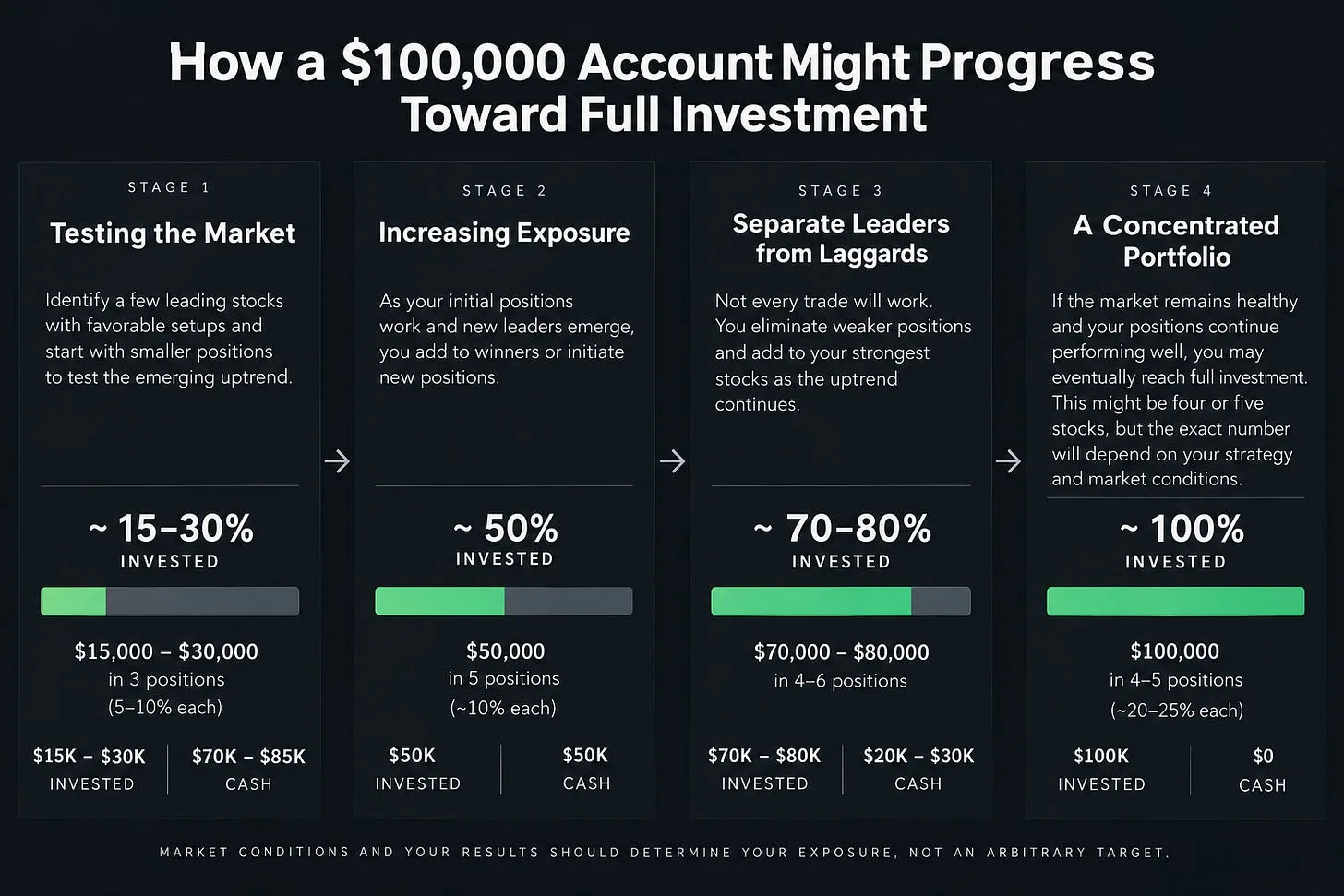
Let’s put these ideas together with a hypothetical example.
Imagine you have a $100,000 trading account, and the market is beginning to emerge from a meaningful correction.
The initial stage: Testing the market
You identify three leading stocks with favorable setups. Rather than investing your entire account, you begin with smaller positions, perhaps 5–10% of your account in each stock.
Depending on your allocations, you might initially have $15,000–$30,000 invested, with the remainder in cash.
You’re participating in the potential new uptrend, but your overall exposure remains relatively modest while you evaluate how the trades behave.
The next stage: Increasing exposure
Your initial positions begin working. Price follows through after the breakouts, volume characteristics remain constructive, and additional leaders begin setting up.
You might increase existing positions at proper entry points or establish new positions in other attractive stocks.
Perhaps you now hold five positions averaging 10% each. You’re approximately 50% invested.
At this point, you have more evidence supporting the emerging market advance than you had when you initiated your first trades.
The third stage: Separating leaders from laggards
Not every trade will work.
Some positions may fail their breakouts and trigger your stops. Others may stall, struggle to keep pace with their industry groups, or simply offer less attractive prospects than newly emerging leaders.
You eliminate positions when your sell rules or opportunity-cost considerations justify doing so.
Meanwhile, some of your strongest stocks continue advancing and may provide additional buying opportunities.
Your portfolio might temporarily contain more positions than you ultimately expect to hold. Alternatively, you may keep the number of holdings tightly limited throughout the process.
Either approach requires discipline.
The final stage: A concentrated portfolio
If the general market remains healthy and your positions continue performing well, you may eventually reach 100% exposure.
Perhaps you now own five stocks averaging 20% each, or four positions around 25% each.
But you didn’t necessarily begin with those allocations.
Your concentrated portfolio developed as the market and your trades justified greater exposure.
And the outcome isn’t always four or five stocks. Depending on your strategy, account size, and market conditions, you might end up with six, eight, or more positions. You might also remain partially invested because the opportunities simply aren’t there or your trades aren’t working.
Mark Minervini has said that, over his career, he has averaged roughly 50% market exposure.
Don’t feel pressured to reach 100% exposure. Being partially invested doesn’t mean you’re doing something wrong. Let market conditions and your trading results determine your exposure, not an arbitrary target.
The important lesson is that you don’t force your portfolio to become fully invested merely to satisfy a predetermined stock count.
Additional note: On an initial follow-through day, you might start even smaller, sometimes allocating as little as 1% of your account to a position. The idea is to test the emerging uptrend with limited exposure, then gradually increase your commitment as your stocks begin working and the market demonstrates sustained strength.
6. Position Size and Actual Account Risk Are Two Different Things
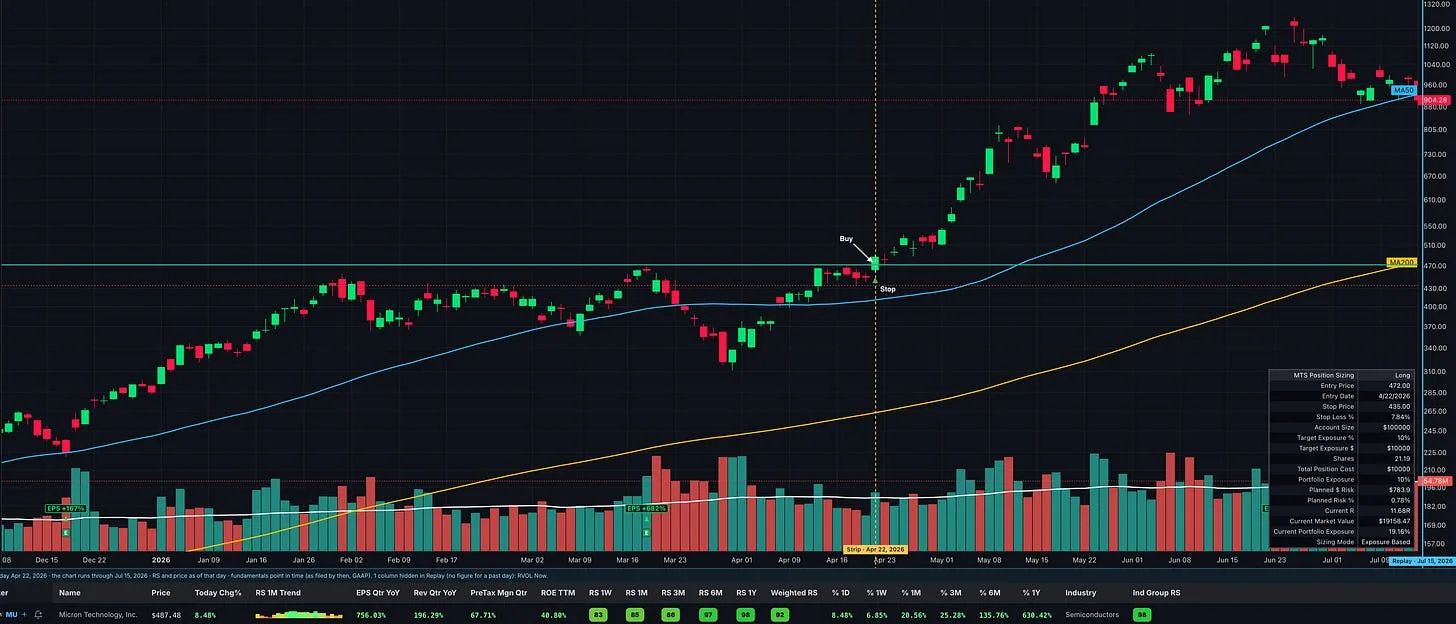
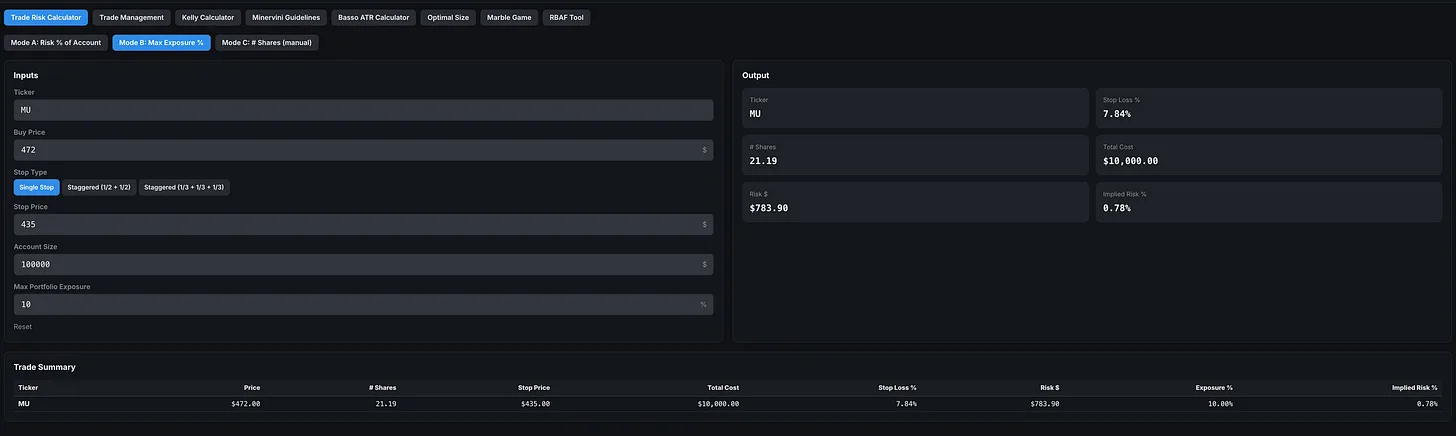
There’s another distinction worth making because I regularly see traders confuse the two.
Having 10% of your account invested in a stock does not mean you’re risking 10% of your account on that trade.
Suppose you have a $100,000 account and purchase $10,000 worth of stock. That’s a 10% position.
If your planned stop-loss is 5% below your entry, your intended loss is $500, or 0.5% of total account equity, assuming execution at that stop price.
You could also have a 20% position with a 2.5% stop distance and have the same planned $500 account risk.
The actual loss can exceed that amount if price gaps through the stop or execution suffers slippage, but the example illustrates why these measurements should be kept separate.
Kristjan Kullamägi, reinforces this distinction in Market Wizards: The Next Generation. He reports typically risking 0.5% or less of account equity per trade, sometimes as much as 1%.
That doesn’t mean he’s investing only 0.5% of his capital in each stock. It refers to his intended loss if the trade fails.
Of course, multiple positions can also carry correlated risk. Owning five semiconductor stocks is not the same as owning five unrelated businesses. Even with carefully calculated individual stops, significant market gaps can create portfolio losses larger than expected.
This is why I believe traders need to evaluate individual position size, account risk per trade, total portfolio exposure, and market & industry conditions together.
7. How Much Cash Should You Keep Available?
This question came up after I shared my earlier notes on concentration.
A member asked what happens when you’re fully invested and a great opportunity appears. Should you deliberately maintain some cash for future trades?
My view is that I don’t believe in maintaining a fixed cash reserve solely for hypothetical future buying opportunities.
Cash in my trading account should largely reflect market conditions, the number of valid opportunities available, and how my existing positions are performing.
Coming out of a correction, I might have substantial cash. As trades start working and additional leading stocks emerge, I can gradually commit more capital.
Eventually, if the market is particularly favorable, I may become 100% invested.
And that’s perfectly fine.
Why would I deliberately hold back 20% of my trading capital just because another attractive stock might set up next week?
There will always be another breakout, another earnings surprise, another emerging industry group, and another stock that looks capable of making a substantial move.
You cannot participate in every opportunity, and you don’t need to.
That doesn’t mean cash is undesirable. Cash can be one of the most valuable positions during corrections, bear markets, or periods when your strategy isn’t working. It also doesn’t mean deploying money needed for personal emergencies or living expenses. I’m discussing capital specifically allocated to trading.
The point is that I don’t want an arbitrary cash percentage dictating my decisions when the market is providing excellent opportunities.
8. What If You’re Fully Invested and Another Great Stock Breaks Out?
Now we return to the question that started this discussion.
Suppose you’ve built a concentrated portfolio of five positions, representing 100% exposure, and another compelling stock begins breaking out.
What do you do?
William O’Neil addressed this situation directly in How to Make Money in Stocks. He recommended that an investor already holding five stocks consider selling the least attractive holding when another tempting opportunity appears.
That makes sense.
If one position is struggling, losing relative strength, failing to follow through, or simply offering less attractive prospects than another stock, rotating capital into the stronger opportunity may be justified.
Dan Zanger and David Ryan have also discussed reducing exposure to weaker holdings or stocks that aren’t making progress when better opportunities become available. Kristjan Kullamägi has shown this on his old live streams too.
But here’s where I think newer traders need to exercise considerable caution.
Just because another attractive opportunity appears doesn’t mean an existing position deserves to be sold.
There’s a big difference between replacing a weak holding with a stronger opportunity and interrupting a successful trade because something new looks exciting.
If all five of your holdings are acting well, respecting your sell rules, and trending higher, why should you feel obligated to sell one?
You already own five stocks that are doing exactly what you wanted them to do.
Sometimes the better decision is to let the new opportunity go.
9. The Hidden Danger of Constantly Chasing the Next Breakout
I’ve seen how easy it is for traders to become addicted to the process of finding and entering new trades.
Every day, scanners produce fresh candidates. Social media highlights new breakouts. Someone posts a chart of a stock exploding higher, and suddenly the investments already in your portfolio seem less exciting.
Before you know it, you’re selling a perfectly healthy winner because another stock might move faster.
Then the new stock fails, while the one you sold continues higher.
You find another breakout, sell something else to make room, and repeat the process.
What began as an attempt to improve your portfolio gradually becomes overtrading.
This is especially dangerous for traders who have worked hard to build a concentrated portfolio of quality leaders.
Don’t confuse activity with progress.
A successful stock doesn’t need to generate excitement every single day. Strong trends often include ordinary consolidations, pullbacks, and periods of limited price movement. Selling every time another stock looks more exciting can prevent you from participating in the sustained advances that make concentration worthwhile.
Of course, you should still follow your sell rules. If a stock is deteriorating, your thesis changes, or the general market begins sending warning signals, take the appropriate action.
But if you reach the point where you’re fully invested, all your stocks are acting right, and they’re trending higher in a healthy market, I would encourage you to do something many traders find surprisingly difficult.
Sit on your hands and be grateful!
You don’t need to search for a reason to sell. You don’t need cash simply because another stock might become available tomorrow.
You already have what you were looking for.
10. When Cash Becomes the Right Position Again
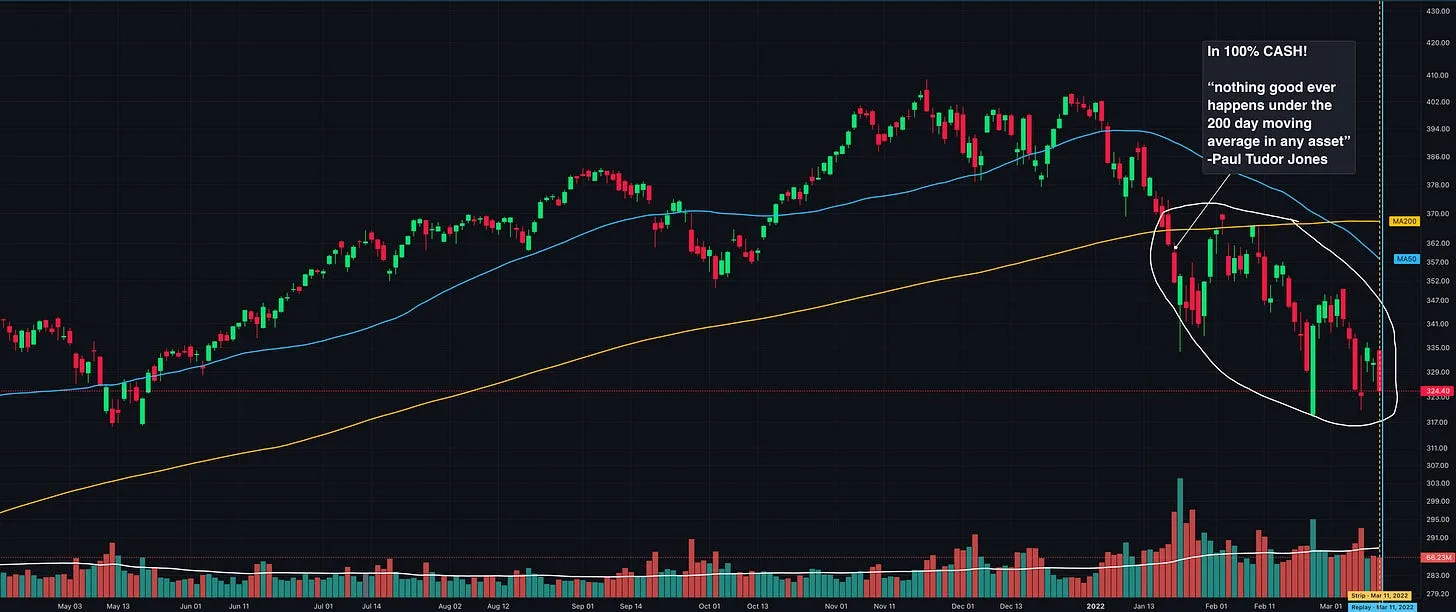
There will eventually come a time when conditions change.
Leading stocks may begin breaking their moving averages. Breakouts may stop following through. Selling pressure may increase across the leading stocks, and the major indexes. Formerly strong industry groups may begin losing leadership.
When those warning signs appear, the same discipline that allowed you to progressively increase exposure should also allow you to reduce it.
Your portfolio might move from 100% invested to 70%, then 40%, or even entirely to cash if your rules and the environment justify it.
That’s not a failure to remain invested. It’s risk management.
Minervini’s philosophy of progressive exposure works in both directions. Increase exposure when conditions and trading results justify it, and decrease exposure when they’re no longer favorable.
Likewise, O’Neil emphasized the importance of recognizing major market tops, respecting sell signals, and protecting capital during unfavorable market environments.
Being fully invested is not a badge of honor. Neither is holding 100% cash.
Both are simply possible outcomes of a disciplined trading process.
A trader should be willing to do either when the evidence supports it.
11. Managing a Big Winner: Portfolio Weighting vs. Portfolio Heat
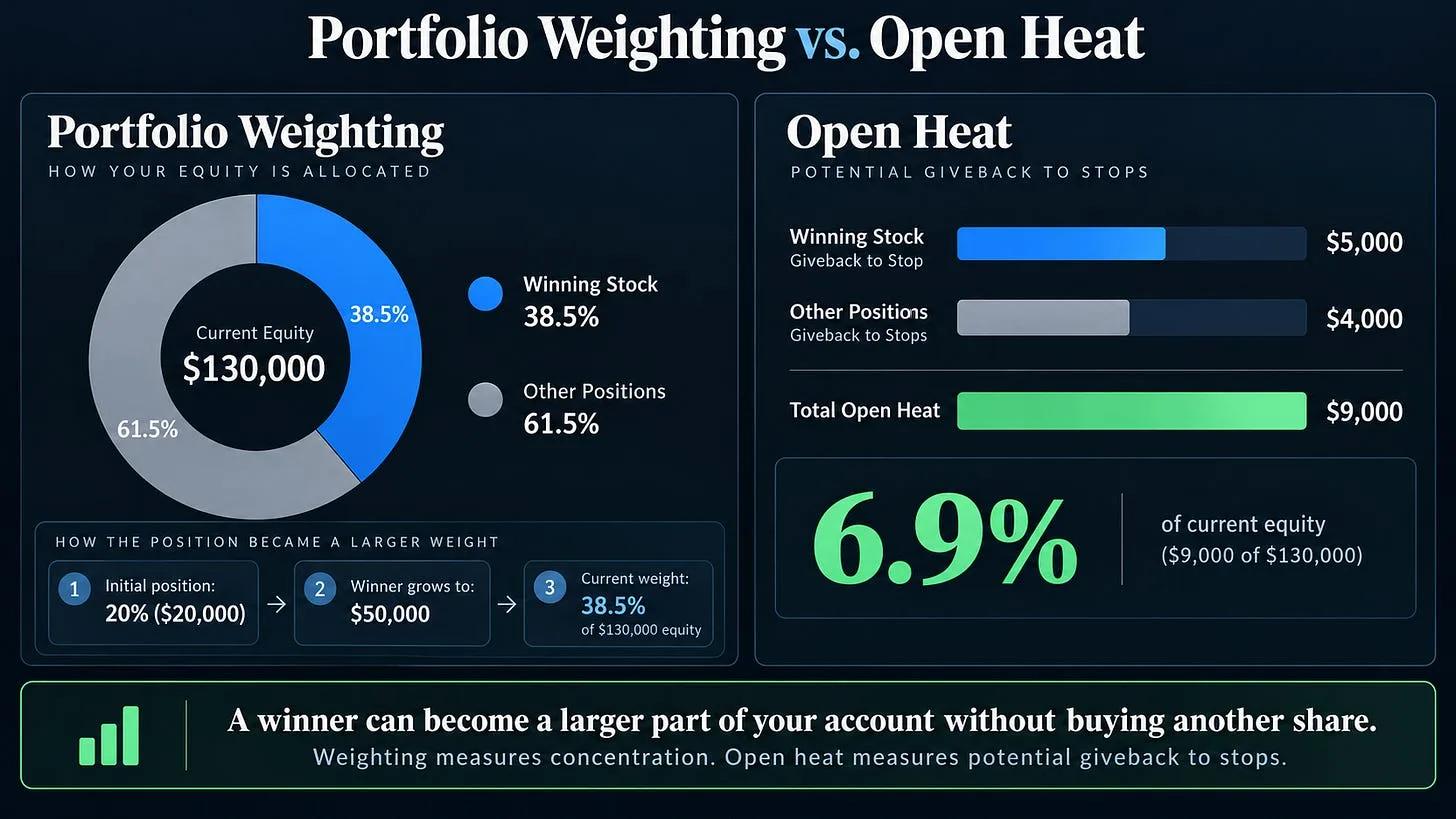
A winning stock can become a larger part of your account without you buying another share, but deciding whether to trim it requires looking beyond its size.
Portfolio weighting measures the position’s current market value as a percentage of your current account equity. It tells you how concentrated you are in that stock.
Current open portfolio heat measures the potential decline from your current account equity if all your positions exit at their specified stops. Here, that includes unrealized profits you could surrender, not just losses below your original purchase prices. It is different from measuring initial entry-to-stop risk.
Consider a $100,000 account invested equally in five stocks. One $20,000 position grows to $50,000 while the other four remain worth $80,000 combined. Your account is now worth $130,000, including the $30,000 unrealized gain. No shares have been added or sold.
Suppose the winner’s stop is 10% below its current price, representing $5,000 of potential giveback. The other four positions have another $4,000 of combined potential giveback to their stops.
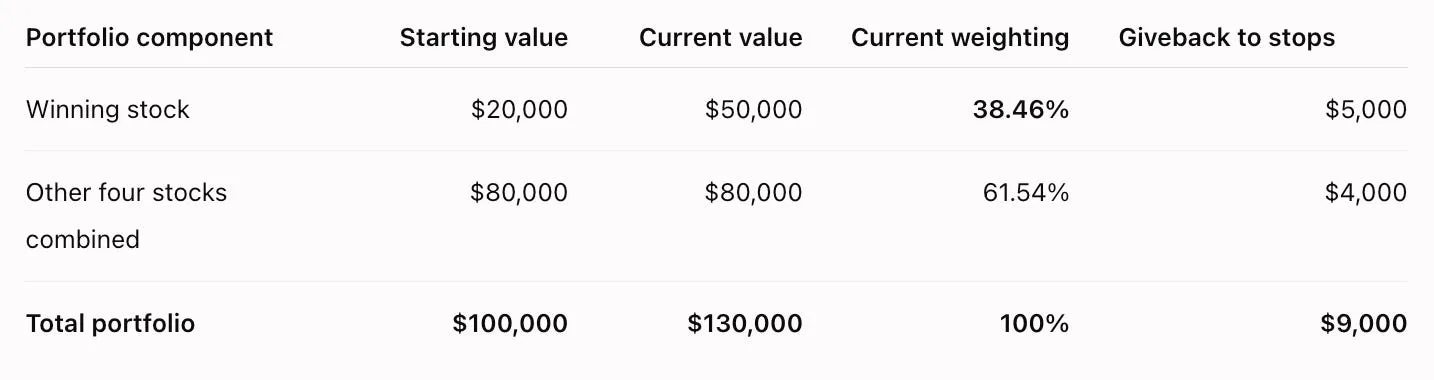
Winner’s portfolio weighting: $50,000 ÷ $130,000 = 38.46%, up from 20% at entry.
Current open portfolio heat: $9,000 ÷ $130,000 = 6.92% of current account equity.
Same five stocks. Still 100% invested. But one stock now represents almost 40% of the account, while the portfolio’s planned giveback to its stops is approximately 6.9%. Those numbers answer different questions.
These are illustrative portfolio values and stop assumptions, not exact measurements from the chart. Calculations assume execution at the specified stops and exclude fees and slippage. Gaps or execution problems can produce larger losses.
How the Market Wizards Manage This
There’s no one-size-fits-all approach. Minervini may trim excess size after a rapid advance. Ryan builds winners and adjusts exposure based on price behavior. Zanger sells portions into strength. Kullamägi takes partial profits and trails the remainder with moving averages.
Trimming reduces position weighting and, with the same stop and proceeds retained as cash, open heat. Raising a protective stop reduces planned giveback, but not concentration.
Let winners run, with rules for how large a position can become and how much equity you’re willing to give back.
The Real Lesson: Let Your Portfolio Earn Its Concentration
The deeper I study the great growth-stock and momentum traders and the longer I do this, the more I appreciate how closely portfolio construction is tied to risk management, market timing, and psychology.
It’s tempting to turn everything into a rigid formula.
Own five stocks. Maintain 10% cash. Allocate 20% to each position. Stay fully invested during bull markets.
But real trading is more dynamic than that.
The number of holdings changes. Individual allocations evolve. Some stocks fail and are eliminated. Others become meaningful winners. Market conditions alternate between periods that reward aggression and periods that punish it.
The objective isn’t to force your portfolio into a particular structure.
It’s to gradually direct more capital toward the strongest opportunities while protecting yourself when the evidence changes.
That means starting smaller when appropriate, increasing exposure after success, cutting losses, replacing weak holdings when justified, and resisting the temptation to constantly interfere with positions that are working.
As Mark Minervini wrote in Trade Like a Stock Market Wizard:
“Build on success. Subtract on setbacks. Let your portfolio guide you.”
I think that statement captures the heart of this entire discussion.
More in Risk Management
All Risk Management articles →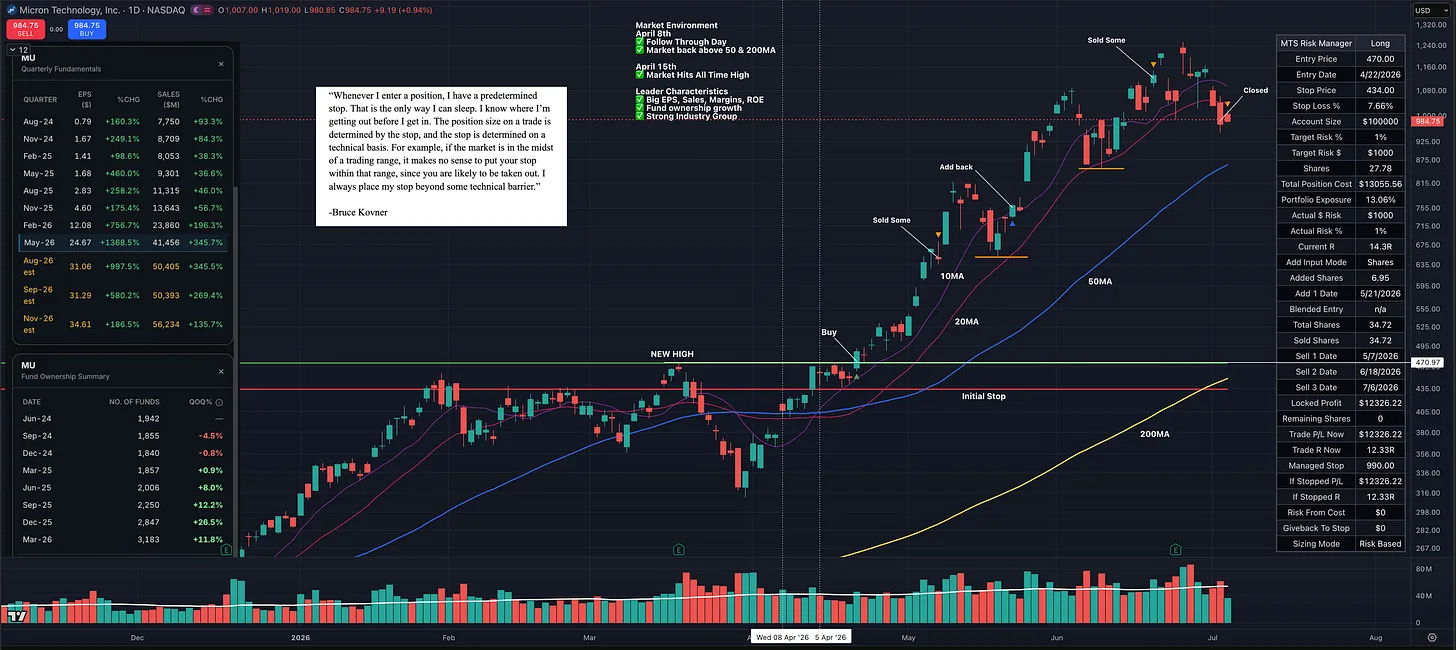
Jul 7, 2026 · Risk Management
Position Size and Manage Risk Like a Market Wizard
Using Bruce Kovner’s stop-loss principle to plan the trade before the trade begins.
- growth stocks
- Momentum Trading
- fundamental analysis
- Learn Trading
- technical analysis
- Investing
- CANSLIM
- Trading
Jul 2, 2026 · Risk Management
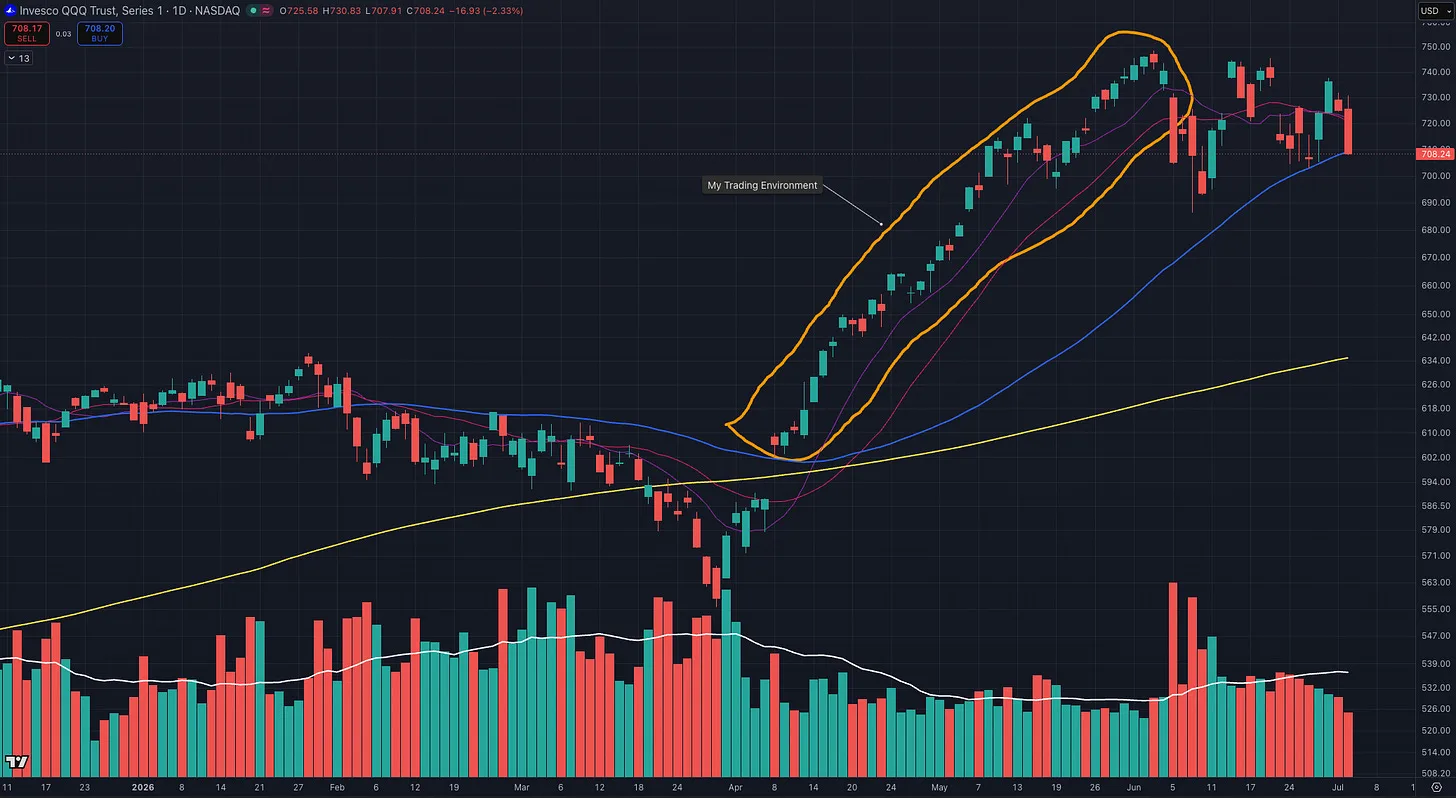
Why Great Traders Can Seem Bipolar in Choppy Markets
The best traders are not changing their minds because they are confused. They are changing their exposure because the market evidence has changed.
- Momentum Trading
- progressive exposure
- Learn Trading
- CANSLIM
- Trading
- position trading
- Growth Stock Trading
- stock trading
May 19, 2026 · Risk Management
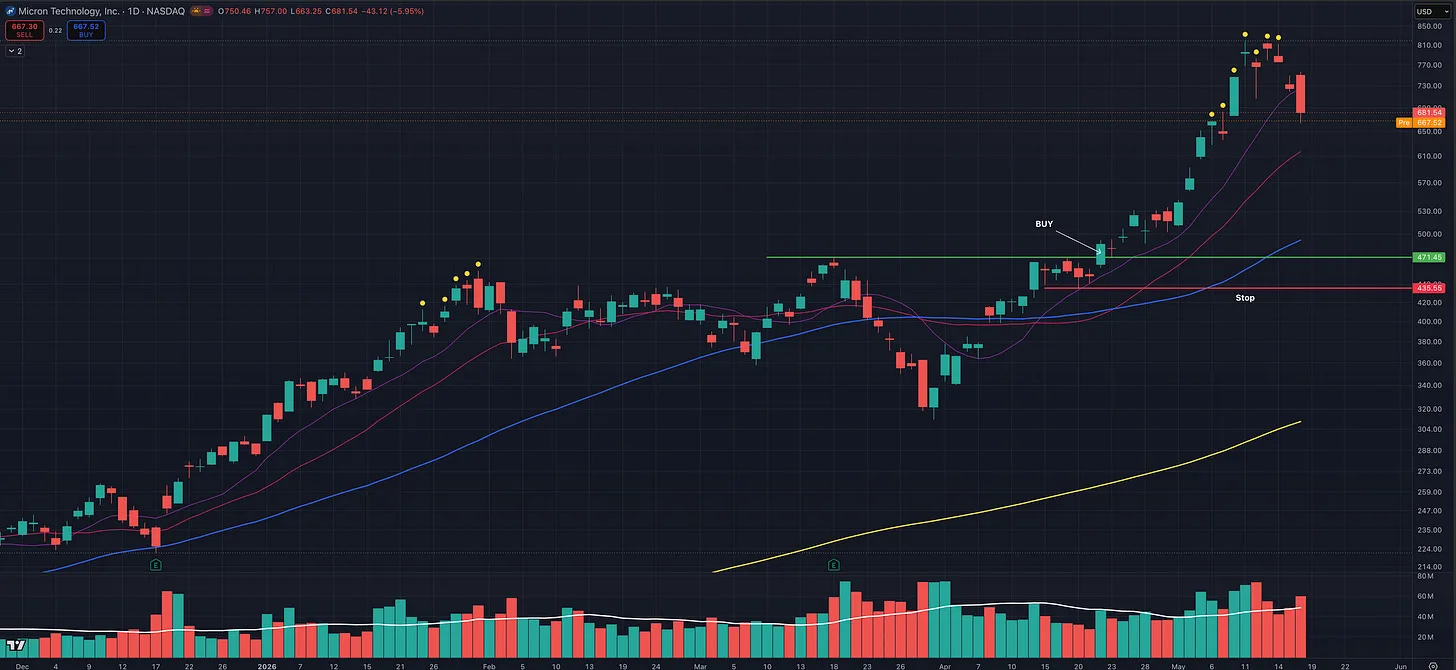
Does O’Neil’s 8% Stop-Loss Rule Still Work Today?
A real trade example showing how the rule works when paired with proper position sizing.
- growth stocks
- Momentum Trading
- learn to trade
- Finance Risk
- CANSLIM
- position trading
- Position Sizing
- Risk Management