
Trading articles/Does O’Neil’s 8% Stop-Loss Rule Still Work Today?
May 19, 2026 · Momentum Trading Strategy
Does O’Neil’s 8% Stop-Loss Rule Still Work Today?
A real trade example showing how the rule works when paired with proper position sizing.
Originally published on Substack.
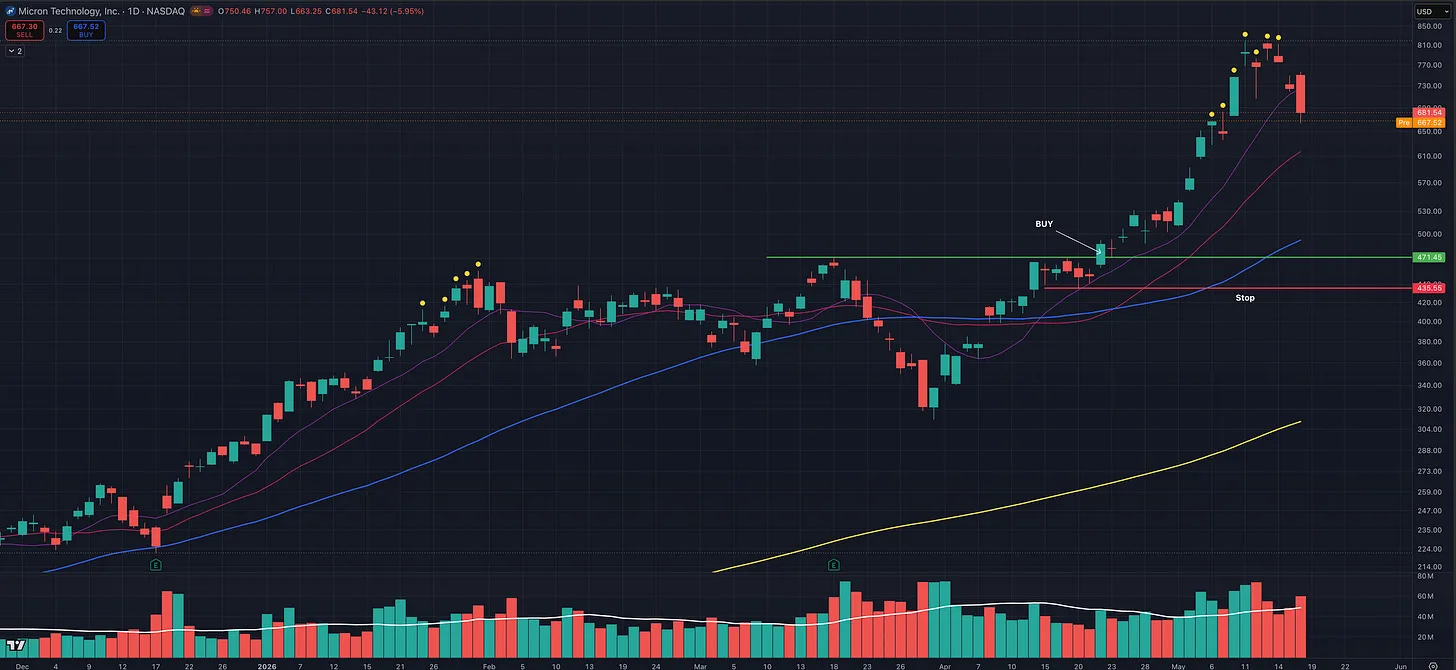
I’ve been getting a lot of questions from different traders asking whether William O’Neil’s 8% stop-loss rule still works in today’s market.
My answer is YES, but only if you understand what the rule was actually designed to do.
Most traders hear “8% stop-loss rule” and think the entire lesson is simply to sell if a stock drops 8% below their entry. That is part of it, but it is not the whole lesson. The real lesson is about buying correctly, being selective, controlling risk, and understanding the difference between the distance to your stop and the actual risk to your account.
Those are not the same thing.
If your stop is 8% below your entry, that does not mean you are risking 8% of your account. Your stop tells you where the trade is wrong. Your position size tells you how much of your account you are actually risking if the trade fails.
That is the part many traders miss.
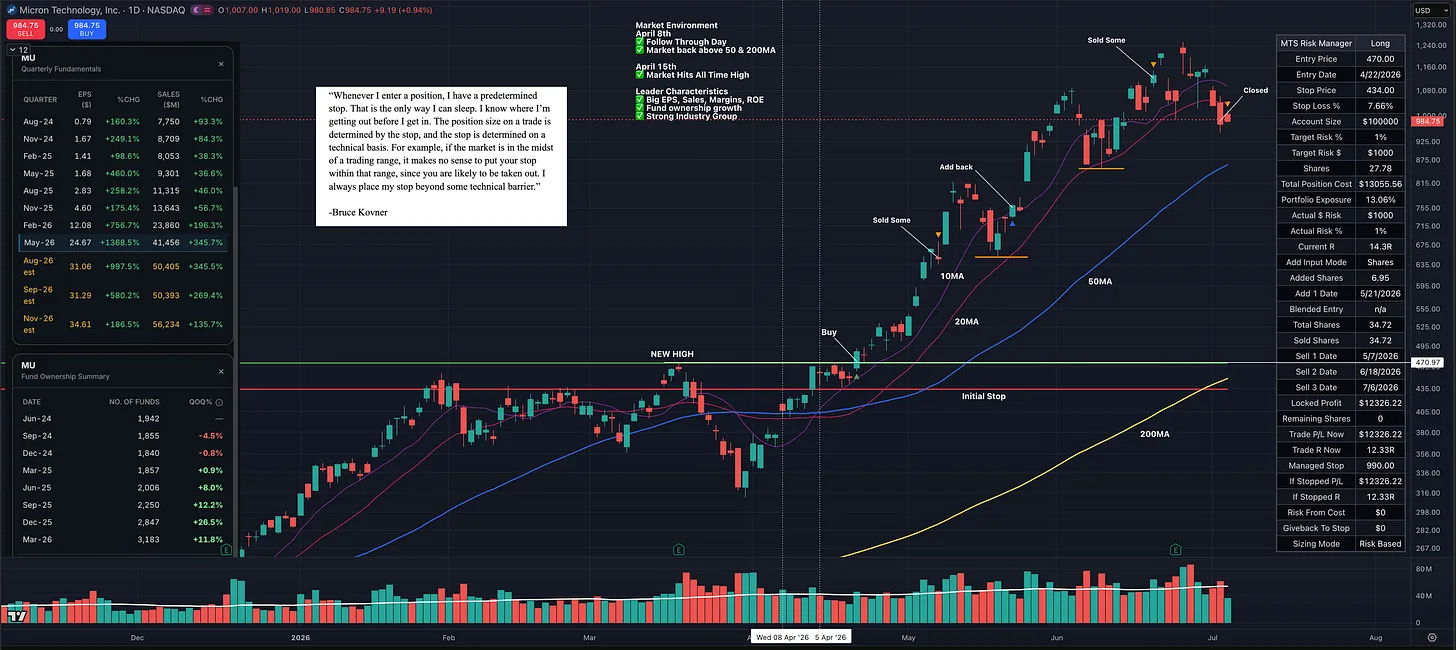
In this MU example, the trader uses the daily chart for the entry and initial risk, while also using the weekly chart for broader context. Once the trade starts working and moves 2–3 times the initial risk, they can begin managing the position differently. That may mean selling some into strength, raising the stop to breakeven, and then using the weekly chart to manage the remainder of the position for a larger move.
This is where you can see why the 8% rule still matters, how it works with proper position sizing, and why the stop-loss rule and account risk are not the same thing.
O’Neil wanted traders to be concentrated in true leading stocks, but concentration only works if you are buying correctly, sizing correctly, and cutting losses quickly when the trade is wrong.
That is why the rule still works today.
You just have to understand how to apply it.
Let’s walk through this example so you can see why O’Neil’s rule still matters, how it fits with position sizing.
MU Trade Example
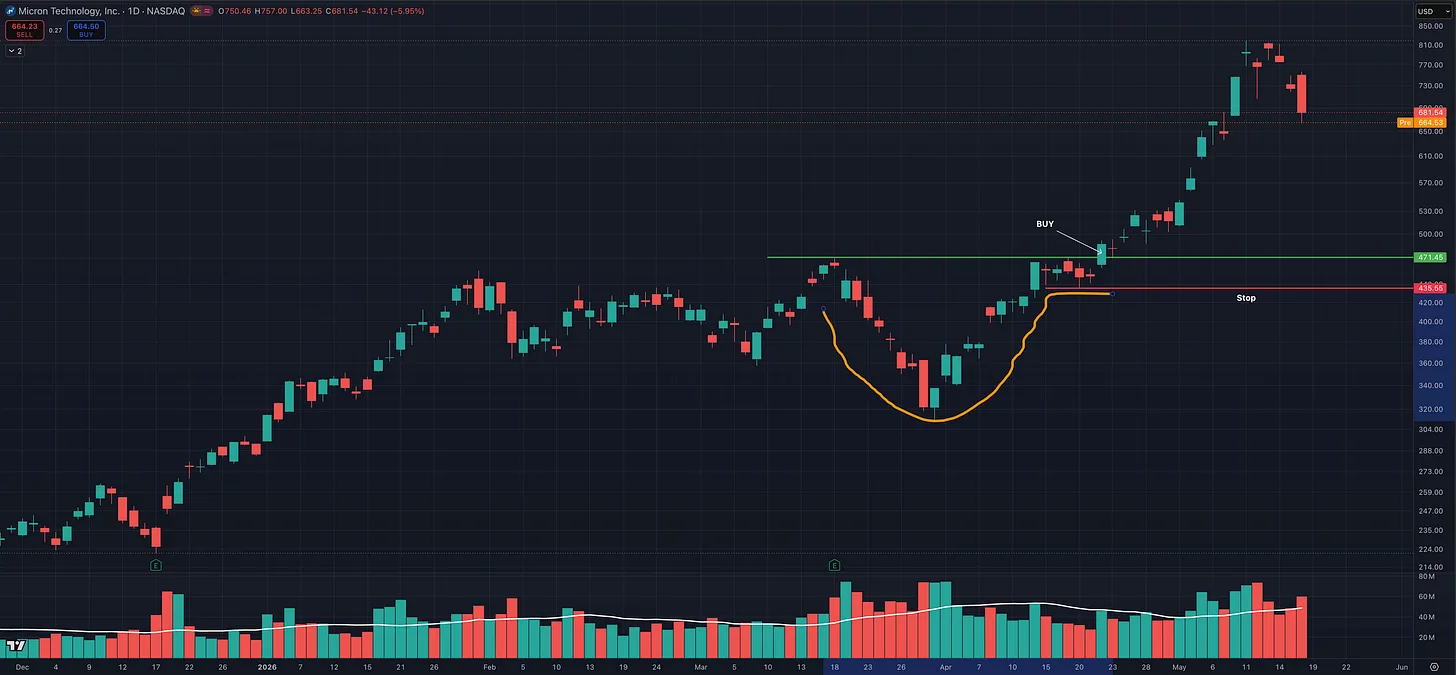
O’Neil originally used 7% as his initial loss-cutting rule, and in the revised version it was moved closer to 8%. But regardless, yes, I would still say the 8–10% area is valid today, and MU is just one of many examples that shows why.
Personally, I tend to use the daily and weekly charts together. I may enter and place my initial stop using the daily chart, but I still want the weekly chart for context. Then, once the trade starts working, I usually manage the rest of the position with the bigger weekly structure in mind.
In this MU example, you had a cup-with-handle setup. I would place the stop below the lowest part of the handle and buy the breakout into new highs. Once the stock moves 2–3 times my initial risk, I want to protect the trade by moving the stop to breakeven and looking for a partial sell.
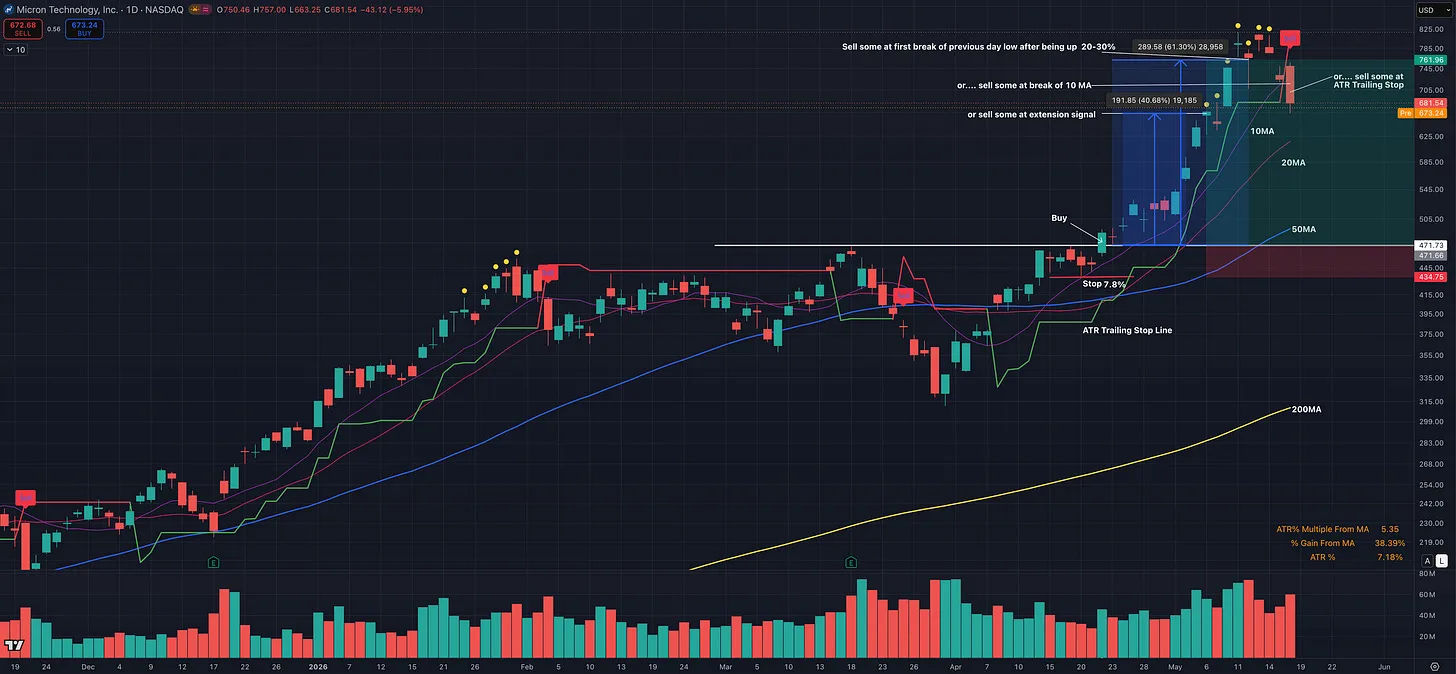
There are several different ways to make that first sell, and all of them still align with O’Neil’s general philosophy of selling into strength and protecting gains.
You could sell the first piece when the stock starts to get extended, such as the first ATR 10 multiple extension signal above the 50-day moving average. You could wait for the first break of the prior day’s low after a strong run. You could wait for a break of the 10-day moving average. Or you could use an ATR trailing stop. (see chart above)
The exact method can vary, but the principle is the same: you are taking a partial sell, maybe 50%, after the stock has moved 5R or even 8R depending on the sell method.
That is very much in line with O’Neil. If his initial risk was around 7–8%, then a 20–30% gain is roughly 3R, and O’Neil often talked about selling some into that 20–30% gain area.
So to me, the point is not that there is only one perfect sell rule. The point is that you define your risk first, let the stock prove itself, protect the trade once it moves in your favor, and then sell partials into strength instead of giving the entire move back.
How to Implement Position Sizing
The two calculator images are using the same MU trade, but with two different position sizing methods, but the same STOP 7.79% from entry).
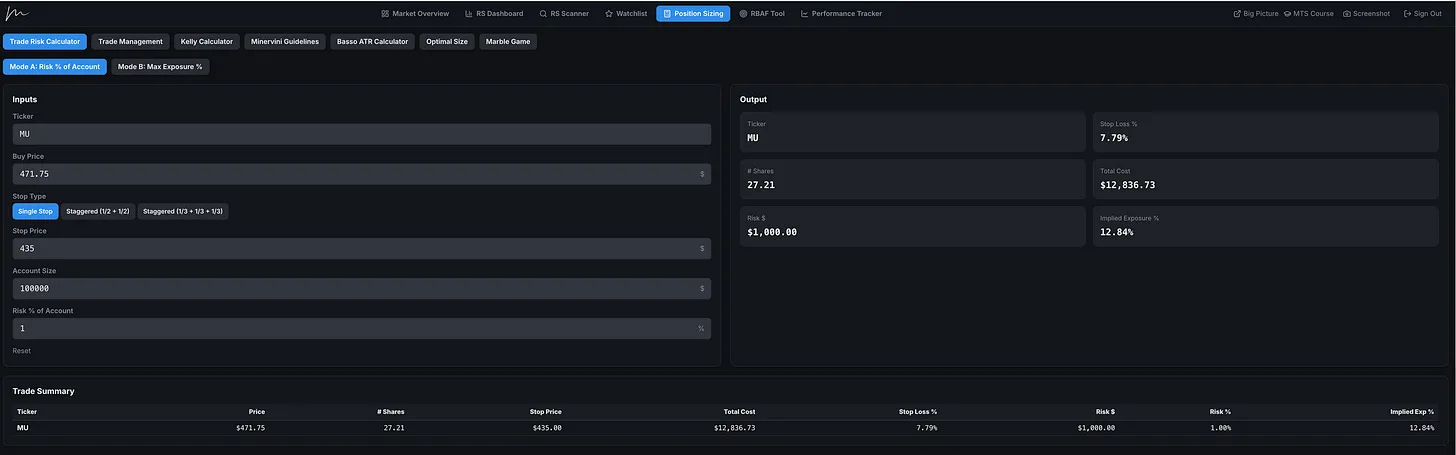
In Mode A, the trade is sized so the total account risk stays at 1%. That means only 12% of the account is used on the trade.
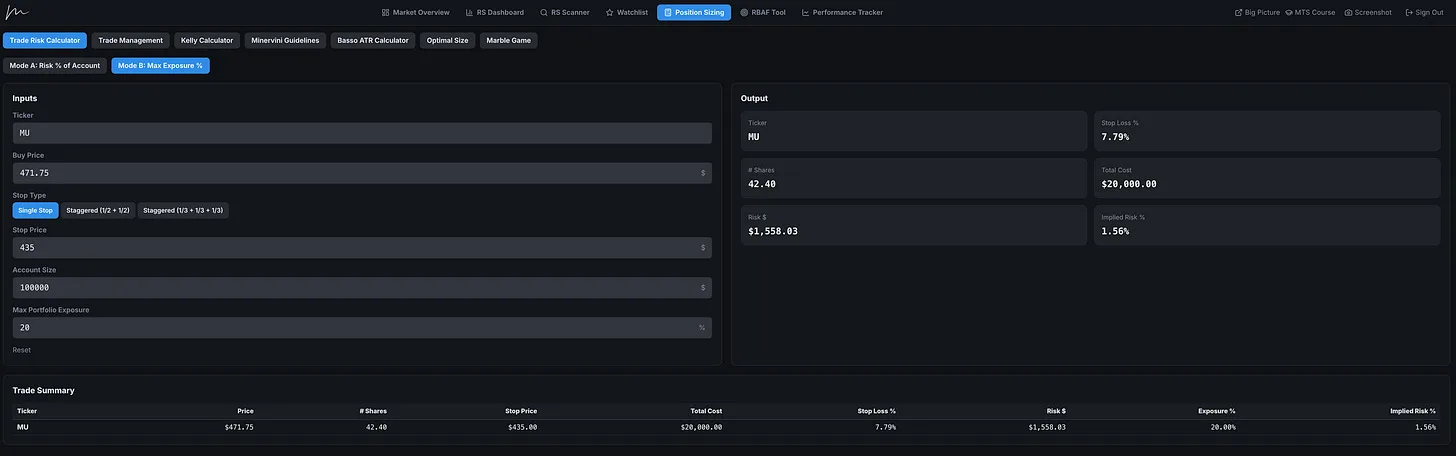
In Mode B, the position uses 20% of the account, but because the stop is wider, the total account risk is 1.56% if stopped out.
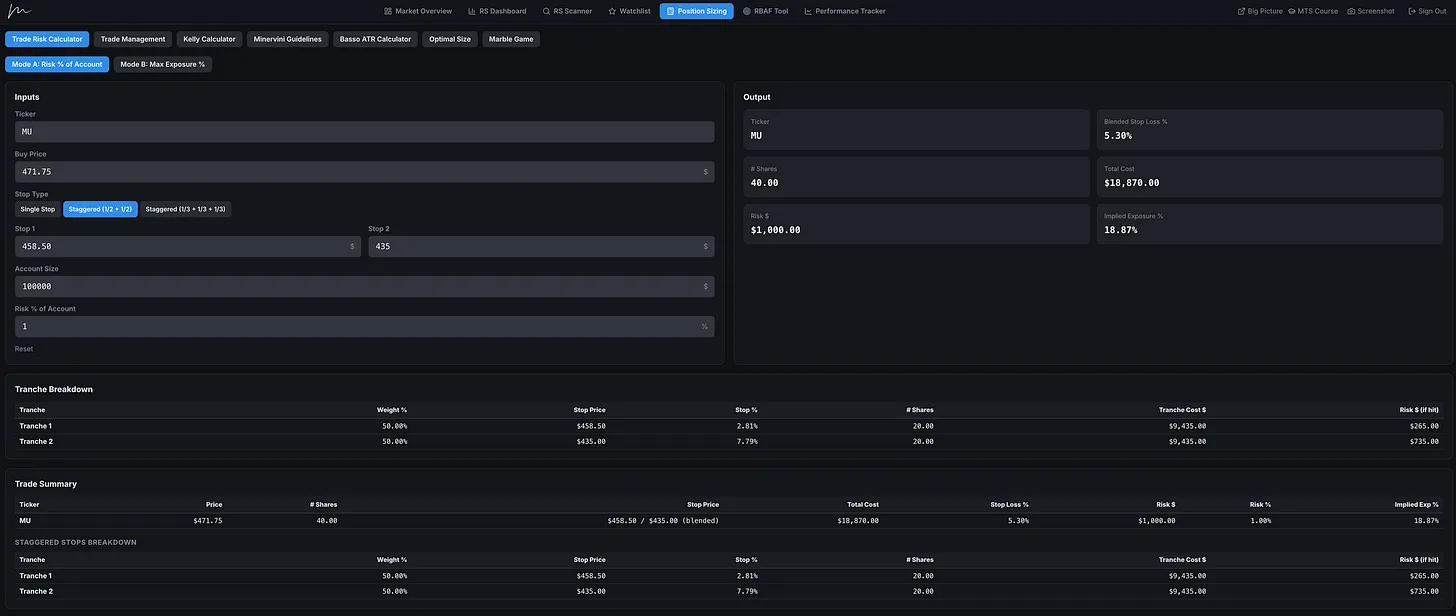
A third option is using a staggered stop method.
For example, half the position could be stopped out if price breaks the low of the entry day on the breakout, while the other half uses the deeper stop below the handle low (same as mode a and b stop location). If both stops are hit, the blended stop loss is about 5.3%.
That allows you to use roughly 18% of the account in the trade, while still keeping the total account risk at only 1%.
This is the part most traders miss. The chart does not tell you how much of your account to risk. Your position sizing does. The stop placement tells you where the trade is wrong. The position size tells you how much damage you are willing to take if you are wrong.
Weekly Chart Entry Traders
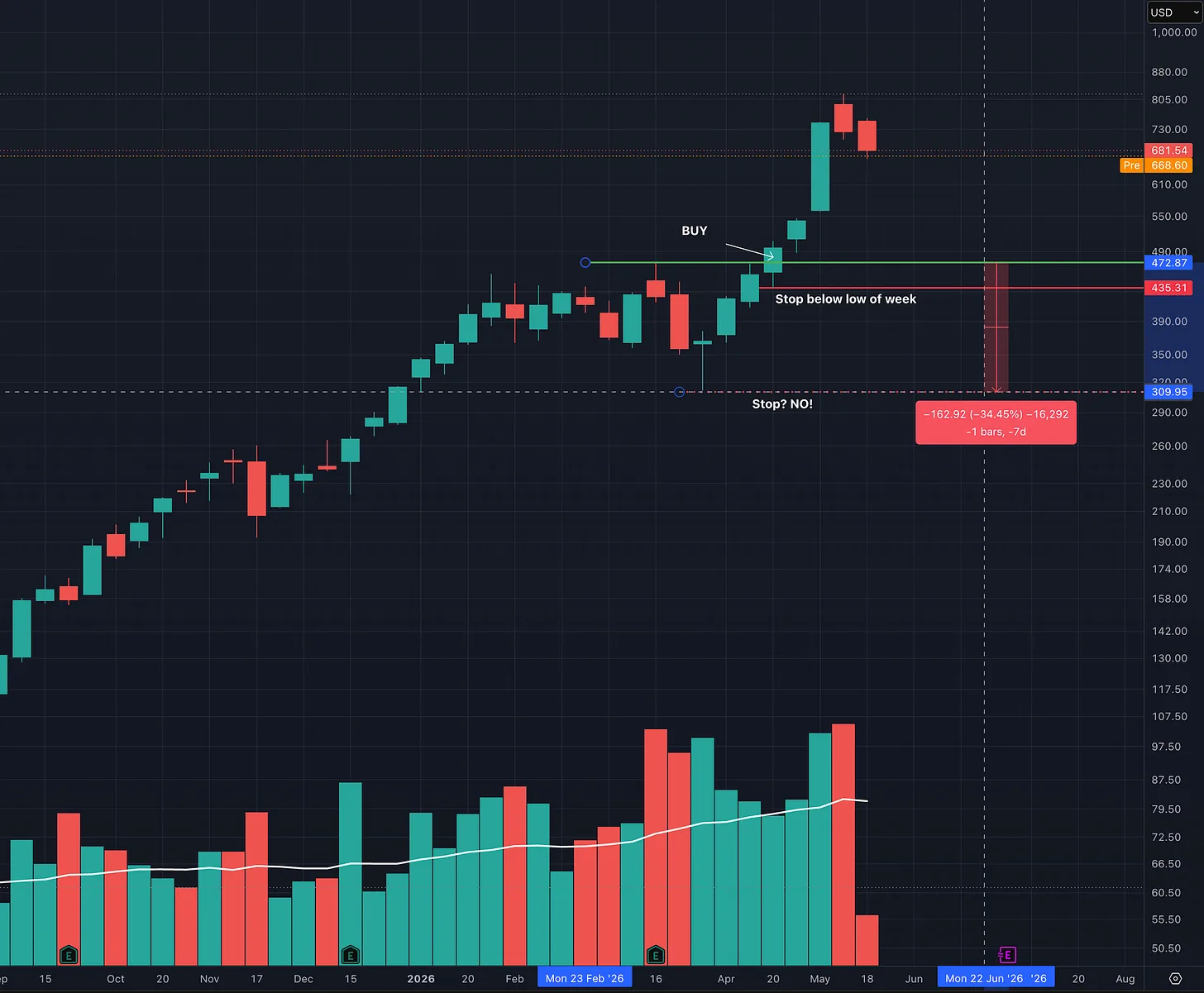
You could also buy the same breakout using the weekly chart, with the stop placed below the low of the breakout week (still under 8%), as long as that risk is still under roughly 8–10%. That would still fit within O’Neil’s risk framework.
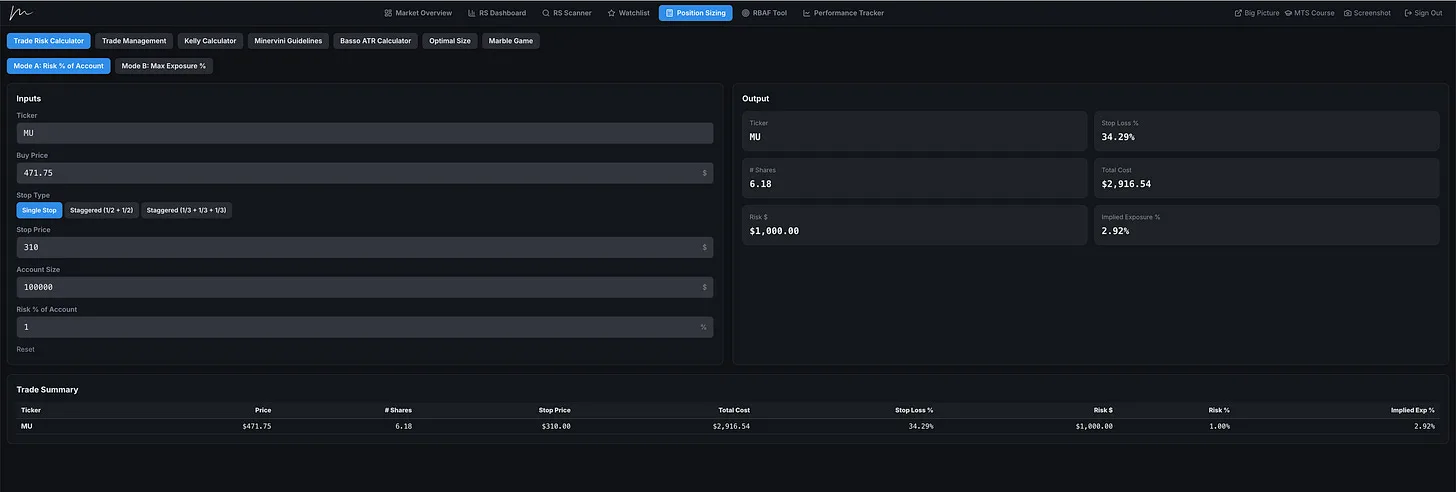
But what you would not do is force a stop all the way down at the prior weekly higher low around $310. From the breakout entry, that would be roughly a 34% stop. O’Neil would never have accepted that kind of loss from his entry.
Yes, the higher low around $310 is a real technical level. If price broke that area, it would likely tell us the broader trade structure had failed. That fits with what we teach about using logical technical levels.
BUT there is a big difference between identifying a meaningful technical level and allowing that level to become your stop-loss if it is 34% below your entry.
At that point, even if you reduce your position size so the account risk is still controlled, the trade likely no longer offers the same risk/reward profile. You would have to size the position so small that the winner may not have enough impact on your portfolio.
It also violates the goal of concentration. O’Neil wanted traders concentrated in their best leading stocks, but that only works when the entry and stop allow you to hold meaningful size while still controlling risk. A 34% stop forces you to shrink the position too much (only 2% of your account exposed on the trade), weakens the opportunity, and turns a proper breakout trade into something O’Neil would not have considered disciplined risk management.
Final Takeaway
“Whenever I enter a position, I have a predetermined stop. That is the only way I can sleep. I know where I’m getting out before I get in. The position size on a trade is determined by the stop, and the stop is determined on a technical basis. For example, if the market is in the midst of a trading range, it makes no sense to put your stop within that range, since you are likely to be taken out. I always place my stop beyond some technical barrier.” - Bruce Kovner
We are trying to stay aligned with O’Neil and Kovner and that is why this isn’t easy and why we are so selective with our trades.
There are times when I will bend O’Neil’s rule.
I have had stops 10–15% from my entry point when the stock’s ATR, average daily range, and overall volatility were much higher. Names like LITE, SNDK, and other high-volatility leaders sometimes had logical stop locations that were slightly beyond the standard 8–10% threshold.
But there are two important distinctions.
First, I was still only risking around 1% of my account if the trade failed. The wider stop did not mean wider account risk. It simply meant a smaller position size.
Second, I was nowhere near using a stop 20%, 30%, or 34% below my entry. That is a completely different situation. A 12–15% stop in an extremely volatile leader is bending the rule by a few percentage points. A 30%+ stop is abandoning the rule entirely.
And I did NOT start doing this early in my trading. For beginner traders, this can get them in trouble fast because “bending the rule” can easily become an excuse for taking oversized losses, buying extended stocks, or refusing to admit they are wrong.
As you gain experience, you may learn when a rule can be bent slightly because of volatility, ATR, position sizing, and the quality of the setup. But the principle never changes: define the risk before the trade, keep the account risk controlled, and never allow one stock to do serious damage to your capital.
And for the hardcore rule followers, I’ll leave you with one of my favorite Ed Seykota quotes.
To put this in context, Seykota was not a technical and fundamental discretionary trader like me. I have rules, but I still operate with discretion inside a defined system. Seykota was one of the original great systematic traders, and one of the best traders of the last 100 years.
And even he said you need to know when to break the rules.
When Jack Schwager asked him, “What are the trading rules you live by?” Seykota answered:
“a. Cut losses.
b. Ride winners.
c. Keep bets small.
d. Follow the rules without question.
e. Know when to break the rules.”
That is the nuance.
Rules matter. Discipline matters. Cutting losses matters, but experience also teaches you when a rule can be bent slightly without violating the principle behind it.
There is a major difference between giving a volatile leader a little more room, while still controlling account risk, and using “discretion” as an excuse to sit through a 30% loss.
One is experienced risk management.
The other is undisciplined hope.
Video talking about this……
More in Risk Management
All Risk Management articles →
Oct 11, 2026 · Risk Management
How Many Stocks Should You Own? The Mistake That Can Cost You Your Biggest Winners
What William O'Neil, Mark Minervini, and the Market Wizards teach us about portfolio concentration, position sizing, cash management, and knowing when to stop trading.
- Momentum Trading
- Investing
- CANSLIM
- Trading
- position trading
- Growth Stock Trading
- Portfolio Heat
- David Ryan
Jul 7, 2026 · Risk Management
Position Size and Manage Risk Like a Market Wizard
Using Bruce Kovner’s stop-loss principle to plan the trade before the trade begins.
- growth stocks
- Momentum Trading
- fundamental analysis
- Learn Trading
- technical analysis
- Investing
- CANSLIM
- Trading
Jul 2, 2026 · Risk Management
Why Great Traders Can Seem Bipolar in Choppy Markets
The best traders are not changing their minds because they are confused. They are changing their exposure because the market evidence has changed.
- Momentum Trading
- progressive exposure
- Learn Trading
- CANSLIM
- Trading
- position trading
- Growth Stock Trading
- stock trading