Momentum Trading Strategy

Notes

Short lessons on momentum trading, every day.

Every note from Substack, in one place: risk, setups, leading stocks, market conditions and the mindset behind them. Search them, browse by topic, or filter by stock.

Showing 561–580 of 1226 notes

View on Substack ↗

The Volume Clue Most Traders Miss Before a Stock Explodes

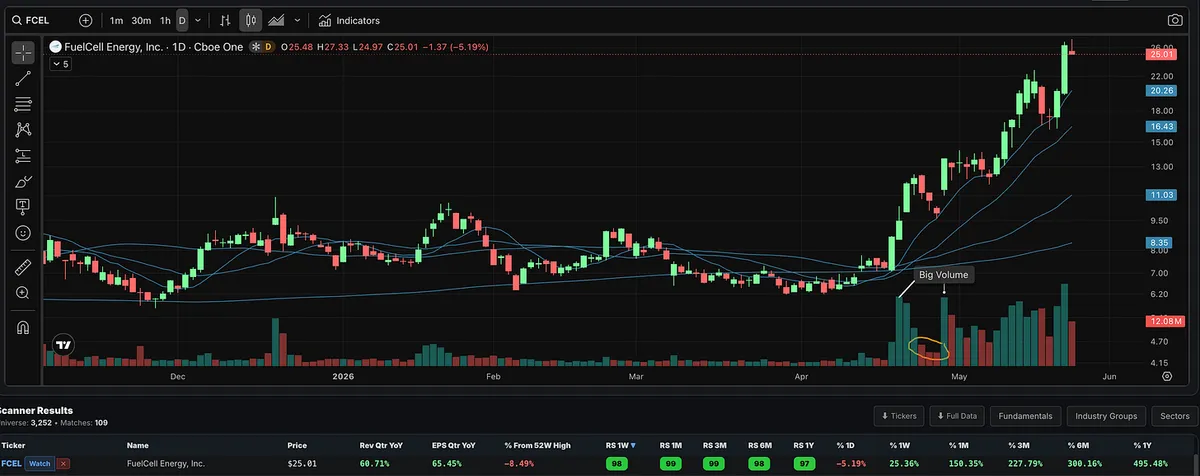
FCEL recently gave a great example of the type of price-volume action I like to look for.

I get a lot of questions on this, so I thought I would share a simple example.

First, you had several strong up days on volume that was roughly 2x, 3x, and even 4x above normal.

That tells you demand was coming in.

But the more important clue came after the move.

The stock pulled back for a few days into the 10-day moving average, but it did it on much lighter volume.

Price was pulling back, but sellers were not showing up aggressively. Volume was drying up as the stock rested.

Then, when price started moving higher again, volume expanded sharply. It was more than 3x the volume we saw during the pullback.

That is the type of action O’Neil and Minervini both teach traders to recognize:

Strong advance on heavy volume.

Controlled pullback on lighter volume.

Renewed move higher with demand coming back in.

Of course, this alone does not make a stock a buy. You still need the market, fundamentals, relative strength, industry group strength, setup quality, and risk/reward to line up.

But as a pure price-volume lesson, this is a clean example.

The big clue was not just that volume came in.

The clue was that volume disappeared on the pullback, then came back when price started moving higher again.
View on Substack ↗

Price Moves First. The Story Comes Later.

The market’s price action usually tells you everything you need to know.

The news comes after.

If price breaks down, the headlines will explain why.

  • Tariffs.

  • Rates.

  • Inflation.

  • Iran.

  • Some deal falling apart.

  • Recession or bubble fears.

  • Some risk.

But if price turns higher, breaks out, and starts hitting all-time highs, the headlines suddenly change.

Now the same market has a “supportive backdrop.”

Now there is “deal optimism.”

Now there is “renewed investor confidence.”

Now the same news cycle finds a reason to explain the move higher.

This is why I care more about price and put very little to almost no effort into headlines.

View on Substack ↗

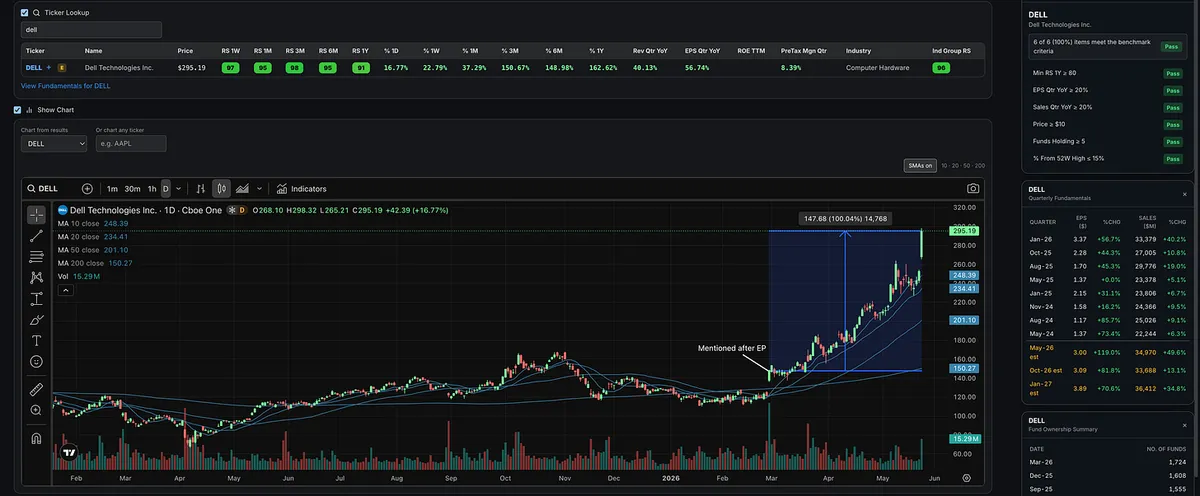
Why I Track Big Gap-Ups Inside the RS Screener

Someone asked me why I track episodic pivots and big gap-ups inside the Relative Strength Stock Screener.

Here’s why.

I wrote about Dell on March 1st after its episodic pivot, when the stock gapped up more than 10% on earnings with massive volume.

Since then, Dell has continued to trend higher, up roughly 100%, while making higher highs and higher lows.

Strong industry group. High relative strength across multiple time frames. Strong earnings. Strong sales. Massive volume after earnings.

That is exactly the kind of behavior I want to track.

Not because every gap-up works.

Not because you blindly chase every stock that moves.

But because big institutional-quality moves often leave footprints before the bigger trend fully develops.

The Relative Strength stock screener inside the Momentum Trading Strategy app is simple, but extremely powerful.

It helps me find the names that are showing up in the right places, at the right time, with the right characteristics.

This is exactly what I’m using to find the stocks I share.

View on Substack ↗

The Most Underrated Thing I Offer

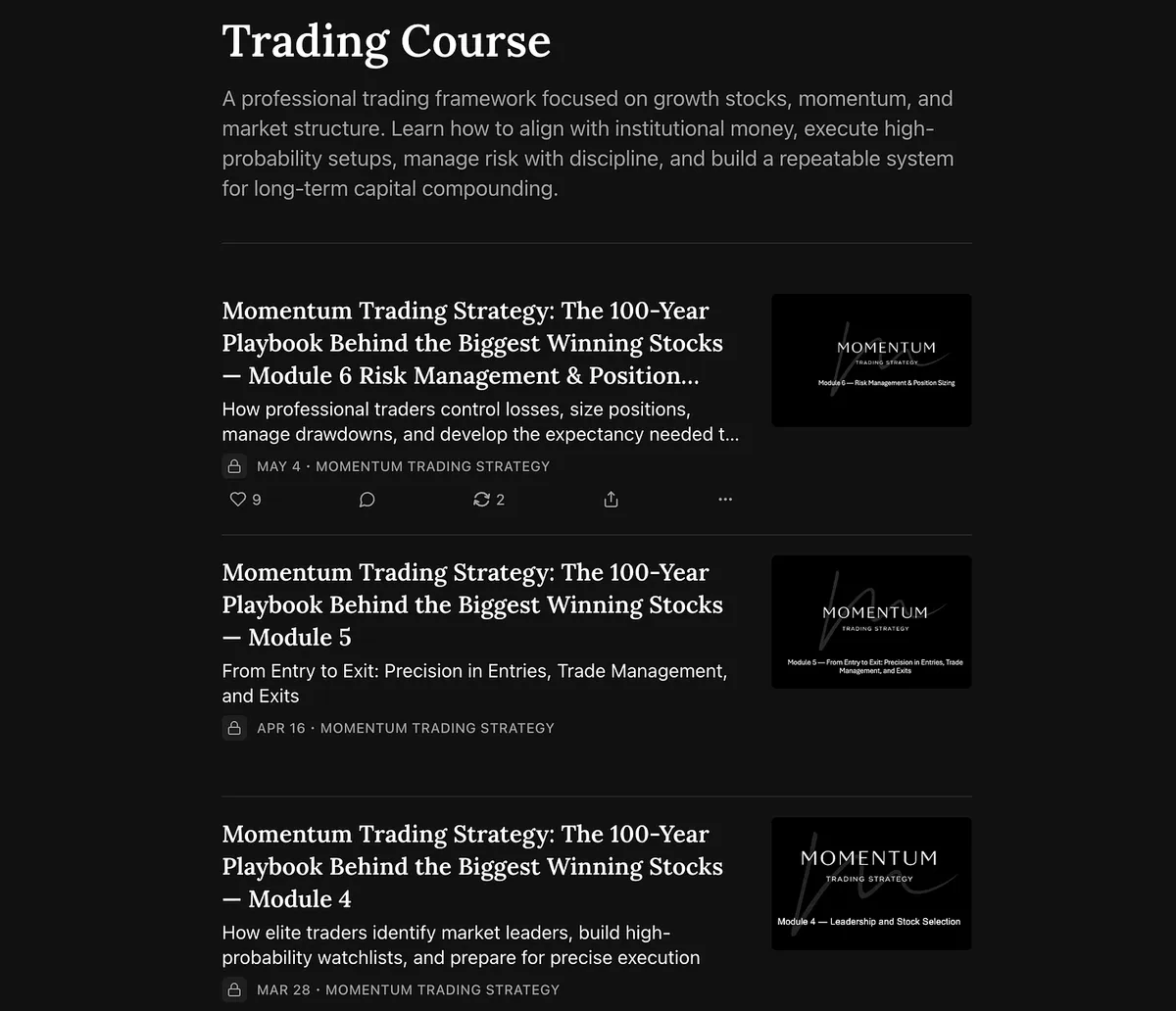
The most underrated high-value content I have to offer is probably the Momentum Trading Strategy Course.

It is modeled after the course that had the biggest impact on me: the Master Trader Program, a $5,000 course that helped shape how I think about markets, setups, risk, trade management, and process.

But I also built this course around everything I’ve learned from more than 20 years of trading and studying the greatest growth and momentum traders of all time.

William O’Neil.

Nicolas Darvas.

Mark Minervini.

Jesse Livermore.

Dan Zanger.

And many more.

Modules 1 through 6 are already live, with Module 7 coming in the next few days.

The course walks through the foundation of growth stock and momentum trading, including market direction, leadership, relative strength, stock selection, entries, trade management, exits, risk management, and position sizing.

Module 5 covers what most traders are looking for: precision entries, trade management, and exits.

Module 6 covers what most traders overlook: risk management and position sizing.

That combination matters.

Because finding a great stock is only one part of the process. You still need to know when to enter, where to place your stop, how much to risk, how to manage the trade, and when the evidence is telling you to exit.

That is what this course is designed to teach.

Not alerts.

Not random stock picks.

A real foundation.

If you are a paid subscriber, you already get access.

https://tradingmomentum.substack.com/s/mts-course

View on Substack ↗

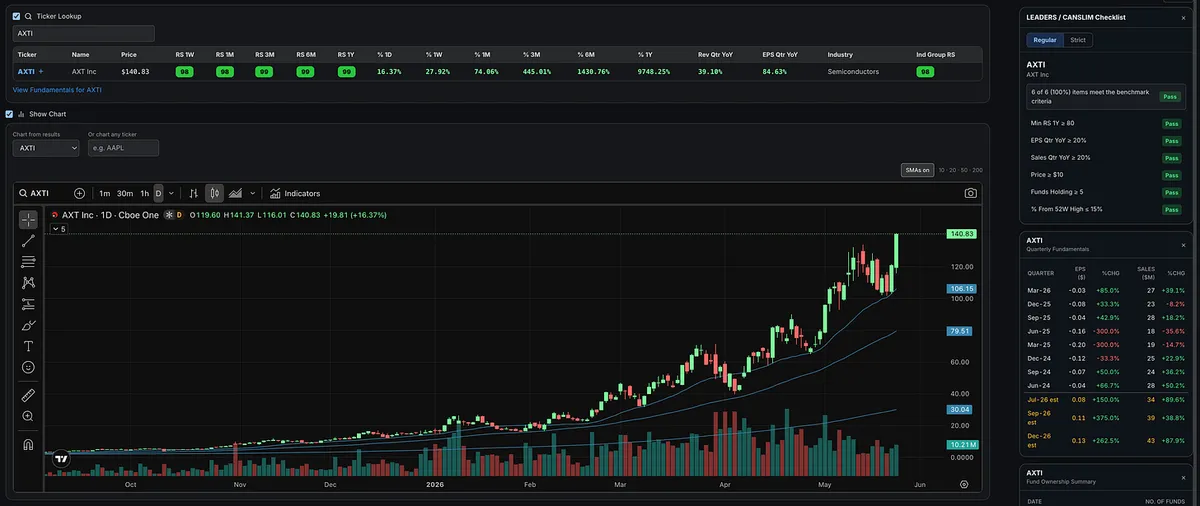
Are You Sick of Me Posting About AXTI Yet?

AXTI is back at all-time highs.

Are you sick of me posting about this stock yet?

Good.

Because this is the whole point of relative strength.

The strongest stocks usually keep showing up before everyone wants to believe them. They keep appearing on the screens. They keep building higher. They keep forcing you to either pay attention or make excuses.

That does not mean you chase.

That does not mean you FOMO into the trade.

And it definitely does not mean the stock can’t pull back or that the trend will last forever.

But when a stock keeps showing up with strong price action, strong relative strength, strong earnings and sales, and strength from a leading industry group, it deserves to stay on the radar.

This is where a lot of traders make the mistake.

They miss the first entry, take it off the watchlist, and never come back.

Or the stock pulls back, and they assume the move is over.

But leading stocks can trend for months.

AXTI has been doing exactly that.

So the better question is not, “Did I miss it?”

The better question is:

Is the trend still intact, and is the stock still acting like a leader?

“The trend is your friend except at the end when it bends.” — Ed Seykota

And right now, AXTI still hasn’t bent.

View on Substack ↗

The Big Picture Market Pulse Is Out

Before diving into individual stock selection this week, step back.

The market is back near all-time highs.

But the real question is not, “Is the market up?”

The better question is:

Where is the strength actually concentrated?

Because if the indexes are moving higher but your stocks are not coming from the strongest areas, you may be working against the real leadership of the market.

This is why I write the Big Picture Market Pulse before the new trading week begins.

It helps us understand the market environment, identify where demand is showing up, and make sure our stock selection is aligned with the strongest areas of the market.

The full report is live for paid subscribers.

https://tradingmomentum.substack.com/p/big-picture-market-pulse-may-25-2026

View on Substack ↗

Why One of the Greatest Traders Wrote a Psychology Book

Ed Seykota was one of the first great systematic trend-following traders.

He was profiled in Market Wizards.

He helped pioneer computerized trading systems and took a small client account from around $5,000 into more than $15 million.

So you would think the one book he wrote about trading would be packed with entries, exits, indicators, formulas, and tactics.

It wasn’t.

The Trading Tribeis mostly about trading psychology.

That should stop every serious trader in their tracks.

Because Seykota already knew what most traders learn the hard way:

The strategy is usually not the biggest problem.

You are.

If you are brand new, yes, you still need to study. You need a real strategy, a real edge, risk management, position sizing, entries, stops, exits, and enough screen time to know what you are doing.

But if you already have rules...

If you already know where your stop goes...

If you already know you should not chase...

If you already know you should cut the loss...

If you already know you should let the winner work...

And you still keep breaking your own rules?

Then your problem is probably not the market.

It is probably not the chart.

It is probably you.

That is why The Trading Tribe matters.

It is not a magic indicator book.

It is not a secret system book.

It is about the emotions and internal drama that cause traders to abandon good systems at the worst possible time.

Hope.

Fear.

Greed.

Despair.

The same emotions that make traders exit good trades too early, enter bad trades too late, move stops, oversize, hesitate, revenge trade, and turn a trading plan into an emotional negotiation.

That is where the real damage happens.

A trader can have a profitable system and still lose money if he cannot follow it.

A trader can know the right thing to do and still fail if he cannot execute under pressure.

A trader can study every setup in the world and still destroy his account if he keeps acting out his emotions in the market.

So here is the challenge:

Study yourself as much as you study charts.

  • Why do you move your stop?

  • Why do you sell too early?

  • Why do you hesitate?

  • Why do you chase?

  • Why do you need to be right?

  • Why can’t you take a small loss?

  • Why do you abandon your plan the second the market makes you uncomfortable?

At some point, the next level is not another indicator.

It is not another setup.

It is not another video.

It is learning how to get out of your own way.

That is where most traders are stuck.

And that is why one of the greatest systematic traders of all time wrote a trading book that was essentially all psychology.

View on Substack ↗

“Most investors think that charts are hocus-pocus. Only about 5 to 10 percent of investors understand charts. Even a lot of professionals are totally ignorant about charts. Just as a doctor would be foolish not to use X-rays and EKGs, investors would be foolish not to use charts.” -William O’Neil

View on Substack ↗

It’s Not Enough to Just Work

William O’Neil wrote in How to Make Money in Stocks:

“Today it’s not enough for you to just work and earn a salary. To do the things you want to do, go where you want to go, and have the things you want to have in your life, you must save and invest intelligently. The income from your investments and net gains you can make will, in time, let you reach your goals and provide you real security.”

I believe that is still 100% true today.

Working hard matters.

Having a job matters.

Earning a steady income matters.

But if your entire financial future depends only on your paycheck, you are always one step away from someone else having too much control over your life.

That is the part most people do not want to hear.

A salary can help you survive.

But saving, investing, building skills, starting something of your own, or learning how to put capital to work is what can change your future.

This does not mean everyone needs to become a full-time trader.

It does not mean everyone needs to start a business tomorrow.

But it does mean you need to stop thinking your job alone is the plan.

Your job can be the income source.

But what you do with that income is what determines whether you build freedom or stay stuck.

You have to learn.

You have to save.

You have to invest.

You have to build skills that make you more valuable.

You have to take responsibility for your own financial future.

Nobody is coming to save you.

Not the government.

Not your employer.

Not the economy.

And not the perfect time.

There will always be problems.

There will always be reasons to wait.

There will always be some crisis, some fear, some excuse, or some reason why now does not feel like the right time.

But opportunity still exists.

The question is whether you are willing to prepare yourself to take advantage of it.

That is why I believe O’Neil’s message still matters today.

It is not enough to just work.

You have to invest intelligently.

You have to invest in yourself.

And you have to start before you feel ready.

View on Substack ↗

Bubble Talk Gets Clicks. Sell Rules Make Money.

Talking about bubbles is great for engagement on social media.

But it does very little to help your actual trading.

Honestly, it doesn’t matter if we’re in a bubble.

And if we are?

Great.

Some of the biggest opportunities in market history came during periods people later called bubbles.

The 1920s.

The late 1990s.

These were incredible environments for traders who actually knew what they were doing.

The problem is not the bubble.

The problem is not knowing how to sell.

If we are in a bubble, momentum traders and growth stock invetors can make a lot of money.

And when the bubble eventually pops, it should not destroy you if you have rules.

That’s the part most people miss.

A bubble is only catastrophic if you’re holding with no exit plan, no risk management, and no sell rules (which is most people).

If every bubble headline makes you scared, that’s probably a sign you haven’t learned enough yet to be trading size in the market.

Because professional trading is not about predicting the exact top.

It’s about participating while the trend is working, managing risk the entire way, and getting out when the evidence changes.

That’s exactly what we teach inside the Momentum Trading Strategy Course.

A real process for buying strength, managing risk, selling into strength, and knowing when to get out.

View on Substack ↗

The Quiet Warning Showing Up Under the Surface

A lot of leading stocks are still acting strong.

Many are making new highs. Many still have great relative strength.

Price is still king, and I would never execute a trade based on one data point alone.

But I am noticing something worth paying attention to.

On the most recent earnings reports for a lot of leading names I’ve been following, fund ownership has dropped.

Again, this does not mean the move is over.

These stocks can absolutely keep running higher from here. That’s exactly why price always comes first.

Also, sometimes this happens for a quarter or two, then funds increase again and come right back into the name.

But when leading stocks are pushing higher while fund ownership starts declining, it can be an early sign that some institutions are taking profits into strength.

If price starts to break down later, this gives us a possible clue as to what may have been happening under the surface.

Some names where I’m noticing this:

SIMO, ALAB, MRVL, LITE, TTMI, NVT, LASR, AMD, STRL, LRCX, AAOI.

This is not a sell signal.

This is not a prediction.

Just something I’m taking note of.

View on Substack ↗

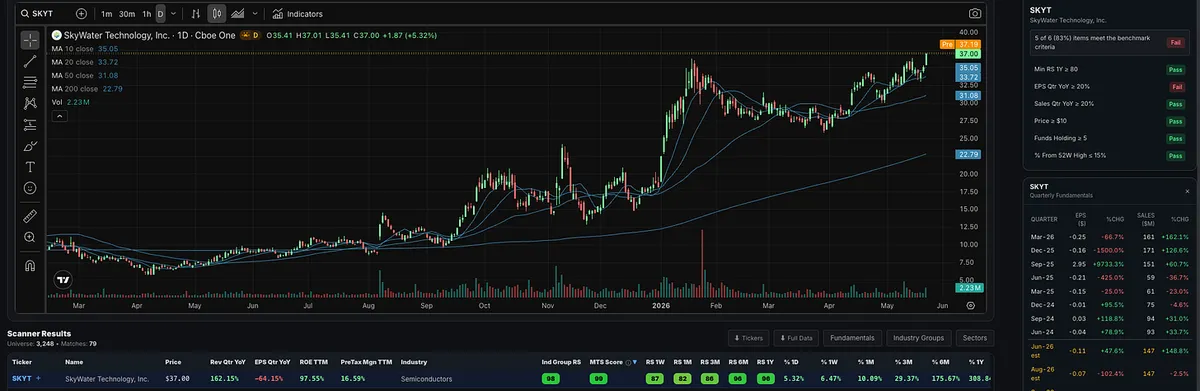
SKYT is not a perfect name, but the VCP action made me take a deeper look.

The earnings are not great. Last quarter was still negative, although it did improve from the prior quarter, and estimates look better going forward.

Fund ownership also dropped almost 50% last quarter, which is not something I ignore.

But price is still king.

And when SKYT showed up on my scanner, the technical action stood out.

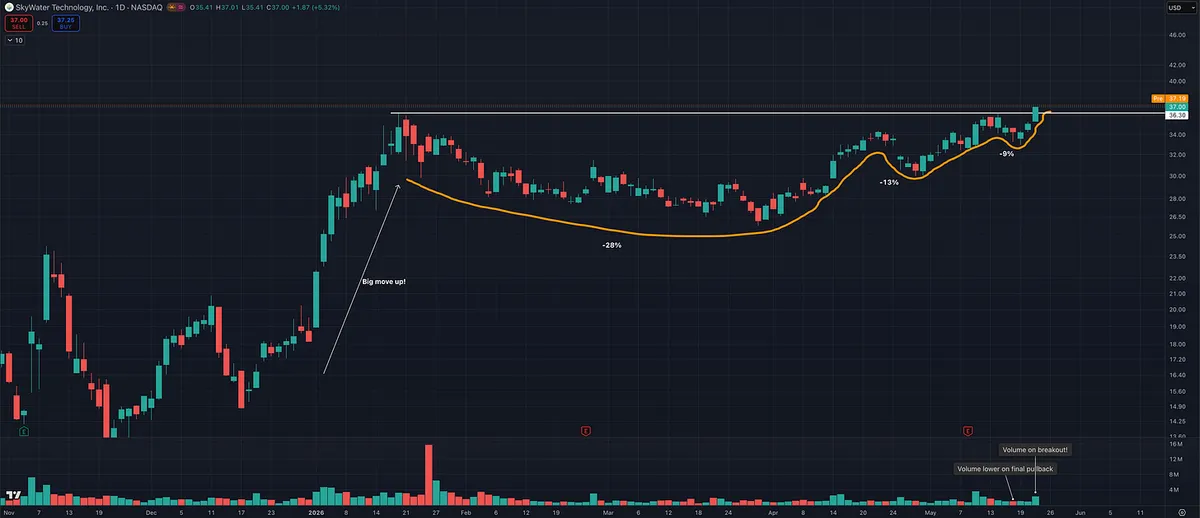
After a huge move of well over 100%, the stock started tightening up near its highs:

  • 28% pullback.

  • 13% pullback.

  • 9% pullback.

That is classic volatility contraction.

The final pullback came on lower volume, then volume came back in on the breakout to all-time highs.

That is exactly what you want to see.

Again, this is not a perfect name.

But it has strong ROE, decent margins, strong sales growth, exposure to a strong semiconductor group, and strong relative strength.

This is why I don’t look at one data point in isolation.

Price is still the final judge.

The best setups are rarely perfect.

Would I prioritize a name with better earnings and stronger fund ownership?

Absolutely.

But I also don’t ignore setups with strong price action, tight volatility contraction, and volume coming in at the right time.

View on Substack ↗

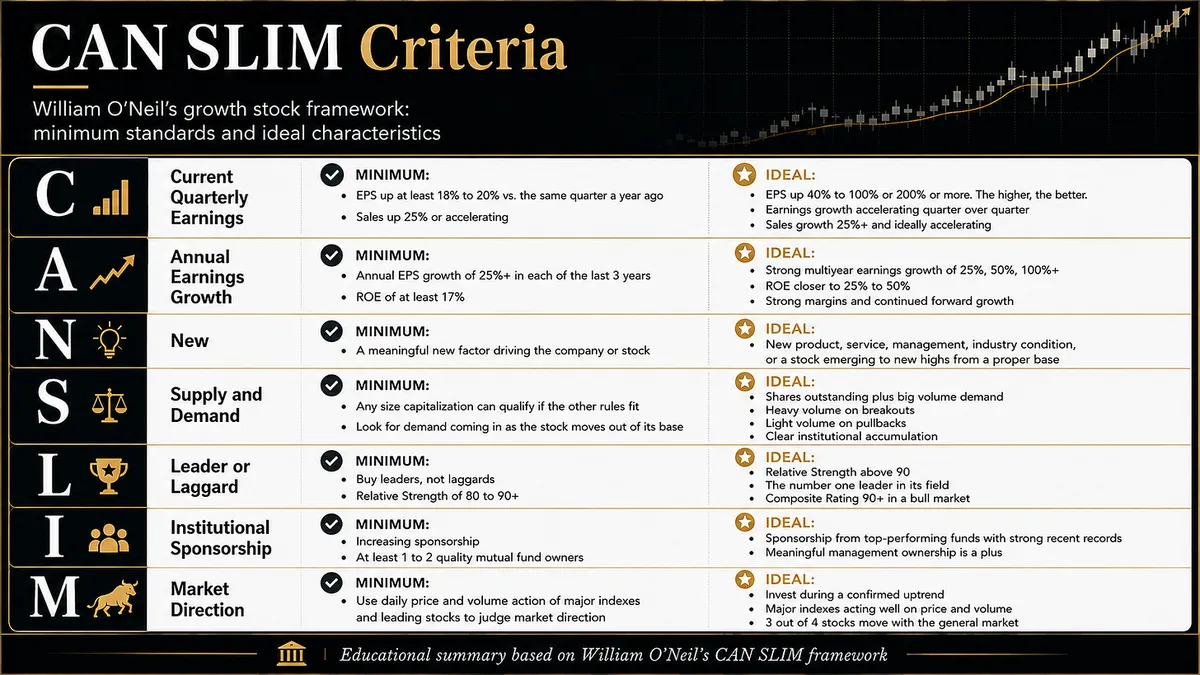
CAN SLIM is still one of the best frameworks for beginning momentum and growth stock traders.

A lot of traders want to start by creating their own system from scratch, but many of the greatest traders of the last few decades started by studying William O’Neil’s work.

There is a reason How to Make Money in Stocks has stood the test of time.

View on Substack ↗

Trading is one of the easiest hard things.

Like I’ve said before, trading is not rocket science.

The concepts are not that complicated. Cut your losses. Let your winners run. Trade with the trend. Manage risk. Focus on quality setups. Follow your rules.

Simple does not mean easy.

Statistically, most people still cannot do it because trading requires strength in multiple areas at the same time. You cannot just be good at finding stocks. You also have to manage risk. You cannot just build a great system. You also have to manage your emotions well enough to actually follow it.

That is where most traders break down.

They do not fail because the market is impossible to understand. They fail because they cannot stay disciplined long enough for their edge to play out.

And honestly, there are easier ways to make money in this world.

Making money from trading is great, but over time I think many serious traders realize the money is not the only reward. The challenge itself becomes part of the reward.

If trading were easy, I probably would not be as drawn to it.

I think a lot of good traders get into this game for the money, but eventually realize trading becomes something deeper. It forces you to become more disciplined, more patient, more self-aware, and more honest with yourself.

To become a better trader, you usually have to become a stronger person.

That is what makes the game so hard.

And that is also what makes it so rewarding.

View on Substack ↗

One of the BEST Trading Quotes of ALL TIME

Mark Weinstein said:

“Although the cheetah is the fastest animal in the world and can catch any animal on the plains, it will wait until it is absolutely sure it can catch its prey. It may hide in the bush for a week, waiting for just the right moment. It will wait for a baby antelope, and not just any baby antelope, but preferably one that is also sick or lame. Only then, when there is no chance it can lose its prey, does it attack. That, to me, is the epitome of professional trading.”

Be like the cheetah.

View on Substack ↗

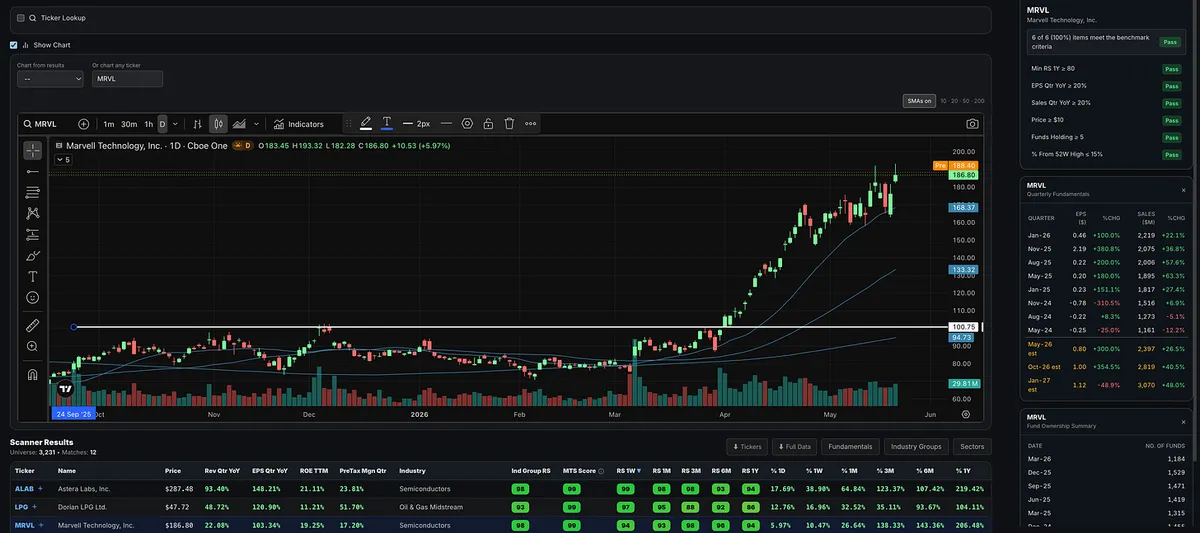
Look at MRVL.

This is what leadership looks like.

The stock has been showing a great deal of relative strength. Over the last week, it has held up extremely well and continues to trade near highs.

Fundamentally, it checks a lot of the boxes we want to see: strong earnings growth, good sales growth, good ROE, solid pre-tax margins, and it belongs to a strong industry group.

The relative strength is also very strong across multiple time frames, and it has been consistently outperforming.

View on Substack ↗

Losses Are Tuition, Not Failure

Tom Basso said:

“I realized that every time I had a loss, I needed to learn something from the experience and view the loss as tuition at the College of Trading. As long as you learn something from a loss, it’s not really a loss.”

That is one of the best ways to think about trading.

Losses are part of the business. You are not going to avoid them. The goal is not to never be wrong. The goal is to make sure every loss gives you information.

  • Was the setup poor?

  • Was your position size too large?

  • Did you ignore your stop?

  • Did you buy too extended?

  • Did you trade in the wrong market environment?

  • Did you follow your plan and simply take a normal loss?

If losses are inevitable, at least gain something from them.

A disciplined loss that follows your process is just the cost of doing business. An undisciplined loss is tuition and an opportunity to learn something.

The real danger is not losing money on a trade.

The real danger is paying tuition over and over again and never learning the lesson.

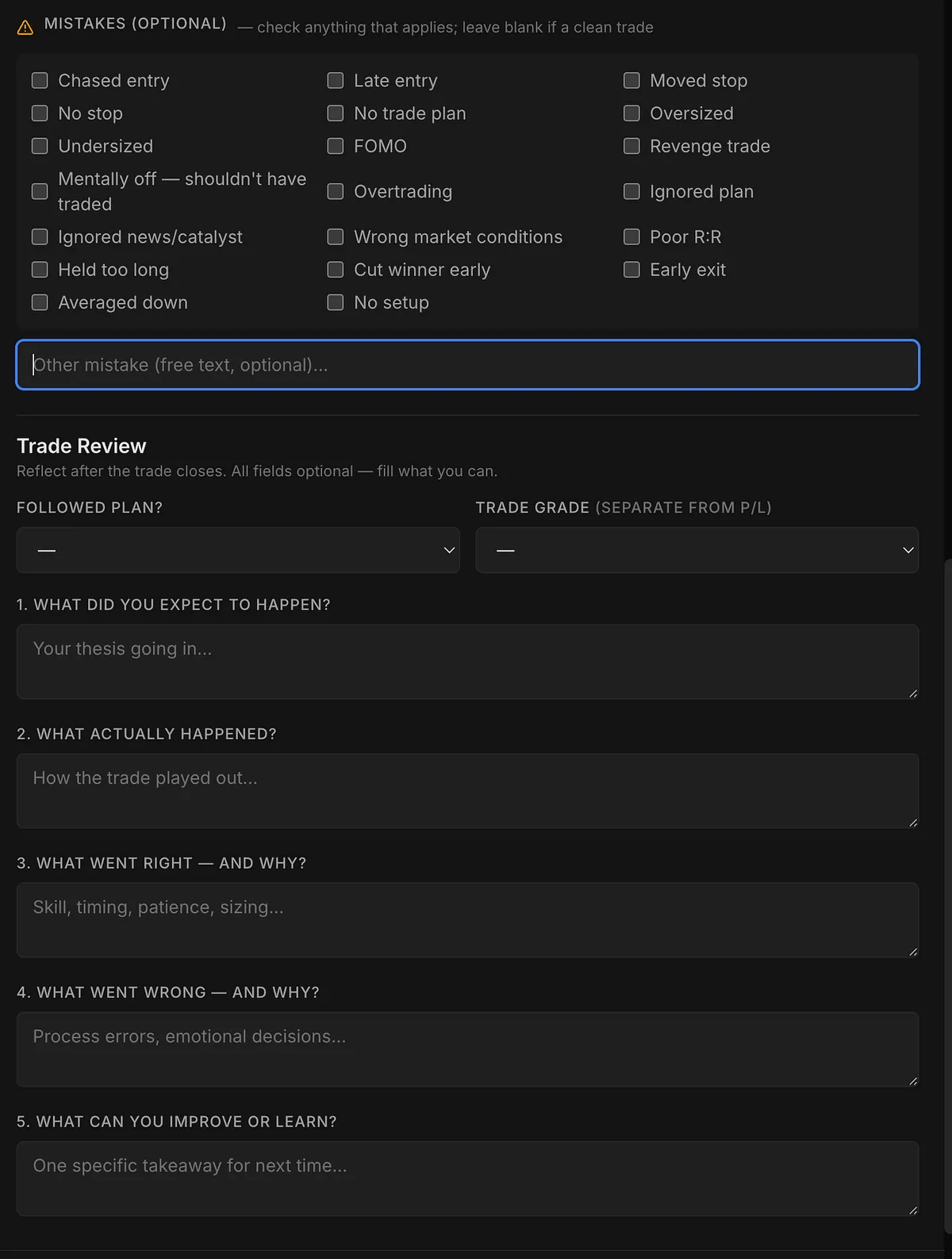
That’s why I track mistakes inside the trade journal tool in the Momentum Trading Strategy Web App. The goal is not just to record trades. The goal is to identify patterns in your own behavior so the same mistake does not keep showing up again and again.

The real issue is not losing money on a trade.

The real issue is paying tuition over and over again and never learning the lesson. Start tracking your mistakes like we do inside the trade journal tool in the Momentum Trading Strategy Web App.