
Trading articles/Your Trading Strategy Isn’t Broken: Your Discipline Score Is
May 11, 2026 · Momentum Trading Strategy
Your Trading Strategy Isn’t Broken: Your Discipline Score Is
Dr. Van Tharp’s 95% rule for trading discipline, mistake tracking, and why most traders never let their edge show up.
Originally published on Substack.
Most traders do not actually know if their strategy works.
They think they do.
But here is the uncomfortable question:
How many traders are actually reviewing, tracking, and measuring whether they followed their rules?
Not just looking back at one trade and saying, “That was good” or “That was bad.”
I mean actually tracking the data.
- How many trades were executed according to plan?
- How many were oversized?
- How many stops were moved?
- How many exits were emotional?
- How many losses came from the same repeated mistake?
Because if you are not tracking that, you may not be measuring your strategy at all.
You may be measuring your strategy mixed with fear, hesitation, boredom trades, oversized positions, early exits, late exits, skipped stops, revenge trades, and emotional decision-making.
That is a completely different system.
And that is where a lot of traders fool themselves.
They blame the setup.
They blame the market.
They blame the stock.
They blame the indicator.
But the real issue might be much simpler:
They are not following the strategy closely enough to know whether it actually works.
A Winning Trade Is Not Always a Good Trade
Dr. Van Tharp had a simple way to cut through this.
In Super Trader, he defined a trading mistake as not following your rules. He also made monitoring yourself and minimizing mistakes one of his five steps to consistent profits.
That changes everything.
- A good trade is not automatically a winning trade.
- A good trade is a trade where you followed your plan.
- A bad trade is not automatically a losing trade.
- A bad trade is a trade where you broke your rules.
That means you can make money on a bad trade, and you can lose money on a good trade.
That is hard for traders to accept because most traders judge themselves by the result of the last trade.
But the market does not reward you for feeling right on one trade.
It rewards you for executing a repeatable process over a large enough sample size.
The 95% Discipline Standard
In Trading Beyond the Matrix, Tharp discusses trader efficiency, which is calculated as the number of trades without mistakes divided by the total number of trades.
The benchmark he gives for Super Traders is 95% efficiency or better. In plain English, that means you can only make five mistakes every 100 trades.
That is a brutal standard.
But it is also the standard that exposes the real problem.
Plenty of traders are searching for a better setup, a better indicator, a better entry, or a better market call.
But the real question might be:
How many of your last 100 trades were actually good trades?
Not profitable trades.
Not exciting trades.
Not trades where the stock eventually went up.
Good trades.
Trades where you followed your process.
If that number is not close to 95%, you may not know whether your edge works yet.
You may only know what happens when your edge gets interrupted by inconsistency.
Most Traders Never Let Their Edge Show Up
A trader can have a real edge and still never experience the full benefit of that edge.
Why?
Because the edge keeps getting polluted.
- One trade is too big.
- One stop gets moved.
- One breakout gets chased.
- One loss turns into a revenge trade.
- One good setup gets skipped because the last trade hurt.
- One winning trade gets sold too early because the trader is afraid to give anything back.
Then, after 50 or 100 trades, the trader looks at the results and says:
“This strategy does not work.”
But was it really the strategy?
Or was it the strategy mixed with fear, ego, boredom, impatience, and rule-breaking?
Mistakes Are Measurable
Tharp’s point was not that traders need to be perfect.
The point was that mistakes can be measured.
And once they are measured, they can be reduced.
In Super Trader, Tharp gives an example of a trader whose mistakes cost him about 20% of his profits. He then asks the question every trader should ask:
What are your mistakes costing you?
That question should hit hard.
Because most traders think their biggest problem is finding better stocks.
But sometimes the bigger problem is much closer.
- The problem is the missed stop.
- The problem is the oversized position.
- The problem is buying against the higher timeframe trend.
- The problem is taking a trade outside the plan.
The Question Every Trader Should Ask After Every Trade
That is why I think every trader should track a discipline score.
After every trade, ask:
- Did I follow my entry rules?
- Did I size the position correctly?
- Did I honor my stop?
- Did I manage the trade according to the plan?
- Did I exit based on the system, not emotion?
- Did I review the trade honestly?
This is not about beating yourself up.
It is about separating process from outcome.
Because if you followed the plan and lost money, that may still be a good trade.
But if you broke your rules and made money, that may be one of the most dangerous trades you can take.
Why?
Because it rewards the wrong behavior.
And once your brain gets rewarded for breaking rules, it will want to do it again.
Your Brain Can Trick You. Your Journal Cannot.
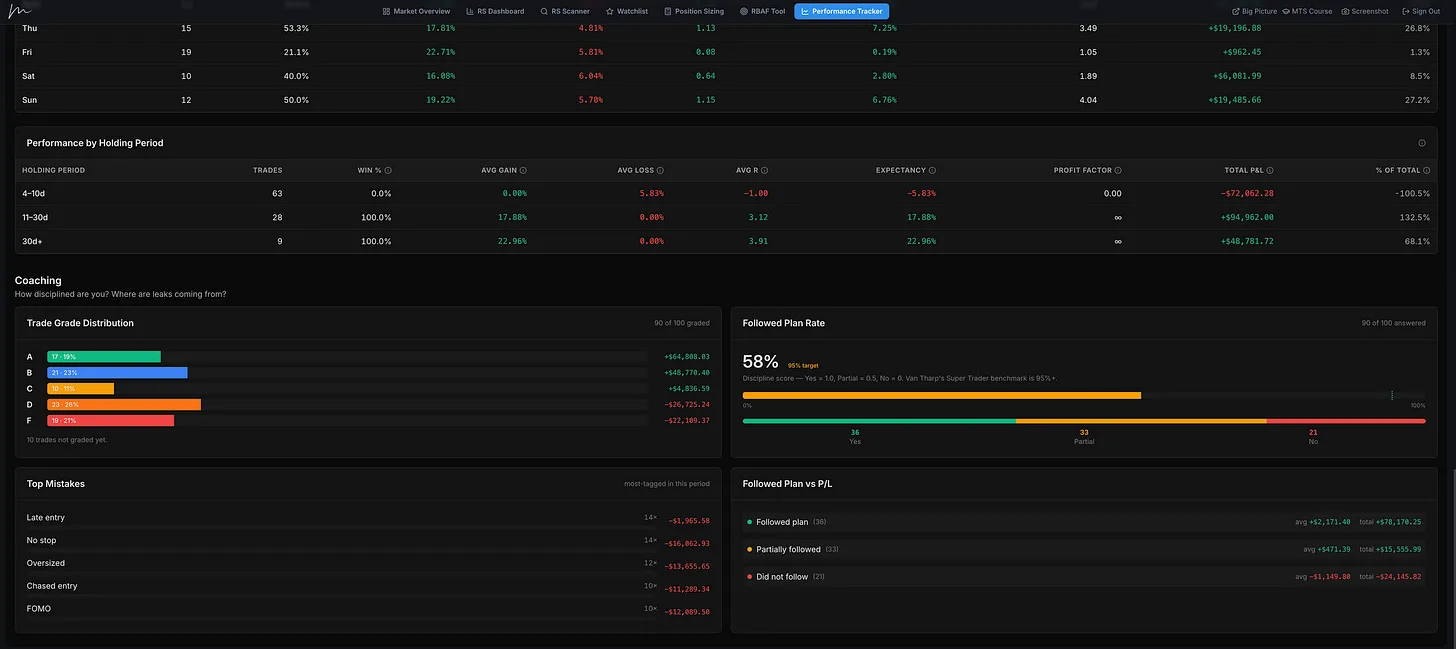
This is exactly why I built the Performance Tracker inside the Momentum Trading Strategy software.
When you journal each individual trade, the review process does not just ask whether the trade made money.
It forces you to grade the trade, label your mistakes, and track whether you actually followed your plan.
Then, inside the analytics section, you can see your most common mistakes, how your trades break down by A, B, C, D, and F grades, and how close or far you are from the kind of discipline score Tharp was talking about.
This level of analysis was eye-opening for me.
A few years back, during a difficult stretch in my own trading, I went back through my data and found something I could not fully see in the moment:
A large portion of my losing trades came from fighting the higher timeframe trend.
I thought I was aware of it.
But the data made it undeniable.
And that is the point.
Your brain can trick you in real time.
Your journal cannot.
When you track your trades honestly, the patterns become visible, the leaks become measurable, and the path to improvement becomes much clearer.
The Goal Is Not To Win Every Trade
The goal is not to win every trade.
The goal is to become the kind of trader who can follow the plan long enough for the edge to show up.
Because the market does not just reward intelligence.
It rewards execution.
Your strategy might already have an edge.
But you may never see it until you stop breaking it.
Follow the strategy.
Track the mistakes.
Reduce the leaks.
That is how you give your strategy a fair chance to work.
More in Trading Psychology
All Trading Psychology articles →
Oct 27, 2026 · Trading Psychology
The Hidden Beliefs Sabotaging Your Trading
Why knowing the rules isn’t enough. Lessons from Van Tharp and Ed Seykota on trading psychology, self-sabotage, and changing the beliefs that hold you back.
- trading psychology
- Investing
- Trading
- Momentum Trading Strategy
- Market Wizards
Sep 1, 2026 · Trading Psychology
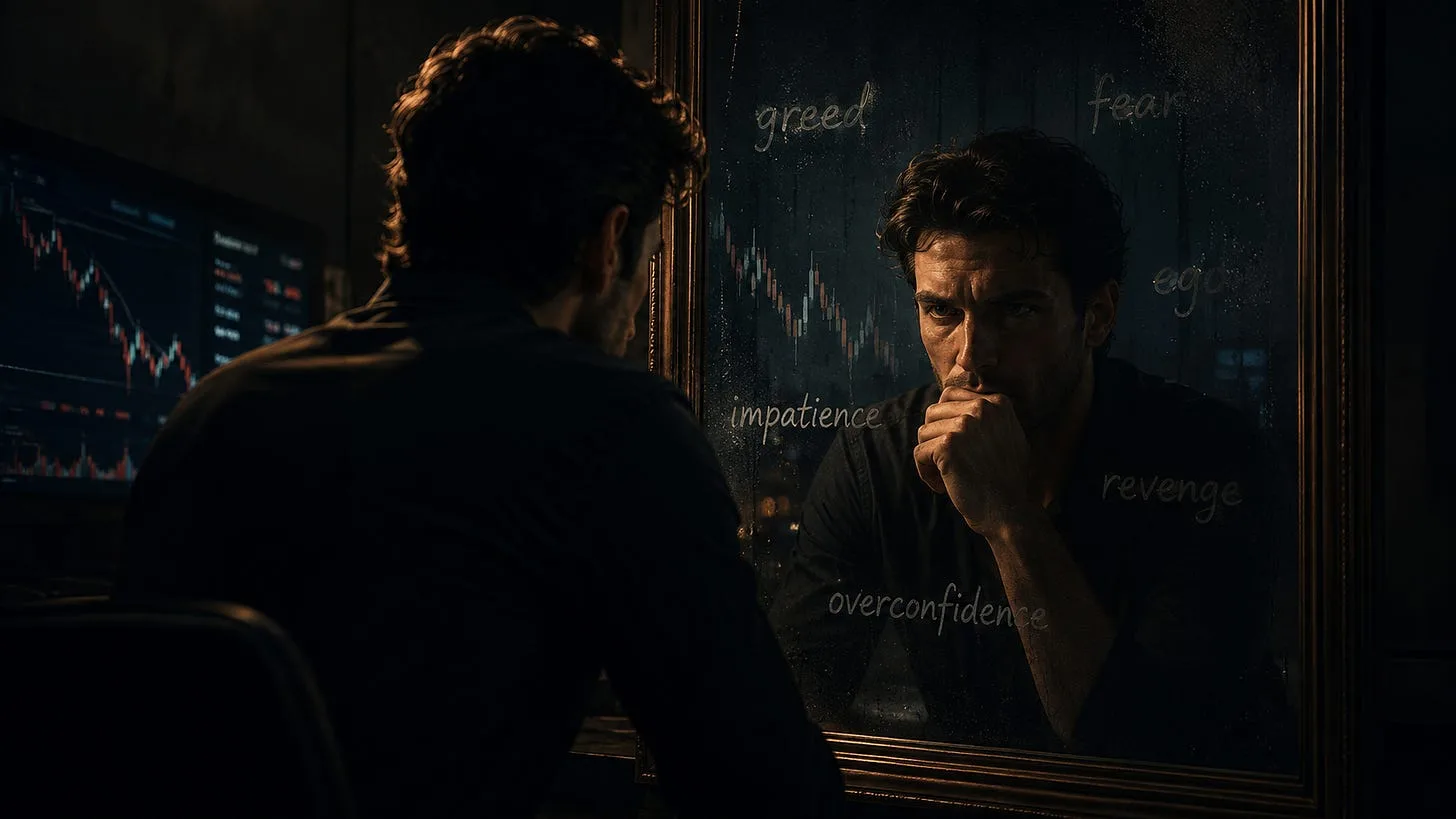
The Market Isn’t Your Biggest Opponent. You Are.
Why the greatest traders eventually discover that trading psychology, discipline, and self-mastery matter more than another setup, indicator, or strategy
- growth stocks
- Momentum Trading
- Learn Trading
- trading psychology
- Investing
- ed seykota
- position trading
- Peter Brandt

Aug 26, 2026 · Trading Psychology
Most Traders Fail. But That Statistic Doesn’t Tell the Whole Story
Why the failure rate in trading may say more about preparation, persistence, and process than your actual odds of success
- Momentum Trading
- Learn Trading
- CANSLIM
- Growth Stock Trading
- trading stocks
- growth stock investing