
Trading articles/The Hidden Beliefs Sabotaging Your Trading
Oct 27, 2026 · Momentum Trading Strategy
The Hidden Beliefs Sabotaging Your Trading
Why knowing the rules isn’t enough. Lessons from Van Tharp and Ed Seykota on trading psychology, self-sabotage, and changing the beliefs that hold you back.
Originally published on Substack.

You can spend thousands of hours studying charts, earnings, trading strategies, market history, and risk management, yet completely overlook one of the most powerful influences on your success: your own belief system.
“Win or lose, everybody gets what they want out of the market. Some people seem to like to lose, so they win by losing money.”
-Ed Seykota
That is an uncomfortable statement, but I believe it raises an important question: Are our actions actually aligned with what we say we want? A trader may say the goal is consistent profitability while repeatedly choosing the excitement of excessive risk over the discipline required to pursue that goal. This doesn’t mean every losing trade is self-sabotage or that people consciously want to fail, but when we repeatedly make decisions we know are working against us, we need to examine more than our trading strategy.
I would argue that examining our beliefs is one of the most under-appreciated areas of trading psychology, and potentially one of the most important. Traders will dedicate years to studying every conceivable aspect of the market, yet many will never seriously examine the beliefs influencing their decisions. They will search endlessly for a better strategy, a better indicator, or a better stock selection process without ever confronting the person responsible for executing those decisions.
In Trading Beyond the Matrix, Dr. Van K. Tharp explores how our beliefs shape our perception of reality, influence our decisions, and ultimately affect our results. It’s a subject I believe deserves considerably more attention, not only from traders but from anyone seeking greater success in business, relationships, or life.
And before some of you dismiss this as another exercise in positive thinking, I would encourage you to keep reading. There is considerably more to this than most people realize.
We Don’t See the World as It Actually Is
One of the most fascinating developments in our understanding of human perception is just how limited our experience of the world really is.
Consider the electromagnetic spectrum. The human eye can detect only a tiny portion of it, what we call visible light. Ultraviolet light, infrared radiation, radio waves, and X-rays all exist, yet we cannot see them with our eyes. Other animals can perceive portions of this spectrum that are completely invisible to us.
The same is true of sound. Human hearing is limited to a particular range of frequencies, while animals such as dogs and bats can detect sounds beyond our capabilities. Our senses provide us with only a fraction of the information that exists in our environment.
Even within those biological limitations, our brains are constantly filtering information. We selectively direct our attention, interpret what we experience, and fill in missing details based on prior knowledge and expectations. This filtering is essential because consciously processing every available stimulus would be overwhelming.
What we experience is not a complete representation of reality. It is a filtered interpretation of it.
Just as we have biological filters, we also develop psychological filters through our upbringing, culture, education, experiences, and the people who influence us. Over time, these experiences help create our belief systems, which shape how we interpret the world around us.
Some of those beliefs serve us extraordinarily well. Others can quietly undermine our decisions, relationships, happiness, and success for decades.
The troubling part is that most people never seriously question the beliefs they’ve developed. They simply accept them as reality.
Your Beliefs Influence What You See in the Market
Think about two traders looking at the exact same market.
One sees opportunity, while the other sees danger. One experiences a losing trade as useful feedback, while the other experiences it as a personal failure. One believes successful trading is a skill that can be developed through study, practice, and discipline, while the other believes the market is rigged, successful traders are simply lucky, or that they personally lack the ability to succeed.
The market hasn’t changed. The information available to both traders hasn’t changed. Yet their interpretation of that information, their emotional responses, and their subsequent decisions may be dramatically different.
Same market. Different beliefs. Different decisions. Potentially very different outcomes.
This is central to what Tharp is explaining. Our beliefs don’t simply influence how we interpret information. They also influence what information we notice, what we ignore, how we respond emotionally, and ultimately what actions we take.
Modern psychology has extensively documented mechanisms such as confirmation bias, selective attention, and the influence of expectations on behavior. We naturally tend to seek evidence that supports what we already believe, often without realizing we’re doing it.
Consider a trader who believes a particular stock is destined to become the next great market leader. That belief can cause the trader to focus almost exclusively on favorable earnings reports, optimistic analyst projections, and bullish technical signals while overlooking deteriorating price action, institutional selling, or weakness in the broader market.
The trader may believe they’re objectively analyzing the stock, when in reality they’re selectively interpreting information through an existing belief.
This is one reason I place so much emphasis on following the evidence of the market rather than becoming emotionally attached to a particular outcome.
The market doesn’t care what you believe. But what you believe can dramatically influence how you respond to the market.
The Beliefs You Inherited Are Not Necessarily the Beliefs You Should Keep
One of the most important lessons in Tharp’s work is that our beliefs are not permanent.
Just because you were raised to think a certain way doesn’t mean you must continue thinking that way. Just because you’ve spent your entire life seeing the glass as half-empty doesn’t mean you cannot learn to see it as half-full. And just because you’ve always considered yourself undisciplined, unsuccessful, or incapable of accomplishing something doesn’t mean that identity has to define your future.
Many people treat their beliefs almost as if they were inherited physical characteristics. They assume that being pessimistic, fearful, impatient, or lacking confidence is simply who they are. They rarely consider that much of their thinking developed through experiences and conditioning that can be examined and changed.
This doesn’t mean changing deeply ingrained beliefs is always easy. Some beliefs are connected to powerful emotions, painful experiences, or our fundamental sense of identity. Changing them can require substantial time, effort, and self-examination.
But difficult is not the same as impossible.
Tharp introduces what he calls the Belief Examination Paradigm. He encourages readers to identify their beliefs, question where those beliefs originated, examine how they influence their experiences, and determine whether they are actually useful.
That last question is particularly powerful.
Is this belief useful?
Not simply, “Is this what I’ve always believed?” Not, “Is this what my parents taught me?” Not, “Is this how I’ve always been?”
But whether that belief is helping you become the person and trader you want to be.
And if it isn’t, why continue holding on to it?
Tharp also discusses how beliefs exist at different levels, including beliefs about our environment, behavior, capabilities, values, and identity. A deeply rooted belief about who we are can influence many of the more superficial beliefs and behaviors built upon it.
For example, a trader who fundamentally believes, “I’m not capable of becoming successful,” may unconsciously approach setbacks very differently from someone who believes, “I can develop the skills necessary to succeed.”
Changing a trading rule may be relatively straightforward. Changing the underlying identity that repeatedly causes someone to violate that rule can be considerably more challenging.
Sometimes the problem isn’t that you don’t know what to do. It’s that your underlying beliefs keep interfering with your ability to do it.
Why Successful Entrepreneurs Have Long Understood This
I believe many successful entrepreneurs have understood the practical importance of beliefs and mindset for generations.
It’s one reason books such as Napoleon Hill’s Think and Grow Rich have remained influential for so long. It’s also why practices such as meditation, reflection, visualization, and gratitude have become part of the daily routines of many entrepreneurs and business leaders.
These practices aren’t magical formulas for success, and positive thinking certainly doesn’t guarantee a favorable outcome. Their potential value comes from helping people become more aware of their thoughts, regulate their emotional responses, maintain perspective, and approach challenges more constructively.
Consider the difference between someone who consistently views the world through a lens of scarcity and someone who approaches it through a lens of opportunity.
The first person may see competition as a threat, setbacks as confirmation of their limitations, and other people’s success as evidence that opportunities are disappearing. The second may see competition as proof that a market exists, setbacks as problems to solve, and successful people as examples from whom they can learn.
Neither person is guaranteed success, but their beliefs can influence the opportunities they pursue, the effort they invest, and how they respond when things become difficult.
The most effective optimists aren’t oblivious to the world’s problems. They simply refuse to build their entire worldview around them.
They understand that terrible things happen, that people can be dishonest, and that failure and disappointment are unavoidable parts of life. They also recognize that the world contains extraordinary opportunities, remarkable people, and possibilities that may not be immediately apparent.
They choose to believe that problems can be solved, skills can be developed, and circumstances can be improved. When they see someone else accomplish something extraordinary, their response isn’t necessarily jealousy or resentment. Instead, they may think, “If that person figured out how to do it, perhaps I can learn to do it too.”
That belief alone can dramatically change how someone approaches life.
And I would argue that this way of thinking is just as important in trading, if not more so.
Your Beliefs Can Undermine Even the Best Trading Strategy
Trading involves constant uncertainty, frequent disappointment, and repeated confrontation with your own mistakes. Unlike many other professions, you can make excellent decisions and still lose money, or make terrible decisions and temporarily be rewarded.
That environment can expose weaknesses in our thinking that might remain hidden elsewhere in life.
Consider how different beliefs can influence trading behavior.
If you believe being wrong makes you a failure, how difficult will it be to take a small loss? If you believe every losing streak means your strategy is broken, how likely are you to abandon a sound method at precisely the wrong time? If you believe successful traders never experience drawdowns, what happens when you inevitably experience one?
And if you believe you must always be right, how difficult will it be to accept what the market is telling you?
These aren’t simply philosophical questions. They can have direct consequences for position sizing, risk management, trade selection, and the ability to execute a strategy consistently.
Now consider the alternative.
A trader who believes losses are a normal cost of doing business may find it easier to follow predetermined risk rules. A trader who believes mistakes provide opportunities to learn may be more willing to review and correct them. A trader who believes patience is a competitive advantage may be less inclined to force trades when market conditions are unfavorable.
And a trader who genuinely believes protecting capital matters more than proving a prediction correct may find it easier to step aside when the evidence deteriorates.
These beliefs don’t guarantee profitability, but they can help create the psychological foundation necessary to execute a sound trading process consistently.
There’s also an important distinction between adopting positive beliefs and adopting useful beliefs.
A useful belief isn’t necessarily the most optimistic belief. It’s the belief that helps you respond effectively to reality.
Believing every trade will work is not useful. Believing you can follow your rules regardless of whether the next trade wins or loses is.
Believing the market owes you money is not useful. Believing you can improve through deliberate practice, honest evaluation, and disciplined execution is.
Believing a bear market cannot happen because you’re optimistic is not useful. Believing you can protect capital during difficult markets and remain prepared for the next opportunity is.
Successful trading requires confidence, but it also requires humility. It requires the willingness to pursue opportunities aggressively when conditions warrant it and the discipline to retreat when they don’t.
Your beliefs can either support those behaviors or work against them.
Self-Sabotage: When You Become Your Own Worst Enemy
One of the most troubling aspects of human behavior is how frequently people act against their own interests, even when they know better. We see it everywhere in life, and trading is certainly no exception.
Consider someone trying to lose weight who repeatedly makes unhealthy food choices despite knowing those choices undermine their goals. Or someone whose excessive alcohol consumption is damaging their health, relationships, or career, yet they continue the behavior. In the workplace, people sometimes repeatedly engage in behaviors that undermine their opportunities for advancement.
I’m not talking about enjoying an occasional drink with friends or indulging in dessert. Life is meant to be enjoyed, and there’s a difference between making a conscious choice to enjoy something in moderation and repeatedly engaging in behavior that causes meaningful harm.
I’m talking about destructive patterns that people recognize, regret, and then repeat anyway.
In trading, I’ve watched this play out in some of the most unforgiving ways imaginable. A trader spends months or years building an account, sometimes achieving impressive results, only to begin abandoning the very rules that helped create that success.
They start taking excessive risks, ignoring stops, overtrading, or allowing their emotions to dictate decisions. Eventually, they give back much of what they’ve earned, sometimes wiping out their account entirely.
Then they start over, rebuild their account, and repeat the same destructive cycle.
At some point, you have to ask whether the problem is really the trading strategy or something much deeper within the trader.
This is where the work Tharp discusses becomes especially relevant. Our beliefs about money, success, failure, self-worth, and even what we believe we deserve can influence our behavior in ways we don’t immediately recognize. Self-sabotage can also arise from ingrained habits, emotional reactions, and conflicting motivations, so it would be a mistake to assume every destructive pattern comes from a single limiting belief.
One of Tharp’s important distinctions is that we are not necessarily the thoughts that pass through our minds. Thoughts arise constantly, often without conscious intention. What matters is developing the awareness to recognize those thoughts without automatically identifying with them or acting upon them.
A trader might experience the urge to double down on a losing position, revenge trade after a loss, or increase risk dramatically after a winning streak. Having that thought or impulse isn’t necessarily the problem. The problem begins when the trader repeatedly allows those impulses to override sound judgment and established rules.
This is why examining our beliefs and developing greater self-awareness can be so valuable. It can help us recognize recurring behavioral patterns, understand what triggers them, and begin addressing the underlying causes rather than simply promising ourselves we’ll do better next time.
And sometimes those causes run considerably deeper than trading.
You can spend your entire career learning how to beat the market, only to discover that the person repeatedly defeating you is yourself.
Understanding why that happens, and doing the work necessary to change it, may be among the most valuable investments a trader can make.
Before You Dismiss This as Mental Weakness, Consider Something
I want to address something directly, particularly to the younger men reading this who may be inclined to dismiss this entire discussion.
Perhaps you’re thinking that examining your beliefs, practicing self-awareness, or working on your psychology is something for mentally weak people. Maybe you believe you’re already disciplined, competitive, and mentally tough enough that none of this applies to you.
I understand that reaction because, in my younger years, I likely would have thought the same thing.
I say this not from a place of ego, and certainly not to impress anyone, but because I hope my experience might cause someone to reconsider before dismissing something that could profoundly influence their future.
I was extremely competitive in sports growing up. Later, I served in the military, where I led soldiers in elite units, including in combat. I’ve experienced environments where discipline, mental toughness, leadership, and the ability to perform under pressure were not optional.
And I’m telling you that understanding my own beliefs and psychology has been an important part of my success in trading.
Mental toughness and self-awareness are not opposites. In fact, I would argue that genuine mental toughness requires the willingness to confront uncomfortable truths about yourself.
It’s relatively easy to project confidence, dismiss criticism, or convince yourself that you have everything figured out. It’s considerably harder to examine your weaknesses, acknowledge the beliefs that may be limiting you, and deliberately work to change them.
That requires humility, discipline, and a willingness to challenge your own ego.
The same qualities that can help someone perform under pressure can also become liabilities if they are accompanied by an unwillingness to admit mistakes or reconsider deeply held assumptions.
In trading, stubbornness can be financially devastating. An inability to accept being wrong can turn manageable losses into catastrophic ones. And the belief that asking questions or examining your psychology is a sign of weakness can prevent you from addressing the very issues holding you back.
There is nothing weak about understanding how your own mind works. The weakness is refusing to examine it because your ego won’t allow you to.
I wish I had understood the importance of this work earlier in life. That’s one reason I feel strongly enough about the subject to share it with others.
The Most Important Questions May Be the Ones You’re Not Asking
I would encourage every trader to dedicate some time to examining the beliefs they carry into the market. Not just their beliefs about stocks, economics, or trading strategies, but their beliefs about themselves.
Ask yourself why you feel the need to be right. Why does taking a loss bother you so much? Why do you feel compelled to trade when there is no opportunity? Why do you repeatedly abandon your rules or make the same mistakes, even when you know better?
Then go a little deeper.
Where did those beliefs originate? Were they developed through your own experiences, inherited from your upbringing, or reinforced by the people around you? Are they actually supported by evidence, or have you simply accepted them because you’ve believed them for so long?
Most importantly, are they useful?
Tharp’s framework provides a practical starting point for examining these questions. The goal isn’t to replace every negative thought with a positive one or convince yourself that everything will work out.
The goal is to recognize beliefs that may be limiting your effectiveness and deliberately develop more constructive ways of thinking and responding.
For some people, that process may involve journaling, meditation, structured self-reflection, or working with a qualified professional. Deeply ingrained beliefs, particularly those connected to powerful emotional experiences, may require more than simply deciding to think differently.
But the first step is recognizing that your current beliefs are not necessarily permanent truths.
They’re beliefs and beliefs can be examined, challenged, and changed.
The Work That Extends Far Beyond Trading
What I find especially compelling about this subject is that its implications extend well beyond financial markets.
The same beliefs that influence how you handle uncertainty, losses, discipline, and setbacks in trading often influence how you approach business, relationships, personal growth, and happiness.
Someone who believes every setback is evidence of personal failure may struggle not only in trading but in entrepreneurship and relationships. Someone who believes they have little control over their future may hesitate to pursue opportunities that could meaningfully improve their life.
Conversely, someone who develops the belief that they can learn, adapt, and improve may approach challenges with greater confidence and resilience.
This doesn’t mean we can control everything that happens to us. We cannot. Life contains circumstances, hardships, and events that are completely outside our control.
But we can often influence how we interpret those experiences, what meaning we assign to them, and how we choose to respond.
That distinction can have enormous consequences for both success and happiness.
You don’t have to remain the person your past experiences conditioned you to become.
You can challenge beliefs that no longer serve you. You can develop more useful ones. And over time, you can change how you respond to the world.
Final Thoughts: The Trader Behind the Strategy
Most traders will spend countless hours searching for the next great setup, indicator, trading system, or stock selection process. Far fewer will dedicate that same effort to understanding the person responsible for executing it. I believe that’s a tremendous mistake.
You can change your strategy, your indicators, your software, and even the markets you trade, but if you never examine the beliefs driving your decisions, you may continue repeating the same mistakes with every new approach you try.
This is why I place so much importance on the work Dr. Van Tharp discusses in Trading Beyond the Matrix. It’s not simply about becoming a more positive person or developing greater confidence. It’s about understanding how your mind interprets information, how your beliefs influence your behavior, and whether those beliefs are helping or hindering your ability to achieve your objectives.
Perhaps the greatest benefit of doing this work is that it doesn’t end when the market closes. The benefits can influence how you approach your family, your business, your relationships, and your overall happiness. You may begin this process hoping to become a better trader and discover that you’re becoming a better version of yourself in the process.
The market will always be outside your control. Your beliefs don’t have to be.
Maybe the next breakthrough in your trading won’t come from another book on technical analysis, another strategy or setup, or another thousand hours studying charts.
Maybe it will come from finally confronting the person looking at those charts.
More in Trading Psychology
All Trading Psychology articles →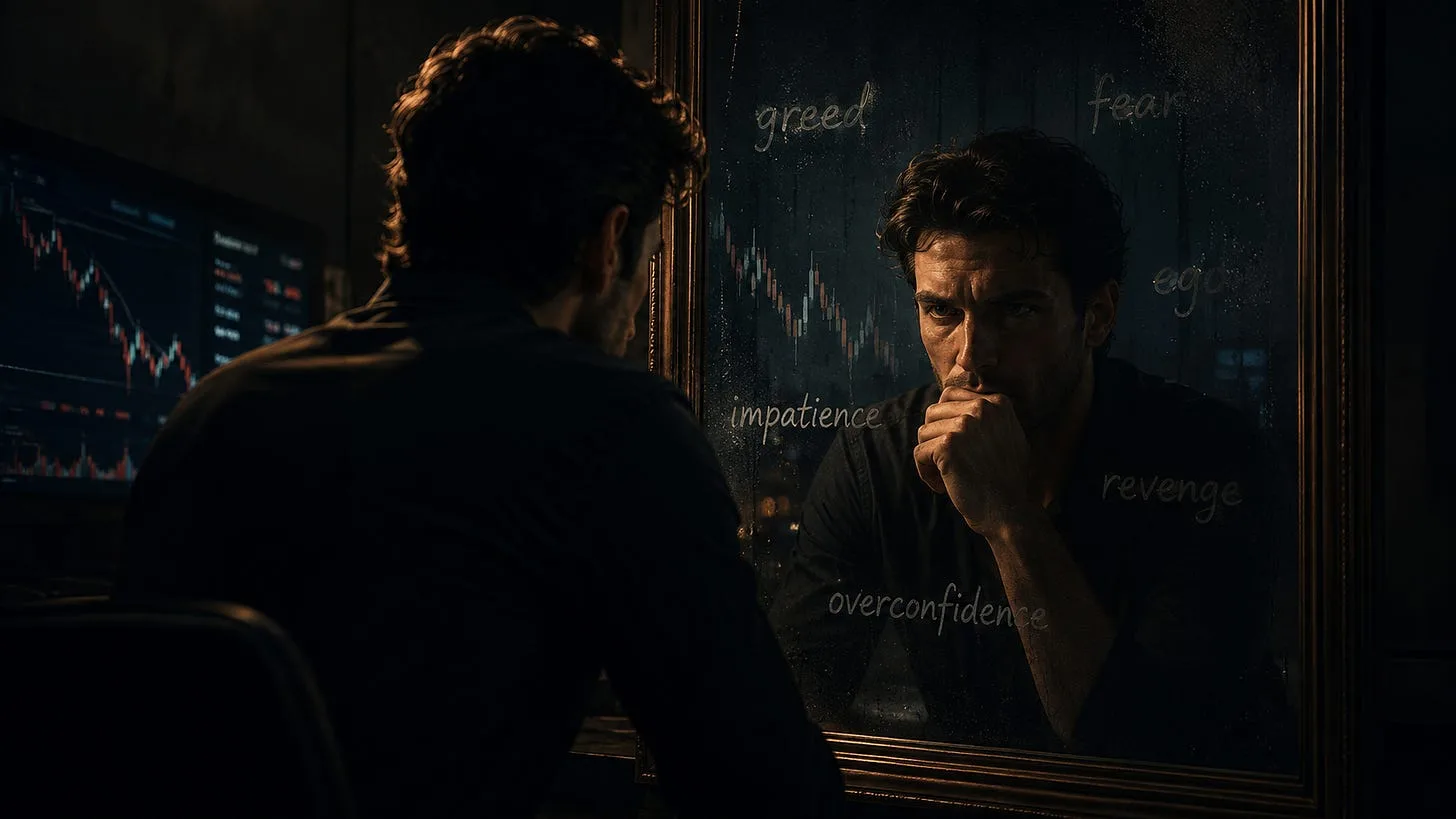
Sep 1, 2026 · Trading Psychology
The Market Isn’t Your Biggest Opponent. You Are.
Why the greatest traders eventually discover that trading psychology, discipline, and self-mastery matter more than another setup, indicator, or strategy
- growth stocks
- Momentum Trading
- Learn Trading
- trading psychology
- Investing
- ed seykota
- position trading
- Peter Brandt

Aug 26, 2026 · Trading Psychology
Most Traders Fail. But That Statistic Doesn’t Tell the Whole Story
Why the failure rate in trading may say more about preparation, persistence, and process than your actual odds of success
- Momentum Trading
- Learn Trading
- CANSLIM
- Growth Stock Trading
- trading stocks
- growth stock investing
Jul 18, 2026 · Trading Psychology
Strong Opinions, Weakly Held: The Mindset That Separates Great Traders and Investors from Everyone Else
Why the world's greatest traders and investors build high conviction, change their minds without hesitation, and never let an investment thesis become their identity.
- Investing
- CANSLIM
- Trading
- George Soros
- Tom Hougaard
- Stock Market
- William O'Neil
- Stanley Druckenmiller