
Trading articles/The Market Isn’t Your Biggest Opponent. You Are.
Sep 1, 2026 · Momentum Trading Strategy
The Market Isn’t Your Biggest Opponent. You Are.
Why the greatest traders eventually discover that trading psychology, discipline, and self-mastery matter more than another setup, indicator, or strategy
Originally published on Substack.
If your sole goal in trading is to make a lot of money, good luck. You are probably going to need it. And to be clear, it is completely okay if money is what attracted you to trading in the first place. That was part of what attracted me too.
But that is not what ultimately helped me make it, and it certainly is not why I stayed. Somewhere along the way, if you take this seriously enough, your relationship with trading begins to change. You start realizing that money is really just the scorecard. The deeper game is learning how to beat yourself.
That probably sounds strange to someone who is new to trading. We come into the market believing our job is to figure out stocks, charts, earnings, economic data, breakouts, trends, or whatever strategy we happen to trade. Naturally, we assume that becoming better at analyzing those things is what will eventually make us successful.
It matters, of course. You need a real strategy, an edge, proper risk management, and enough experience to know what you are doing. But eventually you discover something uncomfortable: knowing what to do and actually doing it are two completely different skills.
The Setup Usually Isn’t the Hardest Part
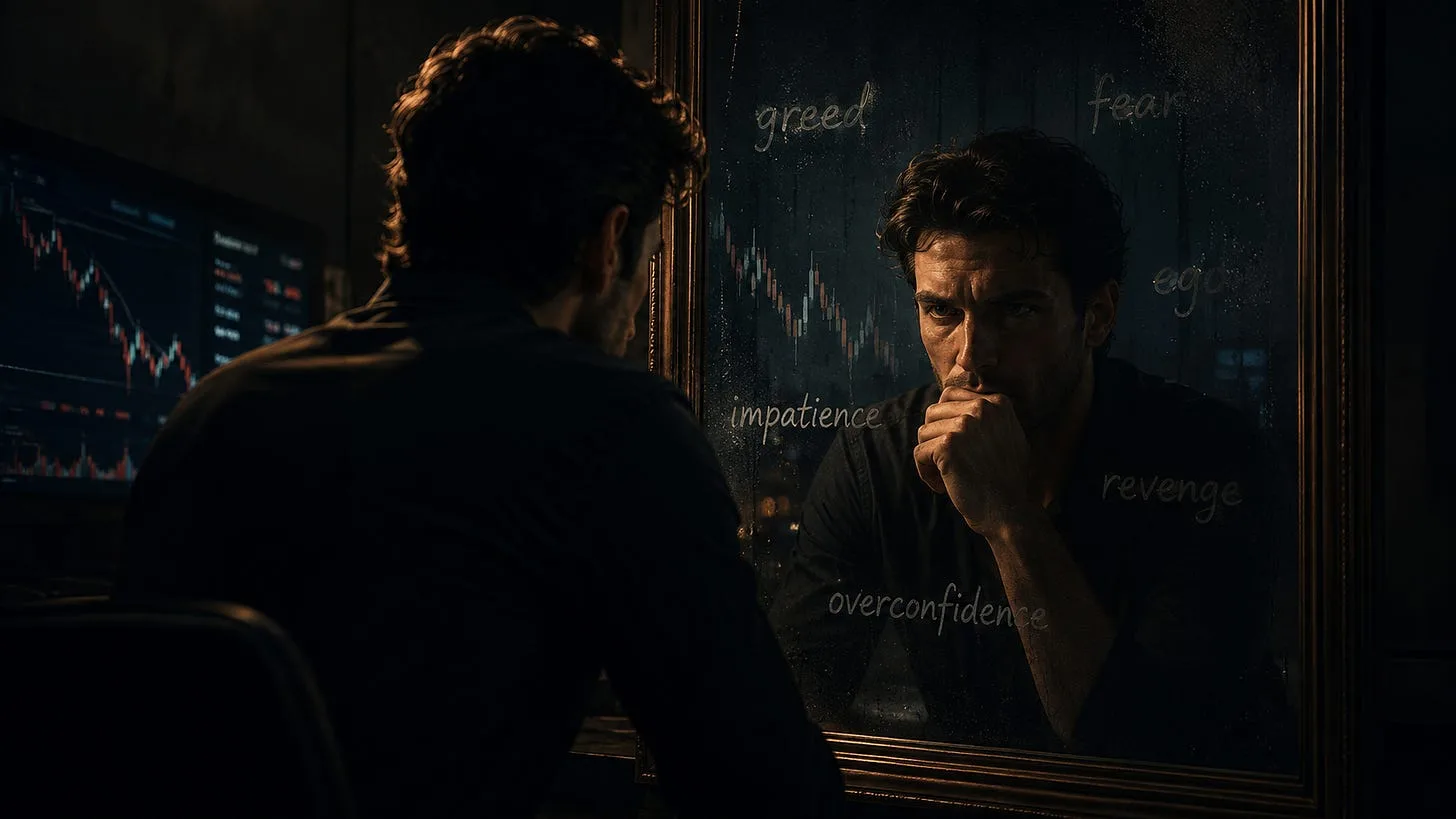
Finding a setup is often the easy part. The hard part is controlling the greed that makes you size too large after three winners in a row, or the fear that makes you sell your best stock because you cannot stand watching a profit fluctuate. It is the ego that prevents you from admitting you are wrong and the impatience that convinces you there must be something to trade today.
Then there is the urge to make money back after a loss. There is the temptation to abandon your system when it goes through a normal cold streak, and the overconfidence that quietly appears when everything you touch seems to work. None of those problems are solved by adding another moving average to your chart.
This is one of the reasons I think so many traders remain stuck despite consuming enormous amounts of trading education. They continue searching externally for something that will solve a problem that increasingly exists internally. Another scanner, indicator, setup, newsletter, or trading book may improve the system, but none of those things can force you to execute it properly.
At some point, every serious discretionary trader has to confront himself. You begin asking different questions. Instead of only asking, “What is the market doing?” you start asking, “What am I doing, and why am I doing it?”
Money Is the Scorecard, Not the Game
This idea appears repeatedly throughout Jack Schwager’s Market Wizards interviews. Tom Baldwin, one of the great floor traders featured in the original book, had an unusually detached attitude toward money. Schwager summarized Baldwin’s philosophy by explaining that money was essentially a means of keeping score, rather than something that should interfere with individual trading decisions.
That distinction is enormous. Once you begin translating every fluctuation into what that money could buy, pay for, or change in your life, the trade becomes emotionally loaded. You are no longer objectively managing a position according to your rules because you are now managing your feelings about the money.
That does not mean money is meaningless or that risk should be treated casually. In fact, the best traders tend to have an extraordinary respect for risk precisely because they understand what capital represents. The point is that money cannot be the emotional driver behind every decision you make.
Psychologist Dr. Van Tharp made the point even more forcefully in his Market Wizards interview. When describing beliefs he had observed among top traders, two stood out: “Money is NOT important” and “Trading is a game.” He then observed that many people approach trading primarily to make a lot of money, and that this obsession with money becomes one of the reasons they struggle.
Ed Seykota’s Uncomfortable Truth
Nobody explored this idea more deeply than Ed Seykota. One of his most famous statements from the original Market Wizards is also one of the strangest when you first hear it: “Win or lose, everybody gets what they want out of the market.”
At first glance, that sounds absurd. Why would anyone who blows up an account, repeatedly overtrades, or sabotages years of progress actually want that outcome? Seykota’s point was more subtle: human behavior can be driven by psychological needs and patterns we do not consciously recognize.
A trader may consciously say he wants consistent profitability while subconsciously craving excitement. Another may claim to value discipline while repeatedly finding reasons to ignore his rules. Someone else may become exceptionally successful and then suddenly begin trading recklessly because success itself has created discomfort, pressure, or overconfidence.
Seykota described traders who repeated these patterns even when they intellectually understood what they were doing wrong. That is what makes his observation so powerful. Sometimes the market is not exposing a weakness in your strategy. It is exposing something in you.
“I Am My Own Worst Enemy”
More than three decades after Seykota’s original interview, Peter Brandt made essentially the same discovery. When Schwager asked Brandt what he knew later in his career that he wished he had understood when he started, Brandt answered: “I am my own worst enemy.”
Brandt openly described himself as impulsive. He said his natural instincts could lead him astray and that if he simply stared at the screen and acted on those impulses, he believed he would eventually self-destruct. His solution was not to eliminate emotion from being human, but to build a disciplined process that prevented those emotions from controlling his execution.
That part is the key. Becoming a great trader does not necessarily mean becoming fearless, emotionless, or somehow psychologically perfect. It means becoming aware enough of your tendencies that you can create rules and processes that protect you from yourself.
Brandt’s experience also reminds us why trading plans matter so much. A plan is not merely a technical document containing entries, stops, and targets. A good trading process is a barrier between your strategy and the version of yourself that occasionally wants to abandon it.
What Feels Good Is Often Wrong
William Eckhardt, Richard Dennis’s longtime trading partner and one of the minds behind the famous Turtle experiment, expressed the problem another way. His observation was simple: “If you’re playing for emotional satisfaction, you’re bound to lose.”
That is because many of the behaviors that feel good in the moment are exactly what hurt us over time. Holding onto a loser can feel better than admitting we were wrong, taking a quick profit can feel safer than allowing a winner room to develop, and chasing a stock can temporarily eliminate the discomfort of feeling like we are missing out. None of those emotional rewards necessarily have anything to do with making good trading decisions.
The reverse is also true. Many correct trading decisions feel terrible when you make them. Cutting a stock you believed strongly in, sitting in cash while everyone else appears to be making money, buying strength when something feels “too high,” or taking the next valid setup after several consecutive losses can all be psychologically uncomfortable.
That is one of the great paradoxes of trading. The market constantly offers opportunities to trade for emotional relief instead of expected value. Developing as a trader means gradually learning to recognize the difference.
Why David Ryan Starts His Morning With the Bible
This is also why something David Ryan said years ago has always stuck with me. Ryan is one of the greatest growth-stock traders of his generation, a three-time U.S. Investing Championship winner who compounded extraordinary returns while working closely with William O’Neil. Yet when asked about the daily habits that helped keep his mind in the right state, Ryan did not begin his answer with charts.
He said his mornings begin by reading the Bible. Ryan explained that going over its values and principles helps put him in the right mindset and reduce the emotion that can lead to poor decisions. Only after that does he move on to the stocks he is monitoring.
Think about that for a moment. One of the greatest growth-stock traders was deliberately working on his state of mind before working on the market. In another interview, Ryan said that figuring yourself out and developing discipline are probably among the most important parts of trading.
Whether you read the Bible, other religious text, meditate, visualize, journal, exercise, review your trading rules, pray, walk, all of the above or simply spend time in quiet reflection is personal. The larger lesson is the same. The trader operating the strategy needs maintenance too.
The Market Gives You Nowhere to Hide
One of the fascinating things about trading is that the market provides brutally honest feedback. You can blame algorithms, market makers, institutions, news, manipulation, your broker, or bad luck, but eventually your equity curve reflects the sum of your decisions. That does not mean every loss is your fault because losses are an unavoidable part of any legitimate trading strategy.
The important distinction is between a losing trade and a bad trade. A good trade can lose money if you followed a profitable methodology correctly, while a bad trade can make money because you violated your rules and happened to get lucky. Brandt emphasized exactly this, arguing that whether he followed his methodology mattered more than the outcome of any individual trade.
That shift in perspective changes everything. If profit is your only definition of success, you can accidentally reward terrible behavior whenever it happens to make money. If process becomes your standard, you start rewarding the behaviors that actually produce longevity.
This is why traders who survive long enough eventually become obsessed with process. Entries still matter, charts still matter, earnings still matter, and market conditions still matter. But none of those things matter very much if you cannot consistently execute what you already know.
Your Trading Eventually Becomes a Mirror
The longer you trade, the more the market begins reflecting your personality back at you. If you are impatient, trading will expose your impatience. If you need constant excitement, the market will eventually make you pay for that need.
If your ego cannot tolerate being wrong, losses can become much larger than they need to be. If you are naturally fearful, you may repeatedly sabotage your best opportunities precisely when you should be pressing your advantage. If you become complacent after success, a winning streak can quietly become the setup for your next drawdown.
This is why journaling can become so powerful. You are not simply recording entries and exits. You are identifying recurring behavioral patterns and learning what version of yourself tends to appear under different market and emotional conditions.
Some traders discover they become reckless after large wins. Others become timid after losses, overtrade when bored, abandon stops when emotionally attached to a stock, or increase size when they desperately want to make money quickly. Those patterns are every bit as real as the patterns appearing on the chart.
The Real Game Is Self-Mastery
Eventually, if you stay in this game long enough, you begin to understand what Seykota, Brandt, Eckhardt, Ryan, Baldwin, Tharp, and so many accomplished traders were pointing toward. The market matters enormously, but the market is not your biggest opponent.
You are.
For ALL traders (yes, even the systematic ones), but the discretionary trader especially, becoming a better trader eventually requires becoming better at understanding yourself. Your fear, greed, ego, impatience, need to be right, relationship with money, reaction to uncertainty, response to losing, and response to winning all become part of your trading system.
That is why I no longer look at trading as simply a money-making pursuit. Money matters, obviously, and there is nothing wrong with wanting to make a lot of it, but if money is the only thing you are chasing, I think you miss one of the greatest lessons this profession has to offer.
Trading is ultimately a journey of self-development.
You start out thinking you are going to master the market. Somewhere along the way, you discover that the real challenge is mastering yourself, and if you approach that challenge correctly, the person you have to become in order to succeed may ultimately be worth far more than the money you make along the way.
More in Trading Psychology
All Trading Psychology articles →
Oct 27, 2026 · Trading Psychology
The Hidden Beliefs Sabotaging Your Trading
Why knowing the rules isn’t enough. Lessons from Van Tharp and Ed Seykota on trading psychology, self-sabotage, and changing the beliefs that hold you back.
- trading psychology
- Investing
- Trading
- Momentum Trading Strategy
- Market Wizards
Aug 26, 2026 · Trading Psychology
Most Traders Fail. But That Statistic Doesn’t Tell the Whole Story
Why the failure rate in trading may say more about preparation, persistence, and process than your actual odds of success
- Momentum Trading
- Learn Trading
- CANSLIM
- Growth Stock Trading
- trading stocks
- growth stock investing
Jul 18, 2026 · Trading Psychology
Strong Opinions, Weakly Held: The Mindset That Separates Great Traders and Investors from Everyone Else
Why the world's greatest traders and investors build high conviction, change their minds without hesitation, and never let an investment thesis become their identity.
- Investing
- CANSLIM
- Trading
- George Soros
- Tom Hougaard
- Stock Market
- William O'Neil
- Stanley Druckenmiller