Momentum Trading Strategy

Notes

Short lessons on momentum trading, every day.

Every note from Substack, in one place: risk, setups, leading stocks, market conditions and the mindset behind them. Search them, browse by topic, or filter by stock.

Showing 321–340 of 1222 notes

View on Substack ↗

This Is One of My Favorite Price Patterns to Watch

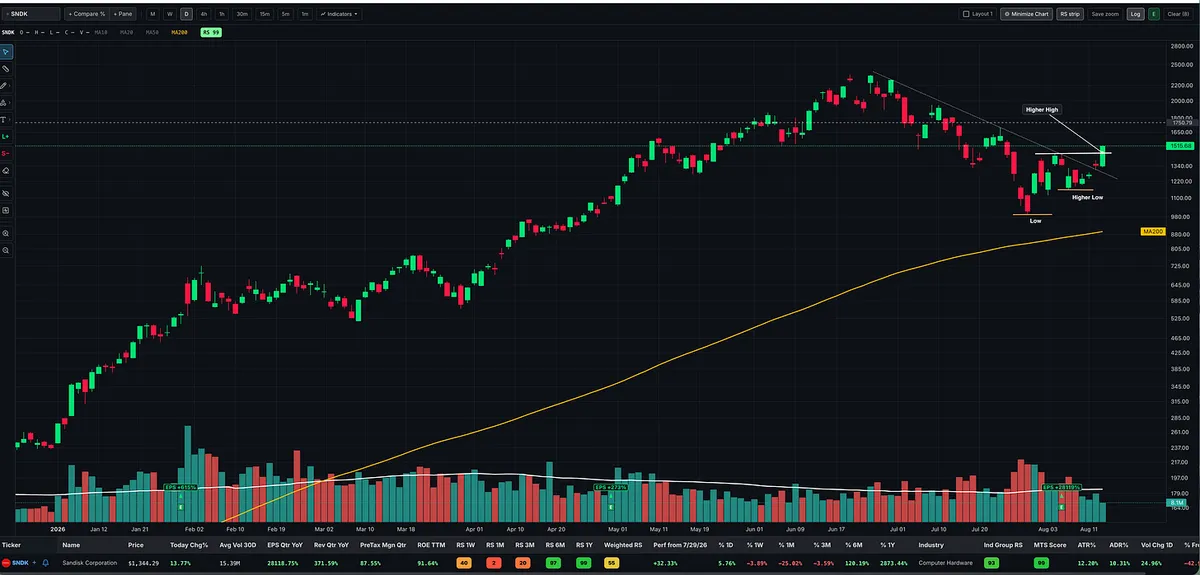
SNDK is showing up near the top of today’s market mover scan.

Big earnings growth. Big sales growth. Strong relative strength. And now the price action is starting to get interesting.

Look at the chart.

SNDK put in a low, rallied, pulled back without making a new low, and formed a higher low.

Today it pushed above the August 4 swing high, giving us the next higher high.

Higher low → Higher high.

This is one of my favorite patterns to watch because I’m not trying to guess the exact bottom. I want price to start showing me evidence that the trend may be changing.

There are still plenty of reasons to remain patient.

The stock is still below its 50-day moving average, and I would like to see more volume coming into the advance.

And this stock has a lot of work left to do.

From around current prices, SNDK would still need to climb more than 50% just to get back to its June highs.

So I’m not saying the stock is suddenly fixed or that it has to go back to the highs.

I’m simply saying:

This is the type of price action that gets my attention.

Strong fundamentals get the stock on my radar.

Price has to earn the trade.

View on Substack ↗

Sometimes You Just Need to Keep It Simple

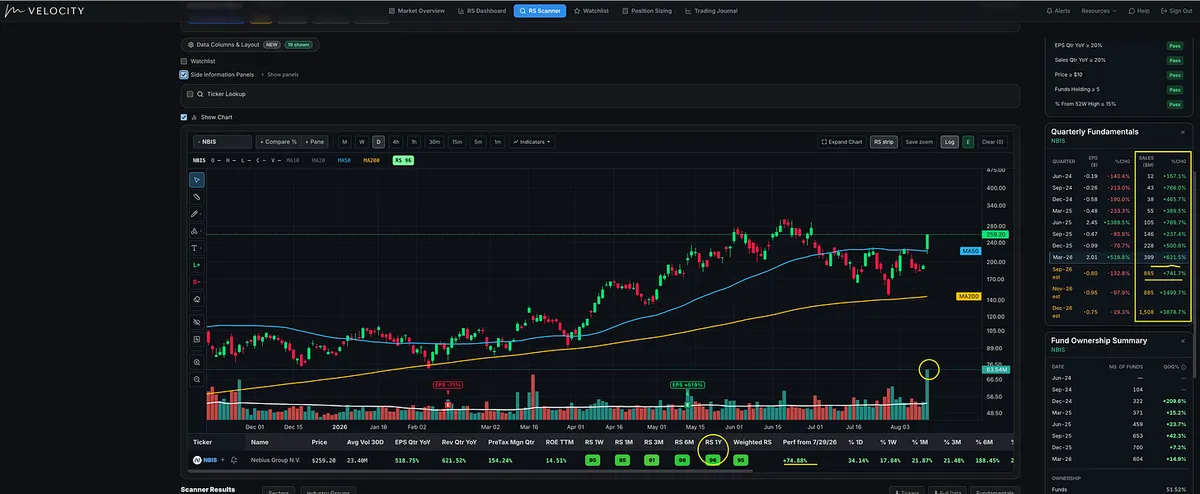
Look at the sales growth on NBIS.

It’s a high-relative-strength stock outperforming the major indexes and almost every stock in the market.

But why?

Quarter after quarter of triple-digit sales growth. And now look directly below it: fund ownership has been climbing dramatically right alongside it.

That’s not a coincidence.

We can make growth investing incredibly complicated with dozens of indicators, ratios, screens, and opinions.

But sometimes the question is much simpler:

If you’re looking for growth stocks, what tells you whether a company is actually growing?

Sales.

And not just one great quarter. You want rapid, sustained sales growth quarter after quarter.

NBIS has been putting up extraordinary numbers, with sales growth repeatedly running into the triple digits. At the same time, the number of funds owning the stock has climbed from roughly 100 to more than 800.

Institutions are noticing.

Sometimes the biggest opportunities are sitting right in front of us in the numbers.

Find the growth. Follow the strength. Then let price tell you when to act.

View on Substack ↗

What If Part of You Doesn’t Actually Want to Win?

This might be one of the most uncomfortable ideas in Market Wizards.

“Are you implying that some people actually want to lose on a subconscious level because it fulfills some other positive intention? How common is that?”

“Half the traders I work with have problems of this nature. I think it’s very common.”

—Dr. Van K. Tharp, Market Wizards

Tharp wasn’t saying traders consciously sit down and decide they want to lose.

He was describing internal conflict. You can consciously want to make money while another part of you wants excitement, wants to avoid failure, wants approval, wants to prove something, or is uncomfortable with the success you say you want. These competing motivations can operate subconsciously and create behaviors that sabotage your trading.

He gives the example of a trader who could consistently make about $75,000 a year, but whenever he became more successful, he would begin sabotaging himself. Tharp believed the trader had subconsciously associated greater success with becoming like his successful but alcoholic father. After working through that conflict, Tharp says the trader made $650,000 in roughly two months.

Think about how this might show up in trading.

You finally get momentum, then suddenly oversize. You abandon your rules after a winning streak. You turn a good trade into a gamble. You keep repeating a mistake you already know is a mistake.

Sometimes the next breakthrough isn’t another technical trading book.

Sometimes you need to figure out why you keep doing the things you already know you shouldn’t be doing.

View on Substack ↗

Why Would You Buy a Stock at New Highs?

“I want to buy it as soon as it goes to new highs.”

—David Ryan, Market Wizards, three-time U.S. Investing Champion and William O’Neil protégé

This is one of the hardest concepts for newer traders to understand.

A stock making new highs feels expensive.

So instead, people naturally want to buy the stock that is down 30%, 40%, or 50% because it looks “cheap.”

But growth stock traders like David Ryan learned to think differently.

A stock breaking into new highs is telling you something important: demand is strong enough to absorb all the available supply and push price into territory where virtually everyone who owns it is sitting on a profit.

There is no wall of trapped shareholders waiting to “get their money back” as price moves higher.

Of course, that doesn’t mean you blindly buy every stock making a new high.

You still want a company in a strong industry group with big earnings, big sales, strong relative strength, institutional accumulation, and excellent price and volume action.

But when all of those pieces come together, the new high isn’t something to fear.

It’s often the confirmation you’ve been waiting for.

The strongest stocks often won’t give you the comfortable pullback you’re waiting for. They break out to new highs and keep moving higher.

View on Substack ↗

The Most Important Rule of Trading

“The most important rule of trading is to play great defense, not great offense. Every day I assume every position I have is wrong. I know where my stop risk points are going to be. I do that so I can define my maximum possible drawdown. Hopefully, I spend the rest of the day enjoying positions that are going in my direction. If they are going against me, then I have a game plan for getting out.”

—Paul Tudor Jones, Market Wizards

Most traders spend far too much time thinking about how much they can make.

Great traders think first about how much they can lose.

That is the lesson here.

Before the upside matters, you should already know where you're wrong, where you're getting out, and how much damage that trade can do to your account.

Once the downside is defined, you’re free to let the market do the rest.

If the stock works, enjoy the ride and manage the winner.

If it doesn’t, there’s no panic, hoping, or negotiating with yourself. You already have a game plan.

Protect the downside first. The upside will take care of itself.

View on Substack ↗

Most Traders Will Notice AEHR After It Breaks Out

The real opportunity is learning to recognize the change before everyone else sees it

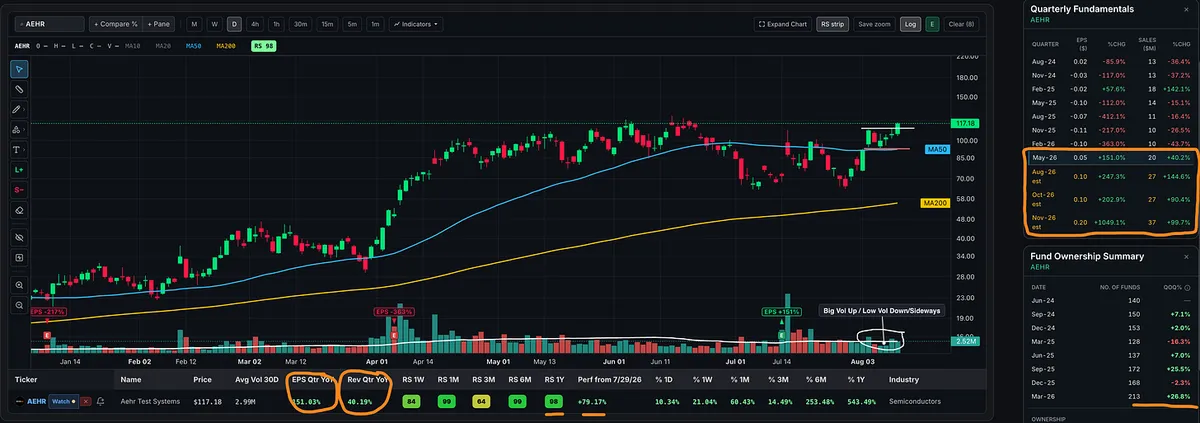
AEHR jumped another 10% today, but the move itself is not what has my attention.

This is starting to look like a textbook earnings and sales turnaround story. Earnings went from deeply negative growth to +151% last quarter, while sales accelerated to roughly +40%. More importantly, forward estimates continue to improve. That is exactly the type of fundamental change I want to see.

Institutional ownership is moving in the right direction too, with fund ownership increasing. At the same time, AEHR has surged off the July 29 lows, reclaimed its 50-day moving average, and is now pushing back toward all-time highs.

What makes this even more interesting is that many semiconductor charts are still damaged.

If the group continues to repair, AEHR is showing the characteristics of a stock that could emerge as one of the leaders. Semiconductors have taken the leadership role several times throughout this bull market going back to 2023, so I would not count out another run.

The biggest winners rarely wait until everything looks perfect.

Often, a handful of stocks begin separating themselves first. Fundamentals improve. Relative strength explodes. Institutions begin accumulating shares. Price starts acting differently.

Then everyone notices.

AEHR currently has an 1Yr RS Rating of 98.

This is exactly why I highlighted AEHR in this weekend's Big Picture Market Pulse.

View on Substack ↗

Everybody Wants the Profits Nobody Wants the Process

Everybody wants to make a lot of money in the market.

But very few people want to master the skills required to do it.

Chart reading. Price action. Supply and demand. Stock screening. Position sizing. Risk management. Psychology.

They don’t want to study hundreds of charts, review trades, learn from mistakes, build rules, and develop the discipline to follow them.

They want the profits without the process.

That’s why so many traders are constantly searching for shortcuts.

But there are no shortcuts.

At the same time, this is not rocket science.

You do not need to be the smartest person in the room. Your ability to execute a sound process with discipline matters far more than your ability to intellectually explain everything happening in the market.

A lot of market content is either fear driven or filled with sophisticated commentary that sounds impressive but does very little to make you a better trader.

Just scroll through and look.

The skills that matter are simpler:

Can you read price and volume?

Can you find strong stocks and proper setups?

Can you size positions correctly and control risk?

Can you cut losses?

Can you manage winners?

Can you follow your rules when your emotions are telling you not to?

The concepts are not that complicated.

Executing them consistently is the hard part.

Everybody wants the profits. Few are willing to master the process that produces them.

View on Substack ↗

The Market Can Go Much Higher Than You Think. And Much Lower Than You Can Imagine.

One of the most important trading skills I’ve developed over the years did not come naturally to me.

I had to force myself to learn it.

In Market Wizards, Jack Schwager asked legendary trader Bruce Kovner what separated him from the average trader.

Kovner said one of his greatest strengths was his ability to “imagine configurations of the world different from today” and actually believe they could happen.

That sounds simple.

It isn’t.

Most investors are anchored to what just happened.

After a correction, they remember the losses, the bad headlines, the economic problems and all the reasons the market supposedly shouldn’t go higher.

Then the market starts turning.

A follow-through day appears. Price begins moving powerfully higher. Leading stocks start reclaiming moving averages and breaking out of bases.

But people hesitate.

“How can the market possibly go higher from here?”

Then it goes higher.

The exact opposite happens during major declines.

A stock falls 30%, and people say it can’t possibly fall another 30%.

The market drops 20%, and suddenly everyone is calling it cheap.

They keep trying to decide where the market should stop instead of watching what the market is actually doing.

Then it keeps falling.

One of the biggest changes in my trading came when I started forcing myself to accept a simple truth:

Anything is possible.

That does not mean predicting crazy outcomes.

It means refusing to mentally eliminate them.

If my process tells me the market is improving, price is confirming it, and quality stocks are setting up, I want to be able to pull the trigger even when the prevailing narrative tells me the market has no business going higher.

And when distribution starts piling up, leaders begin breaking down and price starts telling me something is wrong, I want to be able to reduce exposure even while everyone around me is still euphoric.

Kovner described great traders as independent, extremely contrary and disciplined enough to take appropriate position sizes.

That mindset is important because the market does not care what seems reasonable.

It does not care what economists think fair value should be.

It does not care how far something has already risen or fallen.

Your job is not to decide what the market is going to do.

Your job is to recognize what it is doing, manage your risk and execute your process.

The moment you truly accept that the market can go much farther than you think possible, you stop trying to impose your opinion on it.

And you start listening to it.

View on Substack ↗

The Best Trading Advice I Ever Got Sounds Completely Backwards

Assume every trade is going to be a loser.

That sounds pessimistic, but it’s not. It’s one of the best pieces of advice I’ve ever received in trading.

You find a stock that checks every box.

Big earnings growth. Big sales growth. Strong margins or return on equity. High relative strength. A beautiful cup with handle. Then price starts breaking out through the handle on heavy volume.

Everything looks perfect.

Buy it.

But still assume the trade will fail.

Why?

Because when you assume the trade could be a loser, you stop trying to predict what happens next and start focusing on what you can actually control.

Your process.

You size the position correctly. You define your risk. You know where you’re wrong before you enter. You don’t overbet because you’re convinced “this is the one.” You don’t pile on too much leverage because the setup looks perfect.

And if it fails?

You already planned for that.

If it works?

Great. Now you manage the winner.

The aim is to make sure no single trade matters enough to hurt you when you’re wrong.

Such a simple mindset shift.

But it had an enormous impact on my trading.

View on Substack ↗

Is PLTR Making a Comeback?

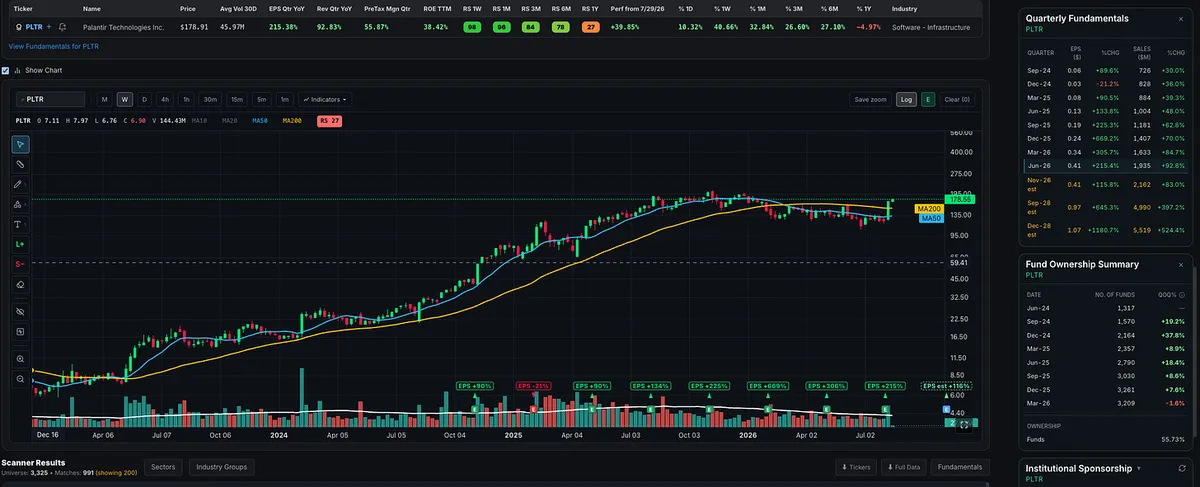
PLTR has been one of the great leaders of this bull market.

From 2023 through 2025, the stock gained more than 2,000%.

But since the fall of 2025, price started telling a different story.

PLTR eventually broke below both the 50-day and 200-day moving averages earlier this year. The earnings story remained strong, but when price breaks down, price is what we follow.

Now things are getting interesting again.

PLTR is back above its key moving averages, pushing back toward its highs, and forward estimates suggest earnings and sales growth may be accelerating again.

That combination has my attention.

The question now is whether PLTR can reestablish itself as a true market leader.

Definitely a name to watch.

View on Substack ↗

One of the Most Important Lessons I Learned From Mark Minervini

The market can look great.

Other traders can be making money.

IBD or your exposure models can all be telling you to get more aggressive.

But don’t forget progressive exposure.

This is one of the most important lessons I learned from Mark Minervini.

If you’re only 20% invested and you’re not finding success at 20%, what sense does it make to suddenly go to 40%, 60%, or 100% just because the market looks good?

Build exposure based on YOUR own success.

If your positions are working, add exposure.

If new buys are following through, add exposure.

If you’re gaining traction, get more aggressive.

But if things stop working, scale it back.

The market gives you information, but your own portfolio gives you information too.

You don’t need to match someone else’s exposure level.

You need to earn your way into higher exposure through your own results.

As things work, increase. As things stop working, decrease.

Simple concept. Incredibly important in practice.

View on Substack ↗

The Market Has Flipped the Switch. Now Comes the Hard Part.

The market gave us the signal we were waiting for.

✅ Follow-through day

✅ S&P 500 reached all-time highs last week

✅ Breadth expanded

✅ Major indexes back above key moving averages

But here’s where it gets interesting.

A strong index tape doesn’t automatically mean the next great growth-stock leaders have emerged.

Some of the biggest moves off the July 29 lows are coming from stocks that were previously crushed. Meanwhile, many former leaders are still technically damaged.

So I’m not interested in chasing everything that’s bouncing.

I’m looking for the stocks and industry groups showing real relative strength, strong growth fundamentals, and leadership as this new uptrend develops.

The market gave us the green light.

Now we have to figure out which stocks actually deserve our capital.

At the end of this week’s Big Picture Market Pulse, I shared 10 stocks across several different areas of the market that are standing out as potential leaders.

Full Big Picture breakdown below 👇

https://tradingmomentum.substack.com/p/the-market-just-gave-us-the-signal

On SubstackBig Picture Market Pulse | August 10, 2026: The Market Just Gave Us the Signal We Were Waiting For: Now Comes the Hard Part
View on Substack ↗

HPE Is Showing the Kind of Strength I Want to See

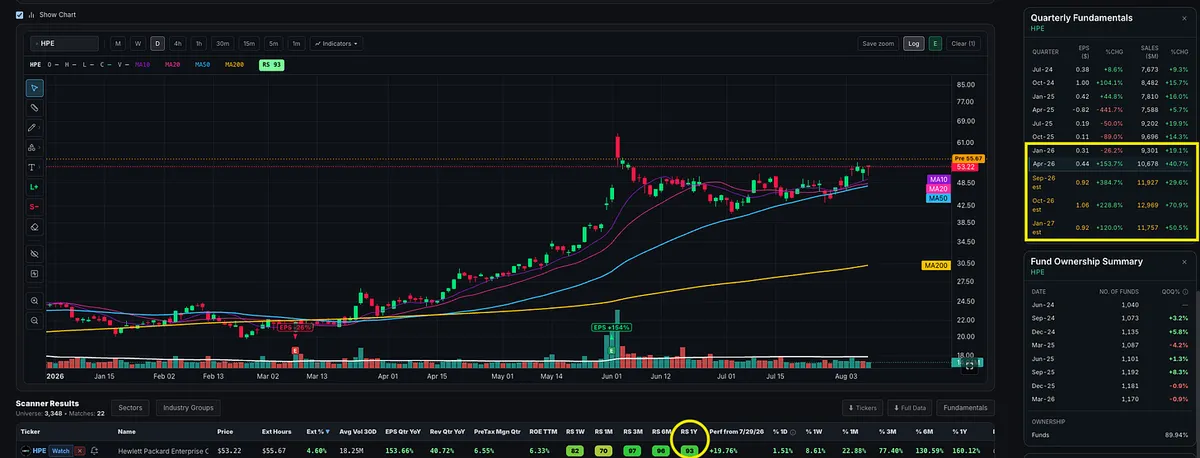
Besides DELL, HPE is another computer hardware name that has held up better than most of the group. It’s up about 4% premarket this morning and has a 93 RS Rating, along with a big improvement in both earnings and sales growth. Definitely one I’m keeping an eye on for continued relative strength.

View on Substack ↗

The Market Climbs a Wall of Worry

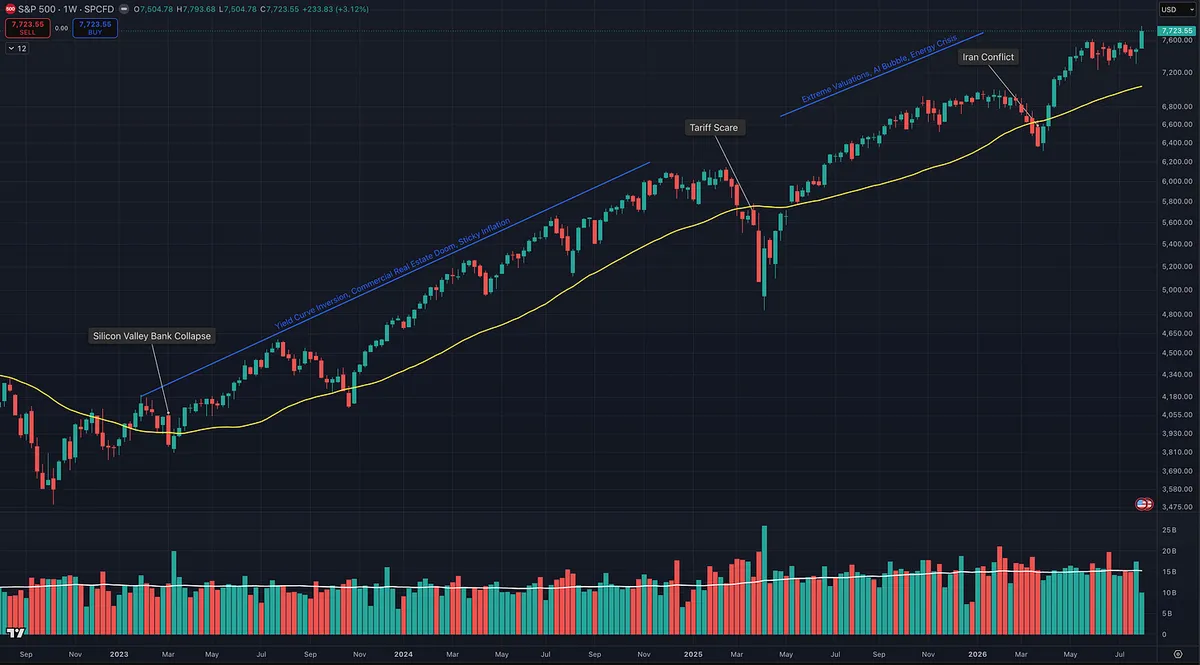
When we look back at this bull cycle, there has been no shortage of reasons to believe the market should not be going higher.

Silicon Valley Bank collapsed in March 2023.

Then came the deeply inverted yield curve, commercial real estate doom, sticky inflation, higher-for-longer interest rates, tariff fears, extreme valuations, the AI bubble narrative, the Iran conflict, and fears of an energy shock.

There have been a million reasons not to participate.

There have been a million reasons to short the market.

Yet it has consistently paid to stay optimistic.

The problem is not optimism.

Optimistic traders usually get destroyed because they fail to manage risk, position sizing, and leverage first.

On the other side, many bearish traders manage risk well but remain so negative that they fail to participate when the market continues moving higher.

The best approach is to combine both sides.

Manage your risk and position sizing first.

Then allow yourself to be an optimist when everyone else is convinced the end is near.

The market climbs a wall of worry.

The time to become truly cautious is when the worry disappears, everyone becomes euphoric, and nobody can imagine prices falling.

When there is no longer a wall of worry left to climb, that may be when the music is finally about to stop.

View on Substack ↗

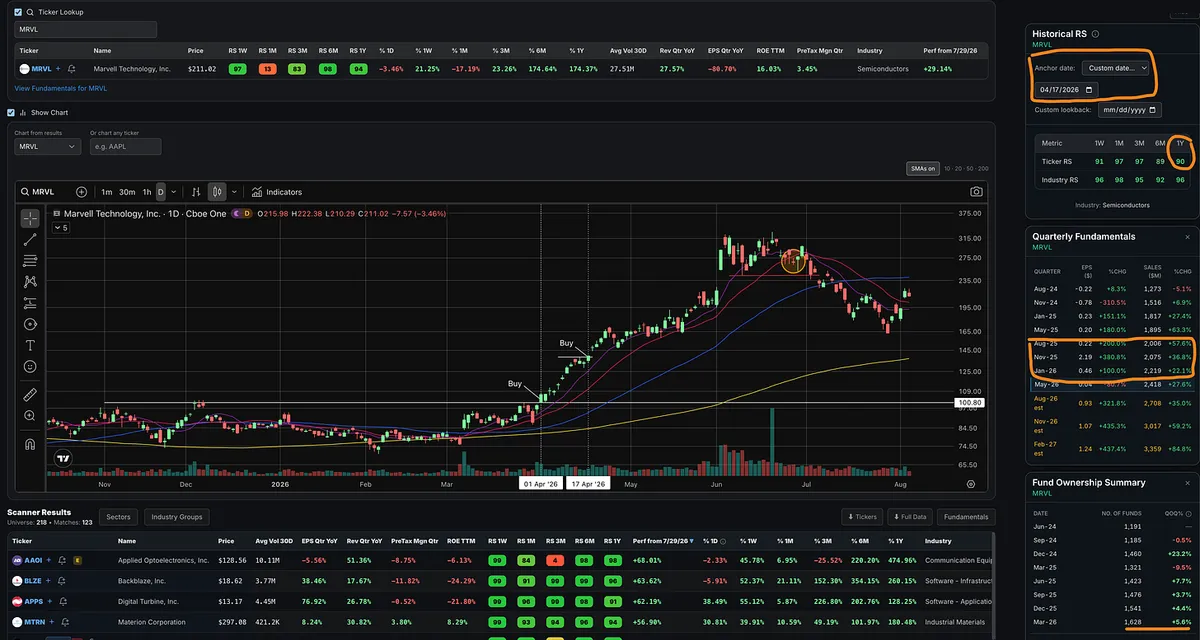
This Stock Had an 82 RS Rating Before It Ran 225%

One of the biggest misconceptions in momentum trading is that once a stock has a high Relative Strength rating, the move must already be over.

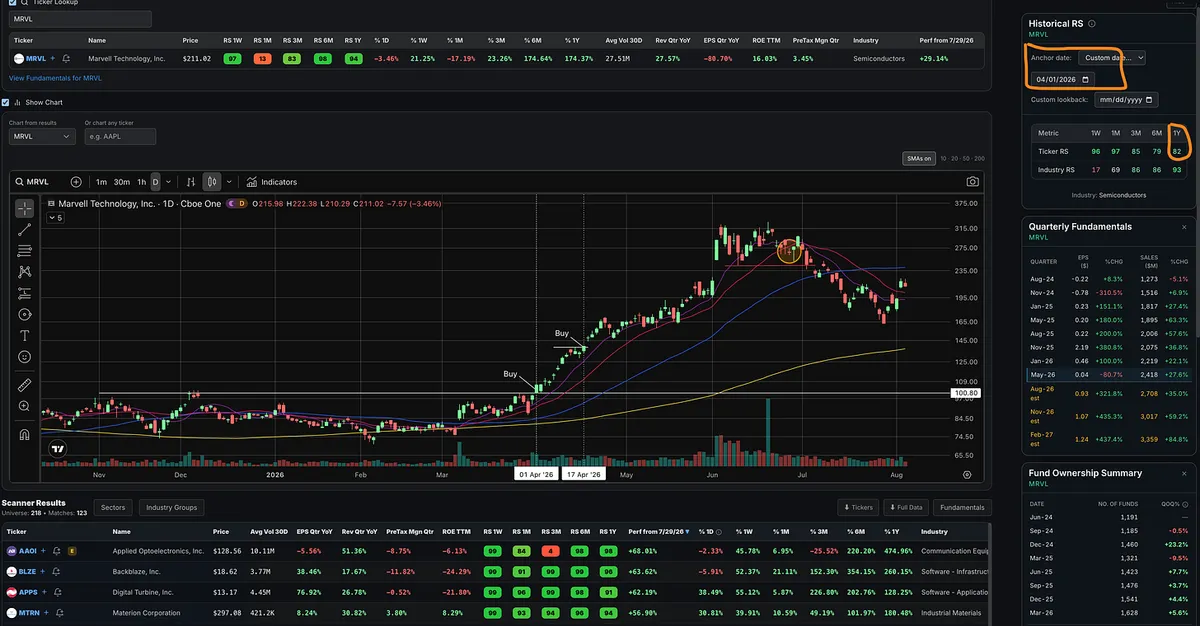
MRVL tells a very different story.

Back in April, the stock broke out of a six-month base. At the time of the breakout, its one-year RS rating was already 82.

If you missed the April 1 breakout on heavy volume into new highs, the stock offered another opportunity on April 17. It formed a tight area with a clearly defined level for placing a stop.

By then, its one-year RS rating had climbed to 90.

From the first entry, MRVL advanced roughly 225%.

From the second entry, it gained nearly 140%.

High relative strength did not mean the move was over.

It was evidence that the stock was already separating itself from the rest of the market.

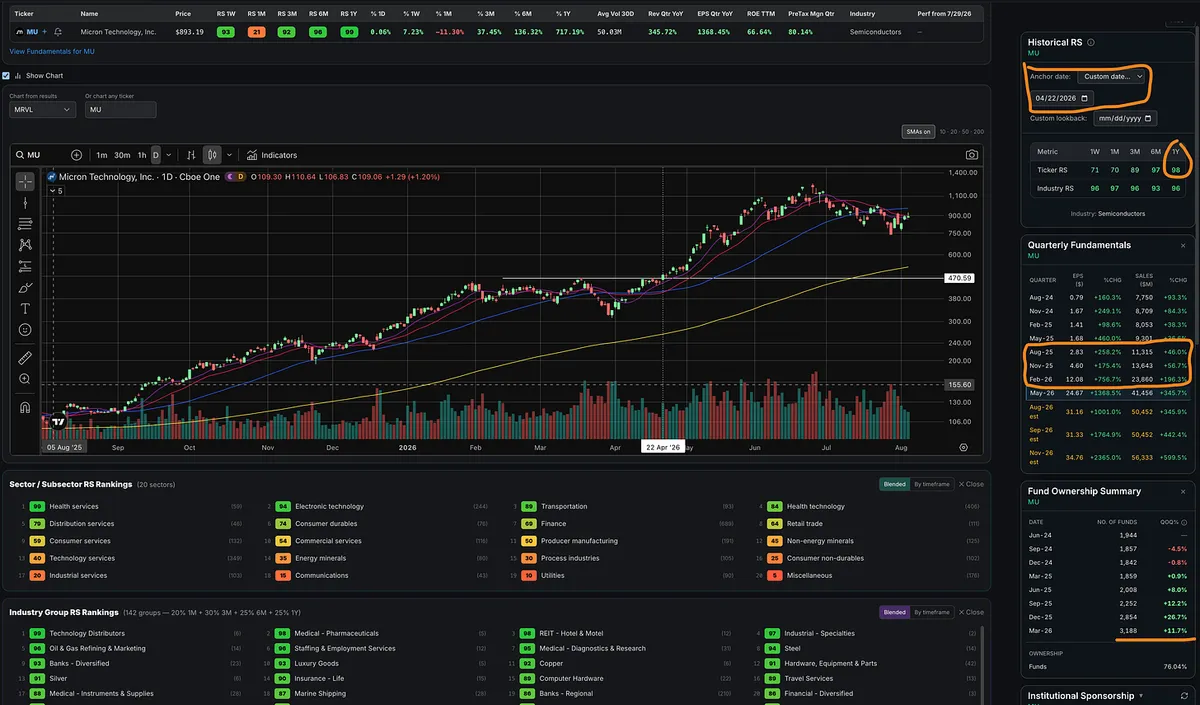
I have always tracked the RS ratings of stocks at the time I purchased them in my model books, but I wanted traders to be able to study this for themselves, so I created a Historical RS feature.

You can now select any previous date and see exactly what a stock’s Relative Strength rating was at that moment.

What you will discover is that many of the market’s biggest winners already had RS ratings of 80 or higher before their largest advances began.

MU provides an even more dramatic example.

When MU broke out on April 22, its one-year RS rating was already 98.

The stock went on to advance more than 160% from that point.

According to the argument that high RS means the move is already over, MU should have had almost no upside remaining.

The exact opposite happened.

This is not simply something William O’Neil wrote about in How to Make Money in Stocks.

You can go back and see the evidence for yourself.

High RS does not tell you the opportunity is over.

Sometimes, it tells you the real move is just beginning.

View on Substack ↗

The Best Traders Look Wrong All the Time

To every beginner who thinks they understand the market after making a few good calls, you probably do not know nearly as much as you think.

If the greatest traders showed you every trade, every idea, every market read, and every stop-out with 100% transparency, many of you would think they were terrible.

They are wrong far more often than most people realize.

Not just on individual trades, but on market direction, timing, themes, and ideas. Many are wrong more often than they are right.

The difference is that their systems already account for being wrong.

They remain successful because of their consistency, discipline, risk management, position sizing, and willingness to exit quickly when the market proves them wrong.

Mark Minervini recently shared that he was short the S&P 500. He was wrong, closed the position, and openly admitted it. That is not weakness. That is what professional trading looks like.

People also attack Michael Burry every time one of his calls is wrong, as though a single incorrect idea erases an entire career. I do not trade or invest the way he does, but I know traders who use similar asymmetric strategies and have been highly successful for decades with win rates near 20%.

They are wrong roughly 80% of the time and still produce exceptional returns because their losses are controlled while their winners can be enormous.

That is the point most beginners miss.

Your win rate means very little without understanding the size of your average win, the size of your average loss, and how consistently you execute your strategy.

Social media has trained people to judge traders by whether their latest opinion was correct. The market judges them by how they manage uncertainty across hundreds of decisions.

If your first reaction when a successful trader is wrong is to call them washed up, call them a fraud, or claim they have lost their edge, then you still do not understand how this game works.

You do not need to be right all the time.

You need to lose small when you are wrong, make significantly more when you are right, and repeat that process with discipline.

View on Substack ↗

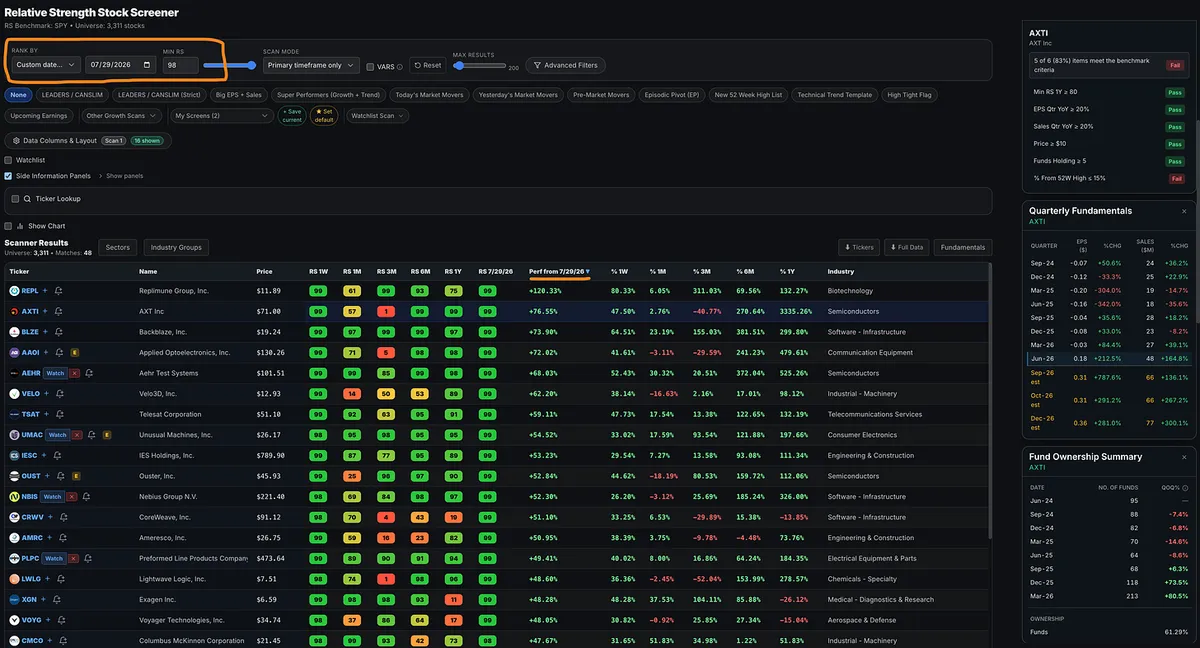
The Stocks Leading Since the July 29 Market Low

I ran a simple relative-strength screen anchored to the market low on July 29, 2026.

No earnings filters. No sales filters. No fundamental requirements. No industry bias.

The only requirement was a 98 or higher Relative Strength Rating since the low.

View on Substack ↗

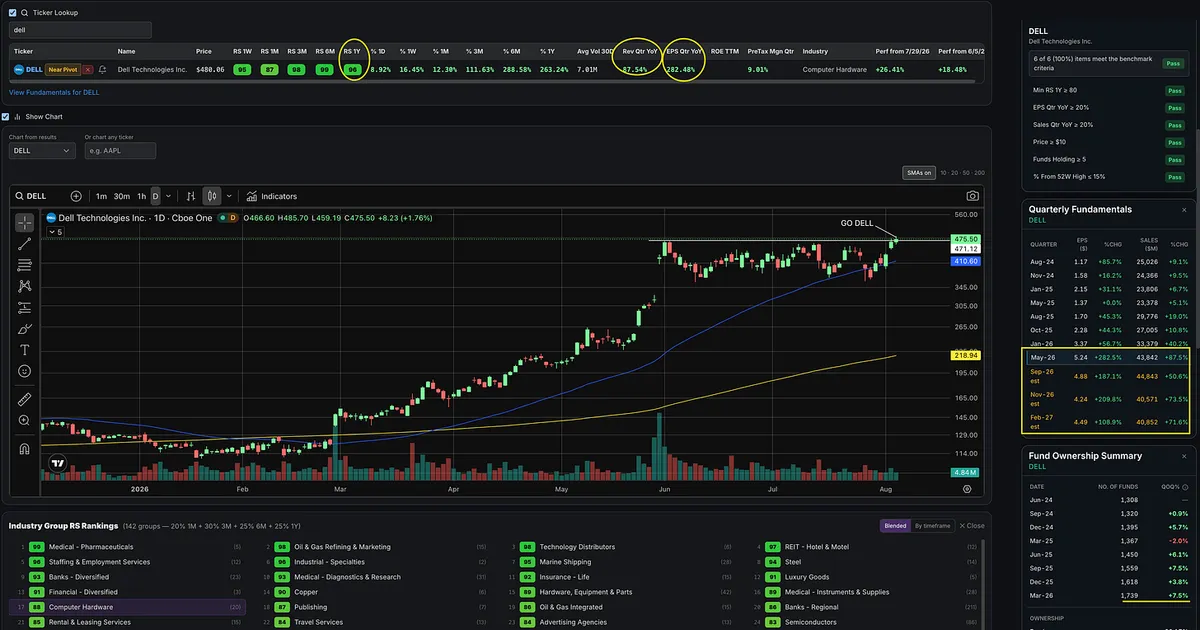
Let’s Go, Dell.

DELL is exactly the type of growth stock I want to trade.

Strong earnings. Strong sales. Strong relative strength.

DELL also showed clear relative strength during the recent market weakness, holding up far better than many of the stocks that led the prior advance.