Momentum Trading Strategy

Notes

Short lessons on momentum trading, every day.

Every note from Substack, in one place: risk, setups, leading stocks, market conditions and the mindset behind them. Search them, browse by topic, or filter by stock.

Showing 301–320 of 1222 notes

View on Substack ↗

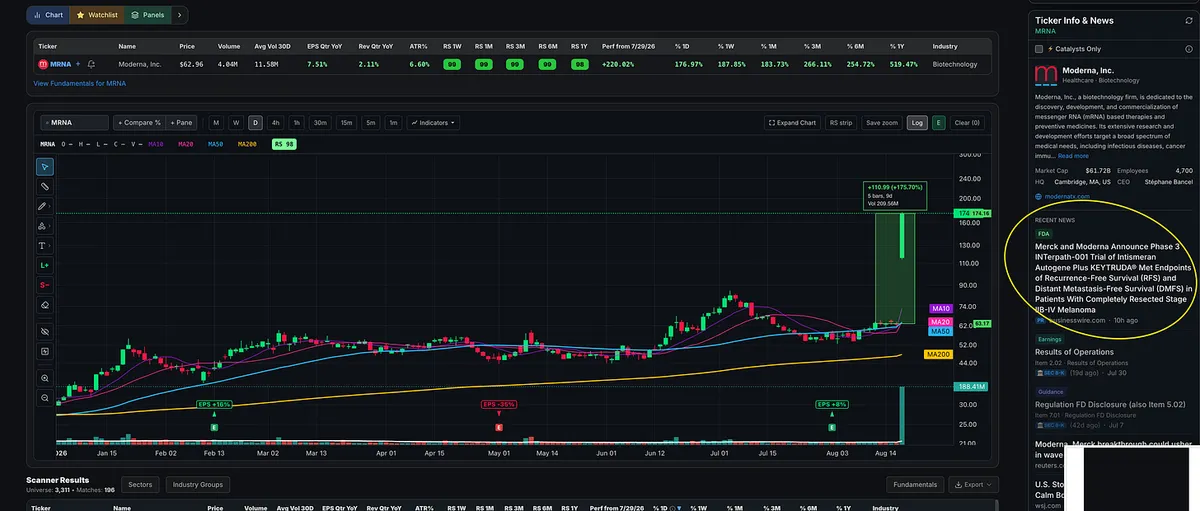
Holy $MRNA. What a gap and move today.

Most market news is bullshit. It either does nothing, or the headline gets written after the stock has already moved and everyone pretends it explains what happened.

But occasionally, a real catalyst hits and creates an opportunity for traders watching the news and tape in real time.

The news was already well known in premarket, but even if you waited for a 15-minute opening range breakout, you still could have captured a 20% to 30% move.

A more aggressive 5-minute opening range breakout offered close to 40% upside while risking roughly 6%.

That is about a 6R trade.

You didn’t need to predict the news or catch the initial gap. You just needed to recognize the unusual strength, define your risk, and execute.

View on Substack ↗

A 70% Win Rate Means Almost Nothing

Social media has trained traders to worship the wrong number:

Win rate.

Everyone wants the trader who is always right. The person who nails every call. The system with a 70%, 80%, or 90% win rate.

But then you read the Market Wizards books and discover something interesting.

Some of the greatest traders in history were wrong a lot. Many were wrong more often than they were right.

And they still made fortunes.

Why?

Because trading doesn’t pay you for being right.

It pays you for positive expectancy.

A trader can win 40% of the time, keep losses small, make 3R, 5R, or 10R on the big winners, and build an incredible track record.

Another trader can win 80% of the time, take tiny profits, refuse to cut losses, and eventually give it all back.

That’s why win rate by itself tells me almost nothing.

And I think the obsession with being right usually comes from something deeper.

Fear of losing. Fear of being wrong. Ego. Insecurity. The need for certainty.

The market doesn’t care about any of that.

Over a large enough sample of trades, your track record is the report card.

Stop trying to prove how often you’re right.

Learn how to lose small when you’re wrong and make enough when you’re right that being wrong doesn’t matter.

View on Substack ↗

Volatility Can Be Good or Bad. Know the Difference.

Volatility isn’t automatically bad.

Momentum traders need stocks that can move. But there’s a huge difference between volatility that creates opportunity and wide, loose, erratic volatility that makes risk difficult to control.

O’Neil, Minervini, David Ryan, and Dan Zanger approach volatility a little differently, but there’s a common thread:

You want a stock capable of making a meaningful move, while still having a setup that allows you to define and control your risk.

Strength before the setup. Tightness near the entry. Expansion when the move begins.

If you automatically avoid volatility, you may avoid some of the market’s best opportunities. But if you don’t understand the wrong kind of volatility, it can wreck your risk management.

Know the difference.

I break it down in the article below.

https://tradingmomentum.substack.com/p/does-high-volatility-mean-high-risk?r=5ccg85&utm_medium=ios

ArticleDoes High Volatility Mean High Risk? What O’Neil, Minervini, Ryan, and Zanger Actually Looked For
View on Substack ↗

High Volatility Doesn’t Automatically Mean High Risk

I get asked this a lot:

Should you avoid a stock because its ATR or ADR is high?

Not necessarily.

Dan Zanger specifically wanted stocks that could move. Minervini, O’Neil, and David Ryan focused more on what that volatility was doing near the entry.

The best setups often look like this:

Strength before the setup.

Tightness before the breakout.

Expansion after the breakout.

Minervini even warns about the “bucking broncos,” stocks so volatile that normal movement can knock you out unless you use a stop that is too wide to make sense.

So the question isn’t just:

“Is this stock volatile?”

It’s:

“Can I structure this trade with a precise entry, a sensible stop, and acceptable risk?”

If yes, volatility may be opportunity.

If no, wait for it to tighten or move on.

View on Substack ↗

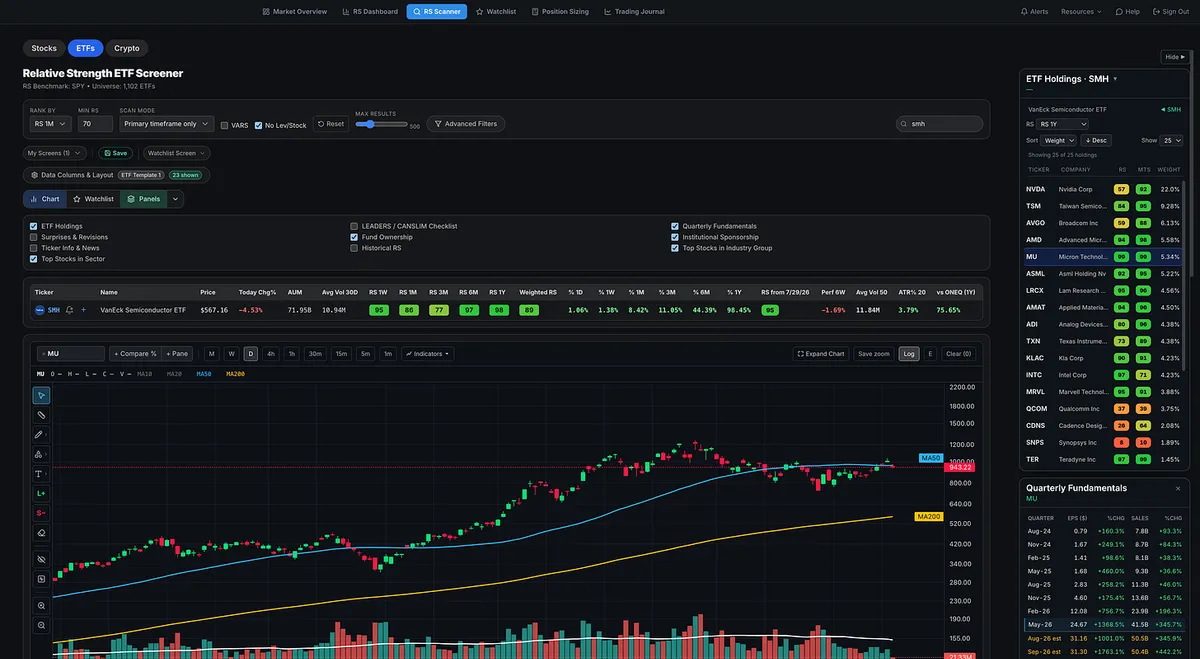
An MTS member gave me a feature idea that was too good not to build.

I loved the idea, so I got to work on it and pushed it live inside the MTS ETF Screener.

You can now open an ETF, see all of its holdings, click into the individual stocks, review their charts, fundamentals, and fund ownership, and quickly flip through the names without ever leaving the screener.

So if you find an ETF showing strong relative strength, you can immediately start digging into the individual stocks inside it to see what may be driving the move.

This is one of those features that seems obvious once you have it.

And it’s one of my favorite things about building MTS with the people actually using it. MTS members are helping shape what this software becomes.

Big thank you to JJ for the recommendation!

MTS Velocity keeps getting better.

View on Substack ↗

What Traders Get Wrong About Volume

I’ve received a bunch of questions about volume, so here is an article I wrote about it back in December.

Bottom line: price matters most, and volume is still valuable confirmation, but especially intraday, it can sometimes give an incomplete or misleading picture. Stock volume can also be revised later because of late reports, corrections, cancellations, or the way data providers process certain trades, although the vast majority of normal trading activity is reported promptly.

I go into more detail in the article below, including the differences between stocks and futures.

https://tradingmomentum.substack.com/p/the-volume-youre-watching-isnt-the

ArticleThe Volume You’re Watching Isn’t the Full Story
View on Substack ↗

The Best Breakouts Get Quiet Before They Explode

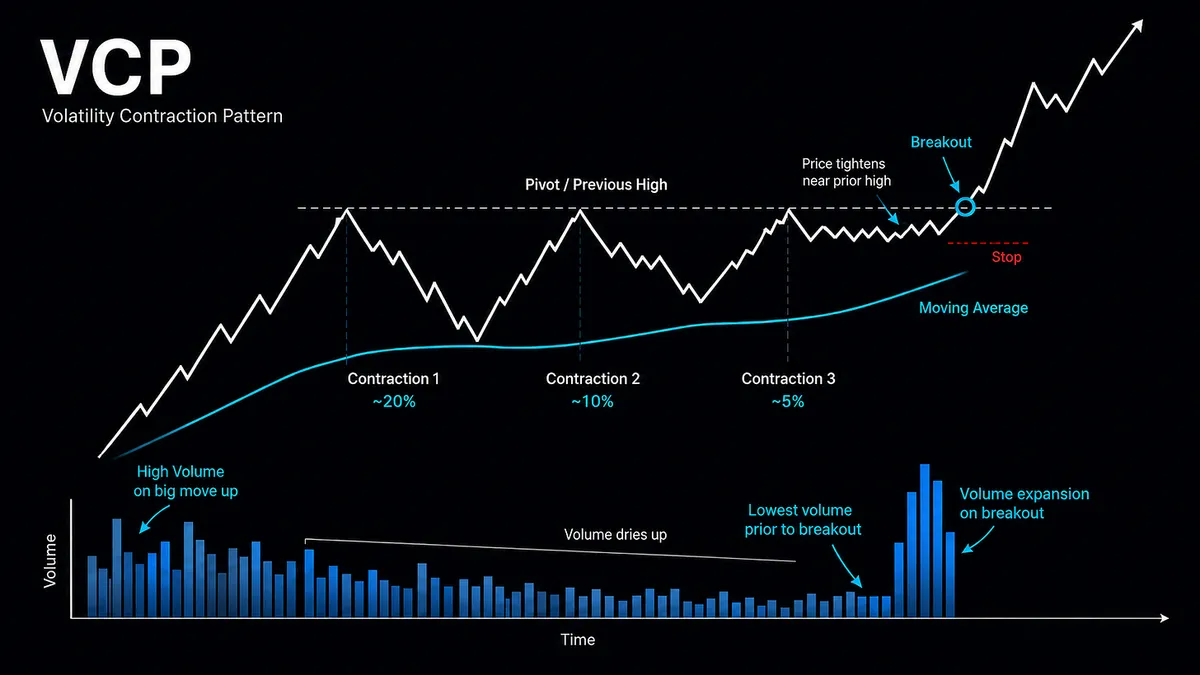
One of the biggest mistakes traders make with a VCP is focusing only on the shape.

Mark Minervini’s Volatility Contraction Pattern is really about supply and demand.

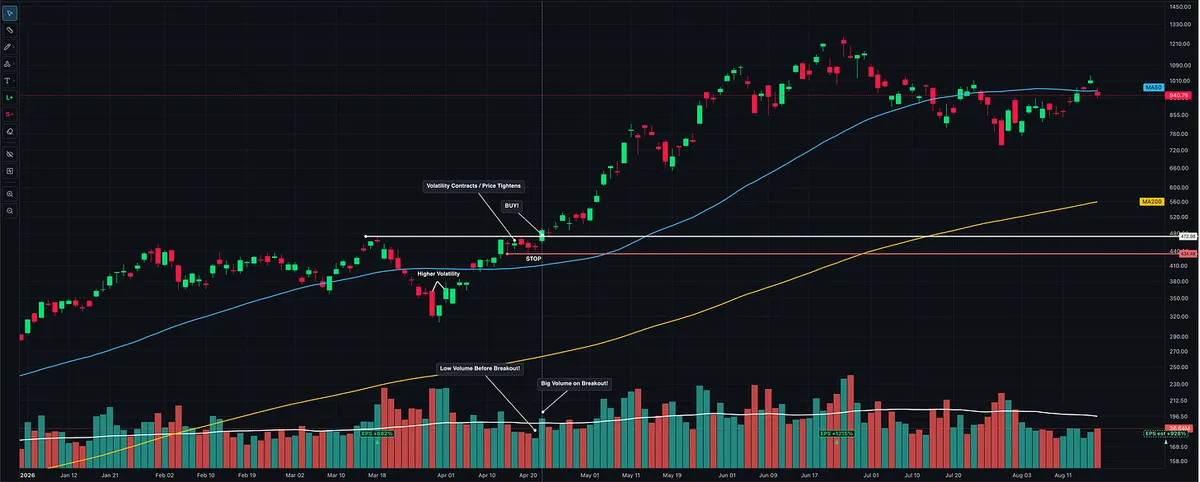
As the base develops, the pullbacks should get progressively smaller from left to right. Minervini gives the example of roughly 20%, then 10%, then 5%, with each contraction generally becoming much smaller than the one before it.

At the same time, volume should contract.

That may be the most important part.

As price tightens near the prior high, selling pressure is drying up. Minervini notes that during the final contraction, volume can fall to some of the lowest levels of the entire base.

Think about what that means.

Price is getting tighter. Volume is getting quieter. Supply is disappearing.

The stock is moving toward what Minervini calls the line of least resistance.

Then comes the trigger.

The entry is when price moves through the pivot on expanding volume, ideally followed by continued institutional buying.

That’s the VCP.

Not just a chart pattern.

It’s the footprint of supply being absorbed until demand finally takes control.

View on Substack ↗

If You’re Complaining About This Market, What Are You Going to Do in a Bear Market?

This market is sitting near all-time highs.

Major indexes are above key moving averages. Breadth is strong. Net new highs are outpacing net new lows. Leadership is broadening. There is plenty of evidence that buyers still have control.

And somehow, people are still complaining about how “hard” the market is.

That actually made me laugh, because it raises a much bigger question:

What are you going to do when a real bear market shows up?

Not if. When.

We will have another 2022. We will have another prolonged bear market. At some point, we will probably live through something much worse.

And 2022 wasn’t even some historic market catastrophe. It was a pretty normal bear market.

If normal volatility, corrections, pullbacks, failed breakouts, and a few frustrating weeks are enough to shake you out mentally, the problem probably isn’t the market.

Maybe you need to spend more time studying the market and its history. Or maybe the market isn’t the problem. Maybe it’s time to look inward.

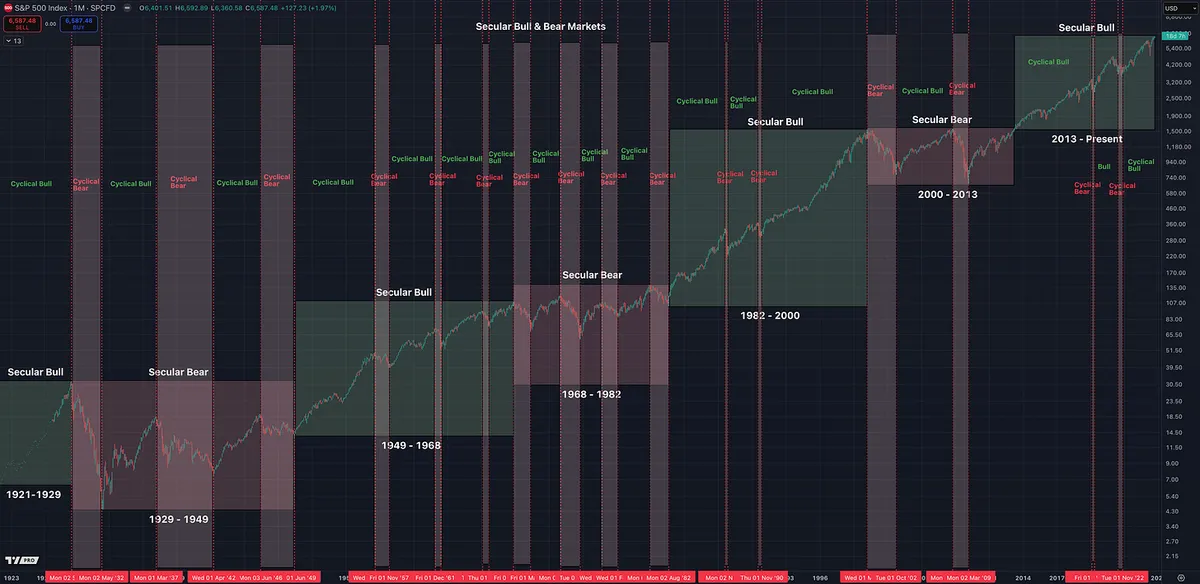
We are in a secular bull market and a cyclical bull market at the same time. It doesn’t get much better than this.

A lot of people who started trading over the last 15 or 20 years have never experienced a true secular bear market. Sure, they’ve lived through bear markets like 2020 and 2022, but those occurred inside a much larger secular bull cycle.

Eventually, that larger cycle will shift too.

I don’t say that to scare anyone. I say it because traders need to understand that markets move through cycles, and the conditions we’ve grown accustomed to will not last forever.

Study market history. Study bull markets. Study bear markets. Learn what changes when the larger cycle changes. And learn what normal, healthy market movement actually looks like.

Because if you think this is hard, eventually the market is going to show you what hard really looks like.

View on Substack ↗

Why CAN SLIM Is One of the Best Trading Strategies for People With a Full-Time Job

There are thousands of trading strategies.

Very few have been documented, studied, and successfully used across multiple generations of markets like William O’Neil’s CAN SLIM.

That’s why How to Make Money in Stocks is still one of the first books I recommend to serious growth stock traders.

But one of the biggest advantages of CAN SLIM doesn’t get talked about enough:

You don’t have to sit in front of six monitors all day to do it well.

O’Neil’s process is largely about doing the work ahead of time.

  • Study the overall market and determine whether conditions favor buying.

  • Watch the major indexes for accumulation, distribution, follow-through, and changes in price and volume.

  • Study daily and weekly charts.

  • Screen for companies with exceptional current and annual earnings and sales growth.

  • Look for something new: a new product, service, management, industry change, or a stock moving toward new highs.

  • Find the leaders, not the laggards, using relative strength.

  • Focus on the strongest industry groups.

  • Look for quality and increasing institutional sponsorship.

  • Watch price and volume for signs of institutional accumulation and demand.

  • Identify proper bases and exact buy points.

  • Build your watchlist ahead of time.

  • Then wait for the stock to prove itself.

That covers the heart of CAN SLIM without making the process unnecessarily complicated. O’Neil specifically taught that market direction should be determined by the price and volume action of the major indexes and the behavior of individual market leaders.

And you can do most of this work at night or on the weekend.

O’Neil even recommended reviewing charts weekly, creating a shopping list of stocks that meet your fundamental and technical criteria, and writing down the buy points ahead of time.

And the track record is hard to ignore.

David Ryan won the U.S. Investing Championship using these principles, and if you spend time going through the history of the competition, you’ll find winner after winner who credits William O’Neil, How to Make Money in Stocks, CAN SLIM, or strategies heavily influenced by the same growth and momentum principles.

We’re talking about traders producing +100%, several-hundred-percent, and even 1,000%+ returns. The championship continues to produce verified results in those ranges today.

The system itself wasn’t built around somebody’s theory of how markets should work.

It came from studying generations of the market’s greatest winning stocks and identifying the characteristics they shared before their biggest advances.

That’s what I love about CAN SLIM.

There are plenty of other great trading edges.

But there aren’t many that are:

Well documented. Repeatable. Built from more than a century of market history. And realistic for someone who still has a career and a life outside the market.

And you can take it as far as you want.

The same basic growth and momentum principles have influenced championship traders, full-time professionals, and people who went on to manage outside capital.

But you don’t need to become a full-time screen watcher to become very good at it.

For a growth stock investor or position trader using daily and weekly charts, CAN SLIM is still one of the best foundations ever put on paper.

View on Substack ↗

Never Freeze Under Fire: A Trading Lesson From Marty Schwartz

Marty Schwartz learned this lesson in Marine Officer training. I learned the same lesson years later in Army Infantry Officer training and Ranger School.

And both of us carried it into trading.

“Don’t just sit there if you are getting the hell beat out of you. Even retreating is offensive, because you are still doing something.”

That quote is about decisiveness under pressure.

Schwartz came into the 1987 crash long, realized he was wrong, honored his risk points, and got out. He took a painful loss, but protected the capital he would need to make his comeback.

That same principle applies to trading every day.

If a trade is going against you, don’t freeze. Don’t hope. Don’t rationalize. Don’t sit there because taking the loss feels painful.

Cut the loss. Reduce exposure. Go to cash if needed.

Retreating is still action.

Sometimes the best offensive move you can make is to play defense and preserve enough capital to fight another day.

View on Substack ↗

Growth Traders: Why Are You Using Options?

First, this is specifically for growth-stock investors and momentum traders following a CAN SLIM, O’Neil, Minervini, Ryan, Zanger, Kullamägi or similar approach.

If that’s not how you trade, I’m not talking to you.

For everyone else, ask yourself:

Why are you using options?

If the answer is:

  • “I want more leverage.”

  • “My account is small.”

  • “I can control more shares with less money.”

  • “I can make a bigger percentage return.”

Then I’d seriously question whether you should be using them.

Because that’s not really an options strategy.

You’re using options for leverage while accepting expiration, time decay, implied volatility, strike selection, spreads, and liquidity risk.

And I don’t think it’s a coincidence that some of the greatest growth-stock traders we study either rarely used options or actively warned against them.

O’Neil wrote that options involve substantially greater risk and volatility than common stocks and believed investors should first prove they can make money in stocks before considering them.

Minervini stopped trading options because he felt there was too much working against you. David Ryan rarely used them because of time decay. Dan Zanger said he didn’t really start making money until he stopped “playing with options.”

Zanger even listed “Avoid options” as one of his top trading rules.

And for the more aggressive short-term swing traders who look up to Kristjan Kullamägi, the message isn’t much different.

Kullamägi strongly discourages developing stock traders from using options. His own FAQ says to avoid them until you’ve already made millions trading stocks and points out that once you’ve done that, you probably won’t need them anyway. He started with only a few thousand dollars and built an extraordinary fortune trading stocks, ultimately reaching roughly $100 million without needing options as the engine of his strategy.

The strategy we follow does not require options to achieve superperformance.

The edge is finding the strongest stocks, buying them at the right time, controlling risk, cutting losses, and getting the most out of your winners.

If you want more exposure and your system, experience, market conditions, and risk parameters justify it, consider traditional leverage. You don’t need to turn a stock trade into an options trade just to get leverage.

If you want leverage, use leverage. If you want to trade options, have an actual options strategy.

Now, if you’ve built an options-specific system, back-tested it, forward-tested it and/or modeled it, understand exactly what options add to the strategy, and have demonstrated positive expectancy, then by all means use them.

That’s different.

But most growth traders I talk to aren’t using options because options improve their edge.

They’re using them for leverage and making an already difficult game even harder.

View on Substack ↗

William O’Neil’s First Real Discovery Was the Exact Opposite of “Buy Low”

Most investors are taught the same thing:

Buy low. Sell high.

William O’Neil discovered something very different.

In 1959, O’Neil studied the Dreyfus Fund, which at the time was dramatically outperforming its competitors.

He obtained the fund’s reports, plotted more than 100 of its stock purchases on charts, and laid them all out in front of him.

Then he noticed something that changed the way he looked at stocks forever:

“Every single stock had been bought when it went to a new high price.”

Not some.

Not most.

Every single one.

View on Substack ↗

The Best Thing About a VCP Isn’t the Breakout

One of my favorite quotes in Market Wizards comes from Bruce Kovner:

“Whenever I enter a position, I have a predetermined stop. That is the only way I can sleep. I know where I’m getting out before I get in. The position size on a trade is determined by the stop, and the stop is determined on a technical basis. For example, if the market is in the midst of a trading range, it makes no sense to put your stop within that range, since you are likely to be taken out. I always place my stop beyond some technical barrier.”

- Bruce Kovner, Market Wizards

That quote explains one of the biggest reasons I love the Volatility Contraction Pattern.

Most people focus on the obvious part of a VCP.

  • Price tightens.

  • Volume dries up.

  • Supply appears to diminish.

It is almost like a rubber band being pulled tighter and tighter, creating the potential for an explosive move once demand overwhelms the remaining supply.

All of that is great, but that is not my favorite part.

My favorite thing about a VCP is that it can give you a very clear technical level where you have decided the trade is wrong.

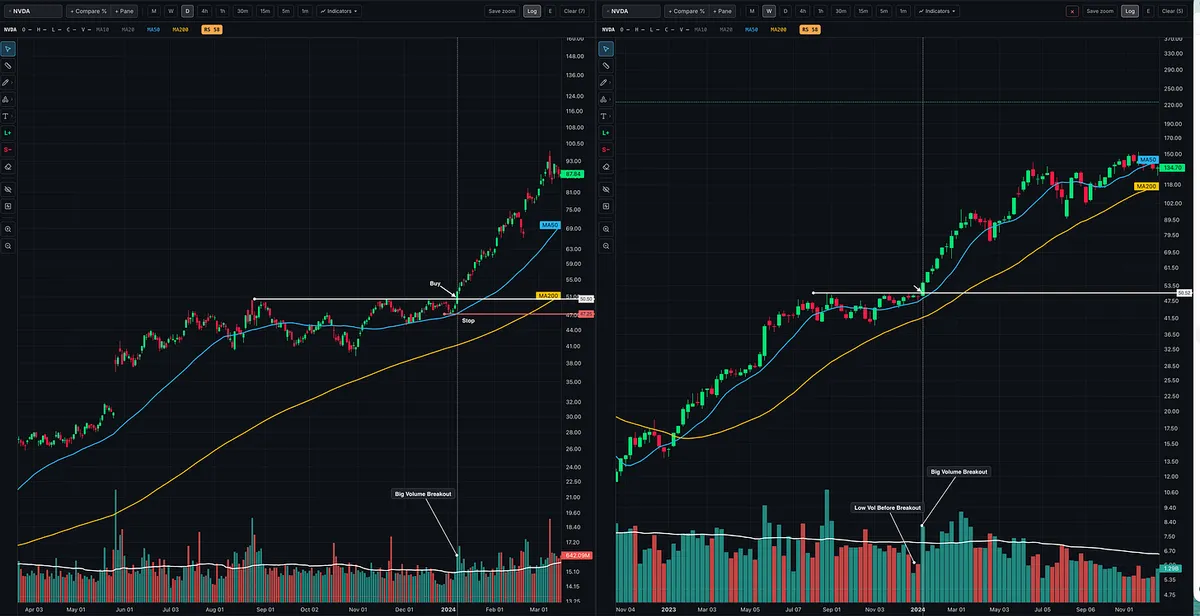
Look at NVIDIA in early 2024.

The stock tightened up near the pivot. Volume dried up. Then price broke through the line of least resistance on expanding volume.

But before the breakout ever happened, I could already identify my risk.

I knew where I wanted to enter.

I knew where the technical structure would begin to fail.

And because I knew my stop, I could determine my position size before putting capital at risk.

That is the part many traders get backwards.

They decide how many shares they want to own first, then try to squeeze a stop somewhere underneath the trade.

I prefer the opposite:

  • Find the setup.

  • Find the technical level that invalidates the setup.

  • Set the stop beyond that level.

  • Then size the position.

The chart determines the risk.

Your desired position size should not determine the chart.

And this is why a tight, well-formed setup can be so powerful. It is not simply that the stock might explode higher.

It is that you can potentially participate in that move while knowing where your idea no longer makes sense.

View on Substack ↗

This Price Action Is Beautiful!!!

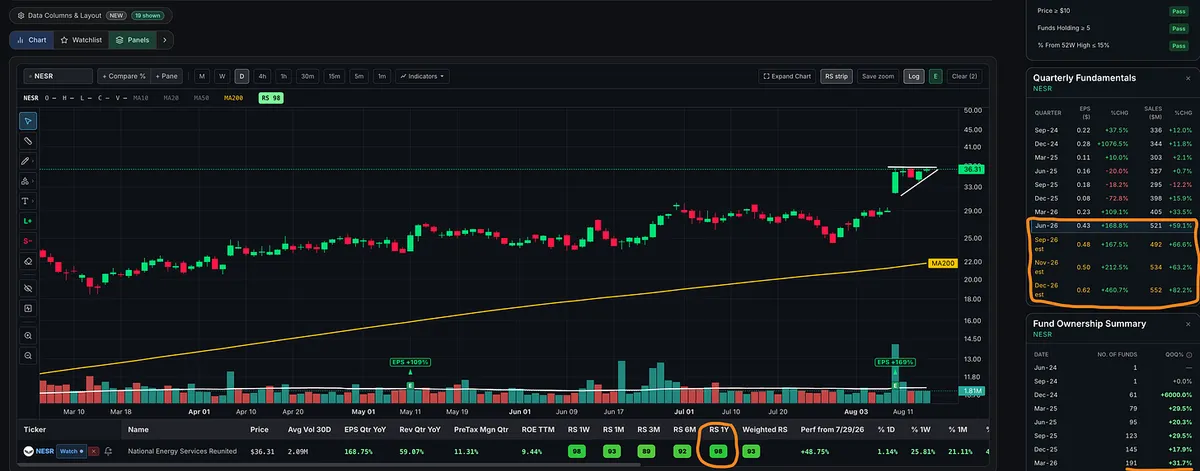
Check out NESR.

This is exactly the kind of setup I love to see.

Strong move higher, followed by tight price compression right at the highs as volume dries up. Higher lows continue pressing into resistance, and now price is sitting just beneath the breakout level.

What I’d love to see Monday: a decisive push through the highs on heavy volume.

And this is the type of trade where I don’t mind being wrong. The setup is tight, the risk is clearly defined, and I can keep my stop close.

The fundamentals are there too:

  • Triple-digit earnings growth.

  • Double-digit sales growth.

  • Fund ownership increasing quarter after quarter.

  • RS near the top of the market.

Explosive upside move. Price tightens during the pause. Strong growth fundamentals. All the ingredients for another powerful move higher.

View on Substack ↗

The Right Setup in the Wrong Stock Is Still the Wrong Trade

Most traders obsess over entries.

And yes, a great entry with proper risk management and position sizing is important, but none of that does you much good if you’re trading the wrong ticker.

I’ve seen plenty of traders struggle simply because they keep trying to trade dead names.

Stocks with no real relative strength. Weak industry groups. Nothing actually moving.

That’s why I track relative strength so closely.

Your odds improve dramatically when you’re trading the strongest stocks in the strongest areas of the market. You’re no longer trying to force something to happen. You’re putting yourself where the money is already flowing.

Nothing is guaranteed in the markets. It’s a game of probabilities, but you can increase those probabilities by making sure you’re trading the right names in the right industry groups.

This is why one of the most important tools we use is our stock screening software.

It helps us quickly find where the strength is so we can spend our time looking for setups in the stocks that are actually moving.

There are a lot of pieces that go into creating positive expectancy in the market.

Stock selection is one of them.

View on Substack ↗

The Market Wizard the Market Wizards Respected

“I deal in probabilities, not certainties. So, the key was strategy, not preaching.”Martin Zweig, Winning on Wall Street

That might be one of the most important market lessons ever written.

Most investors are trying to predict.

  • Where is the market going?

  • Is the Fed going to cut?

  • Is this the top?

  • Is this the bottom?

  • Is the economy going into recession?

Zweig approached the market differently.

He understood that you don't need certainty to make money. You need probabilities, risk control, and a strategy for what you will do as conditions change.

That distinction is enormous.

Before the 1987 crash, Zweig saw risk increasing, but he didn't pretend he knew exactly what would happen. In fact, he explicitly said he wasn't 100% certain. Instead, he adjusted his strategy, reduced risk, and positioned himself so that if he was wrong, the damage was manageable, and if the market collapsed, he was protected.

That is what great trading looks like.

  • Observe what the market is actually doing.

  • Determine the probabilities.

  • Adjust your exposure as the evidence changes.

  • Protect yourself when risk rises.

  • Get aggressive when the odds move back in your favor.

And if you're wondering how respected Martin Zweig was among great traders, go back and read Market Wizards.

Michael Marcus told Jack Schwager that he liked Zweig's market letters. Schwager then made an interesting observation: “Of the traders I have interviewed, Zweig is probably the one most mentioned.” Marcus responded that Zweig was very solid and that you always got something of value from him.

Bruce Kovner, one of the greatest macro traders ever interviewed by Schwager, specifically praised Zweig's risk control and his refusal to act like he could predict the future. Kovner's description is almost a perfect summary of Zweig's philosophy: Zweig observed what was happening and made rational bets from the evidence.

Richard Dennis was asked which analysts he respected.

His response?

“Zweig, is good.”

Paul Tudor Jones was even more direct. When Schwager asked which market advisers he paid attention to, Jones responded:

“Marty Zweig and Ned Davis are great.”

And David Ryan, three-time U.S. Investing Champion and William O'Neil's protégé, included Winning on Wall Street on his recommended reading list for someone serious about becoming a successful stock trader.

There is a reason so many great traders respected Zweig.

He wasn't trying to sound smart by predicting every turn in the market.

He was trying to survive long enough to exploit the opportunities when the probabilities were in his favor.

That's a very different game.

And a much more profitable one.

You don't need to know what the market is going to do next.

You need to know what you're going to do next based on what the market does.

View on Substack ↗

The Market Is Confirming the Rally

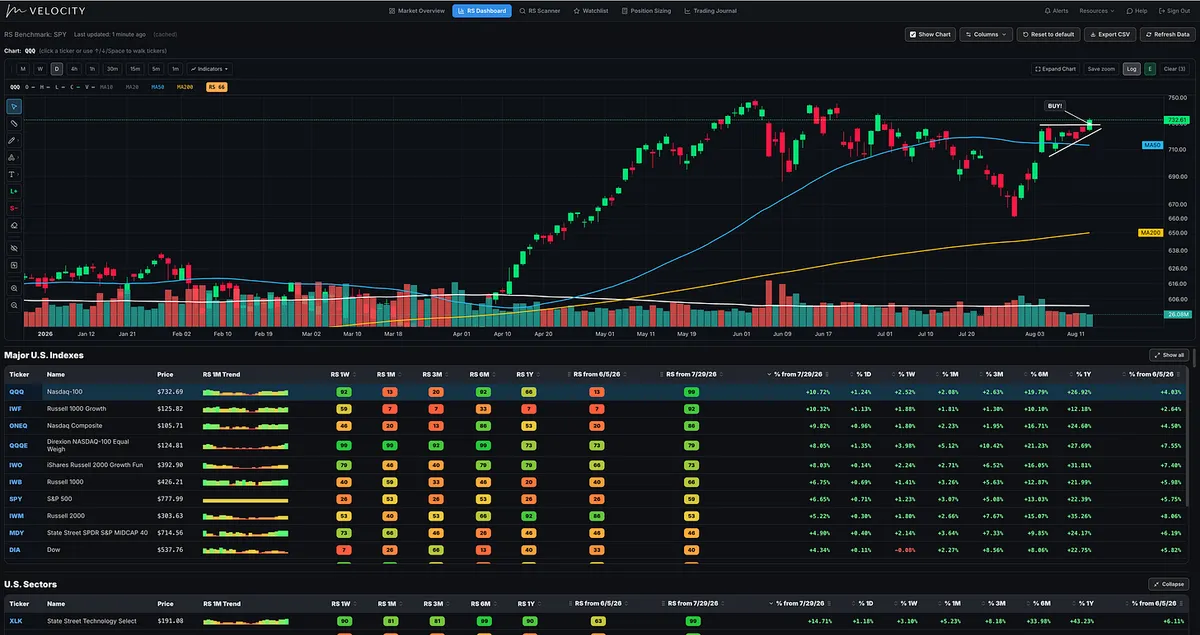
The NASDAQ continues to look strong, but the most important part isn’t simply that QQQ is moving higher.

It’s what’s happening underneath the indexes.

The August 4 follow-through day gave us the important confirmation that the market may have changed character. Since then, the rally has continued to hold up. The Nasdaq 100, Nasdaq Composite, S&P 500, and Russell 2000 are all above their key moving averages, while the Dow is pulling back toward its 10-day and still holding up well.

The market internals are also supporting the move.

Up/down volume is well above 1.0, showing buying volume is outpacing selling volume. The advance/decline ratio is positive. NASDAQ net 52-week highs are positive and expanding. Breadth has improved across the market, and over the past two weeks we’ve consistently seen significantly more stocks advancing 4% or more than declining 4% or more.

I consider those secondary pieces of evidence.

The most important confirmation is coming from the stocks themselves.

Growth stocks are beginning to outperform again. Technology has moved back into the lead, and many of the areas that led earlier in the year are reasserting themselves off the July 29 lows.

Semiconductors. Memory. Cybersecurity. Artificial intelligence. Select software.

And when I go into the stock screener and look at the strongest movers with big earnings and sales growth, I’m finding many of those same areas showing up again.

There was significant damage to growth leadership beginning in early June. So I didn’t want to assume that leadership had returned simply because the indexes bounced.

I wanted the market to prove it.

A follow-through day was one piece of evidence.

Improving price action was another.

Expanding new highs and stronger breadth added confirmation.

But ultimately, the strongest evidence is seeing fundamentally strong growth stocks with high relative strength beginning to break out, move higher, and emerge as leaders again.

That is what we want to see.

Of course, none of this means the market has to continue higher. There are no guarantees.

The goal isn’t to predict what happens next.

The goal is to objectively read what the market is doing right now, follow the strongest stocks and industry groups, and let our own trading results determine how aggressive we should become.

If the leaders keep working, exposure can increase progressively. If breakouts begin failing and our trades stop working, we pull back.

Right now, the weight of the evidence continues to improve.

But as always, the stocks themselves get the final word.

View on Substack ↗

Your Trading Strategy Has to Fit Your Life

You can study every Market Wizard on the planet and still fail if you copy their strategy without considering your own circumstances.

Your starting capital matters.

Your available time matters.

Your risk tolerance matters.

Your financial obligations matter.

Even the asset class matters. A strategy that works beautifully with a large account may be completely impractical with a smaller account if the position size required would violate your risk parameters.

The same goes for trading style.

If you work full time, trying to trade like someone staring at screens all day may be setting yourself up for frustration before you even begin.

This is why Dr. Van Tharp emphasized building a trading plan around your goals, objectives, resources, and constraints.

There is no single “best” trading strategy.

There is a best strategy for you, at this stage, with the capital, time, and risk you have available right now.

Before asking, “How did this great trader do it?”

Ask:

“Does the way they traded actually fit the life and account I’m trading with?”

That question can save you years of frustration.