Momentum Trading Strategy

Notes

Short lessons on momentum trading, every day.

Every note from Substack, in one place: risk, setups, leading stocks, market conditions and the mindset behind them. Search them, browse by topic, or filter by stock.

Showing 241–260 of 1222 notes

View on Substack ↗

What Livermore Really Meant by “Sitting”

A lot of traders know Jesse Livermore’s famous quote:

“It never was my thinking that made the big money for me. It always was my sitting.”

Most people interpret that as letting your winners run, and that is absolutely part of it.

But there is another side to Livermore’s “sitting” that gets overlooked.

Sometimes sitting means not trading at all.

Not forcing trades when the market is choppy. Not overtrading because you are bored. Not buying something just because you feel like you should be doing something.

Livermore understood that real moves take time, and that a trader has to wait for the right conditions before committing capital.

That reminds me of one of my favorite quotes from Market Wizard Mark Weinstein:

“Although the cheetah is the fastest animal in the world and can catch any animal on the plains, it will wait until it is absolutely sure it can catch its prey. It may hide in the bush for a week, waiting for just the right moment. It will wait for a baby antelope, and not just any baby antelope, but preferably one that is also sick or lame. Only then, when there is no chance it can lose its prey, does it attack. That, to me, is the epitome of professional trading.” 

That is how I think about Livermore’s quote.

Sitting is not passive.

Sometimes it means sitting with a great winner.

Sometimes it means sitting in cash.

And sometimes it means sitting on your hands until the market finally gives you the trade you have been waiting for.

View on Substack ↗

When Your Favorite Setup Stops Working

One mistake traders make is assuming that when a setup stops working for a period of time, the entire method is broken.

Sometimes the method is fine, actually, most of the time it is.

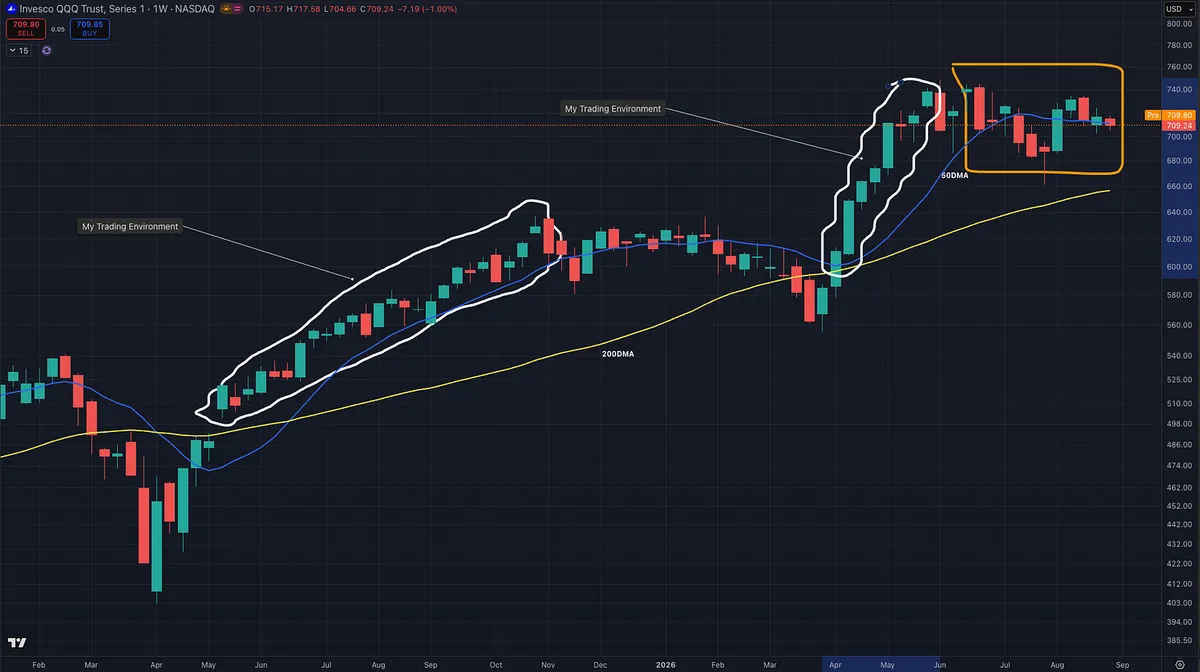
The market environment changed.

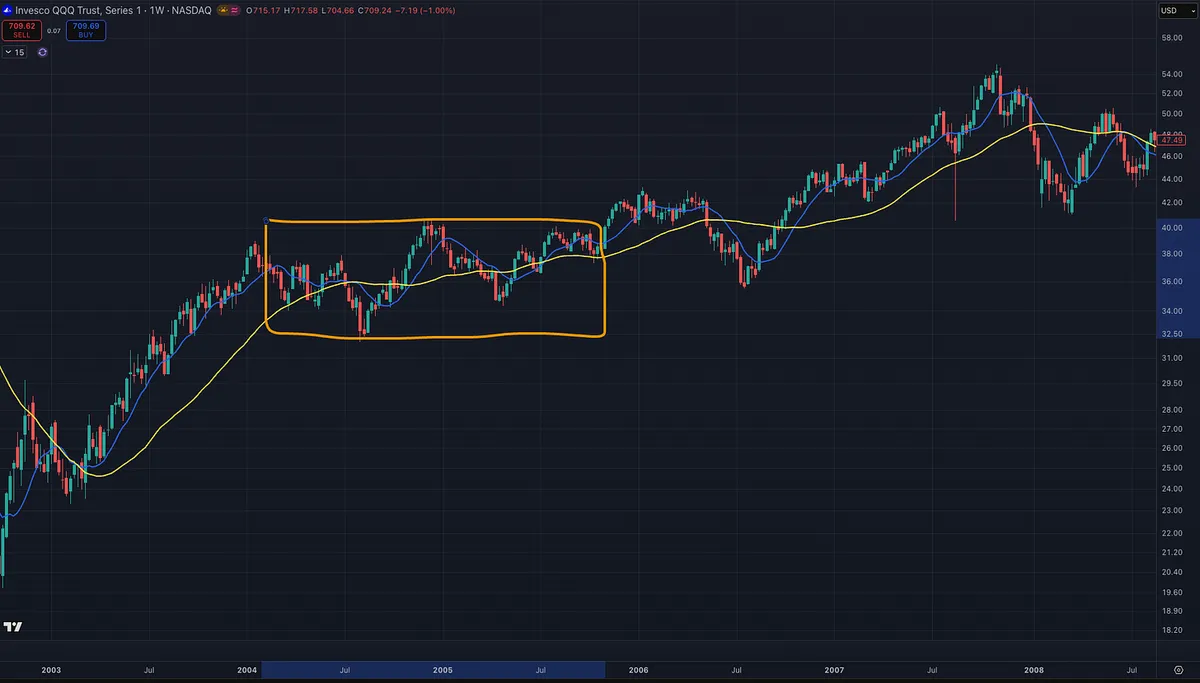
Morales and Kacher ran into exactly this in 2004 and 2005 in Trade Like an O’Neil Disciple. Traditional base breakouts were struggling in a choppy, sideways market. Instead of abandoning growth-stock trading, they adapted their entries to the environment.

Sound relevant right now?

Van Tharp taught a similar principle: there is no trading system that works in every market environment.

I’d take it one step further for most growth and momentum traders.

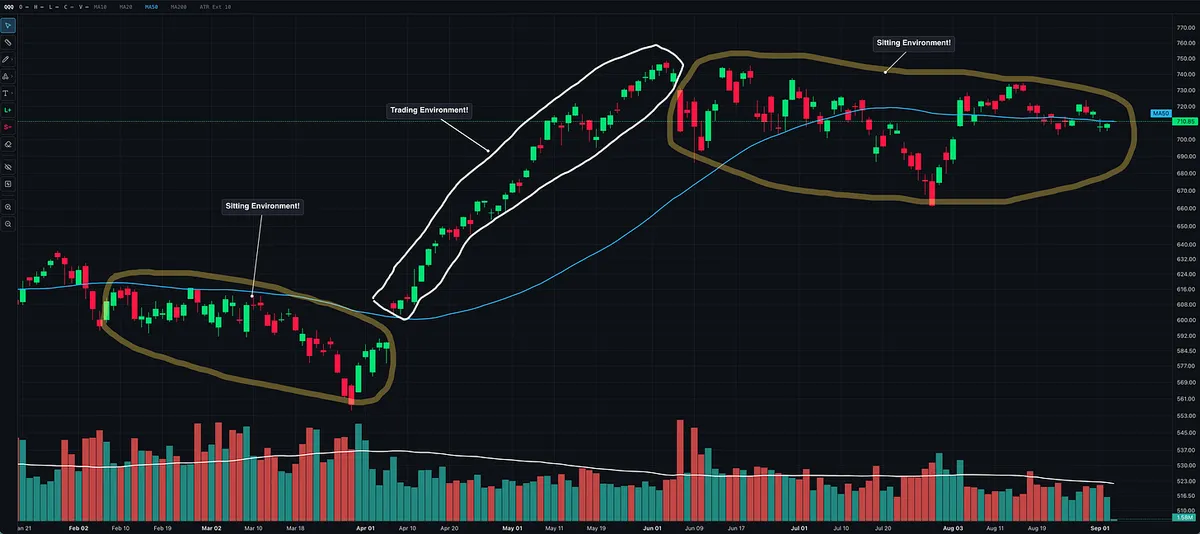
Sometimes the best adjustment in a sideways market is to stop trading.

If existing positions are holding up, I may keep them, take some profit, and trail stops. But I do not need to keep forcing new buys while breakouts are failing, leadership is rotating week to week, and the market is chopping sideways.

Morales and Kacher make this point elsewhere in the book too. There are periods when the best decision is simply to sit in cash, study, and wait for conditions to improve.

For me, that means waiting for the Stage 2 uptrend to reassert itself, the sideways action to resolve, and consistent leadership to return.

You do not have to change your entire method every time your favorite setup stops working. Sometimes you just have to wait for the environment your method was built for.

View on Substack ↗

Price Tells You What Happened. Volume Tells You Whether to Trust It.

One of the best lessons in Anna Coulling’s A Complete Guide to Volume Price Analysis is also one of the simplest:

Every price move should be judged against the volume behind it.

Coulling reduces Volume Price Analysis to two questions:

Is volume confirming the price action, or is there an anomaly?

That is especially useful around breakouts.

A stock breaking out of a base looks bullish, but the breakout itself is only half the information.

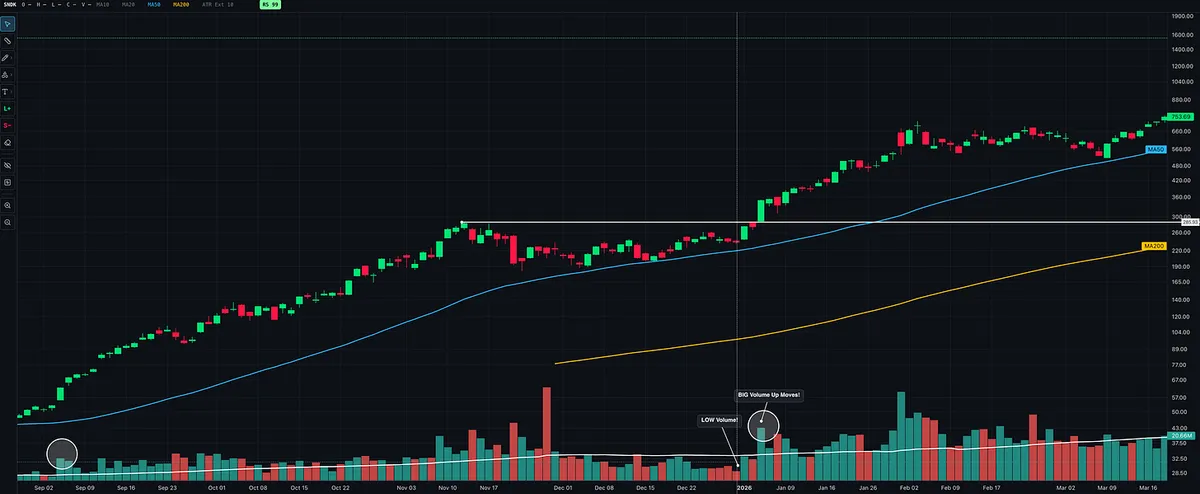
If price pushes through resistance with strong, expanding volume, the volume is confirming the move.

If price breaks out on weak volume, something is missing. Coulling specifically warns that a breakout from congestion on low volume should be treated with suspicion rather than automatically chased.

That gives us a simple way to read a breakout:

Price tells you the stock broke out. Volume tells you whether buyers actually showed up.

The same applies after the breakout.

Coulling writes that a valid move away from consolidation should generally be supported by above-average volume. If the stock then pulls back to test the breakout area, you would prefer to see volume contract. Heavy volume on the breakout, lighter volume on the pullback.

That is supply and demand on the chart.

Strong volume as price advances tells you demand is present.

Light volume on a pullback tells you selling pressure may be limited.

View on Substack ↗

You Don’t Need to Be Right That Often

One of the best lessons in Momentum Masters is…..

You do not need a high win rate to make big money.

Mark Minervini says he would rather keep losses small and let gains outweigh them than focus on being right all the time.

David Ryan says two or three really good stocks in a year can make up for all the small losses.

Dan Zanger says most of his profits came from a small number of massive winners.

Small losses are part of the business.

The mistake is letting a small loss turn into a large one, or selling your best winners too early.

Keep losses small, let winners run.

View on Substack ↗

The Right Stock at the Wrong Time Is Still the Wrong Trade

Chapter 2 of William O’Neil’s How to Make Money in Stocks says a lot in the title alone:

How to Read Charts Like a Pro and Improve Your Selection and Timing.

Selection and timing.

O’Neil did not separate the two. Strong earnings and sales can help identify a great company, but the chart helps determine whether it is actually time to buy.

This is where traders often go wrong. They fall in love with the stock or fundamentals first, then start looking for an excuse to enter.

O’Neil taught the opposite.

Qualify the stock fundamentally. Then wait for the chart.

He wrote that the objective is not to buy at the cheapest price, but at the right time, when the stock reaches a proper buy point and proves its strength. Buying too early can leave you stuck in a stock that never breaks out. Buying too late means chasing, and chasing increases risk. If you compensate by sizing down, you dilute your winners and reduce your ability to concentrate in your best setups.

“There’s a right time, and then there are all the other times.”

-William O’Neil

So the process is straightforward:

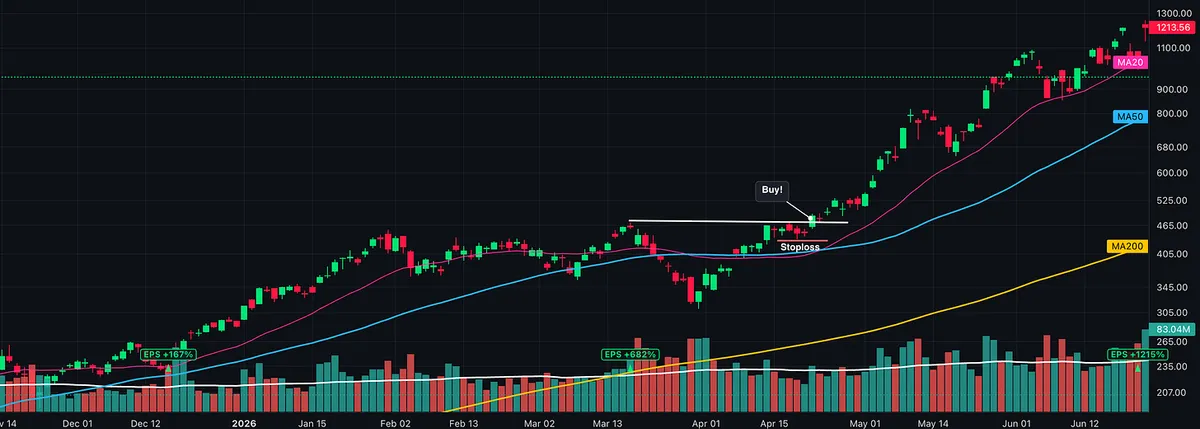
Qualify the company. Read the chart. Wait for the setup. Buy at the proper time.

If the setup is not there, you wait.

Missing a move because your setup never appeared is NOT a failure of the process.

Buying without the proper setup is.

View on Substack ↗

Jesse Livermore Told You Who Would Lose Before He Told You How to Trade

Jesse Livermore did not open How to Trade in Stocks with a setup or a secret entry technique.

He opened with a warning.

“It is not a game for the mentally lazy... nor for the get-rich-quick adventurer. They will die poor.”

Think about that.

Before Livermore taught readers how to trade, he essentially told them who should not trade at all.

For years, people would corner him at dinner parties and ask the same question traders still ask today:

How can I make some money in the market?

What stock should I Buy?

Eventually, Livermore's answer became brutally simple:

“I don't know.”

He wasn't hiding the secret.

He was rejecting the premise.

Because asking a professional speculator how to make quick and easy money in stocks, Livermore argued, was like asking a surgeon how to make quick money in surgery.

There is no shortcut around the work.

What Livermore would offer was a signpost.

Study. Keep records. Think for yourself. Develop emotional control. Wait patiently. Act when the market gives you a legitimate opportunity.

More than 80 years later, traders are still looking for the shortcut Livermore warned them did not exist.

The market does not pay you because you want action.

It pays you when preparation, patience, emotional control, and opportunity finally meet.

That may be the most important lesson in the entire book.

No adventuring. No get-rich-quick mentality. Study the game and put in the work.

View on Substack ↗

Want to Understand the “M” in CAN SLIM Better? Learn How the Rest of the Market Thinks.

This is not something I originally set out to learn in order to become a better growth stock and momentum trader.

But the more experience I gained, the more I realized how valuable it was to understand how the rest of the market thinks.

I tend to buy stocks near 52-week highs and all-time highs. I want strong earnings and sales, powerful relative strength, institutional accumulation, and stocks moving up the right side of the chart. I am willing to buy high with the intention of selling higher.

But a huge amount of capital in the market does not think that way.

Many investors are extremely valuation-conscious. They care about P/E ratios, discounted cash flows, dividend yields, interest rates, and whether an asset appears cheap or expensive relative to alternatives.

That matters to us even if we never trade that way.

Take Treasury yields.

When investors can earn 5%, 6%, or potentially more in relatively safe government debt, the calculation changes. Stocks now have to compete against a much more attractive risk-free return. Investors may become less willing to pay premium valuations for stocks, particularly long-duration growth companies whose value depends heavily on earnings far into the future.

That can affect liquidity, valuations, institutional positioning, and ultimately the general market environment we are trying to trade.

The opposite can matter too. When Treasury yields suddenly collapse, it is not automatically bullish. Sometimes yields are falling because investors are rushing toward safety as economic conditions deteriorate.

This is where I think understanding the rest of the market has helped me better understand the “M” in CAN SLIM: Market Direction.

It reminds me of something we drilled constantly in the military. You cannot properly understand the battlefield by studying only how you intend to fight. A major part of planning is understanding how the other side is likely to behave.

Trading is obviously not warfare, but the principle translates surprisingly well.

I don’t need to become a value investor, bond trader, macro investor, or economist.

But understanding what drives their decisions, where capital is flowing, and why institutions may suddenly become more or less willing to take risk gives me a much better understanding of the environment in which my growth stocks are trying to operate.

And over time, that understanding has absolutely helped my trading.

View on Substack ↗

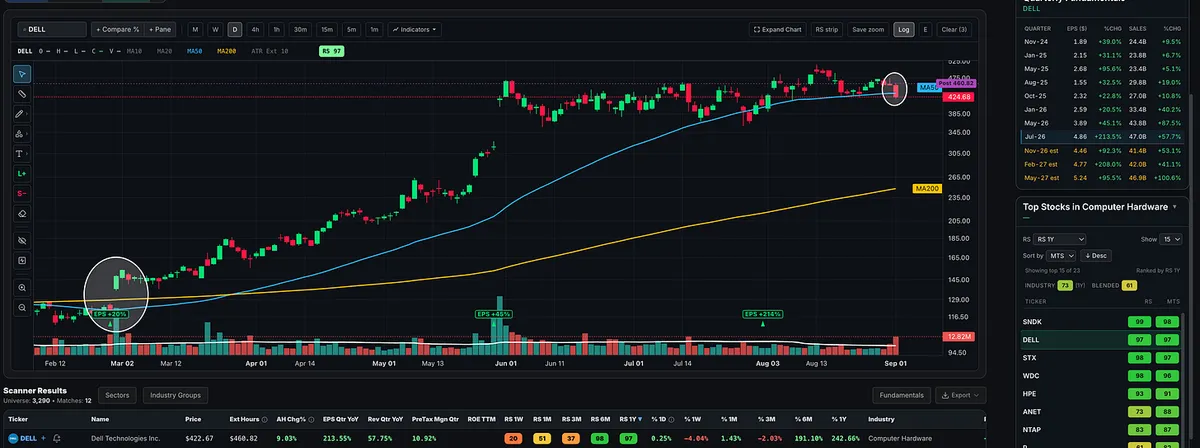
Why I Wouldn’t Buy DELL Right Before Earnings

Someone asked me why I wouldn’t buy DELL before earnings, especially when I’ve held other stocks through earnings.

The difference is context.

With LITE, I was already in the stock and had roughly a 25% cushion going into earnings. In situations like that, I may sell some before the report and hold the rest through earnings.

That is completely different from initiating a brand-new position right before earnings.

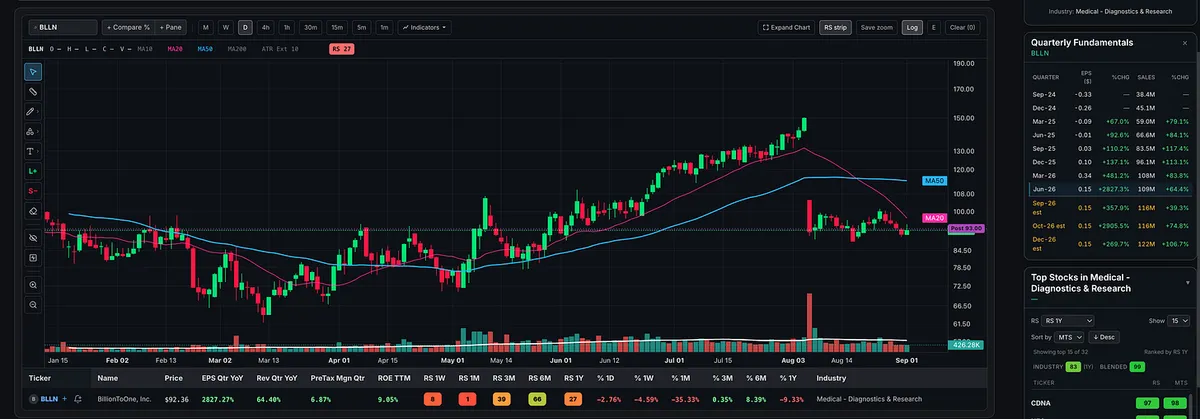
If you want to hold stocks long enough to capture really big moves, eventually you have to get comfortable sitting through some earnings reports. There is no way around that. Even with a large profit cushion, you can still get hit with an ugly reaction, like we saw with BLLN.

But I will NOT buy a stock immediately before earnings just to gamble on the report.

And with DELL specifically, the decision was even easier.

The stock looked like it wanted to go higher, but showed very little follow-through. Then it had a bad day today, falling more than 6% and closing below the 50-day moving average.

On top of that, the overall market hasn’t been acting well.

So now you have:

  • Poor follow-through after a failed breakout attempt

  • A greater than 6% down day

  • A close below the 50-day moving average

  • A less-than-ideal overall market

  • Earnings immediately ahead

Why would I initiate a brand-new position and take on earnings risk with all of that working against me?

For me, there is a big difference between holding earnings with a 20% to 30% profit cushion in an existing position and buying a stock immediately before earnings with no cushion at all.

Those are two completely different risk situations.

Now, with DELL up roughly 10% after hours, I’ll watch how the price continues to act and see whether it gives me a setup. It did something similar in early March after the big gap up in late February.

I don’t need to predict the earnings reaction or gamble on the report. I can wait for the report, see how the market reacts, and then look for a proper setup.

View on Substack ↗

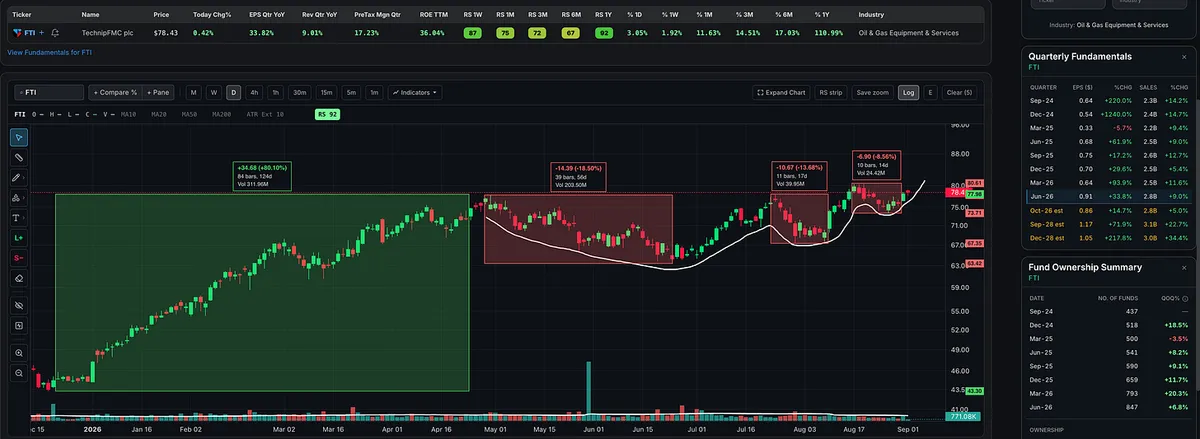
FTI | Another Oil & Gas Name Tightening Up

Another Oil & Gas name catching my attention: FTI | TechnipFMC

What immediately stands out to me is the VCP-like price action developing near the highs.

FTI had a powerful run of roughly 80%, and since then the corrections have progressively tightened:

18.5% → 13.7% → 8.6%

That is exactly the type of behavior we want to see as a stock works through a constructive base.

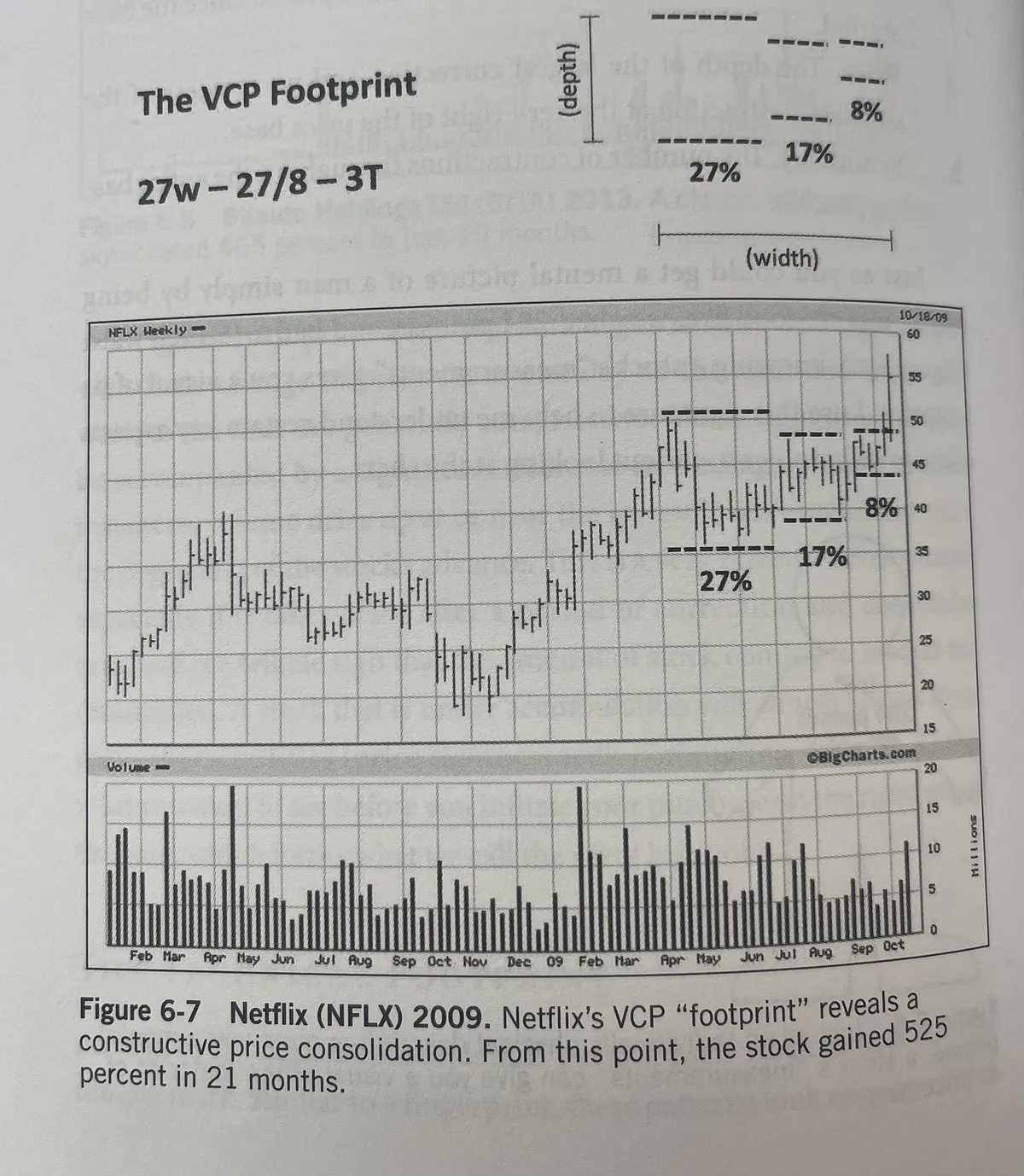
Mark Minervini describes the Volatility Contraction Pattern, or VCP, as volatility contracting from left to right as supply is gradually absorbed. The stock moves from wider price swings on the left side of the base toward increasingly tighter action on the right, ideally accompanied by volume drying up.

That is very similar to what we're seeing here.

The contractions aren't perfectly symmetrical, so I wouldn't call this a textbook VCP, but the character of the setup is very VCP-like: progressively smaller pullbacks, tightening price action on the right side, and price working back toward the highs.

The stock also has a 92 1-Year RS Rating, with fundamentals that continue to move in the right direction:

  • Quarterly EPS: +33%

  • Quarterly sales: +9%

  • ROE: 36%

  • Pretax margin: 17%

  • Fund ownership increasing

And perhaps most importantly, this is another Oil & Gas Equipment & Services name showing strength.

Now let's see if demand shows up with BIG volume.

View on Substack ↗

The Market Is Always Right

The price is always right, and the market is always right.

That doesn’t mean you need to buy everything that’s going up. It means you need to stop arguing with what the market is actually telling you.

Focus on what you can control:

  • Your selection criteria

  • Your entry

  • Your stop

  • Your position size

  • How you manage the trade

  • Selling some into strength

  • Raising stops as the trade works

Those are your decisions.

What you cannot control is what the market does next.

So NEVER, EVER argue with the market. Don’t convince yourself the price is wrong and don’t believe you know where a stock should trade.

You don’t. Neither do I.

We can build probabilities, find great setups, study fundamentals, and manage risk, but ultimately price has the final say.

Control what you can control.

Then let the market tell you whether you’re right or wrong.

View on Substack ↗

The Market Isn’t Your Biggest Opponent. You Are.

If your sole goal in trading is to make a lot of money, good luck. You are probably going to need it.

And to be clear, it’s okay if that’s what attracted you to trading. That’s part of what attracted me too.

But that isn’t what ultimately helped me make it, and it certainly isn’t why I stayed.

Eventually, you realize money is just the scorecard. The real game is beating yourself.

Unfortunately, most traders will scroll right past a message like this because there isn’t a fancy chart, a new setup, or some indicator promising to improve their trading.

But I think this is something almost every serious trader eventually has to discover for themselves.

The strategy and setup usually isn’t the hardest part.

The hard part is controlling the greed that makes you size too large.

The fear that makes you sell a winner too early.

The ego that prevents you from admitting you’re wrong.

The impatience that makes you trade when there is nothing to do.

The need to make money back after a loss.

The overconfidence that appears after a winning streak.

In Market Wizards, Tom Baldwin viewed money essentially as a way of keeping score, rather than something that should drive individual trading decisions.

Dr. Van Tharp went even further when discussing the beliefs he found among top traders:

“Money is NOT important.”

“Trading is a game.”

He then made an observation that should probably be read twice:

“Most people approach trading to make a lot of money, and that is one of the primary reasons they lose.”

Ed Seykota approached the same problem from an even deeper psychological level:

“Win or lose, everybody gets what they want out of the market.”

His point was that our trading often reveals motivations and patterns inside us that we may not even recognize.

If you look deeply enough at your own trading behavior, you may discover that some of your worst mistakes are not really market problems at all.

Peter Brandt put it more simply:

“I am my own worst enemy.”

Brandt explained that his natural impulses would often lead him astray and that without a disciplined process, he believed he would eventually self-destruct as a trader.

William Eckhardt said something equally powerful:

“If you’re playing for emotional satisfaction, you’re bound to lose, because what feels good is often the wrong thing to do.”

And this is also why something David Ryan said years ago has always stuck with me.

Ryan said he starts his mornings by reading the Bible. He explained that reviewing its values and principles helps put him in the right mindset and remove the emotion that can lead to poor trading decisions.

Think about that.

One of the greatest growth-stock traders of his generation wasn’t starting his morning looking at the market.

He was working on himself.

That is the part of trading nobody wants to talk about because it doesn’t sell nearly as well as charts, setups, scanners, and strategies.

But eventually, if you stay in this game long enough, you begin to understand what Seykota, Tharp, Eckhardt, Brandt, Ryan, and so many great traders were getting at.

The market is not your biggest opponent.

You are.

Becoming a better trader often requires becoming better at understanding yourself.

Your fears. Your greed. Your ego. Your impatience. Your need to be right. Your relationship with money. Your response to winning and losing.

In that sense, trading eventually becomes much more than a pursuit of money.

It becomes a journey of self-development.

And if you approach it the right way, the person you have to become to succeed may ultimately be worth far more than the money you make along the way.

View on Substack ↗

The Funny Thing About Making Money in the Market

You would think the best way to make more money in trading is to focus on making money.

For me, the opposite has been true.

The more I’ve focused on protecting capital, controlling risk, cutting losses, and avoiding unnecessary damage, the more money I’ve actually made.

That mindset changes everything.

Instead of asking:

“How much can I make on this trade?”

You start asking:

“How much can I lose if I’m wrong?”

That one shift leads to better position sizing, tighter discipline, fewer emotional decisions, and a much greater ability to stay in the game when conditions get difficult.

Paul Tudor Jones put it perfectly:

“Don’t focus on making money; focus on protecting what you have.” — Paul Tudor Jones

View on Substack ↗

When the Market Gets Choppy, Trade Less.

Michael Marcus said it best in Market Wizards:

“I think the secret is cutting down the number of trades you make.”

He was talking about choppier markets and more false breakouts.

His answer was not to force trades. It was to wait for the ones where fundamentals, technicals, and market tone all line up.

Sometimes there are plenty of those opportunities.

Sometimes there are fewer.

When there are fewer, trade less.

View on Substack ↗

New Lows Just Overtook New Highs on Both Exchanges

One thing caught my attention today.

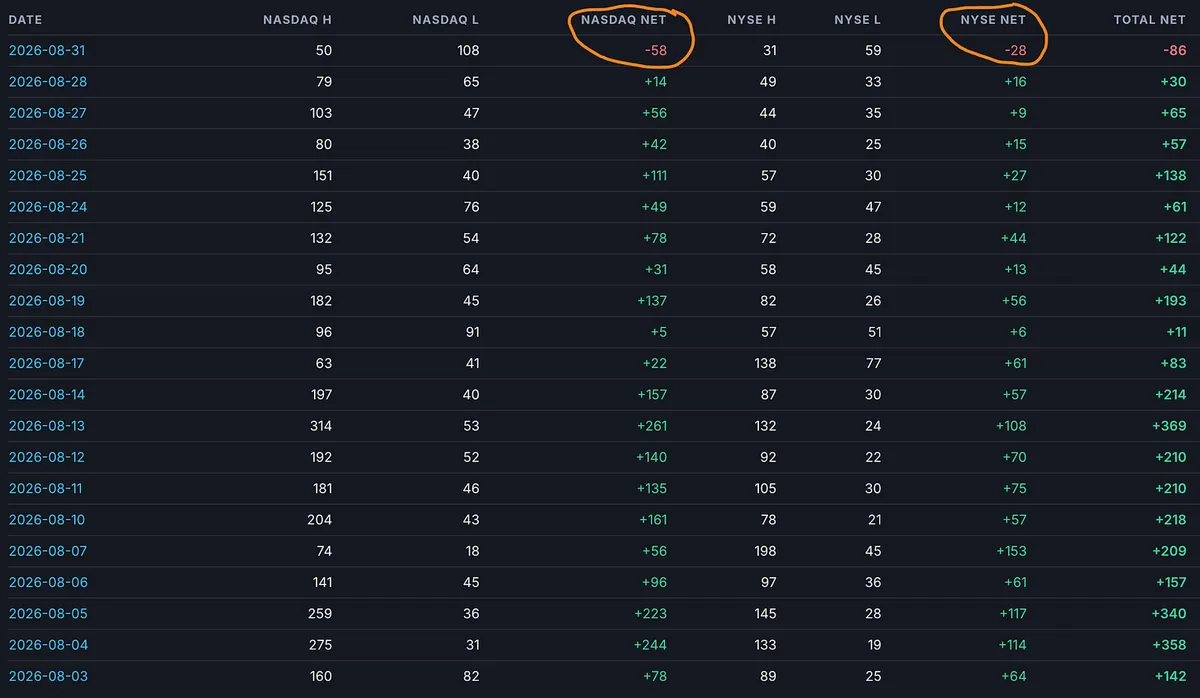
I track Nasdaq and NYSE net new 52-week highs versus lows across multiple data sources. Today was the first session in the past month where both exchanges finished net negative.

In other words, more stocks made new 52-week lows than new 52-week highs on both the Nasdaq and the NYSE.

Data from IBD (I combined AMEX with NYSE)

View on Substack ↗

The Market Has Been Going Up, but Look Who’s Leading.

One thing I’m watching closely right now is the quality of the leadership.

Look at the groups that keep showing up across our rankings and screens:

Healthcare: Biotechnology, Pharmaceuticals, Medical Diagnostics & Research, Medical Distribution, Medical Devices, Genomics, and other medical groups.

Energy: Oil & Gas Refining & Marketing, Drilling, Exploration & Production, Oil Services, and Midstream.

Metals & Mining: Silver, Gold, Copper, Coal, Steel, Uranium, and other precious metals.

Financials & Insurance: Banks, Capital Markets, Investment Banking, Financial Data & Exchanges, Asset Management, Insurance Brokers, and other insurance groups.

We are also still seeing strength in Software, Cybersecurity, and select AI-related names, along with individual opportunities in areas like marine shipping.

These are legitimate leaders right now, and I will absolutely trade them when the individual stocks meet my criteria. Some represent genuine growth leadership, while others are more cyclical, defensive, or secondary areas.

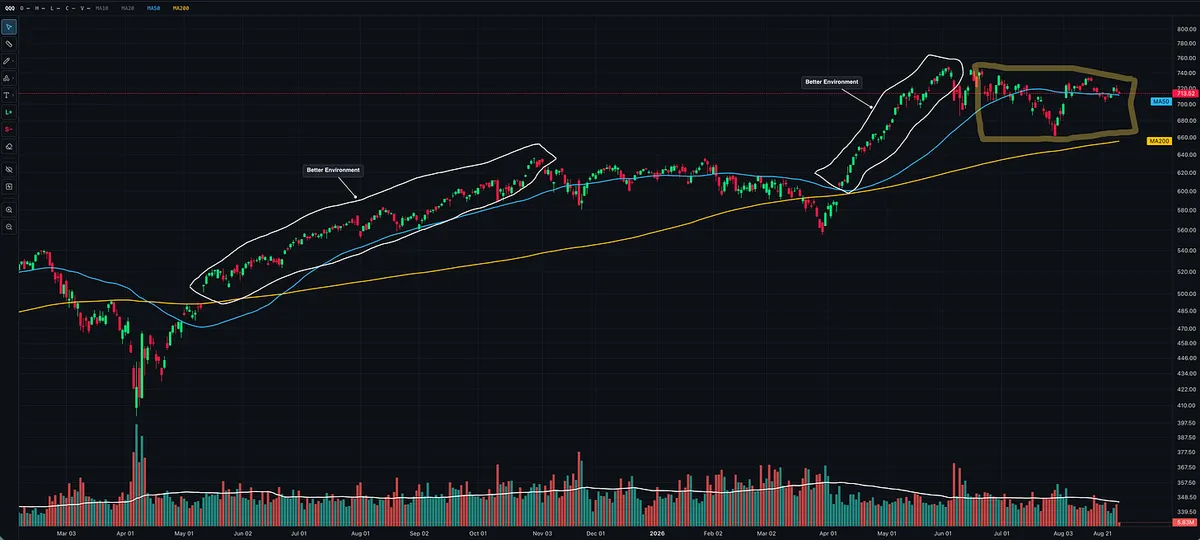
BUT throughout this bull market, many of those non-growth areas have tended to become more prominent when the dominant growth and technology leaders, which have been closely aligned with the AI-driven theme of this bull market, were cooling off, correcting, or moving sideways. During those periods, I generally would have been better served by reducing trade size, frequency, and overall exposure until the stronger growth leadership returned.

That’s the part I’m watching closely.

The market still looks healthy enough to trade, but this is not an easy-money environment.

When a bull market is firing on all cylinders, the strongest growth stocks are breaking out, RS is expanding, and the best setups tend to follow through quickly.

Right now, we are seeing more rotation, more cyclical and defensive leadership, and more laggards beginning to participate, and more failed breakouts. Many of these are the same areas that were overshadowed during the strongest periods of growth and technology leadership in this bull market.

So I would not call this a red-light environment, but I also would not call it a full green-light, easy-money market.

We’re also heading into a seasonally more difficult period for the market, which is another reason to stay alert. Seasonality alone will never determine my positioning. I’ll always let price action, leadership, and my individual trades tell me what to do. But combined with the rotation and changing quality of leadership we’re seeing, it’s something worth keeping in the back of our minds.

It feels more amber right now. Tradable, but cautionary.

View on Substack ↗

Dan Zanger turned $10,775 into more than $18 million. 👀

But the real lesson isn’t the number.

It’s how he traded.

Zanger built his approach around a handful of principles that still matter today:

  • Classic chart patterns and proper bases

  • Breakouts confirmed by price and volume

  • Explosive earnings and sales growth

  • Leadership within strong industry groups

  • Tight risk management and position sizing

  • Cutting failed breakouts quickly

  • Holding the stocks that keep proving themselves

Resharing this breakdown of Dan Zanger’s 10 Golden Rules, along with lessons from Momentum Masters and his broader trading philosophy.

If you trade momentum, growth stocks, or breakouts, there’s a lot worth studying here. Zanger learned from many of the same books and traders we study and teach in the Momentum Trading Strategy Course, including William O’Neil, Nicolas Darvas, and Jesse Livermore.

The patterns may be 100 years old, but human behavior hasn’t changed.

https://tradingmomentum.substack.com/p/dan-zangers-golden-rules-for-trading

ArticleDan Zanger’s Trading Strategy: Chart Patterns, Breakouts & 10 Golden Rules
View on Substack ↗

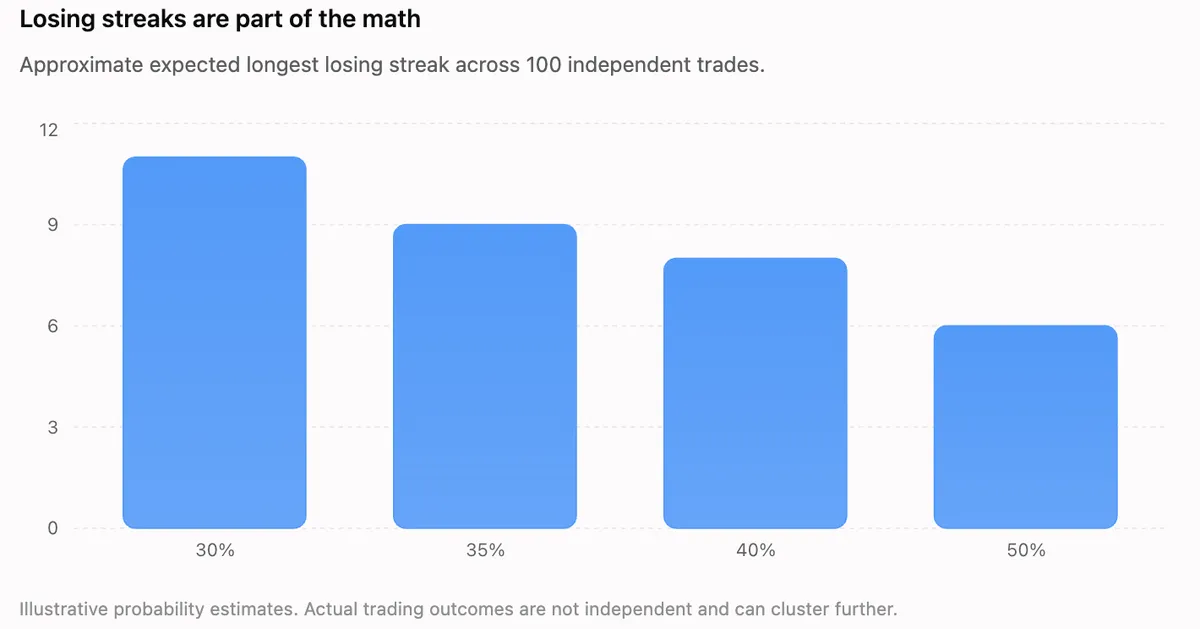
Can You Handle 11 Losses in a Row?

One of the biggest reasons beginner traders fail is not because their strategy has no edge.

They simply cannot handle the losing streaks that mathematically come with it.

A 50% win rate does not mean:

Win → Loss → Win → Loss → Win → Loss

Just like flipping a coin, wins and losses cluster. Over 100 trades, a 50% system can reasonably experience around 6 consecutive losses. Drop the win rate to 30% to 35%, like the type of system Kristjan Kullamägi has openly discussed, and losing streaks of roughly 9 to 11 trades become completely plausible.

Can you take 11 losses in a row and still take trade #12?

Most beginners can't.

First, they're positioned too large, so the drawdown becomes financially painful. Second, they emotionally lose confidence, abandon the strategy, widen stops, revenge trade, or start jumping from one system to another.

Minervini specifically teaches that you want to build failure into your system by keeping losses small enough that you can afford to be wrong repeatedly. When results deteriorate, he says to reduce exposure, not increase it, and then pyramid back up when your trading starts working again. Stanley Druckenmiller does the same thing!

That is why position sizing and progressive exposure matter so much.

Small when you're wrong. Bigger when you're right.

Having an edge isn't enough.

You have to survive long enough, financially and emotionally, for the edge to play out.

View on Substack ↗

When You’re Cold, Stop Swinging for the Fences

Stanley Druckenmiller once said:

“One of my most important jobs as a money manager was to understand whether I was hot or cold. Life goes in streaks, and like a hitter in baseball, sometimes a money manager is seeing the ball and sometimes they’re not... When you are cold, you should be trying for bunts. You shouldn’t be swinging for the fences.”

Sound familiar?

This is essentially what we preach with progressive exposure.

When my trades aren’t working, I don’t respond by getting more aggressive and trying to make the money back.

I get smaller.

I take fewer trades. Smaller positions. Less portfolio exposure. I bunt.

Then, as my trades begin working, setups follow through, and the market confirms that I’m in sync, I progressively increase exposure.

That’s when I start swinging harder.

The market tells you when you’ve earned the right to get aggressive.

Cold → Protect capital. Play small.

Hot → Press your advantage. Get bigger.

One of the biggest mistakes traders make is doing the exact opposite: betting biggest when they’re trading worst because they’re trying to make back what they lost.

Great traders understand that position size should expand and contract with the feedback they are receiving.

You don’t swing for the fences until you’re seeing the ball.