Momentum Trading Strategy

Notes

Short lessons on momentum trading, every day.

Every note from Substack, in one place: risk, setups, leading stocks, market conditions and the mindset behind them. Search them, browse by topic, or filter by stock.

Showing 1–4 of 4 notes

$EDRY ×
View on Substack ↗

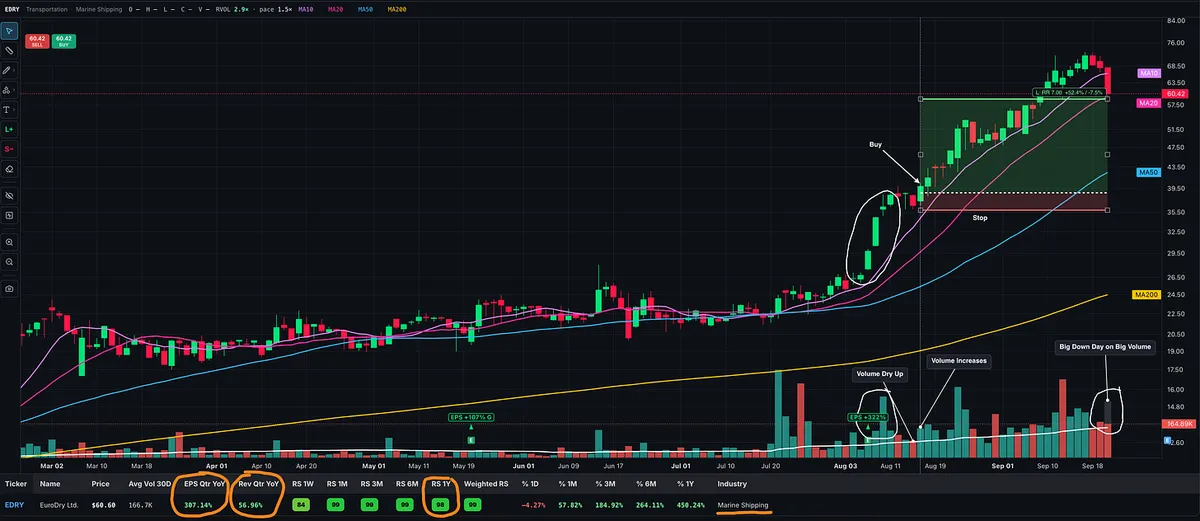
EDRY Just Showed Why Sell Rules Matter

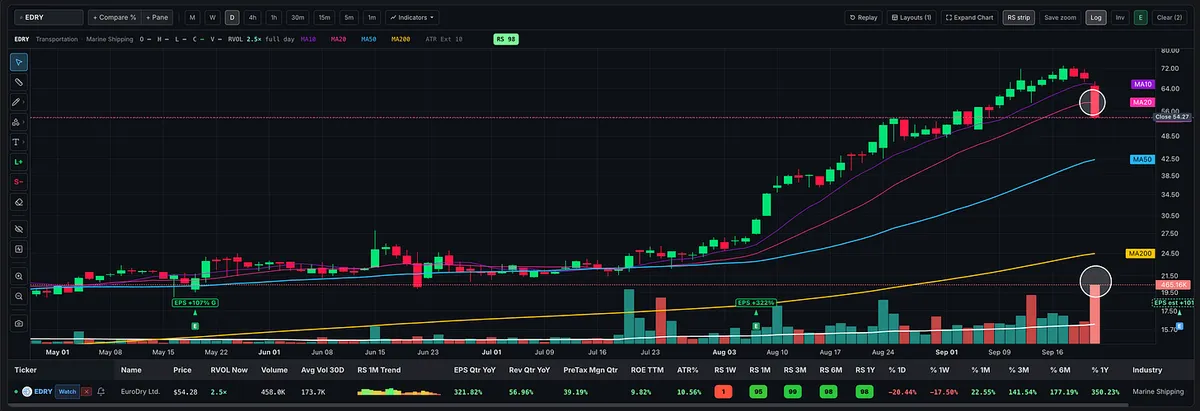
EDRY fell 20.44% today on roughly 2.5× relative volume. After a powerful advance that largely followed the 10-day moving average, the stock delivered a clear change in character.

The first warning was the gap below the 10-day. Selling continued through much of the morning, and price then broke through the 20-day. In MTS Velocity, RVOL Now was already flagging elevated volume early in the session, giving us another reason to pay attention.

An alert near your planned exit level brings the stock front and center. Your sell rules determine what you do next. If you caught the earlier breakout, an orderly exit could still leave you with a substantial profit, even after giving back some of the advance.

Unfortunately, catching a big winner doesn’t automatically make someone good at managing it. Without sell rules, it’s easy to keep finding reasons to hold: the earnings still look great, the industry is strong, or the stock will probably bounce. Meanwhile, a meaningful gain starts disappearing.

Kullamägi’s approach is relevant here. His published breakout rules include taking partial profits after the initial burst and trailing the remaining shares with the 10-day or 20-day moving average, using a closing break of the selected average as the exit signal. EDRY finished below both today.

For a swing trader following a similar approach, this is a textbook sell signal. Other traders may have acted earlier under rules for a sharp, heavy-volume breakdown. The important thing is having those rules established before the selling starts.

And if EDRY rebounds tomorrow or reaches new highs again? That wouldn’t invalidate a disciplined exit based on today’s evidence. You evaluate a trading process across many trades, and protecting gains sometimes means leaving before a stock’s final advance.

Sell rules exist because you cannot know which breakdown will recover and which will become a much larger decline.

A single unmanaged position can undo months of good trading. You don’t need to capture the exact top, but you do need to know when your plan says the trade is over.
View on Substack ↗

Give Me the Meat in the Middle

A lot of traders obsess over buying the exact bottom and selling the exact top. I’ve found plenty of success, and a lot more contentment, taking the meat in the middle.

Look at EDRY.

For months, it chopped sideways, developing higher lows and finding support around the 50-day. Buying a pullback might have kept you involved, but your capital could have spent considerable time waiting for sustained progress. Minervini addresses this directly: money sitting in a stock that goes nowhere has an opportunity cost while other setups develop.

Then August brought an explosive earnings move on heavy volume.

Buying immediately before the announcement would have meant gambling on the market’s reaction. Instead, you could wait and study that reaction, how well the stock held its gains, and whether buying continued afterward. Missing the first burst doesn’t necessarily mean missing the opportunity.

EDRY then tightened up. After several sessions of strong momentum, price moved sideways and volume dried up. Both Minervini and O’Neil describe tight price action accompanied by contracting volume as constructive evidence that selling pressure is diminishing.

When volume returned and price pushed out of that short consolidation, there was an entry opportunity with a nearby low against which to define risk. Depending on the entry, the low of the day could also serve as the stop.

As O’Neil writes: “You want a stock to prove its strength to you before you invest in it.”

From there, EDRY largely followed its 10-day moving average higher. Now the sharp break beneath that line on heavy volume, toward the 20-day, marks a change in behavior. For a swing trader managing this move around those averages, that deserves attention.

Kullamägi’s published approach includes taking partial profits and trailing the remaining position with the 10-day or 20-day moving average. His moving-average exit rule looks for a close below the selected line, which matters when evaluating an intraday break.

There were opportunities to sell some into strength along the way, too. Many successful traders have made the broader point that consistently capturing the exact low and high is unrealistic. Successful trading leaves some of the move behind.

You could miss the bottom, wait until after earnings, and exit below the peak while still capturing a substantial move.

That’s why I maintain a watchlist, set alerts, and look for momentum followed by tightness, drying volume, and renewed demand.

Give me a sound entry and defined risk. The meat in the middle is enough.

And if I miss it? Stay patient and move on to the next setup.

View on Substack ↗

Marine Shipping Is Showing Exactly What O’Neil Taught

“The majority of the leading stocks are usually in leading industries.” — William O’Neil, How to Make Money in Stocks

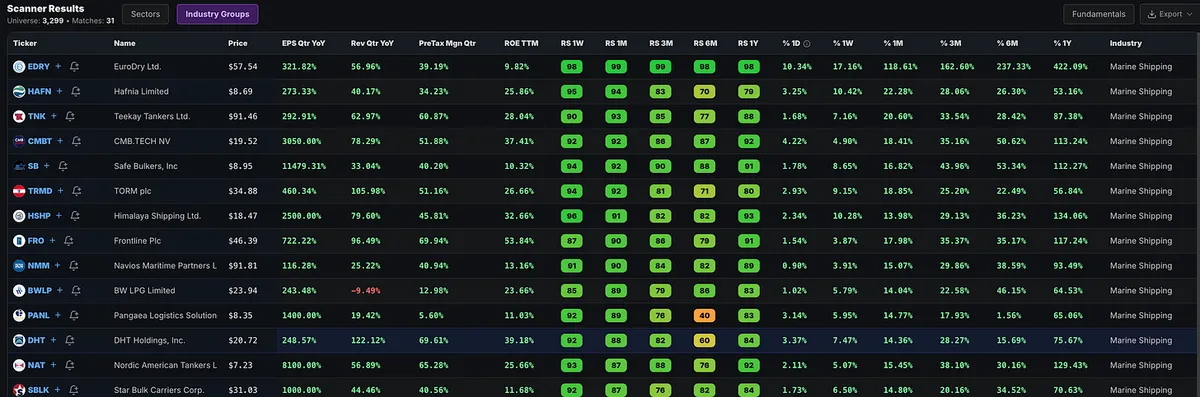
Look at the Marine Shipping strength in MTS Velocity. The group ranks #3 out of 140 industry groups, with a blended relative strength rating of 98.

EDRY, TNK, SB, TRMD, FRO, DHT. Multiple names are advancing together, with strong earnings growth and relative strength showing up across the group. This is exactly why I look beyond an individual stock’s chart and check what its peers are doing.

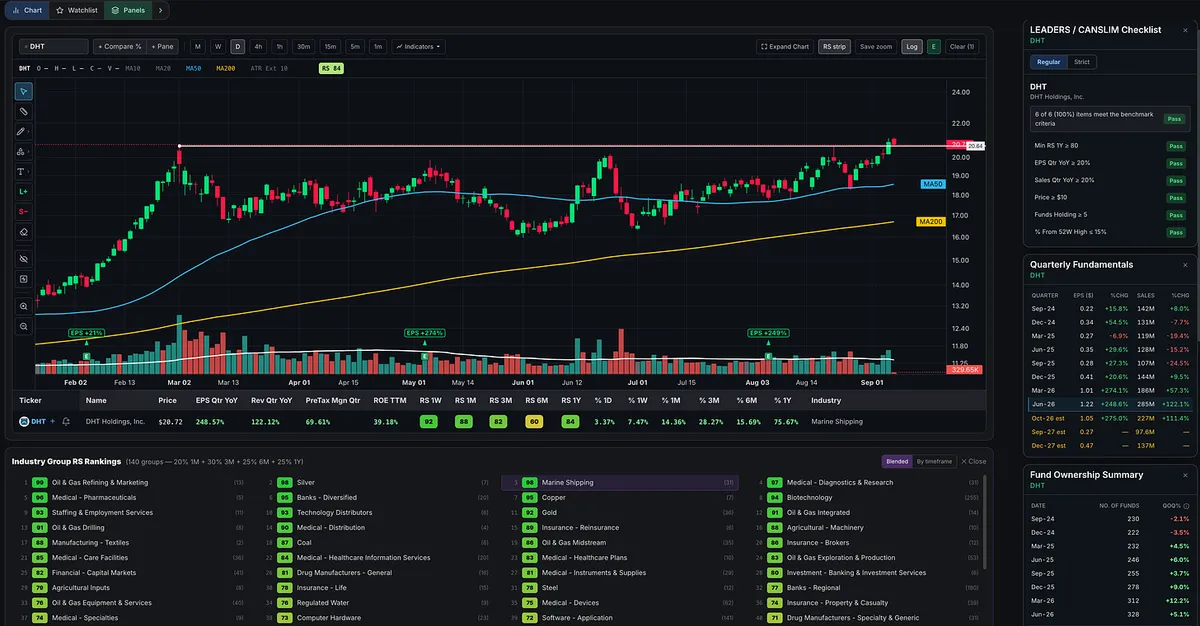
DHT is one example, working through resistance near $20.64 after a multimonth base. The attached screen shows quarterly earnings growth of approximately 249%, sales growth of 122%, and fund ownership climbing from 222 to 328 funds since December 2024.

Strong fundamentals. An improving chart. A leading industry group behind it.

That doesn’t make every shipping stock a buy. O’Neil emphasized selecting the leaders within strong groups, and we still need a proper entry and a defined exit if the trade fails.

Before you buy a stock, look at the company it keeps.

View on Substack ↗

This Is What Demand Looks Like

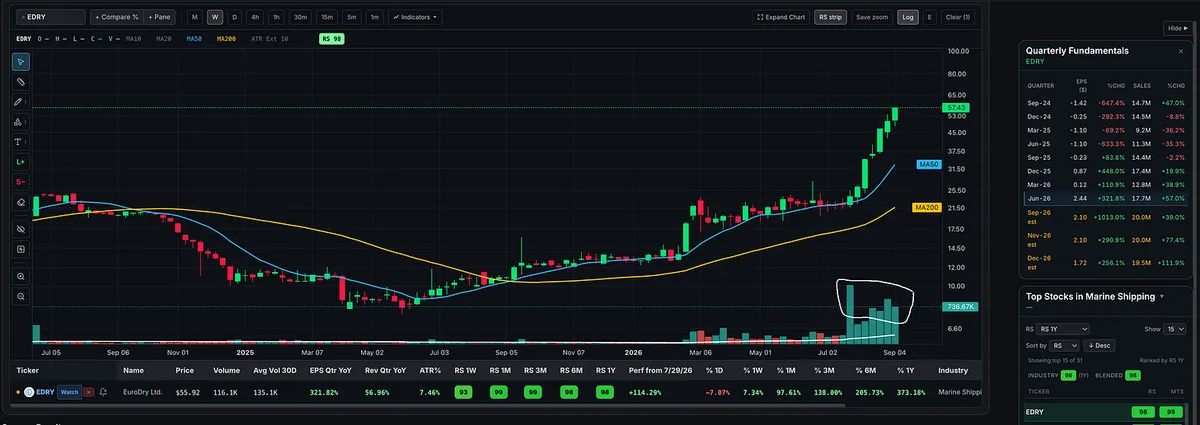
Look at that volume coming into EDRY.

William O’Neil taught that volume is the best measure of supply and demand and institutional sponsorship. Mark Minervini makes the same point: a proper Stage 2 advance should show significant volume on big up days and weeks, with lighter volume during normal pullbacks.

That is exactly what this weekly chart is showing. As EDRY broke out and accelerated, volume expanded dramatically. Price and volume rising together tell you that demand is overwhelming supply.

Train your eye to recognize this kind of volume expansion. Big price moves need fuel, and volume shows you when serious buyers are stepping in.