Back at Your Entry Doesn’t Automatically Mean Sell.
You buy the breakout. The stock moves higher. Then it pulls back toward your entry.
Suddenly, you’re questioning the entire trade.
Ideally, a stock takes off after you buy and never looks back, but good trades don’t always develop that cleanly.
Mark Minervini discusses this in his explanation of “squats and reversal recoveries.” A breakout can stall, pull back, and still recover. He cautions against abandoning a trade prematurely when the stop remains intact and major technical violations aren’t developing, particularly in a healthy market.
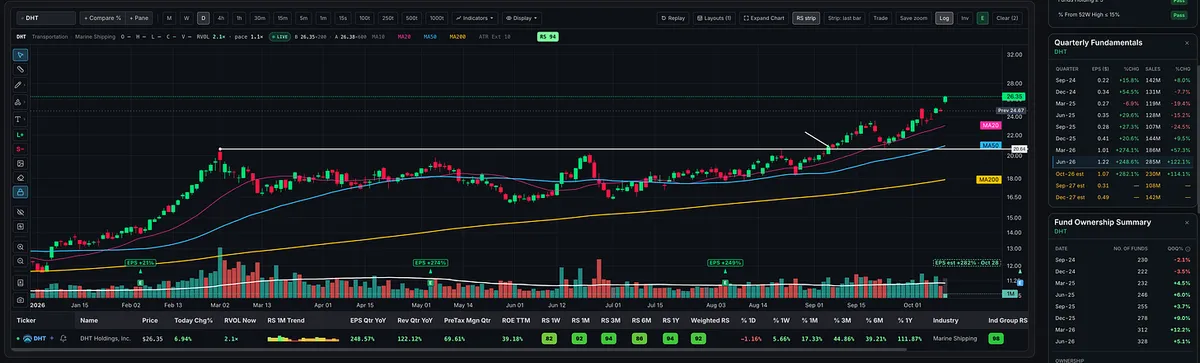
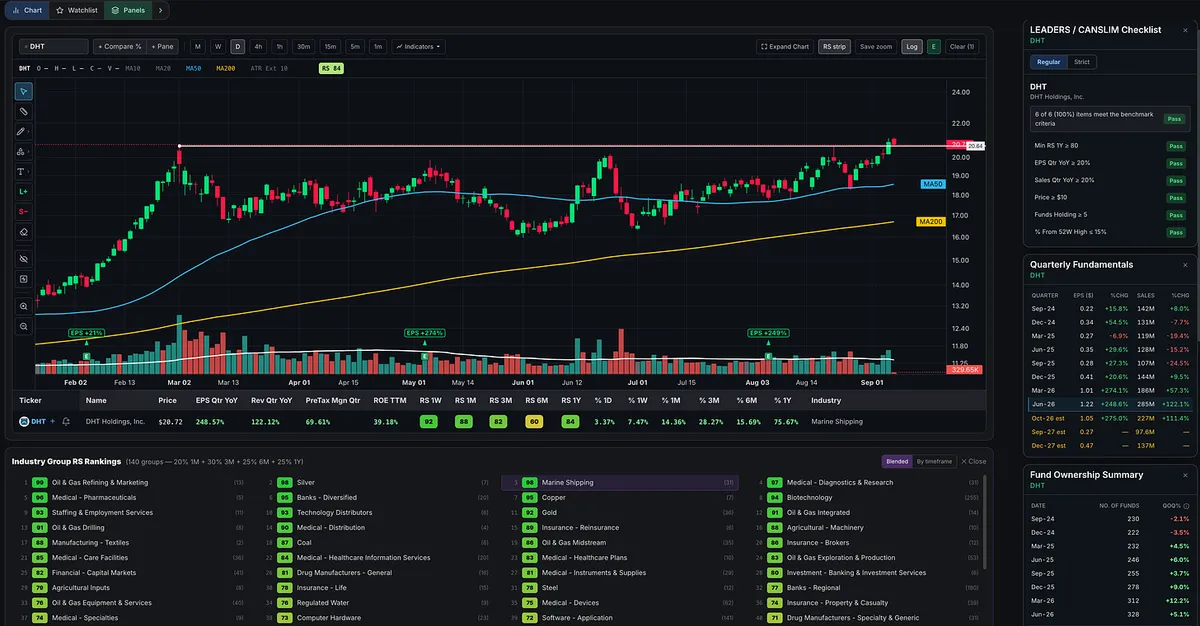
DHT illustrates the broader lesson.
On the chart, price clears the base, advances, then pulls back toward the original breakout area in its first natural reaction. It finds support and resumes moving higher.
That return toward the breakout area didn’t automatically mean the trade had failed.
Depending on your original stop, time horizon, and the stock’s behavior, this may be a situation where you simply follow your plan and allow the reaction to play out.
Minervini describes a natural reaction followed by a recovery to new highs as an opportunity to raise your stop. Once that recovery occurs, moving the stop to breakeven or better may make sense, depending on the structure of the trade.
How far the stock has already moved in your favor matters, too.
A small initial gain pulling back toward your entry is different from surrendering a profit worth several times your original risk.
Minervini also discusses raising stops after gains of roughly two or three times initial risk, particularly when those gains exceed your historical average. Protecting that progress may involve raising your stop or taking some profit into strength, depending on your plan and market conditions.
The distinction is between normal fluctuation and price action that invalidates your setup. Is support holding? Is selling pressure easing? Or are heavy selling and technical violations piling up?
Respect your stop. Respond to genuine deterioration. Give the trade room to develop within the risk you planned.
Your entry price is a reference point. Returning to it is not, by itself, a reason to sell.