Momentum Trading Strategy

Notes

Short lessons on momentum trading, every day.

Every note from Substack, in one place: risk, setups, leading stocks, market conditions and the mindset behind them. Search them, browse by topic, or filter by stock.

Showing 101–120 of 1222 notes

View on Substack ↗

You Came Here to Become a Better Trader. You May Leave With Much More.

In Jack Schwager’s Market Wizards, Ed Seykota said:

“Yes, the winning traders have usually been winning at whatever field they are in for years.”

That line goes far beyond trading.

A great student. A dedicated athlete. A successful business owner. Different pursuits, but often the same underlying habits: discipline, preparation, accountability, and a willingness to improve.

We love the stories of high school dropouts and people working ordinary jobs who become exceptional traders. But the important part of those stories is what they did to get there.

They changed their behavior before they changed their results.

Many people come to Momentum Trading Strategy to learn growth-stock momentum trading. That’s what we teach. But I believe one of the biggest benefits is something you might not initially recognize:

An environment built around behaviors that help you succeed throughout life.

We talk about:

  • Confidence with humility. Believe in yourself while accepting that you have more to learn.

  • Big goals backed by daily work. Ambition means little if your behavior stays the same.

  • Process and honest review. Study what you do well and confront what needs to change.

  • Openness to feedback. Listen to uncomfortable truths without immediately defending yourself.

  • Emotional awareness. Recognize what you feel without letting every feeling dictate your next decision.

Those habits can strengthen your business, your relationships, and your ability to master another craft.

And I would argue that trading can raise the bar even higher.

A successful doctor, lawyer, engineer, or athlete can still struggle in markets. Success elsewhere doesn’t automatically transfer. Trading requires new skills and can expose blind spots that another profession never forced someone to confront.

The need to be right. Impatience. An unwillingness to accept uncertainty. Taking mistakes personally.

Working through those weaknesses can benefit far more than your account. Learning to accept feedback, own a mistake, and respond thoughtfully under pressure can benefit your family and everyone around you.

Even risk management carries over.

You begin thinking more carefully about how much to commit, what you can afford to lose, and whether the potential reward justifies the downside. You become more willing to try, fail small, learn, and take another chance when the upside is worth pursuing.

You don’t have to arrive as someone who has always been winning. But you have to be willing to change the behaviors that keep holding you back.

That’s one of the most beautiful opportunities in trading: the work you do on yourself can keep paying off long after you close the charts.
View on Substack ↗

The Market Doesn’t Care Who You Are. And That’s a Beautiful Thing.

In life, your background, connections, appearance, and other people’s biases can open doors or close them.

In trading, you don’t need someone to like you, hire you, or decide you belong. The market doesn’t care about your race, religion, politics, or last name.

That’s an extraordinary opportunity.

Yes, big players have advantages in market making and high-frequency trading.

Get over it. You don’t have to play in those arenas. There are plenty of ways to make money without competing where their edges dominate.

Trading offers something rare: a chance to compete without first winning someone else’s approval.

Don’t use their advantages as an excuse to avoid confronting your own mistakes or putting in the work.

Stop obsessing over the edge they have. Start building yours.

View on Substack ↗

I’d Take a 40% Return Over 100%. Here’s Why.

Big returns are the goal. But a profitable outcome doesn’t justify behavior that can destroy an account.

Consider two hypothetical traders over the same full year:

  • Trader A: Returns 100%, but suffers a 60% maximum equity drawdown while oversizing positions and ignoring planned exits.

  • Trader B: Returns 40% with a 10% maximum equity drawdown while following position-sizing and exit rules.

I would favor Trader B. I want a process I can keep repeating.

Two metrics help me evaluate that:

1. Calmar ratio: Annualized compounded return divided by maximum drawdown over the same period. Using the same equity-measurement method, these traders’ one-year ratios are 1.67 and 4.0. Trader B earned more return relative to the drawdown experienced.

That drawdown should reflect account equity, including open profits and losses. A closed-trade report can hide declines that recovered before exit. Intraday observations can also reveal losses missed by daily snapshots.

2. Maximum adverse excursion (MAE): How far an individual trade went against you while it was open.

A stock bought at $100, held through $75, and sold at $115 produced a 15% gain with a 25% price MAE. That isn’t automatically a 25% account drawdown, but it raises a question: Did you follow your risk plan?

Jack Schwager writes in Unknown Market Wizards:

“Return levels only have meaning in context of the risk undertaken to achieve those returns.”

Peter Brandt explicitly advocates Calmar as a measure of performance relative to risk. And Mark Minervini writes:

“My goal, as always, is to minimize risk and maximize my potential gains.”

The older I get, the more I care about improving that balance.

Positions need to be large enough for winners to matter and controlled enough for losses to remain manageable. Calmar and MAE help evaluate that balance, although neither reveals every risk.

I want substantial returns earned through a process that protects my ability to keep trading.

View on Substack ↗

The Trading Work You Avoid Could Be Costing You

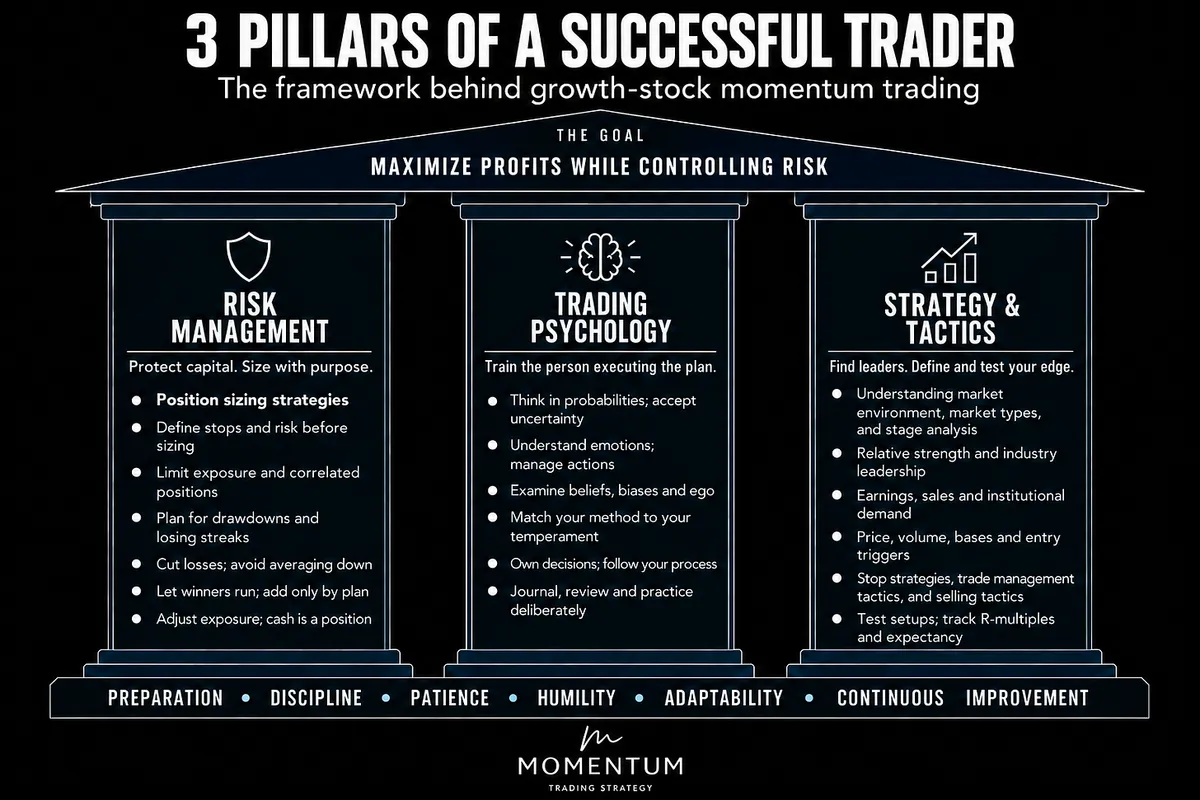
If you’re struggling with trading or not getting the results you want, take an honest look at the three pillars: risk management, trading psychology, and strategy & tactics.

Are you giving each one the time and effort it deserves?

It’s easy to spend hours studying charts, finding setups, and refining entries. But how much time goes into improving your position sizing, reviewing your mistakes, or understanding why you abandon your plan under pressure?

One or two recurring weaknesses can undermine an otherwise sound approach. Taking too much risk. Refusing to accept a small loss. Repeating a mistake you never stop to examine.

And the areas we neglect are often the ones we least want to work on.

Imagine what could change if you gave risk management and trading psychology the same attention and commitment you give your strategy.

Which pillar have you been neglecting, and what’s one thing you can work on this week?

View on Substack ↗

William O’Neil Said This Decades Ago.

One of my favorite distinctions from William O’Neil in Market Wizards:

“So you treat a fund very differently from an individual stock account?” “Very, very differently. With an individual stock, you absolutely have to have a stop-loss point, because you never know how far down the stock is going.” - William O’Neil, Market Wizards

This is an important difference.

An individual stock and a diversified fund should not always be managed the same way.

An individual company can permanently deteriorate.

Earnings can collapse. Management can fail. A competitive advantage can disappear. In extreme cases, the stock can eventually become nearly worthless.

That is why O’Neil was so aggressive about cutting losses in individual stocks.

But a broadly diversified fund is different.

O’Neil went on to say:

“When you buy a fund, you want to be in it for 15 years or more. That is how you will make the really big money. But in order to do that, you need the courage to sit through three, four, or five bear markets. The typical diversified growth stock fund will go up 75 to 100 percent in a bull market, but it will decline by only 20 to 30 percent in a bear market.”

- William O’Neil, Market Wizards

That gets to the heart of his argument.

A diversified fund owns many companies across the economy. Individual companies can fail while the fund survives, changes its holdings, and participates when the broader market eventually recovers.

And I think this principle translates directly to many ETFs today.

A broad-market ETF tracking something like the Nasdaq-100 (QQQ), S&P 500 (SPY) or total U.S. stock market (VTI) is much closer to the diversified mutual funds O’Neil was describing than it is to owning one individual company.

But….

Not every ETF should be treated this way.

Leveraged ETFs, inverse ETFs, single-stock ETFs, highly concentrated sector ETFs, and narrow thematic ETFs can carry very different risks.

And if you are trading an ETF tactically rather than holding it as a long-term diversified investment, a predefined stop should be used.

Don’t treat a broken individual stock like a diversified index fund.

And don’t treat a normal bear-market drawdown in a broadly diversified long-term fund like one company whose thesis has completely failed.

Ironically, O’Neil pointed out that many investors do the exact opposite.

They hold individual-stock losers hoping they come back, then panic and sell diversified funds during bear markets.

Individual stocks require protection from permanent loss.

Broad diversified funds require the patience to survive normal market cycles.

Two different vehicles.

Two different jobs.

Two different timeframes.

Two different approaches to risk.

View on Substack ↗

I Came for the Money. I Stayed for the Game.

I came to trading to make money. Most of us did.

But somewhere along the way, what kept me here changed.

Some people stay because the occasional winner keeps them chasing the next rush, even while their account shrinks. That can become the same trap that keeps someone returning to a casino.

For others, something different happens. We discover that trading is far more difficult than we imagined, and the difficulty draws us deeper into the work. Like someone training for a marathon or mastering any craft, the challenge itself becomes part of the reward.

That theme comes through in Jack Schwager’s Market Wizards interviews:

  • Mark Minervini, Stock Market Wizards: “You have to love trading.” He explains that money initially attracted him, but his motivation became the pursuit of being the best at something.

  • Bill Lipschutz, The New Market Wizards: “I like the game. I think it’s a great challenge.” Asked whether he would still trade without being paid, he says he would.

  • David Ryan, Market Wizards: “To me it is like a giant treasure hunt.” His satisfaction comes from finding a potential big winner before its move.

  • Ed Seykota, Market Wizards: “Great traders are ones who are absorbed by the talent.” He explains that they do not merely possess the talent; “the talent has them.” Elsewhere in the interview, he credits his success to his love of the markets and describes trading as his calling.

I understand that feeling.

What hooks me goes beyond finding the next winning stock. It is the person I have to become to trade well.

Patient enough to wait. Disciplined enough to prepare. Confident enough to act. Humble enough to admit I am wrong. Willing to take a loss without turning it into a verdict on my ability.

The market has a way of exposing the distance between who you think you are and how you actually behave.

You can talk about patience until you have to sit in cash. You can talk about humility until you’re on a hot streak. You can talk about discipline until following your rules becomes uncomfortable.

And there is always more to learn. Experience improves your judgment, but it never gives you certainty. The market can still surprise you.

If this were easy, with nothing left to discover or improve, I would lose interest. There are easier ways to make money.

Momentum Trading Strategy is for people who love the game and want to do it right. People willing to study, take responsibility, and grow as both traders and individuals.

If you’re here to gamble, chase a dopamine hit, or collect stock tips without doing the work, this is not the place for you. The internet already has plenty of content feeding those habits.

What brought you to trading, and what made you stay?

View on Substack ↗

Before You Blame the Strategy, Show Me Your Last 20 Trades.

“O’Neil doesn’t work anymore.”

“Minervini is outdated.”

“That stuff only worked back then.”

Maybe start with a harder question:

Have you actually followed the strategy well enough to evaluate it?

I’ve received messages from traders ready to dismiss an entire approach before they’ve learned its rules, studied their results, or understood the conditions it requires.

These principles have deep roots. In How to Make Money in Stocks, O’Neil studies market leaders stretching back to the 1880s. Minervini describes building on historical winners and studying the great traders before him. Different generations have refined recurring lessons about leadership, price and volume, risk, and human behavior.

Early in my own journey, I spent countless hours trying to prove them wrong, only to keep finding flaws in my own understanding and execution. I was trying to disprove rules I hadn’t consistently followed. Funny how that works.

That history doesn’t make any strategy immune to scrutiny, but scrutiny requires evidence.

Before blaming the method, audit yourself:

  • Market conditions: Are you forcing trades in an environment your strategy is poorly suited for? A method built around sustained advances will struggle when breakouts repeatedly fail.

  • Expectations: If your approach can be profitable with a 30–40% win rate because winners substantially outweigh losers, why are you demanding a 70% win rate? Do you understand its expected losing streaks?

  • Position sizing: Are you taking so much risk that ordinary losses become financially or emotionally unbearable?

  • Exits: Are you cutting winners before they can offset your losses? Are you widening stops after entry and allowing one oversized loss to erase multiple gains?

  • Execution: Can you identify a valid setup, explain the price and volume action, and define where the trade is invalidated before entering?

  • Review: Do you know your average win, average loss, win rate, and how consistently you follow your rules?

Minervini dedicates an entire section of Think and Trade Like a Champion to knowing the truth about your trading. As he puts it:

“Your results are your personal truth.”

I’ve offered some of these traders a straightforward starting point: send me your last 20 trades, and let’s review them.

Sometimes those trades never arrive.

I can’t know why, but without examining the evidence, we’re left debating opinions while the actual problem remains unidentified. Twenty trades won’t establish a strategy’s long-term edge, but they can reveal repeated execution mistakes.

Among those who have shared their trades with me, I’ve almost always found violations of several basic rules. Some initially felt defeated by that realization, but their willingness to face the evidence gave them something useful: specific mistakes they could correct, potentially saving years of repeating them.

I try to approach this with empathy. I don’t know what pressure someone is under or how urgently they need money. That pressure can make patience and objectivity difficult.

But becoming a trader requires learning to lead yourself.

That includes me. When I’ve struggled, I’ve often found that I drifted from my process and violated the same rules the Market Wizards teach and I emphasize myself.

When conditions deteriorate, I know I should reduce size, trade less, and sometimes move entirely to cash. There have been times when I ignored that and paid the price.

Paul Tudor Jones explains it plainly in Market Wizards:

“When I am trading poorly, I keep reducing my position size.”

Good execution can still produce losses. Strategies don’t work equally well in every environment. Accountability means understanding those realities and examining how you responded.

The spiritual teacher Sadhguru’s idea of becoming a “blissful failure” captures something valuable here: pursue ambitious goals wholeheartedly without making your inner peace dependent on every outcome.

For trading, that means accepting that you can do the work, execute properly, and still lose on the next trade.

Get comfortable being wrong. Get rigorous about finding out why.

You cannot improve what you refuse to examine.

View on Substack ↗

How to Stay in Big Winners Without Guessing the Top

If you’re a position trader focused on growth and momentum stocks, here’s a practical way to let your winners run while still cutting your losses short.

You finally buy a great stock. You sell for a nice gain. Then you spend the next three months watching it double.

Finding the winner wasn’t the problem. Holding it was.

Mark Minervini and David Ryan discussed two tools that can help you stay with a strong stock through a bigger move.

First: let the 50-day moving average catch up to your entry.

Start with a proper entry and an initial stop based on the setup. If the trade fails, take the loss.

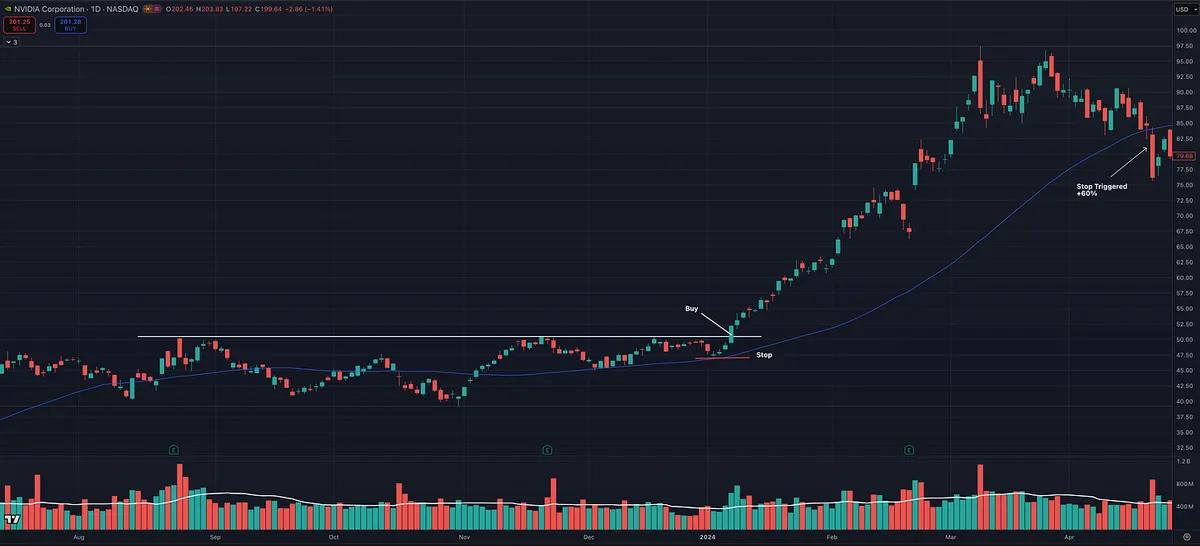
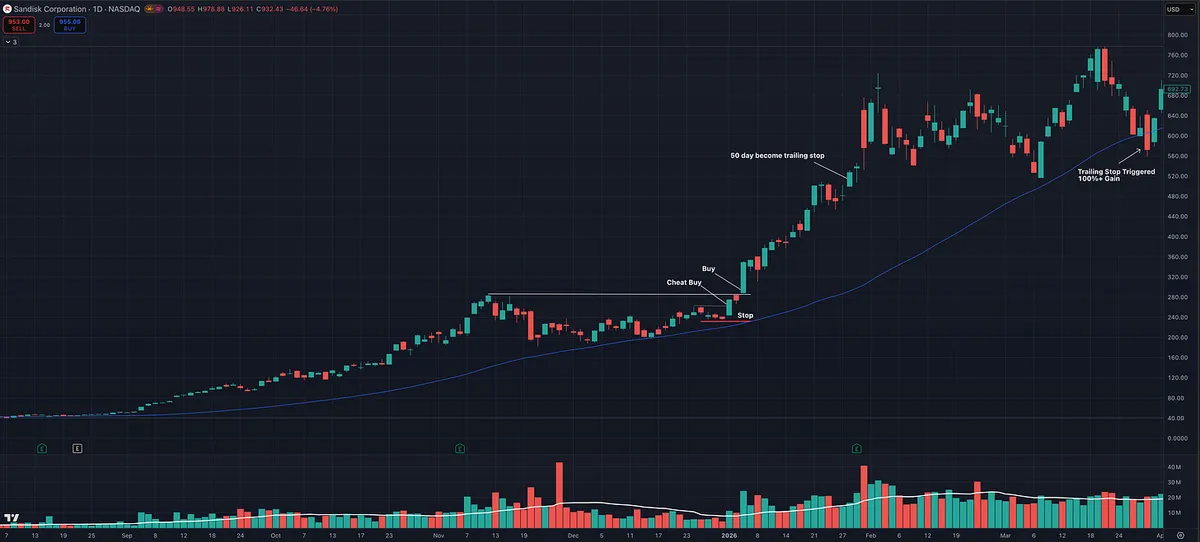
As the stock advances, its 50-day moving average rises. Once that line reaches your entry price or higher, Minervini explains that you can switch to using it as a trailing stop.

He describes this as “breakeven or better.” Your stop reference is now at or above your cost, although a gap below it can still produce a loss.

Minervini particularly likes this approach early in a new bull market, when emerging leaders can run for months while holding their rising 50-day.

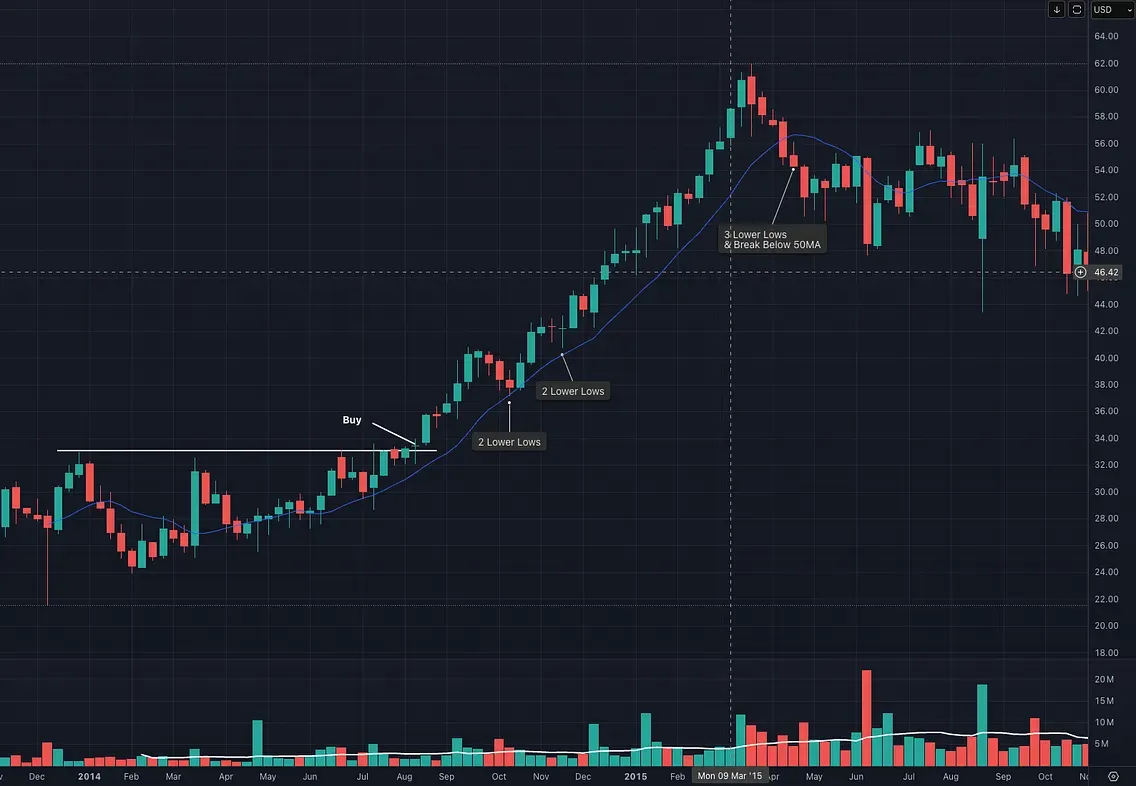
The charts attached show how this can work: a defined entry and initial stop, followed by the rising 50-day helping you stay in the move.

Second: watch the weekly lows.

Ryan noticed that many of the great winners he studied rarely made three consecutive weekly lower lows during their strongest advances.

One or two weeks of pullback were common. Three successive lower lows were a warning that selling had become more persistent.

But he wasn’t talking about each week undercutting the previous low by a few cents. The size of the decline and the volume are important.

Meaningful weekly declines on heavier volume, especially alongside a break of the 50-day or the weekly 10-week line, provide stronger evidence that the stock’s behavior is changing.

Minervini combines Ryan’s observation with the moving average to help judge whether to keep holding. A stock that continues to hold its rising average without persistent weekly deterioration may deserve more time.

You don’t wait for three weak weeks if your stop has already been hit. Remember, these tools help manage an established winner, but your initial risk limits still apply.

Also, holding longer means accepting some giveback. A trailing stop won’t get you out at the exact high. You give the stock room to keep advancing, knowing that some profit will come back before you exit.

If you want to catch a bigger move, you have to sit through some pullbacks. Decide what will get you out before the pullback starts.

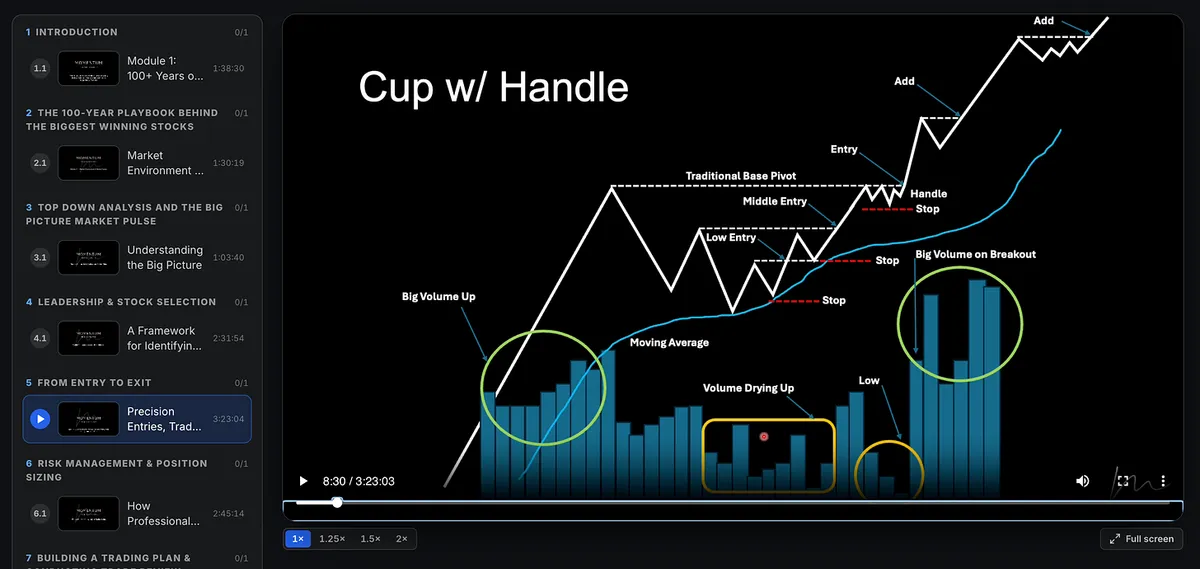
I cover these methods and other ways to manage trades in Module 5 of the Momentum Trading Strategy Course, available to all paid subscribers.

View on Substack ↗

Same Base. Three Places to Buy. They Are Not Equal.

Buying lower feels safer, but inside a stock’s base, the lower entry can be the trickier trade.

Why? More overhead supply. More people who bought higher and may sell as the stock recovers toward their purchase price.

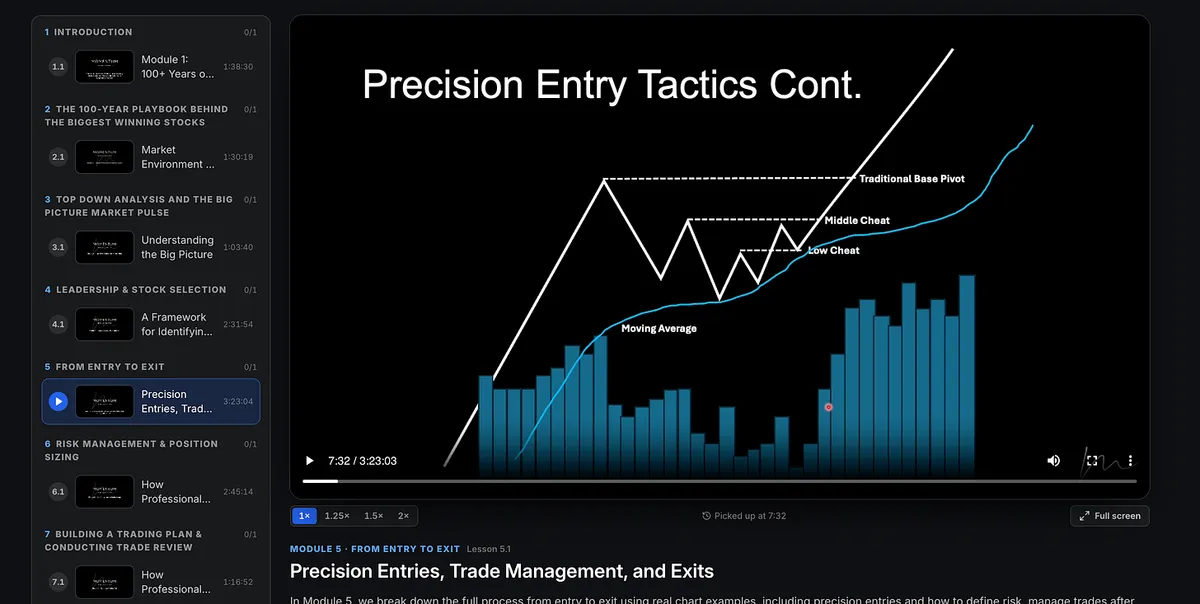
Minervini describes three potential entry areas as a base develops:

1. The low cheat. An early entry as the stock turns up off its lows and forms a small pivot. You’re buying before much of the recovery has happened, with more potential selling pressure above you. It takes more skill than simply spotting a stock that looks cheap.

2. The cheat. A setup higher on the right side of the base. The stock has made more progress and worked through some of that supply, but it still has ground to recover before reaching the old highs.

3. The traditional base pivot. The breakout near the top of the base or a cup with handle can provide an entry in this area. Once the stock clears its all-time high, there are no prior buyers sitting above it waiting to get back to even. That doesn’t eliminate selling, but it removes that particular source of resistance.

The lower price comes with a trade-off. You get in earlier, but the stock has more to prove.

Minervini says he spent roughly a decade trading cups with handles and flat bases before adding cheats, then years trading cheats before adding low cheats.

The advanced entry wasn’t his starting point.

At any entry, know what would invalidate the trade and how much you’re willing to lose. Give normal fluctuations room within your plan, and act when your rules call for it.

Buying lower means dealing with more overhead supply, make sure you have the skill to trade it.

View on Substack ↗

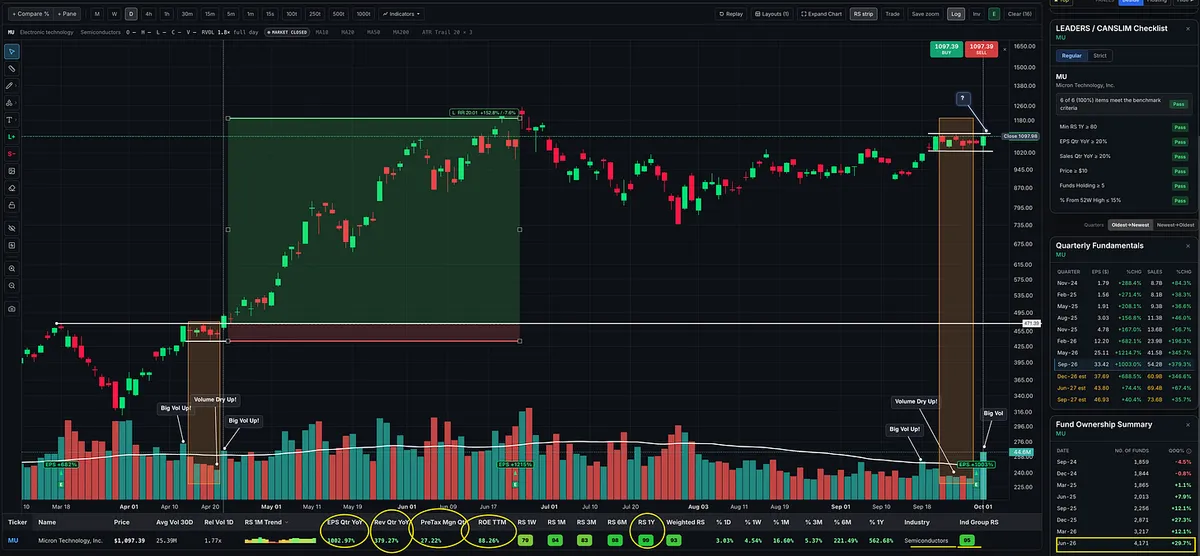
Ummm… hello, MU. 👀

Another massive earnings report, and the chart is getting interesting.

Look at the highlighted setup in April. Now look at the right side of the chart.

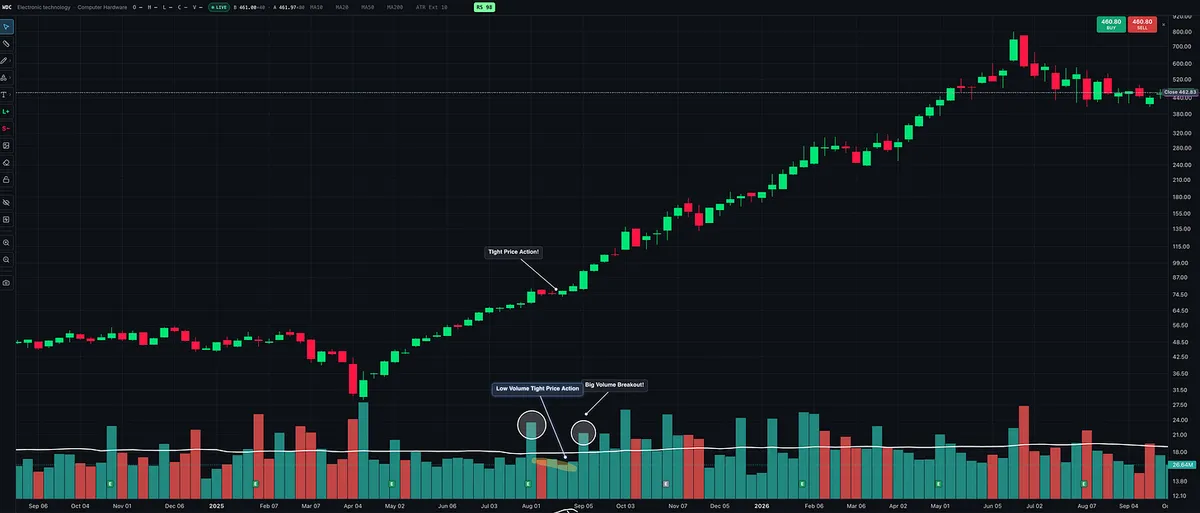
Price tightened, volume dried up, and then buyers showed up before that huge advance.

Now MU is tightening again in the upper half of its base, with volume starting to return. This is exactly the kind of price and volume behavior I like.

I’m watching for a decisive move through the top of this tight range, backed by volume and follow-through.

MU, are we getting ready for another launch? 🚀

View on Substack ↗

Anyone can spot a winner after it doubles.

The skill is recognizing the setup before the move.

When you only study charts after stocks explode, you’re training your eye to recognize the result, not the conditions that preceded it.

Try this instead:

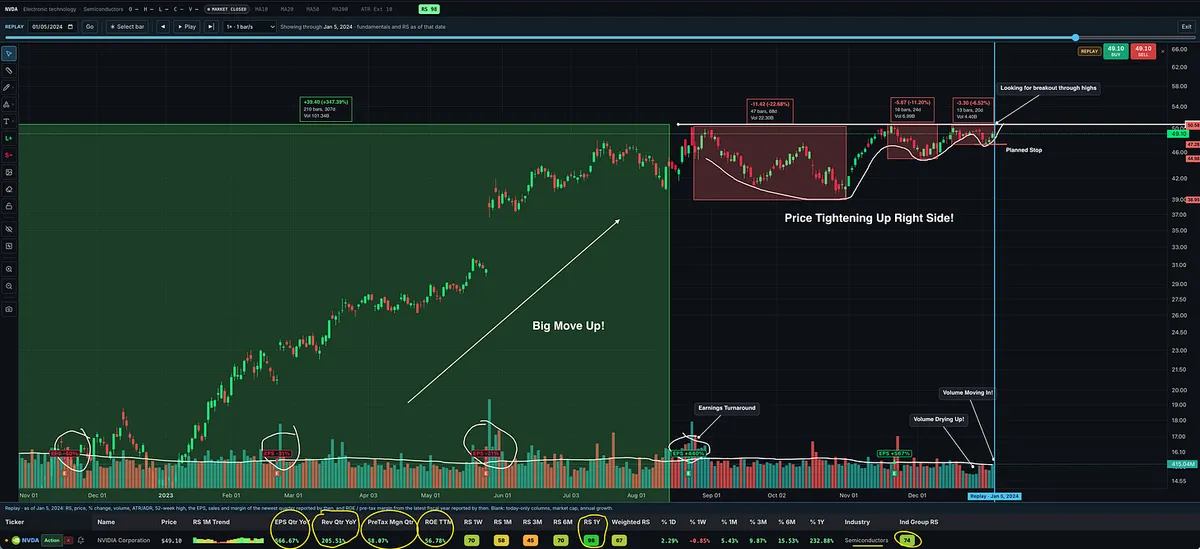
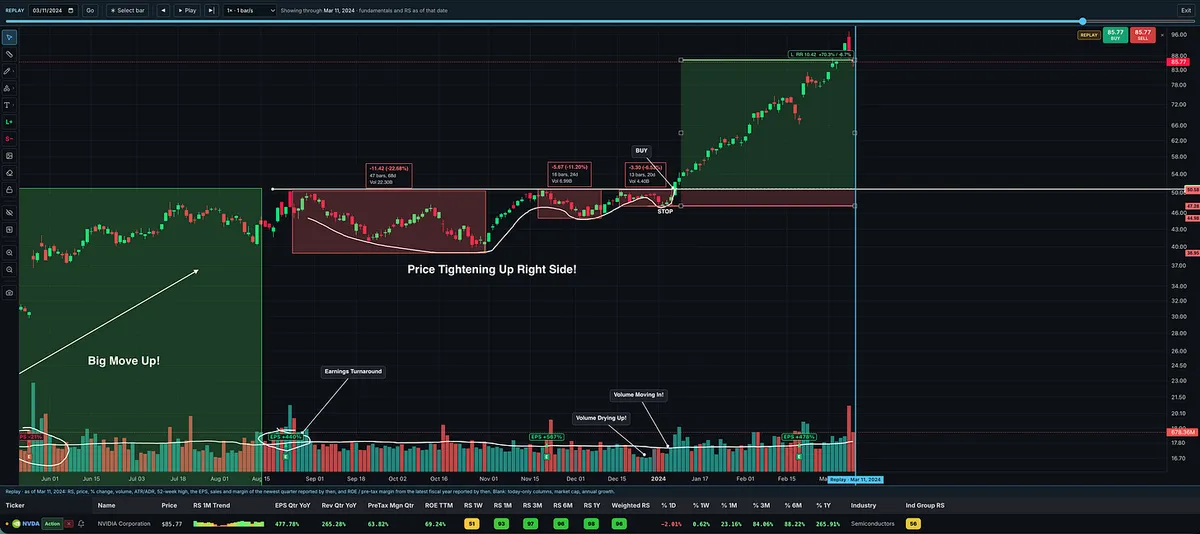
  • Pull up a former market leader and hide the breakout and the run that followed.

  • Use chart replay to move forward one bar at a time, studying the developing base.

  • Before revealing the move, ask: Would this stock interest me without knowing what happens next?

Look for tightening price ranges, higher lows, shallower pullbacks, and volume drying up.

Not the giant green candle. The behavior that came before it.

A scanner can narrow your list, but it cannot do these repetitions for you. That takes deliberate chart study, repeated across many examples.

View on Substack ↗

The breakout is loud. The clues are often quiet.

Everyone notices a stock exploding higher on huge volume. I’m interested in what it was doing before that move.

David Ryan explained it in Market Wizards:

“When a stock that has been moving up starts consolidating, you want to see volume dry up.”

He reinforced the idea in Momentum Masters:

“I would also like to see a very tight base with a small price range and dry-up in volume.”

That’s the sequence I’m watching:

  • Strength first. A strong advance supported by heavy volume.

  • Then quiet. Price holds its gains, the trading range tightens, and volume dries up.

  • Then renewed demand. Volume returns as price pushes higher, sometimes before the obvious new high.

Low volume alone doesn’t interest me. A strong stock holding its gains while price tightens and volume fades does.

That combination can suggest selling pressure is drying up. Then I’m watching for buyers to return and price to confirm an entry.

Don’t just chase noise. Watch for strength that goes quiet, tightens up, and then shows fresh demand.

That is often where the next opportunity begins.

View on Substack ↗

A Cheetah That Chases Every Antelope Starves

Every chase costs energy. Waste enough of it on poor opportunities, and you won’t have much left when the right one appears.

Minervini used this analogy to explain selectivity: the cheetah waits for a vulnerable target before committing to the chase.

Traders face the same problem with their capital, attention, and emotional energy.

There’s always a stock ripping somewhere. Another breakout. Another chart someone posts after a huge move.

You can exhaust yourself chasing opportunities that were never yours to take.

Minervini explains that he watches stocks move every day without participating in almost any of them. Much of his return comes in relatively small windows of opportunity, but he’s always watching.

That’s the work people don’t see: screening, preparing, setting alerts, and passing on trades that don’t meet the criteria.

Waiting doesn’t mean you’ve stopped working. It means you’re prepared to act when your setup appears, with a clear entry and defined risk.

You don’t need to catch every move. Be more like the cheetah.

View on Substack ↗

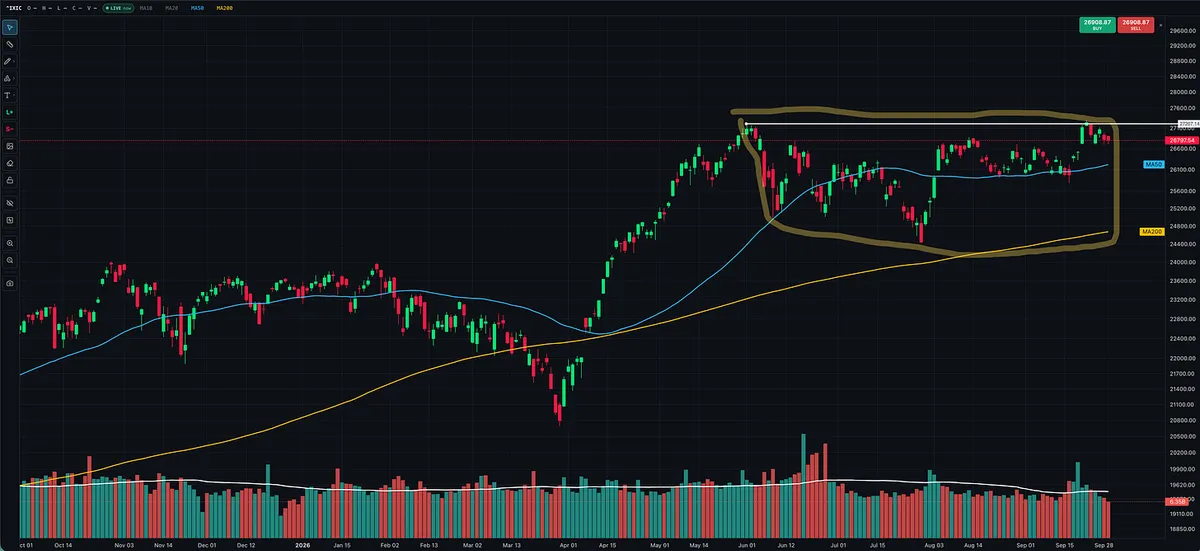
Buying Earlier Won’t Fix a Bad Market.

Most of the time in a sideways, choppy market, I’m in cash.

Growth-stock momentum trading needs sustained follow-through. When the market keeps chopping up our setups, preserving capital is part of the strategy.

When I do trade, it’s usually because strong stocks are emerging within strong industry groups, while the market is pushing toward its highs and showing signs of transitioning out of the range. That’s why I was buying AEHR and other names in early August.

During those transitions, I’ve often found pullbacks and cheat entries easier to work with than traditional breakouts. That’s my experience, not an automatic rule.

I adapt to what the market is rewarding, including what my own trades are telling me.

The stock-selection standards stay the same: strong relative strength, earnings and sales growth, industry leadership, and constructive price and volume action. I want volume supporting advances, quieter pullbacks, higher lows, and tightening price action up the right side of the chart.

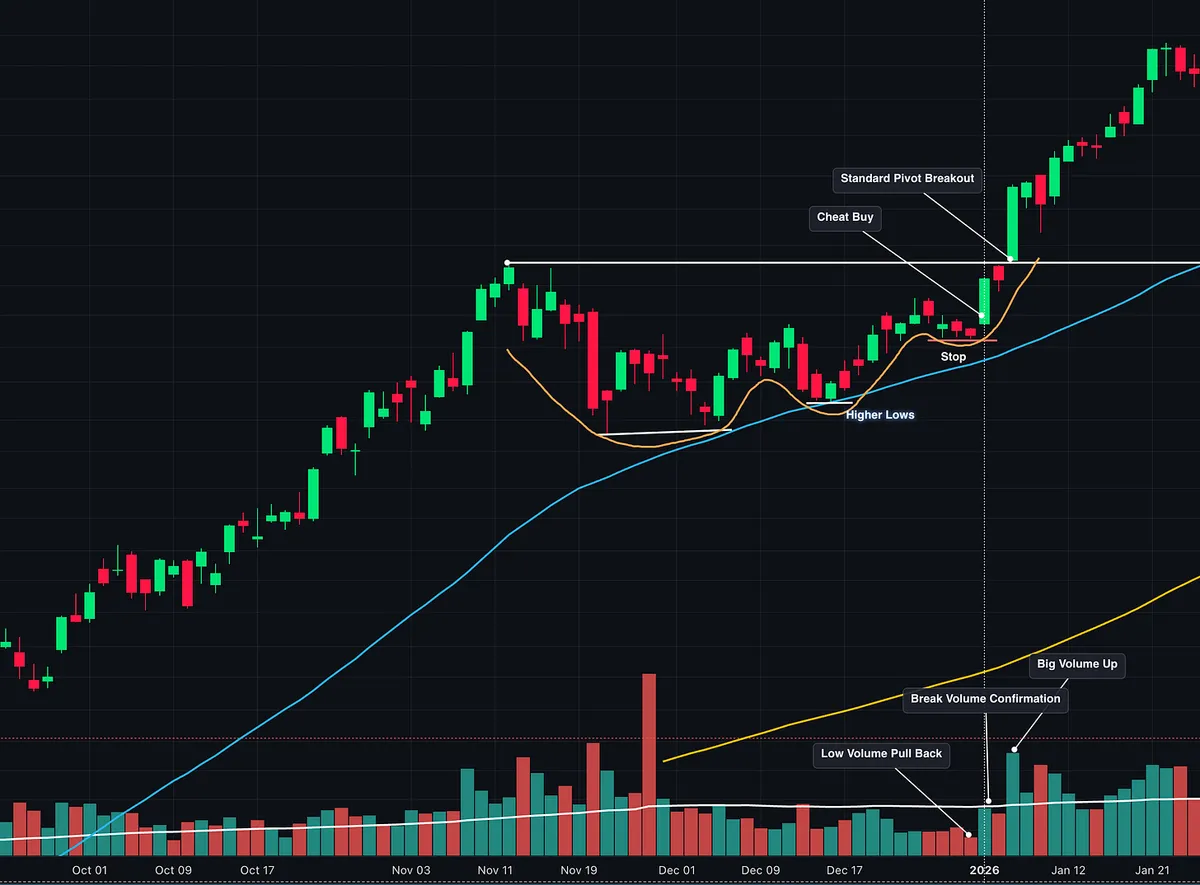
A cheat entry means buying the turn higher through an earlier buy point within the base, before the standard breakout. A pullback entry means waiting for controlled selling to give way to a defined turn higher.

Neither means buying simply because the price is lower.

My stop is defined before entry, usually below the tight setup, relevant pullback low, or low of entry day provided that distance fits my risk limits.

There are trade-offs. Low cheats face more overhead supply. During transitions, I’m quicker to reduce risk as trades progress, even if that means cutting some off prematurely.

I make selective attempts and build exposure as they work. If the market keeps rejecting those attempts, I return to cash.

Cheat entry below: Buying the turn higher before the standard pivot breakout, with risk defined below the recent pullback low.

View on Substack ↗

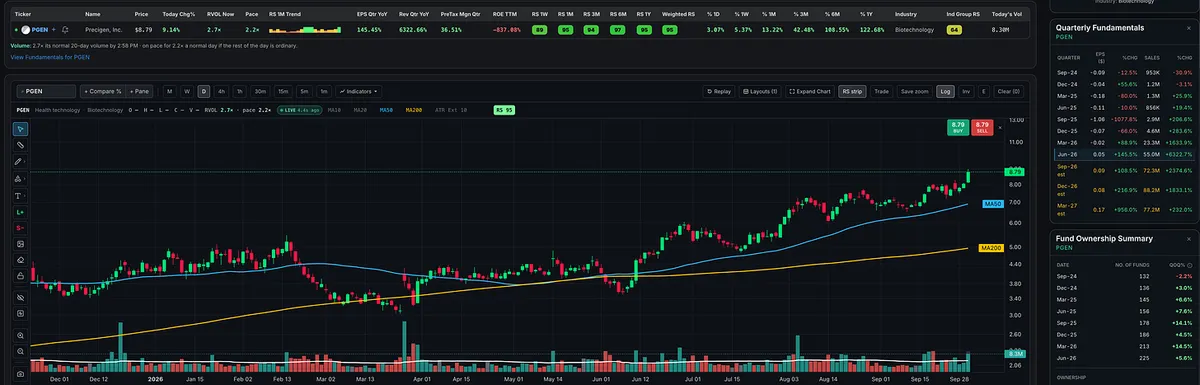
Biotech Keeps Stealing the Show 🧬

Another day of biotech names delivering big gains with strong volume behind the moves.

PGEN is one example: pushing higher with 2.7x relative volume.

View on Substack ↗

Some of You Need More Study. Others Need More Mastery.

Some people open a brokerage account, follow a couple of YouTubers, and think they’ll figure out this trading thing as they go.

Trading requires serious study, just like any other profession. There’s no shortcut around building that foundation.

But there’s another group that has already read the right books and studied successful traders. Their problem isn’t a lack of information. They haven’t learned to consistently apply what they already know.

Have you read How to Make Money in Stocks once, or have you studied it repeatedly? Have you worked through Minervini’s books and Weinstein’s Secrets for Profiting in Bull and Bear Markets until you can explain the principles, recognize them on a chart, and use them to make decisions?

I’d take mastery of five great trading books over a surface-level understanding of 100.

I’ve read more than 30+ myself, But I keep coming back to the same handful. I’ve gone through them over and over, and I still revisit them today. Familiarity with the words isn’t the same as mastery of the material.

For some of you, the next step is more study. For others, it’s going deeper into what you’ve already studied.

But rereading alone won’t make you a trader. You have to practice, review your decisions, and correct your mistakes.

Think crawl, walk, run:

  • Crawl: Build your foundation. Study one sound approach. Work through historical charts. Learn what qualifies as a setup, where you would enter, where you would exit, and how you would control risk. Use a simulator to practice putting those decisions together.

  • Walk: Trade small with real money. Put that process into practice with an amount you can afford to lose. Learn to follow your rules while dealing with the actual emotions of gains and losses. Keep records, review your trades, and continue deepening your understanding of the material.

  • Run: Gradually scale up. Apply the same principle we teach with progressive exposure: build on success. Commit more capital as your execution and results justify it, while keeping your exposure appropriate for market conditions. If your trading deteriorates, scale back.

I see value in simulated trading as a starting point. If you can’t consistently follow your rules in a simulator, adding real money isn’t going to magically create discipline.

But being profitable in a simulator doesn’t automatically mean you’re ready to trade meaningful money. Once fear, greed, and the discomfort of actual losses enter the picture, you have another skill to develop.

You don’t need to know everything before taking a small trade, but you do need a plan, defined risk, and the discipline to learn from what happens.

Reading another book won’t automatically fix the same execution mistake you keep making, and trading bigger won’t fix a process that isn’t working.

Study the material. Master the principles through practice and execution. Review your execution. Earn the right to scale.

But what do I know? 😉

View on Substack ↗

The Market Doesn’t Have to Crash to Wreck Your Account

Everybody fears the big market drop, but for a momentum trader, a sideways, choppy market can do more damage than a clear downtrend.

Think about COVID or the tariff selloff. Those moves were large, and sudden gaps can carry a stock beyond your stop. But with disciplined sell rules, a sustained breakdown pushes us out of positions and into cash. We take the losses, reduce exposure, and wait for conditions to improve.

The danger in a choppy market is that it keeps convincing you to come back.

A stock sets up. You buy. It breaks out, stalls, reverses, and stops you out. Another setup appears, and you think this one will be different. Maybe you even make a little money before the next few trades take it back.

Each loss looks manageable. The cumulative damage is not.

Mark Minervini addresses this directly in Momentum Masters:

“A whipsaw market is more dangerous than a bear market.”

He describes the repeated buying and stopping out as “death by a thousand cuts.” His point is that a clear bear market can force you into cash, while a whipsaw market keeps drawing you into trades that fail.

David Ryan calls a whipsaw market the toughest environment to trade. His response is to reduce exposure, trade smaller, and favor selective pullbacks in leading stocks over breakouts.

Dan Zanger often steps aside entirely:

“Long or short, chop will eat you alive.”

This is why having a stop on every trade is only part of risk management. You also have to manage how often you trade and how much you commit when your setups aren’t working.

You can obey every individual stop and still bleed your account by repeatedly taking full-size positions in an environment that offers little follow-through.

For me, repeated failures are a signal to slow down, reduce size, and become more selective. I want successful trades to justify increasing exposure.

We don’t need to wait for a crash, or settle the debate over whether the market is officially in Stage 3, to recognize that our approach isn’t being rewarded.

Protect your capital from the small losses you keep volunteering to take, too.

View on Substack ↗

Minervini Averaged 50% Cash. Still Feel Underinvested?

Stocks are ripping. The Nasdaq is making new highs. You look at the cash in your account and feel like you’re doing something wrong.

That feeling can get expensive.

Mark Minervini said he had averaged roughly 50% cash over his career.

People see his big returns and assume he must always be fully invested or leveraged, but he explained that he gets aggressive when conditions and results support it, while spending plenty of time in cash or smaller positions.

Big returns don’t require maximum exposure all the time.

The pressure to be fully invested can push you into extended stocks, mediocre setups, and positions you never would have taken without the fear of missing out.

Having cash available doesn’t mean you need to find something to buy today. Let the opportunities develop. Start with manageable exposure, increase it as your trades work, and pull back when they don’t.

That 50% figure was a historical average, not a target allocation. The point is to let your setups and results determine your exposure.

Cash is a position. Your job is to grow the account, not to keep every dollar busy.

View on Substack ↗

You Need Experience to Recognize Expertise

One of the hardest parts of learning to trade is figuring out who is actually worth learning from.

People who don’t know what they’re doing can look incredibly knowledgeable to people who don’t know what they’re doing yet.

Confident predictions. Complicated indicators. Fancy charts. Screenshots of P&L. It can all look like expertise when you haven’t developed the experience to evaluate it.

Meanwhile, someone talking about probability, position sizing, and cutting losses can sound unimpressive.

I think this partly explains why I didn’t find O’Neil, Minervini, and Zanger right at the beginning. By the time I discovered them, I certainly didn’t have trading figured out, but I had enough experience, including enough mistakes, to recognize the value in what they were teaching.

I knew enough to realize they were worth studying deeply.

The more experience you gain, the more your questions change. You start asking how someone manages risk and losses, and how different position sizing strategies affect their results.

That’s the unfortunate part of trading. Some people find the right teachers early. Others spend years stumbling in the dark before they know enough to recognize useful guidance.

My takeaway from my own experience and reading the Market Wizards books was that a large majority seemed to spend five to ten years finding their footing. Two things stood out to me: time spent following the wrong guidance and the stubbornness to keep repeating their own mistakes.

Among those who progressed sooner, some were fortunate enough to join the right firm, find the right mentors, and learn a sound process from the start. They still had to do the work, but they had the right direction much earlier.

Others seemed to need painful losses, sometimes blown accounts, before they were finally willing to say, “All right. I’m ready to do this the right way.”

I don’t think that pain has to be a requirement, but unfortunately, it seems to be part of the process for many traders.

Finding good guidance and being ready to follow it are two different things. Some haven’t found it yet. Others already know what they should be doing but haven’t started doing it consistently.

And that leads to another problem: you haven’t committed to a method that fits you.

You want results now, but you’re bouncing from teacher to teacher and strategy to strategy. Those people may actually be giving you good advice, but you take an entry from one, a stop from another, and an exit from someone trading a completely different timeframe.

You end up with a collection of rules that were never designed to work together, with no evidence that your combination has an edge.

Exploring different approaches has its place. Most of us have gone through that while figuring out what fits our personality, schedule, and risk tolerance. But be honest about the phase you’re in. While you’re still experimenting, you can’t expect consistent profits from a process you haven’t established.

At some point, you have to commit long enough to learn a strategy, execute it consistently, and evaluate your results.

Commitment alone doesn’t guarantee success, but constantly changing the method makes it almost impossible.

You can spend years collecting trading knowledge without ever becoming proficient at applying any of it.