“Nike Isn’t Going Anywhere” Is Not a Buy Signal
Nike doesn’t have to go bankrupt to cost you years.
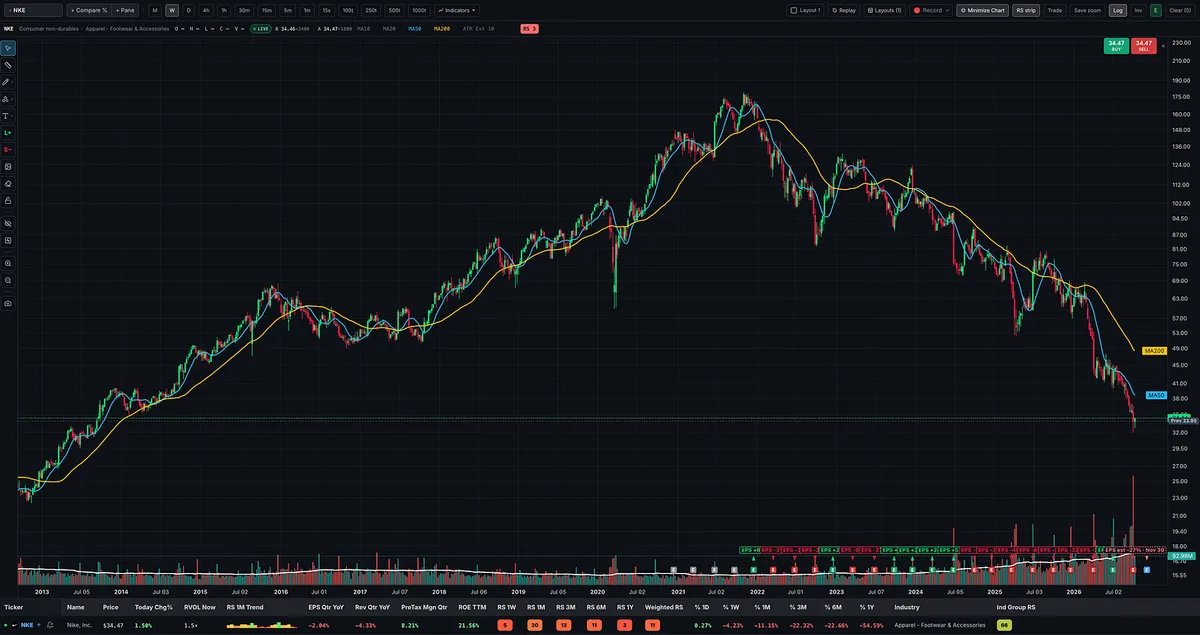
The stock is roughly 80% below its 2021 peak, back around prices last seen in 2013. Yet one of the most common defenses I keep seeing is: “It’s Nike. The company isn’t going anywhere.”
Okay, but the company’s survival doesn’t tell you when to buy its stock.
On the chart in front of me, I see a Stage 4 decline: lower highs, lower lows, and price beneath falling major moving averages. A familiar name doesn’t change that evidence.
If you’re a value investor or turnaround investor, you may have a different process, time horizon, and set of rules. Fair enough.
But if you call yourself a growth stock or momentum trader, buying an aggressive Stage 4 decline because “it’s Nike” is a departure from your process.
You can believe in Nike’s future and still require its stock to earn your capital.
That principle runs through the trading books I study. These are the published rules I’m applying to this chart.
William O’Neil wrote in How to Make Money in Stocks:
“You should buy stocks when they’re on the way up in price, not on the way down.”
Mark Minervini wrote in Think & Trade Like a Champion:
“I avoid going long a stock in any stage except Stage 2.”
Stan Weinstein made the instruction unmistakable in Secrets for Profiting in Bull and Bear Markets:
“Never buy a stock that’s in Stage 3 or 4 (especially Stage 4).”
And when David Ryan was asked in Momentum Masters whether he ever bottom-fishes, his answer was:
“I never buy new lows, if that is what you are asking.”
Their methods have differences, but they all agree on this. Dan Zanger describes his preference in Momentum Masters this way:
“Uptrends are my best friend and certainly my preference…”
There is a reason this emphasis on strength keeps appearing.
Minervini describes making the opposite mistake early in his career: buying depressed household names like AT&T and General Electric because he assumed their familiarity and size made them safer and that they eventually had to go up. That reasoning led to losses.
“It’s a great company” can become a very expensive substitute for an entry strategy.
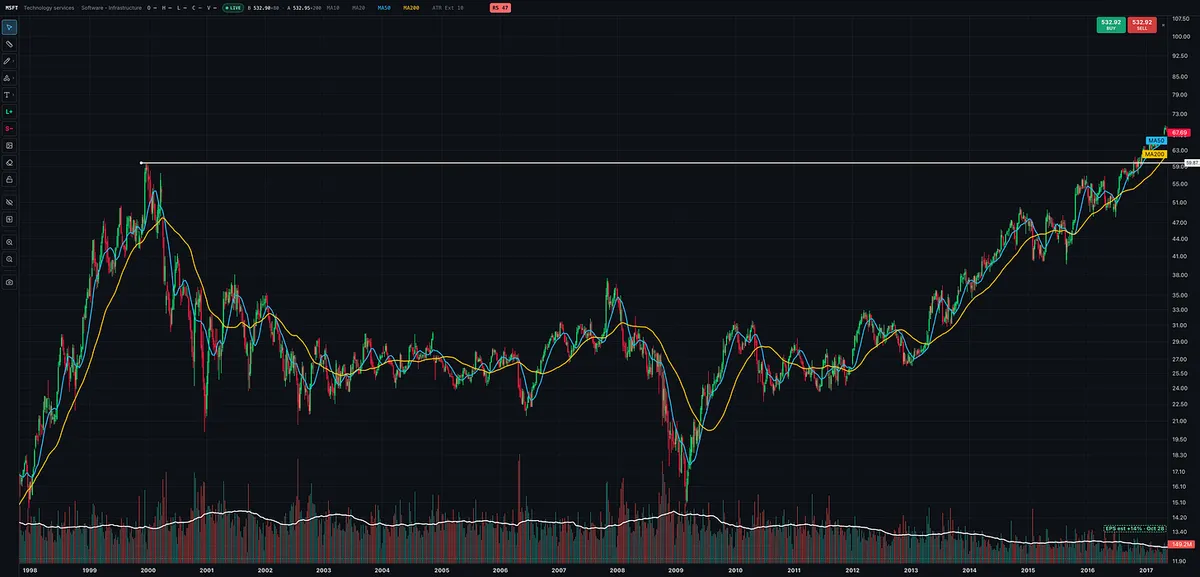
Microsoft is a reminder of how long the wait can be.
After its late-1999 peak, Microsoft’s share price did not set a new record until October 2016, nearly 17 years later. That is a share-price comparison, excluding dividends. Recovering an old price also does not restore purchasing power lost to inflation.
Also, the cost is more than the decline in your account. There is also the time spent waiting and the other opportunities you cannot take with that same capital.
Nicolas Darvas captured the discipline in How I Made $2,000,000 in the Stock Market:
“I should hold the rising ones and sell those that fall.”
Nike may recover. It may become an attractive momentum setup again. I can reconsider it when the evidence changes.
Let it end the decline. Let it build a base, establish a Stage 2 uptrend, and present a valid entry with defined risk.
Until then, “it’s Nike” does not satisfy my buying criteria.
A famous logo does not get an exception to your rules.