Stop Predicting. Start Profiting.
The one mindset shift that separates amateurs from consistent winners
Do you want consistency?
Do you want less stress?
Do you want long-term, professional-level performance?
Then read this.
Most traders are obsessed with predictions. Targets. Price forecasts. “Where will it go next?”
That feels right. It feels intelligent. It feels like control.
But it is the exact habit that keeps people from real performance.
The best traders are not trying to predict.
In fact, they know they do not have a clue what will actually happen next.
You see it everywhere. Endless market calls. Exact price targets. Confident opinions about the future.
And beginners feel comforted by that certainty.
But it is all wrong.
The real edge is not in being right.
It is in how you respond.
As Stanley Druckenmiller said it simply:
“I never predict. I just react.”
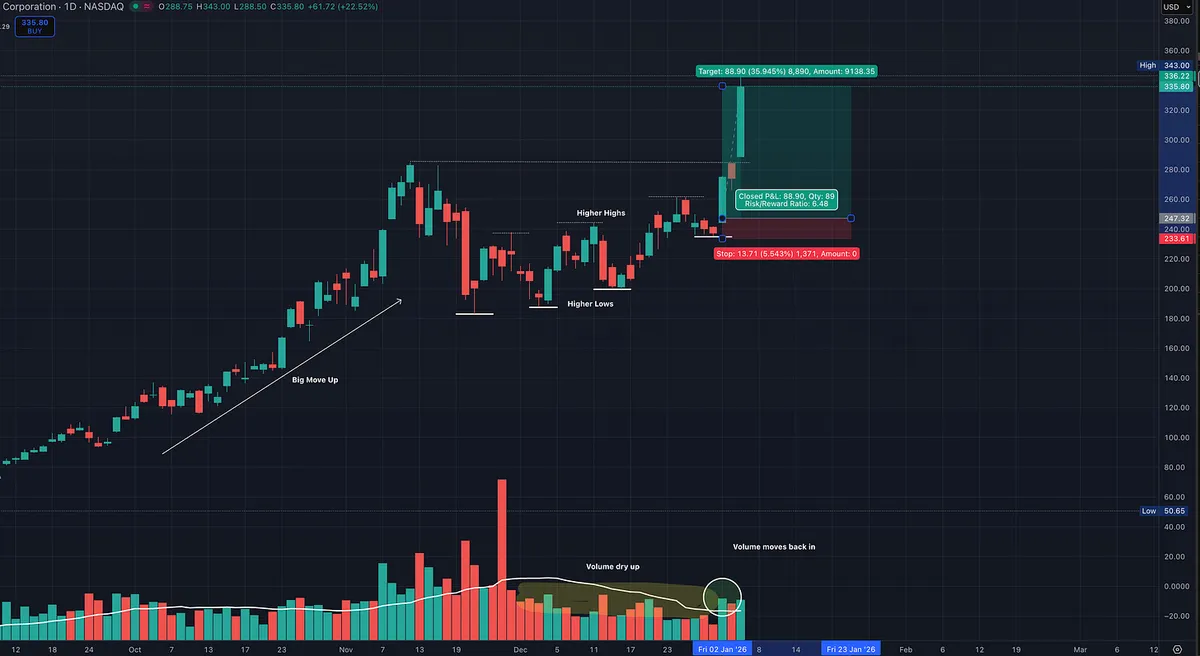
That is why I do not put profit targets on my charts.
I trade patterns that have shown positive expectancy over time.
I know that, on average, my winners are larger than my losers with these setups.
But any single trade could be a 1.5R outcome. A loser.
Or it could be a 10R outlier.
There is no way to know which one it will be in advance.
So I remove the illusion of control.
I enter knowing two things only.
My entry.
My stop.
That is it.
From there, I react.
If price breaks out, stalls, and collapses back into my stop, I am out. No debate.
If price moves higher and begins forming higher lows and higher highs, I move my stop to break even and trail structure.
If price goes vertical into a blow-off top, I sell into strength.
No hoping.
No forecasting.
No emotional attachment to a target that exists only in my head.
Just information. Then action.
Here is the truth most traders never accept.
You do not get paid for being right about the future.
You get paid for managing risk and acting on what the market is giving you right now.
Paul Tudor Jones explained this perfectly in Market Wizards:
“Don’t be too concerned about where you got into a position. The only relevant question is whether you are bullish or bearish on the position that day. Always think of your entry point as last night’s close. I can always tell a rookie trader because he will ask me, ‘Are you short or long?’… Next he will ask, ‘Where are you long from?’ Who cares where I am long from? That has no relevance to whether the market environment is bullish or bearish right now, or to the risk/reward balance of a position at that moment.”
This is the difference.
You stop hoping trades hit your prediction.
You stop fighting price because it “should” do something.
You stop turning small losses into large ones just to defend an idea.
You trade what is happening, not what you want to happen.
If you want better results, you do not need a new indicator.
You need a new relationship with uncertainty.
React. Do not predict.