Momentum Trading Strategy

Notes

Short lessons on momentum trading, every day.

Every note from Substack, in one place: risk, setups, leading stocks, market conditions and the mindset behind them. Search them, browse by topic, or filter by stock.

Showing 41–60 of 1222 notes

View on Substack ↗

You Have a Thesis. Do You Have a Risk Plan?

Study the greatest traders and investors, and one lesson keeps appearing: protecting capital is fundamental to lasting success.

Yet look at where so much of our attention goes.

The macro trader can become consumed by the thesis, the research, and the intellectual stimulation of explaining what should happen next.

The growth and momentum trader can spend endless hours studying setups, running screens, and hunting for the next hot stock.

The systematic trader can get trapped in a loop of backtesting and tweaking, eventually fitting the rules to historical results while searching for a perfect system.

The value investor can spend months digging through financial statements, convinced the next overlooked company will be the needle in the haystack.

Research is important. Understanding your approach and finding opportunities are essential parts of the work.

But how much effort goes into managing the money attached to those ideas?

Can you clearly explain:

  • How much of your account you are willing to risk on a trade?

  • How you determine the size of each position?

  • What requires you to reduce or exit a position?

  • When and how you sell a portion into strength or reduce into weakness?

  • When and how you add to a winning position?

  • How much total exposure and concentration you will allow?

  • What happens if several positions move against you together?

  • How you adjust when losses accumulate or market conditions deteriorate?

These decisions deserve a process every bit as deliberate as your research.

The same trade signals can produce dramatically different account results depending on position sizing.

Three traders can start with the same capital and follow the same buy and sell signals, yet finish with very different outcomes. One can generate substantial profits, another finish roughly flat, and another suffer devastating losses.

The difference can be how much each risks on each trade and how that amount changes along the way.

Why would something that consequential be an afterthought in your trading process?

A sound strategy is still important. Position sizing does not replace the need for an edge, but poor sizing and undisciplined risk-taking can undermine an otherwise sound approach.

Before assuming your next breakthrough requires another screen, another indicator, or another round of backtesting, examine the part of your process that determines how much you risk when you’re wrong and how much of a gain you are willing to give back when you’re right.

If you can explain your thesis in detail but cannot explain your risk, your trading strategy / plan is unfinished.
View on Substack ↗

“I’ll Sell When It Gets Back” Is Not a Sell Rule

William O’Neil shares a story by Fred C. Kelly about a man trying to catch wild turkeys.

The man has 12 turkeys inside his trap. All he needs to do is pull the string.

Then one walks out.

He decides to wait for it to return.

More leave. Now he wishes he had been satisfied with 11, but instead of securing what remains, he keeps waiting for another turkey to come back.

Eventually, the last one leaves.

He goes home empty-handed.

He became so attached to what he once had that he failed to protect what he still had.

That same thinking shows up in investing:

“I was up much more last week.”

“I’ll sell if it gets back to yesterday’s price.”

“I just want to get back to breakeven.”

Meanwhile, the stock keeps weakening, and the acceptable exit keeps changing.

The trader’s attention shifts away from what the stock is doing and toward recovering an opportunity that has already passed.

Normal pullbacks are part of trading. The problem is ignoring a valid sell signal because you want a better exit. The market doesn’t care what you want.

Your previous profit, purchase price, and missed selling opportunity do not obligate the market to give you another chance.

When your sell rules tell you the trade is wrong, act. You can evaluate a new opportunity later. You cannot make the current one better by refusing to acknowledge its deterioration.

Don’t lose the turkeys you still have waiting for the ones that got away.

For the full, original turkey story, read here. https://tradingmomentum.substack.com/p/the-turkey-story-william-oneils-timeless

View on Substack ↗

Before O’Neil’s 8% Rule, There Was Loeb’s 10%.

Most growth traders know William O’Neil’s rule: cut a losing position before the loss exceeds 7% to 8% of your purchase price.

But O’Neil also studied and learned from the successful investors who came before him.

In How to Make Money in Stocks, he recounts a visit from Gerald M. Loeb, author of The Battle for Investment Survival.

Loeb had advocated cutting losses at 10%. O’Neil asked whether he always followed that policy himself.

Loeb’s answer:

“I would hope to be out long before they ever reach 10%.”

O’Neil likewise treated 7% to 8% as an absolute maximum loss from cost. He explained that disciplined investors could keep their average losses smaller, perhaps 5% to 6%, and could sell sooner when a stock or the market wasn’t acting right.

A maximum loss limit does not require you to wait until you reach it.

But there’s another lesson in that conversation.

O’Neil conducted extensive research of his own, yet he still asked questions of an experienced investor and shared that investor’s perspective with his readers.

That is what we’re doing when we study O’Neil, Minervini, Ryan, and the traders who came before them.

We have the opportunity to learn from experience that took others decades to accumulate. We can study their reasoning, examine the evidence, and apply those lessons to our own trading.

The knowledge can be passed down. The discipline still has to be yours.

View on Substack ↗

Your Bills Have a Schedule. The Market Doesn’t.

One thing that hurts aspiring traders is the paycheck mindset.

We’ve been conditioned to expect money every week, every two weeks, or every month. Trading doesn’t follow that schedule.

You can have flat stretches, losing stretches, and periods when the best decision is to do very little. Then favorable conditions arrive, and a few productive weeks can account for a substantial share of your profits.

The trouble starts when you need the market to pay you before the opportunities are there.

That pressure encourages forced trades, oversized positions, and activity your strategy doesn’t justify.

In that respect, trading reminds me of entrepreneurship.

When my wife and I were building our skincare business, we spent years directing income from my career into it. We invested our time, too. While friends enjoyed trips and weekends on the boat, we were choosing to build something whose rewards were still uncertain.

There were plenty of moments when we questioned whether it was worth it.

Five plus years later, we began enjoying what those sacrifices had helped create: more control over our time and the freedom to attend our children’s activities without working around an employer’s schedule.

People could see the freedom. They hadn’t necessarily seen the years that came before it.

Trading required years of work from me, too. Late nights. Weekends. Studying during whatever free time I could find.

And progress can feel painfully unrewarding.

Losing less is improvement, but it doesn’t feel like getting paid. Breaking even can feel like wasting your time. Even small profits can leave you wondering whether another use of those hours would have earned more.

Sometimes it would have.

Trading, like entrepreneurship, is not a business you can expect to pay you consistently, but the rewards can make years of sacrifice worthwhile.

Read the Market Wizards interviews and pay attention to what came before the success. The doubts and difficult stretches are part of the story, too.

No one can guarantee you a breakthrough. That uncertainty is part of what you’re choosing, and it’s why you need to love more than the idea of making money.

If the markets don’t fascinate you, there are other ways to build wealth that may suit you better. They come with their own work, sacrifices, and uncertainty. Since you’re going to devote so much of your life to the process, choose something you actually want to do.

Take the time to think honestly about that decision. Then accept the realities that come with it, including the periods when your effort earns no immediate reward.

If trading is what you want, commit to learning it. Keep studying, correcting your mistakes, and improving. You’ll need patience and some faith in your ability to develop before the results fully arrive.

The market will test that faith, just as building a business does.

From my own experience, the freedom we eventually built was worth the years when we wondered whether we were getting anywhere.

View on Substack ↗

I Can Go Months Without Trading. I Still Show Up Every Day.

One advantage I’ve developed is the ability to watch the market closely without feeling obligated to trade.

Even as a short-term swing trader, I can go weeks or months without taking a position when conditions don’t support my approach.

But I’m still there. Studying charts. Updating my watchlist. Watching which stocks hold up and which groups begin to lead.

In conversations with other traders, I’ve noticed two common traps:

  • They stop trading and stop preparing. They get bored, lose touch with the market, and hesitate when opportunities return.

  • They keep watching and feel compelled to trade. They force setups until their capital and confidence are depleted.

Both can leave them unprepared when the market finally improves.

After weeks of inactivity, a follow-through day like April 8 can get me participating again. If my trades work and conditions improve, I can potentially build to full exposure within a week or two.

That ability to change gears comes from staying prepared while I wait.

The work continues even when the trading stops.

I don’t need to manufacture a trade to justify the time I spend studying. That preparation earns its value when the right opportunity finally arrives.

View on Substack ↗

Price Is Now Confirming the Warning Signs

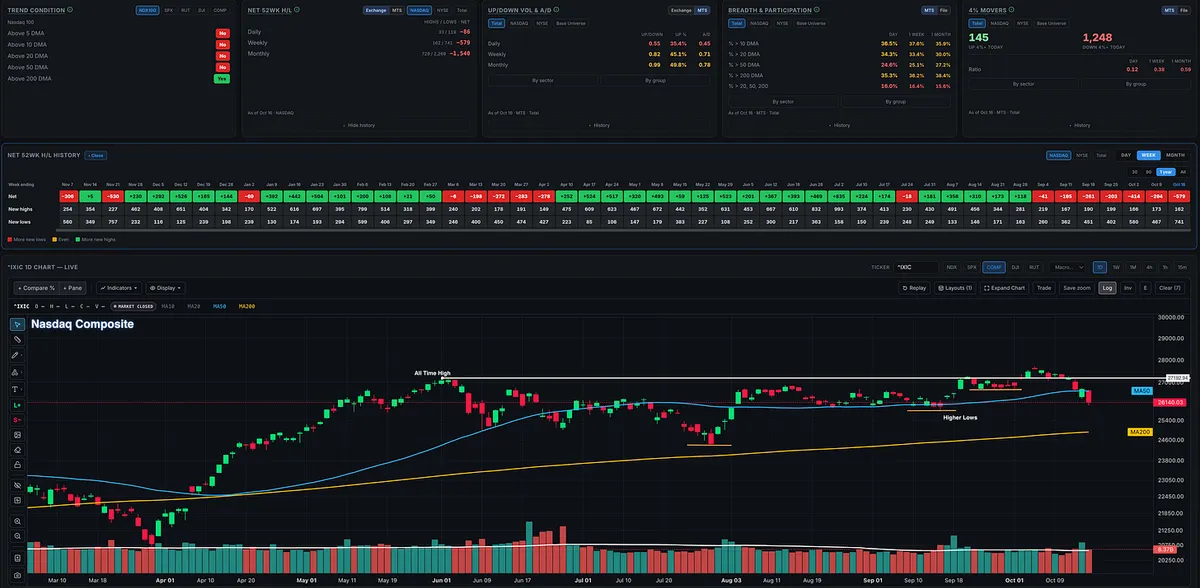
For weeks, the market’s internals looked weak while the major indexes held up.

New lows persistently outnumbered new highs. Breadth deteriorated. Breakouts struggled to follow through. More stocks were making large downside moves than upside moves.

Last week, the indexes began confirming those warnings.

The Nasdaq and S&P 500 fell below their 50-day moving averages. Former leaders in semiconductors, and computer hardware suffered even greater damage.

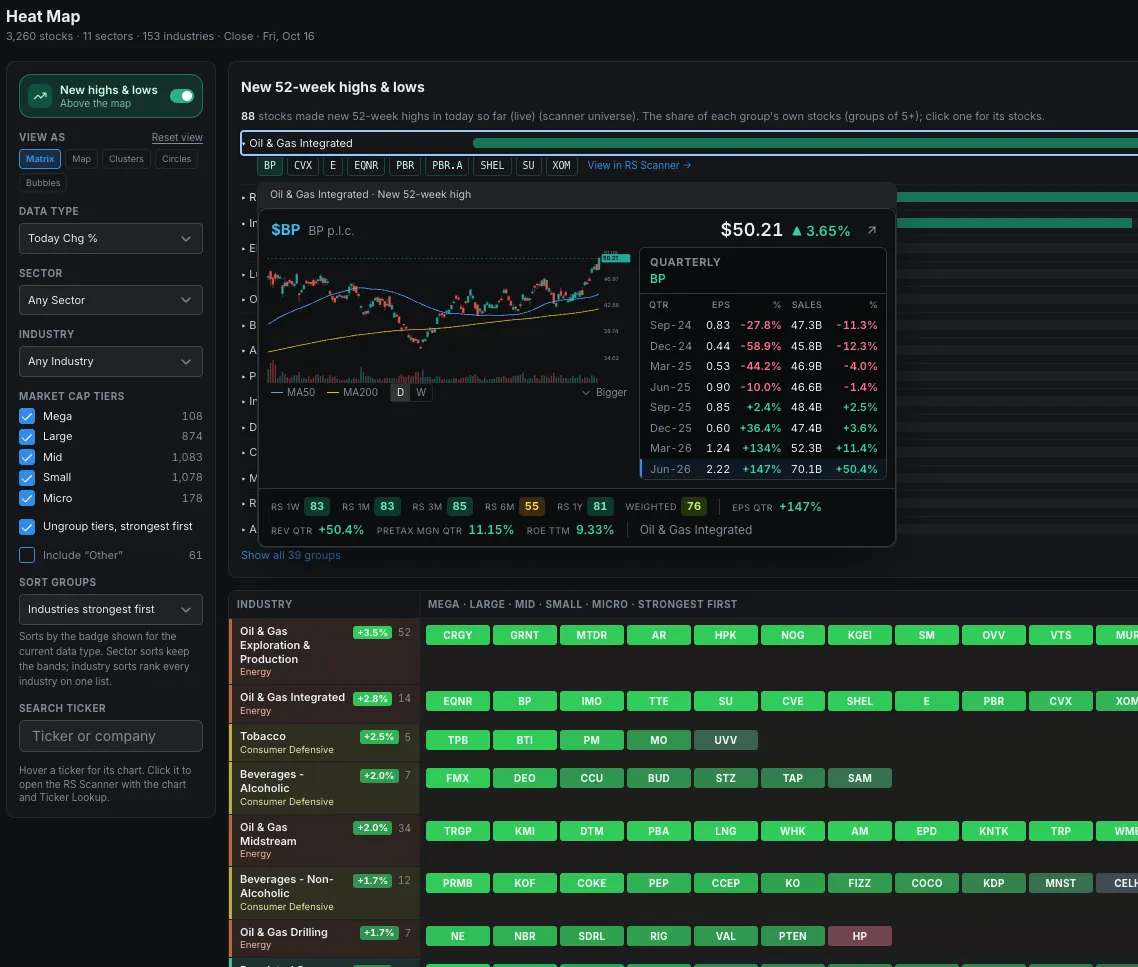
Meanwhile, energy and defensive areas moved to the front.

The important change is that price is now supporting the caution the underlying data had already been suggesting.

That still does not establish a major market top. The Nasdaq and S&P 500 remain above their 200-day moving averages and inside their broader trading ranges. A recovery is still possible.

But I’m willing to let otherwise attractive setups go without me until conditions improve.

I’ll keep building my watchlist, watching for stocks with relative strength lines near new highs, and studying which groups lead any recovery.

Being prepared for the next opportunity does not require trading through every difficult stretch.

View on Substack ↗

Intelligence Isn’t a Trading Strategy

Macro voices seem to dominate my financial feed. And many of them don’t just sound intelligent. They are intelligent.

But too often, their analysis leaves the most important questions unanswered:

Where do you buy?

Where do you sell?

How much do you risk?

How do you size the position?

What tells you you’re wrong?

The other night, I listened to a very intelligent macro commentator say things like:

“There is no other way.”

“This will happen.”

“I am right about this.”

“Gold will do this.”

“Bonds will do this.”

That certainty is a red flag for me. It tells me nothing about whether someone can make money and keep it through different market environments.

You can understand economics, explain every policy decision, and build a compelling argument and still struggle to manage a losing position.

The danger comes when conviction becomes ego. When “this should happen” becomes “this has to happen,” what happens to your risk management?

That’s what I appreciate about Jason Shapiro and Stanley Druckenmiller: strong opinions alongside a willingness to let market behavior change their positioning. Shapiro also discusses how he enters trades and what invalidates them. There’s a process you can examine beyond the forecast.

Experienced traders know the market can disagree with them longer than their account can afford. They plan for being wrong even when they feel certain.

A compelling forecast alone isn’t enough to guide a trade.

Certainty can be especially appealing when you’re inexperienced and looking for reassurance. But you may be borrowing someone’s conviction without knowing their position size, their exit plan, or whether they’re even taking the trade.

Their confidence doesn’t make your position safer.

There’s an uncomfortable reality here, too: a less intellectually sophisticated trader with a repeatable edge and disciplined risk management can outperform a brilliant analyst.

Someone with little formal education can build a multimillion-dollar business. Someone with a PhD in business may understand every theory without achieving the same commercial success. Understanding a subject and successfully applying it are different skills.

That can be a difficult reality for the ego to accept. The market doesn’t award returns based on intelligence, credentials, or how convincing you sound.

With that said, I’m grateful for the intelligent, humble analysts who share their knowledge, acknowledge uncertainty, and remain willing to change their minds. Their work helps me understand the markets better. Turning that understanding into a trade, and managing its risk, is my responsibility.

Before you borrow someone’s conviction, make sure you have your own plan for being wrong.

View on Substack ↗

You Might Have to Buy 10 Stocks to Find 1 Big Winner. That’s Trading.

What if I told you that even when you're doing everything right, most of the stocks you buy won't become big winners?

William O'Neil understood this better than most.

In How to Make Money in Stocks, he explains that throughout his career, only one or two out of every ten stocks he purchased turned into truly outstanding winners.

Think about that.

Even with his proven CAN SLIM methodology, most of his purchases didn't become the big winners he was looking for.

So what did he do with the rest? He sold what wasn't working and kept looking.

If those odds surprise you coming from a proven methodology used by some of the greatest traders and U.S. Investing Champions, imagine the odds facing the average retail investor buying stocks based on tips, opinions, and gut feelings.

Even a proven strategy won't make every trade a winner. That's why risk management and position sizing matter so much.

I experienced this firsthand with $LITE and $MU this year.

When I purchased LITE, I had no idea it would become a 100%+ winner. It met my criteria, just like many other stocks I was buying. But I couldn't have predicted which one would deliver that kind of return.

Same with MU. Following my April 22 setup and buy, I knew it had the potential for a significant move. But it wasn't even the strongest leader coming off the market bottom. I never expected the magnitude of its advance.

But... that's the point. You don't know in advance which stocks will become your biggest winners.

You might eventually build a concentrated portfolio of four or five outstanding stocks, but finding those winners could require buying 10, cutting eight, buying another 10, cutting several more, and repeating the process.

This is exactly why I emphasize progressive exposure and building on success.

You start with your criteria. You manage your risk. You cut what isn't working. And you gradually concentrate capital into the stocks proving themselves.

Concentration should be earned through performance, not based on how convinced you are before entering a trade.

Also, O’Neil is not saying eight out of every ten trades must be losers. Some might produce small gains, others might break even, and some will be losses.

He's saying that even an exceptional stock selection methodology cannot reliably predict which opportunities will become extraordinary winners.

That's why you need both sides of the equation: the discipline to cut unsuccessful trades and the patience to let exceptional winners develop.

The goal isn't to be right on every trade. It's to find the few stocks that can make a meaningful difference in your portfolio.

You might have to buy 10 stocks to find one exceptional winner. That's okay. The other nine are simply part of the process, provided you manage them properly.

Cut what isn't working. Build on what is. And never forget that your biggest winners often reveal themselves only after you've bought them.

That's how you turn a handful of exceptional winners into meaningful portfolio returns.

View on Substack ↗

You're Not Always Losing Because of Your Trading Strategy. Sometimes, You're the Problem.

One of the hardest lessons in trading, business, and life is learning to get out of your own way.

I'm not talking to the new trader who watched a few YouTube videos, opened a brokerage account, and thinks they're going to get rich.

I'm talking to the trader who has actually put in the work.

You've read legitimate trading books. You've studied successful traders. You understand risk management, proven setups, and the importance of having a sound methodology.

Yet you're still struggling to produce consistent results.

What if your biggest problem isn't your strategy or your knowledge? What if it's you?

I believe successful trading comes down to three pillars:

  1. Strategy, tactics, and execution.

  2. Risk management and position sizing.

  3. Trader psychology, the mental game.

And that third pillar is one that far too many traders underestimate.

I've watched traders spend years searching for answers they already have.

They read another book. Watch another podcast. Buy another course. Change another indicator.

All because it's easier to keep learning than to confront the uncomfortable changes they know they need to make.

Think about the trader who:

  • Knows they shouldn't be aggressively trading when the market is moving sideways, below key moving averages, and flashing bearish signals. Yet they keep forcing trades.

  • Knows they should be doing their homework, developing a weekly routine, reviewing stocks each evening, reviewing the state of the market each weekend, and identifying the strongest stocks in the strongest groups. Yet they sit down every morning just looking for something to buy.

  • Has a proven methodology but abandons it every time the market environment becomes unfavorable, jumping to another strategy instead of mastering one.

  • Refuses to take accountability, blaming the market, the system, the books, or everyone else rather than examining their own decisions.

These traders don't necessarily need more knowledge.

They need to start doing what they already know they should be doing.

It's no different from someone who wants to get in the best shape of their life.

They spend hours in the gym lifting weights, doing cardio, and learning everything they can about fitness.

But they refuse to change their eating habits.

They know their diet is holding them back. They've been told repeatedly what they need to do. Yet instead of making that uncomfortable change, they keep searching for a better workout program, another supplement, or some new fitness hack.

They're willing to work harder at everything except the one thing they know they need to change.

Trading is no different.

And neither is entrepreneurship.

I've experienced this in my own businesses. Sometimes you become so attached to an idea you've invested money and time into that you refuse to acknowledge what the market is telling you.

Meanwhile, a better opportunity with demonstrated demand is staring you in the face.

But pride, stubbornness, or fear of admitting you were wrong keeps you stuck.

That's getting in your own way.

Now, life isn't fair. Everyone faces circumstances beyond their control, and not every setback is self-inflicted.

But we also have to be willing to acknowledge how often our own habits, decisions, and unwillingness to change contribute to our struggles.

And that's a difficult conversation to have with yourself.

Because taking accountability means giving up the comfort of excuses.

It means doing the boring work when you don't feel like it.

It means accepting that the market doesn't care how hard you've worked, how much you've studied, or how badly you want to succeed.

It means changing the behaviors you've been defending for years.

You can spend the next five years looking for another answer, or you can start acting on the answers you already have.

It might eliminate some of the biggest obstacles standing between you and your goals.

The most successful traders and entrepreneurs I've studied share an important characteristic: they're willing to confront their mistakes, adapt, and take responsibility for what they can control.

Don't take your mistakes so personally that you refuse to acknowledge them.

Learn from them. Change what needs changing. Move forward.

Sometimes the breakthrough you're looking for doesn't come from learning something new.

It comes from finally doing what you've known you should have been doing all along.

Learn to get out of your own way.

View on Substack ↗

Stop Copying the Traders Who Hit the Lottery.

Would you rather build a business around a proven model or a lottery ticket?

Sounds like an easy decision, right?

Yet every day, traders do the exact opposite.

There will always be one-hit wonders in the stock market. Traders who made a fortune on one big trade or during one incredible bull market, then spend decades being glorified for it.

And who does everyone want to copy?

The guy who hit the lottery.

But trading is a business, and like any business, your long-term success depends on having a repeatable process with a positive expectancy.

Think about successful franchises. Their value isn't built on one spectacular year. It's built on a proven business model that can be replicated successfully, decade after decade.

Trading should be no different.

Many of the greatest trading principles have been passed down for well over a century. Each generation puts its own spin on them, changes the terminology, or rebrands them as something new.

But the fundamentals remain remarkably similar.

Manage risk. Cut losses. Let winners work. Understand the market environment.

Does that mean a proven strategy works in every market? Absolutely not.

There will be difficult periods, drawdowns, and stretches of underperformance.

But ask yourself this:

What gives you better odds of long-term success?

Chasing the flashy trader who made millions or billions once, or studying a disciplined methodology that has demonstrated repeatability across multiple market cycles, for multiple generations of traders?

A proven process doesn't guarantee success, but a spectacular outcome doesn't prove a repeatable process, either.

Stop confusing someone who made a fortune once with someone who has demonstrated how to make a fortune repeatedly, using principles that have also worked for countless other traders across generations.

There's a massive difference.

The goal isn't to become the next one-hit wonder. It's to build a trading business that can survive, adapt, and compound over decades.

View on Substack ↗

The Stock Market Doesn’t Care How Smart You Are.

Some of the smartest people in the world make terrible investors. And sometimes their intelligence is exactly what gets them into trouble.

William O’Neil understood this well.

In How to Make Money in Stocks, under “Experts, Education, and Egos,” he writes:

“On Wall Street, wise men can be drawn into booby traps just as easily as fools.”

Think about that for a moment.

A high IQ, an advanced degree, or decades of professional success doesn’t automatically make someone a successful trader.

In fact, intelligence can sometimes work against you.

The smarter you believe you are, the easier it becomes to convince yourself that your analysis must be correct.

You rationalize losing positions. You defend your predictions. You argue with price action. You become more interested in proving you’re right than protecting your capital.

And the market has absolutely no interest in your opinion.

O’Neil observed that some of the most successful investors he knew were decisive individuals without oversized egos.

They understood something fundamental.

Your job isn’t to prove you’re right. Your job is to recognize what the market is telling you and act accordingly.

That’s why humility, objectivity, discipline, and risk management matter so much.

You can have an exceptional understanding of economics, fundamentals, and market history and still lose money if you refuse to accept what price action is telling you.

The market will humble everyone eventually.

The difference is whether you learn from it or keep trying to prove you’re smarter than it.

View on Substack ↗

Beginners Search for the Perfect Indicator. Experienced Traders Learn to Read the Market.

How many traders start with RSI, MACD, stochastic oscillators, or some magical buy/sell indicator?

It’s human nature to look for shortcuts. We want something simple that tells us what to do.

But simplicity in trading doesn’t mean finding an indicator that does the thinking for you. It means developing enough understanding that you no longer need one.

My charts are extremely simple. Price, volume, and a few moving averages that I frequently turn on and off.

In Chapter 9 of How to Make Money in Stocks, William O’Neil discusses numerous market indicators, including breadth, new highs versus new lows, distribution days, upside/downside volume, and sentiment.

He also warns about relying on overbought/oversold indicators:

“Needless to say, I rarely pay attention to overbought/oversold indicators.” — William O’Neil

I study many of these broader market indicators, too. They provide valuable context, but they’re secondary to what matters most.

The price and volume action of the major market indexes and the leading stocks in the leading industry groups.

Are institutions accumulating or distributing? Are breakouts working or failing? Are leaders acting healthy or breaking down?

Most conventional technical indicators are simply calculations derived from price, volume, or both.

Some successful traders use them effectively, but there’s no substitute for understanding supply and demand directly on a chart.

If you’re searching for simplicity, stop searching for an indicator that will interpret the market for you. Learn to interpret the market yourself.

View on Substack ↗

When Energy Leads While the Rest of the Market Breaks Down, Pay Attention.

Some of the biggest market tops over the past several decades have shared an interesting combination: deteriorating market breadth, former leading stocks breaking down, and energy emerging as one of the strongest areas of the market.

Sound familiar?

“It doesn’t pay to argue with the market. Experience teaches that second-guessing the market can be a very expensive mistake.”

— William J. O'Neil

William O'Neil explained that major market tops typically develop through a series of warning signs.

Institutional distribution begins accumulating. Leading stocks start behaving abnormally and breaking down. Rallies struggle to make meaningful progress. Eventually, the major indexes begin confirming the underlying deterioration.

O'Neil also cautioned that poor breadth alone doesn't necessarily signal a market top. It's when multiple warning signs begin confirming one another that the evidence becomes more compelling.

But here's another historical relationship worth paying attention to: ENERGY.

Looking back at major market declines over the past several decades, energy has repeatedly demonstrated significant relative strength while the broader market deteriorated.

Consider the historical evidence.

An S&P 500 Study found that energy outperformed the S&P 500 during three of the four major market declines it examined between 2000 and 2022:

  • 2000–2002: Energy outperformed the S&P 500 by 23.3 percentage points during the dot-com bear market.

  • 2007–2009: Energy outperformed by 9.9 percentage points during the financial crisis.

  • 2022: Energy outperformed by an extraordinary 55 percentage points during the bear market.

That's three out of four major declines, a historical relationship worth understanding.

And there's an economic reason this relationship deserves attention.

Rising energy prices can benefit oil and gas producers while creating inflationary pressure throughout the broader economy. Higher transportation, manufacturing, and operating costs can squeeze corporate profit margins, pressure consumers, and complicate monetary policy.

Now look at what we're experiencing today.

Energy is demonstrating exceptional relative strength while market breadth remains extremely weak, former leading stocks are breaking down, institutional distribution is elevated, and the major indexes are pulling back.

We're seeing a combination of conditions that has accompanied major market tops before.

Does that mean we've reached a major market top?

Absolutely not.

This could turn out to be another correction within an ongoing bull market. The indexes could recover, leadership could improve, and the advance could continue.

But when the same warning signs O'Neil taught us to recognize begin appearing alongside a historical pattern of energy leadership and broad market deterioration, I believe that deserves our attention.

Protecting capital doesn't require predicting the future.

If we become defensive and the market recovers, we can progressively increase exposure as conditions improve.

If the weakness develops into something more serious, we've protected our capital and preserved the ability to take advantage of the next opportunity.

You don't need to predict a market top to protect yourself from one.

View on Substack ↗

Cash Is a Position. But Where Do You Keep It?

“Go to cash” tells you to reduce stock exposure. It leaves another practical question unanswered: where should that money sit while you wait?

Most of the time, I keep mine in plain brokerage cash. I keep it simple. As a growth stock and momentum trader, I want it readily available as I increase or decrease exposure.

During brief corrections or sideways markets, I’m comfortable accepting some forgone interest for that convenience. That’s my preference, not a rule everyone needs to follow.

If capital sits idle for months, as it might during a bear market like 2022, interest can add up, especially with a large balance. A suitable money market fund or short-term Treasury bills can be worth considering.

During prolonged bear markets, that becomes more significant. In How to Make Money in Stocks, O’Neil describes staying in money market funds for most of 2000–2002.

Know your broker’s rules. Some automatically use money market balances to fund stock purchases. Others require you to sell the fund yourself. Longer-term bonds carry price risk and shouldn’t automatically be treated as cash.

We only know how long a downturn lasted afterward, so our capital needs to remain accessible when opportunities return.

For my trading account, capital preservation, simplicity, and readiness come first. If you can earn interest while maintaining those benefits, that’s reasonable too.

View on Substack ↗

Opening a Brokerage Account Is Easy. Keeping Your Money Is Hard.

You open the account. Transfer the money. Start imagining what you could make.

Suddenly, trading small feels like wasting time. You want meaningful profits, and you want them now.

That excitement can get expensive.

Start by learning the basics and building consistency in a simulator. Then move to a SMALL account with money you’re willing and able to lose. Real money introduces emotions a simulator can’t replicate. Keep your mistakes affordable while you learn.

Gradually increase your account size as you demonstrate improvement, discipline, and consistency. This is progressive exposure applied to your development as a trader.

Everyone’s relationship with money is different. You might handle a $50 loss calmly and start breaking your rules over a $500 loss, even when both represent the same percentage of your account.

The math is the same. The emotional experience can be completely different.

If bigger dollar amounts cause you to hesitate, overthink, or ignore your stops, get comfortable at that level before increasing again. A loss might sting, but it shouldn’t cost you sleep.

Give yourself a 5 to 10 year runway to develop this skill. Some find consistency in 2 to 3 years, but someone else’s timeline shouldn’t become your deadline.

Five years sounds long now. If you’re trading consistently by then, you probably won’t care how long it took.

Crawl, walk, run. Earn the right to trade bigger.

View on Substack ↗

When the Leaders Stop Leading, Pay Attention.

The indexes can still look reassuring while the stocks that carried the market higher are beginning to deteriorate. That change deserves your attention.

In How to Make Money in Stocks, William O’Neil identifies the behavior of leading stocks as the second most important indicator of a major change in market direction, after the daily market averages.

Tracking distribution days is part of the process. The next step is examining the individual leaders:

  • Abnormal selling: Sharp price breaks on heavy volume.

  • Poor recoveries: Leaders struggle to recover after those declines.

  • Deteriorating bases: Price action becomes wide, loose, and erratic, particularly in third or fourth-stage bases.

  • Climax runs: After months of gains, a leader suddenly accelerates for two or three weeks.

  • Weakening leadership: Sound buying opportunities become scarce while lower-quality, speculative laggards attract attention.

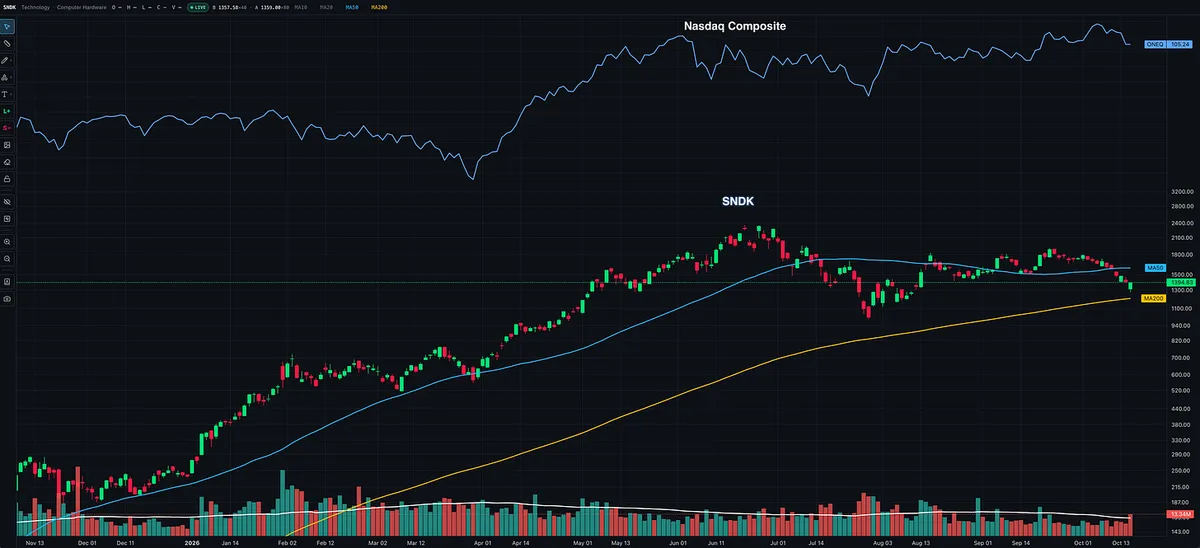
Look at SNDK in the attached chart. After a powerful advance, it peaked in June and declined substantially. Subsequent rallies failed to reclaim that peak, and the stock has fallen back below its 50-day moving average.

Meanwhile, ONEQ, the Nasdaq Composite ETF shown by the blue line, went on to new highs. The broader benchmark’s strength has not been matched by this prior winner.

O’Neil also suggests reviewing your last four or five purchases. If none has made progress, that may be another clue that conditions are changing.

One struggling stock doesn’t establish a market top. But when abnormal behavior spreads across the leaders while distribution builds in the indexes, the warning becomes more significant.

A stock’s past leadership is no guarantee of its future strength. Keep watching how it acts.

View on Substack ↗

The Market Can Look Strong While It’s Getting Weaker.

A rising market can make it easy to dismiss a few down days. But those seemingly isolated sessions may be revealing something important: institutions are selling while investors still feel bullish.

In Chapter 9 of How to Make Money in Stocks, William O’Neil explains why tracking distribution days is essential. Distribution can develop while the market is still advancing, before the weakness becomes obvious.

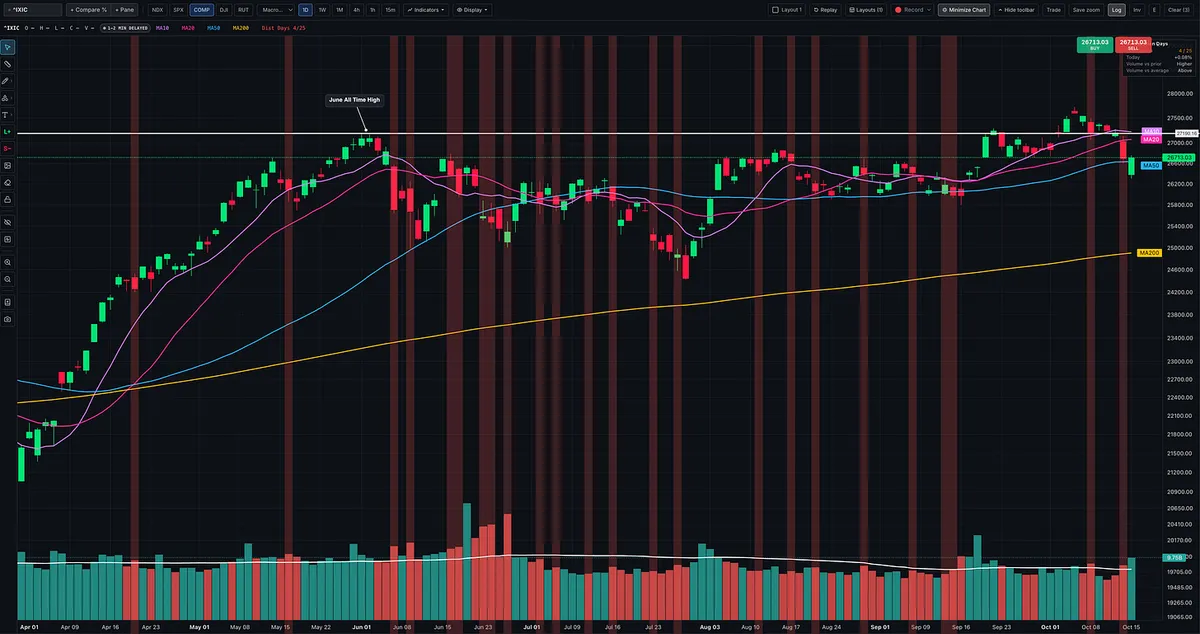
A typical distribution day occurs when a major index declines more than 0.2% on higher volume than the previous session. O’Neil also describes stalling, when increased trading volume produces little upward price progress. The index doesn’t always have to close lower to show distribution.

The concern grows when these sessions accumulate. O’Neil highlighted four or five definite distribution days over four or five weeks as a serious warning that the market could be topping.

The red shaded sessions on this Nasdaq Composite chart mark the distribution days flagged by my indicator, with four currently counted over the last 25 trading sessions. Tracking them helps reveal a pattern you might miss when judging each day separately.

That count doesn’t guarantee a decline. It gives you a reason to reassess your exposure, watch how leading stocks respond, and follow your sell rules as conditions deteriorate.

Your bullish opinion can take time to change. Tracking distribution helps you notice when the evidence already has.

View on Substack ↗

The Stock Market Doesn't Wait for Good News. Neither Should You.

One of the most important lessons William O'Neil teaches in How to Make Money in Stocks is that the stock market is a leading economic indicator, not a lagging one.

Bull markets often top out when the economy still looks great. Employment is strong, corporate earnings look healthy, and optimism is everywhere. Yet the market is already anticipating trouble ahead.

The opposite happens at major market bottoms. Economic news is terrible, fear dominates the headlines, and investors are convinced things will only get worse. Yet stocks may already be entering a new bull market.

The market doesn't need good news to bottom, and it doesn't need bad news to top.

O'Neil, Martin Zweig, Stan Weinstein, and other legendary traders understood the importance of studying what the market is actually doing instead of relying on economic predictions.

The market is constantly discounting future expectations, with human nature and crowd psychology influencing every cycle.

Successful trading isn't about predicting the future. It's about learning to recognize what the market is telling you before the headlines catch up.

View on Substack ↗

If Someone Guarantees You Income From the Stock Market, Run.

Anyone trying to sell you on guaranteed daily, weekly, or monthly income from the markets is someone I would strongly recommend walking away from.

I don't think there's a single Market Wizard who would disagree with me on this one.

Can you make more money in the markets than you ever dreamed possible through years of hard work, discipline, and developing a real edge?

Absolutely.

But the moment someone starts using the words "guaranteed income" when talking about trading, that should be a massive red flag.

The greatest traders in history have experienced losing days, losing weeks, losing months, and even losing years.

That's the nature of the markets.

You can develop an edge. You can improve your probabilities. You can build extraordinary wealth, but you cannot eliminate uncertainty or guarantee anyone a specific amount of income.

And anyone promising you otherwise is selling you something other than the reality of trading.

View on Substack ↗

“You Can’t Time the Market.” O’Neil Called That a Myth.

“Don’t ever let anyone tell you that you can’t time the market. This is a giant myth passed on mainly by Wall Street, the media, and those who have never been able to do it, so they think it’s impossible.”

— William J. O’Neil

O’Neil’s argument centers on studying what the market is actually doing: the price and volume action of the major indexes, the evidence of institutional selling, and the signals of renewed buying.

That takes rules. Homework. And the willingness to act when the evidence changes, even when the headlines and your emotions pull you the other way.

He also makes a point individual traders should remember: a massive fund has constraints you don’t. You can raise cash without spending weeks unwinding positions.

Market timing is a skill you can study and develop. O’Neil lays out a process for it: follow the major indexes, study their daily price and volume, and learn to recognize when the evidence points to a change in market direction. Then act on those signals.

Nobody said timing the market would be easy. But difficulty is a reason to study, not a reason to stop trying.