Momentum Trading Strategy

Notes

Short lessons on momentum trading, every day.

Every note from Substack, in one place: risk, setups, leading stocks, market conditions and the mindset behind them. Search them, browse by topic, or filter by stock.

Showing 21–40 of 1222 notes

View on Substack ↗

When the Market Hits You, Don’t Freeze.

You know where you’re supposed to sell. Then price gets there, and suddenly you need another opinion.

You check another indicator, look for someone who agrees with you, or convince yourself to give it one more day.

Meanwhile, the loss keeps growing.

In Market Wizards, Marty Schwartz describes exiting his losing long position during the October 1987 crash:

“It was painful, and I was bleeding, but I honored my risk points and bit the bullet. That’s another example where my Marine training came into play. They teach you never to freeze when you are under attack. One of the tactics in the Marine Corps officer’s manual is either go forward or backward. Don’t just sit there if you are getting the hell beat out of you. Even retreating is offensive, because you are still doing something. It is the same thing in the market.”

Schwartz took a $315,000 loss. He described being proud of getting out because he understood how difficult it is to act when taking a loss hurts.

Having a risk plan only helps if you’re willing to follow it when you least want to.

That’s where many traders struggle. Before entering, the rules seem perfectly reasonable. Once money and ego are involved, the negotiations begin.

Maybe it will bounce. Maybe the market is wrong. Maybe I’ll sell when I get back to even.

But your break-even price means nothing to the market and refusing to make a decision leaves your capital exposed just the same.

Following your plan might mean taking the loss, reducing exposure, or moving to cash when your rules call for it. Those decisions preserve your ability to participate when conditions improve.

There is a difference between patiently holding a trade that remains valid and freezing in one that has violated your exit rules.
View on Substack ↗

More Volatility Doesn’t Have to Mean More Money at Risk.

A stock starts moving twice as much, and many traders immediately call it twice as risky.

But how much are they buying?

Dr. Van K. Tharp challenges the practice of equating volatility with risk:

“Method two is what Wall Street would have you think of as risk, which is volatility. In my opinion, this is a pretty meaningless definition of risk.”

His framework focuses on knowing where you’re wrong, planning your exit, and sizing the position around the loss you’re prepared to take.

The stock’s movement alone doesn’t tell you how much of your account is at stake. Position size and your exit plan matter together.

Suppose your planned risk budget for a new trade is $500, before trading costs.

With a stop $2 below your entry, buying 250 shares puts $500 at planned risk.

With a stop $4 below your entry, buying 125 shares puts the same $500 at planned risk.

Twice the room. Half the shares. The same planned dollar risk.

A newer trader might look at that smaller position and assume it means less profit potential. But half as many shares can produce the same dollar profit if the price moves twice as far in your favor.

Higher volatility creates the potential for larger moves in either direction. Reducing your share count adjusts your exposure to those larger swings.

For momentum traders, expanding volatility can accompany a powerful breakout or a strong advance. Once I’m in a winning position, I generally prefer a smoother, more orderly trend. A bull quiet environment can be easier to stay with, but that doesn’t make every bull volatile environment unattractive.

Volatility changes how you size and manage the opportunity.

If you allow a wider stop while keeping the same position size, you increase your planned risk. Make that calculation before entering the trade. Widening a stop afterward to avoid taking a loss is a different decision.

Tharp also emphasizes matching your strategy to the market environment. A smaller position won’t turn an unsuitable strategy into a profitable one.

When volatility changes, reassess your position size, exits, how you manage a winning trade, and whether your setup still makes sense.

Volatility isn’t automatically the enemy. Failing to adjust to it can be.

View on Substack ↗

How Much Is Your Need to Be Right Costing You?

Before becoming a remarkably successful trader, Marty Schwartz spent a decade losing money while working as a well-paid securities analyst.

In Market Wizards, Jack Schwager asks him:

“When did you turn from a loser to a winner?”

Schwartz replies:

“When I was able to separate my ego needs from making money. When I was able to accept being wrong. Before, admitting I was wrong was more upsetting than losing the money.”

He was willing to lose money to avoid admitting he was wrong.

There’s an irony here. The market can attract people who want to prove how intelligent they are, show others how successful they’ve become, or conquer a challenge that validates their abilities. Yet those same motivations can interfere with the decisions successful trading requires.

You can achieve considerable success in another profession while carrying a big ego. Bring that ego into the market, and every losing position can become something personal.

Selling means admitting your analysis was wrong. Changing your outlook means backing away from a prediction you made publicly. Taking a small loss feels like defeat, so you keep holding, searching for evidence that you were right all along.

Your need for validation starts making decisions that your trading rules should be making.

The danger becomes especially clear when you’ve spent hours researching an idea. The more effort you’ve invested in the thesis, the harder it can become to accept evidence against it.

This lesson comes up repeatedly in Market Wizards: accepting mistakes, remaining flexible, and controlling losses. Even highly competitive, confident traders have to recognize when their judgment has failed them.

Schwartz’s turning point was learning to accept being wrong and preserve his money for the next opportunity.

If you’re unwilling to confront your ego, trading is the wrong business for you.

Try political commentary, run for office, or become a trial lawyer. At least there, you can get paid to argue.

The market is an expensive place to seek validation.

View on Substack ↗

Before You Give Up on Trading, Read William O’Neil’s Parting Advice.

At the end of How to Make Money in Stocks, William O’Neil leaves readers with a message worth revisiting whenever this business tests your confidence:

“You can definitely become financially independent once you learn to save and invest properly. But you first have to get serious and make up your mind to work at it and never let yourself get discouraged, regardless of circumstances.

My parting advice: have courage, be positive, and don’t ever give up. Great opportunities occur every year in America. Get yourself prepared, study, learn, and go for them.

What you’ll find is that little acorns can, over time, grow into giant oaks, and that with persistence and hard work, anything is possible. You can do it, and your own determination to succeed is the most important element.

When you get off the track and make mistakes, which all of us do, re-read this book, attend a workshop or seminar, or take a home-study course and get back on track . . . there are no overnight successes in the stock market.”

A big win can happen overnight. Developing the skill and discipline to keep that money and produce repeatable results takes work.

I write these reminders for myself, too. Experience doesn’t exempt any of us from mistakes or from the responsibility to correct them.

If you’ve gotten off track, take an honest look at what went wrong. Revisit your rules. Put in the study. There will be opportunities ahead, and the work you do now can leave you better prepared to recognize and handle them.

Get serious about the work. Don’t give up on yourself.

View on Substack ↗

Most Investors Buy in the Wrong Stage. Here’s How to Avoid It.

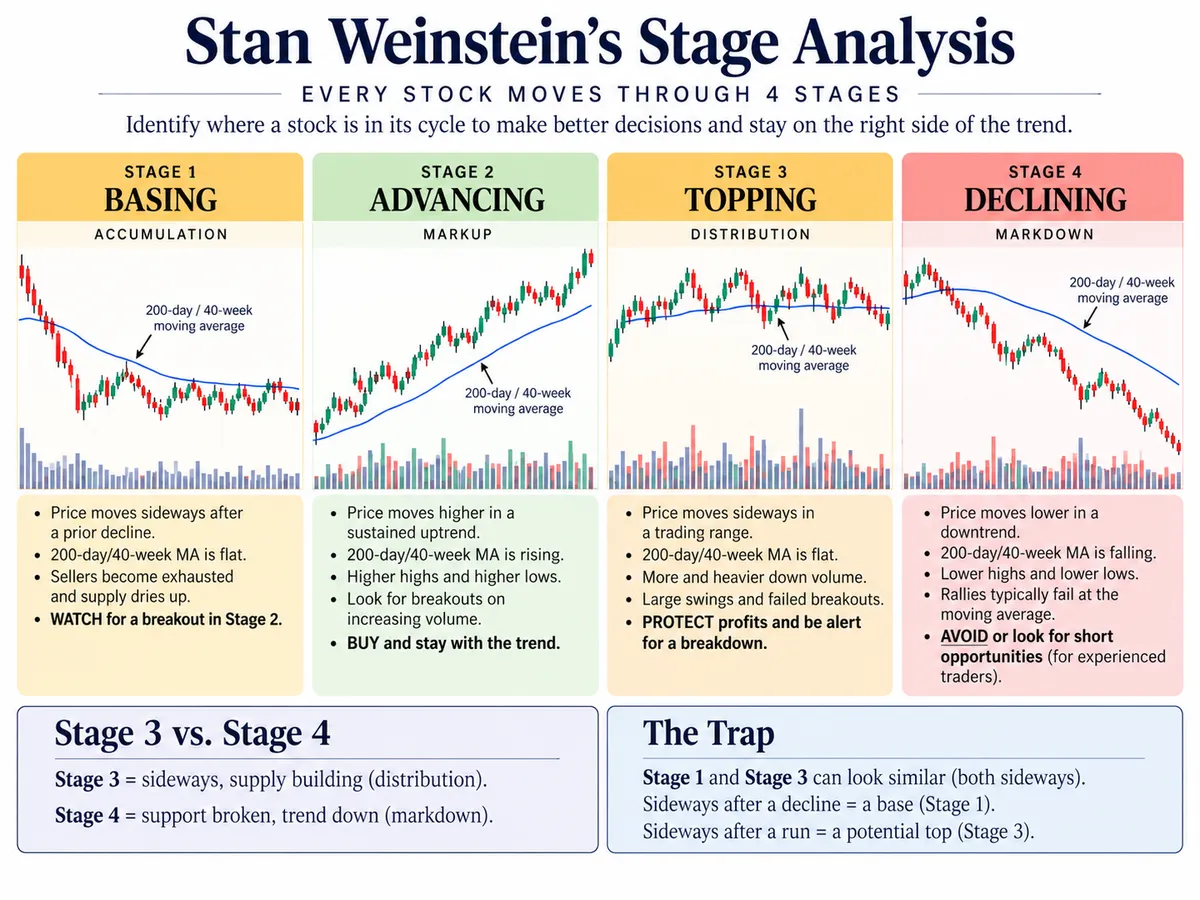
One of the most important concepts in technical analysis comes from Stan Weinstein's book Secrets for Profiting in Bull and Bear Markets.

Weinstein identified four stages that stocks move through. Understanding these stages can help you recognize when a stock is setting up for a major advance, when an uptrend is healthy, when a former leader may be topping, and when it's time to get out of the way.

Stage 1: Basing

After a significant decline, the stock begins moving sideways. Selling pressure diminishes, the moving average flattens, and a base starts forming.

This is where I want to build my watchlist, not necessarily start buying. A stock can remain in Stage 1 for months or even years.

Stage 2: Advancing

The stock breaks above resistance, ideally on expanding volume, and begins making higher highs and higher lows. The moving average turns higher, and relative strength improves.

This is where I want to be buying. Particularly when a stock is emerging from a sound base or breaking out of a constructive consolidation within an established uptrend.

Stage 3: Topping

After a prolonged advance, the stock begins losing momentum. Price becomes choppy, the moving average flattens, and heavy-volume selling may appear.

This is where I become defensive, protect profits, and pay closer attention to sell signals.

Importantly, not every sideways consolidation after an advance becomes a major top. Some resolve higher and resume Stage 2.

Stage 4: Declining

The stock breaks important support, begins making lower highs and lower lows, and trades beneath a declining moving average.

This is where I want to avoid being long. I don't care how cheap the stock looks or how impressive its most recent earnings/sales were. A former market leader can still have a long way to fall.

One important distinction: Stage 1 and Stage 3 can look remarkably similar.

The difference is what preceded them.

A sideways range following a prolonged decline may be a Stage 1 base. A sideways range following a major advance may be a Stage 3 top.

Neither is confirmed simply because the stock starts moving sideways. Watch how price, volume, support, resistance, and the moving average develop.

Weinstein originally emphasized the 30-week moving average in his book, but later explained that he had shifted to using the 200-day moving average, which covers approximately the same time span as the 40-week moving average on a weekly chart.

But remember, the moving average alone isn't a trading system. Price action, stock selection, relative strength, volume, position sizing, and the overall market environment all matter.

My biggest takeaway from Weinstein's work is simple:

I don't need to catch the exact bottom or sell at the exact top. I want to participate in the strongest portion of Stage 2, protect my capital when conditions deteriorate, and avoid riding stocks through Stage 4 declines.

Recognize what the market is telling you and act accordingly.

View on Substack ↗

Before You Change Your Trading Strategy, Check These Two Things.

If you haven’t been trading well in this market, the first questions I’d ask are simple:

  1. Are you buying when the general market is on your side?

  2. Are you buying the leading stocks in the leading industry groups?

Three out of four stocks generally follow the market’s direction. Also, roughly half of a stock’s price movement is tied to its industry group and broader sector.

Think about what that means. You can spend hours researching a company, studying its earnings, and analyzing its chart, while the market and its industry group are working against you.

Dr. Van Tharp puts it bluntly in Super Trader:

“The common mistake most people make in designing systems is to try to find a system that works in all market conditions. That’s insane.”

You don’t have to trade every environment. You need to recognize when conditions suit your approach and when to step aside.

For a growth and momentum trader, buying leaders in leading groups during a healthy market uptrend is one of the simplest ways to improve the odds.

If you’re consistently struggling when the market is strong and you’re trading those leaders, then look more closely at your entries, sell rules, position sizing, and execution.

But start with those first two questions. Before changing your entire strategy, check whether you’ve been giving it a fair chance to work.

For some of you, getting the market and industry group on your side could be the change that helps turn your trading around.

View on Substack ↗

I’m Defensive. I’m Also Ready to Pounce.

The market looks pretty lousy right now, but I’ve done this long enough and studied enough history to know that conditions can turn on a dime.

That doesn’t mean I’m sticking my neck out because some historical precedent suggests we should rally here. I’ll wait for evidence: quality setups, accumulation, a follow-through day, and breakouts that hold and make progress. A follow-through day is important, but the action in leading stocks needs to support it.

As I write this:

  • The Nasdaq 100 is roughly 7.6% below its all-time high.

  • The S&P 500 is roughly 2.86% below its all-time high.

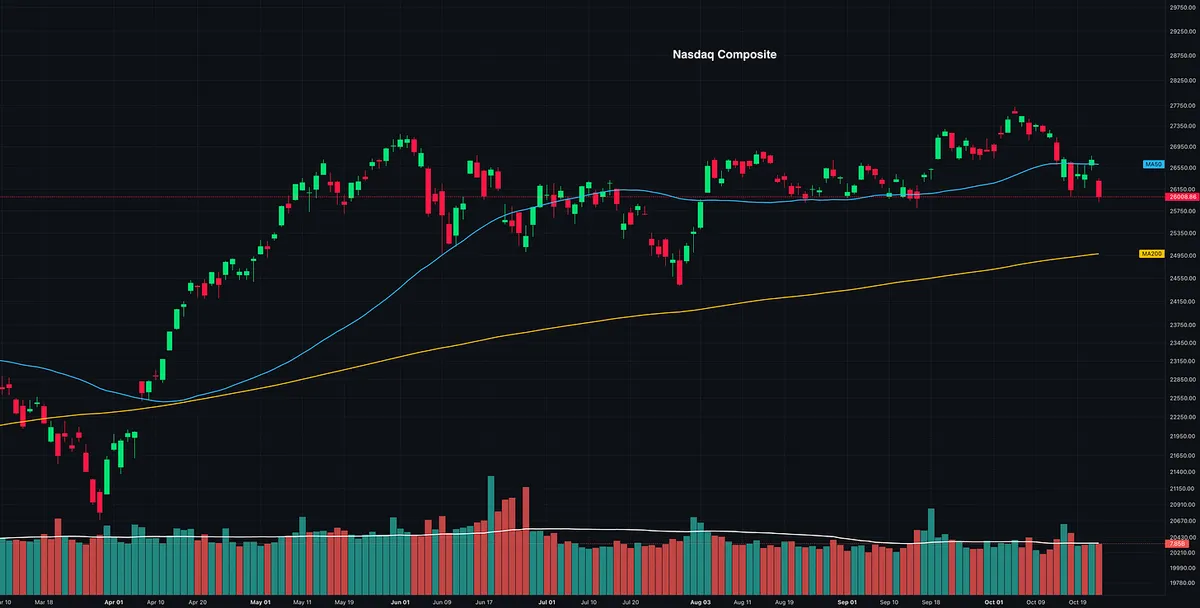
  • The Nasdaq Composite is roughly 6.4% below its all-time high.

For all the bearish indicators and deterioration underneath the surface, those indexes are still within reach of their highs.

So yes, I’m defensive. But best believe I’m ready to pounce when the evidence changes. When the turn comes, it can happen quickly.

Personally, I’d welcome a proper flush toward the 200-day moving average, or even below it, followed by a convincing recovery. Something resembling the March shakeout before the April and May runs, or the reset during the 2025 tariff scare. That kind of washout can help clear out excesses and set the stage for a powerful advance.

But I don’t need that exact scenario to unfold.

The market can also work through its excesses by spending more time consolidating. Neither a deeper correction nor a longer base guarantees a strong uptrend. What matters is the quality of the action that emerges.

That brings me back to two quotes from Market Wizards that I’ve shared many times.

Jim Rogers:

“I just wait until there is money lying in the corner, and all I have to do is go over there and pick it up. I do nothing in the meantime.”

And Mark Weinstein, describing the patience behind his trading:

“Although the cheetah is the fastest animal in the world and can catch any animal on the plains, it will wait until it is absolutely sure it can catch its prey. It may hide in the bush for a week, waiting for just the right moment. It will wait for a baby antelope, and not just any baby antelope, but preferably one that is also sick or lame. Only then, when there is no chance it can lose its prey, does it attack. That, to me, is the epitome of professional trading.”

For me, the lesson is patience, selectivity, and decisive action when the opportunity finally appears.

I can respect the weakness in front of me while preparing for the next opportunity. My watchlist stays fresh. My sell rules stay in place, and my willingness to buy changes with the evidence.

I don’t need to predict the turn. I need to be prepared to act when the market earns my money.

View on Substack ↗

Bored With the Market? Don’t Take It Out on Your Account.

In markets like this, one of the best ways I keep myself from overtrading is to put that energy back into improving my process.

I return to the same books I’ve read multiple times over the years. They remind me of things I already know but haven’t been applying consistently. I see where I’ve gotten sloppy, what I’ve been neglecting, and what needs tightening up.

I also use this time to do research.

Right now, I’m running a thorough backtest of my stock screens, comparing the stocks they identify against the market indexes to test whether those screens provide a measurable edge.

I go through my trading analytics, too. Which setups have produced my best results? Which have been hurting my account? Am I repeating mistakes that my own data is already telling me to stop making?

There is plenty of work to do that doesn’t require putting on another trade.

Stepping back from the daily action also helps me see the market more clearly.

To me, this looks like a transition in leadership. Many of the stocks and industry grooups that led through 2025 and into June 2026 appear to have lost that role. I’m not assuming they’ll reclaim it anytime soon.

Whether we get a bear market or a longer sideways period, the next sustained Stage 2 uptrend will likely be led by different industry groups.

That makes studying what’s holding up best right now valuable. Which groups are showing relative strength? Which stocks are resisting the selling and building constructive bases? Those are clues worth researching.

Taking a break and spending more time with family is a perfectly good choice, but if you love the markets and want to stay engaged, use this period for education, research, and honest self-review.

Every one of us has something in our trading that needs work. I certainly do.

The goal is to arrive at the next favorable market with a stronger process, better habits, and capital preserved.

You don’t have to force a trade today to become a better trader for tomorrow.

View on Substack ↗

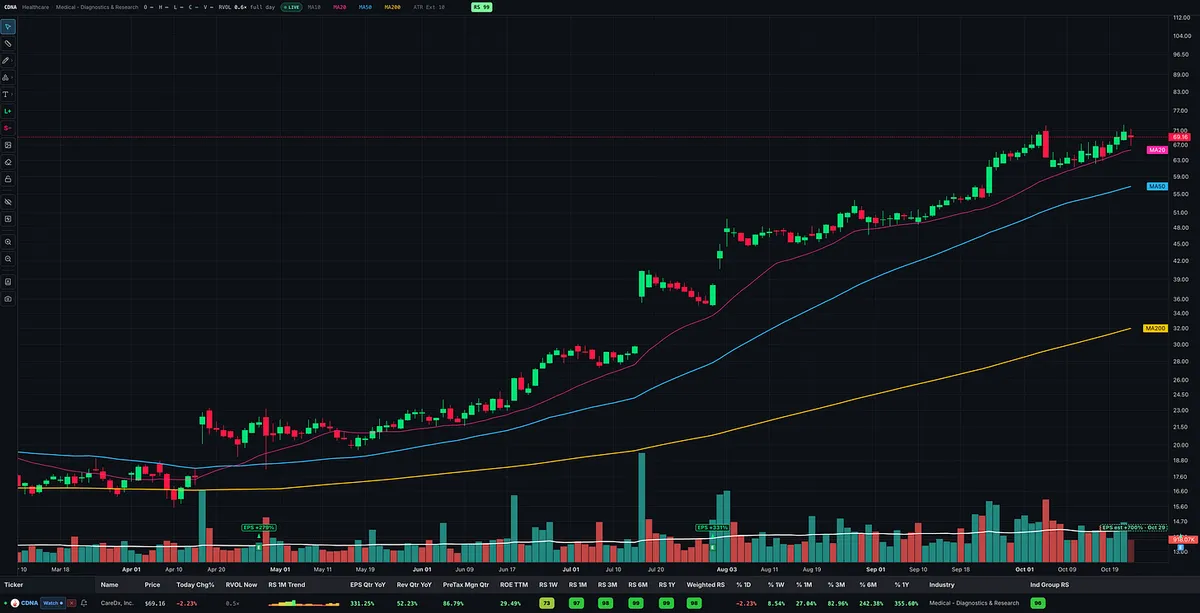
We Spotted CDNA Before the Breakout. Here’s What Happened Next. 👀

We originally found CDNA using MTS Velocity because it had many of the characteristics we look for: big earnings and sales growth, strong margins, strong relative strength, and a leading stock in a leading group.

The price and volume action gave us more reasons to pay attention:

• Higher highs and higher lows.

• Powerful advances on heavy volume.

• Several pullbacks and sideways pauses with tight price action and volume drying up below average.

• Renewed buying as price pushed higher.

After its last earnings surge, CDNA spent time consolidating in a relatively tight range before continuing its advance. The rising 20-day moving average has been a useful guide throughout much of that trend.

This is what we spend our time studying inside MTS: finding strong candidates, preparing before the breakout, and watching how they behave afterward.

It’s also a reminder that finding a winner is only part of the job. You have to give it room to work.

A stock being up from your purchase price is not, by itself, a reason to sell. Follow the price and volume action, respect your sell rules, and avoid cutting a healthy trend short simply because you have a profit.

Cut your losers short. Let your winners run.

Quoting Momentum Trading StrategyWe Didn’t Find CDNA After the Breakout. We Were Watching It Before. 👀 On August 6, I shared a list of medical, pharmaceutical, biotech, and healthcare stocks we were watching inside the MTS Community. CDNA was on it. We originally spotted the stock using the MTS Velocity screener, and the numbers made it difficult…
View on Substack ↗

Bull Markets Hide Bad Habits. Sideways Markets Expose Them.

Is everyone having fun yet?

It’s relatively easy to make money in a strong Stage 2 uptrend. Even inexperienced traders can do well when the market is doing most of the work.

And in a clear Stage 4 decline, the decision to stop buying and protect your capital can become more obvious.

But a long, drawn-out sideways market tests your discipline differently.

There’s just enough strength to tempt you back in, followed by enough failed moves to chip away at your capital and confidence.

Are you actually following progressive exposure? Or are you trading just as often, with the same position sizes, even though your results are telling you to slow down?

Minervini’s approach is straightforward: start small, increase exposure as your trades gain traction, and scale back when they aren’t working. You earn the right to get more aggressive through results, not because another green day makes you feel optimistic.

Are you waiting for quality setups, or chasing whichever stock or industry group happens to be moving today?

Even if the market starts looking healthy again, you still need quality stocks breaking out of sound bases. A sign of strength from the market doesn’t eliminate your buying criteria.

And are you mastering your strategy, or shopping for a new one every time conditions get difficult?

Many of the market wizards throughout the decades have warned against changing styles whenever your approach enters an unfavorable period. Learning a strategy includes learning when to apply it aggressively and when to do less.

Staying committed to your system does not mean keeping the same amount of money at risk.

You can follow your stops and still damage your account by repeatedly replacing one failed trade with another. When unfavorable conditions keep whipsawing your positions, step aside until the probabilities improve.

That doesn’t mean ignoring new opportunities. Keep studying. Keep building your watchlist. When the market environment, industry groups, and leading stocks look right and your criteria are met, start with selective pilot buys. But let those trades prove themselves before committing more capital.

These markets expose the difference between having rules and actually following them.

Making money when conditions are favorable is only half the job. How you handle the periods in between can be the difference between a profitable trader and a boom-and-bust trader.

View on Substack ↗

Your Strengths Won’t Save You From the Weaknesses You Ignore

Most people focus on their strengths and avoid working on their weaknesses. It’s more comfortable to keep doing what you’re already good at.

But in the markets, I find that your results improve when you put more effort into correcting your weaknesses while maintaining and gradually improving your strengths.

If your weakness is risk management or position sizing, that’s where more of your attention needs to go. Finding another great stock won’t solve the problem of taking positions so large that one loss wipes out several winners.

If your weakness is stock selection, focus on learning what separates a true market leader from a stock that simply looks interesting.

If you know when you should sell but keep ignoring your rules, more research isn’t going to fix that. You need to work on your execution.

Put the effort where your process is breaking down, not just where you feel most confident.

That doesn’t mean abandoning your strengths. It means recognizing that getting even better at one part of trading won’t necessarily compensate for repeatedly failing at another.

The market will expose those weak areas, whether you’re willing to work on them or not.

View on Substack ↗

The Biggest Lie You’ve Been Told About Diversification

A lot of investors have been convinced that owning more stocks means they’re managing risk.

Own 50 stocks instead of 5. Spread your money around. Don’t put all your eggs in one basket.

Sounds safe, doesn’t it?

But what happens when the market enters a serious correction and 40 of those 50 stocks decline together?

You weren’t managing risk. You were spreading it around.

William O’Neil addressed this in How to Make Money in Stocks:

“Broad diversification is plainly and simply often a hedge for ignorance.”

And Warren Buffett, despite being a completely different type of investor, expressed almost the exact same philosophy:

“Diversification is a protection against ignorance.”

Two of the greatest investors, with very different approaches, reaching a similar conclusion.

O’Neil understood that owning 30 or 50 stocks doesn’t protect you from a bear market. What protects you is having sound buy and sell rules, knowing when to reduce exposure, cutting losses, and being willing to move into cash.

Buffett believed that if you truly understand the businesses you’re investing in, owning a handful of exceptional companies can make more sense than spreading your capital across dozens of mediocre opportunities.

The common denominator isn’t simply concentration. It’s knowing what you own and understanding how to manage the risk.

Now, the next argument is usually diversification across asset classes. Stocks, bonds, commodities, real estate, and so on.

And there’s merit to that. Different assets can behave differently, potentially reducing portfolio volatility and drawdowns.

But there’s also a trade-off. Allocating capital to lower-returning assets can dilute the gains from your strongest opportunities.

For someone whose objective is aggressive capital growth, that trade-off matters.

What concerns me most is how many investors use diversification as a substitute for having an actual risk management strategy.

They feel safer because they own more things.

But feeling safe and being protected are two entirely different things.

I’d rather own a concentrated portfolio of my best opportunities, manage those positions with disciplined sell rules, and move heavily into cash when conditions deteriorate than own 50 stocks simply because someone told me diversification was protection.

Concentration without risk management can be disastrous. But concentration combined with proper position sizing, disciplined selling, and an understanding of general market conditions is an entirely different approach.

You don’t need to be a professional trader or sit in front of a screen all day to understand and apply these principles. Generations of successful growth stock investors have followed them while working full-time jobs.

And if your objective is simply broad market exposure without actively selecting and managing individual stocks, you can accomplish that through an index fund.

But if you’re going to take the time to study markets, select individual stocks, and manage your own portfolio, why spread your capital across dozens of positions simply for the sake of diversification?

Sometimes diversification is nothing more than an expensive way to feel comfortable.

View on Substack ↗

You Can Be Wrong 70% of the Time and Still Build a Fortune.

Most traders are obsessed with being right.

But what if being right isn't what separates successful traders from everyone else?

More than 70 years ago, legendary Wall Street speculator Bernard Baruch wrote in My Own Story:

"Even being right three or four times out of ten should yield a person a fortune if he has the sense to cut his losses quickly on the ventures where he has been wrong."

Read that again.

You can lose on 6 or 7 out of every 10 trades and still be highly profitable.

The secret isn't predicting the market correctly every time. It's understanding the mathematics of trading.

Keep your losses small. Give your winners room to grow. Never allow one bad trade to undo the progress of several good ones.

Think about it. If you win just 3 out of 10 trades, but your average winner is four times the size of your average loser, you're profitable before costs.

Your win rate doesn't determine your profitability. The relationship between your winners and losers does.

Of course, cutting losses alone isn't enough. You also need a repeatable edge and the discipline to capitalize when you're right.

Trading is a game of probabilities, not certainties.

Stop trying to be right all the time. Start learning how to make money even when you're wrong.

That's a lesson traders were being taught generations ago, and it's just as important today.

View on Substack ↗

The Earnings Are Booming. The Stock May Already Have Topped.

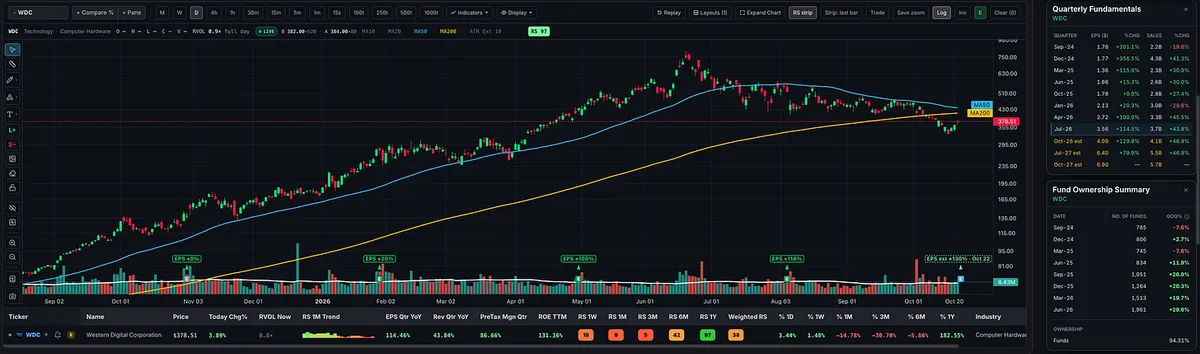
A lot of you have been asking me about broken-down AI stocks in former leading groups like semiconductors and computer hardware, especially the memory names.

The earnings are massive. Sales look incredible. Why wouldn’t I be interested?

I’ve done very well trading this area going back to 2025. But having made money in a stock doesn’t give me a reason to ignore what its chart is telling me today.

In How to Make Money in Stocks, William O’Neil writes:

“Many big investors get out of a stock before trouble appears on the income statement.”

O’Neil explains that many stocks peak while earnings are up 100% and analysts are still projecting more growth and higher prices.

Waiting for the numbers to look bad can mean waiting well past the stock’s top.

William O’Neil gives a powerful example from 2008: U.S. Steel fell even though its next two quarterly earnings reports showed growth above 100%. Potash topped with current-quarter earnings growth of 181% and next-quarter growth of 220%.

The earnings looked phenomenal. They didn’t prevent those stocks from breaking down.

Institutions need buyers to absorb the shares they sell. An exciting story and impressive earnings can still attract those buyers while large holders are heading for the exit.

That doesn’t mean every pullback signals the end. O’Neil distinguishes normal corrections from abnormal price and volume action. Heavy selling, broken support, and weak recovery attempts after a major advance deserve your attention, especially when other leaders in the group are deteriorating too.

That’s my concern with the broken-down names people are sending me. The damage I’m seeing looks consistent with a run that may be over for now.

Could they build new bases, tighten up, and offer another opportunity? Absolutely. Whether that takes six months, a year, or longer, I’m willing to reassess when the chart earns it.

Strong fundamentals matter, and they’re central to O’Neil’s method, but they don’t cancel a sell signal.

You don’t have to take my word for it. Study how past leaders behaved near their tops, including what their earnings looked like at the time.

Before you buy yesterday’s leader because the numbers look great, make sure you’re not buying what institutions are selling.

View on Substack ↗

The Next Bull Run Won’t Wait for You to Recover

Fighting every correction and sideways market can leave you without the money or confidence to capitalize when conditions finally improve.

I’ve written extensively about distribution days, weakening leadership, and reducing exposure when trades stop working.

But knowing when to get back in is just as important.

William O’Neil’s follow-through day helps identify a potentially meaningful rally: a major index closing sharply higher on volume above the previous session, generally on day 4 or later. He emphasized decisive strength, with the strongest signals often appearing between days 4 and 7.

Follow-through days can fail. They are a reason to start looking for quality entries, not a reason to go all-in.

That’s where progressive exposure comes in.

Start small, define your risk, and build exposure as your trades work. When they fail, cut losses and scale back.

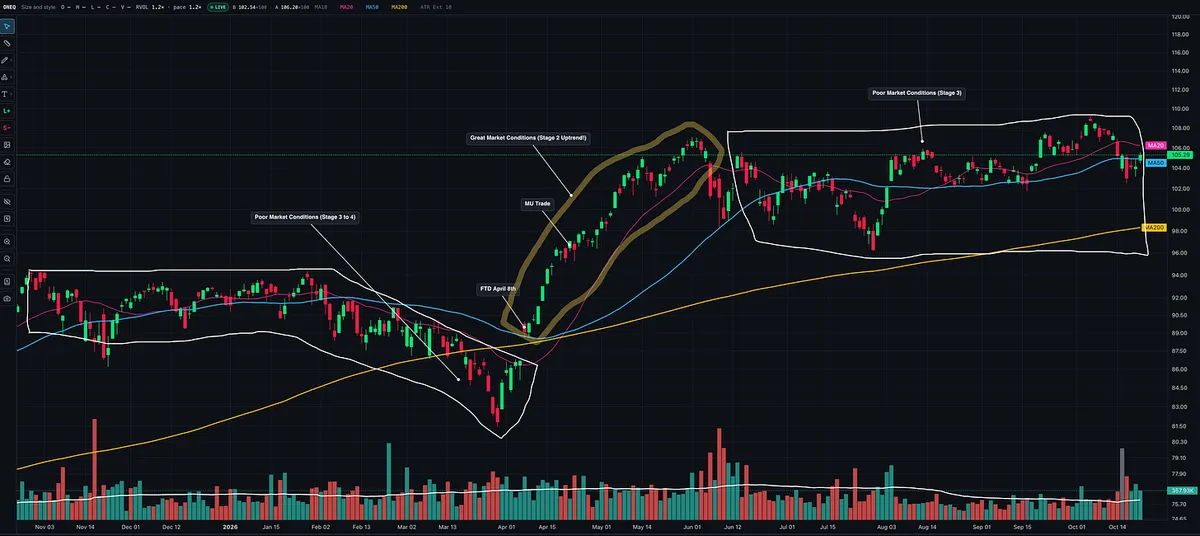
On the morning of April 8, I was discussing a potential follow-through day and sharing stocks preparing to break out. By April 22, MU was setting up beautifully. Several leaders went on powerful runs.

I didn’t know the rally would succeed. I was prepared to test it.

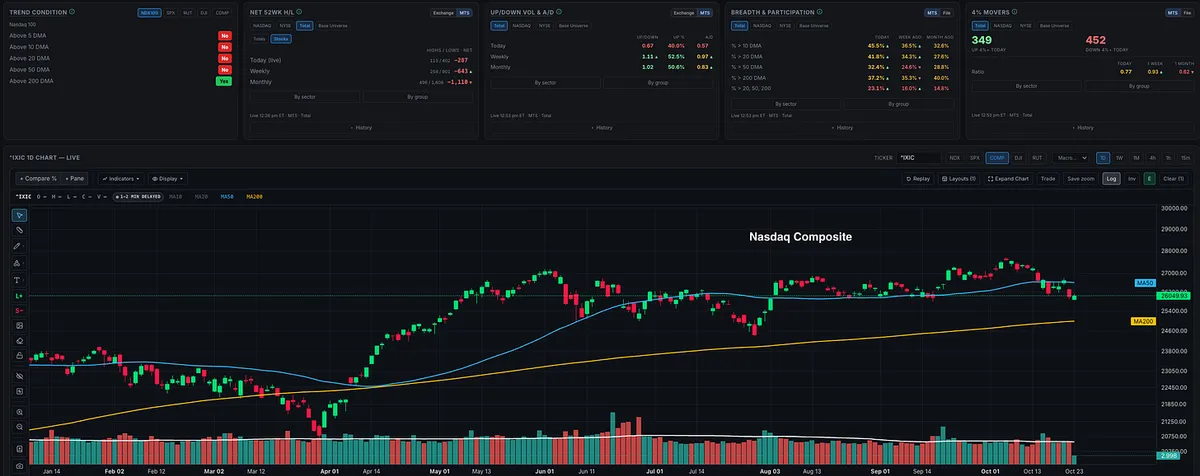
Then came June 5, when the Nasdaq fell more than 4%. I wrote in The Big Picture about the warning shot and a potential change in market character.

What followed was the Stage 3 sideways action shown on the chart, while many former leaders suffered much deeper declines.

I didn’t need to predict what came next. I needed to recognize that the favorable trading environment was deteriorating.

This is where traders get themselves into trouble.

They keep forcing trades through difficult conditions, draining both financial and mental capital. Then the next April 8 arrives, and they’re too beaten down to act.

After 20 years of trading, studying great traders, and making plenty of my own mistakes, this lesson keeps coming back:

You don’t need to make money in every market. You need to protect yourself during difficult periods so you’re prepared to capitalize when conditions improve.

When conditions deteriorate, I trade less. But I keep studying, building watchlists, and preparing.

I’m not married to being bullish or bearish. I’m willing to get defensive, and just as willing to start buying again when the evidence improves.

Protecting capital is only half the job. Being ready to put it back to work is the other half.

View on Substack ↗

There’s Always Something to Buy. That Doesn’t Mean You Have an Edge.

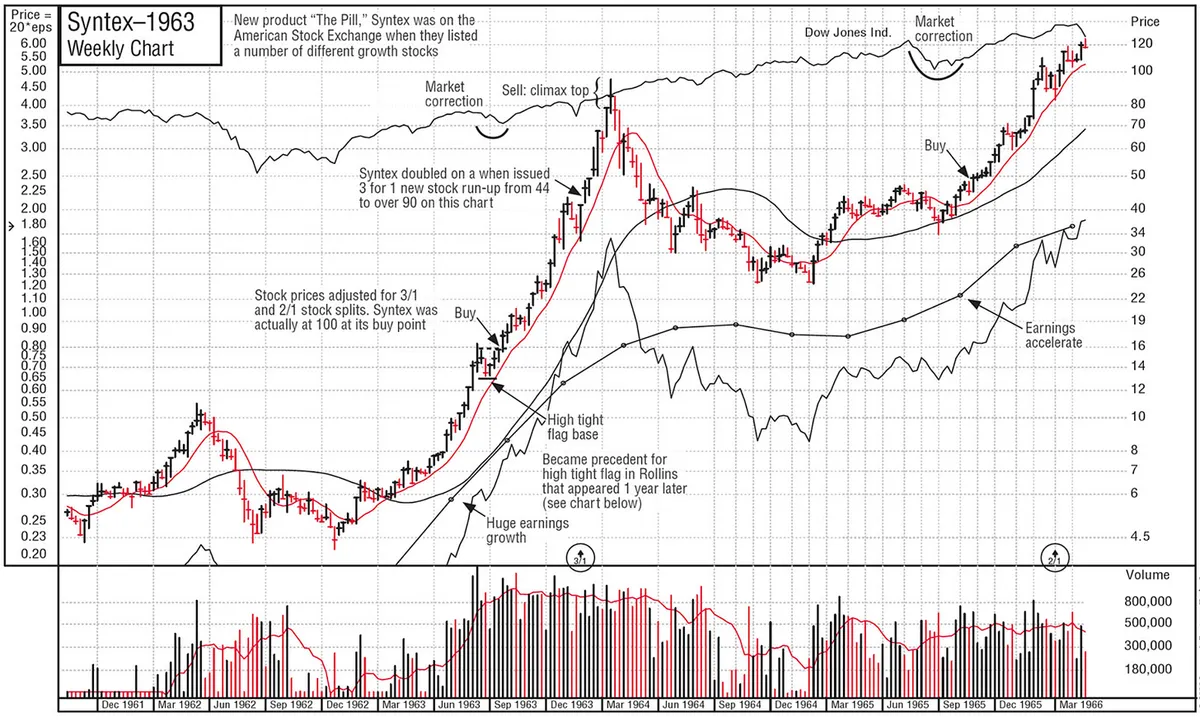
William O’Neil describes buying Chrysler from a cup-with-handle base after the market followed through coming out of the Cuban Missile Crisis. Later came Syntex.

He reports that his worst-performing managed account gained 115% in 1963 without margin. Other accounts using margin gained several hundred percent.

He also had numerous losing trades. He kept losses small and carefully added to positions that were working.

The system allowed for being wrong.

O’Neil developed his approach by studying the market’s biggest winners, successful investors such as Jack Dreyfus, and his own trading mistakes. That research shaped his rules for what to buy, when to buy, when to sell, and when to protect capital.

CAN SLIM is designed to put the odds in your favor by combining stock selection, market direction, proper entries, and disciplined selling. Any individual trade can still fail.

I want strong earnings and sales, leadership within a strong industry group, evidence of institutional demand, and a sound base with an entry that allows me to define my risk. I also want a market that supports those breakouts.

I have spent years testing these characteristics in my own screens. That research informs my decisions, while my trading results tell me whether conditions are supporting my approach.

When the market turns choppy, breakouts repeatedly fail, and my sell rules are triggered, I reduce exposure. If that continues, I end up in cash.

A follow-through day gives me a reason to begin buying qualified leaders as they emerge from proper bases. It can still fail, so I build exposure as my trades prove themselves.

That’s what I mean by thinking in probabilities. I use judgment, but that judgment operates within a researched system. I want the market, the stock, and the setup working together, with rules for protecting capital when I’m wrong and building on success when I’m right.

There’s always something to buy. The discipline is knowing when the evidence justifies the risk, and being willing to wait when it doesn’t.

View on Substack ↗

He Picked the Right Stocks. He Still Broke Even.

Early in his career, William O’Neil was finding winning stocks, buying them at the right time, and adding as they advanced.

Yet after more than a year of getting his stock selections right, he had essentially broken even.

O’Neil explains why:

“I knew how to select the best leading stocks, but I had no plan for when to sell them and take profits.”

Some positions produced substantial gains that he watched disappear. Others he sold prematurely because he got nervous.

With Certain-teed, he bought in the low $20s, became frightened during market weakness, and sold for a gain of only two or three points.

The stock went on to triple.

He was finding the opportunities. His decisions after buying were costing him the results.

O’Neil spent the last six months of 1961 reviewing every transaction from the preceding year. He marked his buys and sells on charts, then overlaid the general market averages.

He studied what he had actually done with his money.

He had already learned from exceptional investors. The Dreyfus Fund helped him recognize the importance of buying new highs out of sound bases. Livermore taught him to build on positions that were working. Baruch and Gerald Loeb emphasized selling into strength.

His own mistakes showed him where his approach remained incomplete.

He needed rules for cutting losses, taking worthwhile profits, and holding exceptional winners long enough to capture a meaningful move.

Simply telling himself to “sell sooner” would not solve both problems. Neither would telling himself to “be more patient.”

Patience without sell discipline can give back your profits. Selling without a plan can repeatedly cut your best opportunities short.

That is why reviewing your trades matters.

Where did you ignore an exit? Where did you sell out of fear? Where did you confuse a normal correction with a broken stock?

Then turn what you learn into written rules you can follow.

Before spending another weekend searching for the next great stock, study what happened to the great stocks you already found.

Your next breakthrough may come from correcting an old mistake you keep repeating.

View on Substack ↗

A 4% Dividend Won’t Fix a 35% Loss

“To be a successful investor, you must face facts and stop rationalizing and hoping.”

-William O’Neil

This dividend example makes the point painfully clear.

A stock falls 35%, but the investor reassures himself that he’s still collecting a 4% dividend.

Put that into dollars. Your $10,000 position falls to $6,500. Even if you collect $400 in dividends over that same period, you have $6,900. You’re still down 31%.

The dividend is real. So is the loss.

O’Neil challenges several other comforting beliefs investors use to justify holding losing stocks:

  • “It’s not a loss until I sell.” Your investment is already worth less. Refusing to sell doesn’t restore the missing money.

  • “It’s a good company.” Even a good company’s stock can suffer a devastating decline.

  • “It has to come back.” Some stocks take years to recover. Others never do.

  • “I’m a long-term investor.” A longer holding period doesn’t guarantee a better outcome.

  • “I’m diversified.” Owning more stocks doesn’t eliminate the risk of a broad market decline.

The problem is how easily these beliefs become permission to ignore mounting losses.

We stop asking whether the evidence still supports owning the stock. Instead, we search for reasons we shouldn’t have to admit we were wrong.

The dividend becomes the reason. Then the company’s reputation. Then our time horizon. Whatever lets us postpone the uncomfortable decision.

O’Neil offers a useful test: imagine you didn’t own the stock and had its current value in cash. Would you buy it today?

If the answer is no, what is your reason for continuing to hold it?

A convincing explanation can make a bad decision feel responsible for a very long time.

If the habits you’ve adopted leave you badly underperforming the market, or losing money while it advances, their popularity should give you no comfort.

Maybe you shouldn’t keep doing what everyone else does simply because everyone else does it.

There is no financial reward for making the same mistake as the crowd.

View on Substack ↗

Would You Run a Business the Way You Run Your Portfolio?

In How to Make Money in Stocks, William O’Neil asks you to imagine owning a women’s clothing store.

You stock dresses in three colors: red, green, and yellow.

The red dresses sell out. Half the green dresses sell. The yellow dresses barely move.

Would you order more yellow dresses because yellow happens to be your favorite color? Would you ignore what customers are buying because you still believe the yellow dresses are wonderful?

That would be a costly way to run a store.

A sensible merchant recognizes the buying mistake. Mark the yellow dresses down. If they still don’t sell, reduce the price again. Recover the money and put it into more of the red dresses customers actually want.

The purpose of the business is to make money, not prove the owner has good taste.

O’Neil’s question is simple: why do investors struggle to apply that same reasoning to their stocks?

We sell a winner because taking a profit feels good. We hold a loser because selling would mean admitting a mistake. Sometimes we buy even more as it falls, increasing our commitment to something that isn’t working.

Our preference starts carrying more weight than the market’s response.

The retailer has unsold yellow dresses. The investor has a position they keep defending while their capital sits tied up in it.

Both need to ask whether that money could be put to better use.

O’Neil’s lesson is that investing should be operated like a business. Buying mistakes are inevitable. Recognizing and correcting them is part of the job.

That means having rules for when to cut a loss, when to hold a winner, and when adding to a position is justified.

Your favorite color doesn’t determine what customers buy. Your favorite stock doesn’t determine what the market rewards.

How much of your portfolio is a rack of yellow dresses you refuse to mark down?

View on Substack ↗

I Buy New Highs. Sometimes I’d Rather See a Bear Market.

People sometimes assume that because I’m a momentum growth trader buying stocks at new highs, I always want the market pushing higher.

But the stage of the cycle matters.

In How to Make Money in Stocks, William O’Neil writes:

“The really big money is usually made in the first one or two years of a normal new bull market cycle.”

That matches my experience. My best opportunities often come early, when fresh leaders emerge and breakouts follow through.

Count from the late-2022 lows, and we’re well beyond those first two years. Even if you consider the April 2025 tariff selloff a reset, we’re roughly 18 months into that advance.

The market could go much higher or be forming a top. Nobody knows.

The calendar provides context. The market’s behavior determines my exposure.

As I take profits, sell stocks that break down, and find fewer quality setups to replace them, my exposure naturally shrinks.

If I’m sitting in cash, I’d often rather see a substantial correction or bear market than spend months grinding through choppy conditions that offer little reward for the risk.

If the thought of a big correction terrifies you, you may not be ready to trade. That fear can come from having too much at risk or lacking clear sell rules, proper position sizing, and disciplined risk management.

Following those rules means exiting failing positions and reducing exposure as conditions deteriorate, potentially well before a bear market is widely recognized.

By the time others recognize the damage, a trader who has protected their capital can already be getting excited about the next opportunity.

O’Neil explains why:

“Even if you sell out completely and move to cash, you never want to throw in the towel on stock investing because bear markets create new bases in new stocks, some of which could be the next cycle’s 1,000% winners.”

Those are the opportunities I want to preserve my capital for.

When conditions improve and my trades start working, I’ll rebuild exposure, whether we get a bear market first or not.