Momentum Trading Strategy

Notes

Market Conditions

Reading the overall market and deciding how aggressive to be.

Showing 81–100 of 227 notes

View on Substack ↗

Risk/Reward Changes With Every Candle. Most Traders Realize It Too Late.

As a growth stock trader and momentum trader, I am not trying to guess the bottom.

I am also not trying to pick the top.

I wait for the market to confirm.

Then I do the same thing with individual stocks.

This is something I talk about in Module 6 of the Momentum Trading Strategy Course in the risk management section.

Risk-reward is not static.

It changes as a stock moves.

After a long consolidation, correction, or deep pullback, the first few days off the lows are always hard to trust.

You do not know if it is real yet.

It could just be another failed rally.

It could just be another bounce before the next leg lower.

But once the market gives a real green light, that is where your focus should shift.

  • A follow-through day.

  • Price reclaiming key moving averages.

  • Leading stocks setting up.

  • Stocks breaking out to new highs.

William O’Neil talked about this idea repeatedly. The goal is not to predict the market. The goal is to understand what the market has actually done and what it is doing now.

He also wrote that investors should buy stocks as they emerge from properly formed bases and begin making new highs in price.

Mark Minervini described a similar moment in Trade Like a Stock Market Wizard.

When a leading stock moved into new high ground as the general market rallied off its lows, he wrote:

“This was the green light to buy.”

You are not trying to be a hero at the bottom.

You are trying to recognize when the evidence has changed.

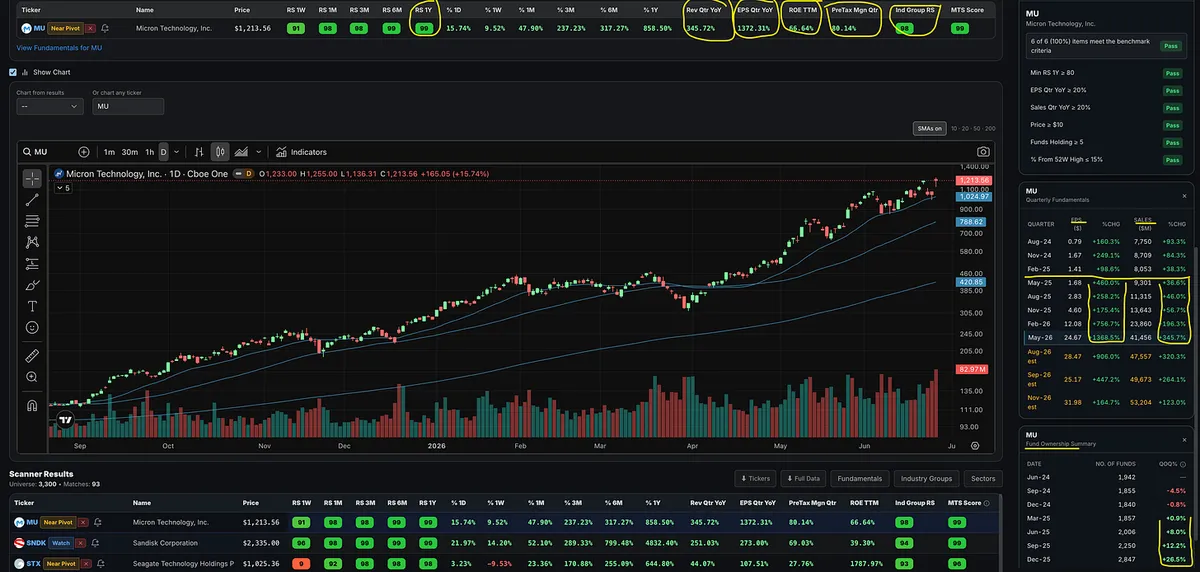
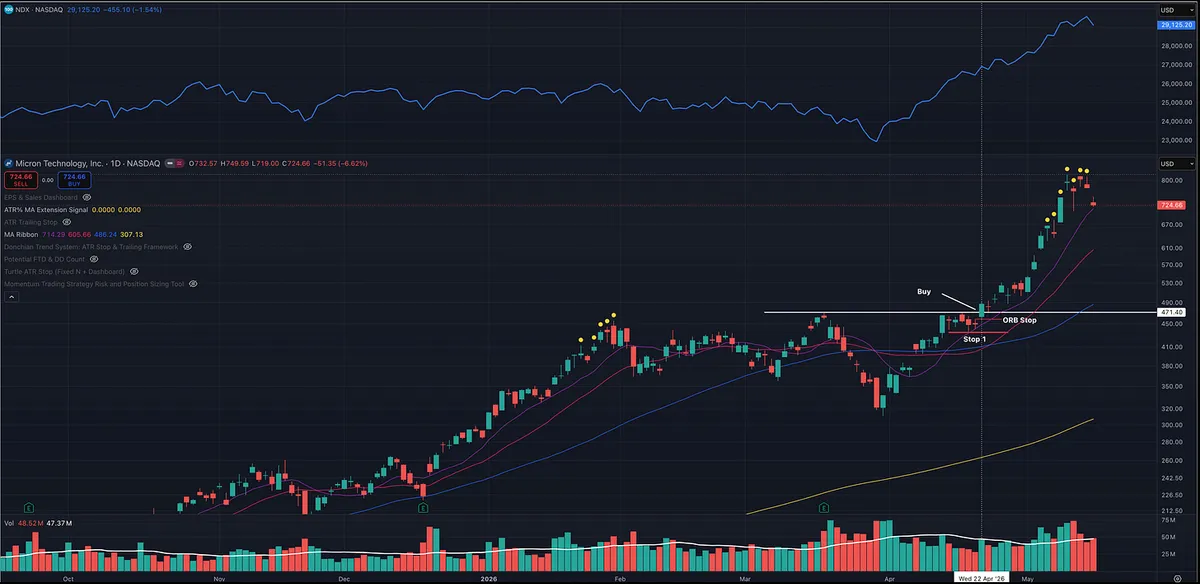
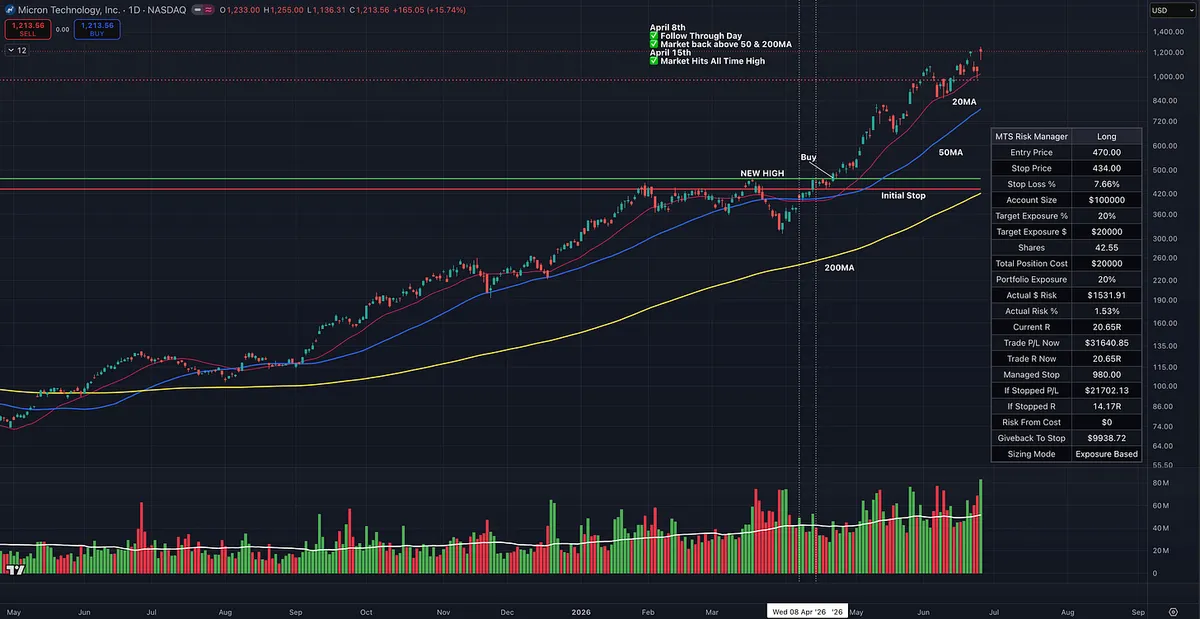
Now look at MU.

This was not some random stock waking up.

This name has been showing the characteristics of a leader for months.

  • Strong relative strength.

  • A hot industry group.

  • Explosive earnings.

  • Explosive sales.

  • Strong margins.

  • Strong institutional sponsorship.

  • Price above key moving averages.

  • A cup-with-handle type setup.

  • A breakout to new highs on strong volume.

Back in April, during this breakout, the risk-reward was much better.

The multi-month consolidation gave the market and MU the time it needed to reset, shake out weak holders, and build the structure for its next leg higher.

Then, after briefly breaking below the 200-day moving average and washing out many traders, the stock reclaimed key levels, tightened up, and broke out to new highs.

That kind of action can fuel a move that goes much higher and lasts much longer than most people expect.

Now the stock is up roughly 20R from the initial risk.

Could you have made money buying it later?

Sure.

But that is not the point.

The point is that the risk-reward relationship changed.

The market can still go much higher from here.

Or it may not.

Nobody has a crystal ball.

But what we can know is when the market gives us a green light, when leading stocks are setting up, and when the risk can be defined before the move becomes obvious to everyone else.

This is why experienced traders get excited after long consolidations and deep corrections.

Not because the damage is fun.

Because corrections reset the playing field.

When conditions improve and leaders begin breaking out, the risk-reward is usually far better than it is months later after everyone finally feels comfortable.

By the time the trade looks obvious, the best risk-reward is usually already behind you.
View on Substack ↗

The Nasdaq Is About 1% From Highs. Are You Looking in the Right Areas?

This three-day break from the market is a gift. It gives you time to step back, clear the noise, and study the big picture before drilling down into individual stock selection.

The Nasdaq-100 is now only about 1% from all-time highs, technology is back on top, and semiconductors are leading the market again. That does not mean every stock is a buy, but it does mean we need to be focused on the right areas.

Read here: https://tradingmomentum.substack.com/p/the-green-light-is-back-but-only

On SubstackBig Picture Market Pulse | June 19, 2026: The Green Light Is Back, But Only Leaders Deserve Your Money
View on Substack ↗

Before You Chase the Next Breakout, Step Back

Like I say every week, before you dive into individual stock screening and selection, step back and understand the market environment and the big picture.

The weekend is the perfect time to do this while the market is closed.

The Nasdaq-100 held the 10-week moving average this week, breadth improved, net new highs stayed positive, and volatility cooled.

But the market has not fully repaired last week’s warning shot. QQQ and SPY still need to reclaim the 10-day and 20-day moving averages, distribution days remain elevated, and short-term leadership is rotating beneath the surface.

Stepping back and reviewing the big picture can give you clarity before stock screening and help you ask the right questions:

  • Which stocks held up best during the pullback?

  • Which names are already moving to new highs while the major indexes are still repairing?

  • Which groups are attracting new demand?

  • Which stocks are continuing to lead?

That is where the next watchlist starts.

Read the Big Picture Market Pulse here:

https://tradingmomentum.substack.com/p/the-nasdaq-held-the-10-week-now-comes

On SubstackBig Picture Market Pulse | June 14, 2026: The Nasdaq Held the 10-Week. Now Comes the Real Test
View on Substack ↗

Not sure how to define the current market environment?

Dr. Van Tharp broke the market down into 6 different market types:

Bull Quiet

Bull Volatile

Bear Quiet

Bear Volatile

Sideways Quiet

Sideways Volatile

The point is simple: every strategy does not work in every market.

Some environments reward aggression. Some reward patience. Some reward defense. Some should barely be traded at all.

Before worrying about individual setups, it helps to first ask:

“What type of market are we actually in?”

I wrote more about the 6 market types here:

https://tradingmomentum.substack.com/p/the-6-market-types-every-trader-must

ArticleThe 6 Market Types Every Trader Must Understand
View on Substack ↗

Worried About the Market? Read This First

Most traders don’t need more panic.

They need more understanding.

I took the paywall down on one of my best-performing posts because I’m seeing a lot of worried traders and investors right now.

And honestly, this is exactly why I wrote it.

Most people think market crashes come out of nowhere. They don’t.

The market usually gives warning signs before major tops, and it usually gives confirmation when a new bull market is beginning. Once you learn how to read market structure, the market becomes a lot less emotional.

You stop reacting to every headline.

You stop getting shaken out by every red day.

You stop guessing.

This post breaks down how to recognize major changes in market character using principles from Stan Weinstein, and William O’Neil.

It has been one of my most-read posts for a reason.

If you’ve been feeling worried about the market, start here.

https://tradingmomentum.substack.com/p/how-the-market-warns-you-before-the

ArticleHow the Market Warns You Before the Crash (and When It’s Safe to Get Back In)
View on Substack ↗

The Nasdaq Fired a Warning Shot. Read This Before Planning Trades.

Before screening or planning trades this week, step back and zoom out.

Read the big picture first.

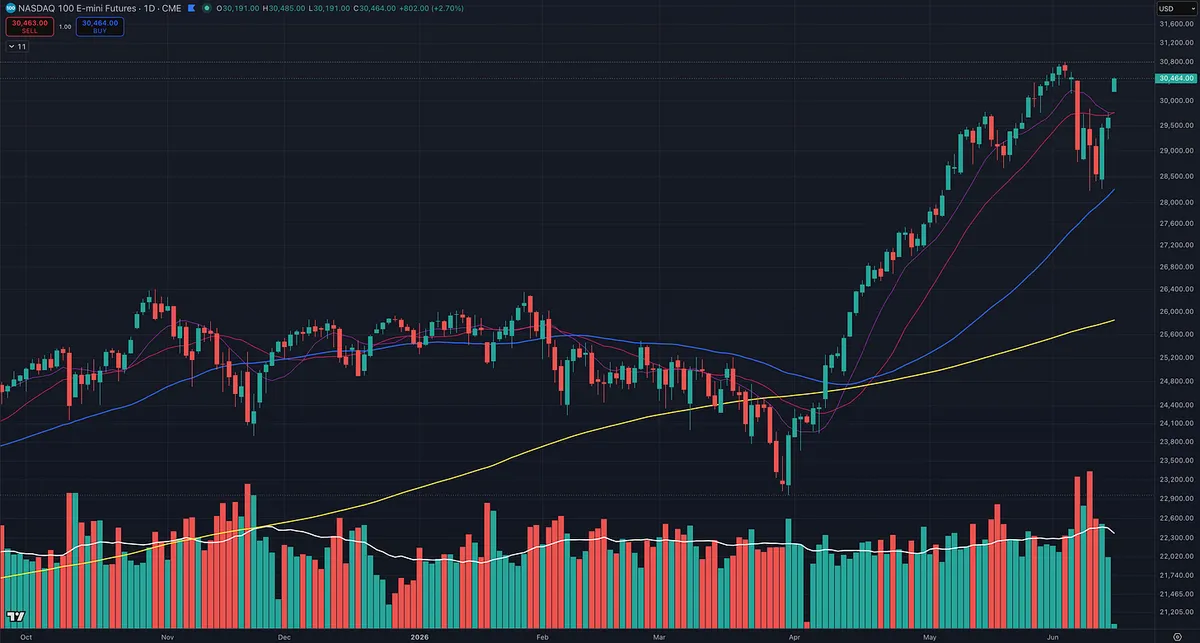
Friday was not a normal pullback. The Nasdaq-100 dropped 4.77%, the S&P 500 fell 2.64%, volatility spiked, breadth weakened, and leadership shifted defensively.

That is a warning shot that should not be ignored.

The Stage 2 uptrend is still intact, but this is no longer a maximum-aggression environment. When the market changes character, your process has to adjust with it.

The goal is not to predict whether Friday was a one-day outlier or the start of a deeper correction. The goal is to manage risk, protect capital, and let the market confirm the next move.

Stock selection and industry group strength matters, but the general market is still the tide that lifts or lowers most boats.

This week’s Big Picture Market Pulse breaks down the major indexes, volatility, breadth, distribution, relative strength, sector rotation, the Composite Model, and updated exposure levels.

https://tradingmomentum.substack.com/p/the-nasdaq-just-fired-a-warning-shot

On SubstackBig Picture Market Pulse | June 7, 2026: The Nasdaq Just Fired a Warning Shot
View on Substack ↗

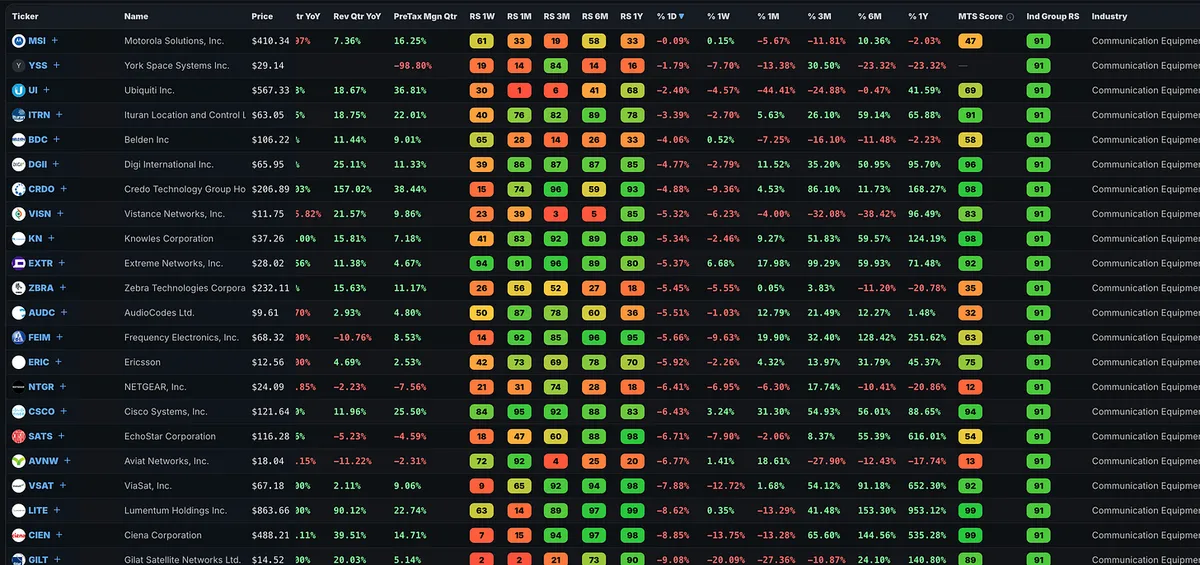
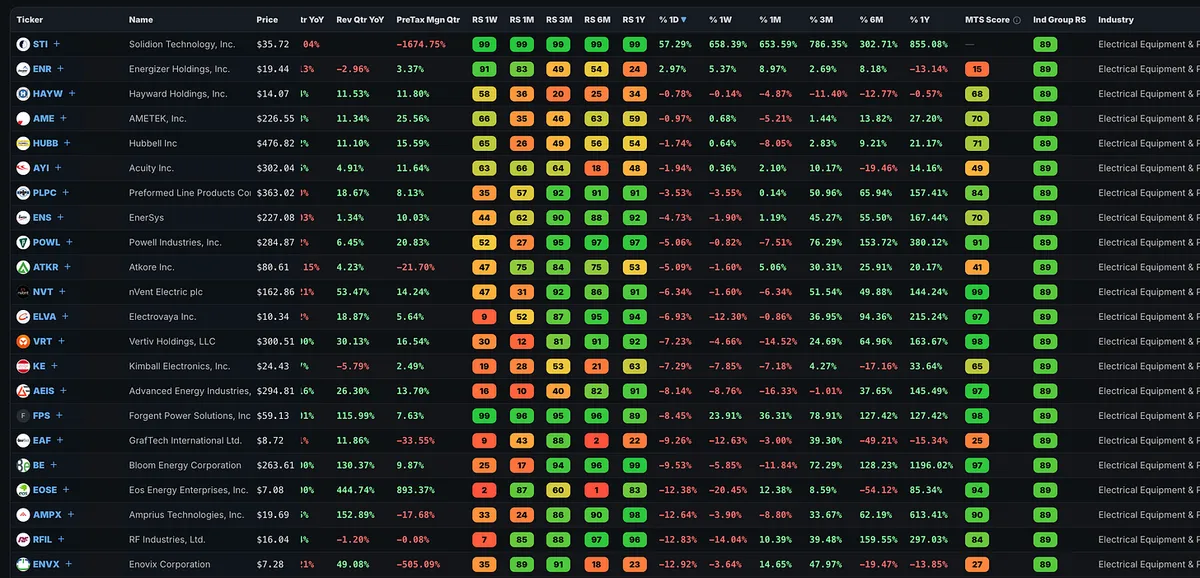
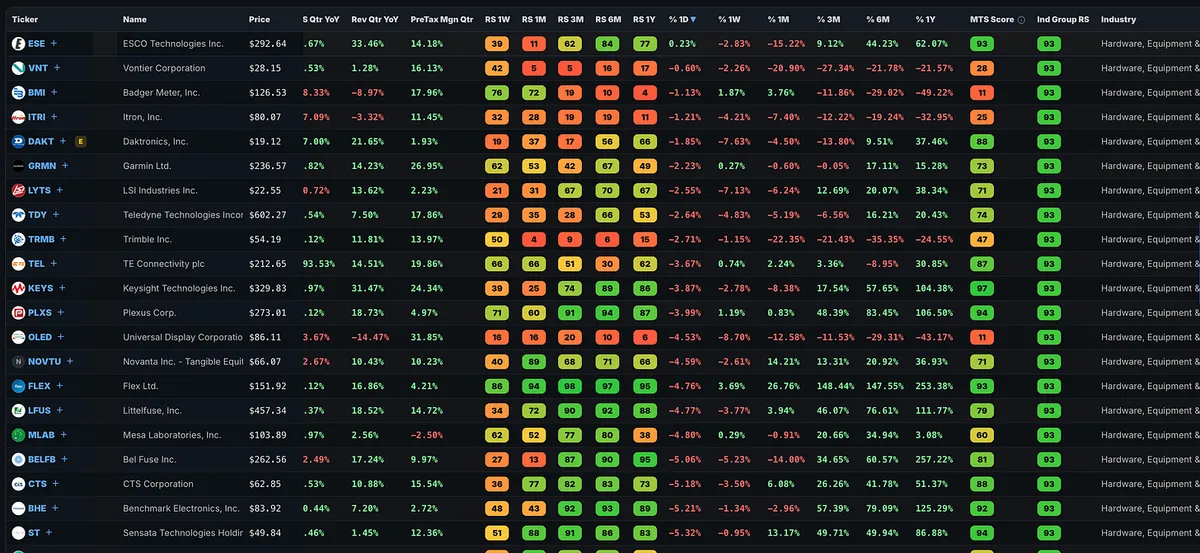
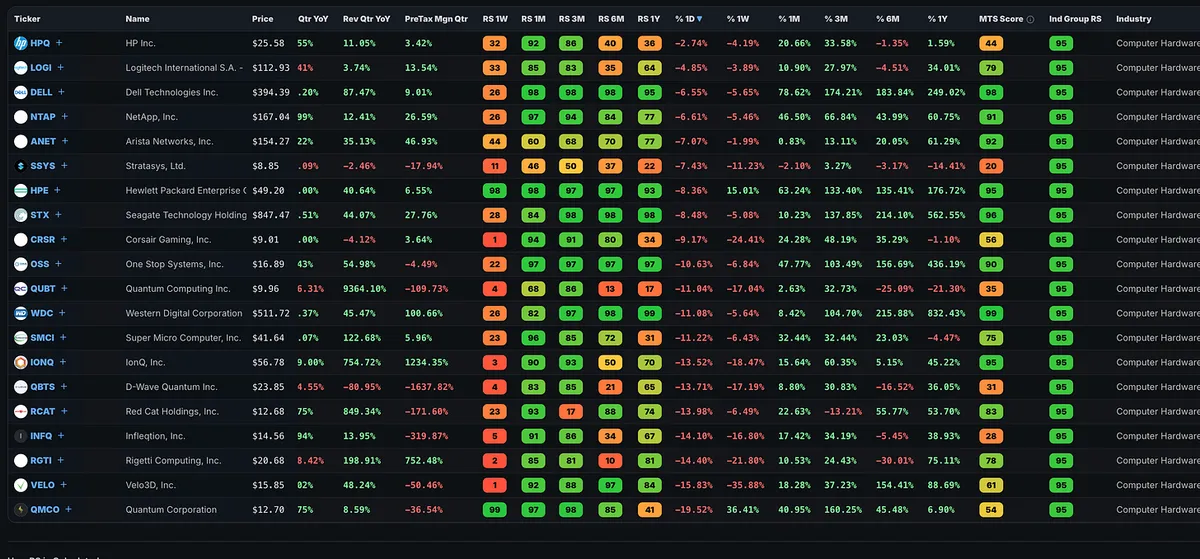
Think You Can Ignore the Market? Look at These Screenshots.

One of the questions I get asked most is:

"Why do you put so much emphasis on the general market?"

Because the market sets the environment that almost every stock trades in.

Since the April follow-through day, the market has been led by the Nasdaq, growth stocks, technology (XLK), and AI-related industry groups.

  • Semiconductors.

  • Computer Hardware.

  • Electronic Components.

  • Communication Equipment.

  • Computer Data Storage

  • Telecom

These weren't weak groups trying to catch up.

These were the leaders driving the advance.

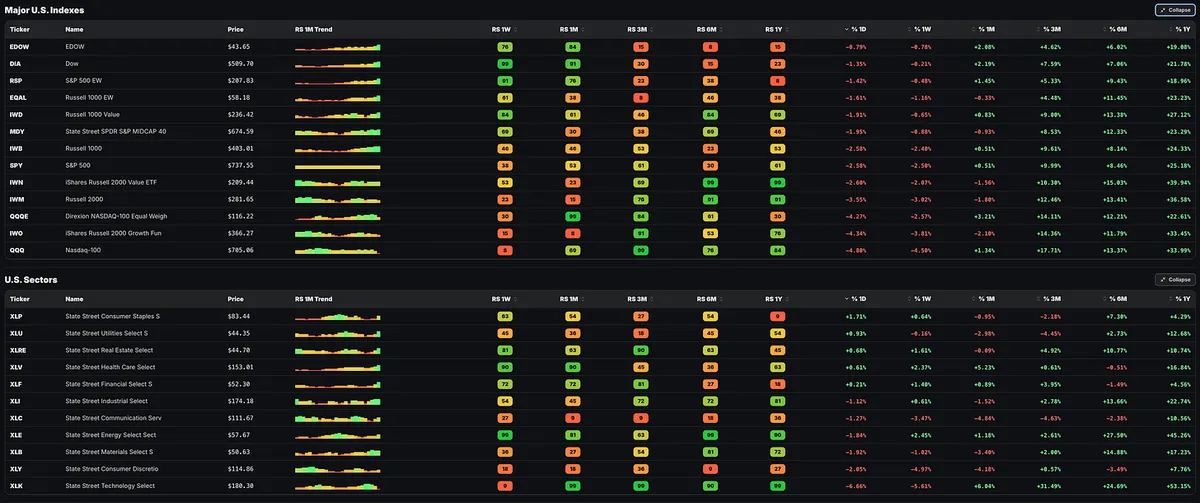
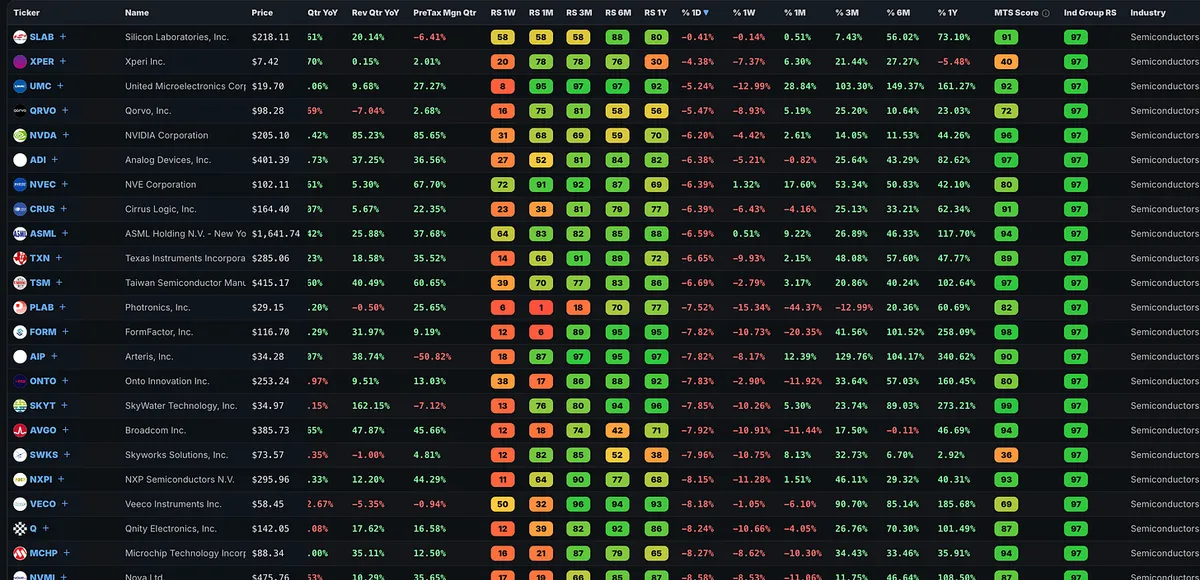
Now look at the screenshots.

On Friday, the Nasdaq fell 4.8% and the S&P 500 dropped 2.64%. Both sliced right through their 20-day moving averages.

If there was ever a time for the strongest stocks to prove they could ignore the market, this was it.

But they didn't.

The same industry groups that had been leading the rally were hit across the board. Many of their top stocks were down 5%, 8%, 10% or more.

How many truly bucked the trend?

Very few.

This is exactly why William O'Neil placed so much importance on the "M" for Market Direction in CAN SLIM. After studying more than a century of the biggest stock market winners, he recognized that even the strongest leaders are heavily influenced by the direction of the general market.

The lesson isn't that you should fear every red day, but you should respect the market.

Stock selection matters.

Industry group selection matters.

But the general market is the tide that lifts or lowers almost every boat.

The screenshots are a perfect reminder that the goal isn't simply to own the strongest stocks.

It's to own the strongest stocks when the wind is at your back.

View on Substack ↗

The Hardest Thing in Trading Is Doing Nothing

Jesse Livermore gave this lesson over 100 years ago, and it is still one of the hardest lessons for traders to actually follow:

“It never was my thinking that made the big money for me. It was always my sitting. Got that? My sitting tight!”

Most people read that quote and think Livermore was only talking about holding winning positions.

And yes, that is part of it.

If you find a true market leader, enter correctly, manage risk, and the stock is acting right, you need the patience to let the move develop. Big money is rarely made by constantly jumping in and out of every small fluctuation.

But “sitting tight” means more than just letting your winners run.

It also means sitting and waiting for the right setup.

It means not chasing a stock just because you like the story.

It means waiting for the stock to build properly, tighten up, approach the right area, and show real demand at the right moment.

And sometimes, it means sitting in cash.

That is the part most traders hate.

Many breakout strategies and momentum setups work best when the general market is in a supportive stage two uptrend. When the market is correcting, choppy, or under distribution, even good-looking setups can fail.

The stock may have strong fundamentals.

The chart may look good.

The theme may be powerful.

But if the general market is not supporting growth stocks, the odds change.

Most stocks follow the general market. That means your setup does not exist in isolation. The environment matters.

So patience has three sides:

  • Sitting with a winner when it is acting right.

  • Sitting and waiting for the stock to set up properly.

  • Sitting out when the market is not giving you favorable conditions.

That is why trading is so hard.

Most traders do too much.

The best traders know when to do nothing.

View on Substack ↗

The Market Gave the Green Light

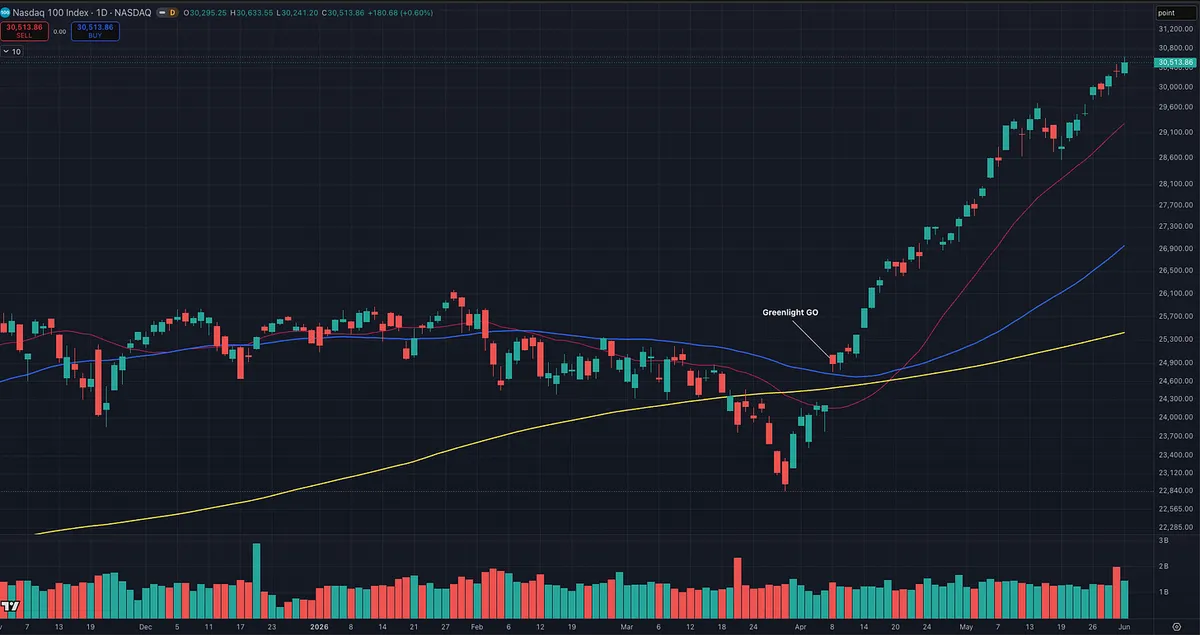
On April 8, the market gapped up above the 50-day and 200-day moving averages on a follow-through day.

That was the green light to start participating again.

Many traders ignored the signal.

Then they complained that there was “nothing to buy.”

Then, after the strongest names started moving, many said the move had already happened and the stocks had already left without them.

But that was not true.

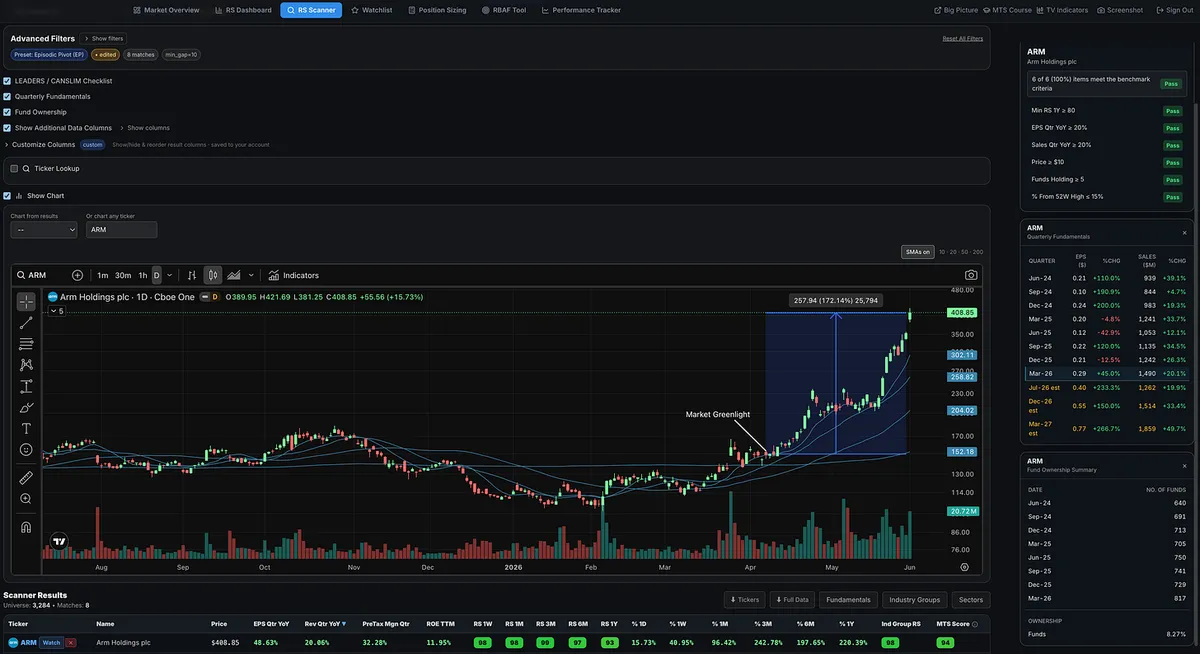
MU was one example I gave that was still setting up on April 22.

ARM is another example of a later mover that gave traders plenty of time to participate.

After the market confirmed strength, ARM began building momentum, tightened up, held key moving averages, and eventually made a powerful move higher.

This is why following a proven process matters.

The market gave the signal.

Leading stocks showed up before, during and after the market moved.

There were plenty of opportunities for traders who were prepared and knew what they were doing.

This is why we built the Momentum Trading Strategy Course and MTS Software.

The course gives you the foundation.

The software helps you find the leaders.

Stop wasting time guessing.

View on Substack ↗

The Market Is At New Highs. Why Are So Many Investors Still Looking In The Wrong Places?

The Nasdaq-100, S&P 500, Dow, and Russell 1000 all closed at all-time highs this week.

Technology continues to dominate every major sector ranking.

  • Volatility is falling.

  • Breadth is improving.

  • Net new highs are expanding again.

Yet many investors are still searching for opportunities in areas the market is clearly not rewarding.

Before diving into stock screens and trade ideas, step back and study the big picture.

This week's Big Picture Market Pulse breaks down where institutional money is flowing, which industry groups continue to lead, why we're shifting toward a Bull Quiet environment, and what the updated Composite Model is telling us.

The market keeps giving us clues. The question is whether we're paying attention.

📈 Full report available now for paid subscribers.

View on Substack ↗

Technology Continues to Dominate

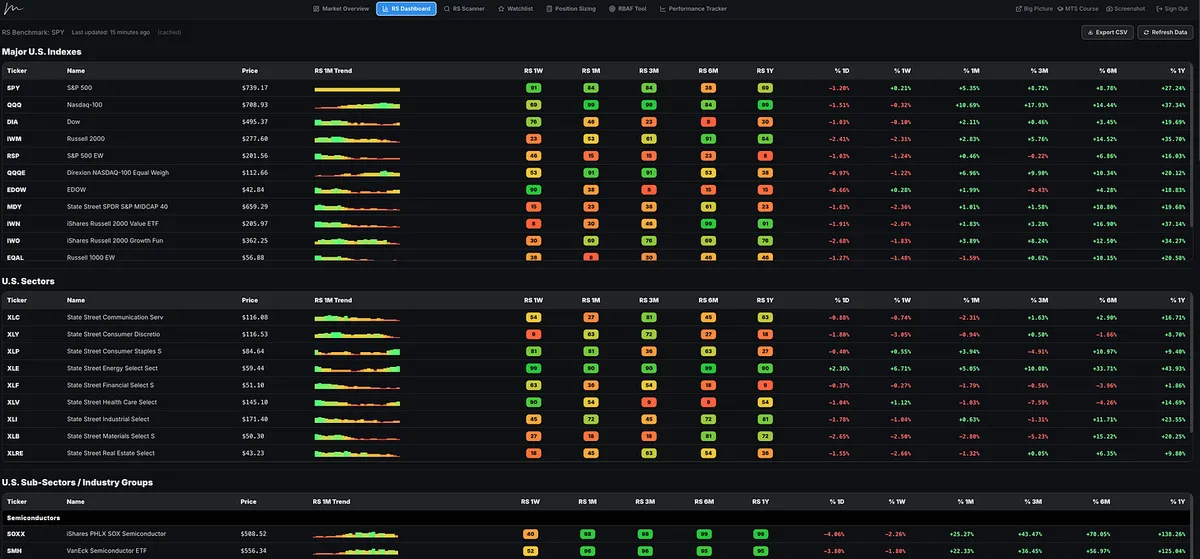
Looking across the 11 major U.S. sectors, one thing remains remarkably clear: technology continues to lead by a wide margin.

Since the April follow-through, no other sector has come close to matching the performance of XLK. The relative strength advantage has been obvious and consistent every week we've reviewed the data. Leadership continues to be concentrated in technology and the growth-oriented industry groups.

As traders, our job is not to argue with leadership. Our job is to identify where capital is flowing and align ourselves accordingly. The evidence has been remarkably clear. If you have been fighting this leadership or searching for strength in weaker areas of the market, perhaps this should be your wake-up call.

View on Substack ↗

The Market Does Not Care About Your Macro Opinion

I’m hearing macro guys again screaming about how equities shouldn’t be making new highs.

  • Oil shock.

  • War with Iran.

  • Rising rates.

  • Inflation fears.

It makes me laugh.

This bull market has already climbed through many reasons people said it should fail.

  • Hot CPI and PPI prints.

  • War in the Middle East.

  • An inverted yield curve.

  • Tariffs.

  • Recession calls.

  • Debt fears.

  • Banking stress.

  • Bubble worries.

And still, the market made new all-time highs.

At some point, that should make traders stop and think.

If your model keeps saying stocks should not be going higher, but stocks keep going higher, maybe the problem is not the market.

Maybe the problem is you.

Macro matters. I follow it.

But price, trend, relative strength, and risk management matter more.

The market does not reward the best sounding thesis.

It rewards those who respect price action.

If stocks are breaking out, semiconductors are leading, relative strength is improving, and institutions are accumulating shares, that is information.

You can argue with it.

You can explain why it should not be happening.

Or you can respect it and make some money.

The best traders I study were not married to a macro narrative.

They followed price.

Are you here to make money, or to sound smart?

View on Substack ↗

Price Moves First. The Story Comes Later.

The market’s price action usually tells you everything you need to know.

The news comes after.

If price breaks down, the headlines will explain why.

  • Tariffs.

  • Rates.

  • Inflation.

  • Iran.

  • Some deal falling apart.

  • Recession or bubble fears.

  • Some risk.

But if price turns higher, breaks out, and starts hitting all-time highs, the headlines suddenly change.

Now the same market has a “supportive backdrop.”

Now there is “deal optimism.”

Now there is “renewed investor confidence.”

Now the same news cycle finds a reason to explain the move higher.

This is why I care more about price and put very little to almost no effort into headlines.

View on Substack ↗

The Big Picture Market Pulse Is Out

Before diving into individual stock selection this week, step back.

The market is back near all-time highs.

But the real question is not, “Is the market up?”

The better question is:

Where is the strength actually concentrated?

Because if the indexes are moving higher but your stocks are not coming from the strongest areas, you may be working against the real leadership of the market.

This is why I write the Big Picture Market Pulse before the new trading week begins.

It helps us understand the market environment, identify where demand is showing up, and make sure our stock selection is aligned with the strongest areas of the market.

The full report is live for paid subscribers.

https://tradingmomentum.substack.com/p/big-picture-market-pulse-may-25-2026

View on Substack ↗

Bubble Talk Gets Clicks. Sell Rules Make Money.

Talking about bubbles is great for engagement on social media.

But it does very little to help your actual trading.

Honestly, it doesn’t matter if we’re in a bubble.

And if we are?

Great.

Some of the biggest opportunities in market history came during periods people later called bubbles.

The 1920s.

The late 1990s.

These were incredible environments for traders who actually knew what they were doing.

The problem is not the bubble.

The problem is not knowing how to sell.

If we are in a bubble, momentum traders and growth stock invetors can make a lot of money.

And when the bubble eventually pops, it should not destroy you if you have rules.

That’s the part most people miss.

A bubble is only catastrophic if you’re holding with no exit plan, no risk management, and no sell rules (which is most people).

If every bubble headline makes you scared, that’s probably a sign you haven’t learned enough yet to be trading size in the market.

Because professional trading is not about predicting the exact top.

It’s about participating while the trend is working, managing risk the entire way, and getting out when the evidence changes.

That’s exactly what we teach inside the Momentum Trading Strategy Course.

A real process for buying strength, managing risk, selling into strength, and knowing when to get out.

View on Substack ↗

The Quiet Warning Showing Up Under the Surface

A lot of leading stocks are still acting strong.

Many are making new highs. Many still have great relative strength.

Price is still king, and I would never execute a trade based on one data point alone.

But I am noticing something worth paying attention to.

On the most recent earnings reports for a lot of leading names I’ve been following, fund ownership has dropped.

Again, this does not mean the move is over.

These stocks can absolutely keep running higher from here. That’s exactly why price always comes first.

Also, sometimes this happens for a quarter or two, then funds increase again and come right back into the name.

But when leading stocks are pushing higher while fund ownership starts declining, it can be an early sign that some institutions are taking profits into strength.

If price starts to break down later, this gives us a possible clue as to what may have been happening under the surface.

Some names where I’m noticing this:

SIMO, ALAB, MRVL, LITE, TTMI, NVT, LASR, AMD, STRL, LRCX, AAOI.

This is not a sell signal.

This is not a prediction.

Just something I’m taking note of.

View on Substack ↗

“This Time Is Different” Is Usually the Most Expensive Phrase in Markets

I’m sorry to tell you, but when someone says, “this time is different,” the odds are usually against them.

Most of the time, it is not different.

If you think it is, you just have not been in this game long enough to realize it yet.

View on Substack ↗

Stop Scanning Blind: Know the Big Picture First

Before you scan for stocks this week, step back and ask the bigger question:

What kind of market am I trading in?

It does not matter if you are a day trader, swing trader, momentum trader, growth stock investor, macro trader, or systematic trader. The best traders do not start with random tickers. They start with understanding the big picture.

Mike Bellafiore makes this clear in The PlayBook. One of the first concepts listed in his trading process is: “The Big Picture: First Know What Is Moving the Market.” That is not coming from a long-term-only investor. That is from a proprietary trading firm built around active traders.

The same idea shows up in Market Wizards. Traders with completely different styles, including Paul Tudor Jones, Michael Marcus, Bruce Kovner, and Richard Dennis, all understood that the bigger picture matters. Jones specifically said, “I also like the market letters put out by Marty Zweig,” and Jack Schwager added, “Of the traders I have interviewed, Zweig is probably the one most mentioned.” Jones then followed with: “You always get something of value out of Marty Zweig. He is very solid.”

That matters.

Zweig was not just giving stock picks. His work focused on the bigger picture: monetary conditions, the tape, sentiment, risk, and the environment surrounding the trade. That is why traders with completely different approaches still found value in his research.

Different time frames. Different instruments. Different strategies. Same principle.

Start with the market.

The market is difficult enough. Why make it harder by scanning for stocks without knowing where strength is, what the major indexes are doing, whether volatility is expanding, whether breadth is confirming, and whether your trades are aligned with the current environment?

That is exactly why I write the Big Picture Market Pulse every week.

This is part of our Top-Down, Bottom-Up process that the best traders and investors use.

View on Substack ↗

Big Down Day? The Warning Signs Were Already There

Nobody should be shocked by today’s price action.

We still have to see how the market closes, but after the type of run we have had, a sharp pullback should not surprise anyone.

I wrote about this in the Big Picture Market Pulse over the weekend.

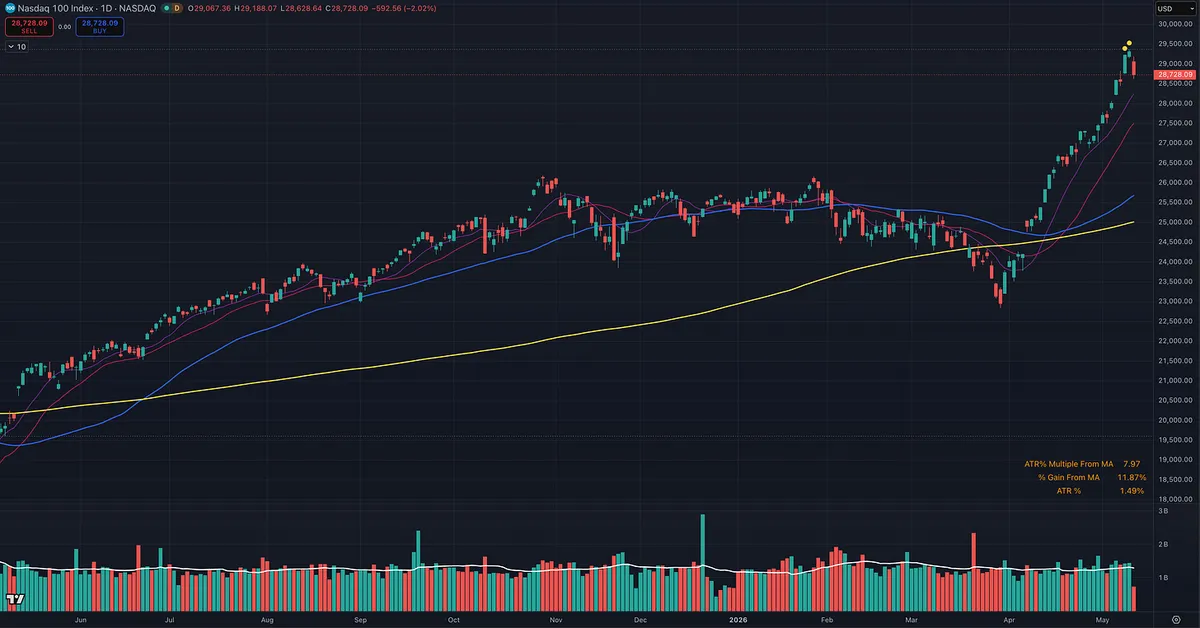
The biggest takeaway was that the Nasdaq 100 had flashed an ATR extension signal from the 50-day moving average, something that had not happened since January 3, 2000.

That does not mean the market has to crash.

It does not mean the bull move is over.

It simply means the market had become extremely extended after a powerful six-week run, and when markets get that stretched, volatility should be expected.

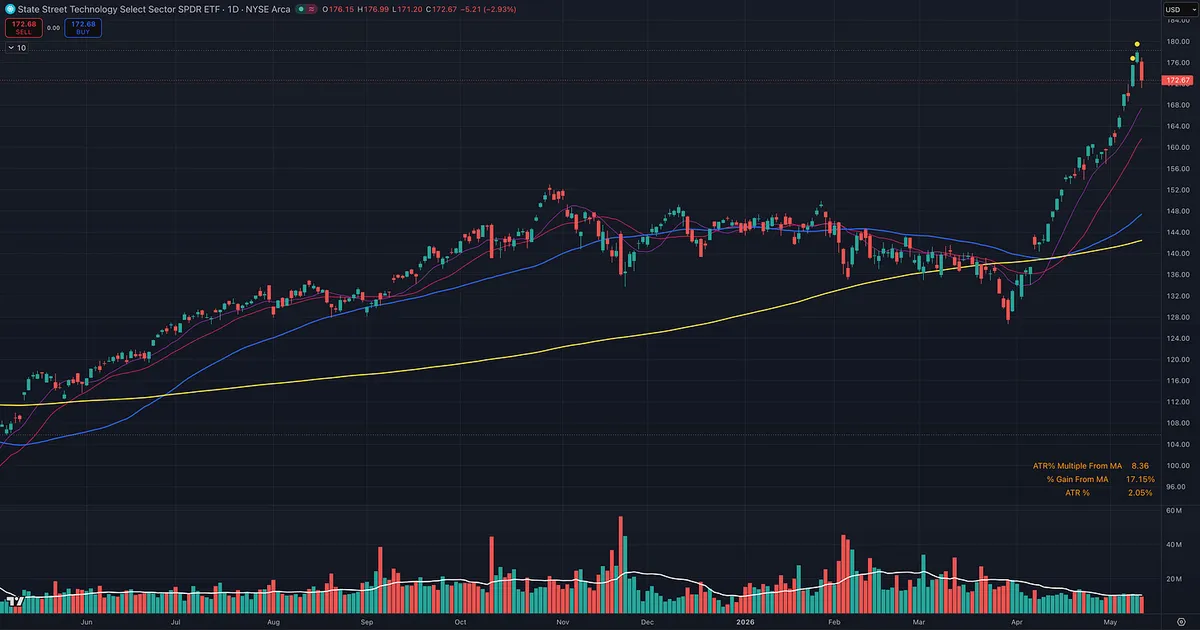
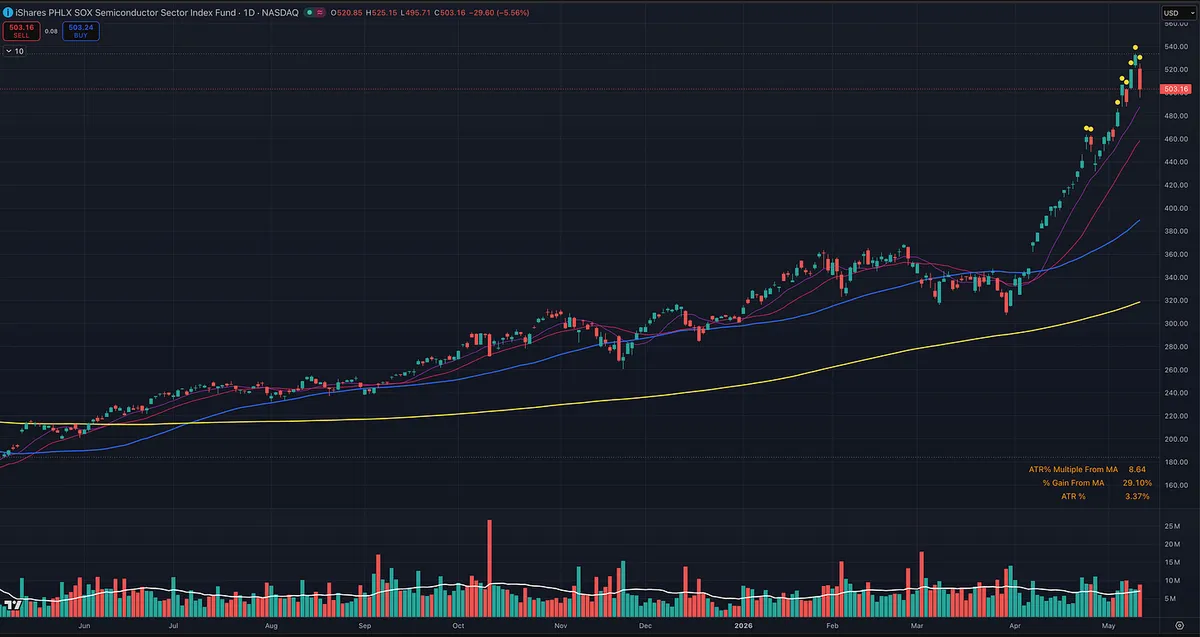
The Nasdaq 100 was not the only area flashing extension.

Technology, through XLK, also became extended. Semiconductors, through SOXX, have been flashing extension signals since April 24th, and that group has been one of the hottest areas driving the move.

This is why we study the big picture and market history.

William O’Neil talked constantly about the importance of understanding the general market. The “M” in CAN SLIM stands for market direction for a reason.

Strong markets create opportunity, but extended markets create risk.

That does not mean you panic.

It means you pay attention.

You watch how the indexes close.

You watch volume.

You watch whether leading stocks hold up or start breaking support.

You watch whether this is normal digestion after a powerful move or the beginning of heavier distribution.

Momentum trading is not about being surprised by every red candle.

It is about understanding the environment, knowing when the wind is at your back, and recognizing when the market is stretched enough that a pullback becomes normal, not shocking.

That is exactly why I do the Big Picture Market Pulse every weekend.