
Momentum Trading Strategy

Notes

Market Conditions

Reading the overall market and deciding how aggressive to be.

Showing 1–2 of 2 notes

$SPY ×
View on Substack ↗

Before You Chase the Next Breakout, Step Back

Like I say every week, before you dive into individual stock screening and selection, step back and understand the market environment and the big picture.

The weekend is the perfect time to do this while the market is closed.

The Nasdaq-100 held the 10-week moving average this week, breadth improved, net new highs stayed positive, and volatility cooled.

But the market has not fully repaired last week’s warning shot. QQQ and SPY still need to reclaim the 10-day and 20-day moving averages, distribution days remain elevated, and short-term leadership is rotating beneath the surface.

Stepping back and reviewing the big picture can give you clarity before stock screening and help you ask the right questions:

  • Which stocks held up best during the pullback?

  • Which names are already moving to new highs while the major indexes are still repairing?

  • Which groups are attracting new demand?

  • Which stocks are continuing to lead?

That is where the next watchlist starts.

Read the Big Picture Market Pulse here:

https://tradingmomentum.substack.com/p/the-nasdaq-held-the-10-week-now-comes
On SubstackBig Picture Market Pulse | June 14, 2026: The Nasdaq Held the 10-Week. Now Comes the Real Test
View on Substack ↗

When emotions run high, zoom out

I’m a short-term trader.

I run a day trading account. I also run a swing and position trading account built around O’Neil and CANSLIM and I also have an account that does nothing fancy and consistently invests into SPY and QQQ.

You would think someone like me would be the most emotionally affected by short-term market moves.

I’m not.

A 2% down day like today is no big deal. It is not the end of the world, no matter how financial media or influencers try to frame it.

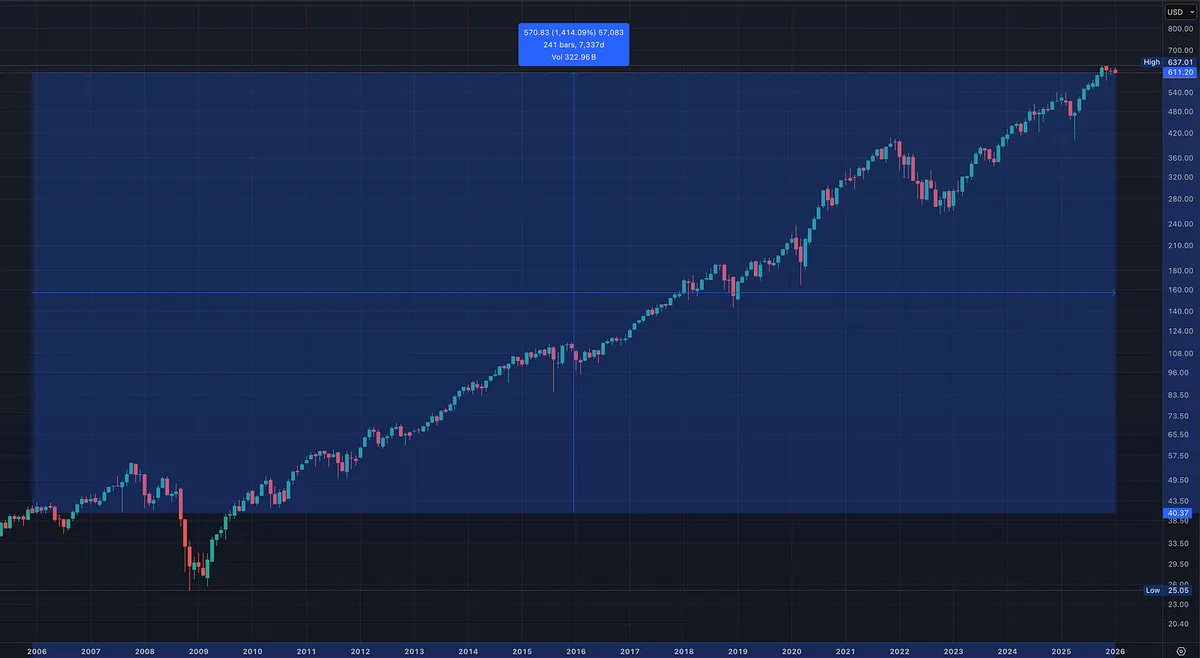
When in doubt, zoom out.

What always surprises me is how emotional people get over pullbacks, corrections, and even full bear markets. Most of these people are not short-term traders. They claim to be long-term investors with long time horizons, yet they panic at exactly the moments that long-term investors should expect.

Look at the last 20 years.

  • Tariff scares.

  • COVID.

  • The 2022 bear market.

  • 2018.

  • 2015.

  • 2011.

  • The Great Financial Crisis.

Even with all of that, the Nasdaq-100 is up over 1400% in the last two decades.

That perspective changes everything.

If normal volatility makes you emotional, that is feedback. It usually means one of two things. You are either gambling, struggle emotionally, or you do not truly understand markets or risk management.

Long-term investing is boring. It requires patience, discipline, and the ability to ignore noise.

The market does not reward emotional reactions. It rewards time, consistency, and perspective.

Zoom out.