Momentum Trading Strategy

Notes

Market Conditions

Reading the overall market and deciding how aggressive to be.

Showing 201–220 of 227 notes

View on Substack ↗

Most strategies do not work in all market types. Do you know how to read the market type you are trading in right now?

Are you forcing trades in the wrong environment for your strategy without realizing it?

I just posted a short guide on the six market types that Van Tharp taught and how to spot them quickly. Understanding the environment changes everything.

Read it here: https://tradingmomentum.substack.com/p/the-6-market-types-every-trader-must

ArticleThe 6 Market Types Every Trader Must Understand
View on Substack ↗

It amazes me how much focus people put on their setup, but very little on how that same setup behaves in different market environments. A pattern that works beautifully in a momentum expansion with strong leadership and breadth can completely fall apart during a correction or choppy, range-bound conditions.

Van Tharp’s six market types opened my eyes to this years ago: bull quiet, bull volatile, bear quiet, bear volatile, sideways volatile, and sideways quiet. The same setup performs very differently depending on which environment you’re in.

The environment dictates the effectiveness of the setup. Understanding when to press and when to step aside is what actually makes a setup work.

View on Substack ↗

Don’t Waste This Pullback

When the market pulls back and everything feels weak, do you still feel the urge to buy something anyway?

If you said yes in your head, you already understand the trap most traders fall into.

Right now we are below key moving averages and making lower lows and lower highs. That is not the time to be buying or fighting the trend. It’s the time to learn and prepare.

This period can be the most beneficial to your long term performance.

Use it to:

• review past winners and losers

• study what actually worked

• identify leaders that are holding up well

• refine your process

• build your watchlists

If the market moves back higher, the names showing strength now usually lead, and you will already be ready.

And if the market moves deeper into this correction, that is still a win. It gives you more time to learn, study, review, and sharpen your edge. It also builds a larger opportunity when we eventually move back up.

It’s a win win for somebody with patience.

Bottom line:

Do not waste this time. This pullback can set up your next big performance jump if you use it well.

View on Substack ↗

Quick question for serious Bitcoin investors:

If Bitcoin has only existed during a secular bull market with rising liquidity, why does everyone assume it will behave the same when that environment ends?

We have never seen Bitcoin in a true secular bear market.

That’s the part almost nobody talks about.

Inside secular bulls, bear markets recover faster. Liquidity returns. Risk appetite comes back. Narratives survive.

All of Bitcoin’s major drawdowns happened during this easier type of bear market.

Secular bears are different:

• valuations compress for years • liquidity dries up • risk assets struggle • themes die and never recover

Bitcoin has never been tested in that environment.

Most Bitcoin investors have never lived through a secular bear in their adult lives. Their expectations were shaped in a rising trend that may not continue.

So it raises the question:

If Bitcoin struggled during the easier bear markets inside a secular bull, what happens when liquidity truly disappears?

Does it hold up the way people expect? Or does it behave like past speculative themes once the macro cycle turns?

Curious what you think.

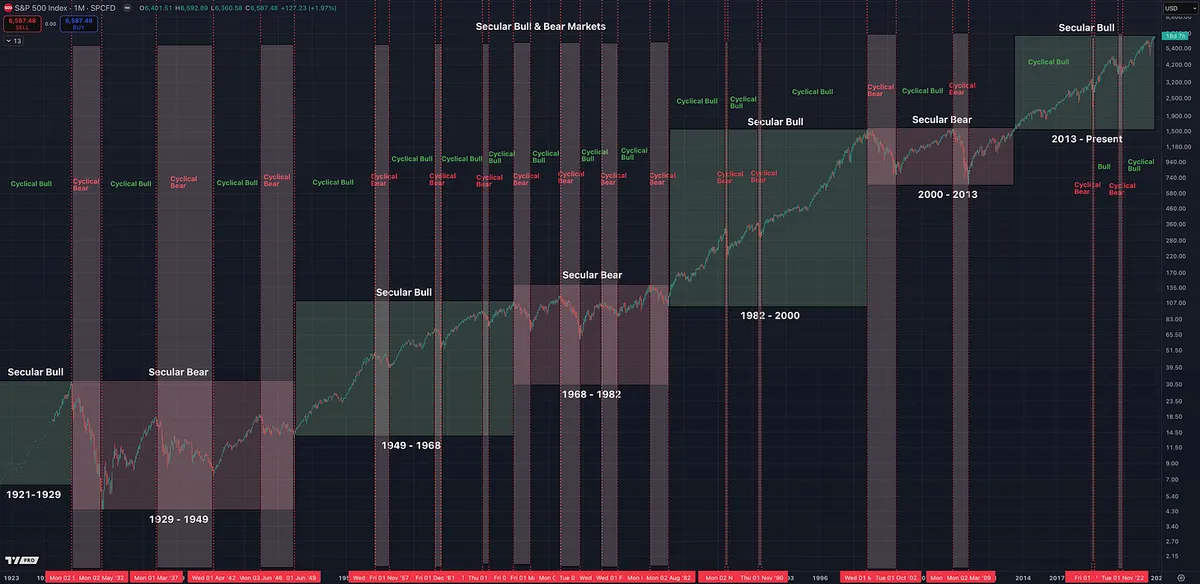
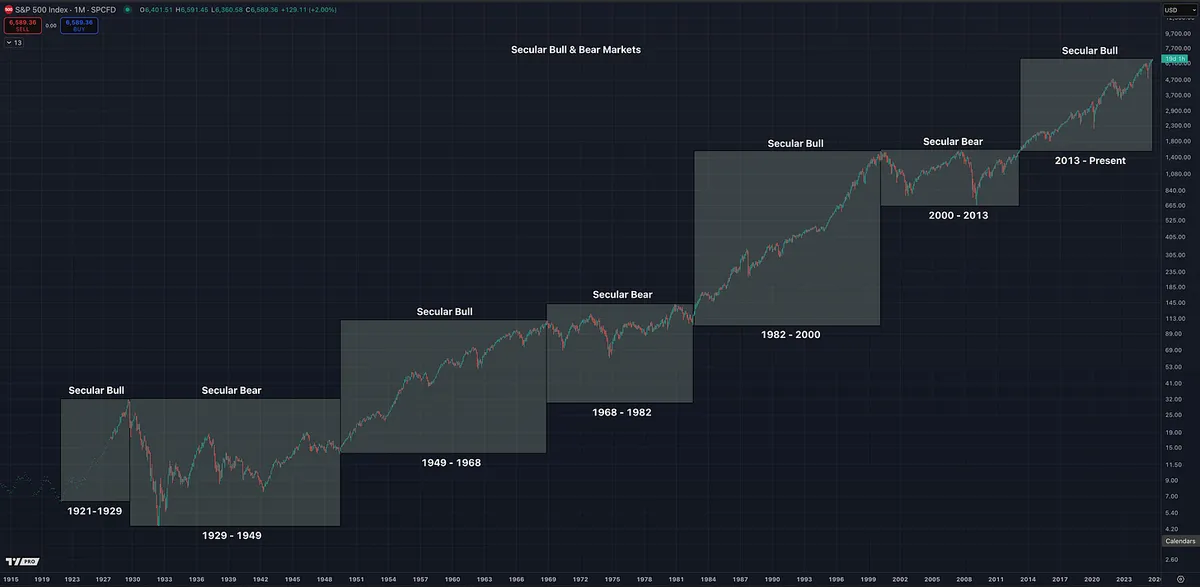
**For context, here is what secular bulls and secular bears have looked like over the last 100 years.

View on Substack ↗

Why the Last 16 Years Produced Mild Bear Markets

People often ask why the past sixteen years have been filled with shorter and more mild bear markets. Because the past 16 years have taken place inside a secular bull market. In secular bulls, cyclical bear markets tend to be shallow, and in secular bear phases the opposite is true with weaker and shorter-lived cyclical bull markets.

This long-term backdrop is why every decline since 2009 has been brief, recoveries have been fast, and fear-driven selloffs have struggled to gain traction. A secular bull market acts as a structural tailwind, compressing the severity of downturns and keeping long-term momentum intact.

If you want to understand what this means for where we are now, and how the late innings of a secular bull typically behave, I break it all down here:

https://tradingmomentum.substack.com/p/the-big-picture-how-to-read-market

View on Substack ↗

I love pullbacks like this. It either sets up the next buying opportunity, or if I have to take a small loss, it’s insignificant compared to what the market has given since early 2023. Either the bull resumes, or it ends and creates an even bigger opportunity down the road.

Shift your mindset.

View on Substack ↗

When Fear and FOMO Collide

Every bubble ends, just not always when you expect it.

That’s what makes them so dangerous: the pain of staying in too long and the regret of stepping aside too soon.

You can lose when the music stops, lose by jumping in too late from FOMO, or lose by never participating out of fear.

View on Substack ↗

Markets Are at All-Time Highs. Why That Matters More Than the Headlines.

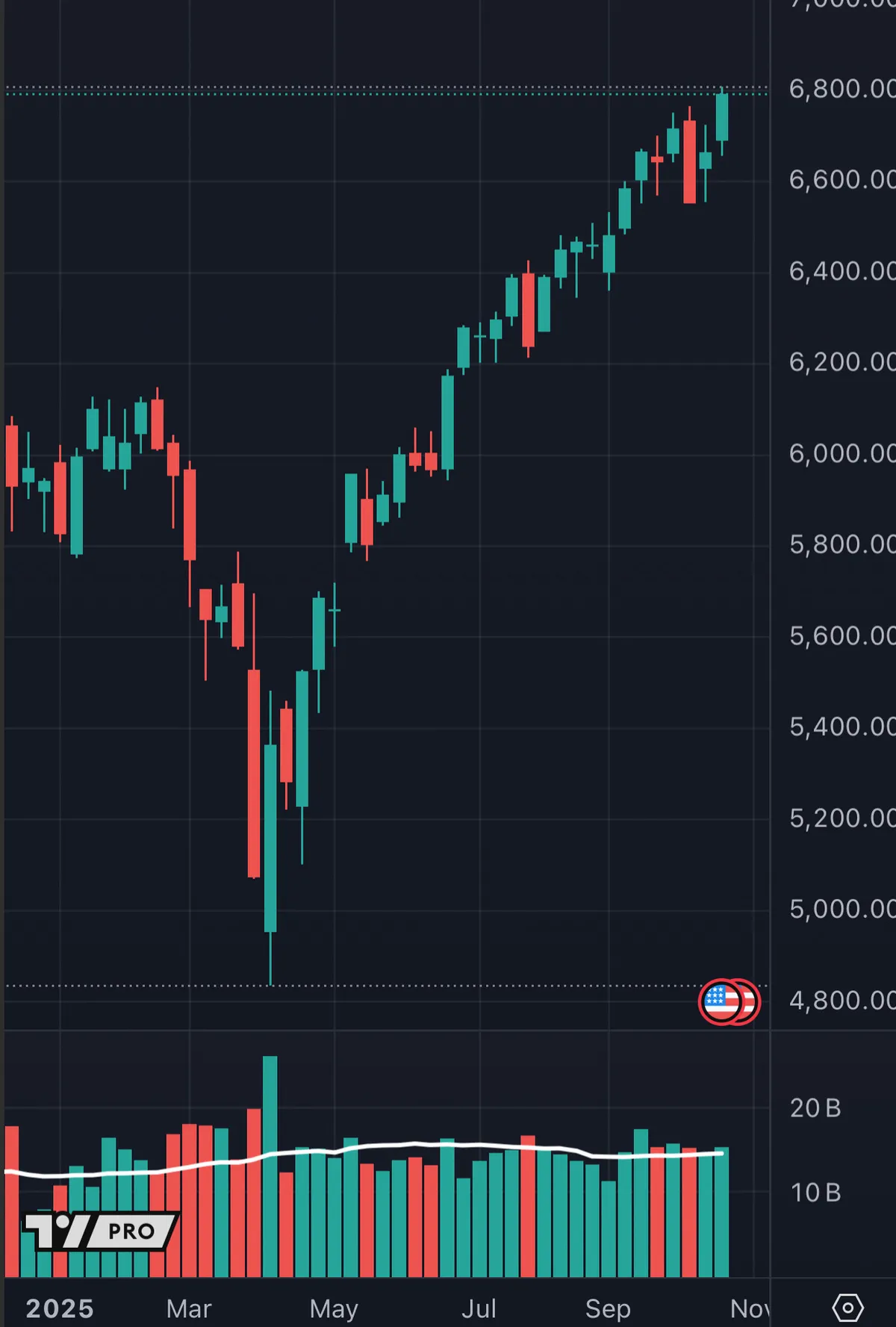
Through all the bearish macro noise, with calls for recession, stretched valuations, geopolitical tension, sticky inflation, and warnings about credit stress, markets are quietly back at all-time highs.

Those themes have been everywhere:

  • Analysts warning valuations are “disconnected from fundamentals.”

  • Economists pointing to a slowing labor market.

  • Commentators fretting over tariffs, geopolitics, and margin pressure.

  • Strategists warning of “credit cockroaches” lurking in private markets.

And yet, despite it all, prices keep climbing.

As Larry Hite once said:

“The second item is something that Ed Seykota taught me. When a market makes a historic high, it is telling you something.”

Markets don’t make new highs out of optimism alone. They do it when real capital, globally, decides risk is still worth taking.

Price action is the market’s collective intelligence. It discounts the future faster than any economist or headline can. So rather than debate every bearish narrative, it might be wiser to simply listen to what the market itself is saying.

New highs aren’t just numbers. They’re signals.

View on Substack ↗

“The markets can remain irrational longer than you can remain solvent.” — Keynes

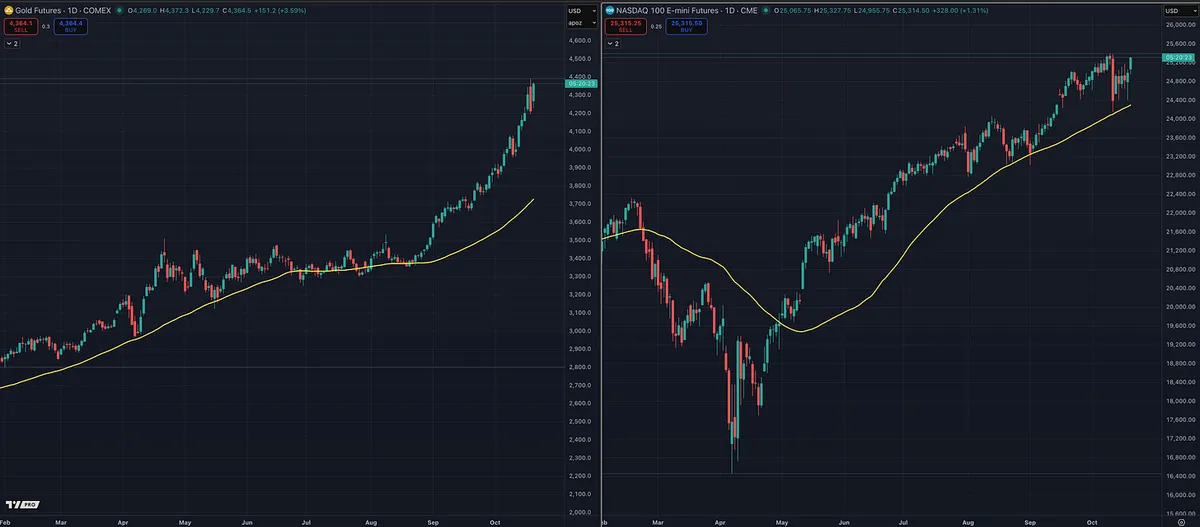
The wave of doom-and-gloom started on Friday, October 10th and continued throughout last week — bout of volatility and suddenly everyone was calling “THE TOP.”

And yet… we’re already right back near all-time highs in gold, the Nasdaq, and the S&P.

This is exactly why I don’t call tops or bottoms.

I focus on price action:

  • Are we still making higher highs and higher lows?

  • Or transitioning into lower lows and lower highs?

  • Have we actually closed below key moving averages?

  • Is there a confirmed trend change, not just intraday noise?

Until then — it’s just chatter.

Most “top calling” you see on social media is engagement farming, not strategy. A real approach is taking defined low-risk / high-reward trades when your system triggers because your edge is in the math, not the prediction.

That’s process. Not ego.

Price > opinions.

Discipline > emotions.

Signals > narratives.

View on Substack ↗

The longer you’re in markets, the more you realize sentiment drives everything — not logic or valuation, but who is still willing to buy or sell next.

• When everyone is euphoric, most people have already bought → risk is highest

• When everyone is bearish, most selling is already done → future returns improve

• When sentiment is mixed, the market quietly climbs the “wall of worry”

Tops are built on greed. Bottoms are built on fear. The middle is where the real trend happens.

View on Substack ↗

The Overbought Myth: Why Strength Is Not a Signal to Sell

Bull markets become and stay overbought in a bull market.

This reminds me of what Larry Hite, one of the original Market Wizards, said when asked about overrated indicators: “Overbought/oversold indicators. None of them seem to prove out in testing.”

Overbought isn’t a sell signal; it’s a symptom of strength. Before you jump the gun and start shorting, make sure the market confirms your hypothesis with price action. If you don’t understand this, you probably shouldn’t be shorting.

View on Substack ↗

Stanley Druckenmiller — one of the greatest investors of our time — said this about macro and fundamental data:

He uses both fundamentals and technicals. But for those who get stuck in their fundamental view and stop paying attention to the ultimate indicator — price — this one’s for you 👇

“I don’t use what traditional economists use to predict the economy, which is things like employment and a bunch of macro, top-down statistics. In fact, I started my career as a bank and chemical analyst, and over time I learned that the inside of the stock market had a very, very present message about future economic activity. And for whatever reason, stocks tend to lead the fundamentals by somewhere between six and twelve months. And you can even go beyond that and look at industries that lead the economy and industries that lag the economy.”

-Stanley Druckenmiller

https://www.youtube.com/shorts/joTuj2PVWYY?feature=share

youtube.com- YouTube
View on Substack ↗

Reminder after yesterday’s sell-off:

I’m not a value investor like Warren Buffett, but I love when the market goes down just like he does.

If big drops or bear markets make you panic, it’s time to reassess your mindset.

Corrections and deep sell-offs create the next great opportunities — that’s when risk/reward becomes truly asymmetric.

Sometimes the hardest move — buying more or stepping back in when fear is highest — ends up being the most profitable.

The biggest gains for many traders and investors come after major corrections.

And this holds true for investors, position traders, swing traders, and even day traders — opportunity always follows panic, just on different timeframes.

⚠️ This doesn’t mean blindly buying while the market is crashing. You still need to know when buyers are stepping back in, manage risk carefully, and size positions properly.

And it doesn’t just apply to bear markets — whether it’s a bull market pullback, a longer-term base, a full-blown correction, or a new secular trend, each offers incredible opportunities if you know how to identify them and control risk.

If you don’t understand what that means, it’s time to study more — or you’ll likely become one of the next victims when volatility returns.

View on Substack ↗

Even day, swing, and position momentum traders should understand the bigger picture.

Reviewing relative strength, volatility, and breadth helps you see where to look — not just what to trade.

Every weekend I review the macro pulse before screening, building watchlists, setting alerts, and planning trades.

Read Part 1 of my weekend prep →

View on Substack ↗

Don’t let big macro narratives blind you. April’s correction looked like doom, but it extended the bull.

The catch: these same resets often show up right before secular bears.

Full breakdown inside:

View on Substack ↗

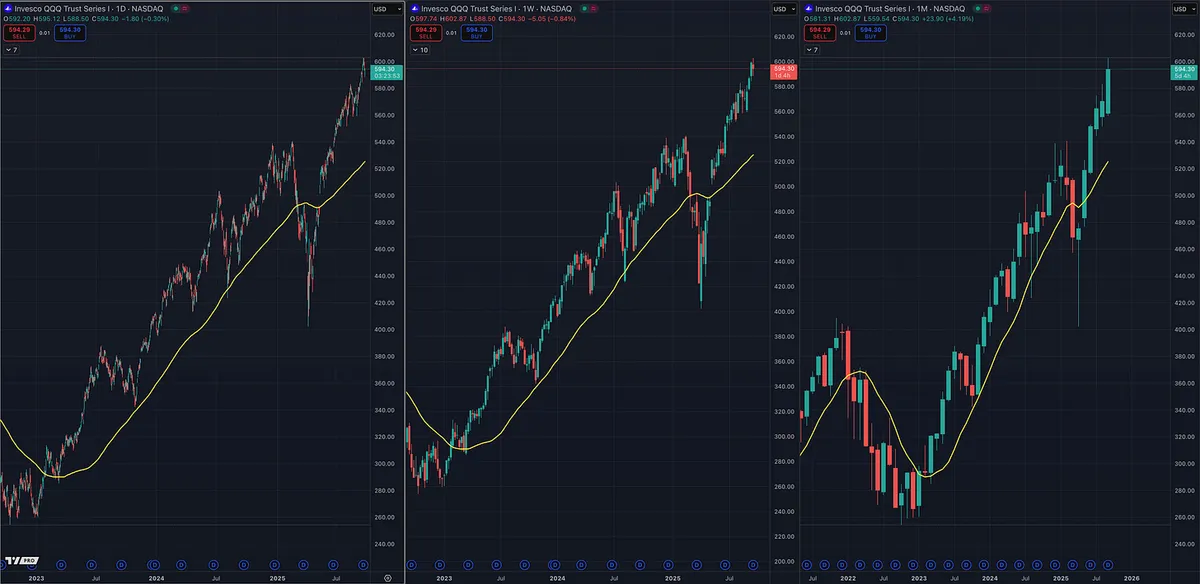
When in doubt, zoom out.

Institutions move on weekly & monthly charts, not just your 5-min candles.

Nothing wrong with lower-timeframe entries (I day & swing trade too) — just align them with the big money trend.

That’s how you stack probabilities.

“The most important rule of trading is to play great defense, not great offense. Never trade against the major trend of the market; you are just fighting the big money, and that’s a game you can’t win.”

— Marty Schwartz, Market Wizards